PREMEDICATION
Dr.Charulatha MD Fellowship in RA
Assistant Professor
Department of Anesthesia &Critical care
PREMEDICATION
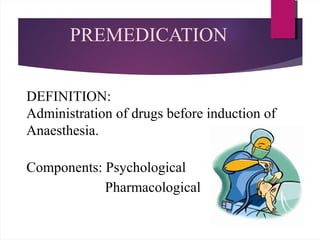
DEFINITION:
Administration of drugs before induction of
Anaesthesia.
Components: Psychological
Pharmacological
PSYCHOLOGICAL PREMEDICATION
Nonpharmacological antidote to anxiety
PHARMACOLOGICAL PREMEDICATION
• Consists of administration of the drugs 1 -2 hrs before the induction of
anaesthesia .
• Route of administration :
• Orally
• Intramuscular
• Intravenous
• Intranasal
• Dermal
• GOALS OF PREMEDICATION:
•
Primary goals
•
Secondary goals.
Primary
goals
• Anxiolysis &Sedation
• Analgesia
• Amnesia
• Increase in gastric fluid ph
and decrease in gastric fluid
volume
• Antisialogogue effect
• Decreased S N S reflex
response
• Hemodynamic stability
• Decrease in anaesthetic
requirement
Secondary
Goals
•Facilitation of induction of
anaesthesia
•Facilitation of Postoperative
analgesia
•Prevention of post operative
nausea and vomiting
• .
Factor to be considered before
premedication
• Patient’s Physical status
• Age
• Level of anxiety and pain
• Type of Surgery
• Timing of surgery
• History of drug allergy , nausea ,
vomiting.
Anxiolysis & sedation
Sedation is a ranging from minimum anxiolysis to a
state of deep sedation but not including G A .
• To minimize physical
discomfort, and pain.
• To control behavior particularly
movements.
• To minimize psychological
disturbances and distress.
• To maximize the potential for
amnesia.
• To guard patient’s safety.
DRUGS USED FOR SEDATION
• Benzodiazepines :
e.g: Diazepam ,midazolam,lorazepam
• Barbiturates :
e.g: phenobarbitone
• Others :
• Promethazine
Factors limiting giving sedatives
• Extremes of age.
• Head injury.
• Altered mental status.
• Minimal cardio- pulmonary reserve
• Hypovolemia.
• Full stomach.
ANALGESIA
• OPIOIDS:
• Pethidine 50 -100 mg im
• Morphine 8 – 12 mg im
• Fentanyl 50 – 100 microg iv
• NSAIDS
• Ketorolac
• Diclofenac
ASPIRATION PROPHYLAXIS
• What is Aspiration ?
• Complications of Aspiration ??
RISK FACTORS
FOR ASPIRATION
• Extremes of age
• Emergency cases
• Type of surgery
• Recent meal
• Trauma
• PREGNANCY
• Pain and stress
• Depressed level of
consciousness
• Morbid obesity
• Difficulty airway
• Poor motor control
• DM.
PREVENTIVE MEASURES
• FASTING
• Reduce gastric volume ,Increase gastric pHReduce gastric volume ,Increase gastric pH
• H2 receptor antagonist
• Proton pump inhibitor
• Antacid
• Increase gastric motilityIncrease gastric motility
• Prokinetic drugs
ANTISIALOGOGUES
Decreases salivary gland and mucosal gland
secretion .
•GLYCOPYROLATE potent antisecretory
•ATROPINE
•SCOPOLAMINE
ANTIEMESIS PROPHYLAXIS
Risk factor for Nausea vomiting ???
Drugs
• Metaclopramide
• Ondensetron
• Dexamethasone.
Antiemetics
Metoclopramide 10 mg used as antiemetic
and prokinetic agent prior to surgery
Domperidone 10 mg oral more preferred
Ondansetron 4-8 mg 1v found effective in
preventing post anesthetic nausea and
vomiting
Drugs reducing acid secretion
Ranitidine 150 -300 mg oral given
night and in the morning reduces
risk of gastric regurgitation and
aspiration pneumonia
Proton pump inhibitors like
omeprazole are preferred
nowadays
CONTINUATION AND
DISCONTINUATION OF DRUGS
CONTINUATION
•Beta blocker
•Bronchodilators
•Anti-epileptics
DISCONTINUATION
•MAO-inhibitors
•Anti-coagulants
•Oral hypoglycemic
•ACE inhibitors ??
• AT 2 antagonists.
Conclusion
• Reducing the morbidity of surgery.
• Increasing the quality and decreasing the
cost of peri operative care.
• To return the patient to desirable
functioning as quickly as possible.
• Pre operative medical optimisation
significantly reduces the complications.
Thank you

premedication

  • 1.
    PREMEDICATION Dr.Charulatha MD Fellowshipin RA Assistant Professor Department of Anesthesia &Critical care
  • 2.
    PREMEDICATION DEFINITION: Administration of drugsbefore induction of Anaesthesia. Components: Psychological Pharmacological
  • 3.
  • 4.
    PHARMACOLOGICAL PREMEDICATION • Consistsof administration of the drugs 1 -2 hrs before the induction of anaesthesia . • Route of administration : • Orally • Intramuscular • Intravenous • Intranasal • Dermal • GOALS OF PREMEDICATION: • Primary goals • Secondary goals.
  • 5.
    Primary goals • Anxiolysis &Sedation •Analgesia • Amnesia • Increase in gastric fluid ph and decrease in gastric fluid volume • Antisialogogue effect • Decreased S N S reflex response • Hemodynamic stability • Decrease in anaesthetic requirement
  • 6.
    Secondary Goals •Facilitation of inductionof anaesthesia •Facilitation of Postoperative analgesia •Prevention of post operative nausea and vomiting • .
  • 7.
    Factor to beconsidered before premedication • Patient’s Physical status • Age • Level of anxiety and pain • Type of Surgery • Timing of surgery • History of drug allergy , nausea , vomiting.
  • 8.
    Anxiolysis & sedation Sedationis a ranging from minimum anxiolysis to a state of deep sedation but not including G A .
  • 9.
    • To minimizephysical discomfort, and pain. • To control behavior particularly movements. • To minimize psychological disturbances and distress. • To maximize the potential for amnesia. • To guard patient’s safety.
  • 10.
    DRUGS USED FORSEDATION • Benzodiazepines : e.g: Diazepam ,midazolam,lorazepam • Barbiturates : e.g: phenobarbitone • Others : • Promethazine
  • 11.
    Factors limiting givingsedatives • Extremes of age. • Head injury. • Altered mental status. • Minimal cardio- pulmonary reserve • Hypovolemia. • Full stomach.
  • 12.
    ANALGESIA • OPIOIDS: • Pethidine50 -100 mg im • Morphine 8 – 12 mg im • Fentanyl 50 – 100 microg iv • NSAIDS • Ketorolac • Diclofenac
  • 13.
    ASPIRATION PROPHYLAXIS • Whatis Aspiration ? • Complications of Aspiration ??
  • 14.
    RISK FACTORS FOR ASPIRATION •Extremes of age • Emergency cases • Type of surgery • Recent meal • Trauma • PREGNANCY • Pain and stress • Depressed level of consciousness • Morbid obesity • Difficulty airway • Poor motor control • DM.
  • 15.
    PREVENTIVE MEASURES • FASTING •Reduce gastric volume ,Increase gastric pHReduce gastric volume ,Increase gastric pH • H2 receptor antagonist • Proton pump inhibitor • Antacid • Increase gastric motilityIncrease gastric motility • Prokinetic drugs
  • 16.
    ANTISIALOGOGUES Decreases salivary glandand mucosal gland secretion . •GLYCOPYROLATE potent antisecretory •ATROPINE •SCOPOLAMINE
  • 17.
    ANTIEMESIS PROPHYLAXIS Risk factorfor Nausea vomiting ??? Drugs • Metaclopramide • Ondensetron • Dexamethasone.
  • 18.
    Antiemetics Metoclopramide 10 mgused as antiemetic and prokinetic agent prior to surgery Domperidone 10 mg oral more preferred Ondansetron 4-8 mg 1v found effective in preventing post anesthetic nausea and vomiting
  • 19.
    Drugs reducing acidsecretion Ranitidine 150 -300 mg oral given night and in the morning reduces risk of gastric regurgitation and aspiration pneumonia Proton pump inhibitors like omeprazole are preferred nowadays
  • 20.
    CONTINUATION AND DISCONTINUATION OFDRUGS CONTINUATION •Beta blocker •Bronchodilators •Anti-epileptics DISCONTINUATION •MAO-inhibitors •Anti-coagulants •Oral hypoglycemic •ACE inhibitors ?? • AT 2 antagonists.
  • 21.
    Conclusion • Reducing themorbidity of surgery. • Increasing the quality and decreasing the cost of peri operative care. • To return the patient to desirable functioning as quickly as possible. • Pre operative medical optimisation significantly reduces the complications.
  • 22.

Editor's Notes

  • #3 To make perioperative period smooth. Management of anesthesia begins with preoperative psychological preparation of the patient and administration of a drug or drugs selected to elicit specific pharmacologic responses this initial psychological and pharmacologic component of anesthetic management is referred to as “Premedication
  • #4 is provided by the anesthesiologist’s preoperative visit and interview with the patient and family members
  • #5 Pic of tablet injection
  • #6 Put stars to important one.
  • #8 Selection of drugs …route of adm.. Dose , timing need to be according What is ASA physical status , Age: peads vs adult
  • #9 Sedation df: Grade of sedation: When it is called as GA.
  • #11 Anxiolysis Amnesia Sedation Anti-convulsant All effects are dose-dependent Phenergan antihistamine only more than 2 yr… 1mg/kg
  • #13 Pre emptive analgesia
  • #14 Pulmonary aspiration is the entry of material (such as pharyngeal secretions, food or drink, or stomach contents) from the oropharynx or gastrointestinal tract into the larynx (voice box) and lower respiratory tract (the portions of the respiratory system from the trachea—i.e., windpipe—to the lungs). A person may either inhale the material, or it may be delivered into the tracheobronchial tree during positive pressure ventilation. Consequences of pulmonary aspiration range from no injury at all, to chemical pneumonitis or pneumonia, to death within minutes from asphyxiation. These consequences depend in part on the volume, chemical composition, particle size, Mendelson's syndrome is chemical pneumonitis caused by aspiration during anaesthesia, especially during pregnancy Residual gastric volume of greater than 25ml, with pH of less than 2.5
  • #15 Any condition which dec gastric emptying or airway reflex
  • #18 Metoclopramide (INN) /ˌmɛtəˈklɒprəmaɪd/ is a medication used mostly for stomach andesophageal problems.[1] It belongs to the group of medications known as dopamine-receptor antagonists Ondansetron (INN), originally marketed under the brand name Zofran, is a serotonin 5-HT3receptor antagonist used to prevent nausea and vomiting caused by cancer chemotherapy, radiation therapy, and surgery. Dexa: These results suggest that dexamethasone exerts its central antiemetic action through an activation of the glucocorticoid receptors in the bilateral nuclei tractus solitarii in the medulla.