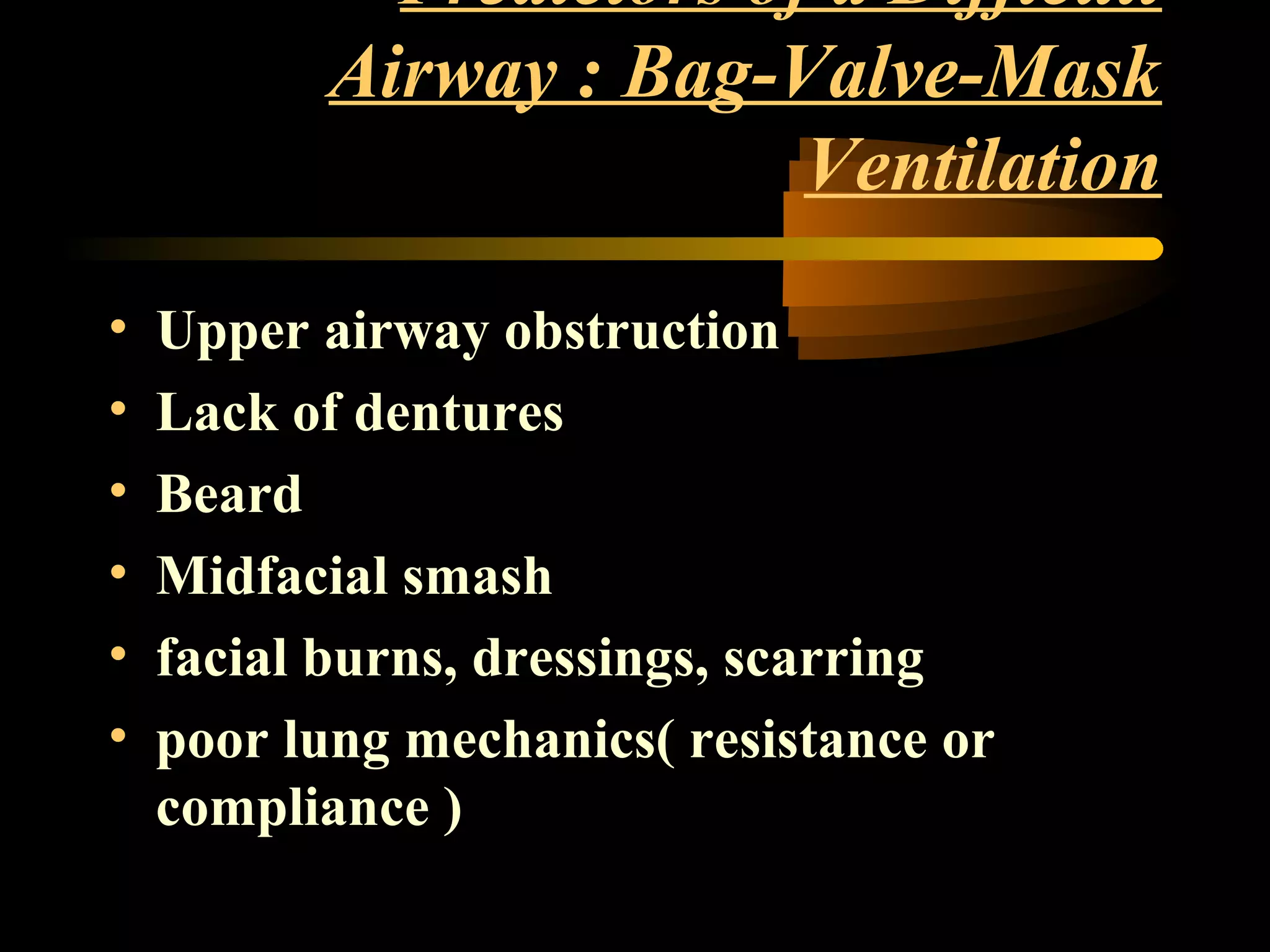
Bag-mask ventilation (BVM) is the most important airway skill and first response to inadequate oxygenation. Mastering BVM technique requires practice and involves maintaining a face seal while ventilating with one hand. Factors like obesity, lack of dentures, facial hair or injuries can make BVM difficult. The key is optimizing head position, using oral/nasal airways, and a two-person technique before considering other advanced airway interventions for difficult ventilation.
BVM Ventilation
• Themost important airway skill
• Always the first response to inadequate
oxygenation and ventilation
• The first “bail-out” maneuver to a failed
intubation attempt
• Attenuates the urgency to intubate
3.
Golden Rules ofBagging
• “ Anybody ( almost ) can be oxygenated
and ventilated with a bag and a mask “
• The art of bagging should be mastered
before the art of intubation
• Manual ventilation skill with proper
equipment is a fundamental premise of
advanced airway Rx
4.
BVM Ventilation
• Requirespractice to master
• One hand to
– maintain face seal
– position head
– maintain patency
• Other hand ventilates
5.
BVM Ventilation: Technique
•insert oropharyngeal/nasopharyngeal
• “Sniffing”position if C-spine OK
• Thumb + index to maintain face seal
– Stem of mask in thenar webspace
• Middle finger under mandibular
symphysis
• Ring/little finger under angle of
mandible
6.
BVM Ventilation:
Assessment ofEfficacy
• Observe the chest rise and fall
• Good bilateral air entry
• Lack of air entering the stomach
• Feeling the bag
• Pulse oximetry
7.
BVM Ventilation:
Mask SealTips and Pearls
• Easier to get seals with masks too large
than too small
• Inflate mask collar correctly
• Apply lubricant to beards to “mat down”
hair
• It is easier to bag with dentures in place
• If edentulous insert gauze sponges into
cheeks
Difficult Airway :BVM
• degree of difficulty from zero to infinite
• zero = no external effort or internal device
required
• one person jaw thrust/ face seal
• oropharyngeal or nasopharyngeal AW
• two person jaw thrust / face seal
– both internal airway devices
• infinite = no patency despite maximal external
effort and full use of OP/NP
10.
Algorithm for Difficulty
“Bagging”
•Remove FB - Magill forceps
• Triple maneuver if c-spine clear
– Head tilt, jaw lift, mouth opening
• Nasal or oropharyngeal airways
• two-person, four-hand technique
• Do not abandon bagging unless it is
impossible with two people and both an
11.
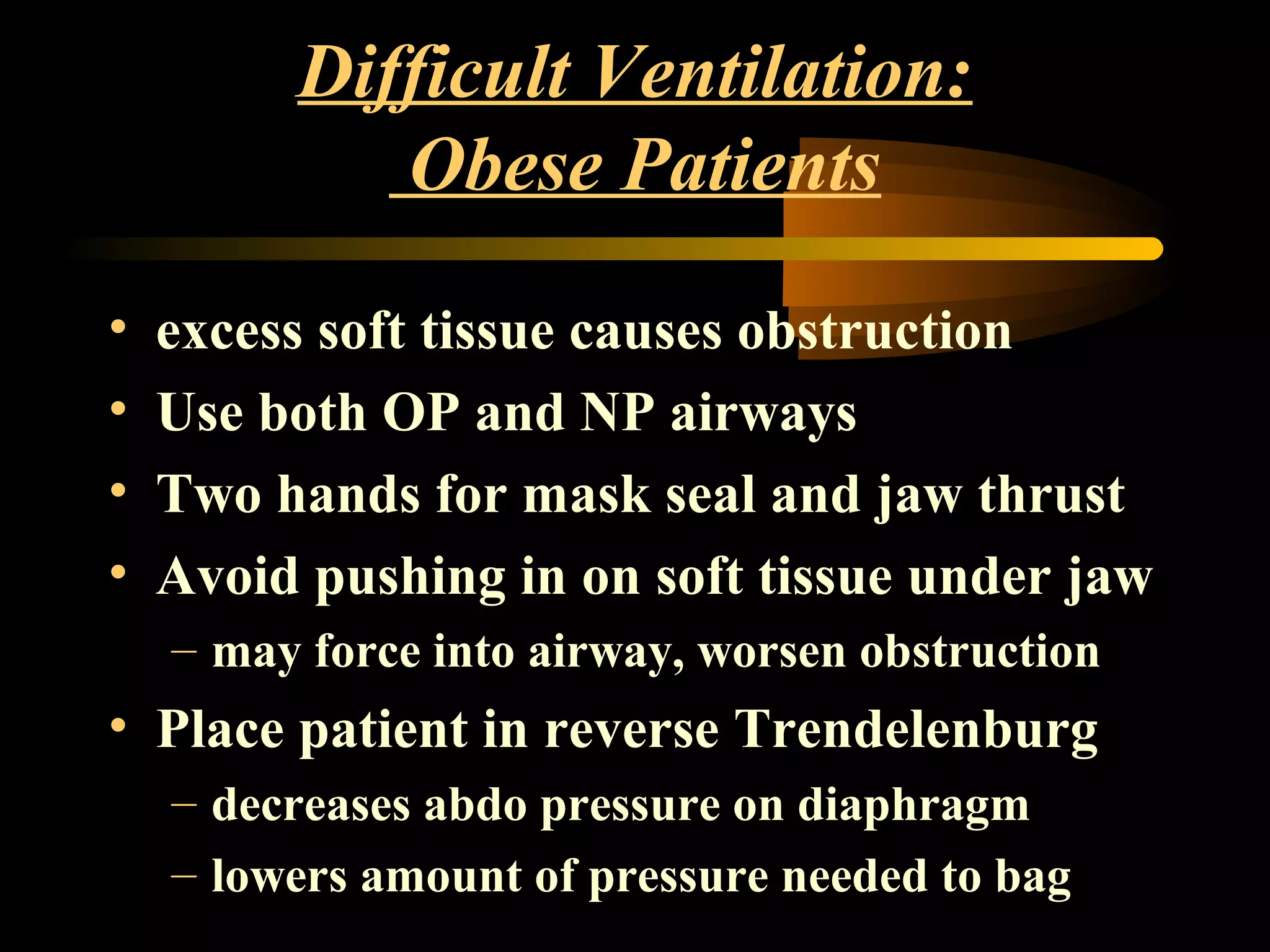
Difficult Ventilation:
Obese Patients
•excess soft tissue causes obstruction
• Use both OP and NP airways
• Two hands for mask seal and jaw thrust
• Avoid pushing in on soft tissue under jaw
– may force into airway, worsen obstruction
• Place patient in reverse Trendelenburg
– decreases abdo pressure on diaphragm
– lowers amount of pressure needed to bag
12.
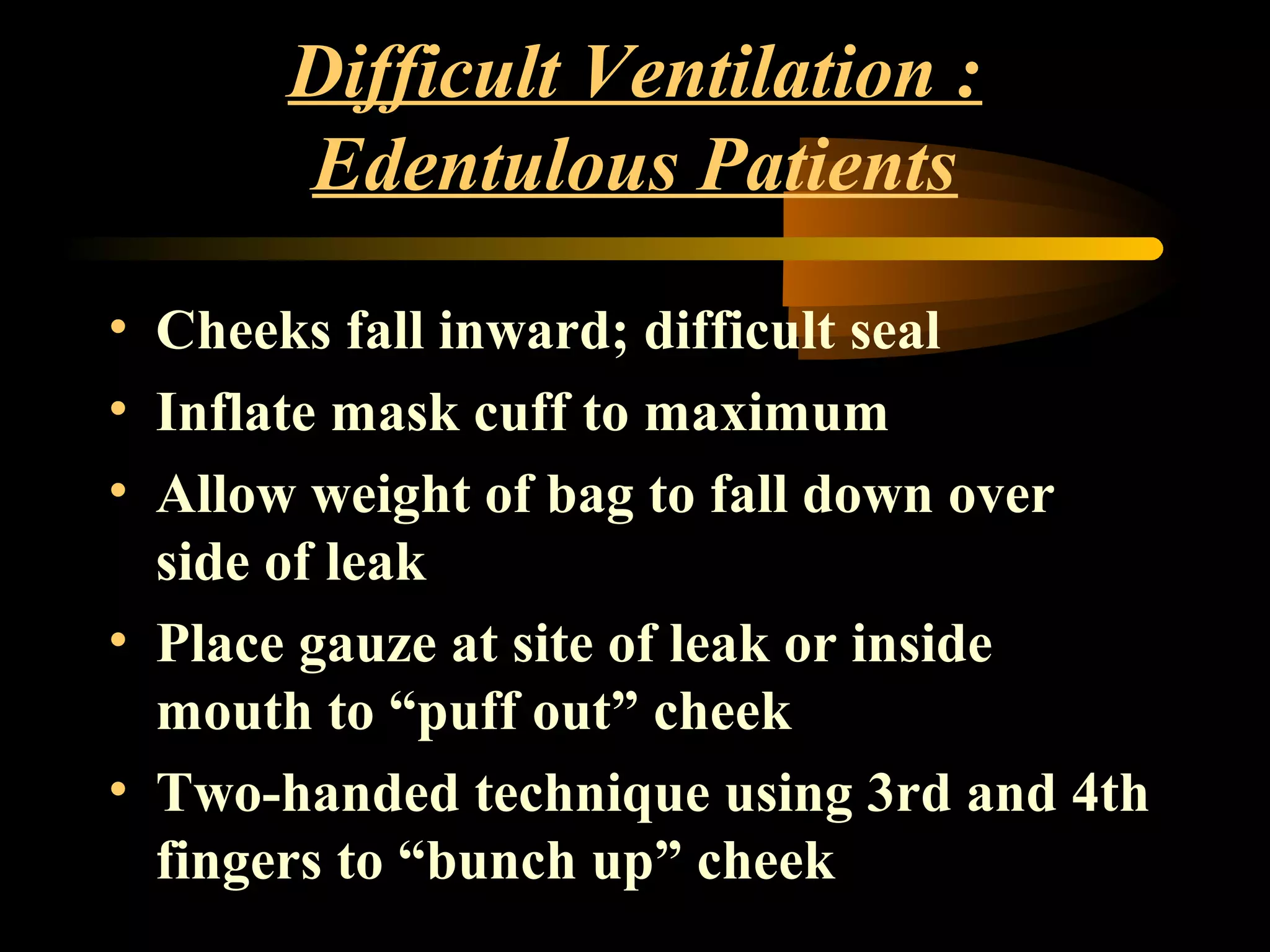
Difficult Ventilation :
EdentulousPatients
• Cheeks fall inward; difficult seal
• Inflate mask cuff to maximum
• Allow weight of bag to fall down over
side of leak
• Place gauze at site of leak or inside
mouth to “puff out” cheek
• Two-handed technique using 3rd and 4th
fingers to “bunch up” cheek
Difficult Ventilation :Upper
Airway Obstruction (Epiglottitis)
• The pop-off valve is designed to prevent
delivering excessive volume and pressure
• Higher pressures may be required in
upper airway obstruction
• Occlude valve manually or with the built
in occluding device
Difficult Airway Maxims
•The first response to failure of bag-mask
ventilation is always better bag-mask
ventilation
– optimize airway position
– place OP and NP airways
– two-handed technique
– try lifting head off pillow to open airway
• Generate as much positive pressure as
possible without inflating the stomach










![Dual controlled modes of mechanical ventilation [onarılmış]](https://cdn.slidesharecdn.com/ss_thumbnails/dualcontrolledmodesofmechanicalventilationonarlm-151116121024-lva1-app6891-thumbnail.jpg?width=640&height=640&fit=bounds)


![Understanding Parkinson’s Disease: Causes, Symptoms, and Treatment [2025]](https://cdn.slidesharecdn.com/ss_thumbnails/understandingparkinson-251208102525-80ba3223-thumbnail.jpg?width=640&height=640&fit=bounds)


