SHAHID NAWAZ
KSU,RIYADH
SAUDI ARABIA
Date: 12.01.2015
 Nephelometry is the most commonly used measurement principle for
the immunochemical determination of protein in serum, urine and other
body fluids. It is also the most accurate one.
 In this method, the light which is scattered by the antigen-antibody
complexes is measure .
 If a sample containing antigen and the corresponding antiserum are put
 into a cuvette, antigen-antibody complexes are formed.
 The intensity of the measured light scatter is - under certain conditions
(antibody excess range, - proportional to the amount of the antigen-
antibody complex in the sample.
 At a constant antibody level, the signal is proportional to the antigen
level. A reference curve is created from a standard with known antigen
levels. The scattered light signal of the samples can then be read from
this curve as an antigen concentration.
 The scattered light signal is considerably amplified by the adherence of
antibodies or antigens to latex particles. This makes sensitive measurements
of trace proteins possible.
 A light beam is generated by means of a laser diode, and this is then sent
through the cuvette. The light is scattered by the antigen-antibody
complexes which are present.
 The intensity distribution of the scattered light depends on the relationship
of the particle size of the antigen-antibody complex to the wavelength.
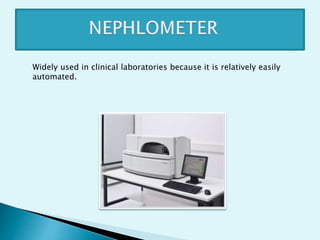
Widely used in clinical laboratories because it is relatively easily
automated.
 Methods: More than 60 programmed assay protocols
 Sample throughput: Approx. 65 tests/hour depending on the assay mix .
Nominal: 100 tests/hour
 Analysis method: Fixed-time kinetics, end-point measurement,
 Calibration Multi-point calibration
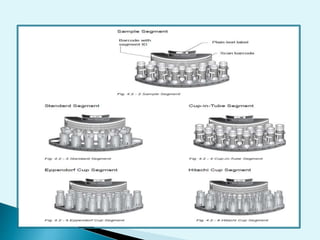
 Rack transport unit: Segments for 3 control serum vials
Segments for 2 reagent vials
Segments for 15 sample tubes
 Size of sample tubes : Diameter: 11 - 16 mm
Height: 55 - 100 mm
For pediatric samples: conical microtubes with a maximum filling
volume of 1.5 mL
 Reagent volume: 40 µL reagent consumption on average
 Sample dilution: 1 : 1 to 1 : 32,000
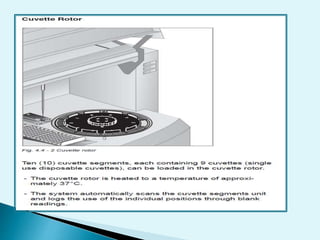
 Reaction cuvettes: 90 disposable cuvettes
 Measuring temperature: 37 ± 1.5°C
 Light source Infrared high performance LED
 Wavelength: 840 ± 25 nm
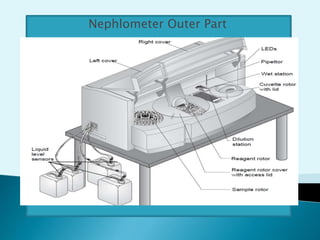
Nephlometer Outer Part
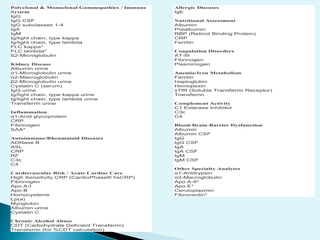
Polyclonal & Monoclonal Gammopathies / Immune
System
IgG
IgG CSF
IgG subclasses 1-4
IgA
IgM
Ig/light chain, type kappa
Ig/light chain, type lambda
FLC kappa*
FLC lambda*
ß2-Microglobulin
Kidney Disease
Albumin urine
α1-Microglobulin urine
α2-Macroglobulin
β2-Microglobulin urine
Cystatin C (serum)
IgG urine
Ig/light chain, type kappa urine
Ig/light chain, type lambda urine
Transferrin urine
Inflammation
α1-Acid glycoprotein
CRP
Fibrinogen
SAA*
Autoimmune/Rheumatoid Diseases
ADNase B
ASL
CRP
RF
C3c
C4
Cardiovascular Risk / Acute Cardiac Care
High Sensitivity CRP (CardioPhase® hsCRP)
Fibrinogen
Apo A-I
Apo B
Homocysteine
Lp(a)
Myoglobin
Albumin urine
Cystatin C
Chronic Alcohol Abuse
CDT (Carbohydrate Deficient Transferrin)
Transferrin (for %CDT calculation)
Allergic Diseases
IgE
Nutritional Assessment
Albumin
Prealbumin
RBP (Retinol Binding Protein)
CRP
Ferritin
Coagulation Disorders
AT-III
Fibrinogen
Plasminogen
Anemia/Iron Metabolism
Ferritin
Haptoglobin
Hemopexin
sTfR (Soluble Transferrin Receptor)
Transferrin
Complement Activity
C1 Esterase Inhibitor
C3c
C4
Blood-Brain-Barrier Dysfunction
Albumin
Albumin CSF
IgG
IgG CSF
IgA
IgA CSF
IgM
IgM CSF
Other Specialty Analytes
α1-Antitrypsin
α2-Macroglobulin
Apo A-II*
Apo E*
Ceruloplasmin
Fibronectin*
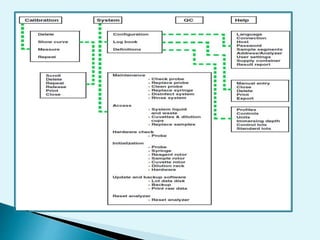
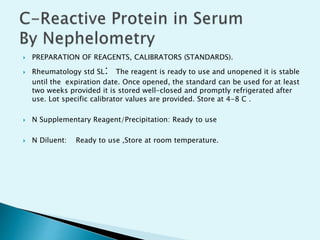
 PREPARATION OF REAGENTS, CALIBRATORS (STANDARDS).
 Rheumatology std SL: The reagent is ready to use and unopened it is stable
until the expiration date. Once opened, the standard can be used for at least
two weeks provided it is stored well-closed and promptly refrigerated after
use. Lot specific calibrator values are provided. Store at 4-8 C .
 N Supplementary Reagent/Precipitation: Ready to use
 N Diluent: Ready to use ,Store at room temperature.
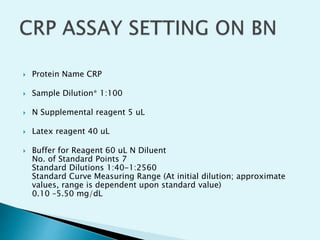
 Protein Name CRP
 Sample Dilution* 1:100
 N Supplemental reagent 5 uL
 Latex reagent 40 uL
 Buffer for Reagent 60 uL N Diluent
No. of Standard Points 7
Standard Dilutions 1:40-1:2560
Standard Curve Measuring Range (At initial dilution; approximate
values, range is dependent upon standard value)
0.10 –5.50 mg/dL
1- Preliminaries:
 a) Bring all Standard, controls and patient specimens to room
temperature before use. Mix any specimens or controls that have
been frozen.
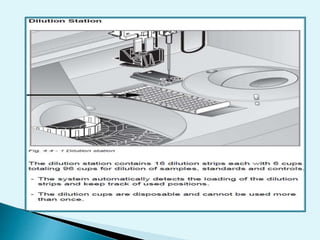
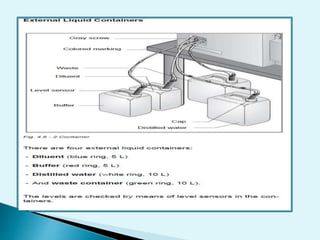
b) Check the levels of buffer and diluent. Verify that the dilution
wells are empty.
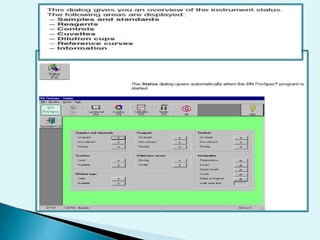
 c) Turn power on BN2 and computer, the instrument will
automatically initialize and prime.
 2- Instrument Operation
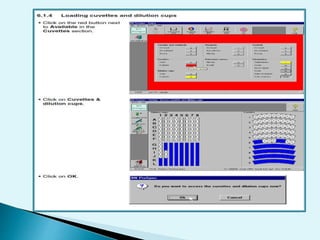
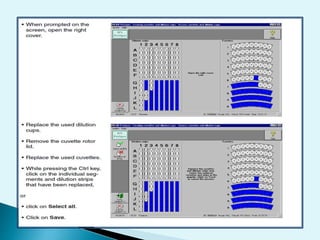
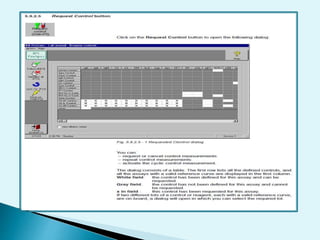
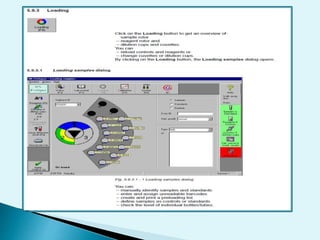
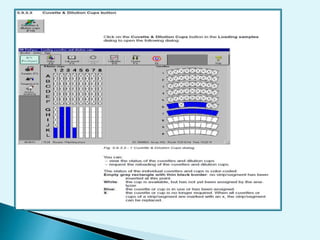
 a. Gently mix, uncap and load specimens into serum racks,
with the barcode in the open slot. Make sure there are no
bubbles. Load the racks in the specimen lanes.
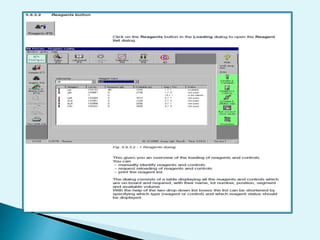
 b. Uncap and load reagents in the reagent racks, with the
barcode in the open slot. Load the rack in a reagent lane.
 C. Uncap and load the Standard into the Standard Rack.
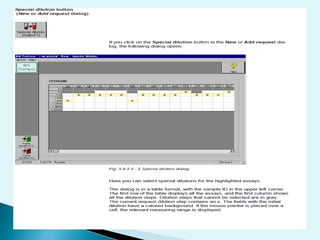
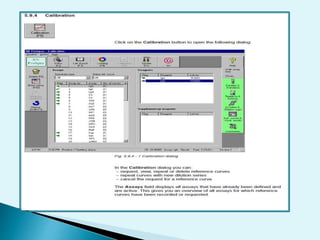
Calibration Curve:
 The standard is diluted 1:40, 1:80, 1:160, 1:320, 1:640, 1:1280, and 1:2560 by
the instrument.
 These dilutions must be used within 4 hours of preparation.
 Light scattering is measured with an automatic blank subtraction.
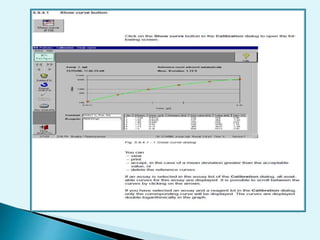
 CRP concentrations are calculated by using a calibration curve. Data reduction of
the signals is performed by using a storable logit-log function for the calibration
curve.
 This method results in a linearized 7-point (including zero) standard curve with a
direct relationship of measured light scatter to concentration of C-reactive
protein in the serum sample. Serum results are expressed as mg/dL.
 A valid standard curve for the CRP assay must be stored in the BNA memory
before sample results can be quantified.
 Reference curves should be determined monthly or whenever new lot numbers
of CRP latex or N-Supplemental reagents are placed into use.
 Select the CRP study test for all specimens. Testing
is done in silicate. The instrument will
automatically rerun the specimen with a higher or
lower dilution if the initial result is outside the
range of the standard curve.
 d. The instrument automatically calculates all
results. After testing is completed, results are
printed.
 3-Recording of Data
 a. Specimen results are entered into the assay specific results
table created from the send file corresponding to the specific
sample box using Excel software (Microsoft Corporation,
Redmond WA). A copy of this table is printed out and checked for
accuracy of data entry.
 b. Control results are entered to the Assay Specific QC/Levy-
Jennings Table using the Excel program. Compliance with the
Westgard rules is evaluated. A copy of this table is printed out
and checked for accuracy of data entry.
 Results are reported to the nearest hundredth (0.01).
 The lowest reportable CRP result is approximately 0.02 mg/dL. This will vary
slightly with different calibrator lots.
 The assay does not have a maximum reportable limit since the instrument
automatically prepares a higher dilution and retests specimens with results
above the linearity of the assay to obtain reactions within the linear range
for the assay.
 REFERENCE RANGES (NORMAL VALUES)
0.0 – 1.0 mg/dL
THE END
THANKS
SHAHID NAWAZ

What is Nephelometry,and a fully automated Nephlometer analyzer for protein analysis.

  • 1.
  • 2.
     Nephelometry isthe most commonly used measurement principle for the immunochemical determination of protein in serum, urine and other body fluids. It is also the most accurate one.  In this method, the light which is scattered by the antigen-antibody complexes is measure .  If a sample containing antigen and the corresponding antiserum are put  into a cuvette, antigen-antibody complexes are formed.  The intensity of the measured light scatter is - under certain conditions (antibody excess range, - proportional to the amount of the antigen- antibody complex in the sample.  At a constant antibody level, the signal is proportional to the antigen level. A reference curve is created from a standard with known antigen levels. The scattered light signal of the samples can then be read from this curve as an antigen concentration.
  • 3.
     The scatteredlight signal is considerably amplified by the adherence of antibodies or antigens to latex particles. This makes sensitive measurements of trace proteins possible.  A light beam is generated by means of a laser diode, and this is then sent through the cuvette. The light is scattered by the antigen-antibody complexes which are present.  The intensity distribution of the scattered light depends on the relationship of the particle size of the antigen-antibody complex to the wavelength.
  • 4.
    Widely used inclinical laboratories because it is relatively easily automated.
  • 5.
     Methods: Morethan 60 programmed assay protocols  Sample throughput: Approx. 65 tests/hour depending on the assay mix . Nominal: 100 tests/hour  Analysis method: Fixed-time kinetics, end-point measurement,  Calibration Multi-point calibration  Rack transport unit: Segments for 3 control serum vials Segments for 2 reagent vials Segments for 15 sample tubes  Size of sample tubes : Diameter: 11 - 16 mm Height: 55 - 100 mm For pediatric samples: conical microtubes with a maximum filling volume of 1.5 mL
  • 6.
     Reagent volume:40 µL reagent consumption on average  Sample dilution: 1 : 1 to 1 : 32,000  Reaction cuvettes: 90 disposable cuvettes  Measuring temperature: 37 ± 1.5°C  Light source Infrared high performance LED  Wavelength: 840 ± 25 nm
  • 7.
  • 25.
    Polyclonal & MonoclonalGammopathies / Immune System IgG IgG CSF IgG subclasses 1-4 IgA IgM Ig/light chain, type kappa Ig/light chain, type lambda FLC kappa* FLC lambda* ß2-Microglobulin Kidney Disease Albumin urine α1-Microglobulin urine α2-Macroglobulin β2-Microglobulin urine Cystatin C (serum) IgG urine Ig/light chain, type kappa urine Ig/light chain, type lambda urine Transferrin urine Inflammation α1-Acid glycoprotein CRP Fibrinogen SAA* Autoimmune/Rheumatoid Diseases ADNase B ASL CRP RF C3c C4 Cardiovascular Risk / Acute Cardiac Care High Sensitivity CRP (CardioPhase® hsCRP) Fibrinogen Apo A-I Apo B Homocysteine Lp(a) Myoglobin Albumin urine Cystatin C Chronic Alcohol Abuse CDT (Carbohydrate Deficient Transferrin) Transferrin (for %CDT calculation) Allergic Diseases IgE Nutritional Assessment Albumin Prealbumin RBP (Retinol Binding Protein) CRP Ferritin Coagulation Disorders AT-III Fibrinogen Plasminogen Anemia/Iron Metabolism Ferritin Haptoglobin Hemopexin sTfR (Soluble Transferrin Receptor) Transferrin Complement Activity C1 Esterase Inhibitor C3c C4 Blood-Brain-Barrier Dysfunction Albumin Albumin CSF IgG IgG CSF IgA IgA CSF IgM IgM CSF Other Specialty Analytes α1-Antitrypsin α2-Macroglobulin Apo A-II* Apo E* Ceruloplasmin Fibronectin*
  • 26.
     PREPARATION OFREAGENTS, CALIBRATORS (STANDARDS).  Rheumatology std SL: The reagent is ready to use and unopened it is stable until the expiration date. Once opened, the standard can be used for at least two weeks provided it is stored well-closed and promptly refrigerated after use. Lot specific calibrator values are provided. Store at 4-8 C .  N Supplementary Reagent/Precipitation: Ready to use  N Diluent: Ready to use ,Store at room temperature.
  • 27.
     Protein NameCRP  Sample Dilution* 1:100  N Supplemental reagent 5 uL  Latex reagent 40 uL  Buffer for Reagent 60 uL N Diluent No. of Standard Points 7 Standard Dilutions 1:40-1:2560 Standard Curve Measuring Range (At initial dilution; approximate values, range is dependent upon standard value) 0.10 –5.50 mg/dL
  • 28.
    1- Preliminaries:  a)Bring all Standard, controls and patient specimens to room temperature before use. Mix any specimens or controls that have been frozen. b) Check the levels of buffer and diluent. Verify that the dilution wells are empty.  c) Turn power on BN2 and computer, the instrument will automatically initialize and prime.
  • 29.
     2- InstrumentOperation  a. Gently mix, uncap and load specimens into serum racks, with the barcode in the open slot. Make sure there are no bubbles. Load the racks in the specimen lanes.  b. Uncap and load reagents in the reagent racks, with the barcode in the open slot. Load the rack in a reagent lane.  C. Uncap and load the Standard into the Standard Rack.
  • 31.
    Calibration Curve:  Thestandard is diluted 1:40, 1:80, 1:160, 1:320, 1:640, 1:1280, and 1:2560 by the instrument.  These dilutions must be used within 4 hours of preparation.  Light scattering is measured with an automatic blank subtraction.  CRP concentrations are calculated by using a calibration curve. Data reduction of the signals is performed by using a storable logit-log function for the calibration curve.  This method results in a linearized 7-point (including zero) standard curve with a direct relationship of measured light scatter to concentration of C-reactive protein in the serum sample. Serum results are expressed as mg/dL.  A valid standard curve for the CRP assay must be stored in the BNA memory before sample results can be quantified.  Reference curves should be determined monthly or whenever new lot numbers of CRP latex or N-Supplemental reagents are placed into use.
  • 32.
     Select theCRP study test for all specimens. Testing is done in silicate. The instrument will automatically rerun the specimen with a higher or lower dilution if the initial result is outside the range of the standard curve.  d. The instrument automatically calculates all results. After testing is completed, results are printed.
  • 33.
     3-Recording ofData  a. Specimen results are entered into the assay specific results table created from the send file corresponding to the specific sample box using Excel software (Microsoft Corporation, Redmond WA). A copy of this table is printed out and checked for accuracy of data entry.  b. Control results are entered to the Assay Specific QC/Levy- Jennings Table using the Excel program. Compliance with the Westgard rules is evaluated. A copy of this table is printed out and checked for accuracy of data entry.
  • 34.
     Results arereported to the nearest hundredth (0.01).  The lowest reportable CRP result is approximately 0.02 mg/dL. This will vary slightly with different calibrator lots.  The assay does not have a maximum reportable limit since the instrument automatically prepares a higher dilution and retests specimens with results above the linearity of the assay to obtain reactions within the linear range for the assay.  REFERENCE RANGES (NORMAL VALUES) 0.0 – 1.0 mg/dL
  • 35.

Editor's Notes