Liver
Function
Tests (LFTs)
GIT/Hematology Block
Objectives
Upon completion of this lecture, the students
should be able to:
•Understand the major metabolic functions of the liver and
causes of liver dysfunction.
•Discuss markers of liver function tests such as liver
enzymes, bilirubin, albumin and prothrombin time that can
diagnose hepatic injury and assess hepatic function.
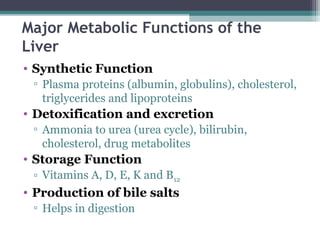
Major Metabolic Functions of the
Liver
• Synthetic Function
▫ Plasma proteins (albumin, globulins), cholesterol,
triglycerides and lipoproteins
• Detoxification and excretion
▫ Ammonia to urea (urea cycle), bilirubin,
cholesterol, drug metabolites
• Storage Function
▫ Vitamins A, D, E, K and B12
• Production of bile salts
▫ Helps in digestion
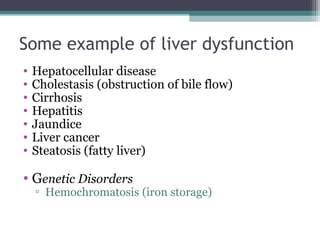
Some example of liver dysfunction
• Hepatocellular disease
• Cholestasis (obstruction of bile flow)
• Cirrhosis
• Hepatitis
• Jaundice
• Liver cancer
• Steatosis (fatty liver)
• Genetic Disorders
▫ Hemochromatosis (iron storage)
Liver Function Tests (LFTs)
• Noninvasive methods for screening of liver
dysfunction
• Help in identifying general types of disorder
• Assess severity and allow prediction of outcome
• Disease and treatment follow up
Liver Function Tests (LFTs)
Broadly classified as:
1.Tests to detect hepatic injury:
• Mild or severe; acute or chronic
• Nature of liver injury (hepatocellular or
cholestasis)
2.Tests to assess hepatic function
Classification of LFTs
Group I: Markers of liver dysfunction
▫ Serum bilirubin: total and conjugated
▫ Urine: bile salts and urobilinogen
▫ Total protein, serum albumin and
albumin/globulin ratio
▫ Prothrombin Time
Classification of LFTs
Group II: Markers of hepatocellular injury
▫ Alanine aminotransferase (ALT)
▫ Aspartate aminotransferase (AST)
Classification of LFTs
Group III: Markers of cholestasis
▫ Alkaline phosphatase (ALP)
▫ -glutamyltransferase (GGT)
Limitations of LFTs
• Normal LFT values do not always indicate
absence of liver disease
▫ Liver a has very large reserve capacity
• Asymptomatic people may have abnormal LFT
results
▫ Diagnosis should be based on clinical
examination
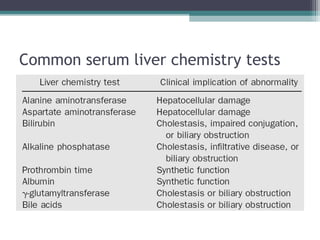
Common serum liver chemistry tests
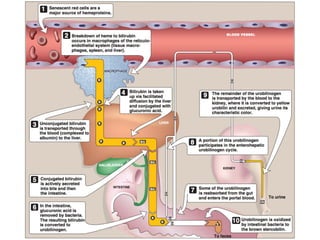
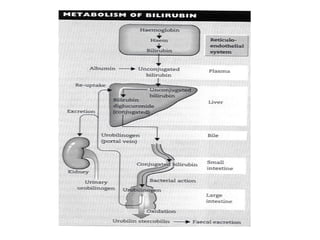
Bilirubin
• A byproduct of red blood cell breakdown
• It is the yellowish pigment observed in jaundice
• High bilirubin levels are observed in:
▫ Gallstones, acute and chronic hepatitis
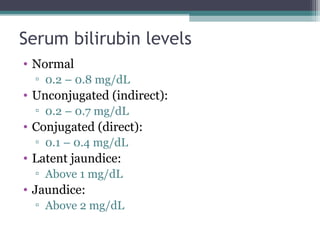
Serum bilirubin levels
• Normal
▫ 0.2 – 0.8 mg/dL
• Unconjugated (indirect):
▫ 0.2 – 0.7 mg/dL
• Conjugated (direct):
▫ 0.1 – 0.4 mg/dL
• Latent jaundice:
▫ Above 1 mg/dL
• Jaundice:
▫ Above 2 mg/dL
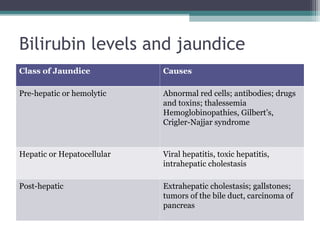
Bilirubin levels and jaundice
Class of Jaundice Causes
Pre-hepatic or hemolytic Abnormal red cells; antibodies; drugs
and toxins; thalessemia
Hemoglobinopathies, Gilbert’s,
Crigler-Najjar syndrome
Hepatic or Hepatocellular Viral hepatitis, toxic hepatitis,
intrahepatic cholestasis
Post-hepatic Extrahepatic cholestasis; gallstones;
tumors of the bile duct, carcinoma of
pancreas
Urobilinogen (UBG) and bile salts
• Most UBG is metabolized in the large intestine
but a fraction is excreted in urine (less than 4
mg/day)
• Normally bile salts are NOT present in urine
• Obstruction in the biliary passages causes:
▫ Leakage of bile salts into circulation
▫ Excretion in urine
Serum Albumin
• The most abundant protein synthesized by the
liver
• Normal serum levels: 3.5 – 5 g/dL
• Synthesis depends on the extent of functioning
liver cell mass
• Longer half-life: 20 days
• Its levels decrease in all chronic liver diseases
Serum Globulin
• Normal serum levels: 2.5 – 3.5g/dL
•  and -globulins mainly synthesized by the liver
• They constitute immunoglobulins (antibodies)
• High serum -globulins are observed in chronic
hepatitis and cirrhosis:
▫ IgG in autoimmune hepatitis
▫ IgA in alcoholic liver disease
Albumin to globulin (A/G) ratio
• Normal A/G ratio: 1.2/1 – 1.5/1
• Globulin levels increase in hypoalbuminemia as
a compensation
Prothrombin Time (PT)
• Prothrombin: synthesized by the liver, a marker
of liver function
• Half-life: 6 hrs. (indicates the present function of
the liver)
• PT is prolonged only when liver loses more than
80% of its reserve capacity
• Vitamin K deficiency also causes prolonged PT
• Intake of vitamin K does not affect PT in liver
disease
Aspartate aminotransferase (AST)
• Normal range: 8 – 20 U/L
• A marker of hepatocellular damage
• High serum levels are observed in:
▫ Chronic hepatitis, cirrhosis and liver cancer
Alanine aminotransferase (ALT)
• More liver-specific than AST
• Normal range (U/L):
▫ Male: 13-35
▫ Female: 10-30
• High serum levels in acute hepatitis (300-
1000U/L)
• Moderate elevation in alcoholic hepatitis (100-
300U/L)
• Minor elevation in cirrhosis, hepatitis C and
non-alcoholic steatohepatitis (NASH) (50-
100U/L)
Alanine aminotransferase (ALT)
• Appears in plasma many days before clinical
signs appear
• A normal value does not always indicate absence
of liver damage
• Obese but otherwise normal individuals may
have elevated ALT levels
Alkaline phosphatase (ALP)
• A non-specific marker of liver disease
• Produced by bone osteoblasts (for bone
calcification)
• Present on hepatocyte membrane
• Normal range: 40 – 125 U/L
• Modearte elevation observed in:
▫ Infective hepatitis, alcoholic hepatitis and
hepatocellular carcinoma
Alkaline phosphatase (ALP)
• High levels are observed in:
▫ Extrahepatic obstruction (obstructive jaundice)
and intrahepatic cholestasis
• Very high levels are observed in:
▫ Bone diseases
-glutamyltransferase (GGT)
• Used for glutathione synthesis
• Normal range: 10 – 30U/L
• Moderate elevation observed in:
▫ Infective hepatitis and prostate cancers
• GGT is increased in alcoholics despite normal
liver function tests
▫ Highly sensitive to detecting alcohol abuse
Take Home Messages
• LFTs help detect liver injury and function.
• LFTs do have some limitations.
References
• Lippincott’s Illustrated Reviews Biochemistry: 6th
edition, Unit IV, Chapter 21, Pages 282 - 285.
• Lecture notes: Clinical Biochemistry: 9th
edition, Chapter
13, Pages 174 - 187.
• Clinical Chemistry - Techniques, Principales and
Correlations: 6th
edition, Chapter 24, Pages 520 -521.

basic biochemistry liver_function_tests.ppt

  • 1.
  • 2.
    Objectives Upon completion ofthis lecture, the students should be able to: •Understand the major metabolic functions of the liver and causes of liver dysfunction. •Discuss markers of liver function tests such as liver enzymes, bilirubin, albumin and prothrombin time that can diagnose hepatic injury and assess hepatic function.
  • 3.
    Major Metabolic Functionsof the Liver • Synthetic Function ▫ Plasma proteins (albumin, globulins), cholesterol, triglycerides and lipoproteins • Detoxification and excretion ▫ Ammonia to urea (urea cycle), bilirubin, cholesterol, drug metabolites • Storage Function ▫ Vitamins A, D, E, K and B12 • Production of bile salts ▫ Helps in digestion
  • 4.
    Some example ofliver dysfunction • Hepatocellular disease • Cholestasis (obstruction of bile flow) • Cirrhosis • Hepatitis • Jaundice • Liver cancer • Steatosis (fatty liver) • Genetic Disorders ▫ Hemochromatosis (iron storage)
  • 5.
    Liver Function Tests(LFTs) • Noninvasive methods for screening of liver dysfunction • Help in identifying general types of disorder • Assess severity and allow prediction of outcome • Disease and treatment follow up
  • 6.
    Liver Function Tests(LFTs) Broadly classified as: 1.Tests to detect hepatic injury: • Mild or severe; acute or chronic • Nature of liver injury (hepatocellular or cholestasis) 2.Tests to assess hepatic function
  • 7.
    Classification of LFTs GroupI: Markers of liver dysfunction ▫ Serum bilirubin: total and conjugated ▫ Urine: bile salts and urobilinogen ▫ Total protein, serum albumin and albumin/globulin ratio ▫ Prothrombin Time
  • 8.
    Classification of LFTs GroupII: Markers of hepatocellular injury ▫ Alanine aminotransferase (ALT) ▫ Aspartate aminotransferase (AST)
  • 9.
    Classification of LFTs GroupIII: Markers of cholestasis ▫ Alkaline phosphatase (ALP) ▫ -glutamyltransferase (GGT)
  • 10.
    Limitations of LFTs •Normal LFT values do not always indicate absence of liver disease ▫ Liver a has very large reserve capacity • Asymptomatic people may have abnormal LFT results ▫ Diagnosis should be based on clinical examination
  • 11.
    Common serum liverchemistry tests
  • 12.
    Bilirubin • A byproductof red blood cell breakdown • It is the yellowish pigment observed in jaundice • High bilirubin levels are observed in: ▫ Gallstones, acute and chronic hepatitis
  • 15.
    Serum bilirubin levels •Normal ▫ 0.2 – 0.8 mg/dL • Unconjugated (indirect): ▫ 0.2 – 0.7 mg/dL • Conjugated (direct): ▫ 0.1 – 0.4 mg/dL • Latent jaundice: ▫ Above 1 mg/dL • Jaundice: ▫ Above 2 mg/dL
  • 16.
    Bilirubin levels andjaundice Class of Jaundice Causes Pre-hepatic or hemolytic Abnormal red cells; antibodies; drugs and toxins; thalessemia Hemoglobinopathies, Gilbert’s, Crigler-Najjar syndrome Hepatic or Hepatocellular Viral hepatitis, toxic hepatitis, intrahepatic cholestasis Post-hepatic Extrahepatic cholestasis; gallstones; tumors of the bile duct, carcinoma of pancreas
  • 17.
    Urobilinogen (UBG) andbile salts • Most UBG is metabolized in the large intestine but a fraction is excreted in urine (less than 4 mg/day) • Normally bile salts are NOT present in urine • Obstruction in the biliary passages causes: ▫ Leakage of bile salts into circulation ▫ Excretion in urine
  • 18.
    Serum Albumin • Themost abundant protein synthesized by the liver • Normal serum levels: 3.5 – 5 g/dL • Synthesis depends on the extent of functioning liver cell mass • Longer half-life: 20 days • Its levels decrease in all chronic liver diseases
  • 19.
    Serum Globulin • Normalserum levels: 2.5 – 3.5g/dL •  and -globulins mainly synthesized by the liver • They constitute immunoglobulins (antibodies) • High serum -globulins are observed in chronic hepatitis and cirrhosis: ▫ IgG in autoimmune hepatitis ▫ IgA in alcoholic liver disease
  • 20.
    Albumin to globulin(A/G) ratio • Normal A/G ratio: 1.2/1 – 1.5/1 • Globulin levels increase in hypoalbuminemia as a compensation
  • 21.
    Prothrombin Time (PT) •Prothrombin: synthesized by the liver, a marker of liver function • Half-life: 6 hrs. (indicates the present function of the liver) • PT is prolonged only when liver loses more than 80% of its reserve capacity • Vitamin K deficiency also causes prolonged PT • Intake of vitamin K does not affect PT in liver disease
  • 22.
    Aspartate aminotransferase (AST) •Normal range: 8 – 20 U/L • A marker of hepatocellular damage • High serum levels are observed in: ▫ Chronic hepatitis, cirrhosis and liver cancer
  • 23.
    Alanine aminotransferase (ALT) •More liver-specific than AST • Normal range (U/L): ▫ Male: 13-35 ▫ Female: 10-30 • High serum levels in acute hepatitis (300- 1000U/L) • Moderate elevation in alcoholic hepatitis (100- 300U/L) • Minor elevation in cirrhosis, hepatitis C and non-alcoholic steatohepatitis (NASH) (50- 100U/L)
  • 24.
    Alanine aminotransferase (ALT) •Appears in plasma many days before clinical signs appear • A normal value does not always indicate absence of liver damage • Obese but otherwise normal individuals may have elevated ALT levels
  • 25.
    Alkaline phosphatase (ALP) •A non-specific marker of liver disease • Produced by bone osteoblasts (for bone calcification) • Present on hepatocyte membrane • Normal range: 40 – 125 U/L • Modearte elevation observed in: ▫ Infective hepatitis, alcoholic hepatitis and hepatocellular carcinoma
  • 26.
    Alkaline phosphatase (ALP) •High levels are observed in: ▫ Extrahepatic obstruction (obstructive jaundice) and intrahepatic cholestasis • Very high levels are observed in: ▫ Bone diseases
  • 27.
    -glutamyltransferase (GGT) • Usedfor glutathione synthesis • Normal range: 10 – 30U/L • Moderate elevation observed in: ▫ Infective hepatitis and prostate cancers • GGT is increased in alcoholics despite normal liver function tests ▫ Highly sensitive to detecting alcohol abuse
  • 28.
    Take Home Messages •LFTs help detect liver injury and function. • LFTs do have some limitations.
  • 29.
    References • Lippincott’s IllustratedReviews Biochemistry: 6th edition, Unit IV, Chapter 21, Pages 282 - 285. • Lecture notes: Clinical Biochemistry: 9th edition, Chapter 13, Pages 174 - 187. • Clinical Chemistry - Techniques, Principales and Correlations: 6th edition, Chapter 24, Pages 520 -521.

Editor's Notes

  • #17 Obstruction can occur in obstructive jaundice and also in hepatic jaundice due to obstruction of microbiliary channels caused by inflammation