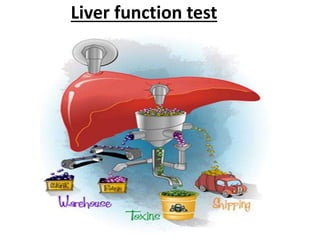
Liver function test
Anatomy
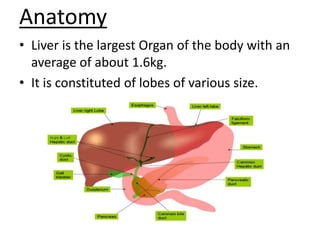
• Liver is the largest Organ of the body with an
average of about 1.6kg.
• It is constituted of lobes of various size.
Functions of Liver
1. Metabolic functions
2. Secretory functions
3. Detoxification and protective functions
4. Storage functions
5. Synthesis of blood coagulation factor
6. Excretory functions
7. Handling of enzymes
8. Miscellaneous functions
1. Metabolic functions
• Conversion of absorbed monosaccharide i.e.
galactose and fructose into glucose.
• Cholesterol biosynthesis and its esterification
and excretion
• Conversion of NH3 into urea.
• Biosynthesis of protein.
• Metabolism of vitamin and minerals. Synthesis
of blood coagulation factors.
• Formation of blood in embryo.
2.Secretory functions
• Liver is responsible bile pigment metabolism
by converting bilirubin , formed from heme
catabolism
3.Detoxification and protective functions
• Liver (Kupffer cells) can remove foreign bodies
from blood by phagocytosis
• It can detoxify various drugs converting them
into less toxic substainces.
4.Storage functions
• Liver stores glucose in the form of glycogen and
stors some vitamin e.g. vitamin A and B12.
5.Synthesis of blood coagulation fector
• Preprothrombin conbert into prothormbin in the
presence of vitamin k.
6.Excretory functions
• Bromosulphthaline (BSP)and Rose Bengal dye are
excreted through liver cells.
7.Handling of enzymes
• Much significance is to liver for handling of
enzymes like alkaline phosphatase (ALP)and
realese of aspartate tramsaminase (GOT)and
alanine transaminase (GPT).
8.Micellaneous functions
• Blood formation in embryo
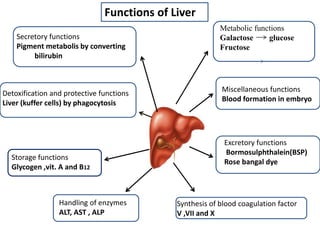
Metabolic functions
Galactose glucose
Fructose
Secretory functions
Pigment metabolis by converting
bilirubin
Detoxification and protective functions
Liver (kuffer cells) by phagocytosis
Storage functions
Glycogen ,vit. A and B12
Synthesis of blood coagulation factor
V ,VII and X
Excretory functions
Bormosulphthalein(BSP)
Rose bangal dye
Handling of enzymes
ALT, AST , ALP
Miscellaneous functions
Blood formation in embryo
Functions of Liver
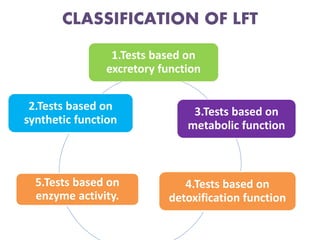
CLASSIFICATION OF LFT
1.Tests based on
excretory function
3.Tests based on
metabolic function
4.Tests based on
detoxification function
2.Tests based on
synthetic function
5.Tests based on
enzyme activity.
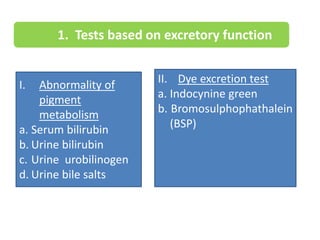
1. Tests based on excretory function
II. Dye excretion test
a. Indocynine green
b. Bromosulphophathalein
(BSP)
I. Abnormality of
pigment
metabolism
a. Serum bilirubin
b. Urine bilirubin
c. Urine urobilinogen
d. Urine bile salts
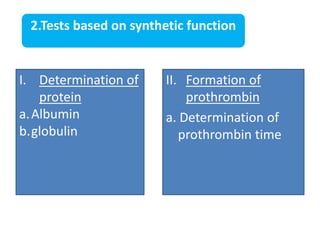
2.Tests based on synthetic function
I. Determination of
protein
a.Albumin
b.globulin
II. Formation of
prothrombin
a. Determination of
prothrombin time
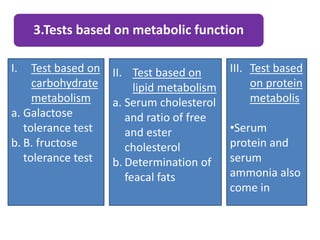
3.Tests based on metabolic function
I. Test based on
carbohydrate
metabolism
a. Galactose
tolerance test
b. B. fructose
tolerance test
II. Test based on
lipid metabolism
a. Serum cholesterol
and ratio of free
and ester
cholesterol
b. Determination of
feacal fats
III. Test based
on protein
metabolis
•Serum
protein and
serum
ammonia also
come in
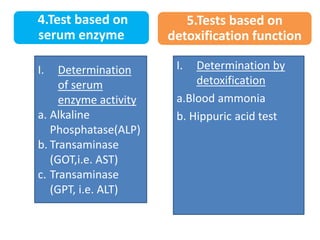
4.Test based on
serum enzyme
I. Determination
of serum
enzyme activity
a. Alkaline
Phosphatase(ALP)
b. Transaminase
(GOT,i.e. AST)
c. Transaminase
(GPT, i.e. ALT)
I. Determination by
detoxification
a.Blood ammonia
b. Hippuric acid test
5.Tests based on
detoxification function
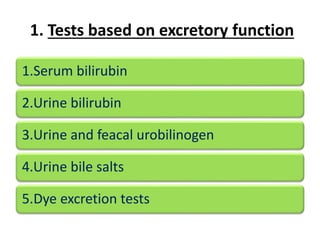
1. Tests based on excretory function
1.Serum bilirubin
2.Urine bilirubin
3.Urine and feacal urobilinogen
4.Urine bile salts
5.Dye excretion tests
I. Test based on
bilirubin/abno-
rmilites of bile
pigment
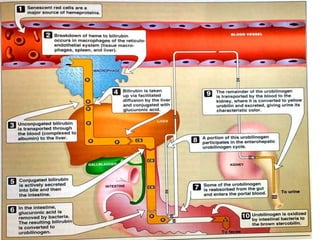
Degradation of heme
• After approximately 120
days in the circulation
R.B.C. are degraded by
reticuloendothelial system.
• Particular in
Liver and Spleen
Knowledge of
bilirubin
metabolism is
essential for
proper
understanding of
hepatic disease.
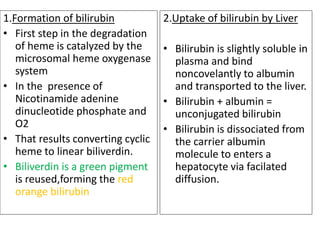
1.Formation of bilirubin
• First step in the degradation
of heme is catalyzed by the
microsomal heme oxygenase
system
• In the presence of
Nicotinamide adenine
dinucleotide phosphate and
O2
• That results converting cyclic
heme to linear biliverdin.
• Biliverdin is a green pigment
is reused,forming the red
orange bilirubin
2.Uptake of bilirubin by Liver
• Bilirubin is slightly soluble in
plasma and bind
noncovelantly to albumin
and transported to the liver.
• Bilirubin + albumin =
unconjugated bilirubin
• Bilirubin is dissociated from
the carrier albumin
molecule to enters a
hepatocyte via facilated
diffusion.
• 3.Formation of
bilurubin diglucuronide
• The solubility of
bilirubin is increased by
the addition of two
molecules of gucoronic
acid.
• That produced bilirubin
diglucuronide
=(Conjugated bilirubin)
4.Secretion of bilirubin in
to bile
• Bilurubin diglucuronide
actively trasportate
again concentration
gradient into the bile
cnaliculi and than into
the bile. This is energy
dependent.
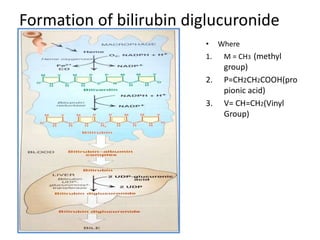
Formation of bilirubin diglucuronide
• Where
1. M = CH3 (methyl
group)
2. P=CH2CH2COOH(pro
pionic acid)
3. V= CH=CH2(Vinyl
Group)
5.Formation of stercobilin
in the intestine
• Bilirubin diglucuronide
is hydrolyzed and
reduced by bacteria in
the gut to yield
urobilinogen.
• Most of the
urobilinogen is oxidized
by intestinal bacteria to
stercobilin.
6.Formation of urobilin in
the kidney
• The remainder of the
urobilinogen is
transported by the blood
to the kidneny and
converted to yellow
urobilin
• This urobilin excreated in
urine.
• Significance of
hyperbilirubinemia
• Daily production of
bilirubin <500mg
• But normal liver can
conjugate upto 1500mg/day
• So plasma bilirubin
concentration is an
insensitive test for liver
disease - since it begins to
rise only after significant
liver damage has occured
• Hyperbilirubinemia
may be due to
• Increased bilirubin
production
• Decresed hepatic uptake
• Decreased hepatic
conjugation
• Decreased excreation of
of bilirubin into bile
 Jaundice
• Jaundice (also called icterus) refers to the
yellow colour of skin, nail beds and sclera
(whites of the eyes) bilirubin concentration
reaches approximately 2.2 to 5 mg/dl
• Hyperbilirubinemia may be acquired or
inherited acquired.
• Types of jaundice –
classified into four
major type
• Aquared
hyperbilirubinaemia
a) Heamolytic
/prehepatic
jaundice
b) Hepatocellular
jaundice
c) Obstructive
jaundice
d) Neonata or
physiological
jaundice
• Inherited
hyperbilirubinaemia
a) Gilbert’s syndrome
b) Crigler Najjar
Syndrome
c) Dubin Johnson
Syndrome
d) Rotor Syndrome
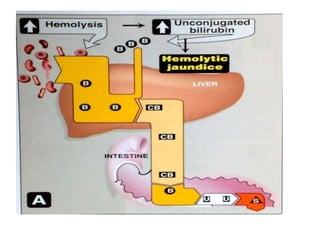
a) Heamolytic jaundice
• Two ways 1. Intrinsic
• In extensive hemolysis (for example patient with
sickle cell anemia, or pyruvate kinase or or
glucose 6- phosphate dehydroginase deficiency)
2.Extrinsic
• Incompatibility blood transfusion,autoimmune
hemolytic aneamia, hemolytic disease.
• It produced bilirubin faster than it can be
conjugated.
• Then unconjugated bilirubin level in blood
become elevated.
b)Hepatocellular jaundice
• Damage of liver cell (in patients with cirrhosis
or hapatitis) can cause unconjugated bilirubin
level increase as a result of decreased
conjugation.
• Urobilinogen also increased due to decreased
the enterohepatic circulation.
• The urine consequently darkens.
• AST and ALT also elevated (in drug induced
itnrahepatic cholestasis) CB can diffuse into the
blood and cause conjugated hyperbilirubinemia
• Divided in to three groups
1.defactive conjugation – chronic hepatitis,
Gilbert’s syndrome, Crigler Najjar Syndrome
2. Viral hepatitis and toxic jaundice – intra
hepatic obstruction.
3. “choleststic” jaundice – occure due to drug
indused.
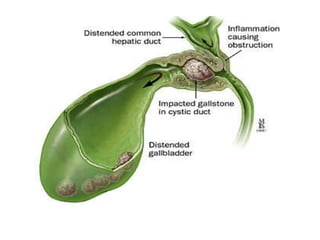
c) Obstructive jaundice
• It is not caused by over production or
decreased conjugation of bilirubin.
• But result from obstruction of the common
bile duct (extra hepatic cholestasis).
• Eg. Gall stones, carcinoma of head of
pancreas, enlarged lymph gland persisting on
bile duct
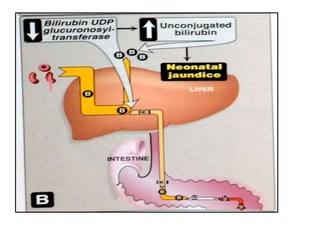
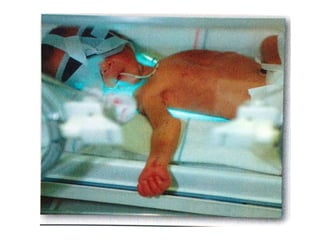
d) Jaundice in new born/physiological
jaundice
• Newborn infants show a rise in un conjugated
bilirubin in the first postnatal week because
activity of hepatic bilirubin UGT(UDP
glucuronosyl transferase).
• It cause elevation of unconjugated bilirubin
• Newborn significantly elevated bilirubin level
are treated with blue fluorescent light
(phototherapy) that convert bilirubin more
polar and water soluble.
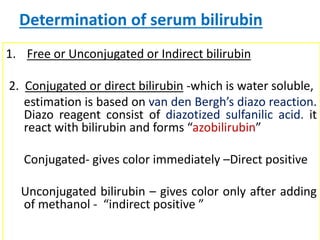
Determination of serum bilirubin
1. Free or Unconjugated or Indirect bilirubin
2. Conjugated or direct bilirubin -which is water soluble,
estimation is based on van den Bergh’s diazo reaction.
Diazo reagent consist of diazotized sulfanilic acid. it
react with bilirubin and forms “azobilirubin”
Conjugated- gives color immediately –Direct positive
Unconjugated bilirubin – gives color only after adding
of methanol - “indirect positive ”
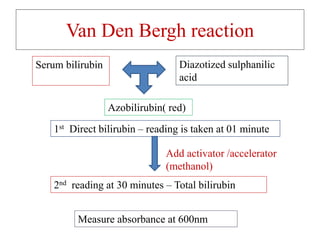
Van Den Bergh reaction
Serum bilirubin Diazotized sulphanilic
acid
Azobilirubin( red)
1st Direct bilirubin – reading is taken at 01 minute
Add activator /accelerator
(methanol)
2nd reading at 30 minutes – Total bilirubin
Measure absorbance at 600nm
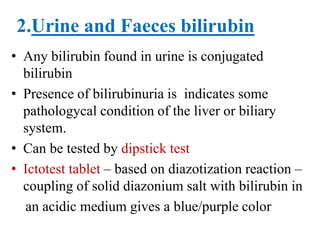
2.Urine and Faeces bilirubin
• Any bilirubin found in urine is conjugated
bilirubin
• Presence of bilirubinuria is indicates some
pathologycal condition of the liver or biliary
system.
• Can be tested by dipstick test
• Ictotest tablet – based on diazotization reaction –
coupling of solid diazonium salt with bilirubin in
an acidic medium gives a blue/purple color
3.URINE UROBILINOGEN
• Increase in urine is sensitive indicator of
hepatocellular disease
• It is increased in hemolysis condition.
• In cholestatic jaundice urobilinogen disappears
from urine
• Urine strips are available
• Fresh urine should be used
• Ehrlich’s test – gives pink-red color
4.Urine Bilesalt
• Products of cholesterol metabolism
• Facilitate absorption of fat from intestine
• Constitute a substantial amount of bile in bilirubin
excretion and can be used in diagnosing cholestasis
• Primary bile salts – cholate and chenodeoxycholate
are produced in liver
• Metabolised by bacteria in intestine
• In normal condition – renal excretion of bile salts is
negligible
• In cholestasis – increased renal excretion of bile salts
• For measuremnet – chromatography (HPLC)
• Hay’s test – bile salts when present lower the surface
tension of urine
• When sulphur powder is added to the urine, sulphur
particles sink to the bottom of the tube
• In case of normal urine, it will float on the surface
II. BASED ON EXCRETION TEST
Three synthetic dyes are commonly employed to
test liver function
1.Bromosulphthalein (BSP)
2.Indocyanine green
3.Rose bengal
1.Bromosulphthalein excretion test –
5% solution of BSP
5mg/kg weight i.v. is given
• BSP is taken up by hepatocytes, conjugat as a
mercaptide with the cystein component of the
glutathion and excreted in bile.
• A blood specimen is taken after25 and 45 minits.
• After 25 minits
• InNormal = 15% after 25 minit and 5% after 45 minits.
• In liver disease = After 45 mins – if >50% dye is retained in
blood – abnormal Liver function is present
• This test is useful in differentiating dubin johnson from
rotor syndrome
• In DJS – At 45 mins – normal blood levels of BSP
At 2 hrs – higher level of BSP
• In rotor syndrome – at 45 mins – higher levels
at 2 hrs – lower levels
 The test is no value if obstruction of biliary tree exist
(obstructive jaundice)useful in liver cell damagr, cirrhosis,
chronic hapetitis.
2. Rose –Bengal dye test – also useful an another
dye for excretory function
10 ml of 1% solution of the dye is injected IV
slowly.
• 50% or more dye disappear from the blood.
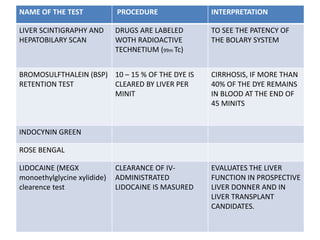
NAME OF THE TEST PROCEDURE INTERPRETATION
LIVER SCINTIGRAPHY AND
HEPATOBILARY SCAN
DRUGS ARE LABELED
WOTH RADIOACTIVE
TECHNETIUM (99m Tc)
TO SEE THE PATENCY OF
THE BOLARY SYSTEM
BROMOSULFTHALEIN (BSP)
RETENTION TEST
10 – 15 % OF THE DYE IS
CLEARED BY LIVER PER
MINIT
CIRRHOSIS, IF MORE THAN
40% OF THE DYE REMAINS
IN BLOOD AT THE END OF
45 MINITS
INDOCYNIN GREEN
ROSE BENGAL
LIDOCAINE (MEGX
monoethylglycine xylidide)
clearence test
CLEARANCE OF IV-
ADMINISTRATED
LIDOCAINE IS MASURED
EVALUATES THE LIVER
FUNCTION IN PROSPECTIVE
LIVER DONNER AND IN
LIVER TRANSPLANT
CANDIDATES.
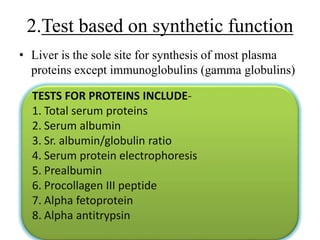
• Liver is the sole site for synthesis of most plasma
proteins except immunoglobulins (gamma globulins)
2.Test based on synthetic function
TESTS FOR PROTEINS INCLUDE-
1. Total serum proteins
2. Serum albumin
3. Sr. albumin/globulin ratio
4. Serum protein electrophoresis
5. Prealbumin
6. Procollagen III peptide
7. Alpha fetoprotein
8. Alpha antitrypsin
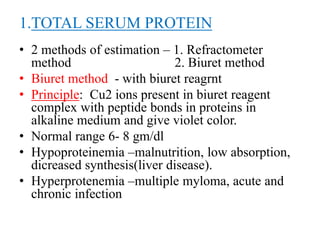
1.TOTAL SERUM PROTEIN
• 2 methods of estimation – 1. Refractometer
method 2. Biuret method
• Biuret method - with biuret reagrnt
• Principle: Cu2 ions present in biuret reagent
complex with peptide bonds in proteins in
alkaline medium and give violet color.
• Normal range 6- 8 gm/dl
• Hypoproteinemia –malnutrition, low absorption,
dicreased synthesis(liver disease).
• Hyperprotenemia –multiple myloma, acute and
chronic infection
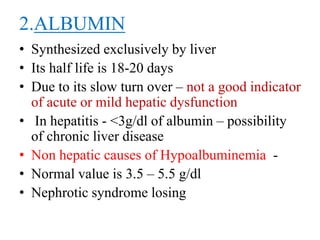
2.ALBUMIN
• Synthesized exclusively by liver
• Its half life is 18-20 days
• Due to its slow turn over – not a good indicator
of acute or mild hepatic dysfunction
• In hepatitis - <3g/dl of albumin – possibility
of chronic liver disease
• Non hepatic causes of Hypoalbuminemia -
• Normal value is 3.5 – 5.5 g/dl
• Nephrotic syndrome losing
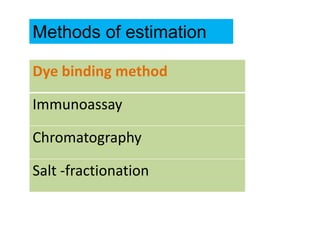
0
Dye binding method
Immunoassay
Chromatography
Salt -fractionation
Methods of estimation
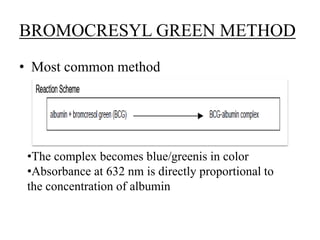
BROMOCRESYL GREEN METHOD
• Most common method
•The complex becomes blue/greenis in color
•Absorbance at 632 nm is directly proportional to
the concentration of albumin
3.GLOBULINS
• Made up of – alpha, beta and gamma globulins
• Gamma globulin is produced by plasma cells
• alpha and beta globulins are synthesized in liver
• In cirrhosis – gamma globulin is increased
• Cirrhotic liver fails to clear bacterial antigens that
normally reach the liver – Abs are formed against
such Ags – so , increased gamma globulin
• Polyclonal gamma globulin if increases by 100%
- autoimmune hepatitis
• Increased IgM – primary biliary cirrhosis
• Increased IgA – alcoholic liver disease
4.COAGULATION FACTORS
• With the exception of F-VIII , all other factors
are synthesized in liver
• Half life ranges from 6hrs for F-VII to 5 days
for fibrinogen
• Tests – Serum prothrombin time
citrated plasma - add thromboplastin and Ca
• normal P T is b/w 10 and 16 sec.
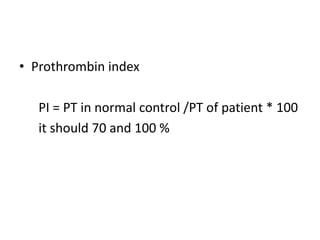
• Prothrombin index
PI = PT in normal control /PT of patient * 100
it should 70 and 100 %
3.Tests based on metabolic function
or carbohydrate
1. Test based on carbohydrate metabolism
o Glucose tolrence test- not much value in liver
disease
o Galactose tolerance test
The normal liver is able to convert galactose to
glucose in patient with hepatic disease this ability is
defective
• It is used primarily to detect liver cell injury.
• It can be performed in presence of jaundice..
2. Test based on lipid metabolism
liver is involved in synthesis and
esterification and excreation of
cholesterol.
The serum cholesterol level range 150 –
250 mg/dl and approximatetely 70 % is
esterified.
• Change in the ratio of free to esterifide
cholesterol are found in liver disease.
3. Test based on protein metabolism
 Serum estimation of protein – done
 Amino acid in urine (amino acidurea)
• Aminoaciduria is found in liver disease with
increased in plasma amino acid levels.
• The increased plasma level of amino acid is
also leads to increased in urine excreation.
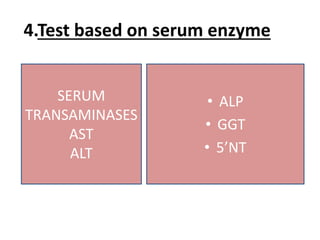
4.Test based on serum enzyme
SERUM
TRANSAMINASES
AST
ALT
• ALP
• GGT
• 5’NT
• Alkaline phosphatase (ALP,Zn containing
enzyme)
• ALP is found in or near bilr canalicular
membranes of hepatocytes.
• particularly concentrated in liver, bile duct,
kidney, bone, and the placenta.
– most effective in an alkaline environment
• Normal range = 40- 100 IU/L
• Levels are significantly higher in children and
pregnant women.
Higher levels of ALP than normal may indicate:
 liver disease (obstructive , infective hepatitis )
 bone disease
 leukemia, a cancer of the blood and bone marrow
Pregnancy
Lower levels of ALP than normal may indicate:
 anemia, or a low red blood cell count(hemolytic
jaundice )
 malnutrition
 various hormone problems
• Clinical significance
• Hepatobilary disease -increased level shows in
obstructive jaundice.
• Bone disease associated with increased
ostioblastic activity.
Bone cancer shows very high level.
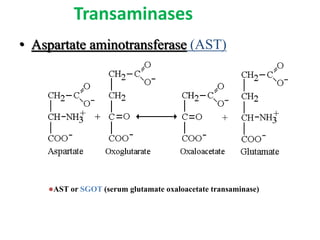
Transaminases
• Aspartate aminotransferase (AST)
AST or SGOT (serum glutamate oxaloacetate transaminase)
• Although SGOT is not a specific for
liver as the GPT, ratios between
SGPT and SGOT are useful to
physicians in assessing the etiology
of liver enzyme abnormalities.
• Normal range AST = 10-40 IU/L
• AST is widely present in
myocardium skeletal muscle, brain
and kidney.
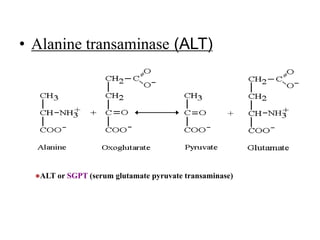
• Alanine transaminase (ALT)
ALT or SGPT (serum glutamate pyruvate transaminase)
• Only ALT is marked as liver specific enzyme
• ALT estimation is useful in early diagnosis to
evaluate severity of parenchymal liver
disease.
• ALT is level is roughly associated with
hepatocellular damage.
• In hapatitis ALT and AST are increased usually
500 – 1500 U/L in obstructive jaundice it
occure 200- 300 U/L.
• Both AST and ALT elevated with viral hepatitis
and other form of liver disease.
• High value of both enzyme two times from
upper normal limit with peak values b/w 7 –
12 days.
• Higher value shoes in case of liver cancer.
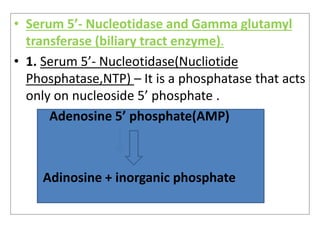
• Serum 5’- Nucleotidase and Gamma glutamyl
transferase (biliary tract enzyme).
• 1. Serum 5’- Nucleotidase(Nucliotide
Phosphatase,NTP) – It is a phosphatase that acts
only on nucleoside 5’ phosphate .
Adenosine 5’ phosphate(AMP)
Adinosine + inorganic phosphate
• Normal value
Normal serum NTP level is 2 to 17 U/L. lower
values have been reported in childeran.
• Clinical Significance
- extra hepatic cause such as a stone or tumor
obstruct the bile duct.
-intra hepatic cause such as cholestasis or
biliary cirrhosis.
2. Gamma Glutamyl Transferase–
• GGT is located in hepatocyte endoplasmic
reticulum. catalyzes the transfer of the ϒ-
glutamyl group from peptides and compound.
Normal value – Male 2- 30 u/l
Fe male 1- 25 u/l
GGT level elevated in all form of liver disease.
Measure serum levels of GGT and 5’NT – they are
elevated in only liver disease but due to wide
tissue distribution specificity of high value is low.
• Serum GGT is increased in –
1.Alcoholism- Is a helpful clue in suspected cases of
alcoholism ( even in absence of alcoholic liver
disease)
2.Cholestasis
• GGT and 5’NT is especially used to assess the
nature of ALP
5.Tests based on detoxification
function
Hippuric acid
test
Determination
of blood
ammonia
Tests based on detoxification function
 Hippuric acid test
• The liver removes benzoic acid by conjugating it
with glycine to form hippuric acid which is
excreat in urine.
• In hippuric acid test a dose of sodium benzoate
is given either oral or intravenously and
ammount
• The test is depends on two factor
1. The ability of liver cells to produced and
provide sufficient glycine.
2.The capacity of liver cells to conjugate it
with benzoic acid.
• Test can perform in two way
1.oral hippuric acid test
2.IV hippuric acid test
• Dissolve 6.0 gram sodium bezoate in 200 ml of
water and test may start after 3 hours without
food only light breakfast can be taken.
• Interpretation
normally 3.0 gm of hippuric acid expresed as
benzioc acid or 3.5 gram sodium benzoate
should be excreat in healthy.
small ammount 1.0 gram found in acut and
cronic liver damage.
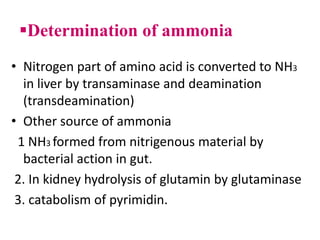
Determination of ammonia
• Nitrogen part of amino acid is converted to NH3
in liver by transaminase and deamination
(transdeamination)
• Other source of ammonia
1 NH3 formed from nitrigenous material by
bacterial action in gut.
2. In kidney hydrolysis of glutamin by glutaminase
3. catabolism of pyrimidin.
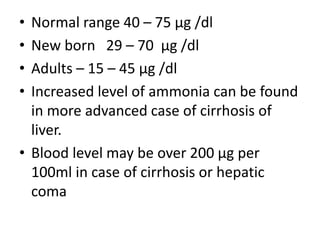
• Normal range 40 – 75 μg /dl
• New born 29 – 70 μg /dl
• Adults – 15 – 45 μg /dl
• Increased level of ammonia can be found
in more advanced case of cirrhosis of
liver.
• Blood level may be over 200 μg per
100ml in case of cirrhosis or hepatic
coma
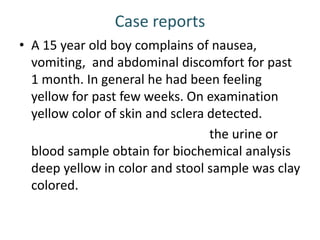
Case reports
• A 15 year old boy complains of nausea,
vomiting, and abdominal discomfort for past
1 month. In general he had been feeling
yellow for past few weeks. On examination
yellow color of skin and sclera detected.
the urine or
blood sample obtain for biochemical analysis
deep yellow in color and stool sample was clay
colored.
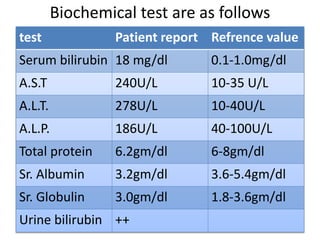
Biochemical test are as follows
test Patient report Refrence value
Serum bilirubin 18 mg/dl 0.1-1.0mg/dl
A.S.T 240U/L 10-35 U/L
A.L.T. 278U/L 10-40U/L
A.L.P. 186U/L 40-100U/L
Total protein 6.2gm/dl 6-8gm/dl
Sr. Albumin 3.2gm/dl 3.6-5.4gm/dl
Sr. Globulin 3.0gm/dl 1.8-3.6gm/dl
Urine bilirubin ++
• In hepatic jaundice ALT and AST increased which
go1000 units (500- 1500U/L).
• In hemolytic these enzymes is normal.
• In obstructive jaundice increased but usually in
the range of (200-300U/L).
• In this case same finding suggest obstruction.
• Increased alkaline phosphate are also suggested
of obstruction b/c in hepatocellular jaundice mild
increased.
• Serum protein shows normal functioning of
hepatic cell.
• There for the patient is suffering from obstructive
jaundice.
Liver function test
Liver function test

Liver function test

  • 1.
  • 2.
    Anatomy • Liver isthe largest Organ of the body with an average of about 1.6kg. • It is constituted of lobes of various size.
  • 3.
    Functions of Liver 1.Metabolic functions 2. Secretory functions 3. Detoxification and protective functions 4. Storage functions 5. Synthesis of blood coagulation factor 6. Excretory functions 7. Handling of enzymes 8. Miscellaneous functions
  • 4.
    1. Metabolic functions •Conversion of absorbed monosaccharide i.e. galactose and fructose into glucose. • Cholesterol biosynthesis and its esterification and excretion • Conversion of NH3 into urea. • Biosynthesis of protein. • Metabolism of vitamin and minerals. Synthesis of blood coagulation factors. • Formation of blood in embryo.
  • 5.
    2.Secretory functions • Liveris responsible bile pigment metabolism by converting bilirubin , formed from heme catabolism 3.Detoxification and protective functions • Liver (Kupffer cells) can remove foreign bodies from blood by phagocytosis • It can detoxify various drugs converting them into less toxic substainces.
  • 6.
    4.Storage functions • Liverstores glucose in the form of glycogen and stors some vitamin e.g. vitamin A and B12. 5.Synthesis of blood coagulation fector • Preprothrombin conbert into prothormbin in the presence of vitamin k. 6.Excretory functions • Bromosulphthaline (BSP)and Rose Bengal dye are excreted through liver cells.
  • 7.
    7.Handling of enzymes •Much significance is to liver for handling of enzymes like alkaline phosphatase (ALP)and realese of aspartate tramsaminase (GOT)and alanine transaminase (GPT). 8.Micellaneous functions • Blood formation in embryo
  • 8.
    Metabolic functions Galactose glucose Fructose Secretoryfunctions Pigment metabolis by converting bilirubin Detoxification and protective functions Liver (kuffer cells) by phagocytosis Storage functions Glycogen ,vit. A and B12 Synthesis of blood coagulation factor V ,VII and X Excretory functions Bormosulphthalein(BSP) Rose bangal dye Handling of enzymes ALT, AST , ALP Miscellaneous functions Blood formation in embryo Functions of Liver
  • 9.
    CLASSIFICATION OF LFT 1.Testsbased on excretory function 3.Tests based on metabolic function 4.Tests based on detoxification function 2.Tests based on synthetic function 5.Tests based on enzyme activity.
  • 10.
    1. Tests basedon excretory function II. Dye excretion test a. Indocynine green b. Bromosulphophathalein (BSP) I. Abnormality of pigment metabolism a. Serum bilirubin b. Urine bilirubin c. Urine urobilinogen d. Urine bile salts
  • 11.
    2.Tests based onsynthetic function I. Determination of protein a.Albumin b.globulin II. Formation of prothrombin a. Determination of prothrombin time
  • 12.
    3.Tests based onmetabolic function I. Test based on carbohydrate metabolism a. Galactose tolerance test b. B. fructose tolerance test II. Test based on lipid metabolism a. Serum cholesterol and ratio of free and ester cholesterol b. Determination of feacal fats III. Test based on protein metabolis •Serum protein and serum ammonia also come in
  • 13.
    4.Test based on serumenzyme I. Determination of serum enzyme activity a. Alkaline Phosphatase(ALP) b. Transaminase (GOT,i.e. AST) c. Transaminase (GPT, i.e. ALT) I. Determination by detoxification a.Blood ammonia b. Hippuric acid test 5.Tests based on detoxification function
  • 14.
    1. Tests basedon excretory function 1.Serum bilirubin 2.Urine bilirubin 3.Urine and feacal urobilinogen 4.Urine bile salts 5.Dye excretion tests
  • 15.
    I. Test basedon bilirubin/abno- rmilites of bile pigment Degradation of heme • After approximately 120 days in the circulation R.B.C. are degraded by reticuloendothelial system. • Particular in Liver and Spleen Knowledge of bilirubin metabolism is essential for proper understanding of hepatic disease.
  • 16.
    1.Formation of bilirubin •First step in the degradation of heme is catalyzed by the microsomal heme oxygenase system • In the presence of Nicotinamide adenine dinucleotide phosphate and O2 • That results converting cyclic heme to linear biliverdin. • Biliverdin is a green pigment is reused,forming the red orange bilirubin 2.Uptake of bilirubin by Liver • Bilirubin is slightly soluble in plasma and bind noncovelantly to albumin and transported to the liver. • Bilirubin + albumin = unconjugated bilirubin • Bilirubin is dissociated from the carrier albumin molecule to enters a hepatocyte via facilated diffusion.
  • 17.
    • 3.Formation of bilurubindiglucuronide • The solubility of bilirubin is increased by the addition of two molecules of gucoronic acid. • That produced bilirubin diglucuronide =(Conjugated bilirubin) 4.Secretion of bilirubin in to bile • Bilurubin diglucuronide actively trasportate again concentration gradient into the bile cnaliculi and than into the bile. This is energy dependent.
  • 18.
    Formation of bilirubindiglucuronide • Where 1. M = CH3 (methyl group) 2. P=CH2CH2COOH(pro pionic acid) 3. V= CH=CH2(Vinyl Group)
  • 19.
    5.Formation of stercobilin inthe intestine • Bilirubin diglucuronide is hydrolyzed and reduced by bacteria in the gut to yield urobilinogen. • Most of the urobilinogen is oxidized by intestinal bacteria to stercobilin. 6.Formation of urobilin in the kidney • The remainder of the urobilinogen is transported by the blood to the kidneny and converted to yellow urobilin • This urobilin excreated in urine.
  • 21.
    • Significance of hyperbilirubinemia •Daily production of bilirubin <500mg • But normal liver can conjugate upto 1500mg/day • So plasma bilirubin concentration is an insensitive test for liver disease - since it begins to rise only after significant liver damage has occured • Hyperbilirubinemia may be due to • Increased bilirubin production • Decresed hepatic uptake • Decreased hepatic conjugation • Decreased excreation of of bilirubin into bile
  • 22.
     Jaundice • Jaundice(also called icterus) refers to the yellow colour of skin, nail beds and sclera (whites of the eyes) bilirubin concentration reaches approximately 2.2 to 5 mg/dl • Hyperbilirubinemia may be acquired or inherited acquired.
  • 23.
    • Types ofjaundice – classified into four major type • Aquared hyperbilirubinaemia a) Heamolytic /prehepatic jaundice b) Hepatocellular jaundice c) Obstructive jaundice d) Neonata or physiological jaundice • Inherited hyperbilirubinaemia a) Gilbert’s syndrome b) Crigler Najjar Syndrome c) Dubin Johnson Syndrome d) Rotor Syndrome
  • 24.
    a) Heamolytic jaundice •Two ways 1. Intrinsic • In extensive hemolysis (for example patient with sickle cell anemia, or pyruvate kinase or or glucose 6- phosphate dehydroginase deficiency) 2.Extrinsic • Incompatibility blood transfusion,autoimmune hemolytic aneamia, hemolytic disease. • It produced bilirubin faster than it can be conjugated. • Then unconjugated bilirubin level in blood become elevated.
  • 26.
    b)Hepatocellular jaundice • Damageof liver cell (in patients with cirrhosis or hapatitis) can cause unconjugated bilirubin level increase as a result of decreased conjugation. • Urobilinogen also increased due to decreased the enterohepatic circulation. • The urine consequently darkens. • AST and ALT also elevated (in drug induced itnrahepatic cholestasis) CB can diffuse into the blood and cause conjugated hyperbilirubinemia
  • 27.
    • Divided into three groups 1.defactive conjugation – chronic hepatitis, Gilbert’s syndrome, Crigler Najjar Syndrome 2. Viral hepatitis and toxic jaundice – intra hepatic obstruction. 3. “choleststic” jaundice – occure due to drug indused.
  • 29.
    c) Obstructive jaundice •It is not caused by over production or decreased conjugation of bilirubin. • But result from obstruction of the common bile duct (extra hepatic cholestasis). • Eg. Gall stones, carcinoma of head of pancreas, enlarged lymph gland persisting on bile duct
  • 31.
    d) Jaundice innew born/physiological jaundice • Newborn infants show a rise in un conjugated bilirubin in the first postnatal week because activity of hepatic bilirubin UGT(UDP glucuronosyl transferase). • It cause elevation of unconjugated bilirubin • Newborn significantly elevated bilirubin level are treated with blue fluorescent light (phototherapy) that convert bilirubin more polar and water soluble.
  • 34.
    Determination of serumbilirubin 1. Free or Unconjugated or Indirect bilirubin 2. Conjugated or direct bilirubin -which is water soluble, estimation is based on van den Bergh’s diazo reaction. Diazo reagent consist of diazotized sulfanilic acid. it react with bilirubin and forms “azobilirubin” Conjugated- gives color immediately –Direct positive Unconjugated bilirubin – gives color only after adding of methanol - “indirect positive ”
  • 35.
    Van Den Berghreaction Serum bilirubin Diazotized sulphanilic acid Azobilirubin( red) 1st Direct bilirubin – reading is taken at 01 minute Add activator /accelerator (methanol) 2nd reading at 30 minutes – Total bilirubin Measure absorbance at 600nm
  • 36.
    2.Urine and Faecesbilirubin • Any bilirubin found in urine is conjugated bilirubin • Presence of bilirubinuria is indicates some pathologycal condition of the liver or biliary system. • Can be tested by dipstick test • Ictotest tablet – based on diazotization reaction – coupling of solid diazonium salt with bilirubin in an acidic medium gives a blue/purple color
  • 37.
    3.URINE UROBILINOGEN • Increasein urine is sensitive indicator of hepatocellular disease • It is increased in hemolysis condition. • In cholestatic jaundice urobilinogen disappears from urine • Urine strips are available • Fresh urine should be used • Ehrlich’s test – gives pink-red color
  • 38.
    4.Urine Bilesalt • Productsof cholesterol metabolism • Facilitate absorption of fat from intestine • Constitute a substantial amount of bile in bilirubin excretion and can be used in diagnosing cholestasis • Primary bile salts – cholate and chenodeoxycholate are produced in liver • Metabolised by bacteria in intestine
  • 39.
    • In normalcondition – renal excretion of bile salts is negligible • In cholestasis – increased renal excretion of bile salts • For measuremnet – chromatography (HPLC) • Hay’s test – bile salts when present lower the surface tension of urine • When sulphur powder is added to the urine, sulphur particles sink to the bottom of the tube • In case of normal urine, it will float on the surface
  • 40.
    II. BASED ONEXCRETION TEST Three synthetic dyes are commonly employed to test liver function 1.Bromosulphthalein (BSP) 2.Indocyanine green 3.Rose bengal 1.Bromosulphthalein excretion test – 5% solution of BSP 5mg/kg weight i.v. is given • BSP is taken up by hepatocytes, conjugat as a mercaptide with the cystein component of the glutathion and excreted in bile.
  • 41.
    • A bloodspecimen is taken after25 and 45 minits. • After 25 minits • InNormal = 15% after 25 minit and 5% after 45 minits. • In liver disease = After 45 mins – if >50% dye is retained in blood – abnormal Liver function is present • This test is useful in differentiating dubin johnson from rotor syndrome • In DJS – At 45 mins – normal blood levels of BSP At 2 hrs – higher level of BSP • In rotor syndrome – at 45 mins – higher levels at 2 hrs – lower levels  The test is no value if obstruction of biliary tree exist (obstructive jaundice)useful in liver cell damagr, cirrhosis, chronic hapetitis.
  • 42.
    2. Rose –Bengaldye test – also useful an another dye for excretory function 10 ml of 1% solution of the dye is injected IV slowly. • 50% or more dye disappear from the blood.
  • 43.
    NAME OF THETEST PROCEDURE INTERPRETATION LIVER SCINTIGRAPHY AND HEPATOBILARY SCAN DRUGS ARE LABELED WOTH RADIOACTIVE TECHNETIUM (99m Tc) TO SEE THE PATENCY OF THE BOLARY SYSTEM BROMOSULFTHALEIN (BSP) RETENTION TEST 10 – 15 % OF THE DYE IS CLEARED BY LIVER PER MINIT CIRRHOSIS, IF MORE THAN 40% OF THE DYE REMAINS IN BLOOD AT THE END OF 45 MINITS INDOCYNIN GREEN ROSE BENGAL LIDOCAINE (MEGX monoethylglycine xylidide) clearence test CLEARANCE OF IV- ADMINISTRATED LIDOCAINE IS MASURED EVALUATES THE LIVER FUNCTION IN PROSPECTIVE LIVER DONNER AND IN LIVER TRANSPLANT CANDIDATES.
  • 44.
    • Liver isthe sole site for synthesis of most plasma proteins except immunoglobulins (gamma globulins) 2.Test based on synthetic function TESTS FOR PROTEINS INCLUDE- 1. Total serum proteins 2. Serum albumin 3. Sr. albumin/globulin ratio 4. Serum protein electrophoresis 5. Prealbumin 6. Procollagen III peptide 7. Alpha fetoprotein 8. Alpha antitrypsin
  • 45.
    1.TOTAL SERUM PROTEIN •2 methods of estimation – 1. Refractometer method 2. Biuret method • Biuret method - with biuret reagrnt • Principle: Cu2 ions present in biuret reagent complex with peptide bonds in proteins in alkaline medium and give violet color. • Normal range 6- 8 gm/dl • Hypoproteinemia –malnutrition, low absorption, dicreased synthesis(liver disease). • Hyperprotenemia –multiple myloma, acute and chronic infection
  • 46.
    2.ALBUMIN • Synthesized exclusivelyby liver • Its half life is 18-20 days • Due to its slow turn over – not a good indicator of acute or mild hepatic dysfunction • In hepatitis - <3g/dl of albumin – possibility of chronic liver disease • Non hepatic causes of Hypoalbuminemia - • Normal value is 3.5 – 5.5 g/dl • Nephrotic syndrome losing
  • 47.
    0 Dye binding method Immunoassay Chromatography Salt-fractionation Methods of estimation
  • 48.
    BROMOCRESYL GREEN METHOD •Most common method •The complex becomes blue/greenis in color •Absorbance at 632 nm is directly proportional to the concentration of albumin
  • 49.
    3.GLOBULINS • Made upof – alpha, beta and gamma globulins • Gamma globulin is produced by plasma cells • alpha and beta globulins are synthesized in liver • In cirrhosis – gamma globulin is increased • Cirrhotic liver fails to clear bacterial antigens that normally reach the liver – Abs are formed against such Ags – so , increased gamma globulin • Polyclonal gamma globulin if increases by 100% - autoimmune hepatitis • Increased IgM – primary biliary cirrhosis • Increased IgA – alcoholic liver disease
  • 50.
    4.COAGULATION FACTORS • Withthe exception of F-VIII , all other factors are synthesized in liver • Half life ranges from 6hrs for F-VII to 5 days for fibrinogen • Tests – Serum prothrombin time citrated plasma - add thromboplastin and Ca • normal P T is b/w 10 and 16 sec.
  • 51.
    • Prothrombin index PI= PT in normal control /PT of patient * 100 it should 70 and 100 %
  • 52.
    3.Tests based onmetabolic function or carbohydrate 1. Test based on carbohydrate metabolism o Glucose tolrence test- not much value in liver disease o Galactose tolerance test The normal liver is able to convert galactose to glucose in patient with hepatic disease this ability is defective • It is used primarily to detect liver cell injury. • It can be performed in presence of jaundice..
  • 53.
    2. Test basedon lipid metabolism liver is involved in synthesis and esterification and excreation of cholesterol. The serum cholesterol level range 150 – 250 mg/dl and approximatetely 70 % is esterified. • Change in the ratio of free to esterifide cholesterol are found in liver disease.
  • 54.
    3. Test basedon protein metabolism  Serum estimation of protein – done  Amino acid in urine (amino acidurea) • Aminoaciduria is found in liver disease with increased in plasma amino acid levels. • The increased plasma level of amino acid is also leads to increased in urine excreation.
  • 55.
    4.Test based onserum enzyme SERUM TRANSAMINASES AST ALT • ALP • GGT • 5’NT
  • 56.
    • Alkaline phosphatase(ALP,Zn containing enzyme) • ALP is found in or near bilr canalicular membranes of hepatocytes. • particularly concentrated in liver, bile duct, kidney, bone, and the placenta. – most effective in an alkaline environment • Normal range = 40- 100 IU/L • Levels are significantly higher in children and pregnant women.
  • 57.
    Higher levels ofALP than normal may indicate:  liver disease (obstructive , infective hepatitis )  bone disease  leukemia, a cancer of the blood and bone marrow Pregnancy Lower levels of ALP than normal may indicate:  anemia, or a low red blood cell count(hemolytic jaundice )  malnutrition  various hormone problems
  • 58.
    • Clinical significance •Hepatobilary disease -increased level shows in obstructive jaundice. • Bone disease associated with increased ostioblastic activity. Bone cancer shows very high level.
  • 59.
    Transaminases • Aspartate aminotransferase(AST) AST or SGOT (serum glutamate oxaloacetate transaminase)
  • 60.
    • Although SGOTis not a specific for liver as the GPT, ratios between SGPT and SGOT are useful to physicians in assessing the etiology of liver enzyme abnormalities. • Normal range AST = 10-40 IU/L • AST is widely present in myocardium skeletal muscle, brain and kidney.
  • 61.
    • Alanine transaminase(ALT) ALT or SGPT (serum glutamate pyruvate transaminase)
  • 62.
    • Only ALTis marked as liver specific enzyme • ALT estimation is useful in early diagnosis to evaluate severity of parenchymal liver disease. • ALT is level is roughly associated with hepatocellular damage. • In hapatitis ALT and AST are increased usually 500 – 1500 U/L in obstructive jaundice it occure 200- 300 U/L.
  • 63.
    • Both ASTand ALT elevated with viral hepatitis and other form of liver disease. • High value of both enzyme two times from upper normal limit with peak values b/w 7 – 12 days. • Higher value shoes in case of liver cancer.
  • 64.
    • Serum 5’-Nucleotidase and Gamma glutamyl transferase (biliary tract enzyme). • 1. Serum 5’- Nucleotidase(Nucliotide Phosphatase,NTP) – It is a phosphatase that acts only on nucleoside 5’ phosphate . Adenosine 5’ phosphate(AMP) Adinosine + inorganic phosphate
  • 65.
    • Normal value Normalserum NTP level is 2 to 17 U/L. lower values have been reported in childeran. • Clinical Significance - extra hepatic cause such as a stone or tumor obstruct the bile duct. -intra hepatic cause such as cholestasis or biliary cirrhosis.
  • 66.
    2. Gamma GlutamylTransferase– • GGT is located in hepatocyte endoplasmic reticulum. catalyzes the transfer of the ϒ- glutamyl group from peptides and compound. Normal value – Male 2- 30 u/l Fe male 1- 25 u/l GGT level elevated in all form of liver disease.
  • 67.
    Measure serum levelsof GGT and 5’NT – they are elevated in only liver disease but due to wide tissue distribution specificity of high value is low. • Serum GGT is increased in – 1.Alcoholism- Is a helpful clue in suspected cases of alcoholism ( even in absence of alcoholic liver disease) 2.Cholestasis • GGT and 5’NT is especially used to assess the nature of ALP
  • 68.
    5.Tests based ondetoxification function Hippuric acid test Determination of blood ammonia
  • 69.
    Tests based ondetoxification function  Hippuric acid test • The liver removes benzoic acid by conjugating it with glycine to form hippuric acid which is excreat in urine. • In hippuric acid test a dose of sodium benzoate is given either oral or intravenously and ammount
  • 70.
    • The testis depends on two factor 1. The ability of liver cells to produced and provide sufficient glycine. 2.The capacity of liver cells to conjugate it with benzoic acid. • Test can perform in two way 1.oral hippuric acid test 2.IV hippuric acid test
  • 71.
    • Dissolve 6.0gram sodium bezoate in 200 ml of water and test may start after 3 hours without food only light breakfast can be taken. • Interpretation normally 3.0 gm of hippuric acid expresed as benzioc acid or 3.5 gram sodium benzoate should be excreat in healthy. small ammount 1.0 gram found in acut and cronic liver damage.
  • 72.
    Determination of ammonia •Nitrogen part of amino acid is converted to NH3 in liver by transaminase and deamination (transdeamination) • Other source of ammonia 1 NH3 formed from nitrigenous material by bacterial action in gut. 2. In kidney hydrolysis of glutamin by glutaminase 3. catabolism of pyrimidin.
  • 73.
    • Normal range40 – 75 μg /dl • New born 29 – 70 μg /dl • Adults – 15 – 45 μg /dl • Increased level of ammonia can be found in more advanced case of cirrhosis of liver. • Blood level may be over 200 μg per 100ml in case of cirrhosis or hepatic coma
  • 74.
    Case reports • A15 year old boy complains of nausea, vomiting, and abdominal discomfort for past 1 month. In general he had been feeling yellow for past few weeks. On examination yellow color of skin and sclera detected. the urine or blood sample obtain for biochemical analysis deep yellow in color and stool sample was clay colored.
  • 75.
    Biochemical test areas follows test Patient report Refrence value Serum bilirubin 18 mg/dl 0.1-1.0mg/dl A.S.T 240U/L 10-35 U/L A.L.T. 278U/L 10-40U/L A.L.P. 186U/L 40-100U/L Total protein 6.2gm/dl 6-8gm/dl Sr. Albumin 3.2gm/dl 3.6-5.4gm/dl Sr. Globulin 3.0gm/dl 1.8-3.6gm/dl Urine bilirubin ++
  • 76.
    • In hepaticjaundice ALT and AST increased which go1000 units (500- 1500U/L). • In hemolytic these enzymes is normal. • In obstructive jaundice increased but usually in the range of (200-300U/L). • In this case same finding suggest obstruction. • Increased alkaline phosphate are also suggested of obstruction b/c in hepatocellular jaundice mild increased. • Serum protein shows normal functioning of hepatic cell. • There for the patient is suffering from obstructive jaundice.