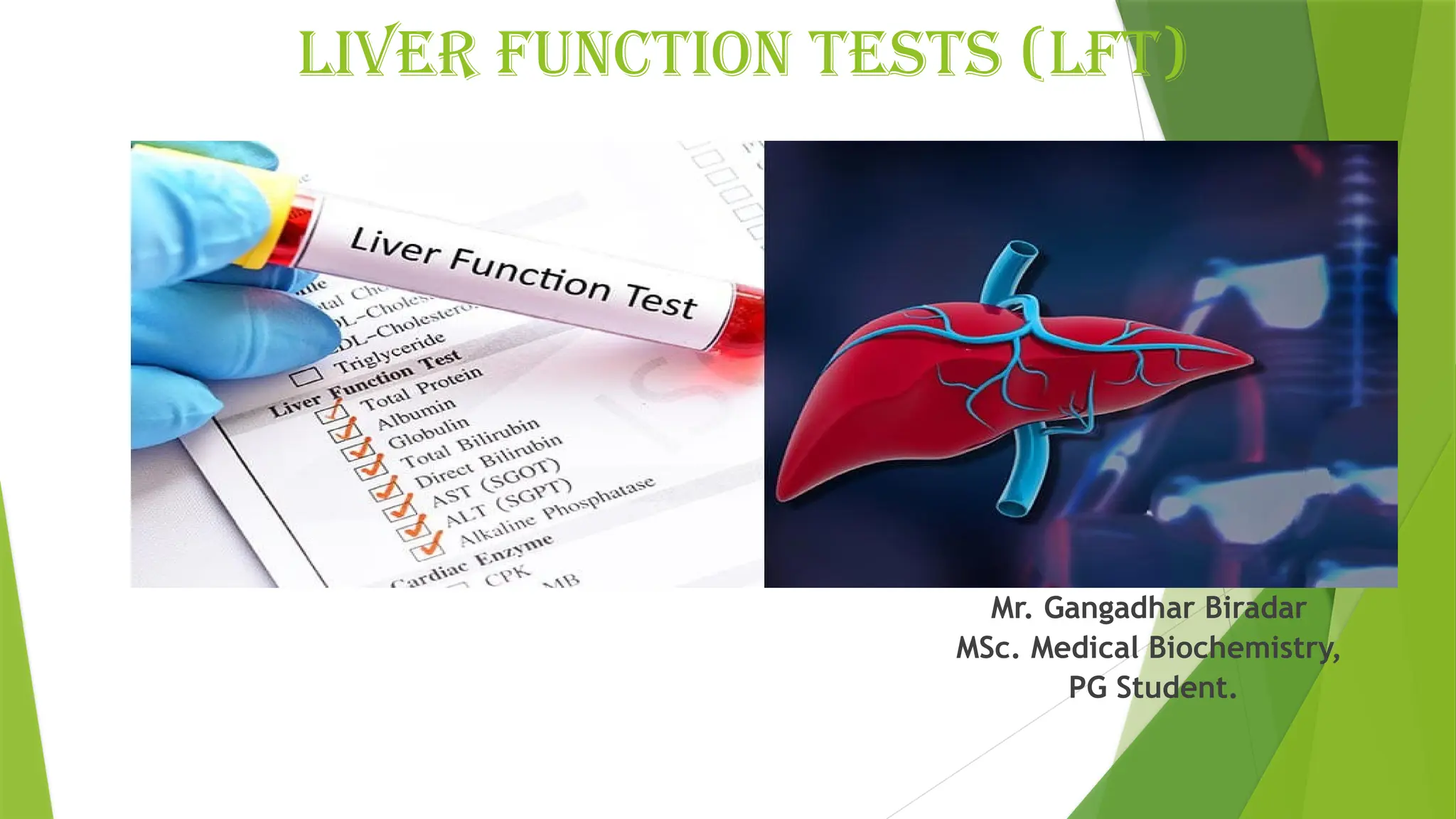
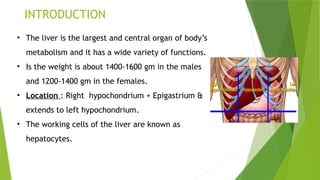
LIVER FUNCTION TESTS (LFT)
Mr. Gangadhar Biradar
MSc. Medical Biochemistry,
PG Student.
INTRODUCTION
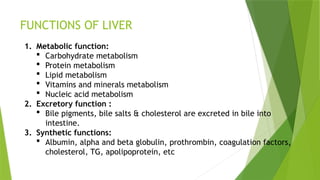
• The liver is the largest and central organ of body’s
metabolism and it has a wide variety of functions.
• Is the weight is about 1400-1600 gm in the males
and 1200-1400 gm in the females.
• Location : Right hypochondrium + Epigastrium &
extends to left hypochondrium.
• The working cells of the liver are known as
hepatocytes.
FUNCTIONS OF LIVER
1. Metabolic function:
 Carbohydrate metabolism
 Protein metabolism
 Lipid metabolism
 Vitamins and minerals metabolism
 Nucleic acid metabolism
2. Excretory function :
 Bile pigments, bile salts & cholesterol are excreted in bile into
intestine.
3. Synthetic functions:
 Albumin, alpha and beta globulin, prothrombin, coagulation factors,
cholesterol, TG, apolipoprotein, etc
4. Detoxicating function:
 Exogenous substances- drugs, toxic substances
 Endogenous substances-ammonia.
5. Storage function:
 Vitamin B12, A, D, K, glucose in the form of glycogen.
6. Protective function:
 Kupffer cells in the liver remove foreign bodies.
Why is LFT (liver function test) done?
• Detect presence of liver disease.
• To Detect the disease whether mild or
Severe.
• Distinguish among different types of liver
disease.
• Follow the response of treatment.
DIFFERENT TESTS TO ASSESS LIVER
FUNCTION
1) ABNORMALITIES OF PIGMENT METABOLISM :
• serum bilirubin and van den berg reaction
• urine bilirubin
• urine and faecal urobilinogen
2) TESTS BASED ON LIVER PART IN CARBOHYDRATES METABOLISM:
• Galactose tolerance test .
• Fructose tolerance test .
3) TESTS BASED ON CHANGE IN PLASMA PROTEINS:
• Estimation of total plasma proteins, albumin and globulin and
determination of A:G ratio .
• Determination of plasma fibrinogen.
• Prothrombin time.
3) TESTS BASED ON ABNORMALITIES OF LIPIDS :
• determination of serum cholesterol and the proportion
of free and ester cholesterol .
5) DETERMINATION OF SERUM ENZYME ACTIVITIES:
• aspartate transaminase (AST)
• alanine transaminase (ALT)
• alkaline phosphatase (ALP)
• 5-nucleotidese
• gamma glutamyl transferases (GGT)
• lactate dehydrogenase
6) TESTS BASED ON THE DETOXICATING FUNCTION OF
LIVER:
• Hippuric acid synthesis test .
7) TESTS BASED ON EXCRETORY FUNCTION OF LIVER:
• Bromosulpthalein test.
1. TESTS BASED ON ABNORMALITIES OF
BILE PIGMENT METABOLISM
►SERUM BILIRUBIN:
• bilirubin is excretory end product of heme degradation.
• conjugated by liver to form bilirubin diglucuronide and excreted
through bile.
 Normal conc. of serum bilirubin ----0.2 to 1.0mg/dl.
 Conjugated bilirubin--- 0.2 to 0.4mg/dl.
 Unconjugated bilirubin--- 0.2 to 0.8mg/dl .
elevated serum bilirubin level, usually beyond 2 mg/dl (normal <1 mg/dl)
causes JAUNDICE is indicate a number of problems.
Van den Bergh Test for Bilirubin
• It is a specific test for identification of increased serum bilirubin levels.
 Mechanism of the reaction:
Van den Bergh reagent is a mixture of equal volumes of sulfanilic acid &
sodium nitrite.
► Principle : Diazotised sulfanilic acid reacts with bilirubin to form a purple
coloured azobilirubin.
There are three possible responses:
1. A direct positive reaction-given by conjugated bilirubin
2. An indirect positive reaction- given by unconjugated bilirubin
3. A biphasic reaction- elevation of both conjugated and unconjugated
bilirubin
 Normal serum gives a negative VD Berg reaction.
Urinary Bilirubin
o Normally bilirubin is absent in urine.
• Bilirubin is found in the urine in obstructive jaundice(detected by
Fouchet's test). as unconjugated bilirubin is carried in plasma attached
to albumin, hence it can not pass through the glomerular
filter(Bilirubinuria is always accompanied with direct VD Bergh
reaction).
Urinary and Faecal Urobilinogen
 Faecal urobilinogen:
• Normal=50-250mg/day.
• Increased in hemolytic jaundice-dark coloured stool is passed.
• Decreased or absent if there is obstruction to the flow of bile in
obstructive jaundice-clay-coloured faeces is passed.
• A complete absence of faecal urobilinogen is strongly suggestive of
malignant obstruction
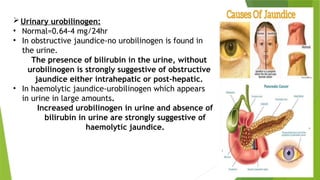
Urinary urobilinogen:
• Normal=0.64-4 mg/24hr
• In obstructive jaundice-no urobilinogen is found in
the urine.
The presence of bilirubin in the urine, without
urobilinogen is strongly suggestive of obstructive
jaundice either intrahepatic or post-hepatic.
• In haemolytic jaundice-urobilinogen which appears
in urine in large amounts.
Increased urobilinogen in urine and absence of
bilirubin in urine are strongly suggestive of
haemolytic jaundice.
2. TESTS BASED ON LIVER PART IN
CARBOHYDRATES METABOLISM:
 GALACTOSE TOLERANCE TEST:
• Galactose is monosaccharide exclusively metabolized by the
liver.
• The liver function can be assessed by measuring the
utilization of galactose.
• The normal liver is able to convert galactose into glucose ;
but this function is impaired in intrahepatic disease and
the amount of blood galactose and galactose in urine is
excessive.
• Half life of galactose is about 10-15mins. this is markedly
increased in hepatocellular damage (cirrhosis, infective
hepatitis)
3. DETERMINATION OF TOTAL PLASMA PROTEIN
ALBUMIN, GLOBULIN & A.G RATIO
Normal Ranges:
Total protein : 6-8gm/dl
Albumin : 3.5-
5gm/dl
Globulin : 2.5-
3.5gm/dl
A/G ratio : 1.5:2.5
In infectious
hepatitis
• Quantitative estimations of albumin and
globulin may give normal results in the
early stages.
• Qualitative changes may be present, in
early stage rise in B-globulins and in later
stages y-globulins show rise.
In obstructive
jaundice
• Normal values are the rule, as long as
the obstructive jaundice is not
associated with accompanying liver
cell damage.
In advanced
parenchymal liver
diseases and in
cirrhosis liver
• The albumin is grossly decreased and
the globulins are often increased, so
that A:G ratio is reversed.
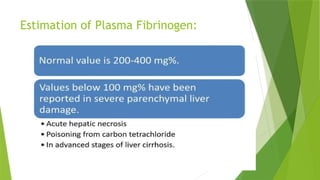
Estimation of Plasma Fibrinogen:
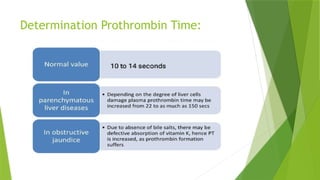
Determination Prothrombin Time:
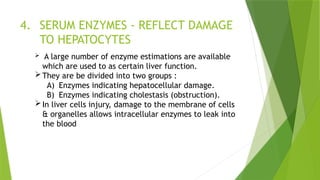
4. SERUM ENZYMES - REFLECT DAMAGE
TO HEPATOCYTES
 A large number of enzyme estimations are available
which are used to as certain liver function.
They are be divided into two groups :
A) Enzymes indicating hepatocellular damage.
B) Enzymes indicating cholestasis (obstruction).
In liver cells injury, damage to the membrane of cells
& organelles allows intracellular enzymes to leak into
the blood
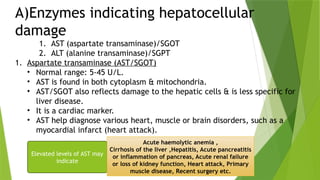
A)Enzymes indicating hepatocellular
damage
1. AST (aspartate transaminase)/SGOT
2. ALT (alanine transaminase)/SGPT
1. Aspartate transaminase (AST/SGOT)
• Normal range: 5-45 U/L.
• AST is found in both cytoplasm & mitochondria.
• AST/SGOT also reflects damage to the hepatic cells & is less specific for
liver disease.
• It is a cardiac marker.
• AST help diagnose various heart, muscle or brain disorders, such as a
myocardial infarct (heart attack).
Elevated levels of AST may
indicate
Acute haemolytic anemia ,
Cirrhosis of the liver ,Hepatitis, Acute pancreatitis
or inflammation of pancreas, Acute renal failure
or loss of kidney function, Heart attack, Primary
muscle disease, Recent surgery etc.
2. Alanine transaminase (ALT/SGPT)
• Normal Range: 5-40 U/L.
• ALT is a cytoplasmic enzyme.
• The activity of these enzymes is low in normal serum.
• ALT is specific for liver disease.
• It's elevations favor liver cell necrosis as a cholestasis.
Elevated levels of
ALT/SGPT may indicate
Alcoholic liver disease, Cancer of liver, Hepatitis
or inflammation of the liver, Noncancerous tumor
of the liver ,Use of medicines or drugs toxic to the
liver, Cirrhosis or scarring of the liver, Death of
liver tissue.etc.
B) Enzymes indicating cholestasis
1) Alkaline Phosphatase (ALP)
2) Gama-Glutamyl transpeptidase (GGT)
• Normal Range : ALP = 3-13 KA unit/L and GGT= 10-15 U/L
 Increased levels are seen in:
• Infiltrating diseases of liver
• Bile duct obstruction due to gall stones or carcinoma head
of pancreas.
5. 5'-Nucleotidase
• Normal range: 2-15 U/L
• The serum activity of 5'-nucleotidase is elevated in
hepatobiliary disease & this parallels ALP.
• It is highest in post-hepatic obstructive jaundice.
• The 5'-nucleotidase is normal in patients with bone disease
where as serum ALP increased.
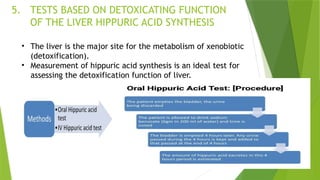
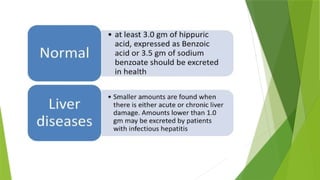
5. TESTS BASED ON DETOXICATING FUNCTION
OF THE LIVER HIPPURIC ACID SYNTHESIS
• The liver is the major site for the metabolism of xenobiotic
(detoxification).
• Measurement of hippuric acid synthesis is an ideal test for
assessing the detoxification function of liver.
6. DETERMINATION OF BIOOD AMMONIA
• The major source of ammonia(NH3) in blood is bacteria
of gastrointestinal tract(GIT).
• Ammonia is later converted to urea by the liver then it is
excreted by kidneys .
• This test used for detecting hepatic encephalopathy.
• Normally, blood ammonia varies from 40-75µg/dl of
blood.
• Increased in ammonia in blood is found in cases of
cirrhosis of liver.
• In liver damage, blood ammonia levels may be >200µg/dl
LIVER FUNCTION TESTS (LFT) G. Biradar.pptxbajajaahah

LIVER FUNCTION TESTS (LFT) G. Biradar.pptxbajajaahah

  • 1.
    LIVER FUNCTION TESTS(LFT) Mr. Gangadhar Biradar MSc. Medical Biochemistry, PG Student.
  • 2.
    INTRODUCTION • The liveris the largest and central organ of body’s metabolism and it has a wide variety of functions. • Is the weight is about 1400-1600 gm in the males and 1200-1400 gm in the females. • Location : Right hypochondrium + Epigastrium & extends to left hypochondrium. • The working cells of the liver are known as hepatocytes.
  • 3.
    FUNCTIONS OF LIVER 1.Metabolic function:  Carbohydrate metabolism  Protein metabolism  Lipid metabolism  Vitamins and minerals metabolism  Nucleic acid metabolism 2. Excretory function :  Bile pigments, bile salts & cholesterol are excreted in bile into intestine. 3. Synthetic functions:  Albumin, alpha and beta globulin, prothrombin, coagulation factors, cholesterol, TG, apolipoprotein, etc
  • 4.
    4. Detoxicating function: Exogenous substances- drugs, toxic substances  Endogenous substances-ammonia. 5. Storage function:  Vitamin B12, A, D, K, glucose in the form of glycogen. 6. Protective function:  Kupffer cells in the liver remove foreign bodies.
  • 5.
    Why is LFT(liver function test) done? • Detect presence of liver disease. • To Detect the disease whether mild or Severe. • Distinguish among different types of liver disease. • Follow the response of treatment.
  • 6.
    DIFFERENT TESTS TOASSESS LIVER FUNCTION 1) ABNORMALITIES OF PIGMENT METABOLISM : • serum bilirubin and van den berg reaction • urine bilirubin • urine and faecal urobilinogen 2) TESTS BASED ON LIVER PART IN CARBOHYDRATES METABOLISM: • Galactose tolerance test . • Fructose tolerance test . 3) TESTS BASED ON CHANGE IN PLASMA PROTEINS: • Estimation of total plasma proteins, albumin and globulin and determination of A:G ratio . • Determination of plasma fibrinogen. • Prothrombin time.
  • 7.
    3) TESTS BASEDON ABNORMALITIES OF LIPIDS : • determination of serum cholesterol and the proportion of free and ester cholesterol . 5) DETERMINATION OF SERUM ENZYME ACTIVITIES: • aspartate transaminase (AST) • alanine transaminase (ALT) • alkaline phosphatase (ALP) • 5-nucleotidese • gamma glutamyl transferases (GGT) • lactate dehydrogenase 6) TESTS BASED ON THE DETOXICATING FUNCTION OF LIVER: • Hippuric acid synthesis test . 7) TESTS BASED ON EXCRETORY FUNCTION OF LIVER: • Bromosulpthalein test.
  • 8.
    1. TESTS BASEDON ABNORMALITIES OF BILE PIGMENT METABOLISM ►SERUM BILIRUBIN: • bilirubin is excretory end product of heme degradation. • conjugated by liver to form bilirubin diglucuronide and excreted through bile.  Normal conc. of serum bilirubin ----0.2 to 1.0mg/dl.  Conjugated bilirubin--- 0.2 to 0.4mg/dl.  Unconjugated bilirubin--- 0.2 to 0.8mg/dl . elevated serum bilirubin level, usually beyond 2 mg/dl (normal <1 mg/dl) causes JAUNDICE is indicate a number of problems.
  • 9.
    Van den BerghTest for Bilirubin • It is a specific test for identification of increased serum bilirubin levels.  Mechanism of the reaction: Van den Bergh reagent is a mixture of equal volumes of sulfanilic acid & sodium nitrite. ► Principle : Diazotised sulfanilic acid reacts with bilirubin to form a purple coloured azobilirubin. There are three possible responses: 1. A direct positive reaction-given by conjugated bilirubin 2. An indirect positive reaction- given by unconjugated bilirubin 3. A biphasic reaction- elevation of both conjugated and unconjugated bilirubin  Normal serum gives a negative VD Berg reaction.
  • 10.
    Urinary Bilirubin o Normallybilirubin is absent in urine. • Bilirubin is found in the urine in obstructive jaundice(detected by Fouchet's test). as unconjugated bilirubin is carried in plasma attached to albumin, hence it can not pass through the glomerular filter(Bilirubinuria is always accompanied with direct VD Bergh reaction). Urinary and Faecal Urobilinogen  Faecal urobilinogen: • Normal=50-250mg/day. • Increased in hemolytic jaundice-dark coloured stool is passed. • Decreased or absent if there is obstruction to the flow of bile in obstructive jaundice-clay-coloured faeces is passed. • A complete absence of faecal urobilinogen is strongly suggestive of malignant obstruction
  • 11.
    Urinary urobilinogen: • Normal=0.64-4mg/24hr • In obstructive jaundice-no urobilinogen is found in the urine. The presence of bilirubin in the urine, without urobilinogen is strongly suggestive of obstructive jaundice either intrahepatic or post-hepatic. • In haemolytic jaundice-urobilinogen which appears in urine in large amounts. Increased urobilinogen in urine and absence of bilirubin in urine are strongly suggestive of haemolytic jaundice.
  • 12.
    2. TESTS BASEDON LIVER PART IN CARBOHYDRATES METABOLISM:  GALACTOSE TOLERANCE TEST: • Galactose is monosaccharide exclusively metabolized by the liver. • The liver function can be assessed by measuring the utilization of galactose. • The normal liver is able to convert galactose into glucose ; but this function is impaired in intrahepatic disease and the amount of blood galactose and galactose in urine is excessive. • Half life of galactose is about 10-15mins. this is markedly increased in hepatocellular damage (cirrhosis, infective hepatitis)
  • 13.
    3. DETERMINATION OFTOTAL PLASMA PROTEIN ALBUMIN, GLOBULIN & A.G RATIO Normal Ranges: Total protein : 6-8gm/dl Albumin : 3.5- 5gm/dl Globulin : 2.5- 3.5gm/dl A/G ratio : 1.5:2.5 In infectious hepatitis • Quantitative estimations of albumin and globulin may give normal results in the early stages. • Qualitative changes may be present, in early stage rise in B-globulins and in later stages y-globulins show rise. In obstructive jaundice • Normal values are the rule, as long as the obstructive jaundice is not associated with accompanying liver cell damage. In advanced parenchymal liver diseases and in cirrhosis liver • The albumin is grossly decreased and the globulins are often increased, so that A:G ratio is reversed.
  • 14.
  • 15.
  • 16.
    4. SERUM ENZYMES- REFLECT DAMAGE TO HEPATOCYTES  A large number of enzyme estimations are available which are used to as certain liver function. They are be divided into two groups : A) Enzymes indicating hepatocellular damage. B) Enzymes indicating cholestasis (obstruction). In liver cells injury, damage to the membrane of cells & organelles allows intracellular enzymes to leak into the blood
  • 17.
    A)Enzymes indicating hepatocellular damage 1.AST (aspartate transaminase)/SGOT 2. ALT (alanine transaminase)/SGPT 1. Aspartate transaminase (AST/SGOT) • Normal range: 5-45 U/L. • AST is found in both cytoplasm & mitochondria. • AST/SGOT also reflects damage to the hepatic cells & is less specific for liver disease. • It is a cardiac marker. • AST help diagnose various heart, muscle or brain disorders, such as a myocardial infarct (heart attack). Elevated levels of AST may indicate Acute haemolytic anemia , Cirrhosis of the liver ,Hepatitis, Acute pancreatitis or inflammation of pancreas, Acute renal failure or loss of kidney function, Heart attack, Primary muscle disease, Recent surgery etc.
  • 18.
    2. Alanine transaminase(ALT/SGPT) • Normal Range: 5-40 U/L. • ALT is a cytoplasmic enzyme. • The activity of these enzymes is low in normal serum. • ALT is specific for liver disease. • It's elevations favor liver cell necrosis as a cholestasis. Elevated levels of ALT/SGPT may indicate Alcoholic liver disease, Cancer of liver, Hepatitis or inflammation of the liver, Noncancerous tumor of the liver ,Use of medicines or drugs toxic to the liver, Cirrhosis or scarring of the liver, Death of liver tissue.etc.
  • 19.
    B) Enzymes indicatingcholestasis 1) Alkaline Phosphatase (ALP) 2) Gama-Glutamyl transpeptidase (GGT) • Normal Range : ALP = 3-13 KA unit/L and GGT= 10-15 U/L  Increased levels are seen in: • Infiltrating diseases of liver • Bile duct obstruction due to gall stones or carcinoma head of pancreas.
  • 20.
    5. 5'-Nucleotidase • Normalrange: 2-15 U/L • The serum activity of 5'-nucleotidase is elevated in hepatobiliary disease & this parallels ALP. • It is highest in post-hepatic obstructive jaundice. • The 5'-nucleotidase is normal in patients with bone disease where as serum ALP increased.
  • 21.
    5. TESTS BASEDON DETOXICATING FUNCTION OF THE LIVER HIPPURIC ACID SYNTHESIS • The liver is the major site for the metabolism of xenobiotic (detoxification). • Measurement of hippuric acid synthesis is an ideal test for assessing the detoxification function of liver.
  • 23.
    6. DETERMINATION OFBIOOD AMMONIA • The major source of ammonia(NH3) in blood is bacteria of gastrointestinal tract(GIT). • Ammonia is later converted to urea by the liver then it is excreted by kidneys . • This test used for detecting hepatic encephalopathy. • Normally, blood ammonia varies from 40-75µg/dl of blood. • Increased in ammonia in blood is found in cases of cirrhosis of liver. • In liver damage, blood ammonia levels may be >200µg/dl