Prepared by: Erika Panganiban
Mythological
and
Archetypal
Approaches
Joseph Campbell
Myth critic is concerned:
to seek out those mysterious elements that inform
certain literary works and that elicit, with almost
uncanny force, dramatic and universal human reactions
to discover how certain works of literature give
readers a perennial response
Joseph Campbell
Mythology tends to be speculative and
philosophical.
Its affinities are with religion, anthropology, and
cultural history.
Myths are merely primitive fictions, illusions, or
opinions based upon false reasoning.
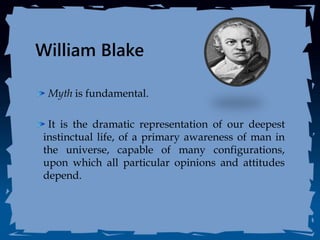
William Blake
Myth is fundamental.
It is the dramatic representation of our deepest
instinctual life, of a primary awareness of man in
the universe, capable of many configurations,
upon which all particular opinions and attitudes
depend.
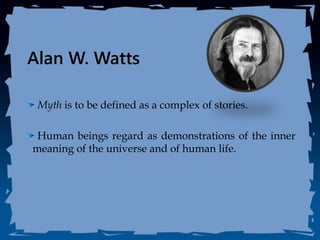
Alan W. Watts
Myth is to be defined as a complex of stories.
Human beings regard as demonstrations of the inner
meaning of the universe and of human life.
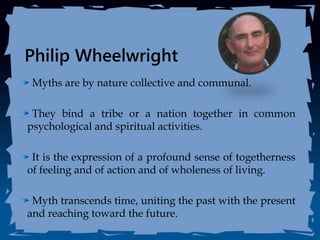
Philip Wheelwright
Myths are by nature collective and communal.
They bind a tribe or a nation together in common
psychological and spiritual activities.
It is the expression of a profound sense of togetherness
of feeling and of action and of wholeness of living.
Myth transcends time, uniting the past with the present
and reaching toward the future.
Archetypes
Motifs
Images
A. Water – mystery of creation; fertility and growth;
purification and redemption; birth-death-
resurrection
Sea – mother of all life
Rivers – death and rebirth, phases of life cycle
B. Sun – creative energy, father principle
Rising sun – birth, creation, enlightenment
Setting sun – death
C. Colors
Red – blood, sacrifice
Green – growth, fertility, death, decay
Blue – religious feeling, highly positive
Black – darkness, chaos, mystery
White – purity, innocence light
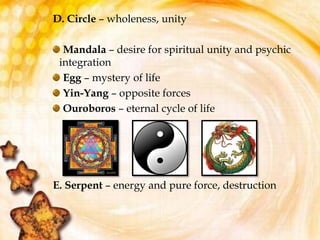
D. Circle – wholeness, unity
Mandala – desire for spiritual unity and psychic
integration
Egg – mystery of life
Yin-Yang – opposite forces
Ouroboros – eternal cycle of life
E. Serpent – energy and pure force, destruction
F. Numbers
Three – male principle
Four – nature
Five – integration
Seven – union of three and four, perfect cycle
G. Archetypal Woman
Good mother – nourishment, protection
Terrible mother – witch, sorceress
Soul mate – princess or beautiful lady, inspiration
H. Demon lover – Satan, Dracula
I. Wise old man – wisdom, cleverness
J. Trickster – joker, clown, fool
K. Garden – paradise, unspoiled beauty
L. Tree – growth, inexhaustible life
M. Desert – hopelessness, death
N. Mountain – aspiration and inspiration
1. Creation
– most fundamental; humankind were brought
into existence by some supernatural being
2. Immortality
Escape from time – return to paradise; the
state of perfect, timeless bliss enjoyed by man
and woman
Mystical submersion into cyclical time
– endless death and regeneration
(e.g To His Coy Mistress)
3. Hero Archetypes
The quest – the hero undertakes some long
journey during which he must perform
impossible tasks
Initiation – the hero undergoes a series of
excruciating ordeals in passing from
ignorance and immaturity to social and
spiritual adulthood
(three phases: separation, transformation,
return)
The sacrificial scapegoat – the hero, with whom
the welfare of tribe is identified
(e.g Hamlet, Oedipus)
Northrop Frye
the mythos of spring: comedy
the mythos of summer: romance
the mythos of fall: tragedy
the mythos of winter: irony
Carl Jung
Archetypes reveal themselves in the dreams of
individuals.
Dreams are personalized myths and myths are
depersonalized dreams.
Carl Jung
Individuation – a psychological growing up
- the process of recognition
(e.g Frankenstein, Young Good Man Brown)
Archetypes:
1. Shadow – darker side of our unconscious self
2. Anima – “soul-image”
3. Persona – actor’s mask that we show to the world
Archetypal Characters
(e.g the scapegoat)
Archetypal Situations
(e.g colors)
Archetypal Images
(e.g the quest)

Mythological and Archetypal Approaches

  • 1.
    Prepared by: ErikaPanganiban Mythological and Archetypal Approaches
  • 2.
    Joseph Campbell Myth criticis concerned: to seek out those mysterious elements that inform certain literary works and that elicit, with almost uncanny force, dramatic and universal human reactions to discover how certain works of literature give readers a perennial response
  • 3.
    Joseph Campbell Mythology tendsto be speculative and philosophical. Its affinities are with religion, anthropology, and cultural history. Myths are merely primitive fictions, illusions, or opinions based upon false reasoning.
  • 4.
    William Blake Myth isfundamental. It is the dramatic representation of our deepest instinctual life, of a primary awareness of man in the universe, capable of many configurations, upon which all particular opinions and attitudes depend.
  • 5.
    Alan W. Watts Mythis to be defined as a complex of stories. Human beings regard as demonstrations of the inner meaning of the universe and of human life.
  • 6.
    Philip Wheelwright Myths areby nature collective and communal. They bind a tribe or a nation together in common psychological and spiritual activities. It is the expression of a profound sense of togetherness of feeling and of action and of wholeness of living. Myth transcends time, uniting the past with the present and reaching toward the future.
  • 7.
  • 8.
    A. Water –mystery of creation; fertility and growth; purification and redemption; birth-death- resurrection Sea – mother of all life Rivers – death and rebirth, phases of life cycle B. Sun – creative energy, father principle Rising sun – birth, creation, enlightenment Setting sun – death
  • 9.
    C. Colors Red –blood, sacrifice Green – growth, fertility, death, decay Blue – religious feeling, highly positive Black – darkness, chaos, mystery White – purity, innocence light
  • 10.
    D. Circle –wholeness, unity Mandala – desire for spiritual unity and psychic integration Egg – mystery of life Yin-Yang – opposite forces Ouroboros – eternal cycle of life E. Serpent – energy and pure force, destruction
  • 11.
    F. Numbers Three –male principle Four – nature Five – integration Seven – union of three and four, perfect cycle G. Archetypal Woman Good mother – nourishment, protection Terrible mother – witch, sorceress Soul mate – princess or beautiful lady, inspiration
  • 12.
    H. Demon lover– Satan, Dracula I. Wise old man – wisdom, cleverness J. Trickster – joker, clown, fool K. Garden – paradise, unspoiled beauty L. Tree – growth, inexhaustible life M. Desert – hopelessness, death N. Mountain – aspiration and inspiration
  • 13.
    1. Creation – mostfundamental; humankind were brought into existence by some supernatural being 2. Immortality Escape from time – return to paradise; the state of perfect, timeless bliss enjoyed by man and woman Mystical submersion into cyclical time – endless death and regeneration (e.g To His Coy Mistress)
  • 14.
    3. Hero Archetypes Thequest – the hero undertakes some long journey during which he must perform impossible tasks Initiation – the hero undergoes a series of excruciating ordeals in passing from ignorance and immaturity to social and spiritual adulthood (three phases: separation, transformation, return) The sacrificial scapegoat – the hero, with whom the welfare of tribe is identified (e.g Hamlet, Oedipus)
  • 15.
    Northrop Frye the mythosof spring: comedy the mythos of summer: romance the mythos of fall: tragedy the mythos of winter: irony
  • 16.
    Carl Jung Archetypes revealthemselves in the dreams of individuals. Dreams are personalized myths and myths are depersonalized dreams.
  • 17.
    Carl Jung Individuation –a psychological growing up - the process of recognition (e.g Frankenstein, Young Good Man Brown) Archetypes: 1. Shadow – darker side of our unconscious self 2. Anima – “soul-image” 3. Persona – actor’s mask that we show to the world
  • 18.
    Archetypal Characters (e.g thescapegoat) Archetypal Situations (e.g colors) Archetypal Images (e.g the quest)