The Wonderful World of Literary Theory: Shine a Light on Literature
The Modes  (well, the major ones… the ones you should know) Reader Response Formalist Deconstructionist Psychological Gender (Feminist, Queer Theory) Historical Biographical Cultural Mythological Sociological
Myriad Approaches Important: No single theory is necessarily correct or true above any other Critical approaches usually derive from personal discretion or applicability Some approaches naturally lend themselves to particular works
For example… Any work by Hemingway would naturally lend itself to a biographical approach
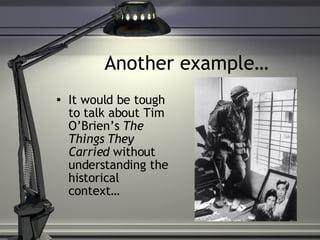
Another example… It would be tough to talk about Tim O’Brien’s  The Things They Carried  without understanding the historical context…
Reader Response Theory Attempts to describe what happens in a person’s mind when interpreting a text Recognizes plurality of texts Explores contradictions inherent in the problem this approach presents
Formalist Criticism Regards literature as a unique form of human knowledge to be regarded in its own terms Apart from or above biographical, social, historical, or cultural influences Literature is understood through its intrinsic literary features TEXT-CENTERED: focus on words
Formalist cont’d… “ Close Reading” Focus on intense relationships in a work Form and content cannot be meaningfully separated Interdependence of form and content make a text literary
Biographical Criticism Considers that literature is written by actual people Understanding of author’s life helps comprehend the work Author’s experience SHAPES the creation of the work Practical advantage: illuminates text Be judicious--base interpretation on what is in the text itself (Cheever, Plath, Fitzgerald examples)
Historical Criticism Investigation of social, cultural, and intellectual contexts that produced the work Necessarily includes author’s biography and  milieu Impact and meaning on original audience (as opposed to today’s) How a text’s meaning has changed over time Connotations of words, images (1940, America)
Psychological Criticism Owes much to the work of Sigmund Freud Analysis of Oedipus--considered Sophocles’ insight into human mind influential Painful memories (esp. from childhood) repressed, stored in subconscious Freud and followers (including Carl Jung) believed that great literature truthfully reflects life
Psychological cont’d… Three approaches 1. Creative process of the arts What is genius and how is it related to mental functions? How does a work impact the mind of the reader? Psychological study of artist Analysis of fictional characters Freud’s analysis of Oedipus is the prototype Attempt to apply modern insights to fictional people All psych criticism seeks to DELVE
Mythological Criticism Seeks recurrent universal patterns Combines insights of many disciplines: Anthropology Psychology History Comparative religion
Mythological cont’d… Explores artist’s common humanity (as opposed to individual emphasis in pysch. crit.) THE ARCHETYPE  A symbol, character, situation, or image that evokes a deep universal response Carl Jung (Swiss psychologist)--lifetime student of myth and religion “ collective unconscious” Set of primal memories common to the human race (existing below conscious mind) Archetypal images (like sun, moon, fire, night, blood) trigger the “c.u.” Important to link text to other texts with similar or related archetypal situations
Sociological Criticism Examines literature in the cultural, economic, and political context in which it is written or received Art not created in a vacuum Relationship between author and society Social status of author Social content of a work (values presented) Role of audience in shaping literature
Sociological cont’d… Marxist criticism Economic and political elements of art Explores ideological content of literature Content determines form; therefore all art is political DANGER: imposing critic’s politics on work in question can sway evaluation based on how closely (or not) the work endorses ideology VALUE: illuminates political and economic dimensions of literature that other approaches may overlook
Gender Criticism Examines how sexual identity influences the creation and reception of literary works Began with feminist movement Influenced by sociology, psychology, and anthropology Feminist critics see a world saturated with “male-produced” assumptions Seek to correct imbalance by battling patriarchal attitudes
Gender cont’d… Feminist criticism analyzes how an author’s gender influences ideas Also, how sexual identity influences reader Reader sees text through eyes of his or her sex Examination of social forces responsible for gender inequality
Gender cont’d… Gender criticism expands beyond original feminist perspective Different sexual orientations Men’s movement Not rejection of feminism, but a contemporary rediscovery of masculinity
Deconstructionist Criticism Rejects traditional assumption that language can accurately represent reality Language fundamentally unstable Literary texts, therefore, have no fixed meaning “ Signs” cannot coincide with what is “signified” i.e., the actual expression ≠ what’s being expressed
Deconstructionist cont’d.. Attention shifts from  what  is being said to  how  language is being used in a text Paradox: Deconstructionist criticism often resembles formalist Both involve close reading BUT: decon. critics break text down into mutually irreconcilable positions
Deconstructionist cont’d.. REJECTION of myth that authors control language Roland Barthes and Michel Foucault call for the “death of the author” No author, no matter how brilliant, can fully control the meaning of a text They have also called for death of literature as a special category of writing Merely words on a page; all texts equally untrustworthy Therefore, literature deserves no status as art No truths; only rival interpretations
Cultural Studies Relatively recent interdisciplinary field of academic study (not solely associated with literary texts) Not a study of fixed, aesthetic objects, but of DYNAMIC SOCIAL PROCESSES Challenge: to identify and understand the complex forms and effects of the process of culture
Cultural Studies cont’d… DEEPLY anti-formalist Investigates complex relationship among history, politics, and literature Rejects notion that literature exists in an aesthetic realm separate from ethical and political categories A political enterprise that views literary analysis as a means of furthering social justice Commitment to examining issues of race, class, and gender as well as “shifting” the canon
Credits Kennedy, X.J. and Gioia, D., eds.  Literature: An Introduction to Fiction, Poetry, and Drama .  Eighth edition. New York: Longman, 2002. All images courtesy of Google Images
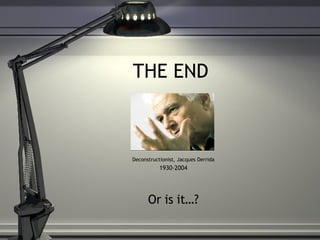
THE END Deconstructionist, Jacques Derrida 1930-2004 Or is it…?

Literary Theory: Crash Course

  • 1.
    The Wonderful Worldof Literary Theory: Shine a Light on Literature
  • 2.
    The Modes (well, the major ones… the ones you should know) Reader Response Formalist Deconstructionist Psychological Gender (Feminist, Queer Theory) Historical Biographical Cultural Mythological Sociological
  • 3.
    Myriad Approaches Important:No single theory is necessarily correct or true above any other Critical approaches usually derive from personal discretion or applicability Some approaches naturally lend themselves to particular works
  • 4.
    For example… Anywork by Hemingway would naturally lend itself to a biographical approach
  • 5.
    Another example… Itwould be tough to talk about Tim O’Brien’s The Things They Carried without understanding the historical context…
  • 6.
    Reader Response TheoryAttempts to describe what happens in a person’s mind when interpreting a text Recognizes plurality of texts Explores contradictions inherent in the problem this approach presents
  • 7.
    Formalist Criticism Regardsliterature as a unique form of human knowledge to be regarded in its own terms Apart from or above biographical, social, historical, or cultural influences Literature is understood through its intrinsic literary features TEXT-CENTERED: focus on words
  • 8.
    Formalist cont’d… “Close Reading” Focus on intense relationships in a work Form and content cannot be meaningfully separated Interdependence of form and content make a text literary
  • 9.
    Biographical Criticism Considersthat literature is written by actual people Understanding of author’s life helps comprehend the work Author’s experience SHAPES the creation of the work Practical advantage: illuminates text Be judicious--base interpretation on what is in the text itself (Cheever, Plath, Fitzgerald examples)
  • 10.
    Historical Criticism Investigationof social, cultural, and intellectual contexts that produced the work Necessarily includes author’s biography and milieu Impact and meaning on original audience (as opposed to today’s) How a text’s meaning has changed over time Connotations of words, images (1940, America)
  • 11.
    Psychological Criticism Owesmuch to the work of Sigmund Freud Analysis of Oedipus--considered Sophocles’ insight into human mind influential Painful memories (esp. from childhood) repressed, stored in subconscious Freud and followers (including Carl Jung) believed that great literature truthfully reflects life
  • 12.
    Psychological cont’d… Threeapproaches 1. Creative process of the arts What is genius and how is it related to mental functions? How does a work impact the mind of the reader? Psychological study of artist Analysis of fictional characters Freud’s analysis of Oedipus is the prototype Attempt to apply modern insights to fictional people All psych criticism seeks to DELVE
  • 13.
    Mythological Criticism Seeksrecurrent universal patterns Combines insights of many disciplines: Anthropology Psychology History Comparative religion
  • 14.
    Mythological cont’d… Exploresartist’s common humanity (as opposed to individual emphasis in pysch. crit.) THE ARCHETYPE A symbol, character, situation, or image that evokes a deep universal response Carl Jung (Swiss psychologist)--lifetime student of myth and religion “ collective unconscious” Set of primal memories common to the human race (existing below conscious mind) Archetypal images (like sun, moon, fire, night, blood) trigger the “c.u.” Important to link text to other texts with similar or related archetypal situations
  • 15.
    Sociological Criticism Examinesliterature in the cultural, economic, and political context in which it is written or received Art not created in a vacuum Relationship between author and society Social status of author Social content of a work (values presented) Role of audience in shaping literature
  • 16.
    Sociological cont’d… Marxistcriticism Economic and political elements of art Explores ideological content of literature Content determines form; therefore all art is political DANGER: imposing critic’s politics on work in question can sway evaluation based on how closely (or not) the work endorses ideology VALUE: illuminates political and economic dimensions of literature that other approaches may overlook
  • 17.
    Gender Criticism Examineshow sexual identity influences the creation and reception of literary works Began with feminist movement Influenced by sociology, psychology, and anthropology Feminist critics see a world saturated with “male-produced” assumptions Seek to correct imbalance by battling patriarchal attitudes
  • 18.
    Gender cont’d… Feministcriticism analyzes how an author’s gender influences ideas Also, how sexual identity influences reader Reader sees text through eyes of his or her sex Examination of social forces responsible for gender inequality
  • 19.
    Gender cont’d… Gendercriticism expands beyond original feminist perspective Different sexual orientations Men’s movement Not rejection of feminism, but a contemporary rediscovery of masculinity
  • 20.
    Deconstructionist Criticism Rejectstraditional assumption that language can accurately represent reality Language fundamentally unstable Literary texts, therefore, have no fixed meaning “ Signs” cannot coincide with what is “signified” i.e., the actual expression ≠ what’s being expressed
  • 21.
    Deconstructionist cont’d.. Attentionshifts from what is being said to how language is being used in a text Paradox: Deconstructionist criticism often resembles formalist Both involve close reading BUT: decon. critics break text down into mutually irreconcilable positions
  • 22.
    Deconstructionist cont’d.. REJECTIONof myth that authors control language Roland Barthes and Michel Foucault call for the “death of the author” No author, no matter how brilliant, can fully control the meaning of a text They have also called for death of literature as a special category of writing Merely words on a page; all texts equally untrustworthy Therefore, literature deserves no status as art No truths; only rival interpretations
  • 23.
    Cultural Studies Relativelyrecent interdisciplinary field of academic study (not solely associated with literary texts) Not a study of fixed, aesthetic objects, but of DYNAMIC SOCIAL PROCESSES Challenge: to identify and understand the complex forms and effects of the process of culture
  • 24.
    Cultural Studies cont’d…DEEPLY anti-formalist Investigates complex relationship among history, politics, and literature Rejects notion that literature exists in an aesthetic realm separate from ethical and political categories A political enterprise that views literary analysis as a means of furthering social justice Commitment to examining issues of race, class, and gender as well as “shifting” the canon
  • 25.
    Credits Kennedy, X.J.and Gioia, D., eds. Literature: An Introduction to Fiction, Poetry, and Drama . Eighth edition. New York: Longman, 2002. All images courtesy of Google Images
  • 26.
    THE END Deconstructionist,Jacques Derrida 1930-2004 Or is it…?