Introduction to Literary
Criticism
Definition and Use
 “Literary criticism” is the name given to
works written by experts who critique—
analyze—an author’s work.
 It does NOT mean “to criticize” as in
complain or disapprove.
 Literary criticism is often referred to as a
“secondary source”.
Definition and Use
 Literary criticism is often referred to as a
“secondary source”, because it is used to
analyze your primary work—the work or
text (novel) you are reading.
 Literary criticism is used by people who
want to use an expert’s opinion to
support their own ideas.
Definition and Use
 Remember, literary criticism is used by
readers to analyze, NOT by authors to
write.
 Therefore, when you begin to analyze
your novel, you’ll make use of expert,
reliable literary criticism to support your
opinion—your thesis—which you will
develop for your paper.
Literary Criticism and Theory
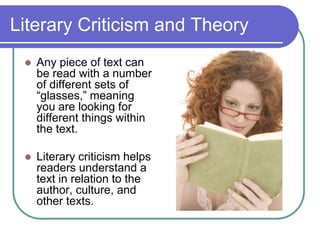
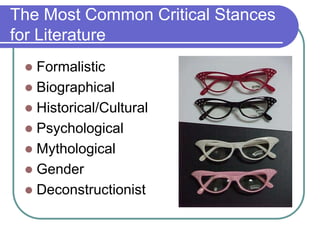
 Any piece of text can
be read with a number
of different sets of
“glasses,” meaning
you are looking for
different things within
the text.
 Literary criticism helps
readers understand a
text in relation to the
author, culture, and
other texts.
The Most Common Critical Stances
for Literature
 Formalistic
 Biographical
 Historical/Cultural
 Psychological
 Mythological
 Gender
 Deconstructionist
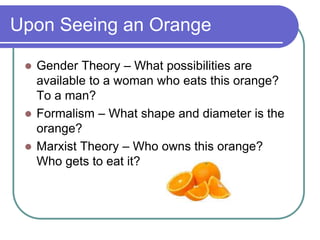
Upon Seeing an Orange
 Gender Theory – What possibilities are
available to a woman who eats this orange?
To a man?
 Formalism – What shape and diameter is the
orange?
 Marxist Theory – Who owns this orange?
Who gets to eat it?
Orange cont’d
 Postcolonial Theory – Who owns the orange?
Who took it away?
 Reader Response Theory – What does the
orange taste like? What does the orange
remind the reader of?
 Psychological/Psychoanalytical – I want this
orange now! Will I get in trouble if I eat it?
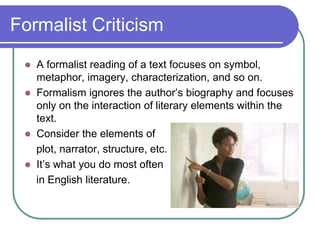
Formalist Criticism
 A formalist reading of a text focuses on symbol,
metaphor, imagery, characterization, and so on.
 Formalism ignores the author’s biography and focuses
only on the interaction of literary elements within the
text.
 Consider the elements of
plot, narrator, structure, etc.
 It’s what you do most often
in English literature.
A Formalist Reading of “The Three
Little Pigs”
 What does the wolf symbolize?
 Notice the consonance/rhyme of “I’ll huff
and I’ll puff…”
 How does the story foreshadow the final
fate of the pigs?
 What does the wolf’s dialogue tell us
about his character?
Biographical Criticism
 As the name
suggests, this type of
criticism reads the
text looking for the
author’s influence.
 By examining the
author’s life, we can
have a deeper
understanding of
his/her writing.
A Biographical Reading of To Build a Fire
by Jack London
 London grew up in poverty and lived on the
streets of San Francisco so he likely had a
negative view of city life. We also know that
he found peace and “breathing room” in
Alaska.
 The settings and circumstances in “To Build a
Fire” reflect the feelings above. (ie.-the
Naturalist idea that nature is indifferent =
effects of his early life on him and setting = his
love of Alaska/the wilderness)
Historical/Cultural Criticism
 This critical viewpoint examines a text in
relation to its historical or cultural
backdrop.
 You may examine a text’s effect on
history or culture or vice versa.
 A historical/cultural analysis is often very
similar to a biographical analysis, and it’s
possible to view history, culture, and
biography in a single essay.
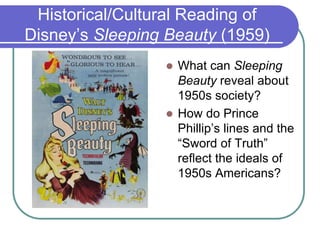
Historical/Cultural Reading of
Disney’s Sleeping Beauty (1959)
 What can Sleeping
Beauty reveal about
1950s society?
 How do Prince
Phillip’s lines and the
“Sword of Truth”
reflect the ideals of
1950s Americans?
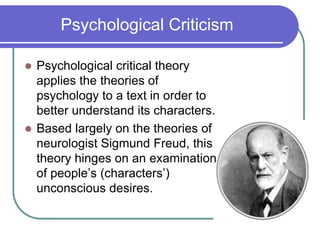
Psychological Criticism
 Psychological critical theory
applies the theories of
psychology to a text in order to
better understand its characters.
 Based largely on the theories of
neurologist Sigmund Freud, this
theory hinges on an examination
of people’s (characters’)
unconscious desires.
Psychological Criticism
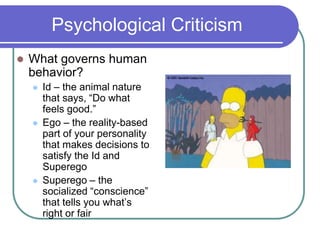
 What governs human
behavior?
 Id – the animal nature
that says, “Do what
feels good.”
 Ego – the reality-based
part of your personality
that makes decisions to
satisfy the Id and
Superego
 Superego – the
socialized “conscience”
that tells you what’s
right or fair
Psychological Criticism
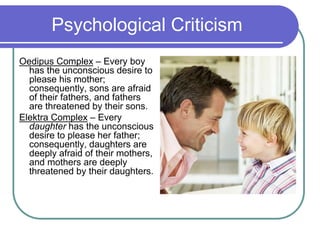
Oedipus Complex – Every boy
has the unconscious desire to
please his mother;
consequently, sons are afraid
of their fathers, and fathers
are threatened by their sons.
Elektra Complex – Every
daughter has the unconscious
desire to please her father;
consequently, daughters are
deeply afraid of their mothers,
and mothers are deeply
threatened by their daughters.
Psychological Criticism
 Of course, these
complexes have their
origins in literature and
mythology.
 Psychological criticism is
a way to understand
characters, not diagnose
them.
A Psychological Reading of
Macbeth
 Macbeth kills King Duncan because he
unconsciously recognizes the king as a
father-figure. Hence, Duncan is a rival for
power and the affections of the people.
 In the latter acts of the play, Macbeth
has indulged his id so often that his ego
has lost the ability to restrain it.
Mythological Criticism
 This stance is not about mythology.
 It is about the universal elements of
human life that are common in all cultures.
 Like ancient mythology, literature is a
window to creating meaning for human
life.
 In other words, stories make us feel like
our lives are more significant.
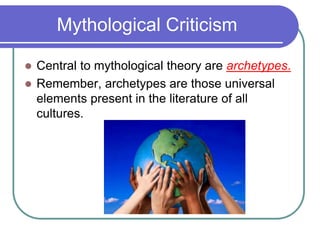
Mythological Criticism
 Central to mythological theory are archetypes.
 Remember, archetypes are those universal
elements present in the literature of all
cultures.
Mythological Criticism
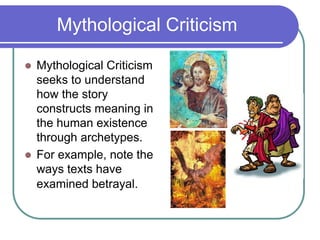
 Mythological Criticism
seeks to understand
how the story
constructs meaning in
the human existence
through archetypes.
 For example, note the
ways texts have
examined betrayal.
Mythological Criticism
 Common Archetypes
 The Hero = Beowulf, Spiderman, Luke
Skywalker, Braveheart
 The Outcast = Macbeth’s clown, Lord of the
Flies, Cain
 The Quest = LOTR, Star Wars, Beowulf
 Sacrificial King = Jesus, The Lion the Witch
and the Wardrobe, LOTR
 Evil Personified = Wicked Witch of the
West, the Devil, the Emperor in SW
Gender Criticism
 Gender criticism analyzes literature
through the lens of socially-constructed
gender roles.
 The largest part of gender criticism is
feminism, which critiques and seeks to
correct women’s subordination to men in
society.
 In its most basic form, feminism is about
equality.
Gender Criticism
 A newer segment of gender criticism is
looks for the influence of homosexuality
within texts.
 Research of this type is fairly difficult
because homosexuality was largely
suppressed in Europe and America, and
it hasn’t been openly discussed until the
last few decades.
A Feminist Reading of Cinderella
 As a single, young woman, Cinderella is without
means or opportunity because she is unattached to a
father or a husband.
 It is only through the magic of a fairy godmother that
she can be made presentable and meet the prince
AND he is the only means of her escaping her plight.
 What skills does she have? She is beautiful, can sing
well, and is kind. These are highlighted as the
desirable qualities in a woman (hence, her UGLY,
UNTALENTED, stepsisters who are portrayed as
undesirable).
Marxist Criticism
 Bases approach largely on works of Karl
Marx (1818-1883) German political
philosopher.
 Investigates assumptions and values
associated with culture, race, class.
 For example: Are the rich always good or
bad? Are the poor always good or bad?
Marxist Criticism
 Explores the power struggles of those
who are minorities in dominant culture.
 Examines who has/does not have
power, how they attained it/why they
don’t have it, and what they do with
it/how they are manipulated by it.
Marxist Criticism
 Believes that literature is essentially
political; it either supports or refutes
economic oppression. In other words,
the author either reinforces the status
quo or rebels against it.
Literary Criticism
 Remember, one need not be a Marxist to
use a Marxist approach, any more than
one needs to be a woman to use a
feminist approach.
 Any critic can take any approach that
helps him/her explain what they think the
author is saying in his/her work.
Literary Criticism
 Once you have decided what you think
the author of your novel is saying—what
his/her message is—you can then
decide on which critical approach you
think will work best to support your
opinion.
More Literary Theory
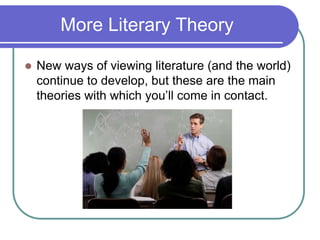
 New ways of viewing literature (and the world)
continue to develop, but these are the main
theories with which you’ll come in contact.
Deconstructionist Criticism
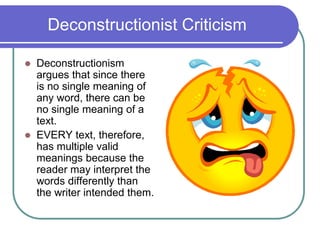
 Deconstructionism
argues that since there
is no single meaning of
any word, there can be
no single meaning of a
text.
 EVERY text, therefore,
has multiple valid
meanings because the
reader may interpret the
words differently than
the writer intended them.
Deconstructionist Criticism
 Much literary criticism is about
construction of a larger meaning from a
text.
 Deconstructionism emphasizes the
breakdown of any meaning within a text
because of the variety of different
readers.
Deconstructionism
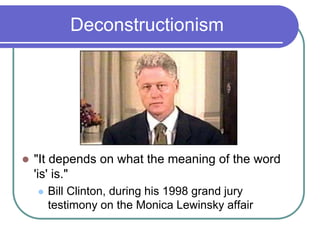
 "It depends on what the meaning of the word
'is' is."
 Bill Clinton, during his 1998 grand jury
testimony on the Monica Lewinsky affair
Deconstructionism
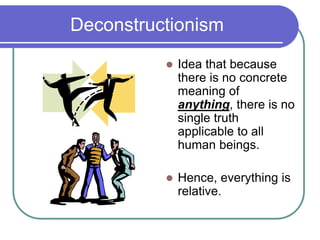
 Idea that because
there is no concrete
meaning of
anything, there is no
single truth
applicable to all
human beings.
 Hence, everything is
relative.
A Deconstructionist Reading of “The
Tortoise and the Hare” (very basic)
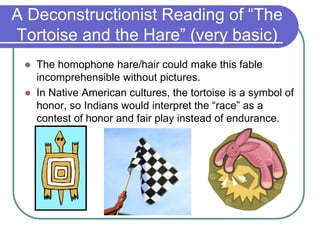
 The homophone hare/hair could make this fable
incomprehensible without pictures.
 In Native American cultures, the tortoise is a symbol of
honor, so Indians would interpret the “race” as a
contest of honor and fair play instead of endurance.

Intro to Literary Criticism powerpoint presentation

  • 1.
  • 2.
    Definition and Use “Literary criticism” is the name given to works written by experts who critique— analyze—an author’s work.  It does NOT mean “to criticize” as in complain or disapprove.  Literary criticism is often referred to as a “secondary source”.
  • 3.
    Definition and Use Literary criticism is often referred to as a “secondary source”, because it is used to analyze your primary work—the work or text (novel) you are reading.  Literary criticism is used by people who want to use an expert’s opinion to support their own ideas.
  • 4.
    Definition and Use Remember, literary criticism is used by readers to analyze, NOT by authors to write.  Therefore, when you begin to analyze your novel, you’ll make use of expert, reliable literary criticism to support your opinion—your thesis—which you will develop for your paper.
  • 5.
    Literary Criticism andTheory  Any piece of text can be read with a number of different sets of “glasses,” meaning you are looking for different things within the text.  Literary criticism helps readers understand a text in relation to the author, culture, and other texts.
  • 6.
    The Most CommonCritical Stances for Literature  Formalistic  Biographical  Historical/Cultural  Psychological  Mythological  Gender  Deconstructionist
  • 7.
    Upon Seeing anOrange  Gender Theory – What possibilities are available to a woman who eats this orange? To a man?  Formalism – What shape and diameter is the orange?  Marxist Theory – Who owns this orange? Who gets to eat it?
  • 8.
    Orange cont’d  PostcolonialTheory – Who owns the orange? Who took it away?  Reader Response Theory – What does the orange taste like? What does the orange remind the reader of?  Psychological/Psychoanalytical – I want this orange now! Will I get in trouble if I eat it?
  • 9.
    Formalist Criticism  Aformalist reading of a text focuses on symbol, metaphor, imagery, characterization, and so on.  Formalism ignores the author’s biography and focuses only on the interaction of literary elements within the text.  Consider the elements of plot, narrator, structure, etc.  It’s what you do most often in English literature.
  • 10.
    A Formalist Readingof “The Three Little Pigs”  What does the wolf symbolize?  Notice the consonance/rhyme of “I’ll huff and I’ll puff…”  How does the story foreshadow the final fate of the pigs?  What does the wolf’s dialogue tell us about his character?
  • 11.
    Biographical Criticism  Asthe name suggests, this type of criticism reads the text looking for the author’s influence.  By examining the author’s life, we can have a deeper understanding of his/her writing.
  • 12.
    A Biographical Readingof To Build a Fire by Jack London  London grew up in poverty and lived on the streets of San Francisco so he likely had a negative view of city life. We also know that he found peace and “breathing room” in Alaska.  The settings and circumstances in “To Build a Fire” reflect the feelings above. (ie.-the Naturalist idea that nature is indifferent = effects of his early life on him and setting = his love of Alaska/the wilderness)
  • 13.
    Historical/Cultural Criticism  Thiscritical viewpoint examines a text in relation to its historical or cultural backdrop.  You may examine a text’s effect on history or culture or vice versa.  A historical/cultural analysis is often very similar to a biographical analysis, and it’s possible to view history, culture, and biography in a single essay.
  • 14.
    Historical/Cultural Reading of Disney’sSleeping Beauty (1959)  What can Sleeping Beauty reveal about 1950s society?  How do Prince Phillip’s lines and the “Sword of Truth” reflect the ideals of 1950s Americans?
  • 15.
    Psychological Criticism  Psychologicalcritical theory applies the theories of psychology to a text in order to better understand its characters.  Based largely on the theories of neurologist Sigmund Freud, this theory hinges on an examination of people’s (characters’) unconscious desires.
  • 16.
    Psychological Criticism  Whatgoverns human behavior?  Id – the animal nature that says, “Do what feels good.”  Ego – the reality-based part of your personality that makes decisions to satisfy the Id and Superego  Superego – the socialized “conscience” that tells you what’s right or fair
  • 17.
    Psychological Criticism Oedipus Complex– Every boy has the unconscious desire to please his mother; consequently, sons are afraid of their fathers, and fathers are threatened by their sons. Elektra Complex – Every daughter has the unconscious desire to please her father; consequently, daughters are deeply afraid of their mothers, and mothers are deeply threatened by their daughters.
  • 18.
    Psychological Criticism  Ofcourse, these complexes have their origins in literature and mythology.  Psychological criticism is a way to understand characters, not diagnose them.
  • 19.
    A Psychological Readingof Macbeth  Macbeth kills King Duncan because he unconsciously recognizes the king as a father-figure. Hence, Duncan is a rival for power and the affections of the people.  In the latter acts of the play, Macbeth has indulged his id so often that his ego has lost the ability to restrain it.
  • 20.
    Mythological Criticism  Thisstance is not about mythology.  It is about the universal elements of human life that are common in all cultures.  Like ancient mythology, literature is a window to creating meaning for human life.  In other words, stories make us feel like our lives are more significant.
  • 21.
    Mythological Criticism  Centralto mythological theory are archetypes.  Remember, archetypes are those universal elements present in the literature of all cultures.
  • 22.
    Mythological Criticism  MythologicalCriticism seeks to understand how the story constructs meaning in the human existence through archetypes.  For example, note the ways texts have examined betrayal.
  • 23.
    Mythological Criticism  CommonArchetypes  The Hero = Beowulf, Spiderman, Luke Skywalker, Braveheart  The Outcast = Macbeth’s clown, Lord of the Flies, Cain  The Quest = LOTR, Star Wars, Beowulf  Sacrificial King = Jesus, The Lion the Witch and the Wardrobe, LOTR  Evil Personified = Wicked Witch of the West, the Devil, the Emperor in SW
  • 24.
    Gender Criticism  Gendercriticism analyzes literature through the lens of socially-constructed gender roles.  The largest part of gender criticism is feminism, which critiques and seeks to correct women’s subordination to men in society.  In its most basic form, feminism is about equality.
  • 25.
    Gender Criticism  Anewer segment of gender criticism is looks for the influence of homosexuality within texts.  Research of this type is fairly difficult because homosexuality was largely suppressed in Europe and America, and it hasn’t been openly discussed until the last few decades.
  • 26.
    A Feminist Readingof Cinderella  As a single, young woman, Cinderella is without means or opportunity because she is unattached to a father or a husband.  It is only through the magic of a fairy godmother that she can be made presentable and meet the prince AND he is the only means of her escaping her plight.  What skills does she have? She is beautiful, can sing well, and is kind. These are highlighted as the desirable qualities in a woman (hence, her UGLY, UNTALENTED, stepsisters who are portrayed as undesirable).
  • 27.
    Marxist Criticism  Basesapproach largely on works of Karl Marx (1818-1883) German political philosopher.  Investigates assumptions and values associated with culture, race, class.  For example: Are the rich always good or bad? Are the poor always good or bad?
  • 28.
    Marxist Criticism  Exploresthe power struggles of those who are minorities in dominant culture.  Examines who has/does not have power, how they attained it/why they don’t have it, and what they do with it/how they are manipulated by it.
  • 29.
    Marxist Criticism  Believesthat literature is essentially political; it either supports or refutes economic oppression. In other words, the author either reinforces the status quo or rebels against it.
  • 30.
    Literary Criticism  Remember,one need not be a Marxist to use a Marxist approach, any more than one needs to be a woman to use a feminist approach.  Any critic can take any approach that helps him/her explain what they think the author is saying in his/her work.
  • 31.
    Literary Criticism  Onceyou have decided what you think the author of your novel is saying—what his/her message is—you can then decide on which critical approach you think will work best to support your opinion.
  • 32.
    More Literary Theory New ways of viewing literature (and the world) continue to develop, but these are the main theories with which you’ll come in contact.
  • 33.
    Deconstructionist Criticism  Deconstructionism arguesthat since there is no single meaning of any word, there can be no single meaning of a text.  EVERY text, therefore, has multiple valid meanings because the reader may interpret the words differently than the writer intended them.
  • 34.
    Deconstructionist Criticism  Muchliterary criticism is about construction of a larger meaning from a text.  Deconstructionism emphasizes the breakdown of any meaning within a text because of the variety of different readers.
  • 35.
    Deconstructionism  "It dependson what the meaning of the word 'is' is."  Bill Clinton, during his 1998 grand jury testimony on the Monica Lewinsky affair
  • 36.
    Deconstructionism  Idea thatbecause there is no concrete meaning of anything, there is no single truth applicable to all human beings.  Hence, everything is relative.
  • 37.
    A Deconstructionist Readingof “The Tortoise and the Hare” (very basic)  The homophone hare/hair could make this fable incomprehensible without pictures.  In Native American cultures, the tortoise is a symbol of honor, so Indians would interpret the “race” as a contest of honor and fair play instead of endurance.

Editor's Notes

  • #36 Start at 1:14 end at 1:36