Postmodern
Literature
Dr.B.Winmayil
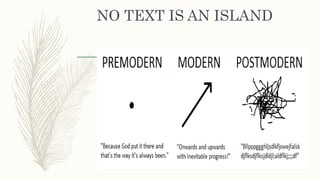
NO TEXT IS AN ISLAND
Postmodern Writers
– Thomas Pynchon
– Jean Lyotard
– Don DeLillo
– Joseph Heller
– Kurt Vonnegut
– John Fowles
– John Ashberry
– Orhan Pamuk
– Vladimir Nabokov
Postmodern works
– Breakfast of Champions. Kurt Vonnegut.
– Labyrinths. Jorges Luis Borges.
– Fear and Loathing in Las Vegas. Hunter S. Thompson.
– American Psycho. Bret Easton Ellis.
– Catch-22. Joseph Heller.
– Gravity's Rainbow. Thomas Pynchon.
– Naked Lunch. William S. Burroughs.
– Infinite Jest. David Foster Wallace
Postmodern Techniques
Little Words, Big Ideas
– Irony, Playfulness, Black Humour
– Serious things in a playful way
– Joseph Heller, Kurt Vonnegut – II World war
Postmodern Techniques
–Intertextuality
– a reference or parallel to another literary work, an extended discussion of a work,
or the adoption of a style
– Umberto Eco's The Name of the Rose takes on the form of a detective novel and
makes references to authors such as Aristotle, Sir Arthur Canon Doyle, and
Borges.
Postmodern Techniques
–Pastiche
– means to combine, or "paste" together, multiple elements
– a representation of the chaotic, pluralistic, or information-drenched
aspects of postmodern society
– B.S.Johnson's 1969 novel The Unfortunates was released in a box
with no binding so that readers could assemble it however they chose.
Postmodern Techniques
– Metafiction
– writing about writing or "foregrounding the apparatus", as it's typical
of deconstructionist approaches
– making the artificiality of art or the fictionality of fiction apparent to the reader
and generally disregards the necessity for "willing suspension of disbelief."
– For example, postmodern sensibility and metafiction dictate that works
of parody should parody the idea of parody itself
– Metafiction is often employed to undermine the authority of the author, for
unexpected narrative shifts, to advance a story in a unique way, for emotional
distance, or to comment on the act of storytelling
– example, Italo Calvino’s1979 novel If on a winter’s night a traveler is about a
reader attempting to read a novel of the same name.
– Minimalism and Maximalism
– Minimalism is all about making things neat, tidy, and low key,
– the most basic and necessary pieces, specific by economy with words.
– Minimalist authors hesitate to use adjectives, adverbs, or meaningless
details
– Jon Fosse and especially Samuel Beckett
– Maximalism goes against the grain by embracing excess.
– if an author is making loads of references to other texts—and to itself as a
text—
– Zadie Smith's White Teeth (2000) &Salman Rushdie's Midnight's
Children (1981)
Postmodern Techniques
Fabulation
– the term was coined by Robert Scholes in his book The
Fabulators
– Fabulation is a term sometimes used interchangeably
with metafiction and relates to pastiche and Magic
Realism.
– rejection of realism which embraces the notion that
literature is a created work and not bound by notions of
mimesis (imitation of life in art) and
verisimilitude(appearance of being true)
– Salman Rushdie's Haroun and the Sea of Stories
Postmodern Techniques
– Poioumena.
– a term coined by Alastair Fowler to refer to a specific type of
metafiction in which the story is about the process of creation
– Samuel Beckett's trilogy (Molloy, Malone Dies and The
Unnamable); Dori Lessing’s The Golden Notebook
– the self-conscious narrator in Salman Rushdie's Midnight's
Children parallels the creation of his book to the creation of chutney
and the creation of independent India
Postmodern Techniques
Historiographic metafiction
– Linda Hutcheon coined the term
– refers to the works that fictionalize actual
historical events or figures;
– The General in His Labyrinth by Gabriel García
Márquez (about Simón Bolívar), Flaubert's
Parrot by Julian Barnes (about Gustave Flaubert)
Postmodern Techniques
Temporal distortion
– fragmentation and nonlinear narratives
– in Robert Coover's "The Babysitter" - multiple
possible events occurring simultaneously—in one
section the babysitter is murdered while in another
section nothing happens and so on—yet no version
of the story is favored as the correct version.
Postmodern Techniques
– Magic realism
– Magic realism may be a literary work marked by the use of
still, sharply defined, smoothly painted images of figures and
objects depicted in a surrealistic manner. The themes and
subjects are often imaginary, somewhat outlandish and
fantastic and with a certain dream-like quality.
– Jorge Luis Borges, the Argentinian who in 1935 published
his Historia universal de la infamia, the first work of magic
realism
– Gabriel García Márquez’s One Hundred Years of Solitude

Postmodern literature

  • 1.
  • 2.
    NO TEXT ISAN ISLAND
  • 3.
    Postmodern Writers – ThomasPynchon – Jean Lyotard – Don DeLillo – Joseph Heller – Kurt Vonnegut – John Fowles – John Ashberry – Orhan Pamuk – Vladimir Nabokov
  • 4.
    Postmodern works – Breakfastof Champions. Kurt Vonnegut. – Labyrinths. Jorges Luis Borges. – Fear and Loathing in Las Vegas. Hunter S. Thompson. – American Psycho. Bret Easton Ellis. – Catch-22. Joseph Heller. – Gravity's Rainbow. Thomas Pynchon. – Naked Lunch. William S. Burroughs. – Infinite Jest. David Foster Wallace
  • 5.
    Postmodern Techniques Little Words,Big Ideas – Irony, Playfulness, Black Humour – Serious things in a playful way – Joseph Heller, Kurt Vonnegut – II World war
  • 6.
    Postmodern Techniques –Intertextuality – areference or parallel to another literary work, an extended discussion of a work, or the adoption of a style – Umberto Eco's The Name of the Rose takes on the form of a detective novel and makes references to authors such as Aristotle, Sir Arthur Canon Doyle, and Borges.
  • 7.
    Postmodern Techniques –Pastiche – meansto combine, or "paste" together, multiple elements – a representation of the chaotic, pluralistic, or information-drenched aspects of postmodern society – B.S.Johnson's 1969 novel The Unfortunates was released in a box with no binding so that readers could assemble it however they chose.
  • 8.
    Postmodern Techniques – Metafiction –writing about writing or "foregrounding the apparatus", as it's typical of deconstructionist approaches – making the artificiality of art or the fictionality of fiction apparent to the reader and generally disregards the necessity for "willing suspension of disbelief." – For example, postmodern sensibility and metafiction dictate that works of parody should parody the idea of parody itself – Metafiction is often employed to undermine the authority of the author, for unexpected narrative shifts, to advance a story in a unique way, for emotional distance, or to comment on the act of storytelling – example, Italo Calvino’s1979 novel If on a winter’s night a traveler is about a reader attempting to read a novel of the same name.
  • 9.
    – Minimalism andMaximalism – Minimalism is all about making things neat, tidy, and low key, – the most basic and necessary pieces, specific by economy with words. – Minimalist authors hesitate to use adjectives, adverbs, or meaningless details – Jon Fosse and especially Samuel Beckett – Maximalism goes against the grain by embracing excess. – if an author is making loads of references to other texts—and to itself as a text— – Zadie Smith's White Teeth (2000) &Salman Rushdie's Midnight's Children (1981)
  • 10.
    Postmodern Techniques Fabulation – theterm was coined by Robert Scholes in his book The Fabulators – Fabulation is a term sometimes used interchangeably with metafiction and relates to pastiche and Magic Realism. – rejection of realism which embraces the notion that literature is a created work and not bound by notions of mimesis (imitation of life in art) and verisimilitude(appearance of being true) – Salman Rushdie's Haroun and the Sea of Stories
  • 11.
    Postmodern Techniques – Poioumena. –a term coined by Alastair Fowler to refer to a specific type of metafiction in which the story is about the process of creation – Samuel Beckett's trilogy (Molloy, Malone Dies and The Unnamable); Dori Lessing’s The Golden Notebook – the self-conscious narrator in Salman Rushdie's Midnight's Children parallels the creation of his book to the creation of chutney and the creation of independent India
  • 12.
    Postmodern Techniques Historiographic metafiction –Linda Hutcheon coined the term – refers to the works that fictionalize actual historical events or figures; – The General in His Labyrinth by Gabriel García Márquez (about Simón Bolívar), Flaubert's Parrot by Julian Barnes (about Gustave Flaubert)
  • 13.
    Postmodern Techniques Temporal distortion –fragmentation and nonlinear narratives – in Robert Coover's "The Babysitter" - multiple possible events occurring simultaneously—in one section the babysitter is murdered while in another section nothing happens and so on—yet no version of the story is favored as the correct version.
  • 14.
    Postmodern Techniques – Magicrealism – Magic realism may be a literary work marked by the use of still, sharply defined, smoothly painted images of figures and objects depicted in a surrealistic manner. The themes and subjects are often imaginary, somewhat outlandish and fantastic and with a certain dream-like quality. – Jorge Luis Borges, the Argentinian who in 1935 published his Historia universal de la infamia, the first work of magic realism – Gabriel García Márquez’s One Hundred Years of Solitude