CRITICISM
The paradigms and the possibilities…
LITERARY
•What is a critic?
•Why do we critic?
•How do we critic?
ORIGIN
• Greek word ”krinein” meaning “to
judge”, and the idea of evaluation
has always been inherent in the
term.
•The noun “kritikos” meaning a
“judge” of literature has a very long
history and was in use as early as the
4th century B.C.
WHO IS A CRITIC?
one who expresses a reasoned
opinion on any matter
especially involving a
judgment of its value, truth,
righteousness, beauty, or
technique
WHAT IS CRITICISM?
• The expression of disapproval of someone
or something based on perceived faults or
mistakes: "he ignored the criticisms of his
friends".
• The analysis and judgment of a literary or
artistic work: "methods of criticism
supported by literary theories".
CRITICISM
Let’s define
LITERARY
Literary criticism is the
study, discussion,
evaluation, and
interpretation of
literature.
"Literary criticism is the
evaluation of literary works.
This includes the
classification by genre,
analysis of structure, and
judgement of value."
"Literary criticism asks
what literature is,
what it does, and
what it is worth."
Literary criticism is the method
used to interpret any given
work of literature. The different
schools of literary criticism
provide us with lenses which
ultimately reveal important
aspects of the literary work.
It is criticism not because it is
negative or corrective, but rather
because those who write criticisms
ask hard, analytical , crucial, or
critical questions about the works
they read.
WHY DO WE HAVE TO
ANALYZE?
• Talking about experiences enhances our
enjoyment of them
• Talking about experiences involves the search
for meaning which increases our understanding
of them
"The life which is unexamined is not worth living.“
Socrates
TO FURTHER EXPLAIN …
Literary criticism helps us to understand
what is important about the text
• Its author
• its structure
• its context: social, economic, historical
• what is written
• how the text influences the reader
• Literary criticism helps us to
understand the relationship
between authors, readers, and
texts
• The act of literary criticism
ultimately enhances the
enjoyment of our reading of the
literary work
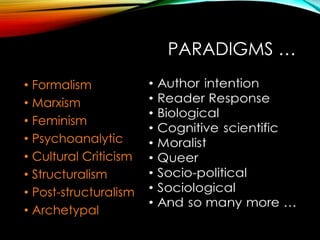
PARADIGMS …
• Formalism
• Marxism
• Feminism
• Psychoanalytic
• Cultural Criticism
• Structuralism
• Post-structuralism
• Archetypal
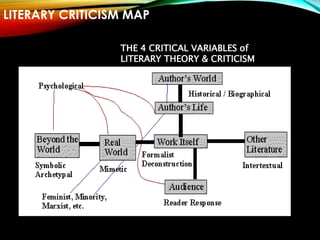
LITERARY CRITICISM MAP
THE 4 CRITICAL VARIABLES of
LITERARY THEORY & CRITICISM
UNDERSTANDING THE
MAP
• The work itself is placed in the center because all
approaches must deal, to some extent or another, with the
text itself.
• Formalism and deconstruction are placed here also because
they deal primarily with the text and not with any of the
outside considerations such as author, the real world,
audience, or other literature. Meaning, formalists argue, is
inherent in the text. Because meaning is determinant, all
other considerations are irrelevant.
• Deconstructionists also subject texts to careful, formal
analysis; however, they reach an opposite conclusion: there
is no meaning in language.
CONT'D …
• A historical approach relies heavily on the author and his
world. In the historical view, it is important to understand the
author and his world in order to understand his intent and to
make sense of his work. In this view, the work is informed by
the author's beliefs, prejudices, time, and history, and to fully
understand the work, we must understand the author and his
age.
• An intertextual approach is concerned with comparing the
work in question to other literature, to get a broader picture.
• Reader-Response is concerned with how the work is viewed
by the audience. In this approach, the reader creates
meaning, not the author or the work.
CONT'D …
• Mimetic criticism seeks to see how well a work
accords with the real world (is it accurate?
correct? moral? ).
• Then, beyond the real world are approaches
dealing with the spiritual and the symbolic--the
images connecting people throughout time and
cultures (archetypes). This is mimetic in a sense too,
but the congruency looked for is not so much with
the real world as with something beyond the real
world--something tying in all the
worlds/times/cultures inhabited by humans.
CONT'D …
• The Psychological approach is placed outside
these poles because it can fit in many places,
depending how it is applied:
(1) Historical if diagnosing the author himself
(2) Mimetic if considering if characters are acting
by "real world" standards and with recognizable
psychological motivations
(3) Archetypal when the idea of the Jungian
collective unconscious is included
(4) Reader-Response when the psychology of the
reader--why he sees what he sees in the text--is
examined.
CONT'D …
• Likewise, Feminist, Minority, Marxist, and other such
approaches may fit in:
(1) Historical if the author's attitudes are being
examined in relation to his times (i.e. was
Shakespeare a feminist for his times, though he
might not be considered so today?)
(2) Mimetic--when asking how well characters
accord with the real world. Does a black
character act like a black person would, or is he a
stereotype? Are women being portrayed
accurately? Does the work show a realistic
economic picture of the world?
WHAT DOES THIS LITERARY WORK MEAN?
THERE ARE SO MANY POSSIBLE ANSWERS
• Different approaches or lenses help us to
discover rich and deeper meaning
• Each lens has its strengths and weaknesses
• Each lens is valuable
• Try to become a pluralist rather than an
inflexible supporter of one
• A very basic way of thinking about literary
theory is that these ideas act as different
lenses critics use to view and talk about art,
literature, and even culture. These different
lenses allow critics to consider works of art
based on certain assumptions within that
school of theory. The different lenses also
allow critics to focus on particular aspects
of a work they consider important.
YOUR TASK
•Learn your theory
like your life
depends on it
FOLLOW THIS PROCESS
Know & present the following information:
• Key person(s) who influenced the theory;
proponents
• Background information about the theory
• Strengths of the theory
• Weaknesses of the theory
• Interpretation of the selection of literature
using the theory
• http://owl.english.purdue.edu/owl/resource/722/11/
• http://www.slideshare.net/makeefer/what-is-literary-
criticism

Literary Criticism

  • 1.
    CRITICISM The paradigms andthe possibilities… LITERARY
  • 2.
    •What is acritic? •Why do we critic? •How do we critic?
  • 3.
    ORIGIN • Greek word”krinein” meaning “to judge”, and the idea of evaluation has always been inherent in the term. •The noun “kritikos” meaning a “judge” of literature has a very long history and was in use as early as the 4th century B.C.
  • 4.
    WHO IS ACRITIC? one who expresses a reasoned opinion on any matter especially involving a judgment of its value, truth, righteousness, beauty, or technique
  • 5.
    WHAT IS CRITICISM? •The expression of disapproval of someone or something based on perceived faults or mistakes: "he ignored the criticisms of his friends". • The analysis and judgment of a literary or artistic work: "methods of criticism supported by literary theories".
  • 6.
  • 7.
    Literary criticism isthe study, discussion, evaluation, and interpretation of literature.
  • 8.
    "Literary criticism isthe evaluation of literary works. This includes the classification by genre, analysis of structure, and judgement of value."
  • 9.
    "Literary criticism asks whatliterature is, what it does, and what it is worth."
  • 10.
    Literary criticism isthe method used to interpret any given work of literature. The different schools of literary criticism provide us with lenses which ultimately reveal important aspects of the literary work.
  • 11.
    It is criticismnot because it is negative or corrective, but rather because those who write criticisms ask hard, analytical , crucial, or critical questions about the works they read.
  • 12.
    WHY DO WEHAVE TO ANALYZE? • Talking about experiences enhances our enjoyment of them • Talking about experiences involves the search for meaning which increases our understanding of them "The life which is unexamined is not worth living.“ Socrates
  • 13.
    TO FURTHER EXPLAIN… Literary criticism helps us to understand what is important about the text • Its author • its structure • its context: social, economic, historical • what is written • how the text influences the reader
  • 14.
    • Literary criticismhelps us to understand the relationship between authors, readers, and texts • The act of literary criticism ultimately enhances the enjoyment of our reading of the literary work
  • 15.
    PARADIGMS … • Formalism •Marxism • Feminism • Psychoanalytic • Cultural Criticism • Structuralism • Post-structuralism • Archetypal
  • 16.
    LITERARY CRITICISM MAP THE4 CRITICAL VARIABLES of LITERARY THEORY & CRITICISM
  • 17.
    UNDERSTANDING THE MAP • Thework itself is placed in the center because all approaches must deal, to some extent or another, with the text itself. • Formalism and deconstruction are placed here also because they deal primarily with the text and not with any of the outside considerations such as author, the real world, audience, or other literature. Meaning, formalists argue, is inherent in the text. Because meaning is determinant, all other considerations are irrelevant. • Deconstructionists also subject texts to careful, formal analysis; however, they reach an opposite conclusion: there is no meaning in language.
  • 18.
    CONT'D … • Ahistorical approach relies heavily on the author and his world. In the historical view, it is important to understand the author and his world in order to understand his intent and to make sense of his work. In this view, the work is informed by the author's beliefs, prejudices, time, and history, and to fully understand the work, we must understand the author and his age. • An intertextual approach is concerned with comparing the work in question to other literature, to get a broader picture. • Reader-Response is concerned with how the work is viewed by the audience. In this approach, the reader creates meaning, not the author or the work.
  • 19.
    CONT'D … • Mimeticcriticism seeks to see how well a work accords with the real world (is it accurate? correct? moral? ). • Then, beyond the real world are approaches dealing with the spiritual and the symbolic--the images connecting people throughout time and cultures (archetypes). This is mimetic in a sense too, but the congruency looked for is not so much with the real world as with something beyond the real world--something tying in all the worlds/times/cultures inhabited by humans.
  • 20.
    CONT'D … • ThePsychological approach is placed outside these poles because it can fit in many places, depending how it is applied: (1) Historical if diagnosing the author himself (2) Mimetic if considering if characters are acting by "real world" standards and with recognizable psychological motivations (3) Archetypal when the idea of the Jungian collective unconscious is included (4) Reader-Response when the psychology of the reader--why he sees what he sees in the text--is examined.
  • 21.
    CONT'D … • Likewise,Feminist, Minority, Marxist, and other such approaches may fit in: (1) Historical if the author's attitudes are being examined in relation to his times (i.e. was Shakespeare a feminist for his times, though he might not be considered so today?) (2) Mimetic--when asking how well characters accord with the real world. Does a black character act like a black person would, or is he a stereotype? Are women being portrayed accurately? Does the work show a realistic economic picture of the world?
  • 22.
    WHAT DOES THISLITERARY WORK MEAN? THERE ARE SO MANY POSSIBLE ANSWERS • Different approaches or lenses help us to discover rich and deeper meaning • Each lens has its strengths and weaknesses • Each lens is valuable • Try to become a pluralist rather than an inflexible supporter of one
  • 23.
    • A verybasic way of thinking about literary theory is that these ideas act as different lenses critics use to view and talk about art, literature, and even culture. These different lenses allow critics to consider works of art based on certain assumptions within that school of theory. The different lenses also allow critics to focus on particular aspects of a work they consider important.
  • 24.
    YOUR TASK •Learn yourtheory like your life depends on it
  • 25.
    FOLLOW THIS PROCESS Know& present the following information: • Key person(s) who influenced the theory; proponents • Background information about the theory • Strengths of the theory • Weaknesses of the theory • Interpretation of the selection of literature using the theory
  • 26.