Liquidity Risk

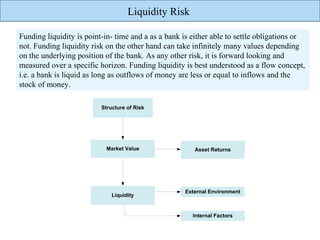
Funding liquidity is point-in- time and a as a bank is either able to settle obligations or
not. Funding liquidity risk on the other hand can take infinitely many values depending
on the underlying position of the bank. As any other risk, it is forward looking and
measured over a specific horizon. Funding liquidity is best understood as a flow concept,
i.e. a bank is liquid as long as outflows of money are less or equal to inflows and the
stock of money.

                          Structure of Risk


                           Market Value                Asset Returns


                                                    External Environment
                              Liquidity


                                                       Internal Factors
Liquidity Risk
                                          Liquidity Risk


                                                      Equity
                                                     Derivative


                                                                      Market Risk

                                     Cash
                                     Equity


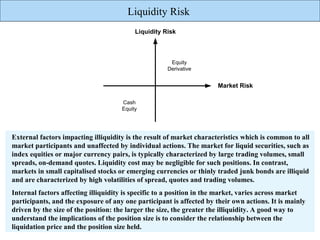
External factors impacting illiquidity is the result of market characteristics which is common to all
market participants and unaffected by individual actions. The market for liquid securities, such as
index equities or major currency pairs, is typically characterized by large trading volumes, small
spreads, on-demand quotes. Liquidity cost may be negligible for such positions. In contrast,
markets in small capitalised stocks or emerging currencies or thinly traded junk bonds are illiquid
and are characterized by high volatilities of spread, quotes and trading volumes.
Internal factors affecting illiquidity is specific to a position in the market, varies across market
participants, and the exposure of any one participant is affected by their own actions. It is mainly
driven by the size of the position: the larger the size, the greater the illiquidity. A good way to
understand the implications of the position size is to consider the relationship between the
liquidation price and the position size held.
Liquidity Risk

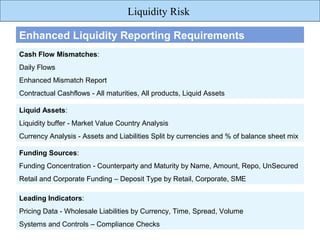
Enhanced Liquidity Reporting Requirements
Cash Flow Mismatches:
Daily Flows
Enhanced Mismatch Report
Contractual Cashflows - All maturities, All products, Liquid Assets

Liquid Assets:
Liquidity buffer - Market Value Country Analysis
Currency Analysis - Assets and Liabilities Split by currencies and % of balance sheet mix

Funding Sources:
Funding Concentration - Counterparty and Maturity by Name, Amount, Repo, UnSecured
Retail and Corporate Funding – Deposit Type by Retail, Corporate, SME

Leading Indicators:
Pricing Data - Wholesale Liabilities by Currency, Time, Spread, Volume
Systems and Controls – Compliance Checks
Liquidity Risk


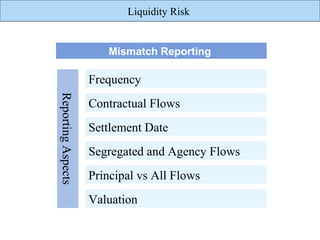
                       Mismatch Reporting

                    Frequency
Reporting Aspects


                    Contractual Flows
                    Settlement Date
                    Segregated and Agency Flows
                    Principal vs All Flows
                    Valuation
Liquidity Risk

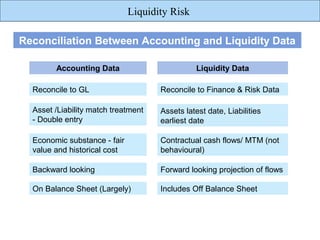
Reconciliation Between Accounting and Liquidity Data

        Accounting Data                         Liquidity Data

  Reconcile to GL                    Reconcile to Finance & Risk Data

  Asset /Liability match treatment   Assets latest date, Liabilities
  - Double entry                     earliest date

  Economic substance - fair          Contractual cash flows/ MTM (not
  value and historical cost          behavioural)

  Backward looking                   Forward looking projection of flows

  On Balance Sheet (Largely)         Includes Off Balance Sheet
Liquidity Risk

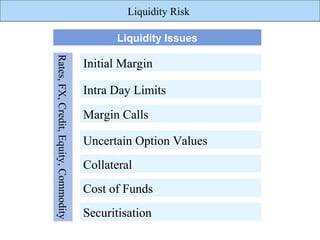
                                             Liquidity Issues
Rates, FX, Credit, Equity, Commodity
                                       Initial Margin

                                       Intra Day Limits
                                       Margin Calls

                                       Uncertain Option Values
                                       Collateral
                                       Cost of Funds
                                       Securitisation

Liquidity Risk

  • 1.
    Liquidity Risk Funding liquidityis point-in- time and a as a bank is either able to settle obligations or not. Funding liquidity risk on the other hand can take infinitely many values depending on the underlying position of the bank. As any other risk, it is forward looking and measured over a specific horizon. Funding liquidity is best understood as a flow concept, i.e. a bank is liquid as long as outflows of money are less or equal to inflows and the stock of money. Structure of Risk Market Value Asset Returns External Environment Liquidity Internal Factors
  • 2.
    Liquidity Risk Liquidity Risk Equity Derivative Market Risk Cash Equity External factors impacting illiquidity is the result of market characteristics which is common to all market participants and unaffected by individual actions. The market for liquid securities, such as index equities or major currency pairs, is typically characterized by large trading volumes, small spreads, on-demand quotes. Liquidity cost may be negligible for such positions. In contrast, markets in small capitalised stocks or emerging currencies or thinly traded junk bonds are illiquid and are characterized by high volatilities of spread, quotes and trading volumes. Internal factors affecting illiquidity is specific to a position in the market, varies across market participants, and the exposure of any one participant is affected by their own actions. It is mainly driven by the size of the position: the larger the size, the greater the illiquidity. A good way to understand the implications of the position size is to consider the relationship between the liquidation price and the position size held.
  • 3.
    Liquidity Risk Enhanced LiquidityReporting Requirements Cash Flow Mismatches: Daily Flows Enhanced Mismatch Report Contractual Cashflows - All maturities, All products, Liquid Assets Liquid Assets: Liquidity buffer - Market Value Country Analysis Currency Analysis - Assets and Liabilities Split by currencies and % of balance sheet mix Funding Sources: Funding Concentration - Counterparty and Maturity by Name, Amount, Repo, UnSecured Retail and Corporate Funding – Deposit Type by Retail, Corporate, SME Leading Indicators: Pricing Data - Wholesale Liabilities by Currency, Time, Spread, Volume Systems and Controls – Compliance Checks
  • 4.
    Liquidity Risk Mismatch Reporting Frequency Reporting Aspects Contractual Flows Settlement Date Segregated and Agency Flows Principal vs All Flows Valuation
  • 5.
    Liquidity Risk Reconciliation BetweenAccounting and Liquidity Data Accounting Data Liquidity Data Reconcile to GL Reconcile to Finance & Risk Data Asset /Liability match treatment Assets latest date, Liabilities - Double entry earliest date Economic substance - fair Contractual cash flows/ MTM (not value and historical cost behavioural) Backward looking Forward looking projection of flows On Balance Sheet (Largely) Includes Off Balance Sheet
  • 6.
    Liquidity Risk Liquidity Issues Rates, FX, Credit, Equity, Commodity Initial Margin Intra Day Limits Margin Calls Uncertain Option Values Collateral Cost of Funds Securitisation