Basel Ⅲ
           Chinwe Boston
          Mengchun Zhang
              Qiuli Guo
               Di Xiao
          Nathan Tsormetsri
OVERVIEW

    Meaning of Basel III

          Why Basel III
          


                  Aims
                  


              Objectives
              


      Major Changes

Implementation of the Changes

What is "Basel III": 


" A global regulatory standard on:

   bank capital adequacy
   stress testing and
   market liquidity risk
Also a set of reform measures to
improve:


   Regulation
   Supervision
   Risk management
Reasons for Basel III Formulation:

   Failures of Basel II being:

A. Inability to strengthen financial stability.

B. Insufficient capital reserve.

C. Inadequate comprehensive risk management approach.

D. Lack of uniformed definition of capital .
Aims & Objectives of Basel III

   To minimize the probability of recurrence of crises to
    greater extent.

   To improve the banking sector's ability to absorb
    shocks arising from financial and economic stress.

   To improve risk management and governance.


   To strengthen banks' transparency and disclosures .
Targets:
Bank-level or micro prudential which will
  help raise the resilience of individual
 banking institutions in periods of stress.

Macro prudential system wide risks that
 build up across the banking sector as
 well as the pro-cyclical amplification of
           these risk over time.
Key Elements of Reforms…


Increasing the quality and quantity capital
    Enhancing risk coverage of capital
       Introducing Leverage ratio
         Improving liquidity rules
      Establishing additional buffers
      Managing counter party risks
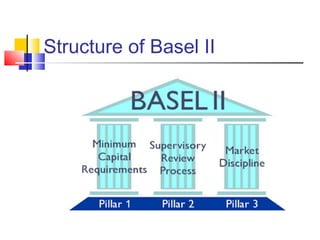
Structure of Basel II
Pillar 1:Minimum Capital
Requirements
•   Pillar 1 aligns the minimum capital requirements
    more closely to actual risks of bank's economic
    loss.

•   revised risks:
    √ Credit risk
    √ Operational risk
    √ Market risk
Pillar 1:Minimum Capital
Requirements(cont.)
•   Credit risk
    √ The standardised approach
    √ Foundation internal ratings based (IRB)
    approach
    √ Advanced IRB approach
•   Operational risk
    √ Basic indicator approach
    √ Standardized approach
    √ Advanced measurement approach
•   Market risk
    √ standardized approach
    √ internal models approach
Pillar 2:Supervisory Review Process
•    Pillar 2 requires banks to think about the whole spectrum
     of risks they might face including those not captured at all
     in Pillar 1 such as interest rate risk.
•    Coverage in Pillar 2:
    √ risks that are not fully covered by Pillar 1
    √ Credit concentration risk
    √ Counterparty credit risk
    √ Risks that are not covered by Pillar 1
    √ Interest rate risk in the banking book
    √ Liquidity risk
    √ Business risk
    √ Stress testing
Pillar 3:Market Discipline


   Pillar 3 is designed to increase the
    transparency of lenders' risk profile by
    requiring them to give details of their
    risk management and risk distributions.
Weaknesses of Basel II

The quality of capital.



Pro-cyclicality.



Liquidity risk.



Systemic banks.

Basel III: Strengthening the global capital
                framework


  A. Capital reform.

  B. Liquidity standards.

  C. Systemic risk and interconnectedness.
A. Capital Reform
   A new definition of capital.

   Capital conservation buffer.

   Countercyclical capital buffer.

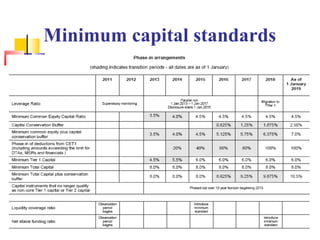
   Minimum capital standards.
A new definition of capital
   Total regulatory capital will consist of the sum of
    the following elements:

    1. Tier 1 Capital (going-concern capital)
       a. Common Equity Tier 1
       b. Additional Tier 1

    2. Tier 2 Capital (gone-concern capital)

   For each of the three categories above (1a, 1b and
    2) there is a single set of criteria that instruments
    are required to meet before inclusion in the
    relevant category.
Capital conservation buffer
   The capital conservation buffer is designed to ensure
    that banks build up capital buffers outside periods of
    stress which can be drawn down as losses are incurred.

   A capital conservation buffer of 2.5%, comprised of
    Common Equity Tier 1, is established above the
    regulatory minimum capital requirement.

   Outside of periods of stress, banks should hold buffers
    of capital above the regulatory minimum.
Countercyclical capital buffer

   The countercyclical buffer aims to ensure that banking
    sector capital requirements take account of the macro-
    financial environment in which banks operate.

   It will be deployed by national jurisdictions when excess
    aggregate credit growth is judged to be associated with a
    build-up of system-wide risk to ensure the banking system
    has a buffer of capital to protect it against future potential
    losses.
Minimum capital standards
B. Liquidity Standards:
 1.   Short-term: Liquidity Coverage
               Ratio(LCR)

 2.   Long-term: Net Stable Funding
              Ratio(NSFR)
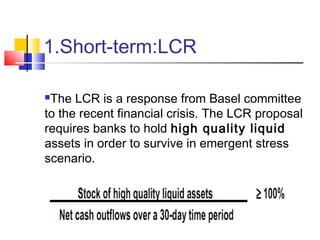
1.Short-term:LCR

The LCR is a response from Basel committee
to the recent financial crisis. The LCR proposal
requires banks to hold high quality liquid
assets in order to survive in emergent stress
scenario.
Short-term:LCR
   Must be no lower than 1.

   The higher the better.

   high quality liquid: liquid in markets during a time of
    stress and, ideally, be central bank eligible.

   Banks are still expected to conduct their own stress tests
    to assess the level of liquidity they should hold beyond
    this minimum, and construct scenarios that could cause
    difficulties for their specific business activities.
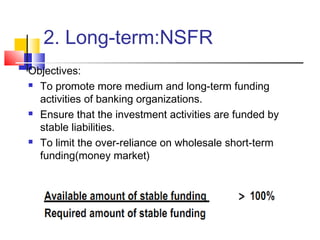
2. Long-term:NSFR
Objectives:
 To promote more medium and long-term funding

  activities of banking organizations.
 Ensure that the investment activities are funded by

  stable liabilities.
 To limit the over-reliance on wholesale short-term

  funding(money market)
Long-term:NSFR

Available stable funding (ASF) is defined as the total
  amount of an institution’s:

   capital.

   preferred stock with maturity of equal to or greater than
    one year.

   liabilities with effective maturities of one year or greater.

   deposits and/or term deposits with maturities of less than
    one year that would be expected to stay with the
    institution for an extended period a stress event.
Required Stable Funding:

   The required amount of stable funding is
    calculated as the sum of the value of the assets
    held and funded by the institution, multiplied by a
    RSF factor, added to the amount of OBS activity
    (or potential liquidity exposure) multiplied by its
    associated RSF factor.
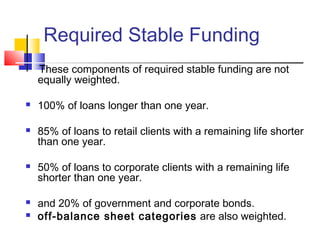
Required Stable Funding
    These components of required stable funding are not
    equally weighted.

   100% of loans longer than one year.

   85% of loans to retail clients with a remaining life shorter
    than one year.

   50% of loans to corporate clients with a remaining life
    shorter than one year.

   and 20% of government and corporate bonds.
   off-balance sheet categories are also weighted.
C. Systemic risk and
    interconnectedness (Counterparty
    risk)
   Capital incentives for using CCPs for OTC.

   Higher capital for systemic derivatives.

   Higher capital for inter-financial exposures.

   Contingent capital.

   Capital surcharge for systemic banks.
CONCLUSION
   Basel III introduces a paradigm shift in capital
    and liquidity standards.

   It was constructed and agreed in relatively
    record time which leaves many elements
    unfinished.

   The final implementation date a long way off.
HOWEVER,
   Market pressure and competitor pressure
    already driving considerable change at a
    range of firms.

   Firms therefore should ensure to engage with
    Basel III as soon as possible to be
    competitively advantaged in the new post-
    crisis financial risk and regulatory landscape.
References:
   Basel II: a guide to capital adequacy standards for Lenders.
    [Available at: http://www.cml.org.uk/cml/policy/issues/748]
   Basel III regulations: a practical overview. [Available at:
    www.moodysanalytics.com] [Accessed on 30/11/12].
   Basel III: Issues and implications. [Available at: www.kpmg.com]
    [Accessed on 30/11/12].
   Federal Reserve Proposes Revised Bank Captial Rules.
    [Available at:
    http://blogs.law.harvard.edu/corpgov/2012/06/12/federal-
    reserve-proposes-revised-ba...] [Accessed on 30/11/12].
   Introduction to Basel II: [Available at:
    http://www.rcg.ch/papers/basel2.pdf]
   Introduction to Basel II. [Available at:
    http://www.horwathmak.com/Literature/Introduction_to_basel_ii.
    pdf]
References: (Cont.)
    http://mpra.ub.uni-muenchen.de/35908/ [Accessed
    on 11/12/2012]
   The New Basel III Framework: Implications for
    Banking Organisations. [Available at:
    www.shearman.com][Accessed on 30/11/12].

Basel iii presentation

  • 1.
    Basel Ⅲ Chinwe Boston Mengchun Zhang Qiuli Guo Di Xiao Nathan Tsormetsri
  • 2.
    OVERVIEW Meaning of Basel III Why Basel III  Aims  Objectives  Major Changes Implementation of the Changes 
  • 3.
    What is "BaselIII":  " A global regulatory standard on:  bank capital adequacy  stress testing and  market liquidity risk
  • 4.
    Also a setof reform measures to improve:  Regulation  Supervision  Risk management
  • 5.
    Reasons for BaselIII Formulation:  Failures of Basel II being: A. Inability to strengthen financial stability. B. Insufficient capital reserve. C. Inadequate comprehensive risk management approach. D. Lack of uniformed definition of capital .
  • 6.
    Aims & Objectivesof Basel III  To minimize the probability of recurrence of crises to greater extent.  To improve the banking sector's ability to absorb shocks arising from financial and economic stress.  To improve risk management and governance.   To strengthen banks' transparency and disclosures .
  • 7.
    Targets: Bank-level or microprudential which will help raise the resilience of individual banking institutions in periods of stress. Macro prudential system wide risks that build up across the banking sector as well as the pro-cyclical amplification of these risk over time.
  • 8.
    Key Elements ofReforms… Increasing the quality and quantity capital Enhancing risk coverage of capital Introducing Leverage ratio Improving liquidity rules Establishing additional buffers Managing counter party risks
  • 9.
  • 10.
    Pillar 1:Minimum Capital Requirements • Pillar 1 aligns the minimum capital requirements more closely to actual risks of bank's economic loss. • revised risks: √ Credit risk √ Operational risk √ Market risk
  • 11.
    Pillar 1:Minimum Capital Requirements(cont.) • Credit risk √ The standardised approach √ Foundation internal ratings based (IRB) approach √ Advanced IRB approach • Operational risk √ Basic indicator approach √ Standardized approach √ Advanced measurement approach • Market risk √ standardized approach √ internal models approach
  • 12.
    Pillar 2:Supervisory ReviewProcess • Pillar 2 requires banks to think about the whole spectrum of risks they might face including those not captured at all in Pillar 1 such as interest rate risk. • Coverage in Pillar 2: √ risks that are not fully covered by Pillar 1 √ Credit concentration risk √ Counterparty credit risk √ Risks that are not covered by Pillar 1 √ Interest rate risk in the banking book √ Liquidity risk √ Business risk √ Stress testing
  • 13.
    Pillar 3:Market Discipline  Pillar 3 is designed to increase the transparency of lenders' risk profile by requiring them to give details of their risk management and risk distributions.
  • 14.
    Weaknesses of BaselII The quality of capital.  Pro-cyclicality.  Liquidity risk.  Systemic banks. 
  • 15.
    Basel III: Strengtheningthe global capital framework A. Capital reform. B. Liquidity standards. C. Systemic risk and interconnectedness.
  • 16.
    A. Capital Reform  A new definition of capital.  Capital conservation buffer.  Countercyclical capital buffer.  Minimum capital standards.
  • 17.
    A new definitionof capital  Total regulatory capital will consist of the sum of the following elements: 1. Tier 1 Capital (going-concern capital) a. Common Equity Tier 1 b. Additional Tier 1 2. Tier 2 Capital (gone-concern capital)  For each of the three categories above (1a, 1b and 2) there is a single set of criteria that instruments are required to meet before inclusion in the relevant category.
  • 18.
    Capital conservation buffer  The capital conservation buffer is designed to ensure that banks build up capital buffers outside periods of stress which can be drawn down as losses are incurred.  A capital conservation buffer of 2.5%, comprised of Common Equity Tier 1, is established above the regulatory minimum capital requirement.  Outside of periods of stress, banks should hold buffers of capital above the regulatory minimum.
  • 19.
    Countercyclical capital buffer  The countercyclical buffer aims to ensure that banking sector capital requirements take account of the macro- financial environment in which banks operate.  It will be deployed by national jurisdictions when excess aggregate credit growth is judged to be associated with a build-up of system-wide risk to ensure the banking system has a buffer of capital to protect it against future potential losses.
  • 20.
  • 21.
    B. Liquidity Standards: 1. Short-term: Liquidity Coverage Ratio(LCR) 2. Long-term: Net Stable Funding Ratio(NSFR)
  • 22.
    1.Short-term:LCR The LCR isa response from Basel committee to the recent financial crisis. The LCR proposal requires banks to hold high quality liquid assets in order to survive in emergent stress scenario.
  • 23.
    Short-term:LCR  Must be no lower than 1.  The higher the better.  high quality liquid: liquid in markets during a time of stress and, ideally, be central bank eligible.  Banks are still expected to conduct their own stress tests to assess the level of liquidity they should hold beyond this minimum, and construct scenarios that could cause difficulties for their specific business activities.
  • 24.
    2. Long-term:NSFR Objectives:  Topromote more medium and long-term funding activities of banking organizations.  Ensure that the investment activities are funded by stable liabilities.  To limit the over-reliance on wholesale short-term funding(money market)
  • 25.
    Long-term:NSFR Available stable funding(ASF) is defined as the total amount of an institution’s:  capital.  preferred stock with maturity of equal to or greater than one year.  liabilities with effective maturities of one year or greater.  deposits and/or term deposits with maturities of less than one year that would be expected to stay with the institution for an extended period a stress event.
  • 26.
    Required Stable Funding:  The required amount of stable funding is calculated as the sum of the value of the assets held and funded by the institution, multiplied by a RSF factor, added to the amount of OBS activity (or potential liquidity exposure) multiplied by its associated RSF factor.
  • 27.
    Required Stable Funding These components of required stable funding are not equally weighted.  100% of loans longer than one year.  85% of loans to retail clients with a remaining life shorter than one year.  50% of loans to corporate clients with a remaining life shorter than one year.  and 20% of government and corporate bonds.  off-balance sheet categories are also weighted.
  • 28.
    C. Systemic riskand interconnectedness (Counterparty risk)  Capital incentives for using CCPs for OTC.  Higher capital for systemic derivatives.  Higher capital for inter-financial exposures.  Contingent capital.  Capital surcharge for systemic banks.
  • 29.
    CONCLUSION  Basel III introduces a paradigm shift in capital and liquidity standards.  It was constructed and agreed in relatively record time which leaves many elements unfinished.  The final implementation date a long way off.
  • 30.
    HOWEVER,  Market pressure and competitor pressure already driving considerable change at a range of firms.  Firms therefore should ensure to engage with Basel III as soon as possible to be competitively advantaged in the new post- crisis financial risk and regulatory landscape.
  • 31.
    References:  Basel II: a guide to capital adequacy standards for Lenders. [Available at: http://www.cml.org.uk/cml/policy/issues/748]  Basel III regulations: a practical overview. [Available at: www.moodysanalytics.com] [Accessed on 30/11/12].  Basel III: Issues and implications. [Available at: www.kpmg.com] [Accessed on 30/11/12].  Federal Reserve Proposes Revised Bank Captial Rules. [Available at: http://blogs.law.harvard.edu/corpgov/2012/06/12/federal- reserve-proposes-revised-ba...] [Accessed on 30/11/12].  Introduction to Basel II: [Available at: http://www.rcg.ch/papers/basel2.pdf]  Introduction to Basel II. [Available at: http://www.horwathmak.com/Literature/Introduction_to_basel_ii. pdf]
  • 32.
    References: (Cont.)   http://mpra.ub.uni-muenchen.de/35908/ [Accessed on 11/12/2012]  The New Basel III Framework: Implications for Banking Organisations. [Available at: www.shearman.com][Accessed on 30/11/12].