NAEC Seminar, 20 November 2014 
EFFECTS OF GROWTH-ENHANCING 
POLICIES ON 
MICROECONOMIC 
STABILITY 
Boris Cournède, Paula Garda, Peter Hoeller, Volker Ziemann 
Public Economics Division of the OECD Economics Department
The impact of reforms on instability: an 
integral part of NAEC 
• OECD Going For Growth publications have recognised side-effects 
of growth-promoting policies on income inequality, the 
environment, government budgets and external accounts. 
• The recent financial crisis has underlined the damage that 
economic instability can inflict on welfare. 
• Looking at macroeconomic stability is not enough. 
• This study moves one step closer to people and analyses 
microeconomic stability focusing on firms, households and 
individuals. 
• Instability also affects growth and social mobility.
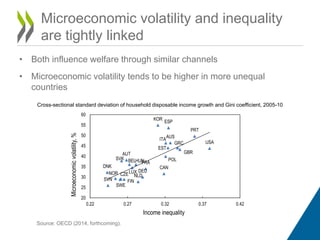
Microeconomic volatility and inequality 
are tightly linked 
• Both influence welfare through similar channels 
• Microeconomic volatility tends to be higher in more unequal 
countries 
Cross-sectional standard deviation of household disposable income growth and Gini coefficient, 2005-10 
60 
55 
50 
45 
40 
35 
30 
25 
Source: OECD (2014, forthcoming). 
AUS 
AUT 
BEL 
KOR 
CAN 
CZE 
DEU 
DNK 
ESP 
EST 
FIN 
FRA 
GBR 
GRC 
HUN 
ITA 
LUX 
NOR NLD 
POL 
PRT 
SVK 
SVN 
SWE 
USA 
20 
0.22 0.27 0.32 0.37 0.42 
Microeconomic volatility, % 
Income inequality
Volatility can be measured in different 
ways at the micro level 
• Rolling window: fluctuations are measured for each individual 
around average growth. Very natural but few degrees of 
freedom (estimation risk). 
• Incidence of large changes: the measure counts the 
proportion of people who undergo large changes (here, 
greater than 20%). It allows separate analyses of large 
increases and decreases. 
• Cross-sectional measure: it evaluates the dispersion of 
individual changes around the average. It is less demanding 
on the data but implicitly assumes constant average growth 
across the population (model risk). 
• The three measures are very highly correlated: correlation 
coefficients are very high and 99% statistically significant.
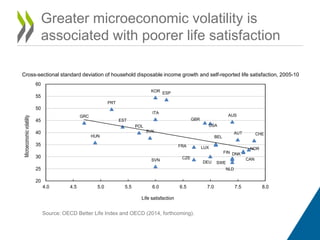
Greater microeconomic volatility is 
associated with poorer life satisfaction 
Cross-sectional standard deviation of household disposable income growth and self-reported life satisfaction, 2005-10 
KOR 
Source: OECD Better Life Index and OECD (2014, forthcoming). 
8 
AUS 
AUT 
USA 
BEL 
CAN 
CHE 
CZE 
DEU 
DNK 
ESP 
EST 
FIN 
FRA 
GBR 
GRC 
HUN 
ITA 
LUX 
NLD 
NOR 
POL 
PRT 
SVK 
SVN 
SWE 
60 
55 
50 
45 
40 
35 
30 
25 
20 
4.0 4.5 5.0 5.5 6.0 6.5 7.0 7.5 8.0 
Microeconomic volatility 
Life satisfaction
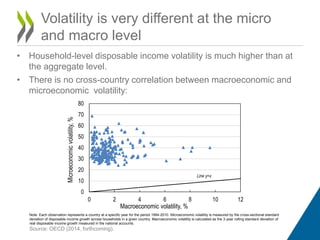
Volatility is very different at the micro 
and macro level 
• Household-level disposable income volatility is much higher than at 
the aggregate level. 
• There is no cross-country correlation between macroeconomic and 
microeconomic volatility: 
80 
70 
60 
50 
40 
30 
20 
10 
0 
Line y=x 
0 2 4 6 8 10 12 
Microeconomic volatility, % 
Macroeconomic volatility, % 
Note: Each observation represents a country at a specific year for the period 1994-2010. Microeconomic volatility is measured by the cross-sectional standard 
deviation of disposable income growth across households in a given country. Macroeconomic volatility is calculated as the 3-year rolling standard deviation of 
real disposable income growth measured in the national accounts. 
Source: OECD (2014, forthcoming).
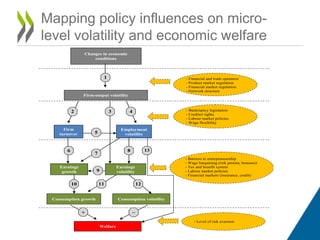
Mapping policy influences on micro-level 
volatility and economic welfare 
Changes in economic 
conditions 
- Financial and trade openness 
- Product market regulation 
- Financial market regulation 
- Network structure 
1 
Firm-output volatility 
- Bankruptcy legislation 
- Creditor rights 
- Labour market policies 
- Wage flexibility 
3 
Firm 
turnover 
Employment 
volatility 
- Barriers to entrepreneurship 
- Wage bargaining (risk premia, bonuses) 
- Tax and benefit system 
- Labour market policies 
- Financial markets (insurance, credit) 
6 
7 
Earnings 
volatility 
Earnings 
growth 
10 11 12 
Consumption growth Consumption volatility 
- Level of risk aversion 
+ − 
Welfare 
13 
2 4 
8 
5 
9
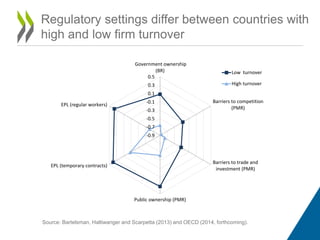
Regulatory settings differ between countries with 
high and low firm turnover 
Government ownership 
0.5 
0.3 
0.1 
-0.1 
-0.3 
-0.5 
-0.7 
-0.9 
(BR) 
Low turnover 
High turnover 
Barriers to competition 
(PMR) 
Barriers to trade and 
investment (PMR) 
Public ownership (PMR) 
EPL (regular workers) 
EPL (temporary contracts) 
Source: Bartelsman, Haltiwanger and Scarpetta (2013) and OECD (2014, forthcoming).
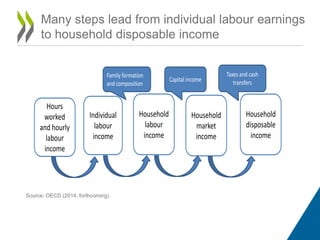
Many steps lead from individual labour earnings 
to household disposable income 
Individual 
labour 
income 
Source: OECD (2014, forthcoming). 
Household 
labour 
income 
Household 
market 
income 
Household 
disposable 
income 
Capital income 
Family formation 
and composition 
Taxes and cash 
transfers 
Hours 
worked 
and hourly 
labour 
income
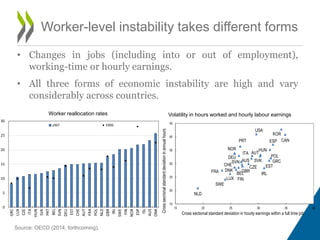
Worker-level instability takes different forms 
• Changes in jobs (including into or out of employment), 
working-time or hourly earnings. 
• All three forms of economic instability are high and vary 
considerably across countries. 
Worker reallocation rates Volatility in hours worked and hourly labour earnings 
2007 1995 
Source: OECD (2014, forthcoming). 
30 
25 
20 
15 
10 
5 
0 
GRC 
LUX 
CZE 
ITA 
HUN 
SVK 
PRT 
BEL 
SVN 
DEU 
EST 
CHE 
AUT 
FRA 
POL 
NLD 
GBR 
IRL 
SWE 
FIN 
NOR 
ESP 
ISL 
AUS 
DNK 
AUS 
AUT 
FRA GBR 
BEL 
CAN 
CHE 
CZE 
DEU 
DNK 
ESP 
EST 
FIN 
GRC 
HUN 
IRL 
ITA 
KOR 
LUX 
NLD 
NOR 
POL 
PRT 
SVN SVK 
SWE 
USA 
45 
40 
35 
30 
25 
20 
15 
15 20 25 30 35 40 
Cross sectional standard deviation in hourly earnings within a full time job 
Cross secrional standard deviation in annual hours
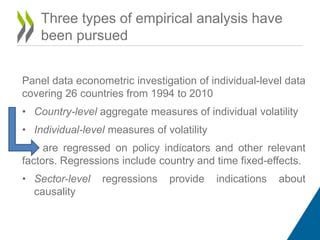
Three types of empirical analysis have 
been pursued 
Panel data econometric investigation of individual-level data 
covering 26 countries from 1994 to 2010 
• Country-level aggregate measures of individual volatility 
• Individual-level measures of volatility 
are regressed on policy indicators and other relevant 
factors. Regressions include country and time fixed-effects. 
• Sector-level regressions provide indications about 
causality
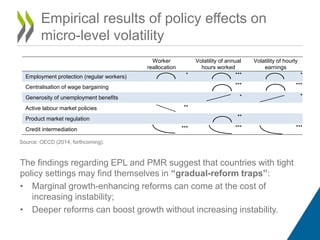
Empirical results of policy effects on 
micro-level volatility 
Worker 
reallocation 
Volatility of annual 
hours worked 
Volatility of hourly 
earnings 
Employment protection (regular workers) * *** * 
Centralisation of wage bargaining *** *** 
Generosity of unemployment benefits * * 
Active labour market policies ** 
Product market regulation ** 
Credit intermediation *** *** *** 
Source: OECD (2014, forthcoming). 
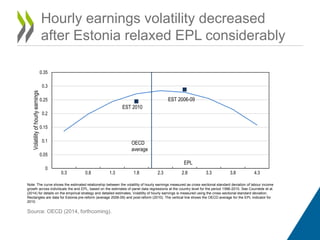
The findings regarding EPL and PMR suggest that countries with tight 
policy settings may find themselves in “gradual-reform traps”: 
• Marginal growth-enhancing reforms can come at the cost of 
increasing instability; 
• Deeper reforms can boost growth without increasing instability.
Hourly earnings volatility decreased 
after Estonia relaxed EPL considerably 
0.35 
0.3 
0.25 
0.2 
0.15 
0.1 
0.05 
EPL 
Note: The curve shows the estimated relationship between the volatility of hourly earnings measured as cross-sectional standard deviation of labour income 
growth across individuals the and EPL, based on the estimates of panel data regressions at the country level for the period 1996-2010. See Cournède et al. 
(2014) for details on the empirical strategy and detailed estimates. Volatility of hourly earnings is measured using the cross-sectional standard deviation. 
Rectangles are data for Estonia pre-reform (average 2006-09) and post-reform (2010). The vertical line shows the OECD average for the EPL indicator for 
2010. 
Source: OECD (2014, forthcoming). 
EST 2010 
EST 2006-09 
0 
0.3 0.8 1.3 1.8 2.3 2.8 3.3 3.8 4.3 
Volatility of hourly earnings 
OECD 
average
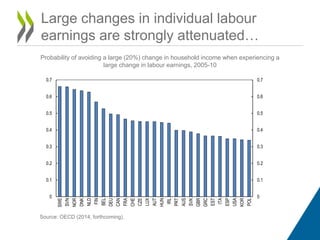
Large changes in individual labour 
earnings are strongly attenuated… 
Probability of avoiding a large (20%) change in household income when experiencing a 
0.7 
0.6 
0.5 
0.4 
0.3 
0.2 
0.1 
0 
0.7 
0.6 
0.5 
0.4 
0.3 
0.2 
0.1 
0 
large change in labour earnings, 2005-10 
SWE 
SVN 
NOR 
DNK 
NLD 
FIN 
BEL 
DEU 
CAN 
FRA 
CHE 
CZE 
LUX 
AUT 
HUN 
IRL 
PRT 
AUS 
SVK 
GBR 
GRC 
EST 
ITA 
ESP 
USA 
KOR 
POL 
Source: OECD (2014, forthcoming).
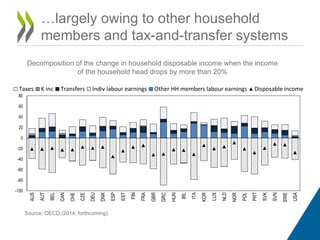
…largely owing to other household 
members and tax-and-transfer systems 
Decomposition of the change in household disposable income when the income 
of the household head drops by more than 20% 
Taxes K inc Transfers Indiv labour earnings Other HH members labour earnings Disposable income 
Source: OECD (2014, forthcoming). 
80 
60 
40 
20 
0 
-20 
-40 
-60 
-80 
-100 
AUS 
AUT 
BEL 
CAN 
CHE 
CZE 
DEU 
DNK 
ESP 
EST 
FIN 
FRA 
GBR 
GRC 
HUN 
IRL 
ITA 
KOR 
LUX 
NLD 
NOR 
POL 
PRT 
SVK 
SVN 
SWE 
USA
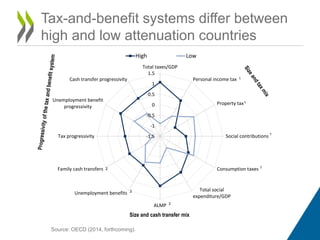
Tax-and-benefit systems differ between 
high and low attenuation countries 
Cash transfer progressivity 
Unemployment benefit 
progressivity 
Tax progressivity 
Family cash transfers 
Source: OECD (2014, forthcoming). 
Total taxes/GDP 
1.5 
1 
0.5 
0 
-0.5 
-1 
-1.5 
Personal income tax 
Property tax 
Social contributions 
Consumption taxes 
Total social 
expenditure/GDP 
ALMP 
Unemployment benefits 
High Low 
Size and cash transfer mix 
1 
1 
2 1 
2 
2 
1
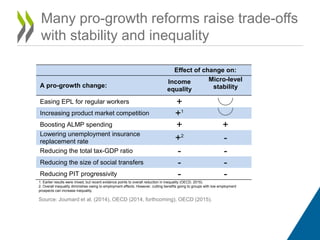
Many pro-growth reforms raise trade-offs 
with stability and inequality 
Effect of change on: 
A pro-growth change: 
Income 
equality 
Micro-level 
stability 
Easing EPL for regular workers + 
Increasing product market competition +1 
Boosting ALMP spending + + 
Lowering unemployment insurance 
replacement rate +2 - 
Reducing the total tax-GDP ratio - - 
Reducing the size of social transfers - - 
Reducing PIT progressivity - - 
1. Earlier results were mixed, but recent evidence points to overall reduction in inequality (OECD, 2015). 
2. Overall inequality diminishes owing to employment effects. However, cutting benefits going to groups with low employment 
prospects can increase inequality. 
Source: Joumard et al. (2014), OECD (2014, forthcoming), OECD (2015).
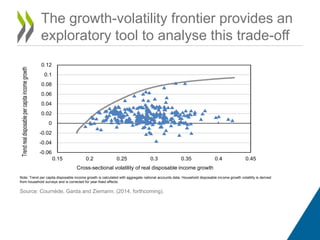
The growth-volatility frontier provides an 
exploratory tool to analyse this trade-off 
0.12 
0.1 
0.08 
0.06 
0.04 
0.02 
0 
-0.02 
-0.04 
-0.06 
0.15 0.2 0.25 0.3 0.35 0.4 0.45 
Cross-sectional volatility of real disposable income growth 
Trend real disposable per capita income growth 
Note: Trend per capita disposable income growth is calculated with aggregate national accounts data. Household disposable income growth volatility is derived 
from household surveys and is corrected for year-fixed effects. 
Source: Cournède, Garda and Ziemann. (2014, forthcoming).
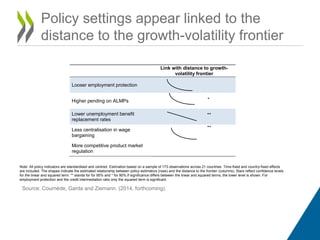
Policy settings appear linked to the 
distance to the growth-volatility frontier 
Link with distance to growth-volatility 
frontier 
Looser employment protection 
Higher pending on ALMPs * 
Lower unemployment benefit 
replacement rates 
** 
Less centralisation in wage 
bargaining 
** 
More competitive product market 
regulation 
Note: All policy indicators are standardised and centred. Estimation based on a sample of 173 observations across 21 countries. Time-fixed and country-fixed effects 
are included. The shapes indicate the estimated relationship between policy estimators (rows) and the distance to the frontier (columns). Stars reflect confidence levels 
for the linear and squared term: ** stands for for 95% and * for 90%.If significance differs between the linear and squared terms, the lower level is shown. For 
employment protection and the credit intermediation ratio only the squared term is significant. 
Source: Cournède, Garda and Ziemann. (2014, forthcoming).
The detailed results are available in: 
• OECD (2014), “Effects of Pro-Growth Policies on the Economic 
Stability of Firms, Workers and Households,” OECD Economic Policy 
Papers, forthcoming. 
• Garda, P. and V. Ziemann (2014), “Economic Policies and 
Microeconomic Stability: A Literature Review and Some Empirics,” 
OECD Economics Department Working Papers, No. 1115. 
• Cournède, B., P. Garda and V. Ziemann (2014), “Effects of Economic 
Policies on Microeconomic Stability,” OECD Economics Department 
Working Papers, forthcoming. 
Additional references: 
• Joumard, I, P. Hoeller and I. Koske (2014), Income Inequality in 
OECD Countries: What are the Drivers and the Policy Options, World 
Scientific Publishing. 
• OECD (2015), Going for Growth: Economic Policy Reforms in OECD 
Countries.

2014.11.20 - NAEC Seminar - Microstability

  • 1.
    NAEC Seminar, 20November 2014 EFFECTS OF GROWTH-ENHANCING POLICIES ON MICROECONOMIC STABILITY Boris Cournède, Paula Garda, Peter Hoeller, Volker Ziemann Public Economics Division of the OECD Economics Department
  • 2.
    The impact ofreforms on instability: an integral part of NAEC • OECD Going For Growth publications have recognised side-effects of growth-promoting policies on income inequality, the environment, government budgets and external accounts. • The recent financial crisis has underlined the damage that economic instability can inflict on welfare. • Looking at macroeconomic stability is not enough. • This study moves one step closer to people and analyses microeconomic stability focusing on firms, households and individuals. • Instability also affects growth and social mobility.
  • 3.
    Microeconomic volatility andinequality are tightly linked • Both influence welfare through similar channels • Microeconomic volatility tends to be higher in more unequal countries Cross-sectional standard deviation of household disposable income growth and Gini coefficient, 2005-10 60 55 50 45 40 35 30 25 Source: OECD (2014, forthcoming). AUS AUT BEL KOR CAN CZE DEU DNK ESP EST FIN FRA GBR GRC HUN ITA LUX NOR NLD POL PRT SVK SVN SWE USA 20 0.22 0.27 0.32 0.37 0.42 Microeconomic volatility, % Income inequality
  • 4.
    Volatility can bemeasured in different ways at the micro level • Rolling window: fluctuations are measured for each individual around average growth. Very natural but few degrees of freedom (estimation risk). • Incidence of large changes: the measure counts the proportion of people who undergo large changes (here, greater than 20%). It allows separate analyses of large increases and decreases. • Cross-sectional measure: it evaluates the dispersion of individual changes around the average. It is less demanding on the data but implicitly assumes constant average growth across the population (model risk). • The three measures are very highly correlated: correlation coefficients are very high and 99% statistically significant.
  • 5.
    Greater microeconomic volatilityis associated with poorer life satisfaction Cross-sectional standard deviation of household disposable income growth and self-reported life satisfaction, 2005-10 KOR Source: OECD Better Life Index and OECD (2014, forthcoming). 8 AUS AUT USA BEL CAN CHE CZE DEU DNK ESP EST FIN FRA GBR GRC HUN ITA LUX NLD NOR POL PRT SVK SVN SWE 60 55 50 45 40 35 30 25 20 4.0 4.5 5.0 5.5 6.0 6.5 7.0 7.5 8.0 Microeconomic volatility Life satisfaction
  • 6.
    Volatility is verydifferent at the micro and macro level • Household-level disposable income volatility is much higher than at the aggregate level. • There is no cross-country correlation between macroeconomic and microeconomic volatility: 80 70 60 50 40 30 20 10 0 Line y=x 0 2 4 6 8 10 12 Microeconomic volatility, % Macroeconomic volatility, % Note: Each observation represents a country at a specific year for the period 1994-2010. Microeconomic volatility is measured by the cross-sectional standard deviation of disposable income growth across households in a given country. Macroeconomic volatility is calculated as the 3-year rolling standard deviation of real disposable income growth measured in the national accounts. Source: OECD (2014, forthcoming).
  • 7.
    Mapping policy influenceson micro-level volatility and economic welfare Changes in economic conditions - Financial and trade openness - Product market regulation - Financial market regulation - Network structure 1 Firm-output volatility - Bankruptcy legislation - Creditor rights - Labour market policies - Wage flexibility 3 Firm turnover Employment volatility - Barriers to entrepreneurship - Wage bargaining (risk premia, bonuses) - Tax and benefit system - Labour market policies - Financial markets (insurance, credit) 6 7 Earnings volatility Earnings growth 10 11 12 Consumption growth Consumption volatility - Level of risk aversion + − Welfare 13 2 4 8 5 9
  • 8.
    Regulatory settings differbetween countries with high and low firm turnover Government ownership 0.5 0.3 0.1 -0.1 -0.3 -0.5 -0.7 -0.9 (BR) Low turnover High turnover Barriers to competition (PMR) Barriers to trade and investment (PMR) Public ownership (PMR) EPL (regular workers) EPL (temporary contracts) Source: Bartelsman, Haltiwanger and Scarpetta (2013) and OECD (2014, forthcoming).
  • 9.
    Many steps leadfrom individual labour earnings to household disposable income Individual labour income Source: OECD (2014, forthcoming). Household labour income Household market income Household disposable income Capital income Family formation and composition Taxes and cash transfers Hours worked and hourly labour income
  • 10.
    Worker-level instability takesdifferent forms • Changes in jobs (including into or out of employment), working-time or hourly earnings. • All three forms of economic instability are high and vary considerably across countries. Worker reallocation rates Volatility in hours worked and hourly labour earnings 2007 1995 Source: OECD (2014, forthcoming). 30 25 20 15 10 5 0 GRC LUX CZE ITA HUN SVK PRT BEL SVN DEU EST CHE AUT FRA POL NLD GBR IRL SWE FIN NOR ESP ISL AUS DNK AUS AUT FRA GBR BEL CAN CHE CZE DEU DNK ESP EST FIN GRC HUN IRL ITA KOR LUX NLD NOR POL PRT SVN SVK SWE USA 45 40 35 30 25 20 15 15 20 25 30 35 40 Cross sectional standard deviation in hourly earnings within a full time job Cross secrional standard deviation in annual hours
  • 11.
    Three types ofempirical analysis have been pursued Panel data econometric investigation of individual-level data covering 26 countries from 1994 to 2010 • Country-level aggregate measures of individual volatility • Individual-level measures of volatility are regressed on policy indicators and other relevant factors. Regressions include country and time fixed-effects. • Sector-level regressions provide indications about causality
  • 12.
    Empirical results ofpolicy effects on micro-level volatility Worker reallocation Volatility of annual hours worked Volatility of hourly earnings Employment protection (regular workers) * *** * Centralisation of wage bargaining *** *** Generosity of unemployment benefits * * Active labour market policies ** Product market regulation ** Credit intermediation *** *** *** Source: OECD (2014, forthcoming). The findings regarding EPL and PMR suggest that countries with tight policy settings may find themselves in “gradual-reform traps”: • Marginal growth-enhancing reforms can come at the cost of increasing instability; • Deeper reforms can boost growth without increasing instability.
  • 13.
    Hourly earnings volatilitydecreased after Estonia relaxed EPL considerably 0.35 0.3 0.25 0.2 0.15 0.1 0.05 EPL Note: The curve shows the estimated relationship between the volatility of hourly earnings measured as cross-sectional standard deviation of labour income growth across individuals the and EPL, based on the estimates of panel data regressions at the country level for the period 1996-2010. See Cournède et al. (2014) for details on the empirical strategy and detailed estimates. Volatility of hourly earnings is measured using the cross-sectional standard deviation. Rectangles are data for Estonia pre-reform (average 2006-09) and post-reform (2010). The vertical line shows the OECD average for the EPL indicator for 2010. Source: OECD (2014, forthcoming). EST 2010 EST 2006-09 0 0.3 0.8 1.3 1.8 2.3 2.8 3.3 3.8 4.3 Volatility of hourly earnings OECD average
  • 14.
    Large changes inindividual labour earnings are strongly attenuated… Probability of avoiding a large (20%) change in household income when experiencing a 0.7 0.6 0.5 0.4 0.3 0.2 0.1 0 0.7 0.6 0.5 0.4 0.3 0.2 0.1 0 large change in labour earnings, 2005-10 SWE SVN NOR DNK NLD FIN BEL DEU CAN FRA CHE CZE LUX AUT HUN IRL PRT AUS SVK GBR GRC EST ITA ESP USA KOR POL Source: OECD (2014, forthcoming).
  • 15.
    …largely owing toother household members and tax-and-transfer systems Decomposition of the change in household disposable income when the income of the household head drops by more than 20% Taxes K inc Transfers Indiv labour earnings Other HH members labour earnings Disposable income Source: OECD (2014, forthcoming). 80 60 40 20 0 -20 -40 -60 -80 -100 AUS AUT BEL CAN CHE CZE DEU DNK ESP EST FIN FRA GBR GRC HUN IRL ITA KOR LUX NLD NOR POL PRT SVK SVN SWE USA
  • 16.
    Tax-and-benefit systems differbetween high and low attenuation countries Cash transfer progressivity Unemployment benefit progressivity Tax progressivity Family cash transfers Source: OECD (2014, forthcoming). Total taxes/GDP 1.5 1 0.5 0 -0.5 -1 -1.5 Personal income tax Property tax Social contributions Consumption taxes Total social expenditure/GDP ALMP Unemployment benefits High Low Size and cash transfer mix 1 1 2 1 2 2 1
  • 17.
    Many pro-growth reformsraise trade-offs with stability and inequality Effect of change on: A pro-growth change: Income equality Micro-level stability Easing EPL for regular workers + Increasing product market competition +1 Boosting ALMP spending + + Lowering unemployment insurance replacement rate +2 - Reducing the total tax-GDP ratio - - Reducing the size of social transfers - - Reducing PIT progressivity - - 1. Earlier results were mixed, but recent evidence points to overall reduction in inequality (OECD, 2015). 2. Overall inequality diminishes owing to employment effects. However, cutting benefits going to groups with low employment prospects can increase inequality. Source: Joumard et al. (2014), OECD (2014, forthcoming), OECD (2015).
  • 18.
    The growth-volatility frontierprovides an exploratory tool to analyse this trade-off 0.12 0.1 0.08 0.06 0.04 0.02 0 -0.02 -0.04 -0.06 0.15 0.2 0.25 0.3 0.35 0.4 0.45 Cross-sectional volatility of real disposable income growth Trend real disposable per capita income growth Note: Trend per capita disposable income growth is calculated with aggregate national accounts data. Household disposable income growth volatility is derived from household surveys and is corrected for year-fixed effects. Source: Cournède, Garda and Ziemann. (2014, forthcoming).
  • 19.
    Policy settings appearlinked to the distance to the growth-volatility frontier Link with distance to growth-volatility frontier Looser employment protection Higher pending on ALMPs * Lower unemployment benefit replacement rates ** Less centralisation in wage bargaining ** More competitive product market regulation Note: All policy indicators are standardised and centred. Estimation based on a sample of 173 observations across 21 countries. Time-fixed and country-fixed effects are included. The shapes indicate the estimated relationship between policy estimators (rows) and the distance to the frontier (columns). Stars reflect confidence levels for the linear and squared term: ** stands for for 95% and * for 90%.If significance differs between the linear and squared terms, the lower level is shown. For employment protection and the credit intermediation ratio only the squared term is significant. Source: Cournède, Garda and Ziemann. (2014, forthcoming).
  • 20.
    The detailed resultsare available in: • OECD (2014), “Effects of Pro-Growth Policies on the Economic Stability of Firms, Workers and Households,” OECD Economic Policy Papers, forthcoming. • Garda, P. and V. Ziemann (2014), “Economic Policies and Microeconomic Stability: A Literature Review and Some Empirics,” OECD Economics Department Working Papers, No. 1115. • Cournède, B., P. Garda and V. Ziemann (2014), “Effects of Economic Policies on Microeconomic Stability,” OECD Economics Department Working Papers, forthcoming. Additional references: • Joumard, I, P. Hoeller and I. Koske (2014), Income Inequality in OECD Countries: What are the Drivers and the Policy Options, World Scientific Publishing. • OECD (2015), Going for Growth: Economic Policy Reforms in OECD Countries.