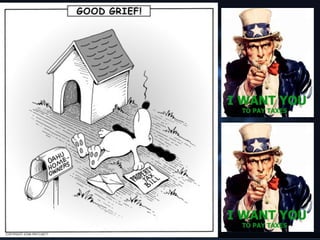
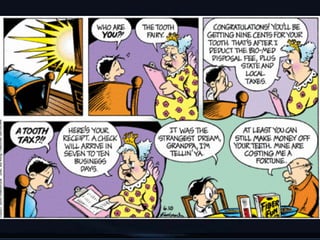
Taxes


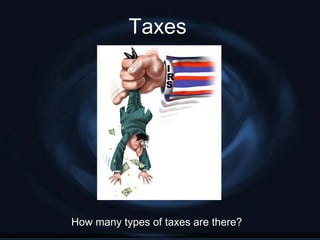
How many types of taxes are there?
In the Beginning
“No Taxation Without Representation” - Immediately after
the Revolutionary War, Americans decided who could and
could not tax them. Under the Articles of Confederation,
the national government could only ASK states for money.
States, not Congress, could tax INDIVIDUALS if they
chose. America quickly(6 years) realized a government
that has no power to tax is really no government. It needs
money to carry out its duties.


“Taxation With Representation” - Our founding fathers
created a taxation framework in the Constitution that would
give government the power to tax, but limit the power so it
would not be abused.
How?
1. All tax bills originate in the House of Representatives
   (2 yr. terms directly elected)

2. National taxes paid by each state will be according to
    their population

3. “All (national) duties, imposts, and excises” will be
    uniform throughout the US


Important - Income taxes were unconstitutional because
   they are based on income and not population
What Was Out First Tax?
Not Income or Sales Tax:

•   Tariffs (Imports) 1790 - Most items were given a 5%
    duty. “Luxury” items such as liquor, coffee, and soap
    were set higher. Imports shipped on US ships were
    taxed at 4%. These tariffs were “revenue tariffs”
    (designed to raise money) not “protective” tariffs (design
    to drive out foreign competition) and were successful.

•   Excise Tax - Many items were chosen over the years for
    tax (carriages, snuff, stamps). However, the whiskey
    tax of 1794 led to the famous Whiskey Rebellion.

•   16th Amendment (1963) - Income tax and the end of the
    servant class
Tax Resistance in History
•   American Quakers refusal to pay taxes during the French and
    Indian War (1757 - 1763)

•   1770s - American colonists resistance to British taxes

•   1848 - Author Henry David Thoreau was jailed for refusing to
    pay taxes in opposition to the Fugitive Slave Act and the
    Mexican American War

•   1930 - Gandhi’s famous Salt March to resist British tax on salt

•   1965 - Amish are exempt from Social Security taxes. They feel
    God is the only insurance they need

•   Recently - Anti-abortion and capital punishment activists have
    refused to pay taxes which support it. Also, gay rights activist.
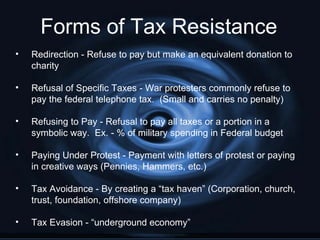
Forms of Tax Resistance
•   Redirection - Refuse to pay but make an equivalent donation to
    charity

•   Refusal of Specific Taxes - War protesters commonly refuse to
    pay the federal telephone tax. (Small and carries no penalty)

•   Refusing to Pay - Refusal to pay all taxes or a portion in a
    symbolic way. Ex. - % of military spending in Federal budget

•   Paying Under Protest - Payment with letters of protest or paying
    in creative ways (Pennies, Hammers, etc.)

•   Tax Avoidance - By creating a “tax haven” (Corporation, church,
    trust, foundation, offshore company)

•   Tax Evasion - “underground economy”

Taxes

  • 1.
    Taxes How many typesof taxes are there?
  • 3.
    In the Beginning “NoTaxation Without Representation” - Immediately after the Revolutionary War, Americans decided who could and could not tax them. Under the Articles of Confederation, the national government could only ASK states for money. States, not Congress, could tax INDIVIDUALS if they chose. America quickly(6 years) realized a government that has no power to tax is really no government. It needs money to carry out its duties. “Taxation With Representation” - Our founding fathers created a taxation framework in the Constitution that would give government the power to tax, but limit the power so it would not be abused.
  • 4.
    How? 1. All taxbills originate in the House of Representatives (2 yr. terms directly elected) 2. National taxes paid by each state will be according to their population 3. “All (national) duties, imposts, and excises” will be uniform throughout the US Important - Income taxes were unconstitutional because they are based on income and not population
  • 6.
    What Was OutFirst Tax? Not Income or Sales Tax: • Tariffs (Imports) 1790 - Most items were given a 5% duty. “Luxury” items such as liquor, coffee, and soap were set higher. Imports shipped on US ships were taxed at 4%. These tariffs were “revenue tariffs” (designed to raise money) not “protective” tariffs (design to drive out foreign competition) and were successful. • Excise Tax - Many items were chosen over the years for tax (carriages, snuff, stamps). However, the whiskey tax of 1794 led to the famous Whiskey Rebellion. • 16th Amendment (1963) - Income tax and the end of the servant class
  • 8.
    Tax Resistance inHistory • American Quakers refusal to pay taxes during the French and Indian War (1757 - 1763) • 1770s - American colonists resistance to British taxes • 1848 - Author Henry David Thoreau was jailed for refusing to pay taxes in opposition to the Fugitive Slave Act and the Mexican American War • 1930 - Gandhi’s famous Salt March to resist British tax on salt • 1965 - Amish are exempt from Social Security taxes. They feel God is the only insurance they need • Recently - Anti-abortion and capital punishment activists have refused to pay taxes which support it. Also, gay rights activist.
  • 9.
    Forms of TaxResistance • Redirection - Refuse to pay but make an equivalent donation to charity • Refusal of Specific Taxes - War protesters commonly refuse to pay the federal telephone tax. (Small and carries no penalty) • Refusing to Pay - Refusal to pay all taxes or a portion in a symbolic way. Ex. - % of military spending in Federal budget • Paying Under Protest - Payment with letters of protest or paying in creative ways (Pennies, Hammers, etc.) • Tax Avoidance - By creating a “tax haven” (Corporation, church, trust, foundation, offshore company) • Tax Evasion - “underground economy”