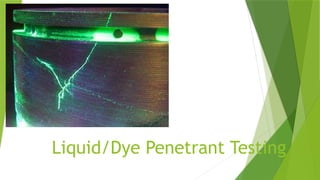
Liquid/Dye Penetrant Testing
LIQUID PENETRANT INSPECTION
 It is a nondestructive method of revealing discontinuities that
are open to the surfaces of solid and essentially nonporous
materials.
 Relative ease of use and flexibility
 Well suited to the detection of all types of surface cracks, laps,
porosity, shrinkage areas, laminations, and similar
discontinuities
 Extensively used for the inspection of wrought and cast
products of both ferrous and nonferrous metals, powder
metallurgy parts, ceramics, plastics, and glass objects
NDT PERSONNEL REQUIREMENTS
 The apparent simplicity of the penetrant process is deceptive.
 Very small processing variations during penetrant application, removal of excess surface
penetrant, application of developer, or examination can produce large differences in
inspection results.
 Therefore, the process is highly dependent on the operator’s knowledge, skill, and
experience.
 The reliability and confidence in the inspection are totally dependent upon the operator
and inspector.
 The operator who is responsible for processing the parts must be trained, have some
experience in processing requirements, and must be aware of the detrimental effects of
processing variations.
 Inspectors who examine and evaluate indications must also be trained and have
experience in the processing requirements and must be capable of making
decisions based on the interpretation of penetrant indications.
Human Eye
 The retina is a mosaic of two basic types of photoreceptors: rods, and cones.
 Rods are sensitive to blue-green light with peak sensitivity at a wavelength of
498 nm, and are used for vision under dark or dim conditions.
 There are three types of cones that give us our basic color vision: L-cones (red)
with a peak sensitivity of 564 nm, M-cones (green) with a peak sensitivity of 533
nm, and S-cones (blue) with a peak sensitivity of 437 nm.
History
 1. Use of carbon black for glazed pottery
 2. 1900s-The kerosene-and-whiting test in Railway workshops
o Low viscosity, good wettability, and ready availability – kerosene
o Contrast- Whitewash was used
o It provided a vast improvement over ordinary visual examination.
 3. 1940- Visible Dye Penetrant
 4. 1942- Fluorescent Dye Penetrant-by R.C. Switzer
Procedure
 Surface Preparation:
 One of the most critical steps of a liquid penetrant inspection
 The surface must be free of oil, grease, water, or other contaminants that may
prevent penetrant from entering flaws.
 The sample may also require etching if mechanical operations such as machining, sanding, or grit
blasting have been performed.
 PenetrantiApplication:
 By spraying, brushing, or immersing the part in a penetrant bath
 Penetrant Dwell:
 Dwell time is the total time that the penetrant is in contact with
the part surface.
 The times vary depending on the application, penetrant materials
used, the material, the form of the material being inspected, and
the type of defect being inspected for.
 Minimum dwell times typically range from five to 60 minutes.
 The penetrant is not allowed to dry.
 The ideal dwell time is often determined by experimentation and
may be very specific to a particular application.
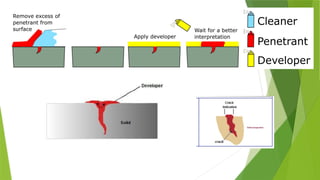
 Excess Penetrant Removal:
 Depending on the penetrant system used, this step may involve
cleaning with a solvent, direct rinsing with water, or first treating
the part with an emulsifier and then rinsing with water.
 Developer Application:
 A thin layer of developer is then applied to the sample to draw penetrant trapped in flaws
back to the surface where it will be visible. Developers come in a variety of forms that may
be applied by dusting (dry powdered), dipping, or spraying (wet developers).
 Indication Development:
 The developer is allowed to stand on the part surface for a period of time sufficient to permit
the extraction of the trapped penetrant out of any surface flaws.
 This development time is usually a minimum of 10 minutes.
 Significantly longer times may be necessary for tight cracks.
 Inspection: Inspection is then performed under appropriate lighting to detect indications from
any flaws which may be present.
 Clean Surface:
 The final step in the process is to thoroughly clean the part surface to remove
the developer from the parts that were found to be acceptable.
Advantages
• The method has high sensitivity to small surface discontinuities.
• The method has few material limitations, i.e. metallic and nonmetallic,
magnetic and nonmagnetic, and conductive and nonconductive materials
may be inspected.
• Large areas and large volumes of parts/materials can be inspected rapidly
and at low cost.
• Parts with complex geometric shapes are routinely inspected.
• Indications are produced directly on the surface of the part and constitute a
visual representation of the flaw
• Aerosol spray cans make penetrant materials very portable.
• Penetrant materials and associated equipment are relatively inexpensive.
Limitations
• Only surface breaking defects can be detected.
• Only materials with a relatively nonporous surface can be
inspected.
• Precleaning is critical since contaminants can mask defects.
• Metal smearing from machining, grinding, and grit or vapor
blasting must be removed prior to LPI.
• The inspector must have direct access to the surface being
inspected.
• Surface finish and roughness can affect inspection sensitivity.
• Multiple process operations must be performed and
controlled.
• Post cleaning of acceptable parts or materials is required.
• Chemical handling and proper disposal is required.
Physical Principles
 Depends mainly on a penetrant's effectively wetting the surface to form a continuous
and reasonably uniform coating, and then migrating into cavities that are open to the
surface.
 The cavities of interest are usually exceedingly small, often invisible to the unaided eye.
 The ability of a given liquid to flow over a surface and enter surface cavities depends
principally on the following:
· Cleanliness of the surface & Cavity
. Ability of the liquid to wet the surface-
· Configuration of the cavity
· Size of surface opening of the cavity-
· Surface tension of the liquid-
·
Capillarity
Contact angle of the liquid
Wetability
Capillary Action
Liquid Penetrant Testing. Very Good Presentation .pptx

Liquid Penetrant Testing. Very Good Presentation .pptx

  • 1.
  • 2.
    LIQUID PENETRANT INSPECTION It is a nondestructive method of revealing discontinuities that are open to the surfaces of solid and essentially nonporous materials.  Relative ease of use and flexibility  Well suited to the detection of all types of surface cracks, laps, porosity, shrinkage areas, laminations, and similar discontinuities  Extensively used for the inspection of wrought and cast products of both ferrous and nonferrous metals, powder metallurgy parts, ceramics, plastics, and glass objects
  • 5.
    NDT PERSONNEL REQUIREMENTS The apparent simplicity of the penetrant process is deceptive.  Very small processing variations during penetrant application, removal of excess surface penetrant, application of developer, or examination can produce large differences in inspection results.  Therefore, the process is highly dependent on the operator’s knowledge, skill, and experience.  The reliability and confidence in the inspection are totally dependent upon the operator and inspector.  The operator who is responsible for processing the parts must be trained, have some experience in processing requirements, and must be aware of the detrimental effects of processing variations.  Inspectors who examine and evaluate indications must also be trained and have experience in the processing requirements and must be capable of making decisions based on the interpretation of penetrant indications.
  • 6.
    Human Eye  Theretina is a mosaic of two basic types of photoreceptors: rods, and cones.  Rods are sensitive to blue-green light with peak sensitivity at a wavelength of 498 nm, and are used for vision under dark or dim conditions.  There are three types of cones that give us our basic color vision: L-cones (red) with a peak sensitivity of 564 nm, M-cones (green) with a peak sensitivity of 533 nm, and S-cones (blue) with a peak sensitivity of 437 nm.
  • 7.
    History  1. Useof carbon black for glazed pottery  2. 1900s-The kerosene-and-whiting test in Railway workshops o Low viscosity, good wettability, and ready availability – kerosene o Contrast- Whitewash was used o It provided a vast improvement over ordinary visual examination.  3. 1940- Visible Dye Penetrant  4. 1942- Fluorescent Dye Penetrant-by R.C. Switzer
  • 8.
    Procedure  Surface Preparation: One of the most critical steps of a liquid penetrant inspection  The surface must be free of oil, grease, water, or other contaminants that may prevent penetrant from entering flaws.  The sample may also require etching if mechanical operations such as machining, sanding, or grit blasting have been performed.  PenetrantiApplication:  By spraying, brushing, or immersing the part in a penetrant bath
  • 9.
     Penetrant Dwell: Dwell time is the total time that the penetrant is in contact with the part surface.  The times vary depending on the application, penetrant materials used, the material, the form of the material being inspected, and the type of defect being inspected for.  Minimum dwell times typically range from five to 60 minutes.  The penetrant is not allowed to dry.  The ideal dwell time is often determined by experimentation and may be very specific to a particular application.  Excess Penetrant Removal:  Depending on the penetrant system used, this step may involve cleaning with a solvent, direct rinsing with water, or first treating the part with an emulsifier and then rinsing with water.
  • 10.
     Developer Application: A thin layer of developer is then applied to the sample to draw penetrant trapped in flaws back to the surface where it will be visible. Developers come in a variety of forms that may be applied by dusting (dry powdered), dipping, or spraying (wet developers).  Indication Development:  The developer is allowed to stand on the part surface for a period of time sufficient to permit the extraction of the trapped penetrant out of any surface flaws.  This development time is usually a minimum of 10 minutes.  Significantly longer times may be necessary for tight cracks.  Inspection: Inspection is then performed under appropriate lighting to detect indications from any flaws which may be present.  Clean Surface:  The final step in the process is to thoroughly clean the part surface to remove the developer from the parts that were found to be acceptable.
  • 12.
    Advantages • The methodhas high sensitivity to small surface discontinuities. • The method has few material limitations, i.e. metallic and nonmetallic, magnetic and nonmagnetic, and conductive and nonconductive materials may be inspected. • Large areas and large volumes of parts/materials can be inspected rapidly and at low cost. • Parts with complex geometric shapes are routinely inspected. • Indications are produced directly on the surface of the part and constitute a visual representation of the flaw • Aerosol spray cans make penetrant materials very portable. • Penetrant materials and associated equipment are relatively inexpensive.
  • 13.
    Limitations • Only surfacebreaking defects can be detected. • Only materials with a relatively nonporous surface can be inspected. • Precleaning is critical since contaminants can mask defects. • Metal smearing from machining, grinding, and grit or vapor blasting must be removed prior to LPI. • The inspector must have direct access to the surface being inspected. • Surface finish and roughness can affect inspection sensitivity. • Multiple process operations must be performed and controlled. • Post cleaning of acceptable parts or materials is required. • Chemical handling and proper disposal is required.
  • 14.
    Physical Principles  Dependsmainly on a penetrant's effectively wetting the surface to form a continuous and reasonably uniform coating, and then migrating into cavities that are open to the surface.  The cavities of interest are usually exceedingly small, often invisible to the unaided eye.  The ability of a given liquid to flow over a surface and enter surface cavities depends principally on the following: · Cleanliness of the surface & Cavity . Ability of the liquid to wet the surface- · Configuration of the cavity · Size of surface opening of the cavity- · Surface tension of the liquid- · Capillarity Contact angle of the liquid
  • 15.
  • 16.