Liquid penetrate inspection
Unit-1
K.KRISHNA KISHORE
kakarlakishore11@gmail.com
• Liquid penetrate inspection:
• Principles of penetrate inspection,
• characteristics of a penetrate,
• water washable system,
• post emulsification system ,
• solvent removable system,
• surface preparation and cleaning,
• penetrate application,
• development,
• advantages limitations,
• and applications.
Principle
• The principle of the technique is that a liquid is
drawn by capillary attraction into the defect and,
after subsequent development, any surface-breaking
defects may be rendered visible to the human eye.
Introduction
• A liquid with high surface wetting characteristics is applied
to the surface of a component under test.
• The penetrant “penetrates” into surface breaking
discontinuities via capillary action and other mechanisms.
• Excess penetrant is removed from the surface and a
developer is applied to pull trapped penetrant back the
surface.
• With good inspection technique, visual indications of any
discontinuities present become apparent.
Basic Process
• 1) Clean & Dry Component
• 2) Apply Penetrant
3) Remove Excess 4) Apply Developer
5) Visual Inspection
6) Post Clean Component
What Can Be Inspected
• Almost any material that has a relatively smooth, non-porous surface on
which discontinuities or defects are suspected.
What Can NOT be Inspected
• Components with rough surfaces, such as sand castings, that
trap and hold penetrant
• Porous ceramics
• Wood and other fibrous materials
• Plastic parts that absorb or react with the penetrant
materials
• Components with coatings that prevent penetrants from
entering defects
Choices of Penetrant Materials
• Penetrant Type
I Fluorescent
II Visible
Method
• Water Washable
• Post emulsifiable
• Solvent Removable
Visible Vs Fluorescent
• Visible Penetrate test is
performed under white light
• level 1 sensitivity range
Photo Courtesy of Contesco
•while fluorescent Penetrate test
must be performed using an
ultraviolet light in a darkened area
•Sensitivity ranges from 1 to 4
Fluorescent Penetrate test is more sensitive than visible Penetrate test
because the eye is more sensitive to a bright indication on a dark
background.
Characteristics Of A Penetrate
• Penetration
– The penetrant must have the ability to enter extremely fine surface defects or
other openings in the component under test.
• Body
– The penetrant must have a good surface wetting ability
• Fluidity
– the penetrant should have the ability to drain away from the
component well
• Solution ability
– If necessary, the penetrant should be capable of dissolving a path into
contaminated defects, through a wide range of contaminants.
• Stability
– The liquid penetrant should be stable over a wide range of
temperature and humidity
– should not form a *scum or lose its **volatile constituents while it is
kept in open tanks or when stored in drums.
– * Scum- a layer of dirt or froth on the surface of a liquid
– ** Volatile -easily evaporated at normal temperatures
• Washability
– It must be possible to remove excess penetrants from component surfaces
easily without affecting the penetrant within any defects.
• Drying characteristics
– A penetrant must resist drying out, and complete bleed out, during hot-air
drying of the component after the wash operation has been completed.
• Visibility
– a good, deep colour can be given to the penetrant by a comparatively
small amount of dye.
– If a large amount of dye is used in the formulation, the penetrating
abilities of the fluid could be reduced.
– Red is the most commonly used colour in dye penetrants as this
colour is the most readily seen by the human eye
Sensitivity Levels
• The higher the sensitivity level, the smaller the defect that
the penetrant system is capable of detecting
– Level 4 - Ultra-High Sensitivity
– Level 3 - High Sensitivity
– Level 2 - Medium Sensitivity
– Level 1 - Low Sensitivity
Developer
• Form
 Dry Powder
 Wet, Water Soluble
 Wet, Water Suspendable
 Wet, Non-Aqueous
Principles (6 Steps) of Liquid
Penetrant Inspection
1. Pre-Clean(Surface preparation)
2. Application of Penetrant
3. Removal of excess penetrant.
4. Development (Developer Application)
5. Observation and inspection.
6. Post-clean
Step 1-Pre-cleaning(surface
preparation)
• Parts must be free of dirt, rust, scale, oil, grease, etc.
to perform a reliable inspection.
• The cleaning process must remove contaminants
from the surfaces of the part and defects, and must
not plug any of the defects.
• Some machining, surface finishing and cleaning operations
can cause a thin layer of metal to smear on the surface and
prevent penetrant from entering any flaws that may be present.
• Etching of the surface prior to inspection is sometimes
required
Before Sanding
After Sanding
After Etching
Step 2- Application of Penetrant
• Many methods of application are possible such as:
– Brushing
– Spraying
– Dipping/
Immersing
– Flow-on
– And more
What is Dwell Time
• The penetrant solution must be
allowed to “dwell” on the surface of
the part to allow the penetrant time
to fill any defects present.
• The dwell time vary according to
penetrant type, temperature,
material type and surface finish.
Step 3- Removal of excess
penetrant
The removal technique depends upon the type
of penetrant used, as stated earlier…
– Solvent Removable
– Water Washable
– Post Emulsifiable
Solvent Removable
•The part is wiped with a clean dry cloth to remove the bulk of the excess
penetrant.
•Then, a cloth lightly dampened with solvent is used to remove any
remaining penetrant on the surface.
•Any time a solvent is used in the penetrant inspection process, a
suitable flash time is required to allow excess solvent to evaporate.
•They are supplied in aerosol cans for portability and are primarily used
for spot checks.
• It is often necessary, to inspect only a small area of a component, or to
inspect a component in situ rather than at a regular inspection station.
• There are two basic solvent types:
– flammable and non-flammable
• this system is extremely sensitive
• the costs are relatively high
• high material expense
• more labour-intensive process
Water Washable
• A coarse water spray is used to remove the excess penetrant.
• The procedure used as a guideline for the inspection will specify water
temperature (typically 50-100°F) and pressure (typically not more than
40 psi), etc.
• They are the easiest to employ and most cost effective when inspecting
large areas.
• Processing conditions
– water pressure and temperature
– duration of rinse cycle
– surface condition of the workpiece
– inherent removal characteristies of the penetrant
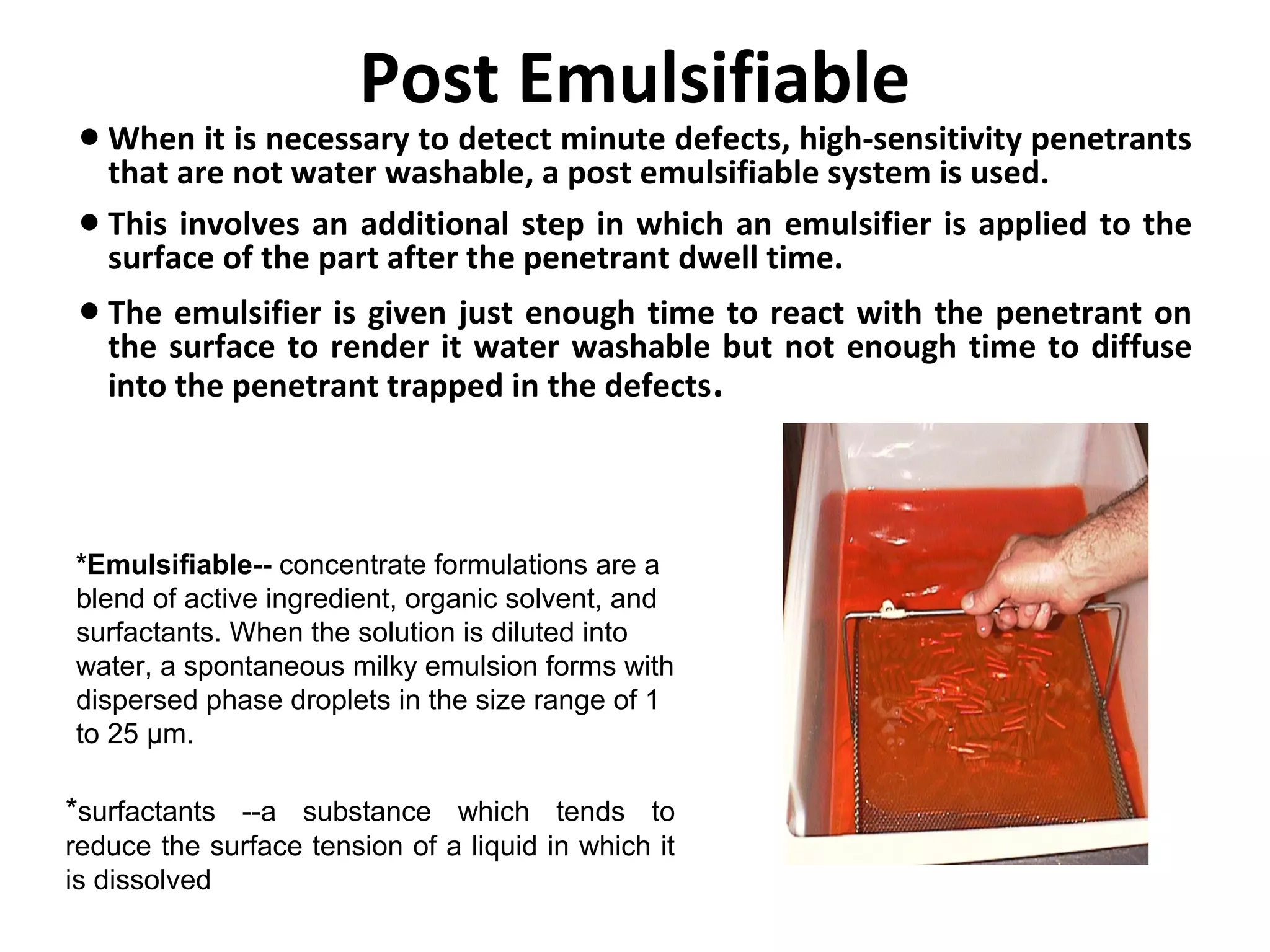
Post Emulsifiable
•When it is necessary to detect minute defects, high-sensitivity penetrants
that are not water washable, a post emulsifiable system is used.
•This involves an additional step in which an emulsifier is applied to the
surface of the part after the penetrant dwell time.
•The emulsifier is given just enough time to react with the penetrant on
the surface to render it water washable but not enough time to diffuse
into the penetrant trapped in the defects.
*Emulsifiable-- concentrate formulations are a 
blend of active ingredient, organic solvent, and 
surfactants. When the solution is diluted into 
water, a spontaneous milky emulsion forms with 
dispersed phase droplets in the size range of 1 
to 25 μm.
*surfactants  --a  substance  which  tends  to 
reduce the surface tension of a liquid in which it 
is dissolved
• An emulsifier is applied after the penetrant has had sufficient time to be
absorbed into defects.
• Small flaws that are often missed because of the penetrant being washed
out are more likely to be identified by the use of this system.
• Disadvantages
– more expensive
– emulsifier costs & additional time
– additional handling equipment and space
Step 4- Development (Developer
Application)
• In order to attain optimum inspection conditions, developers are
designed to work with specific penetrants
• The role of the developer is to pull trapped penetrant out of defects and
to spread it out on the surface so that it can be seen.
• Also provides a light background to increase contrast when visible
penetrant is used.
*Non-Aqueous -made from, with, or by means of a liquid other than water.
• Absorption.
• Application
• Background masking
• Physical characteristics
• Chemical characteristics
• Developer materials
– Dry Powder
– Wet, Water Suspendable
– Wet, Water Soluble
– Wet, Non-Aqueous
Dry Powder Developer
• Prior to applying a dry powder developer, the component
must be thoroughly dried. Drying is usually accomplished in
a hot air circulating oven.
• The developer is then applied by immersing the part in the
powder or by dusting of the part with the powder.
• The part can also be placed in a developer dust cloud
chamber
Wet Developer (water- suspended and water- soluble)
• Wet developers are applied by
immersing or spraying the part while it
is still wet from the penetrant removal
process.
• The part is completely coated and the
excess liquid allowed to drain to
prevent pooling
• The part is then dried in a hot air
circulating oven
Nonaqueous Developer
• Nonaqueous developer is applied by a aerosol spray to a thoroughly
dried and cooled part.
• A thin even coating should be applied.
• The coating should be white but still slightly transparent when
performing a visible dye penetrant inspection, and even thinner when
performing a fluorescent penetrant inspection.
Step 5- Observation and
inspection
• In this step the inspector evaluates the penetrant indications against
specified accept/reject criteria and attempts to determine the origin of
the indication.
• The indications are judged to be either relevant, non-relevant or false.
Non-relevant weld geometry indications
Relevant crack indications from an
abusive drilling process
Step 6- Post Clean
• The final step in the penetrant inspection process is to thoroughly clean
the part that has been tested to remove all penetrant processing
materials.
• The residual materials could possibly affect the performance of the part
or affect its visual appeal
Advantages of Penetrant Testing
• Relative ease of use.
• Can be used on a wide range of material types.
• Large areas or large volumes of parts/materials can be
inspected rapidly and at low cost.
• Parts with complex geometries are routinely inspected.
• Indications are produced directly on surface of the part
providing a visual image of the discontinuity.
• Initial equipment investment is low.
• Aerosol spray cans can make equipment very portable.
Limitations of Penetrant Testing
• Only detects surface breaking defects.
• Requires relatively smooth nonporous material.
• Precleaning is critical. Contaminants can mask
defects.
• Requires multiple operations under controlled
conditions.
• Chemical handling precautions necessary (toxicity,
fire, waste).
• Metal smearing from machining, grinding and other
operations inhibits detection. Materials may need to
be etched prior to inspection.
• Post cleaning is necessary to remove chemicals.
Applications of Penetrant Testing
• All defects that are open to the surface
– Rolled products-- cracks, seams, laminations
– Castings--cold shuts, hot tears, porosity, blow
holes, shrinkage
– Forgings– cracks, laps, external bursts
– Welds– cracks, porosity, undercut, overlap, lack
of fusion, lack of penetration
Rolled products-Seams
FORGING

Liquid penetrate inspection

  • 1.
    Liquid penetrate inspection Unit-1 K.KRISHNAKISHORE kakarlakishore11@gmail.com
  • 2.
    • Liquid penetrateinspection: • Principles of penetrate inspection, • characteristics of a penetrate, • water washable system, • post emulsification system , • solvent removable system, • surface preparation and cleaning, • penetrate application, • development, • advantages limitations, • and applications.
  • 4.
    Principle • The principleof the technique is that a liquid is drawn by capillary attraction into the defect and, after subsequent development, any surface-breaking defects may be rendered visible to the human eye.
  • 5.
    Introduction • A liquidwith high surface wetting characteristics is applied to the surface of a component under test. • The penetrant “penetrates” into surface breaking discontinuities via capillary action and other mechanisms. • Excess penetrant is removed from the surface and a developer is applied to pull trapped penetrant back the surface. • With good inspection technique, visual indications of any discontinuities present become apparent.
  • 6.
    Basic Process • 1)Clean & Dry Component • 2) Apply Penetrant
  • 7.
    3) Remove Excess4) Apply Developer 5) Visual Inspection 6) Post Clean Component
  • 8.
    What Can BeInspected • Almost any material that has a relatively smooth, non-porous surface on which discontinuities or defects are suspected.
  • 9.
    What Can NOTbe Inspected • Components with rough surfaces, such as sand castings, that trap and hold penetrant • Porous ceramics • Wood and other fibrous materials • Plastic parts that absorb or react with the penetrant materials • Components with coatings that prevent penetrants from entering defects
  • 10.
    Choices of PenetrantMaterials • Penetrant Type I Fluorescent II Visible Method • Water Washable • Post emulsifiable • Solvent Removable
  • 11.
    Visible Vs Fluorescent •Visible Penetrate test is performed under white light • level 1 sensitivity range Photo Courtesy of Contesco •while fluorescent Penetrate test must be performed using an ultraviolet light in a darkened area •Sensitivity ranges from 1 to 4 Fluorescent Penetrate test is more sensitive than visible Penetrate test because the eye is more sensitive to a bright indication on a dark background.
  • 12.
    Characteristics Of APenetrate • Penetration – The penetrant must have the ability to enter extremely fine surface defects or other openings in the component under test. • Body – The penetrant must have a good surface wetting ability • Fluidity – the penetrant should have the ability to drain away from the component well • Solution ability – If necessary, the penetrant should be capable of dissolving a path into contaminated defects, through a wide range of contaminants.
  • 13.
    • Stability – Theliquid penetrant should be stable over a wide range of temperature and humidity – should not form a *scum or lose its **volatile constituents while it is kept in open tanks or when stored in drums. – * Scum- a layer of dirt or froth on the surface of a liquid – ** Volatile -easily evaporated at normal temperatures • Washability – It must be possible to remove excess penetrants from component surfaces easily without affecting the penetrant within any defects.
  • 14.
    • Drying characteristics –A penetrant must resist drying out, and complete bleed out, during hot-air drying of the component after the wash operation has been completed. • Visibility – a good, deep colour can be given to the penetrant by a comparatively small amount of dye. – If a large amount of dye is used in the formulation, the penetrating abilities of the fluid could be reduced. – Red is the most commonly used colour in dye penetrants as this colour is the most readily seen by the human eye
  • 15.
    Sensitivity Levels • Thehigher the sensitivity level, the smaller the defect that the penetrant system is capable of detecting – Level 4 - Ultra-High Sensitivity – Level 3 - High Sensitivity – Level 2 - Medium Sensitivity – Level 1 - Low Sensitivity
  • 16.
    Developer • Form  DryPowder  Wet, Water Soluble  Wet, Water Suspendable  Wet, Non-Aqueous
  • 17.
    Principles (6 Steps)of Liquid Penetrant Inspection 1. Pre-Clean(Surface preparation) 2. Application of Penetrant 3. Removal of excess penetrant. 4. Development (Developer Application) 5. Observation and inspection. 6. Post-clean
  • 18.
    Step 1-Pre-cleaning(surface preparation) • Partsmust be free of dirt, rust, scale, oil, grease, etc. to perform a reliable inspection. • The cleaning process must remove contaminants from the surfaces of the part and defects, and must not plug any of the defects.
  • 19.
    • Some machining,surface finishing and cleaning operations can cause a thin layer of metal to smear on the surface and prevent penetrant from entering any flaws that may be present. • Etching of the surface prior to inspection is sometimes required
  • 20.
  • 21.
    Step 2- Applicationof Penetrant • Many methods of application are possible such as: – Brushing – Spraying – Dipping/ Immersing – Flow-on – And more
  • 23.
    What is DwellTime • The penetrant solution must be allowed to “dwell” on the surface of the part to allow the penetrant time to fill any defects present. • The dwell time vary according to penetrant type, temperature, material type and surface finish.
  • 24.
    Step 3- Removalof excess penetrant The removal technique depends upon the type of penetrant used, as stated earlier… – Solvent Removable – Water Washable – Post Emulsifiable
  • 25.
    Solvent Removable •The partis wiped with a clean dry cloth to remove the bulk of the excess penetrant. •Then, a cloth lightly dampened with solvent is used to remove any remaining penetrant on the surface. •Any time a solvent is used in the penetrant inspection process, a suitable flash time is required to allow excess solvent to evaporate. •They are supplied in aerosol cans for portability and are primarily used for spot checks.
  • 27.
    • It isoften necessary, to inspect only a small area of a component, or to inspect a component in situ rather than at a regular inspection station. • There are two basic solvent types: – flammable and non-flammable • this system is extremely sensitive • the costs are relatively high • high material expense • more labour-intensive process
  • 28.
    Water Washable • Acoarse water spray is used to remove the excess penetrant. • The procedure used as a guideline for the inspection will specify water temperature (typically 50-100°F) and pressure (typically not more than 40 psi), etc. • They are the easiest to employ and most cost effective when inspecting large areas.
  • 29.
    • Processing conditions –water pressure and temperature – duration of rinse cycle – surface condition of the workpiece – inherent removal characteristies of the penetrant
  • 30.
    Post Emulsifiable •When itis necessary to detect minute defects, high-sensitivity penetrants that are not water washable, a post emulsifiable system is used. •This involves an additional step in which an emulsifier is applied to the surface of the part after the penetrant dwell time. •The emulsifier is given just enough time to react with the penetrant on the surface to render it water washable but not enough time to diffuse into the penetrant trapped in the defects. *Emulsifiable-- concentrate formulations are a  blend of active ingredient, organic solvent, and  surfactants. When the solution is diluted into  water, a spontaneous milky emulsion forms with  dispersed phase droplets in the size range of 1  to 25 μm. *surfactants  --a  substance  which  tends  to  reduce the surface tension of a liquid in which it  is dissolved
  • 31.
    • An emulsifieris applied after the penetrant has had sufficient time to be absorbed into defects. • Small flaws that are often missed because of the penetrant being washed out are more likely to be identified by the use of this system. • Disadvantages – more expensive – emulsifier costs & additional time – additional handling equipment and space
  • 32.
    Step 4- Development(Developer Application) • In order to attain optimum inspection conditions, developers are designed to work with specific penetrants • The role of the developer is to pull trapped penetrant out of defects and to spread it out on the surface so that it can be seen. • Also provides a light background to increase contrast when visible penetrant is used. *Non-Aqueous -made from, with, or by means of a liquid other than water.
  • 33.
    • Absorption. • Application •Background masking • Physical characteristics • Chemical characteristics
  • 34.
    • Developer materials –Dry Powder – Wet, Water Suspendable – Wet, Water Soluble – Wet, Non-Aqueous
  • 35.
    Dry Powder Developer •Prior to applying a dry powder developer, the component must be thoroughly dried. Drying is usually accomplished in a hot air circulating oven. • The developer is then applied by immersing the part in the powder or by dusting of the part with the powder. • The part can also be placed in a developer dust cloud chamber
  • 36.
    Wet Developer (water-suspended and water- soluble) • Wet developers are applied by immersing or spraying the part while it is still wet from the penetrant removal process. • The part is completely coated and the excess liquid allowed to drain to prevent pooling • The part is then dried in a hot air circulating oven
  • 37.
    Nonaqueous Developer • Nonaqueousdeveloper is applied by a aerosol spray to a thoroughly dried and cooled part. • A thin even coating should be applied. • The coating should be white but still slightly transparent when performing a visible dye penetrant inspection, and even thinner when performing a fluorescent penetrant inspection.
  • 38.
    Step 5- Observationand inspection • In this step the inspector evaluates the penetrant indications against specified accept/reject criteria and attempts to determine the origin of the indication. • The indications are judged to be either relevant, non-relevant or false. Non-relevant weld geometry indications Relevant crack indications from an abusive drilling process
  • 39.
    Step 6- PostClean • The final step in the penetrant inspection process is to thoroughly clean the part that has been tested to remove all penetrant processing materials. • The residual materials could possibly affect the performance of the part or affect its visual appeal
  • 40.
    Advantages of PenetrantTesting • Relative ease of use. • Can be used on a wide range of material types. • Large areas or large volumes of parts/materials can be inspected rapidly and at low cost. • Parts with complex geometries are routinely inspected. • Indications are produced directly on surface of the part providing a visual image of the discontinuity. • Initial equipment investment is low. • Aerosol spray cans can make equipment very portable.
  • 41.
    Limitations of PenetrantTesting • Only detects surface breaking defects. • Requires relatively smooth nonporous material. • Precleaning is critical. Contaminants can mask defects. • Requires multiple operations under controlled conditions. • Chemical handling precautions necessary (toxicity, fire, waste). • Metal smearing from machining, grinding and other operations inhibits detection. Materials may need to be etched prior to inspection. • Post cleaning is necessary to remove chemicals.
  • 42.
    Applications of PenetrantTesting • All defects that are open to the surface – Rolled products-- cracks, seams, laminations – Castings--cold shuts, hot tears, porosity, blow holes, shrinkage – Forgings– cracks, laps, external bursts – Welds– cracks, porosity, undercut, overlap, lack of fusion, lack of penetration
  • 43.
  • 46.