Presented by- Samta Shah
M. Pharm (Pharmaceutics)
MIXING
Contents
• Definition and Objectives
• Introduction
• Applications
• Factors influencing mixing
• Difference between solid and liquid
mixing
• Mechanism of solid mixing, liquid mixing,
semisolid mixing
• Principle, construction, working, uses,
merits, demerits of various mixing
equipments
Mixing
“ an operation in which two or more
components in a separate or roughly mixed
condition are treated so that each particle
lies as nearly as possible in contact with a
particle of each of the other ingredients.”
Or
“a process that tends to result in a
randomization of dissimilar particles
within a system.”
• “Mix”- to put together in one mass or
assemblage with more or less through
diffusion of the constituent elements
among one another.
• “Blending”- to mix smoothly and
inseparably together.
Objectives of Mixing
• To secure uniformity of composition so
that small samples withdrawn from a bulk
material represent the overall composition
of the mixture.
• To promote physical or chemical reactions,
such as dissolution, in which natural
diffusion is supplemented by agitation.
Introduction
Dispensing practice requires the following
methods:
• Spatulation
• Trituration
• Sifting
• Tumbling
• Stirring
• Milling
• Kneading
On industrial scale, we require large
equipments.
Major problems:
• Segregation of particles due to the
gravitational effect.
• For cohesive substances mixing is
difficult.
Classification of mixtures
1. Positive mixtures
• They are formed from materials such
as gases or miscible liquids, where
irreversible mixing would take place,
by diffusion without expenditure of
work.
2. Negative mixtures
• Demonstrated by suspensions of solids
• Any two-phase system, in which the
phases differ in density, will separate
unless continuously agitated –require
work for formation and components
separate unless work is continually
expended on them – difficult to form and
higher degree of mixing efficiency needed.
3. Neutral mixtures
• They are static in behavior, i.e. no
tendency to mix spontaneously, nor do
they segregate when mixed unless on the
system is acted on a system with force.
• Examples are mixing solids with solids
and solids with liquids when the solids
concentration is high.
• Ointments, pastes, gels, mixed powders.
Applications
• It is one of the most common
pharmaceutical operations.
• It is the intermediate stage in the
production of several dosage forms
i. Wet mixing in granulation step in
production of tablets and capsules.
ii. Dry mixing of various ingredients ready
for direct compression in tablets.
iii. Dry blending of powders in capsules,
dry syrup and compound powders.
iv. Production of pellets for capsules.
Factors affecting Mixing
• Particle and powder characteristics influence the
mixing process.
• Aggregation- inhibit proper mixing.
• So, high shearing forces are applied.
• Flow properties of the components is the most
important consideration which is influenced by
number of factors
1. Nature of the surface
2. Density of the particles
3. Particle size
4. Particle shape
5. Particle charge
6. Proportion of materials
1. Nature of the surface
• Rough surface- not induce satisfactory
mixing. (due to entry of API in pores of
other ingredients)
• Addition of a substance adsorbing on the
surface- decrease aggregation.
• Example- Addition of aerosil to ZnO.
• But, a strong aggregating ZnO forms a fine
dusting powder, which can be mixed
easily.
2. Density of particles
• Has a minor impact on mixing.
• De-mixing is accelerated when the density
of the smaller particles is higher or when
mixing is stopped abruptly.
• Because the dense material always moves
downward and settle at the bottom.
3. Particle size
• Mixing of two powders becomes easy if
they have the same particle size.
• Variation of particle size- leads to
separation because, smaller particles
move downward through the spaces
between the bigger particles.
• As the particle size increase, flow
properties also increases due to the
influence of gravitational force on size.
• Powders with mean particle size of 100µm
are free flowing, thus increases mixing.
4. Particle shape
• Ideal particle shape- Spherical
• Irregular shape become interlocked and
there are less chance of separation when
they are mixed together.
5. Particle charge
• Some particles exert attractive forces due
to electrostatic charges on them. This
leads to separation or segregation.
6. Proportion of materials
• Best result- if 2 powders are mixed in
equal proportion by weigh and by volume.
• If large difference in proportion, mixing
is done in ascending order of their
weights.
Difference between solid and liquid
mixing
Liquid mixing Solid mixing
Flow currents are
responsible for
transporting unmixed
material to the mixing
zone adjacent to
impeller.
Flow currents are not
possible.
Truly homogenous
phase can be observed.
Product often consists of
2 or more easily
identifiable phases.
Small sample size is
sufficient to study
degree of mixing.
Large sample size is
required.
Mechanism of mixing in Solids
• The principle mechanisms in solid-solid
mixing are:
1. Convective mixing
• Inversion of the powder bed using
blades or paddles or screw element.
(rotational effect)
• Large mass of material moves from one
part to another
• Also known as macromixing.
• Example: Ribbon blender, paddle mixers.
2. Shear mixing
• Forces of attraction are broken down so that
each particle moves on its own between
regions of different composition and
parallel to their surfaces.
• In a particulate mass, forces of attraction
are predominating, which makes the layers
slip over one another.
• Such types of attraction forces are
predominant among same type of particles.
• Shear forces reduce these attractions and
reduce the scale of segregation.
• Useful for agglomerates.
• Example Plough mixers.
3. Diffusive mixing
• Random motion of particles within the
powder bed, thereby particles change
their positions relative to one another.
• It occurs at the interfaces of dissimilar
regions.
• Also referred to as Micromixing.
• Slow process- so sensitive to segregation.
• Example: Tumbler mixers, V-blender,
Double cone blenders, Drum blenders.
• Powders – neutral mixtures
• Character of powder mixing quiet
different from that of liquids
• Diverse characteristics – size, shape, area,
density, porosity, flow and charge
contribute to solid mixing
• Cohesive and non cohesive
• Non cohesive – easy to mix – flow easily –
grain, chips, sand
• Cohesive powders – Wet clay – resistance
to flow through openings – formation of
lumps and aggregates
Interparticle interactions
1. Inertial Forces
• These forces hold neighboring particles in fixed
relative position.
• E.g. Vander Waals, electrostatic and surface forces
Surface (or interface forces):
• Prevent intimate mixing owing to
interaction of their surfaces.
• Frictional forces resists movement of
particles – formation of lumps.
• Cohesive forces and frictional forces results in
surface-surface interactions which resist the
movement of particles, hence they should be
minimal.
• During mixing, particles develop surface charge
which produce particle-particle repulsions,
which make random mixing impossible.
• These depend on factors like surface area,
roughness, polarity, charge, moisture etc.
Segregation occurs due to following reasons
⚫ Poor flow property
⚫ Wide differences in particle size
⚫ Differences in mobilities of ingredients
⚫ Differences in particle density and shape
⚫ Transporting – pouring the powder from one
container to another (hopper or drums) or
emptying the container
⚫ Dusting stage – fine particles become air borne and
separate from the bulk of the powder
⚫ Segregation can even happen after mixing
2. Gravitational forces
• Tends to improve the movement of two
adjacent particles or group of particles.
• Tumbling action promotes inter particulate
movement due to gravitational forces.
• Motion of particles can result from direct
contact with mixer surface and/or from
contact with one another.
• These processes accelerate the movement of
translational and rotational modes of single
particle or group of particles.
• When particle-particle collisions occur,
exchange of momentum is achieved.
Continuous exchange of momentum b/w
translational and rotational modes is
necessary for effective mixing.
• Efficiency of momentum transfer depends on:
i. Elasticity of the collisions – more elastic
collisions – less transfer of momentum; loss
should be minimal.
ii. Co-efficient of friction – high values lead to
high exchange of rotational momentum.
iii. Surface area of contact – directly
proportional to momentum exchange.
iv. Surface roughness – determines
distribution of transferred momentum
between translational and rotational modes.
v. Centrifugal force – Act on rotating
aggregates to break them into smaller units
and aid in mixing process.
Process of solid-solid mixing involves 4
steps:
• Expansion of the bed of solids
• Application of 3 dimensional shear forces
to the powder bed
• Mix long enough to permit true
randomization of particles
• Maintain randomization
Mixing Rate
• Mixing rate is proportional to the amt of
mixing still to be done.
• Mixing rate for any mixing mechanism
can be represented by the expression;
where M, degree of mixing after time t.
• Integrating this equation gives
M = A ( 1-ekt
)
• Thus the law of mixing appears to follow
first order.
The rate constant k and A depend on:
• Physical nature of the materials being
mixed.
• Mixer geometry.
• Proportion of the material being mixed.
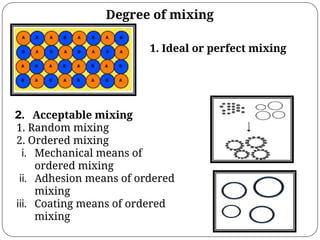
Degree of mixing
1. Ideal or perfect mixing
2. Acceptable mixing
1. Random mixing
2. Ordered mixing
i. Mechanical means of
ordered mixing
ii. Adhesion means of ordered
mixing
iii. Coating means of ordered
mixing
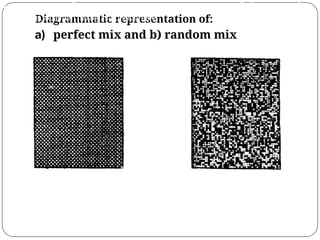
Diagrammatic representation of:
a) perfect mix and b) random mix
The variation in drug content between one tablet and the next is largely controlled by
the mixing.
In practice, optimum mixing is considerable
• Material is collected at bottom of V shaped container
• Blender speed essential – high speeds dusting or
segregation; low speeds- not enough shear
• Type of diffusive mixing
Advantages
• Fragile granules to be blended – minimum attrition
• Large capacities
• Easy to use load and clean
• Minimum maintenance
Disadvantages
• High headspace needed for installation
• Not suitable for fine particulate matter or ingredients
with large diff in particle size as not enough shear is
applied
• Serial dilution or geometric mixing to be followed
Uses
• Suitable for free flowing and granular nature
materials
• Agitator blade rotates , lifts and distribute the
material in an irregular manner.
• Convective and shear mixing and on small
scale sometimes it can be diffusive mixing
Advantages
• Baffles are used for both wet and dry mixing.
• Agitator blades- range of shearing forces.
• No dilution is needed for low dose.
Disadvantages
• Cleaning is difficult.
• Scale up is also difficult.
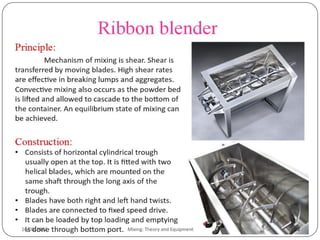
Working
• Through the fixed speed drive, ribbons are
allowed to rotate.
• One blade moves solids slowly in one direction
while other moves quickly in opposite direction.
• Powder is introduced from top.
• Body covered – avoid dust and evaporation of
granulating fluid.
• Powders lifted by centrally located vertical
screws and allowed to cascade to bottom.
• Counteracting blades set up high shear and are
effective in breaking up lumps and aggregates.
• Helical blades move powders from one end to
another.
• Operating conditions – affect steady state and
quality of mixing.
Uses
• Mix finely divided solids, wet solids, sticky
and plastic solids.
• Mixes- uniform size and density materials.
• Used for liquid-solid and solid-solid
mixing.
Advantages
• High shear can be applied using
perforated baffles, that brings about
rubbing and breaking of aggregates.
• Headroom requirement is less.
• Can be used as a continuous blender by
feeding material at one end and
discharging at the other end.
Disadvantages
• Poor mixer, as movement of material is 2-
D.
• Shearing action is less as compared with
planetary mixer.
• Dead spots are observed in the mixer.
• Fixed speed drive.
Uses
• For mixing dough ingredients in bakery
industries.
• For wet granulation process
• Liquid-solid mixing
Advantages
• Creates minimum head space
• Close tolerances between blades and side
walls and also at the bottom of the mixer.
Disadvantages
• It works at a fixed speed.
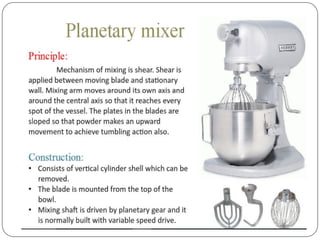
Working
• Agitator has planetary motion.
• Rotates on its own axis and around a central
axis to reach all parts of vessels.
• Beater is shaped to pass with close clearance
over side and bottom of mixing bowl – no
dead spaces.
• Blade tears mass apart and shear is applied
bet moving blade and stationary wall.
• Plates in blade sloped so powder makes an
upward movement – tumbling motion is also
achieved.
• Variable speed – slow speed for pre-mixing
with increased speed for active mixing.
• High shear can be applied for mixing.
Liquid mixing
Liquid mixing may be divided into:
1. Mixing of liquids and liquids
a) Mixing of two miscible liquids
b) Mixing of two immiscible liquids
2. Mixing of liquids and solids
a) Mixing of liquids and soluble solids
b) Mixing of liquids and insoluble solids
Mixing of two miscible liquids
• homogeneous mixtures e.g. solutions – mixing of
two miscible liquids is quite easy and occur by
diffusion. Such type of mixing does not create
any problem. Simple shaking or stirring is
enough but if the liquids are not readily miscible
or if they have very different viscosities then
electric stirrer may be used.
• Sometimes turbulence may be created in the
liquids to be mixed.
• Turbulence is a function of velocity gradient
between two adjacent layers of a liquid.
• Thus if a rapidly moving stream of liquid is in
contact with a nearly stationary liquid, there will
be high velocity gradient at the boundary which
results in tearing off portions of the faster
moving stream and sending it off to the slower
• These eddies persists for some time and
ultimately dissipate themselves as heat. This
results also in drawing in part of the slow
moving liquid into a high velocity liquid
because of differences in static pressures
created as in an ejector.
• Most of the mixing equipments are designed
on the basis of providing high local velocities
but directing them in such a manner that
they will ultimately carry their own
turbulence or the turbulence of the eddies
they create, throughout the mass to be mixed.
Mixing of two immiscible liquids
• (heterogenous mixtures e.g. emulsions) – two
immiscible liquids are mixed to effect transfer of
a dissolved substance from one liquid to another
an eg. of such type of mixing is the extraction of
penicillin in the acid form from aqueous solution
into the organic solvent amyl acetate, to promote
a chemical reaction after transfer of a component,
to allow transfer of heat from one liquid to the
other or to prepare emulsion.
Mixing occurs in two stages:
• Localized mixing in which shear is applied to the
particles of the liquid.
• A general movement sufficient to take all the
particles of the materials through the shearing
zone so as to produce a uniform product.
⚫ On small scale, for the preparation of
emulsions, a pestle and mortar is quite
suitable. Here, shear forces are produced
between the flat head of the pestle and the
flat bottom of the mortar whereas a
general movement is produced by
continuous movement of the pestle along
the sides of the mortar by which the
sticking material to the sides is returned
to the bottom of the mortar.
Mixing of liquids and soluble solids
• Homogenous mixtures e.g. solutions- in this
case solids are dissolved in suitable liquid by
means of stirring.
• Physical change (soluble solid is converted to
a solution).
Mixing of liquids and insoluble solids
(heterogeneous mixtures e.g. suspensions) –
when insoluble solids are mixed with a
liquid a suspension is produced which is
an unstable system.
• The ingredients of a suspension separate
out when allowed to stand for sometime.
Thus a suspending agent is required to
produce a stable suspension.
• On small scale, suspensions may be
prepared in a pestle and mortar.
Liquid mixing
• is usually performed with a mixing element,
commonly a rotational device, which provides the
necessary shear forces, but is of suitable shape to act
as an impeller to produce an appropriate pattern in
the mixing vessel. The movement of the liquid at any
point in the vessel will have three velocity
components and the complete flow pattern will
depend upon variations in these three components in
different parts of the vessel.
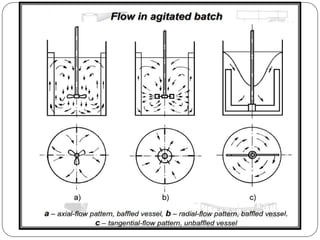
• The three velocity components are;
1. Radial components, acting in a direction vertical
to the impeller shaft.
2. A longitudinal component, acting parallel to the
impeller shaft.
3. A tangential component, acting in a direction
that is a tangent to the circle of rotation round
the impeller shaft.
Flow pattern during mixing
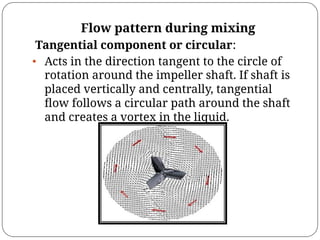
Tangential component or circular:
• Acts in the direction tangent to the circle of
rotation around the impeller shaft. If shaft is
placed vertically and centrally, tangential
flow follows a circular path around the shaft
and creates a vortex in the liquid.
Radial component:
• Acts in the direction vertical to the impeller
shaft. Excessive radial flow takes the material
to the container wall then material falls to the
bottom and rotate as the mass beneath the
impeller.
Axial component or longitudinal or vertical:
• Acts in the direction parallel to the impeller
shaft. Inadequate longitudinal component
causes the liquid and solid to rotate in layers
without mixing. Adequate longitudinal
pattern is best used to generate strong
vertical currents particularly when
suspending solids are present in a liquid.
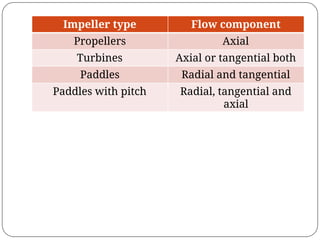
Impeller type Flow component
Propellers Axial
Turbines Axial or tangential both
Paddles Radial and tangential
Paddles with pitch Radial, tangential and
axial
Vortex formation
• A strong circulatory flow pattern
sometimes manifests into formation of a
vortex near the impeller shaft.
• Vortex can be formed when
1. Shaft is placed symmetrically in the tank.
2. Blades in the turbines are arranged
perpendicular to the central shaft.
3. At high impeller speeds
4. In unbaffled tanks
Disadvantages of vortex formation
• Vortex formation reduces mixing intensity
by reducing velocity of the impeller relative
to the surrounding fluid.
• When vortex reaches the impeller, air from
the surface of the liquid are drawn and air
bubbles are produced.
• Air bubbles in the fluid can create uneven
loading of the impeller blades.
• Entrapped air causes oxidation of the
substances in certain cases.
Prevention of vortex formation
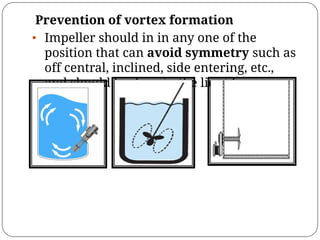
• Impeller should in in any one of the
position that can avoid symmetry such as
off central, inclined, side entering, etc.,
and should be deep in the liquid.
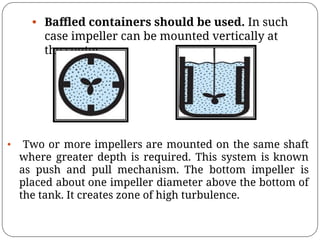
• Baffled containers should be used. In such
case impeller can be mounted vertically at
the center.
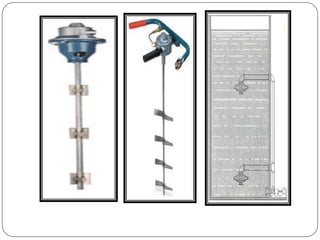
• Two or more impellers are mounted on the same shaft
where greater depth is required. This system is known
as push and pull mechanism. The bottom impeller is
placed about one impeller diameter above the bottom of
the tank. It creates zone of high turbulence.
• Tank other than cylindrical in shape are
used to prevent vortex formation. However,
such shapes may facilitate the formation of
dead spots
Mixing mechanism
• Mixing mechanisms for fluids fall essentially
into four categories: bulk transport, turbulent
flow, laminar flow, and molecular diffusion.
Usually more than one of these processes is
operative in practical mixing situations.
1.Bulk transport
• the movement of a relatively large portion of
the material being mixed from one location
in the system to another constitutes bulk
transport.
• A simple circulation of material in a mixer
may not necessarily result in efficient mixing.
• For bulk transport to be effective it must
result in a rearrangement or permutation of
the various portions of the material to be
mixed.
• This can be accomplished by means of
paddles, revolving blades, or other devices
within the mixer arranged so as to move
adjacent volumes of the fluid in different
directions, thereby shuffling the system in
three dimensions.
2.Turbulent Mixing
• the phenomenon of turbulent mixing is a
direct result of turbulent fluid flow, which is
characterized by a random fluctuation of the
fluid velocity at any given point with in the
system.
• The fluid velocity at a given instant may be expressed
as the vector sum of its components in the x, y, and z
directions.
• With turbulence, these directional components
fluctuate randomly about their individual mean values,
as does the velocity itself.
• In general, with turbulence, the fluid has different
instantaneous velocities at different locations at the
same time.
• This observation is true for both, the direction and the
magnitude of the velocity.
• If the instantaneous velocities at two points in a
turbulent flow field are measured simultaneously, they
show a degree of similarity provided that the points
selected are not too far apart.
• There is no velocity correlation between the points,
however, if they are separated by a sufficient distance.
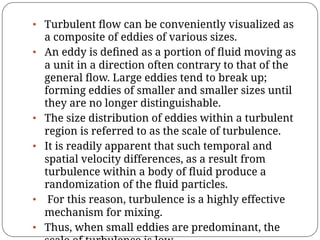
• Turbulent flow can be conveniently visualized as
a composite of eddies of various sizes.
• An eddy is defined as a portion of fluid moving as
a unit in a direction often contrary to that of the
general flow. Large eddies tend to break up;
forming eddies of smaller and smaller sizes until
they are no longer distinguishable.
• The size distribution of eddies within a turbulent
region is referred to as the scale of turbulence.
• It is readily apparent that such temporal and
spatial velocity differences, as a result from
turbulence within a body of fluid produce a
randomization of the fluid particles.
• For this reason, turbulence is a highly effective
mechanism for mixing.
• Thus, when small eddies are predominant, the
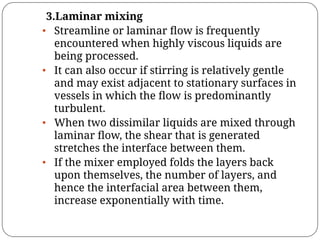
3.Laminar mixing
• Streamline or laminar flow is frequently
encountered when highly viscous liquids are
being processed.
• It can also occur if stirring is relatively gentle
and may exist adjacent to stationary surfaces in
vessels in which the flow is predominantly
turbulent.
• When two dissimilar liquids are mixed through
laminar flow, the shear that is generated
stretches the interface between them.
• If the mixer employed folds the layers back
upon themselves, the number of layers, and
hence the interfacial area between them,
increase exponentially with time.
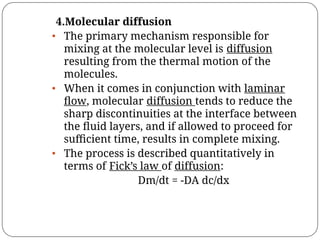
4.Molecular diffusion
• The primary mechanism responsible for
mixing at the molecular level is diffusion
resulting from the thermal motion of the
molecules.
• When it comes in conjunction with laminar
flow, molecular diffusion tends to reduce the
sharp discontinuities at the interface between
the fluid layers, and if allowed to proceed for
sufficient time, results in complete mixing.
• The process is described quantitatively in
terms of Fick’s law of diffusion:
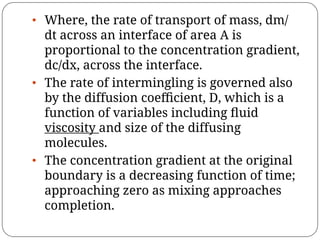
Dm/dt = -DA dc/dx
• Where, the rate of transport of mass, dm/
dt across an interface of area A is
proportional to the concentration gradient,
dc/dx, across the interface.
• The rate of intermingling is governed also
by the diffusion coefficient, D, which is a
function of variables including fluid
viscosity and size of the diffusing
molecules.
• The concentration gradient at the original
boundary is a decreasing function of time;
approaching zero as mixing approaches
completion.
Mixing Apparatus for fluids
• A Container and
• A Mixing Device or Impeller
Mixing Device
• Based on shape and pitch , the are
classified into 3 types,
1. Propellers
2. Turbines
3. Paddles
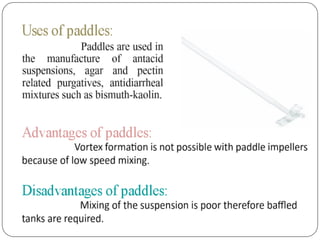
Paddles
• A paddle consists of a central hub with long
flat blades attached to it vertically two blades
or four blades are common sometimes the
blades are pitched and may be dished or
hemispherical in shape and have a large
surface area in relation to the tank in which
they are used.
• Paddles rotates at a low speed of 100rpm.
• They push the liquid radially and tangentially
with almost no axial action unless blades are
pitched.
• In deep tanks several paddles are attached
one above the other on the same shaft.
• At very low speeds it gives mild agitation in
unbaffled tank but as for high speeds baffles
are necessary.
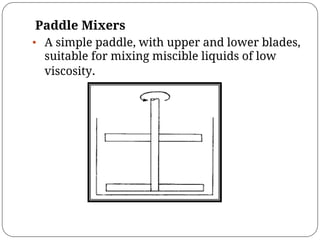
Paddle Mixers
• A simple paddle, with upper and lower blades,
suitable for mixing miscible liquids of low
viscosity.
• The gate paddle is suitable for mixing liquids
of higher viscosity
• Stationary paddles intermeshing with
the moving element suppress swirling in
the mixer.
• Anchor paddle is suitable for mixing liquids
of higher viscosity.
Propeller Mixers
• Propellers are commonly used for mixing
miscible and immiscible liquids of low
viscosity.
• The marine propeller is typical of the group.
• High-speed rotation (400–1500 rpm) of the
relatively small element provides high shear
rates in the vicinity of the impeller and a flow
pattern with mainly axial and tangential
components.
• They may be used in unbaffled tanks when
mounted in an off-center position or inclined
from the vertical. Horizontal mounting in the
side of the vessel is frequently used when the
scale of the operation is large.
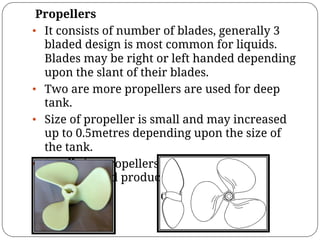
Propellers
• It consists of number of blades, generally 3
bladed design is most common for liquids.
Blades may be right or left handed depending
upon the slant of their blades.
• Two are more propellers are used for deep
tank.
• Size of propeller is small and may increased
up to 0.5metres depending upon the size of
the tank.
• Small size propellers can rotate up to
8000rpm and produce longitudinal
movement.
• Available in diff. diameters from a few
inches to 3 ft.
• Made of cast construction are cheap in
rates.
• Propellers with 300-400 rpm are used for
low speeds while 1750 rpm for high
speeds.
• It depends on viscosity of material.
• It produce axial movement of the liquid.
Advantages of propellers:
• Used when high mixing capacity is
required.
• Effective for liquids which have
maximum viscosity of 2.0pascals.sec or
slurry up to 10% solids of fine mesh size.
• Effective gas-liquid dispersion is possible
at laboratory scale.
Disadvantages of propellers:
• Propellers are not normally effective with
liquids of viscosity greater than 5pascal.
second, such as glycerin castor oil, etc.,
Turbines
• A turbine consists of a circular disc to which a
number of short blades are attached. Blades may
be straight or curved.
• The diameter of the turbine ranges from 30-50%
of the diameter of the vessel.
• Turbines rotates at a lower speed than the
propellers (50-200rpm).
• Flat blade turbines produce radial and tangential
flow but as the speed increases radial flow
dominates. Pitched blade turbine produces axial
flow.
⚫ Near the impeller zone of rapid currents, high
turbulence and intense shear is observed. Shear
produced by turbines can be further enhanced
using a diffuser ring (stationary perforated ring
which surrounds the turbine).
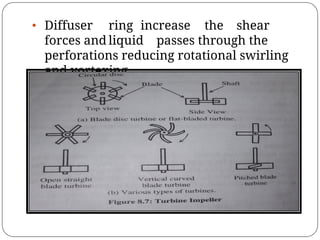
• Diffuser ring increase the shear
forces and liquid passes through the
perforations reducing rotational swirling
and vortexing.
Advantages of Turbines:
• Turbines give greater shearing forces than
propellers through the pumping rate is less.
Therefore suitable for emulsification.
Uses of Turbines:
• Effective for high viscous solutions with a
wide range of viscosities up to 7.0 Pascal.
second.
• In low viscous materials of large volumes turbine
create a strong currents which spread
throughout the tank destroying stagnant pockets.
• They can handle slurries with 60% solids.
• Turbines are suitable for liquids of large volume
and high viscosity, if the tank is baffled.
Mixing of immiscible Liquids
• Carried mainly in the manufacture of
emulsions, and the equipment used for the
preparation of an emulsion is known as
emulsifier. Also known as homogenizer as it
results in fine emulsion.
• Fine emulsion is prepared in 2 stages.
1. In 1st
stage coarse emulsion is prepared by
using one of the following process:-
• Wedge wood
• Mechanical blender
• Hand homogenizer
• Porcelain mortar and pestle
• Milk shake mixer
• Propeller in a baffled tank
Some times the above equipment directly gives fine
2. Otherwise coarse emulsion is subjected
to homogenizer in the 2nd
stage to get
fine emulsion by using following process:
-
• Silverson emulsifier
• Colloidal mill
• Rapisonic homogenizer
Factors influencing selection of an
emulsifier
1. Quantity of emulsion to be prepared:
batch wise or continuous operation
2. Flow properties of liquids: Newtonian,
plastic, pseudo plastic or dilatant.
3. Temperature maintenance: mixing will
be effective at high temperatures
provided the material is stable.
4. Desired rate of cooling: if elevated
temperatures are applied
Silverson mixer -Emulsifier
Principle:
• It produces intense shearing forces and
turbulence by use of high speed rotors.
• Circulation of material takes place through the
head by the suction produced in the inlet at the
bottom of the head.
• Circulation of the material ensures rapid
breakdown of the dispersed liquid into smaller
globules.
Construction
⚫ It consists of long supporting columns and a
central portion.
⚫ Central portion consists of a shaft which is
connected to motor at one end and other to the
head.
⚫ Head carries turbine blades.
⚫ Blades are surrounded by a mesh, which is
further enclosed by a cover having openings.
Working
• Emulsifier head is placed in the vessel having
miscible liquids in such a way that it should get
completely dipped in the liquid.
• When motor starts, central rotating shaft rotates
the head, which in turn rotates the turbine blades
at a very high speed.
• Thus, pressure difference is created.
• So, liquids are sucked in head from the center of
the base and subjected to intense mixing.
• Centrifugal force expel the contents of the head.
• Thus, fine emulsion emerges through the
openings of the outer cover.
• Intake and expulsion of mixture- rapid
breakdown of bigger globules to smaller globules.
Uses:
• Used for the preparation of emulsions and
creams of fine particle size.
Advantages:
• Silver son mixer is available in different sizes
to handle the liquids ranging from a few
milliliters to several thousand liters.
• Can be used for batch operations as well as
for continuous operations by incorporating
into a pipeline, through which the immiscible
liquids flow.
Disadvantages:
• Occasionally, there is a chance is clogging of
pores of the mesh.
Mixing of Semi-solids
• Ointments, creams, pastes, gels, gellies
• Material brought to the agitator or agitator
must move throughout the mixer
• Mech: low speed shearing, smearing, wiping,
folding, compression, stretching
• High energy needed – some dissipated as heat
– rugged equipment – heavy in construction
to handle greater mass
• Agitator arms designed to give a pulling and
kneading action. Shape and movement is
such that material is cleared from the sides
and corners of mixing vessel
• Prop of materials – imp – viscosity increases
with shearing for dilatant property.

MIXING pharmaceutical engineering 3rd sem.pdf

  • 1.
    Presented by- SamtaShah M. Pharm (Pharmaceutics) MIXING
  • 2.
    Contents • Definition andObjectives • Introduction • Applications • Factors influencing mixing • Difference between solid and liquid mixing • Mechanism of solid mixing, liquid mixing, semisolid mixing • Principle, construction, working, uses, merits, demerits of various mixing equipments
  • 3.
    Mixing “ an operationin which two or more components in a separate or roughly mixed condition are treated so that each particle lies as nearly as possible in contact with a particle of each of the other ingredients.” Or “a process that tends to result in a randomization of dissimilar particles within a system.”
  • 4.
    • “Mix”- toput together in one mass or assemblage with more or less through diffusion of the constituent elements among one another. • “Blending”- to mix smoothly and inseparably together. Objectives of Mixing • To secure uniformity of composition so that small samples withdrawn from a bulk material represent the overall composition of the mixture. • To promote physical or chemical reactions, such as dissolution, in which natural diffusion is supplemented by agitation.
  • 5.
    Introduction Dispensing practice requiresthe following methods: • Spatulation • Trituration • Sifting • Tumbling • Stirring • Milling • Kneading On industrial scale, we require large equipments.
  • 6.
    Major problems: • Segregationof particles due to the gravitational effect. • For cohesive substances mixing is difficult. Classification of mixtures 1. Positive mixtures • They are formed from materials such as gases or miscible liquids, where irreversible mixing would take place, by diffusion without expenditure of work. 2. Negative mixtures • Demonstrated by suspensions of solids
  • 7.
    • Any two-phasesystem, in which the phases differ in density, will separate unless continuously agitated –require work for formation and components separate unless work is continually expended on them – difficult to form and higher degree of mixing efficiency needed. 3. Neutral mixtures • They are static in behavior, i.e. no tendency to mix spontaneously, nor do they segregate when mixed unless on the system is acted on a system with force.
  • 8.
    • Examples aremixing solids with solids and solids with liquids when the solids concentration is high. • Ointments, pastes, gels, mixed powders.
  • 9.
    Applications • It isone of the most common pharmaceutical operations. • It is the intermediate stage in the production of several dosage forms i. Wet mixing in granulation step in production of tablets and capsules. ii. Dry mixing of various ingredients ready for direct compression in tablets. iii. Dry blending of powders in capsules, dry syrup and compound powders. iv. Production of pellets for capsules.
  • 10.
    Factors affecting Mixing •Particle and powder characteristics influence the mixing process. • Aggregation- inhibit proper mixing. • So, high shearing forces are applied. • Flow properties of the components is the most important consideration which is influenced by number of factors 1. Nature of the surface 2. Density of the particles 3. Particle size 4. Particle shape 5. Particle charge 6. Proportion of materials
  • 11.
    1. Nature ofthe surface • Rough surface- not induce satisfactory mixing. (due to entry of API in pores of other ingredients) • Addition of a substance adsorbing on the surface- decrease aggregation. • Example- Addition of aerosil to ZnO. • But, a strong aggregating ZnO forms a fine dusting powder, which can be mixed easily.
  • 12.
    2. Density ofparticles • Has a minor impact on mixing. • De-mixing is accelerated when the density of the smaller particles is higher or when mixing is stopped abruptly. • Because the dense material always moves downward and settle at the bottom.
  • 13.
    3. Particle size •Mixing of two powders becomes easy if they have the same particle size. • Variation of particle size- leads to separation because, smaller particles move downward through the spaces between the bigger particles. • As the particle size increase, flow properties also increases due to the influence of gravitational force on size. • Powders with mean particle size of 100µm are free flowing, thus increases mixing.
  • 14.
    4. Particle shape •Ideal particle shape- Spherical • Irregular shape become interlocked and there are less chance of separation when they are mixed together. 5. Particle charge • Some particles exert attractive forces due to electrostatic charges on them. This leads to separation or segregation.
  • 15.
    6. Proportion ofmaterials • Best result- if 2 powders are mixed in equal proportion by weigh and by volume. • If large difference in proportion, mixing is done in ascending order of their weights.
  • 16.
    Difference between solidand liquid mixing Liquid mixing Solid mixing Flow currents are responsible for transporting unmixed material to the mixing zone adjacent to impeller. Flow currents are not possible. Truly homogenous phase can be observed. Product often consists of 2 or more easily identifiable phases. Small sample size is sufficient to study degree of mixing. Large sample size is required.
  • 17.
    Mechanism of mixingin Solids • The principle mechanisms in solid-solid mixing are: 1. Convective mixing • Inversion of the powder bed using blades or paddles or screw element. (rotational effect) • Large mass of material moves from one part to another • Also known as macromixing. • Example: Ribbon blender, paddle mixers.
  • 18.
    2. Shear mixing •Forces of attraction are broken down so that each particle moves on its own between regions of different composition and parallel to their surfaces. • In a particulate mass, forces of attraction are predominating, which makes the layers slip over one another. • Such types of attraction forces are predominant among same type of particles. • Shear forces reduce these attractions and reduce the scale of segregation. • Useful for agglomerates. • Example Plough mixers.
  • 19.
    3. Diffusive mixing •Random motion of particles within the powder bed, thereby particles change their positions relative to one another. • It occurs at the interfaces of dissimilar regions. • Also referred to as Micromixing. • Slow process- so sensitive to segregation. • Example: Tumbler mixers, V-blender, Double cone blenders, Drum blenders.
  • 20.
    • Powders –neutral mixtures • Character of powder mixing quiet different from that of liquids • Diverse characteristics – size, shape, area, density, porosity, flow and charge contribute to solid mixing • Cohesive and non cohesive • Non cohesive – easy to mix – flow easily – grain, chips, sand • Cohesive powders – Wet clay – resistance to flow through openings – formation of lumps and aggregates
  • 21.
    Interparticle interactions 1. InertialForces • These forces hold neighboring particles in fixed relative position. • E.g. Vander Waals, electrostatic and surface forces Surface (or interface forces): • Prevent intimate mixing owing to interaction of their surfaces. • Frictional forces resists movement of particles – formation of lumps. • Cohesive forces and frictional forces results in surface-surface interactions which resist the movement of particles, hence they should be minimal.
  • 22.
    • During mixing,particles develop surface charge which produce particle-particle repulsions, which make random mixing impossible. • These depend on factors like surface area, roughness, polarity, charge, moisture etc. Segregation occurs due to following reasons ⚫ Poor flow property ⚫ Wide differences in particle size ⚫ Differences in mobilities of ingredients ⚫ Differences in particle density and shape ⚫ Transporting – pouring the powder from one container to another (hopper or drums) or emptying the container ⚫ Dusting stage – fine particles become air borne and separate from the bulk of the powder ⚫ Segregation can even happen after mixing
  • 23.
    2. Gravitational forces •Tends to improve the movement of two adjacent particles or group of particles. • Tumbling action promotes inter particulate movement due to gravitational forces. • Motion of particles can result from direct contact with mixer surface and/or from contact with one another. • These processes accelerate the movement of translational and rotational modes of single particle or group of particles. • When particle-particle collisions occur, exchange of momentum is achieved. Continuous exchange of momentum b/w translational and rotational modes is necessary for effective mixing.
  • 24.
    • Efficiency ofmomentum transfer depends on: i. Elasticity of the collisions – more elastic collisions – less transfer of momentum; loss should be minimal. ii. Co-efficient of friction – high values lead to high exchange of rotational momentum. iii. Surface area of contact – directly proportional to momentum exchange. iv. Surface roughness – determines distribution of transferred momentum between translational and rotational modes. v. Centrifugal force – Act on rotating aggregates to break them into smaller units and aid in mixing process.
  • 25.
    Process of solid-solidmixing involves 4 steps: • Expansion of the bed of solids • Application of 3 dimensional shear forces to the powder bed • Mix long enough to permit true randomization of particles • Maintain randomization
  • 26.
    Mixing Rate • Mixingrate is proportional to the amt of mixing still to be done. • Mixing rate for any mixing mechanism can be represented by the expression; where M, degree of mixing after time t. • Integrating this equation gives M = A ( 1-ekt ) • Thus the law of mixing appears to follow first order. The rate constant k and A depend on: • Physical nature of the materials being mixed. • Mixer geometry. • Proportion of the material being mixed.
  • 27.
    Degree of mixing 1.Ideal or perfect mixing 2. Acceptable mixing 1. Random mixing 2. Ordered mixing i. Mechanical means of ordered mixing ii. Adhesion means of ordered mixing iii. Coating means of ordered mixing
  • 28.
    Diagrammatic representation of: a)perfect mix and b) random mix The variation in drug content between one tablet and the next is largely controlled by the mixing. In practice, optimum mixing is considerable
  • 33.
    • Material iscollected at bottom of V shaped container • Blender speed essential – high speeds dusting or segregation; low speeds- not enough shear • Type of diffusive mixing Advantages • Fragile granules to be blended – minimum attrition • Large capacities • Easy to use load and clean • Minimum maintenance Disadvantages • High headspace needed for installation • Not suitable for fine particulate matter or ingredients with large diff in particle size as not enough shear is applied • Serial dilution or geometric mixing to be followed
  • 34.
    Uses • Suitable forfree flowing and granular nature materials
  • 36.
    • Agitator bladerotates , lifts and distribute the material in an irregular manner. • Convective and shear mixing and on small scale sometimes it can be diffusive mixing Advantages • Baffles are used for both wet and dry mixing. • Agitator blades- range of shearing forces. • No dilution is needed for low dose. Disadvantages • Cleaning is difficult. • Scale up is also difficult.
  • 38.
    Working • Through thefixed speed drive, ribbons are allowed to rotate. • One blade moves solids slowly in one direction while other moves quickly in opposite direction. • Powder is introduced from top. • Body covered – avoid dust and evaporation of granulating fluid. • Powders lifted by centrally located vertical screws and allowed to cascade to bottom. • Counteracting blades set up high shear and are effective in breaking up lumps and aggregates. • Helical blades move powders from one end to another. • Operating conditions – affect steady state and quality of mixing.
  • 39.
    Uses • Mix finelydivided solids, wet solids, sticky and plastic solids. • Mixes- uniform size and density materials. • Used for liquid-solid and solid-solid mixing. Advantages • High shear can be applied using perforated baffles, that brings about rubbing and breaking of aggregates. • Headroom requirement is less. • Can be used as a continuous blender by feeding material at one end and discharging at the other end.
  • 40.
    Disadvantages • Poor mixer,as movement of material is 2- D. • Shearing action is less as compared with planetary mixer. • Dead spots are observed in the mixer. • Fixed speed drive.
  • 42.
    Uses • For mixingdough ingredients in bakery industries. • For wet granulation process • Liquid-solid mixing Advantages • Creates minimum head space • Close tolerances between blades and side walls and also at the bottom of the mixer. Disadvantages • It works at a fixed speed.
  • 44.
    Working • Agitator hasplanetary motion. • Rotates on its own axis and around a central axis to reach all parts of vessels. • Beater is shaped to pass with close clearance over side and bottom of mixing bowl – no dead spaces. • Blade tears mass apart and shear is applied bet moving blade and stationary wall. • Plates in blade sloped so powder makes an upward movement – tumbling motion is also achieved. • Variable speed – slow speed for pre-mixing with increased speed for active mixing. • High shear can be applied for mixing.
  • 46.
    Liquid mixing Liquid mixingmay be divided into: 1. Mixing of liquids and liquids a) Mixing of two miscible liquids b) Mixing of two immiscible liquids 2. Mixing of liquids and solids a) Mixing of liquids and soluble solids b) Mixing of liquids and insoluble solids
  • 47.
    Mixing of twomiscible liquids • homogeneous mixtures e.g. solutions – mixing of two miscible liquids is quite easy and occur by diffusion. Such type of mixing does not create any problem. Simple shaking or stirring is enough but if the liquids are not readily miscible or if they have very different viscosities then electric stirrer may be used. • Sometimes turbulence may be created in the liquids to be mixed. • Turbulence is a function of velocity gradient between two adjacent layers of a liquid. • Thus if a rapidly moving stream of liquid is in contact with a nearly stationary liquid, there will be high velocity gradient at the boundary which results in tearing off portions of the faster moving stream and sending it off to the slower
  • 48.
    • These eddiespersists for some time and ultimately dissipate themselves as heat. This results also in drawing in part of the slow moving liquid into a high velocity liquid because of differences in static pressures created as in an ejector. • Most of the mixing equipments are designed on the basis of providing high local velocities but directing them in such a manner that they will ultimately carry their own turbulence or the turbulence of the eddies they create, throughout the mass to be mixed.
  • 49.
    Mixing of twoimmiscible liquids • (heterogenous mixtures e.g. emulsions) – two immiscible liquids are mixed to effect transfer of a dissolved substance from one liquid to another an eg. of such type of mixing is the extraction of penicillin in the acid form from aqueous solution into the organic solvent amyl acetate, to promote a chemical reaction after transfer of a component, to allow transfer of heat from one liquid to the other or to prepare emulsion. Mixing occurs in two stages: • Localized mixing in which shear is applied to the particles of the liquid. • A general movement sufficient to take all the particles of the materials through the shearing zone so as to produce a uniform product.
  • 50.
    ⚫ On smallscale, for the preparation of emulsions, a pestle and mortar is quite suitable. Here, shear forces are produced between the flat head of the pestle and the flat bottom of the mortar whereas a general movement is produced by continuous movement of the pestle along the sides of the mortar by which the sticking material to the sides is returned to the bottom of the mortar.
  • 51.
    Mixing of liquidsand soluble solids • Homogenous mixtures e.g. solutions- in this case solids are dissolved in suitable liquid by means of stirring. • Physical change (soluble solid is converted to a solution).
  • 52.
    Mixing of liquidsand insoluble solids (heterogeneous mixtures e.g. suspensions) – when insoluble solids are mixed with a liquid a suspension is produced which is an unstable system. • The ingredients of a suspension separate out when allowed to stand for sometime. Thus a suspending agent is required to produce a stable suspension. • On small scale, suspensions may be prepared in a pestle and mortar.
  • 53.
    Liquid mixing • isusually performed with a mixing element, commonly a rotational device, which provides the necessary shear forces, but is of suitable shape to act as an impeller to produce an appropriate pattern in the mixing vessel. The movement of the liquid at any point in the vessel will have three velocity components and the complete flow pattern will depend upon variations in these three components in different parts of the vessel. • The three velocity components are; 1. Radial components, acting in a direction vertical to the impeller shaft. 2. A longitudinal component, acting parallel to the impeller shaft. 3. A tangential component, acting in a direction that is a tangent to the circle of rotation round the impeller shaft.
  • 55.
    Flow pattern duringmixing Tangential component or circular: • Acts in the direction tangent to the circle of rotation around the impeller shaft. If shaft is placed vertically and centrally, tangential flow follows a circular path around the shaft and creates a vortex in the liquid.
  • 56.
    Radial component: • Actsin the direction vertical to the impeller shaft. Excessive radial flow takes the material to the container wall then material falls to the bottom and rotate as the mass beneath the impeller.
  • 57.
    Axial component orlongitudinal or vertical: • Acts in the direction parallel to the impeller shaft. Inadequate longitudinal component causes the liquid and solid to rotate in layers without mixing. Adequate longitudinal pattern is best used to generate strong vertical currents particularly when suspending solids are present in a liquid.
  • 58.
    Impeller type Flowcomponent Propellers Axial Turbines Axial or tangential both Paddles Radial and tangential Paddles with pitch Radial, tangential and axial
  • 60.
    Vortex formation • Astrong circulatory flow pattern sometimes manifests into formation of a vortex near the impeller shaft. • Vortex can be formed when 1. Shaft is placed symmetrically in the tank. 2. Blades in the turbines are arranged perpendicular to the central shaft. 3. At high impeller speeds 4. In unbaffled tanks
  • 62.
    Disadvantages of vortexformation • Vortex formation reduces mixing intensity by reducing velocity of the impeller relative to the surrounding fluid. • When vortex reaches the impeller, air from the surface of the liquid are drawn and air bubbles are produced. • Air bubbles in the fluid can create uneven loading of the impeller blades. • Entrapped air causes oxidation of the substances in certain cases.
  • 63.
    Prevention of vortexformation • Impeller should in in any one of the position that can avoid symmetry such as off central, inclined, side entering, etc., and should be deep in the liquid.
  • 64.
    • Baffled containersshould be used. In such case impeller can be mounted vertically at the center. • Two or more impellers are mounted on the same shaft where greater depth is required. This system is known as push and pull mechanism. The bottom impeller is placed about one impeller diameter above the bottom of the tank. It creates zone of high turbulence.
  • 66.
    • Tank otherthan cylindrical in shape are used to prevent vortex formation. However, such shapes may facilitate the formation of dead spots
  • 67.
    Mixing mechanism • Mixingmechanisms for fluids fall essentially into four categories: bulk transport, turbulent flow, laminar flow, and molecular diffusion. Usually more than one of these processes is operative in practical mixing situations. 1.Bulk transport • the movement of a relatively large portion of the material being mixed from one location in the system to another constitutes bulk transport. • A simple circulation of material in a mixer may not necessarily result in efficient mixing.
  • 68.
    • For bulktransport to be effective it must result in a rearrangement or permutation of the various portions of the material to be mixed. • This can be accomplished by means of paddles, revolving blades, or other devices within the mixer arranged so as to move adjacent volumes of the fluid in different directions, thereby shuffling the system in three dimensions. 2.Turbulent Mixing • the phenomenon of turbulent mixing is a direct result of turbulent fluid flow, which is characterized by a random fluctuation of the fluid velocity at any given point with in the system.
  • 69.
    • The fluidvelocity at a given instant may be expressed as the vector sum of its components in the x, y, and z directions. • With turbulence, these directional components fluctuate randomly about their individual mean values, as does the velocity itself. • In general, with turbulence, the fluid has different instantaneous velocities at different locations at the same time. • This observation is true for both, the direction and the magnitude of the velocity. • If the instantaneous velocities at two points in a turbulent flow field are measured simultaneously, they show a degree of similarity provided that the points selected are not too far apart. • There is no velocity correlation between the points, however, if they are separated by a sufficient distance.
  • 70.
    • Turbulent flowcan be conveniently visualized as a composite of eddies of various sizes. • An eddy is defined as a portion of fluid moving as a unit in a direction often contrary to that of the general flow. Large eddies tend to break up; forming eddies of smaller and smaller sizes until they are no longer distinguishable. • The size distribution of eddies within a turbulent region is referred to as the scale of turbulence. • It is readily apparent that such temporal and spatial velocity differences, as a result from turbulence within a body of fluid produce a randomization of the fluid particles. • For this reason, turbulence is a highly effective mechanism for mixing. • Thus, when small eddies are predominant, the
  • 71.
    3.Laminar mixing • Streamlineor laminar flow is frequently encountered when highly viscous liquids are being processed. • It can also occur if stirring is relatively gentle and may exist adjacent to stationary surfaces in vessels in which the flow is predominantly turbulent. • When two dissimilar liquids are mixed through laminar flow, the shear that is generated stretches the interface between them. • If the mixer employed folds the layers back upon themselves, the number of layers, and hence the interfacial area between them, increase exponentially with time.
  • 72.
    4.Molecular diffusion • Theprimary mechanism responsible for mixing at the molecular level is diffusion resulting from the thermal motion of the molecules. • When it comes in conjunction with laminar flow, molecular diffusion tends to reduce the sharp discontinuities at the interface between the fluid layers, and if allowed to proceed for sufficient time, results in complete mixing. • The process is described quantitatively in terms of Fick’s law of diffusion: Dm/dt = -DA dc/dx
  • 73.
    • Where, therate of transport of mass, dm/ dt across an interface of area A is proportional to the concentration gradient, dc/dx, across the interface. • The rate of intermingling is governed also by the diffusion coefficient, D, which is a function of variables including fluid viscosity and size of the diffusing molecules. • The concentration gradient at the original boundary is a decreasing function of time; approaching zero as mixing approaches completion.
  • 74.
    Mixing Apparatus forfluids • A Container and • A Mixing Device or Impeller
  • 75.
    Mixing Device • Basedon shape and pitch , the are classified into 3 types, 1. Propellers 2. Turbines 3. Paddles
  • 76.
    Paddles • A paddleconsists of a central hub with long flat blades attached to it vertically two blades or four blades are common sometimes the blades are pitched and may be dished or hemispherical in shape and have a large surface area in relation to the tank in which they are used. • Paddles rotates at a low speed of 100rpm. • They push the liquid radially and tangentially with almost no axial action unless blades are pitched. • In deep tanks several paddles are attached one above the other on the same shaft. • At very low speeds it gives mild agitation in unbaffled tank but as for high speeds baffles are necessary.
  • 78.
    Paddle Mixers • Asimple paddle, with upper and lower blades, suitable for mixing miscible liquids of low viscosity.
  • 79.
    • The gatepaddle is suitable for mixing liquids of higher viscosity
  • 80.
    • Stationary paddlesintermeshing with the moving element suppress swirling in the mixer.
  • 81.
    • Anchor paddleis suitable for mixing liquids of higher viscosity.
  • 82.
    Propeller Mixers • Propellersare commonly used for mixing miscible and immiscible liquids of low viscosity. • The marine propeller is typical of the group. • High-speed rotation (400–1500 rpm) of the relatively small element provides high shear rates in the vicinity of the impeller and a flow pattern with mainly axial and tangential components. • They may be used in unbaffled tanks when mounted in an off-center position or inclined from the vertical. Horizontal mounting in the side of the vessel is frequently used when the scale of the operation is large.
  • 83.
    Propellers • It consistsof number of blades, generally 3 bladed design is most common for liquids. Blades may be right or left handed depending upon the slant of their blades. • Two are more propellers are used for deep tank. • Size of propeller is small and may increased up to 0.5metres depending upon the size of the tank. • Small size propellers can rotate up to 8000rpm and produce longitudinal movement.
  • 84.
    • Available indiff. diameters from a few inches to 3 ft. • Made of cast construction are cheap in rates. • Propellers with 300-400 rpm are used for low speeds while 1750 rpm for high speeds. • It depends on viscosity of material. • It produce axial movement of the liquid.
  • 85.
    Advantages of propellers: •Used when high mixing capacity is required. • Effective for liquids which have maximum viscosity of 2.0pascals.sec or slurry up to 10% solids of fine mesh size. • Effective gas-liquid dispersion is possible at laboratory scale.
  • 86.
    Disadvantages of propellers: •Propellers are not normally effective with liquids of viscosity greater than 5pascal. second, such as glycerin castor oil, etc.,
  • 87.
    Turbines • A turbineconsists of a circular disc to which a number of short blades are attached. Blades may be straight or curved. • The diameter of the turbine ranges from 30-50% of the diameter of the vessel. • Turbines rotates at a lower speed than the propellers (50-200rpm). • Flat blade turbines produce radial and tangential flow but as the speed increases radial flow dominates. Pitched blade turbine produces axial flow. ⚫ Near the impeller zone of rapid currents, high turbulence and intense shear is observed. Shear produced by turbines can be further enhanced using a diffuser ring (stationary perforated ring which surrounds the turbine).
  • 88.
    • Diffuser ringincrease the shear forces and liquid passes through the perforations reducing rotational swirling and vortexing.
  • 89.
    Advantages of Turbines: •Turbines give greater shearing forces than propellers through the pumping rate is less. Therefore suitable for emulsification. Uses of Turbines: • Effective for high viscous solutions with a wide range of viscosities up to 7.0 Pascal. second. • In low viscous materials of large volumes turbine create a strong currents which spread throughout the tank destroying stagnant pockets. • They can handle slurries with 60% solids. • Turbines are suitable for liquids of large volume and high viscosity, if the tank is baffled.
  • 90.
    Mixing of immiscibleLiquids • Carried mainly in the manufacture of emulsions, and the equipment used for the preparation of an emulsion is known as emulsifier. Also known as homogenizer as it results in fine emulsion. • Fine emulsion is prepared in 2 stages. 1. In 1st stage coarse emulsion is prepared by using one of the following process:- • Wedge wood • Mechanical blender • Hand homogenizer • Porcelain mortar and pestle • Milk shake mixer • Propeller in a baffled tank Some times the above equipment directly gives fine
  • 91.
    2. Otherwise coarseemulsion is subjected to homogenizer in the 2nd stage to get fine emulsion by using following process: - • Silverson emulsifier • Colloidal mill • Rapisonic homogenizer
  • 92.
    Factors influencing selectionof an emulsifier 1. Quantity of emulsion to be prepared: batch wise or continuous operation 2. Flow properties of liquids: Newtonian, plastic, pseudo plastic or dilatant. 3. Temperature maintenance: mixing will be effective at high temperatures provided the material is stable. 4. Desired rate of cooling: if elevated temperatures are applied
  • 93.
    Silverson mixer -Emulsifier Principle: •It produces intense shearing forces and turbulence by use of high speed rotors. • Circulation of material takes place through the head by the suction produced in the inlet at the bottom of the head. • Circulation of the material ensures rapid breakdown of the dispersed liquid into smaller globules. Construction ⚫ It consists of long supporting columns and a central portion. ⚫ Central portion consists of a shaft which is connected to motor at one end and other to the head. ⚫ Head carries turbine blades. ⚫ Blades are surrounded by a mesh, which is further enclosed by a cover having openings.
  • 95.
    Working • Emulsifier headis placed in the vessel having miscible liquids in such a way that it should get completely dipped in the liquid. • When motor starts, central rotating shaft rotates the head, which in turn rotates the turbine blades at a very high speed. • Thus, pressure difference is created. • So, liquids are sucked in head from the center of the base and subjected to intense mixing. • Centrifugal force expel the contents of the head. • Thus, fine emulsion emerges through the openings of the outer cover. • Intake and expulsion of mixture- rapid breakdown of bigger globules to smaller globules.
  • 96.
    Uses: • Used forthe preparation of emulsions and creams of fine particle size. Advantages: • Silver son mixer is available in different sizes to handle the liquids ranging from a few milliliters to several thousand liters. • Can be used for batch operations as well as for continuous operations by incorporating into a pipeline, through which the immiscible liquids flow. Disadvantages: • Occasionally, there is a chance is clogging of pores of the mesh.
  • 97.
    Mixing of Semi-solids •Ointments, creams, pastes, gels, gellies • Material brought to the agitator or agitator must move throughout the mixer • Mech: low speed shearing, smearing, wiping, folding, compression, stretching • High energy needed – some dissipated as heat – rugged equipment – heavy in construction to handle greater mass • Agitator arms designed to give a pulling and kneading action. Shape and movement is such that material is cleared from the sides and corners of mixing vessel • Prop of materials – imp – viscosity increases with shearing for dilatant property.