PRESENTATION ON SOLID-LIQUID MIXING
Mixing
Sub topic : Solid –Liquid Mixing
By- Sagar Dahal
CONTENT :
1. Introduction
2. Aspect of mixing
3. Types of Mixing
4. Theory of Solid & Liquid mixing
5. Rate of Mixing
6. Solid-Liquid Mixing
7. Fluid dynamic property of different food & Mixing
8. Mixing effect on food
9. Some equipments (Blades) and their working
10. Application of mixing
MIXING
 The term “mixing” essentially refers to unit operation reducing the
non uniformities in the spatial distribution of composition properties or
temperature within bulk material.
 Mixing is the dispersing of two or more components, one throughout
the other to obtain a uniform mixture
It occurs in numerable instances in the food industry and is probably
the most commonly encountered of all the process operations.
The larger compounds is some time called continuous phase and
smaller compounds is some time called dispersed phase.
ASPECT OF MIXING
 Mixing is often used primary to developed desirable
product characteristics, rather than simply ensure
homogeneity.
 Often multi components involving ingredients of
different physical properties & quantities
 Some components may be fragile and damaged by over
mixing.
 There may be complex relationship between mixing
pattern & product characteristics.
WHY MIXING???
 Dispersing flavor into solution or solids
 Homogenizing a suspension of particulates
 Forming pastes
 Dissolving gasses in aqueous solution
……………..ETC
TYPES OF MIXING
 Solid – Solid Mixing
(Mixing Mashala, Mixing ingredients in pickel making, Dried
soupes, Cake mixes)
 Liquid –Liquid Mixing (Emulsions)
(Mixing of two oils, Mixing milk & Water, Maragins & Spreads)
 Solid –Liquid mixing
(making Dough, Chocolate making, Sauce making, Jam jelly
making, coffee & sugar, Paste making etc.)
 Gas-Liquid mixing:
(Chlorination, Fermentation, CO2 in soft drinks)
THEORY OF SOLID MIXING
 It is not possible to achieve a completely uniform mixture of
dry powder or particulate solid.
 Degree of mixing, that is achieved depends on;
 The relative particle size, shape and density of each
components
 The moisture content of, surface characteristics and flow
characteristics of each components
 The tendency of the materials to aggregate
 The efficiency of a particular mixer for those components.
THEORY OF LIQUID MIXING
 The quality of mixing depends on the effective energy input by unit
mass or unit volume fluid.
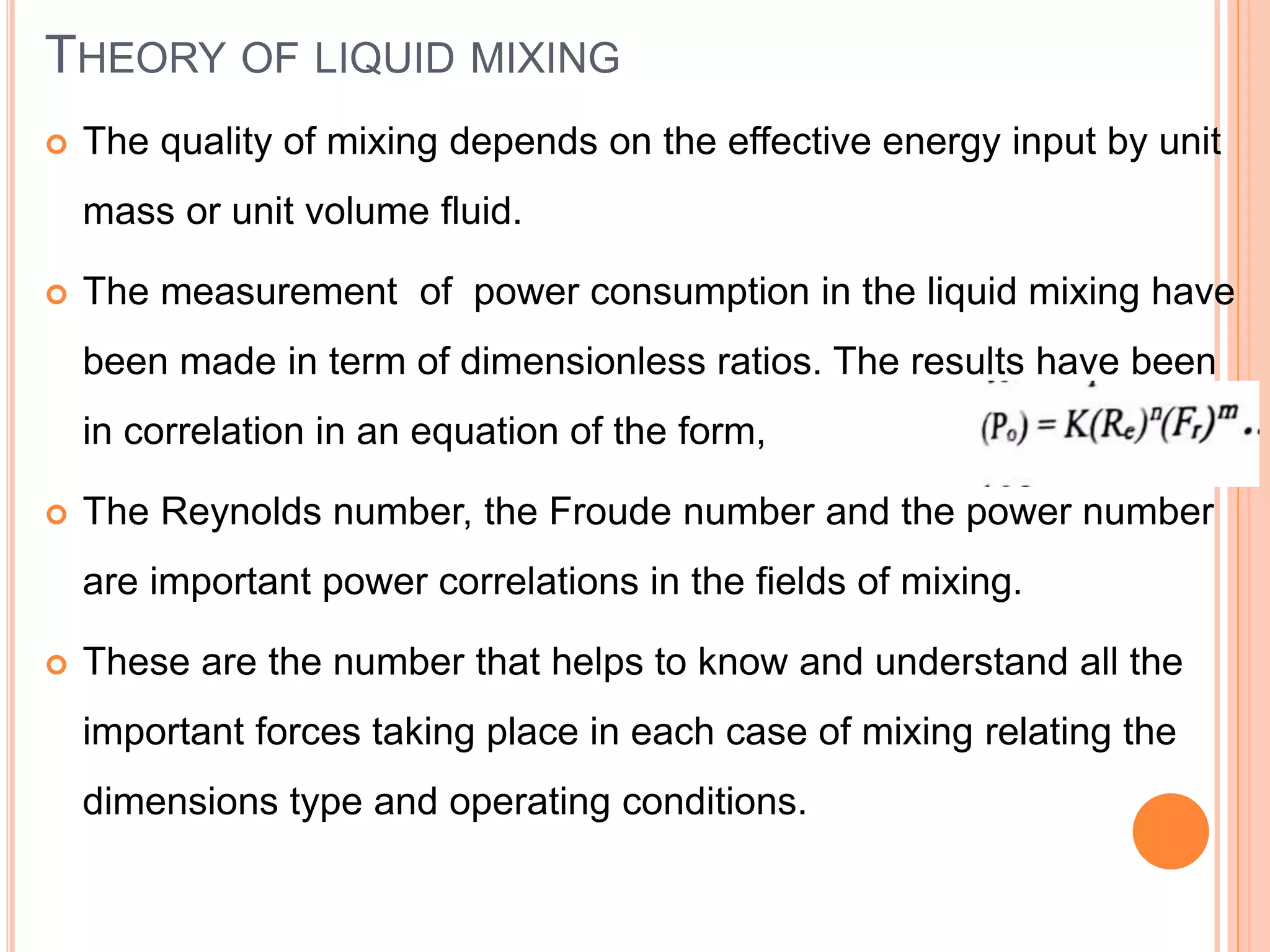
 The measurement of power consumption in the liquid mixing have
been made in term of dimensionless ratios. The results have been
in correlation in an equation of the form,
 The Reynolds number, the Froude number and the power number
are important power correlations in the fields of mixing.
 These are the number that helps to know and understand all the
important forces taking place in each case of mixing relating the
dimensions type and operating conditions.
CONTD..
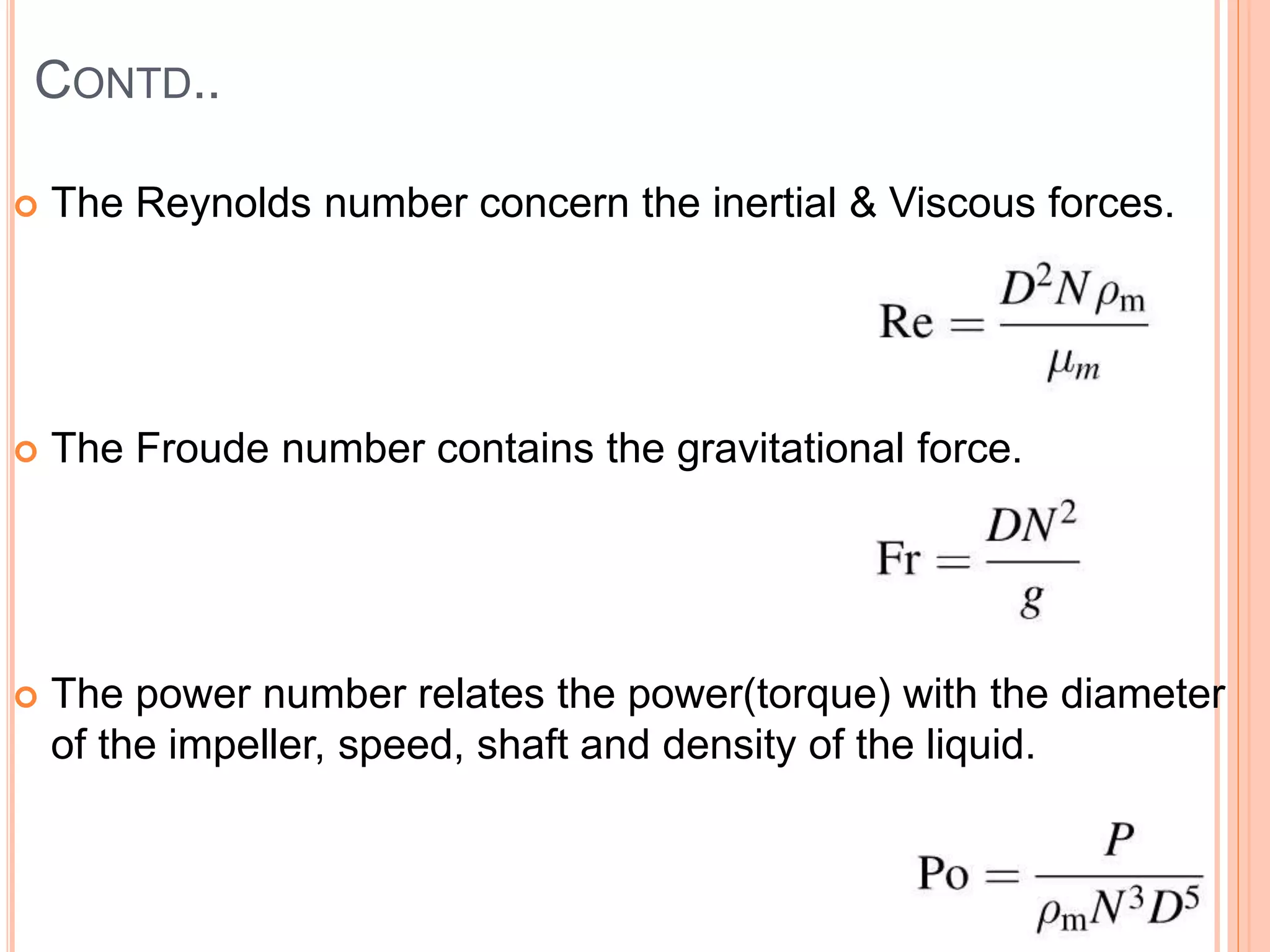
 The Reynolds number concern the inertial & Viscous forces.
 The Froude number contains the gravitational force.
 The power number relates the power(torque) with the diameter
of the impeller, speed, shaft and density of the liquid.
CONTD…
R at e o f m i x i n g :
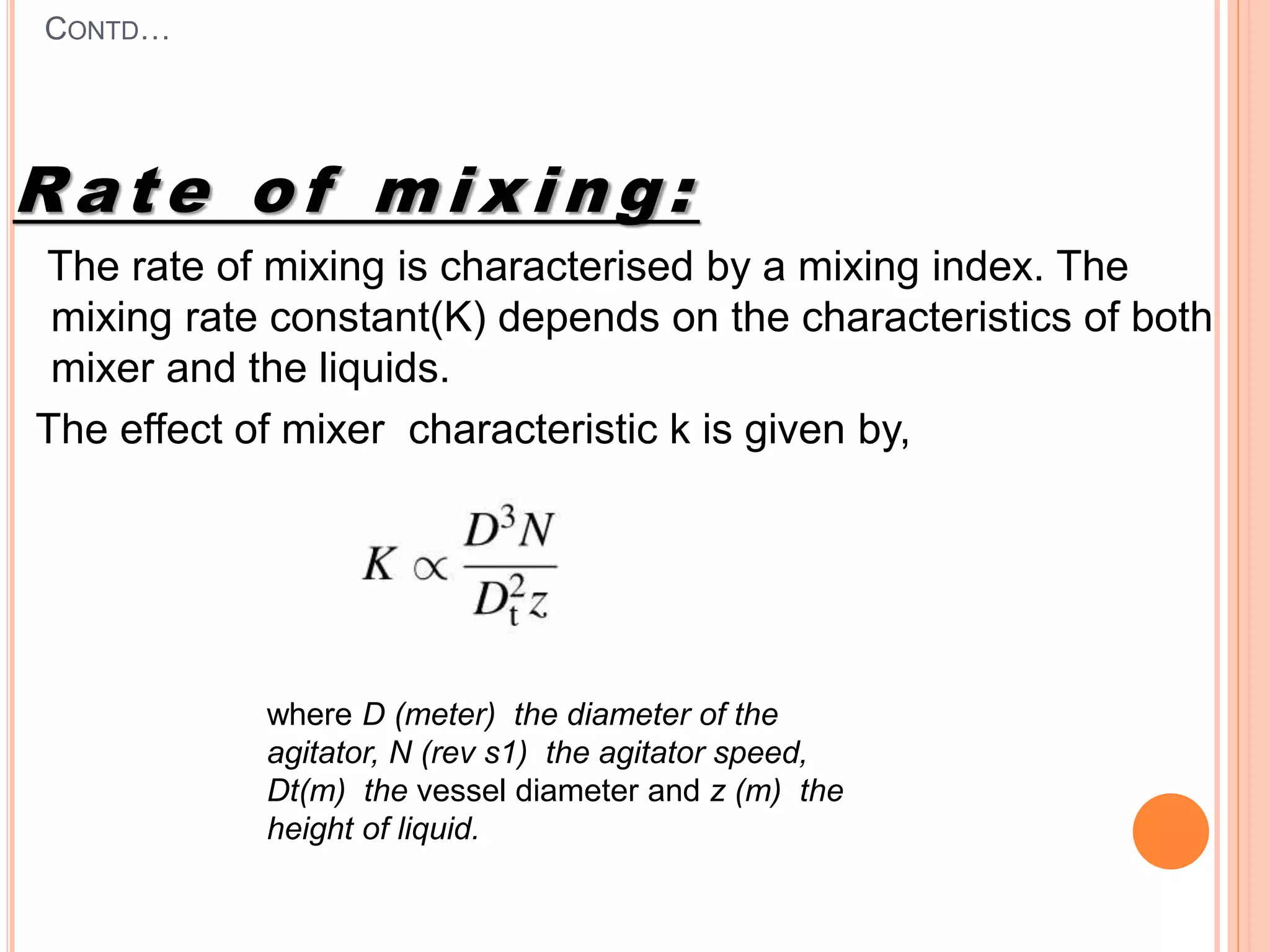
The rate of mixing is characterised by a mixing index. The
mixing rate constant(K) depends on the characteristics of both
mixer and the liquids.
The effect of mixer characteristic k is given by,
where D (meter) the diameter of the
agitator, N (rev s1) the agitator speed,
Dt(m) the vessel diameter and z (m) the
height of liquid.
CONTD…
The power requirement of mixer
vary according to,
 The nature, amount and viscosity of the foods in the
mixer.
 The position, type, speed and size of impeller.
SOLID - LIQUID MIXING
 One general principle which does not apply to the solid-liquid
mixing(i.e paste like materials ) is that their performance depends
on the direct contact between the mixing elements and the
materials of the mixture.
 Thus the materials must be brought to the mixing elements or the
elements must travel to all the parts of the mixing vessel.
 Types of solid liquid mixing.
 Solid in Liquid mixing.
( e.g tea, coffee, etc)
 Liquid in Solid Mixing.
(e.g paste, Dough etc)
FLUID DYNAMIC PROPERTY AND MIXING
 Most liquid food are Non-Newtonian and the common types are
pseudoplastic, dilatent and viscoelastic.
 Pseudoplastic foods (e.g- Sauces) form a zone of thinned
material around small agitator as mixing proceeds and the bulk
of the food does not move. The higher the agitator speed, the
more quickly the zone becomes apparent.
 Dilatent foods (e.g- Cornflour & Chocolate) should be mixed
with great care, if adequate power is not avilable in the mixer,
the increase in viscosity causes damage. to drive mechanism
and shaft.
CONTD…
 Viscoelastic foods (e.g- Dough) Requires folding &
stretching action to shear the material suitable
equipments includes twin-shaft mixers & planetary
mixers with inter-meshing blades.
Viscosity
 The viscosity decreases with increasing shear rate.
 The viscosity deceases with increase in
temperature
 Materials which exhibit viscous & elastic properties
including stress relaxation, creep & recoil.
CONTD….
 In high-viscosity liquids, paste, or dough; mixing occurs by,
 Kneading the materials against the vessel wall or into other
materials.
 Folding unmixed food into the mixed part
 Shearing to stretch the materials.
(The material is subjected shear and is often stretched and torn
apart by the action of the mixing elements)
MIXING AND DIFFICULTIES.
 Efficient mixing is achieved by creating and recombining fresh
surface in the food as often as possible.
 However, because the material does not easily flow, it is
necessary either to move the food to the mixer blades.
 Higher the consistency of the mixture, the greater the diameter
of impeller system and slower the speed of rotation
 Gravity play a role of villen. Homogenesity remains for the fixed
time period and start to settle due to the effect of gravity.
.
The characteristics of solid liquid phase
which are to be mixed together are as
follows:
 Solid should not be coarse.
 Liquid should not be too viscous.
 The amount of solid per unit volume of liquid should not be too
high.
MIXING EFFECTS ON FOODS
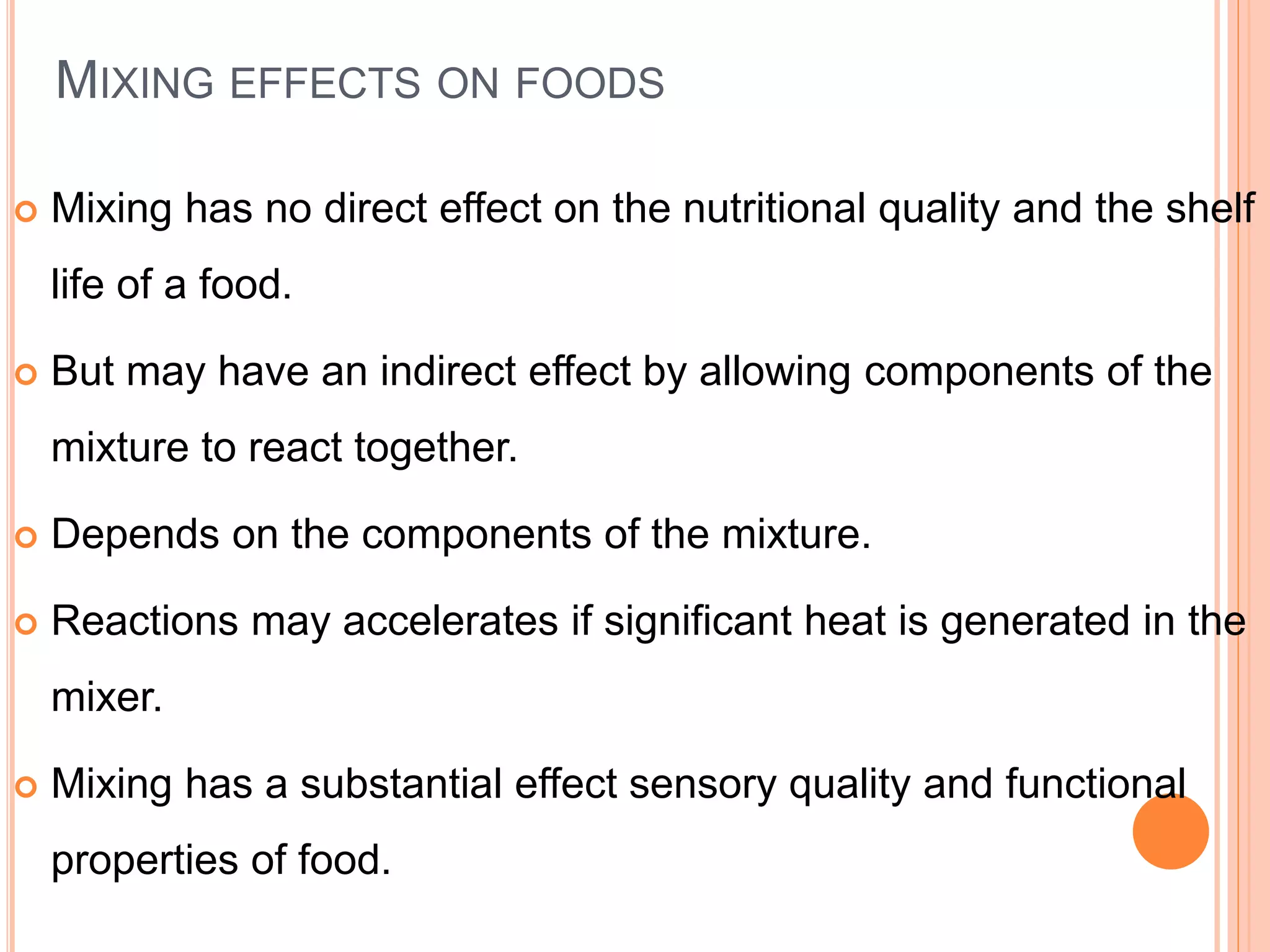
 Mixing has no direct effect on the nutritional quality and the shelf
life of a food.
 But may have an indirect effect by allowing components of the
mixture to react together.
 Depends on the components of the mixture.
 Reactions may accelerates if significant heat is generated in the
mixer.
 Mixing has a substantial effect sensory quality and functional
properties of food.
FOR EXAMPLE;
 Gluten development is promoted during dough making by the
stretching and folding action which aligns, uncoils and extends
protein molecules and develops the strength of the gluten
structure to produce the desired texture in the bread.
o The main effects are to increase the uniformity of products by
evenly distributing ingredients throughout the bulk.
.
Blades & Suitable Mixer
 Gates blades are used for mixing pastes, blending ingredients &
preparation of spreads.
 Hooks are used for dough mixing
 Whisks are used for butter preparation.
MARINE-TYPE PROPELLER IMPELLERS
 As shown in Figure 13.5 , a propeller-type impeller typically has
three blades, similar to propellers used in boats for propulsion in
water.
 Propeller-type impellers are used largely for low-viscosity fluids
and are operated at high speeds.
 The discharge flow in a propeller is
parallel to the axis. This type of flow
pattern is called axial flow. the fluid
moves up along the sides and down
along the central axis.
■ Figure :A marine type propeller and flow
behavior inside an agitation vessel.
PADDLE IMPELLERS
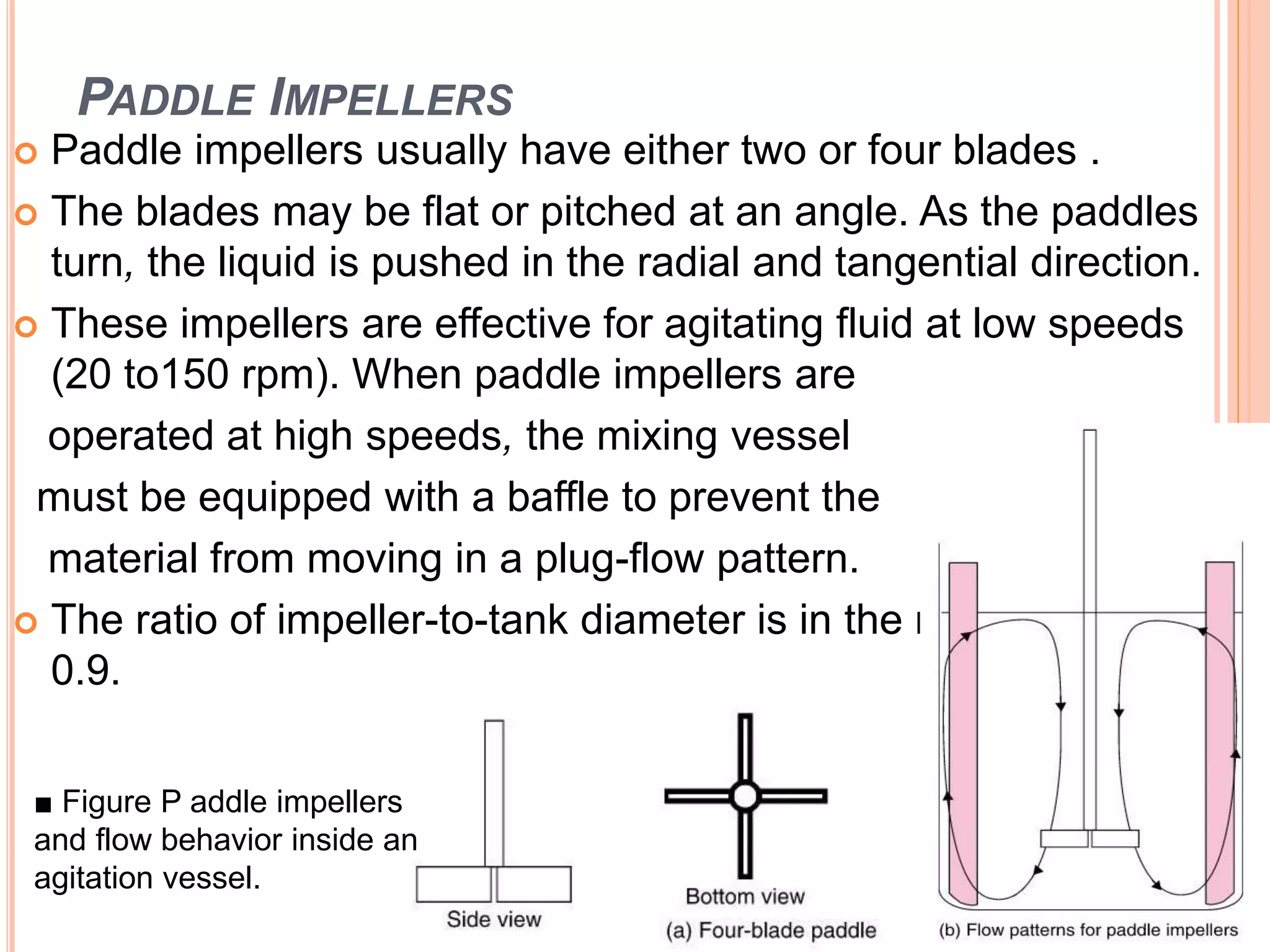
 Paddle impellers usually have either two or four blades .
 The blades may be flat or pitched at an angle. As the paddles
turn, the liquid is pushed in the radial and tangential direction.
 These impellers are effective for agitating fluid at low speeds
(20 to150 rpm). When paddle impellers are
operated at high speeds, the mixing vessel
must be equipped with a baffle to prevent the
material from moving in a plug-flow pattern.
 The ratio of impeller-to-tank diameter is in the range of 0.5 to
0.9.
■ Figure P addle impellers
and flow behavior inside an
agitation vessel.
TURBINE AGITATORS
 Turbine agitators are similar to paddle impellers equipped with
short multiple blades.
 The diameter of the turbine is usually less than half of the
diameter of the vessel.
 Axial flow is induced when pitched blades are used. Flat-bladed
turbines discharge in the radial direction. In curved-bladed
turbines, the blade curves away from the direction of rotation.
 This modification causes less mechanical
shear of the product and is
more suitable for products
with friable solids.
■ Figure Turbine agitator and flow behavior
inside a vessel.
EQUIPMENTS OF SOLID LIQUID MIXING
DOUGH AND PASTE MIXER
 Should be heavy and powerful.
 These machine mix with reasonable efficiency due to large
power requirement.
 As power is dissipated in the form of heat, ti may cause
substantial heating of Product.
 In such machine jacketing of the mixer to remove as much heat
as possible with cooling water.
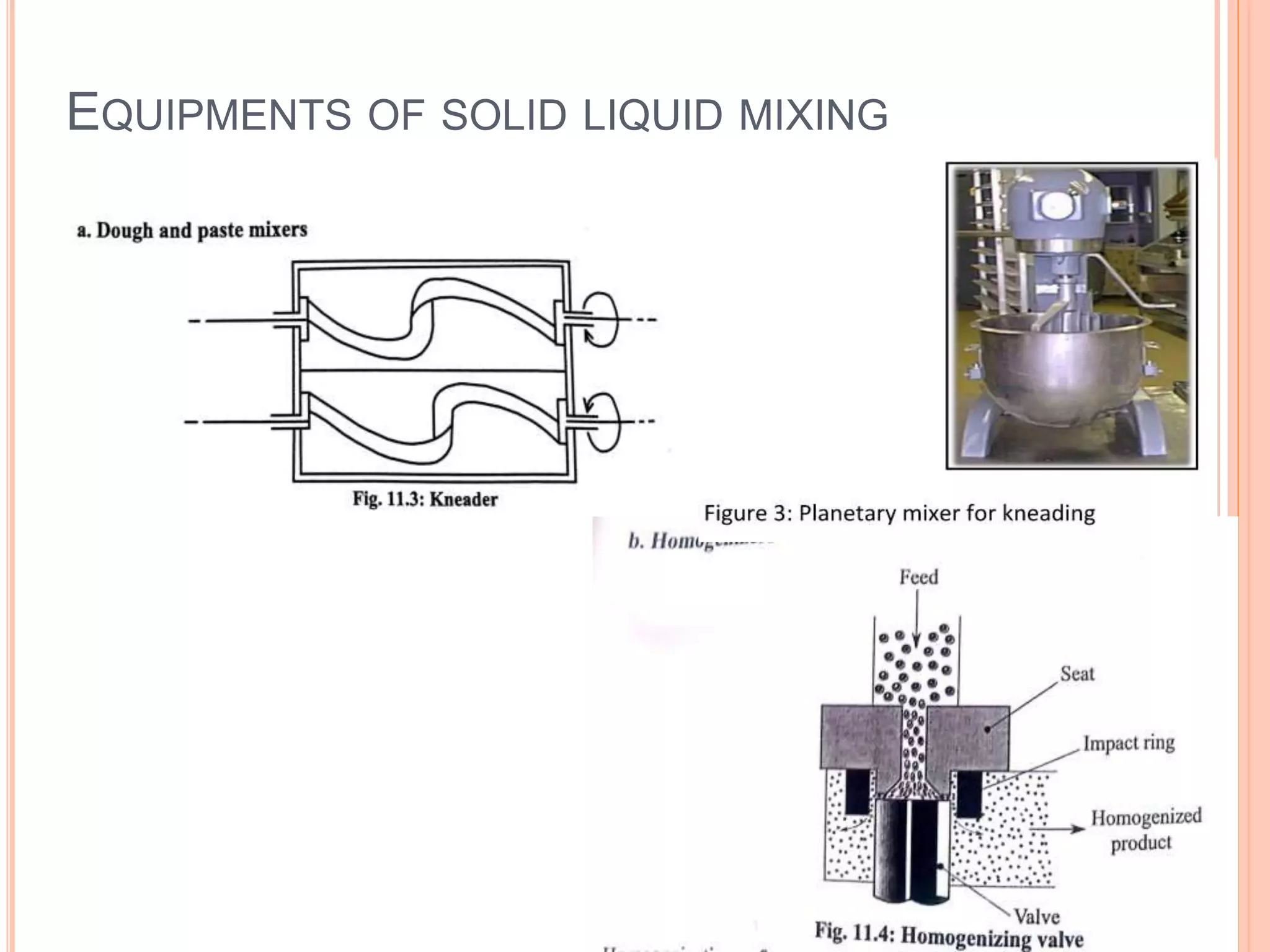
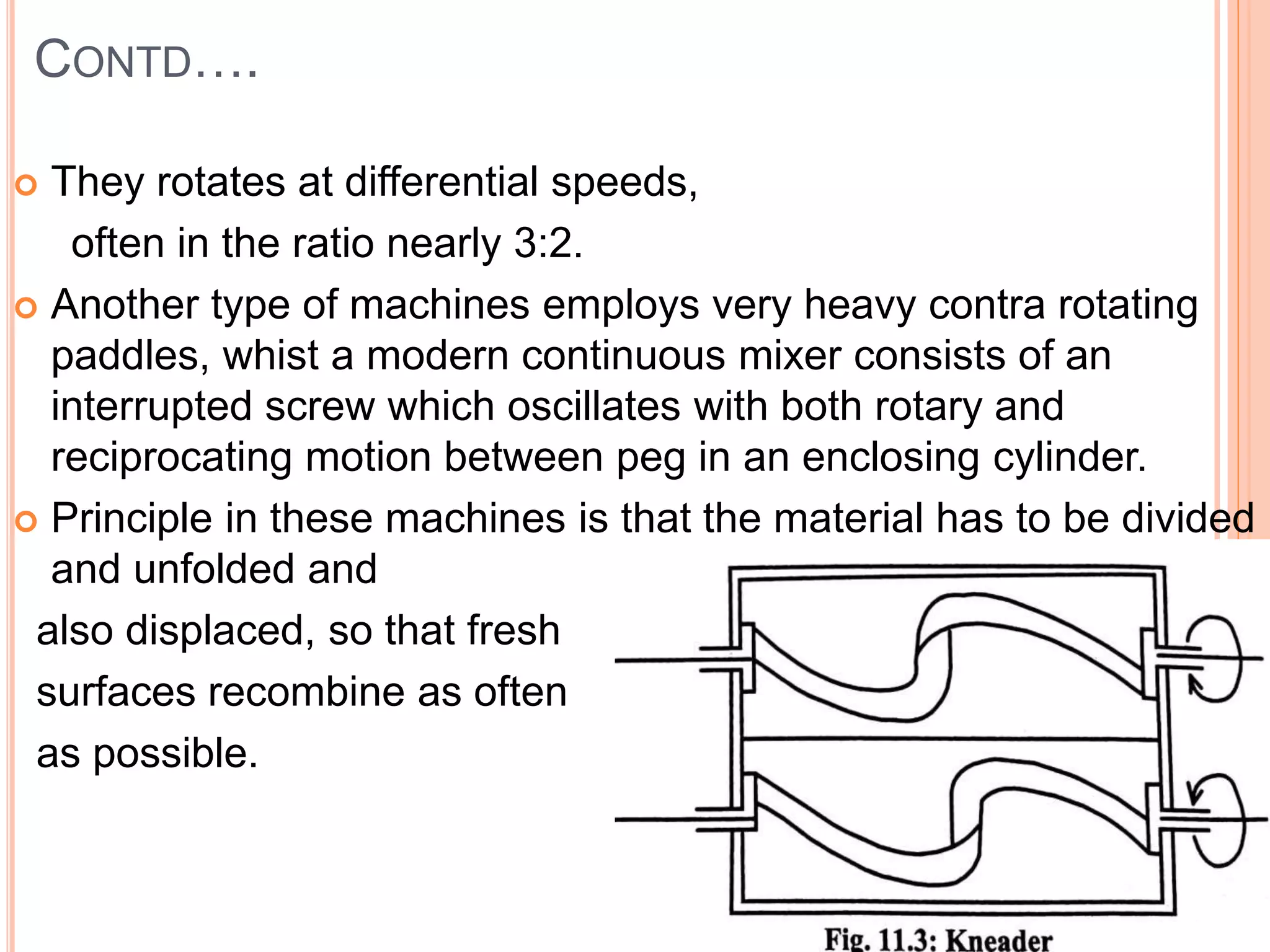
 Kneader is the most commonly used mixers.
 It employs two contra-rotating arms of special shape, which fold
and shear the material across a cusp, or division, in the bottom
of the mixer.
 The arms are so called sigmoid shaped.
CONTD….
 They rotates at differential speeds,
often in the ratio nearly 3:2.
 Another type of machines employs very heavy contra rotating
paddles, whist a modern continuous mixer consists of an
interrupted screw which oscillates with both rotary and
reciprocating motion between peg in an enclosing cylinder.
 Principle in these machines is that the material has to be divided
and unfolded and
also displaced, so that fresh
surfaces recombine as often
as possible.
HOMOGENIZERS
 Based on milk.
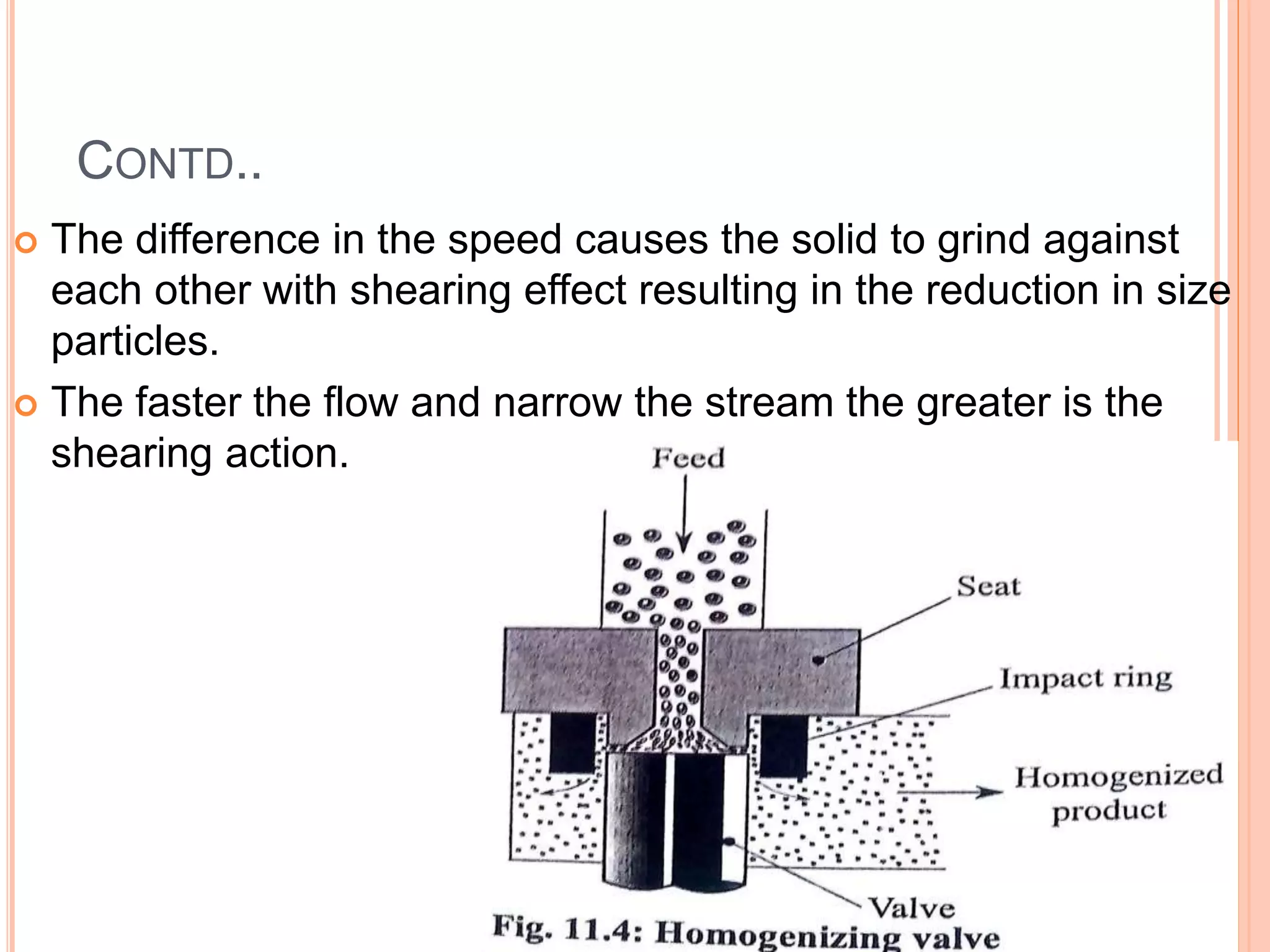
 Homogenizer refers to the process of forcing the milk through
homogenizer with the objectives of subdividing the fat globules.
 Homogenized milk has been treated in such a manner so as to
ensure break up of fat globules to such an extent that after 48
hours of qucesent storage at 45’F no visible cream sepration
occcurs in milk. The disrupting action takes place as a result of
shearing action between the globules as they follow through a
passage a high velosity.
 The solid particles nearest the edge of the stream are retarted
somewhat by the fraction of the fluid on the banks of the stream
which therefore carries the particles nearest in the centre at a
more rapid velocity than those near the edge.
CONTD..
 The difference in the speed causes the solid to grind against
each other with shearing effect resulting in the reduction in size
particles.
 The faster the flow and narrow the stream the greater is the
shearing action.
ADVANTAGES….
 No formation of cream layer.
 Fat in the milk doesn’t churn to rough handling or excessive
agitation.
 More palatable, heavy body and richer flavor.
 Produce soft curd and its better digested.
 Less susceptible to oxidized flavor development.
ANIMATION OF FLASH MIXER
HOMOGENIZER. (PRESSURE)
APPLICATION OF MIXING:
Not only in food but it is also applicable in,
1.Fine chemicals, agrichemicals, and pharmaceuticals
2. Petrochemicals
3. Polymer processing
4. Paints and automotive finishes
5. Cosmetics and consumer products
6. Food
7. Drinking water and wastewater treatment
8. Pulp and paper
9. Mineral Processing
DISCUSSION:
Agitate & Mixing.
 We can agitate a vessel full of cold water but in mixing
we would add hot water to cold water to raise the
temperature of the mixture.
ANY QUESTION???????
Mail me at
dahalsagar42@gmail.com
REFRENCE:
 1)R.Paul Singh & Dennis R. Helmond Introduction
to Food Engineering Fourth Edition Food Science
and Technology, (page-709 to 717)
 2)Felows, Food processing Technology: Principles
& Practice 2nd edition (Chapter-5)
 3)solid-liquid mixing in agitated tanks: experimental and cfd
analysis by seyed hosseini
.
Thank you

Science of Mixing

  • 1.
    PRESENTATION ON SOLID-LIQUIDMIXING Mixing Sub topic : Solid –Liquid Mixing By- Sagar Dahal
  • 2.
    CONTENT : 1. Introduction 2.Aspect of mixing 3. Types of Mixing 4. Theory of Solid & Liquid mixing 5. Rate of Mixing 6. Solid-Liquid Mixing 7. Fluid dynamic property of different food & Mixing 8. Mixing effect on food 9. Some equipments (Blades) and their working 10. Application of mixing
  • 3.
    MIXING  The term“mixing” essentially refers to unit operation reducing the non uniformities in the spatial distribution of composition properties or temperature within bulk material.  Mixing is the dispersing of two or more components, one throughout the other to obtain a uniform mixture It occurs in numerable instances in the food industry and is probably the most commonly encountered of all the process operations. The larger compounds is some time called continuous phase and smaller compounds is some time called dispersed phase.
  • 4.
    ASPECT OF MIXING Mixing is often used primary to developed desirable product characteristics, rather than simply ensure homogeneity.  Often multi components involving ingredients of different physical properties & quantities  Some components may be fragile and damaged by over mixing.  There may be complex relationship between mixing pattern & product characteristics.
  • 5.
    WHY MIXING???  Dispersingflavor into solution or solids  Homogenizing a suspension of particulates  Forming pastes  Dissolving gasses in aqueous solution ……………..ETC
  • 6.
    TYPES OF MIXING Solid – Solid Mixing (Mixing Mashala, Mixing ingredients in pickel making, Dried soupes, Cake mixes)  Liquid –Liquid Mixing (Emulsions) (Mixing of two oils, Mixing milk & Water, Maragins & Spreads)  Solid –Liquid mixing (making Dough, Chocolate making, Sauce making, Jam jelly making, coffee & sugar, Paste making etc.)  Gas-Liquid mixing: (Chlorination, Fermentation, CO2 in soft drinks)
  • 7.
    THEORY OF SOLIDMIXING  It is not possible to achieve a completely uniform mixture of dry powder or particulate solid.  Degree of mixing, that is achieved depends on;  The relative particle size, shape and density of each components  The moisture content of, surface characteristics and flow characteristics of each components  The tendency of the materials to aggregate  The efficiency of a particular mixer for those components.
  • 8.
    THEORY OF LIQUIDMIXING  The quality of mixing depends on the effective energy input by unit mass or unit volume fluid.  The measurement of power consumption in the liquid mixing have been made in term of dimensionless ratios. The results have been in correlation in an equation of the form,  The Reynolds number, the Froude number and the power number are important power correlations in the fields of mixing.  These are the number that helps to know and understand all the important forces taking place in each case of mixing relating the dimensions type and operating conditions.
  • 9.
    CONTD..  The Reynoldsnumber concern the inertial & Viscous forces.  The Froude number contains the gravitational force.  The power number relates the power(torque) with the diameter of the impeller, speed, shaft and density of the liquid.
  • 10.
    CONTD… R at eo f m i x i n g : The rate of mixing is characterised by a mixing index. The mixing rate constant(K) depends on the characteristics of both mixer and the liquids. The effect of mixer characteristic k is given by, where D (meter) the diameter of the agitator, N (rev s1) the agitator speed, Dt(m) the vessel diameter and z (m) the height of liquid.
  • 11.
    CONTD… The power requirementof mixer vary according to,  The nature, amount and viscosity of the foods in the mixer.  The position, type, speed and size of impeller.
  • 12.
    SOLID - LIQUIDMIXING  One general principle which does not apply to the solid-liquid mixing(i.e paste like materials ) is that their performance depends on the direct contact between the mixing elements and the materials of the mixture.  Thus the materials must be brought to the mixing elements or the elements must travel to all the parts of the mixing vessel.  Types of solid liquid mixing.  Solid in Liquid mixing. ( e.g tea, coffee, etc)  Liquid in Solid Mixing. (e.g paste, Dough etc)
  • 13.
    FLUID DYNAMIC PROPERTYAND MIXING  Most liquid food are Non-Newtonian and the common types are pseudoplastic, dilatent and viscoelastic.  Pseudoplastic foods (e.g- Sauces) form a zone of thinned material around small agitator as mixing proceeds and the bulk of the food does not move. The higher the agitator speed, the more quickly the zone becomes apparent.  Dilatent foods (e.g- Cornflour & Chocolate) should be mixed with great care, if adequate power is not avilable in the mixer, the increase in viscosity causes damage. to drive mechanism and shaft.
  • 14.
    CONTD…  Viscoelastic foods(e.g- Dough) Requires folding & stretching action to shear the material suitable equipments includes twin-shaft mixers & planetary mixers with inter-meshing blades. Viscosity  The viscosity decreases with increasing shear rate.  The viscosity deceases with increase in temperature  Materials which exhibit viscous & elastic properties including stress relaxation, creep & recoil.
  • 15.
    CONTD….  In high-viscosityliquids, paste, or dough; mixing occurs by,  Kneading the materials against the vessel wall or into other materials.  Folding unmixed food into the mixed part  Shearing to stretch the materials. (The material is subjected shear and is often stretched and torn apart by the action of the mixing elements)
  • 16.
    MIXING AND DIFFICULTIES. Efficient mixing is achieved by creating and recombining fresh surface in the food as often as possible.  However, because the material does not easily flow, it is necessary either to move the food to the mixer blades.  Higher the consistency of the mixture, the greater the diameter of impeller system and slower the speed of rotation  Gravity play a role of villen. Homogenesity remains for the fixed time period and start to settle due to the effect of gravity.
  • 17.
    . The characteristics ofsolid liquid phase which are to be mixed together are as follows:  Solid should not be coarse.  Liquid should not be too viscous.  The amount of solid per unit volume of liquid should not be too high.
  • 18.
    MIXING EFFECTS ONFOODS  Mixing has no direct effect on the nutritional quality and the shelf life of a food.  But may have an indirect effect by allowing components of the mixture to react together.  Depends on the components of the mixture.  Reactions may accelerates if significant heat is generated in the mixer.  Mixing has a substantial effect sensory quality and functional properties of food.
  • 19.
    FOR EXAMPLE;  Glutendevelopment is promoted during dough making by the stretching and folding action which aligns, uncoils and extends protein molecules and develops the strength of the gluten structure to produce the desired texture in the bread. o The main effects are to increase the uniformity of products by evenly distributing ingredients throughout the bulk.
  • 20.
    . Blades & SuitableMixer  Gates blades are used for mixing pastes, blending ingredients & preparation of spreads.  Hooks are used for dough mixing  Whisks are used for butter preparation.
  • 21.
    MARINE-TYPE PROPELLER IMPELLERS As shown in Figure 13.5 , a propeller-type impeller typically has three blades, similar to propellers used in boats for propulsion in water.  Propeller-type impellers are used largely for low-viscosity fluids and are operated at high speeds.  The discharge flow in a propeller is parallel to the axis. This type of flow pattern is called axial flow. the fluid moves up along the sides and down along the central axis. ■ Figure :A marine type propeller and flow behavior inside an agitation vessel.
  • 22.
    PADDLE IMPELLERS  Paddleimpellers usually have either two or four blades .  The blades may be flat or pitched at an angle. As the paddles turn, the liquid is pushed in the radial and tangential direction.  These impellers are effective for agitating fluid at low speeds (20 to150 rpm). When paddle impellers are operated at high speeds, the mixing vessel must be equipped with a baffle to prevent the material from moving in a plug-flow pattern.  The ratio of impeller-to-tank diameter is in the range of 0.5 to 0.9. ■ Figure P addle impellers and flow behavior inside an agitation vessel.
  • 23.
    TURBINE AGITATORS  Turbineagitators are similar to paddle impellers equipped with short multiple blades.  The diameter of the turbine is usually less than half of the diameter of the vessel.  Axial flow is induced when pitched blades are used. Flat-bladed turbines discharge in the radial direction. In curved-bladed turbines, the blade curves away from the direction of rotation.  This modification causes less mechanical shear of the product and is more suitable for products with friable solids. ■ Figure Turbine agitator and flow behavior inside a vessel.
  • 24.
    EQUIPMENTS OF SOLIDLIQUID MIXING
  • 25.
    DOUGH AND PASTEMIXER  Should be heavy and powerful.  These machine mix with reasonable efficiency due to large power requirement.  As power is dissipated in the form of heat, ti may cause substantial heating of Product.  In such machine jacketing of the mixer to remove as much heat as possible with cooling water.  Kneader is the most commonly used mixers.  It employs two contra-rotating arms of special shape, which fold and shear the material across a cusp, or division, in the bottom of the mixer.  The arms are so called sigmoid shaped.
  • 26.
    CONTD….  They rotatesat differential speeds, often in the ratio nearly 3:2.  Another type of machines employs very heavy contra rotating paddles, whist a modern continuous mixer consists of an interrupted screw which oscillates with both rotary and reciprocating motion between peg in an enclosing cylinder.  Principle in these machines is that the material has to be divided and unfolded and also displaced, so that fresh surfaces recombine as often as possible.
  • 27.
    HOMOGENIZERS  Based onmilk.  Homogenizer refers to the process of forcing the milk through homogenizer with the objectives of subdividing the fat globules.  Homogenized milk has been treated in such a manner so as to ensure break up of fat globules to such an extent that after 48 hours of qucesent storage at 45’F no visible cream sepration occcurs in milk. The disrupting action takes place as a result of shearing action between the globules as they follow through a passage a high velosity.  The solid particles nearest the edge of the stream are retarted somewhat by the fraction of the fluid on the banks of the stream which therefore carries the particles nearest in the centre at a more rapid velocity than those near the edge.
  • 28.
    CONTD..  The differencein the speed causes the solid to grind against each other with shearing effect resulting in the reduction in size particles.  The faster the flow and narrow the stream the greater is the shearing action.
  • 29.
    ADVANTAGES….  No formationof cream layer.  Fat in the milk doesn’t churn to rough handling or excessive agitation.  More palatable, heavy body and richer flavor.  Produce soft curd and its better digested.  Less susceptible to oxidized flavor development.
  • 30.
  • 31.
  • 32.
    APPLICATION OF MIXING: Notonly in food but it is also applicable in, 1.Fine chemicals, agrichemicals, and pharmaceuticals 2. Petrochemicals 3. Polymer processing 4. Paints and automotive finishes 5. Cosmetics and consumer products 6. Food 7. Drinking water and wastewater treatment 8. Pulp and paper 9. Mineral Processing
  • 33.
    DISCUSSION: Agitate & Mixing. We can agitate a vessel full of cold water but in mixing we would add hot water to cold water to raise the temperature of the mixture.
  • 34.
    ANY QUESTION??????? Mail meat dahalsagar42@gmail.com
  • 35.
    REFRENCE:  1)R.Paul Singh& Dennis R. Helmond Introduction to Food Engineering Fourth Edition Food Science and Technology, (page-709 to 717)  2)Felows, Food processing Technology: Principles & Practice 2nd edition (Chapter-5)  3)solid-liquid mixing in agitated tanks: experimental and cfd analysis by seyed hosseini
  • 36.