Seminar on
QUALITY CONTROL CHECKING DONE FOR
FACE POWDER
Presented by
AYAN PAL
M.PHARM, 2nd SEM
ROLL NO-15920320008
DEPARTMENT OF PHARMACEUTICS
GGB
CALCUTTA INSTITUTE OF PHARMACEUTICAL TECHNOLOGY
AND A.H.S, ULUBERIA,HOWRAH
CONTENTS
 INTRODUCTION
 DEFINITION
 IDEAL PROPERTIES
 IDEAL CHARACTERISTICS
 TYPES OF FACE POWDER
 METHOD OF PREPARATION
 QUALITY CONTROL TEST
 CONCLUSION
 REFERENCES
INTRODUCTION
 A powder is a dry, bulk solid composed of a large number
of very fine particles that may flow freely when shaken.
 Various types of powders are body powder, face powders,
compacts medicated powders, deodorant powders and
foot powders for treatment purposes.
 Powders have different physical properties when
compared to the liquid preparations.
 They have very fine particle size, which helps in producing
large surface area per unit weight.
FACE POWDER
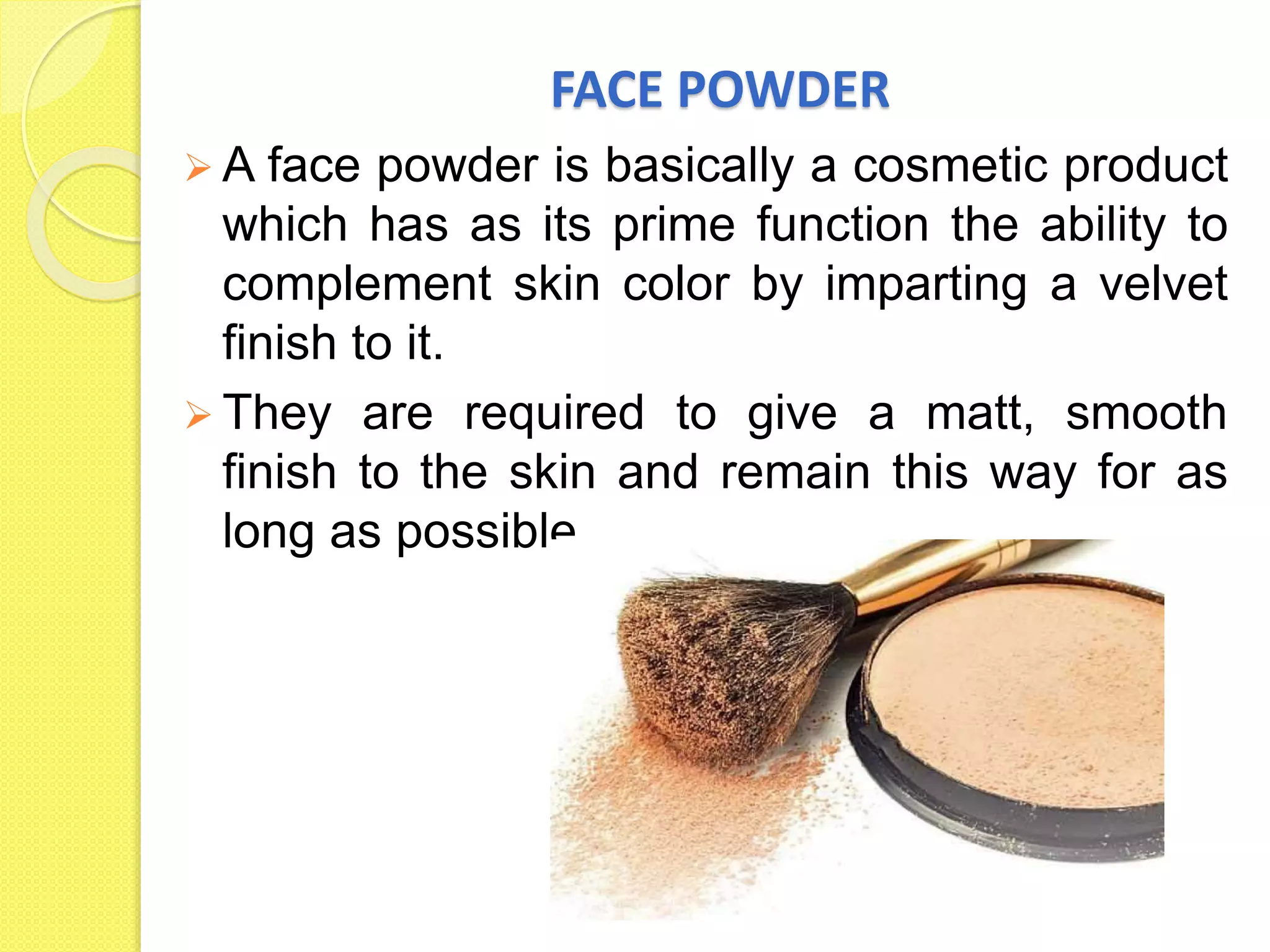
 A face powder is basically a cosmetic product
which has as its prime function the ability to
complement skin color by imparting a velvet
finish to it.
 They are required to give a matt, smooth
finish to the skin and remain this way for as
long as possible.
A Survey Shows That……
Category Percentage
Male 11
Female 89
%USE BY
Male
Femal
e
IDEAL PROPERTIES
 Should produce a smooth finish to the facial skin.
 Masking small visible imperfection of the face & shine
due to moisture or secretion of sebaceous and sweat
glands.
 Must produce a lasting effect , so that frequent
application is unnecessary.
 Should make face pleasant to look and touch.
 Must adhere to skin.
IDEAL CHARACTERISTICS(When applied)
 Covering Power
 Slip
 Adhesiveness
 Absorbency
 Bloom
 Coloring
 Perfuming
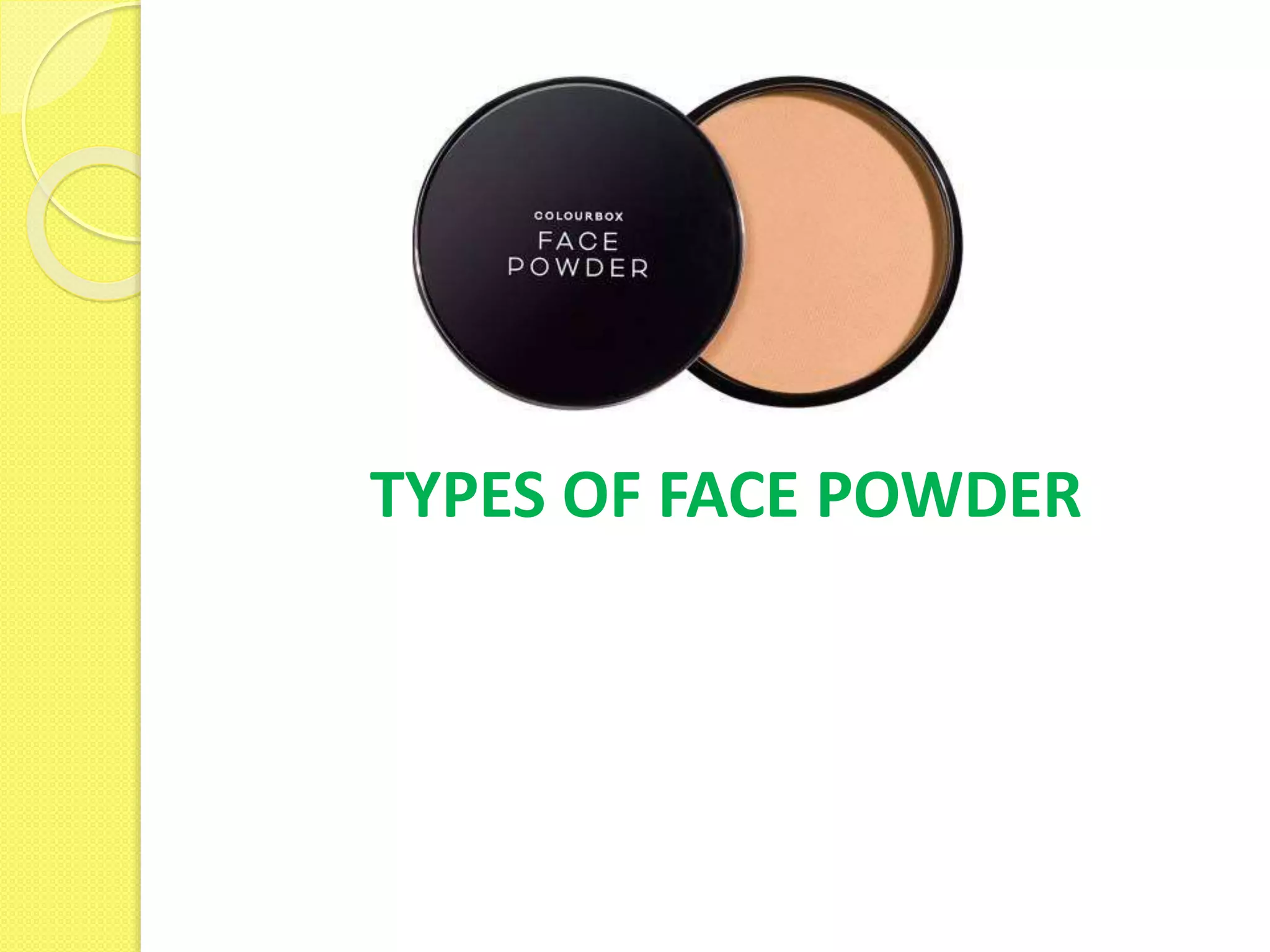
TYPES OF FACE POWDER
Depends on Nature of Skin
Types of Skin Types of Powder Characteristics
Dry Light Slight covering power
Contain large quantity of talc
Normal or
Moderately Oily
Medium •Comparatively higher
covering power
•Lesser talc and balanced by
zinc oxide
Very Oily Heavy •High covering power
•Lower quantity of talc and
high quantity of Zinc oxide
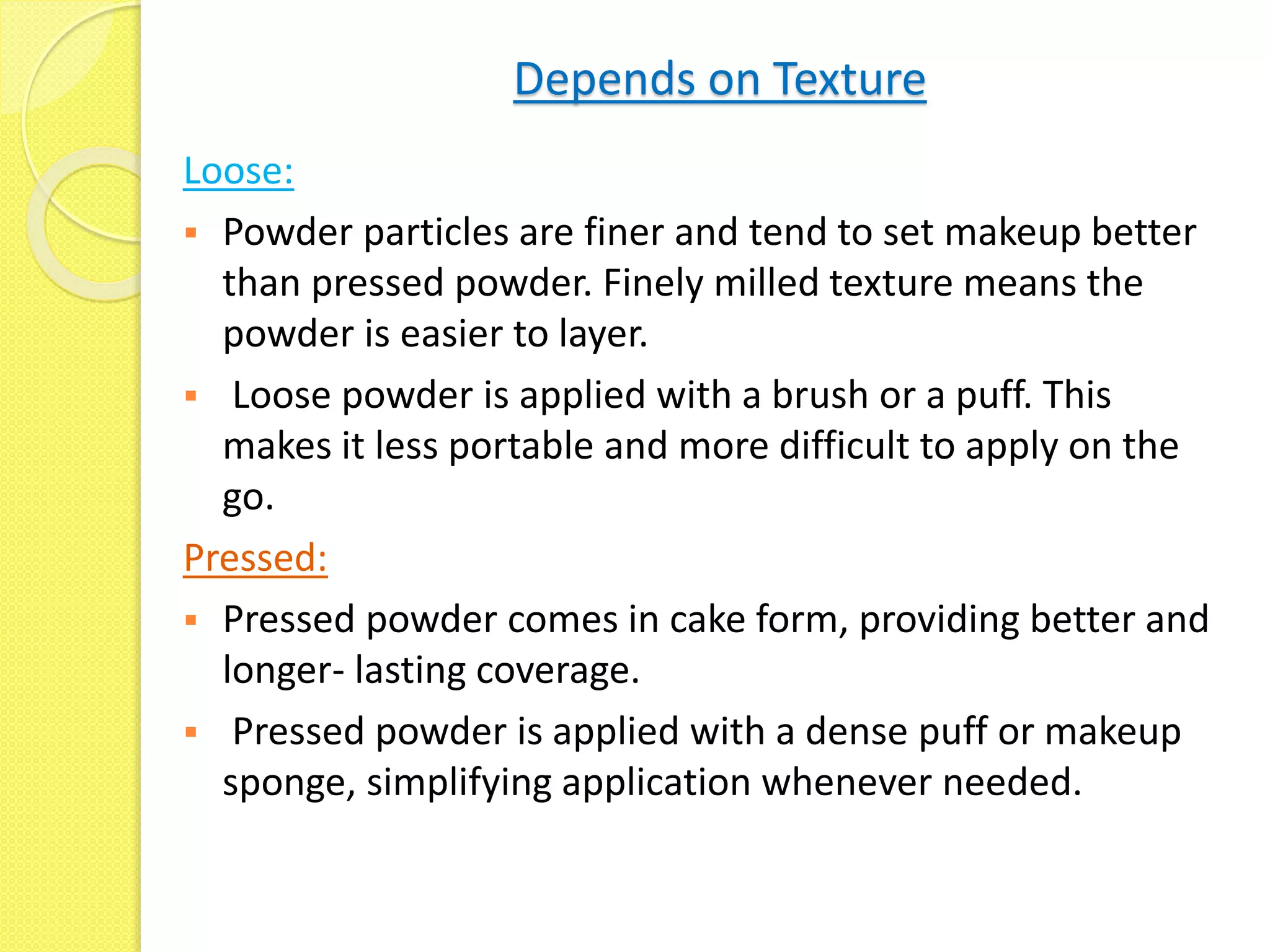
Depends on Texture
Loose:
 Powder particles are finer and tend to set makeup better
than pressed powder. Finely milled texture means the
powder is easier to layer.
 Loose powder is applied with a brush or a puff. This
makes it less portable and more difficult to apply on the
go.
Pressed:
 Pressed powder comes in cake form, providing better and
longer- lasting coverage.
 Pressed powder is applied with a dense puff or makeup
sponge, simplifying application whenever needed.
Continue
Translucent:
o Translucent powder is unpigmented,
sheer powder used mainly to control
oily zones.
o Translucent powder can be pressed or
loose powder.
Tinted:
o Tinted powder is pigmented and is
usually worn without foundation.
o Tinted powder can be pressed or loose
powder.
FORMULATION
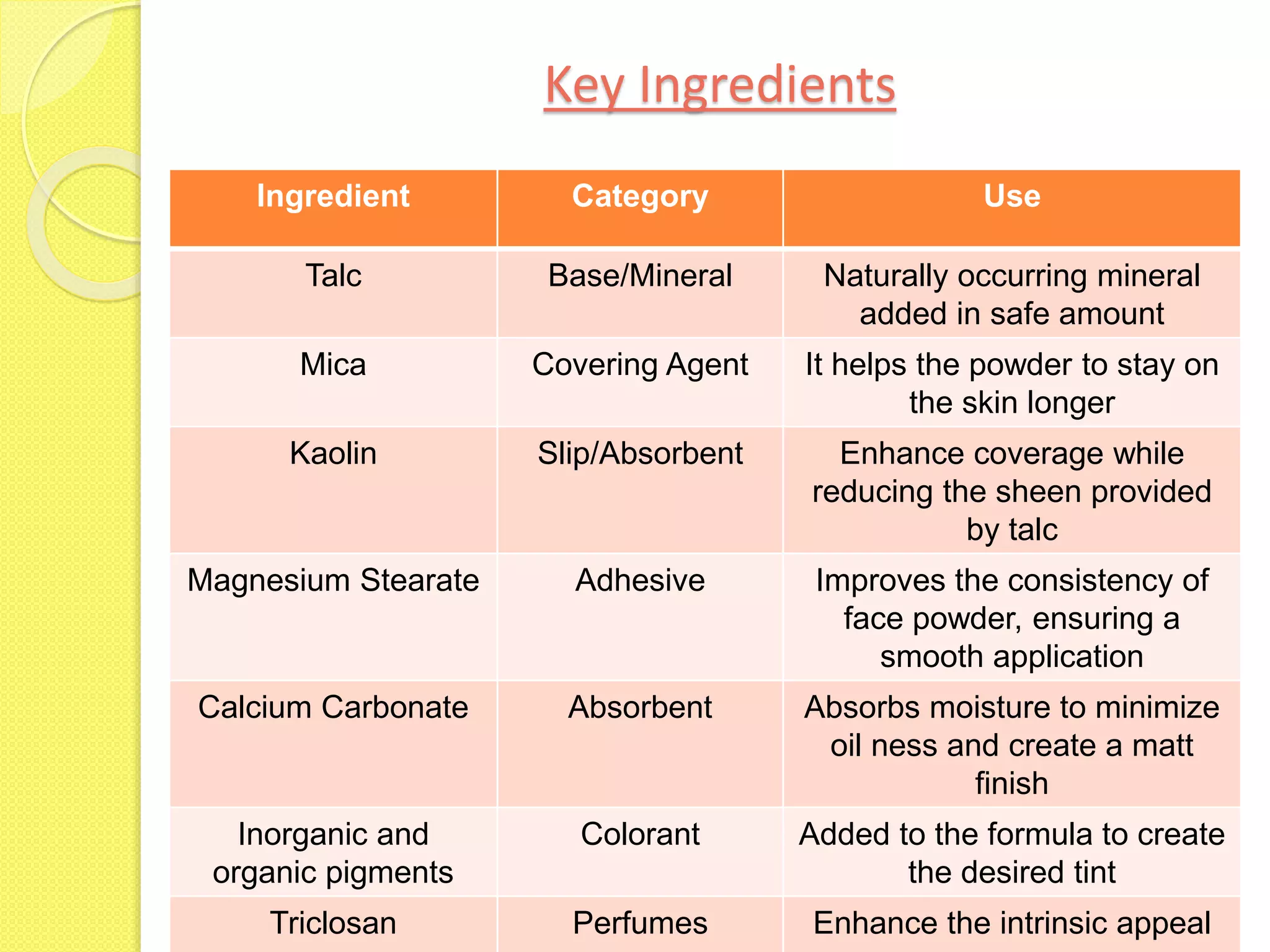
Key Ingredients
Ingredient Category Use
Talc Base/Mineral Naturally occurring mineral
added in safe amount
Mica Covering Agent It helps the powder to stay on
the skin longer
Kaolin Slip/Absorbent Enhance coverage while
reducing the sheen provided
by talc
Magnesium Stearate Adhesive Improves the consistency of
face powder, ensuring a
smooth application
Calcium Carbonate Absorbent Absorbs moisture to minimize
oil ness and create a matt
finish
Inorganic and
organic pigments
Colorant Added to the formula to create
the desired tint
Triclosan Perfumes Enhance the intrinsic appeal
General Preparation
 The preparation of powder is simple as it is simply a
matter of dry mixing of finely powdered materials.
 Add perfume with a part of absorbent materials like
calcium carbonate or with magnesium carbonate and
keep it aside for some time.
 Mix the color with part of the talc properly and add
the other powders and then the perfume mixture.
 Mix and sieve the powder mixture using a silk mesh
or an old washed nylon cloth.
METHOD OF PREPARATION
 Wet Method
 Dry Method
 Damp Method
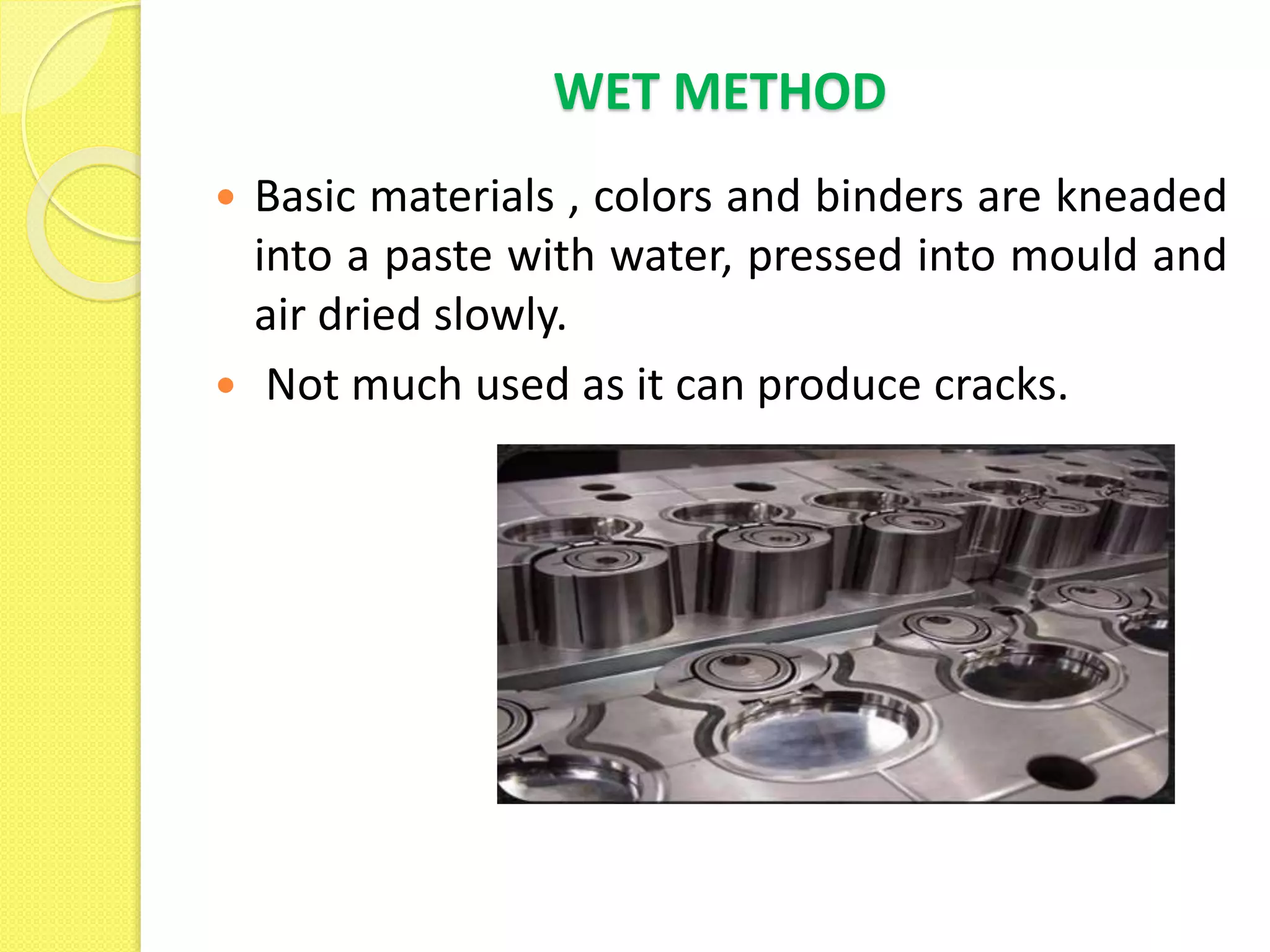
WET METHOD
 Basic materials , colors and binders are kneaded
into a paste with water, pressed into mould and
air dried slowly.
 Not much used as it can produce cracks.
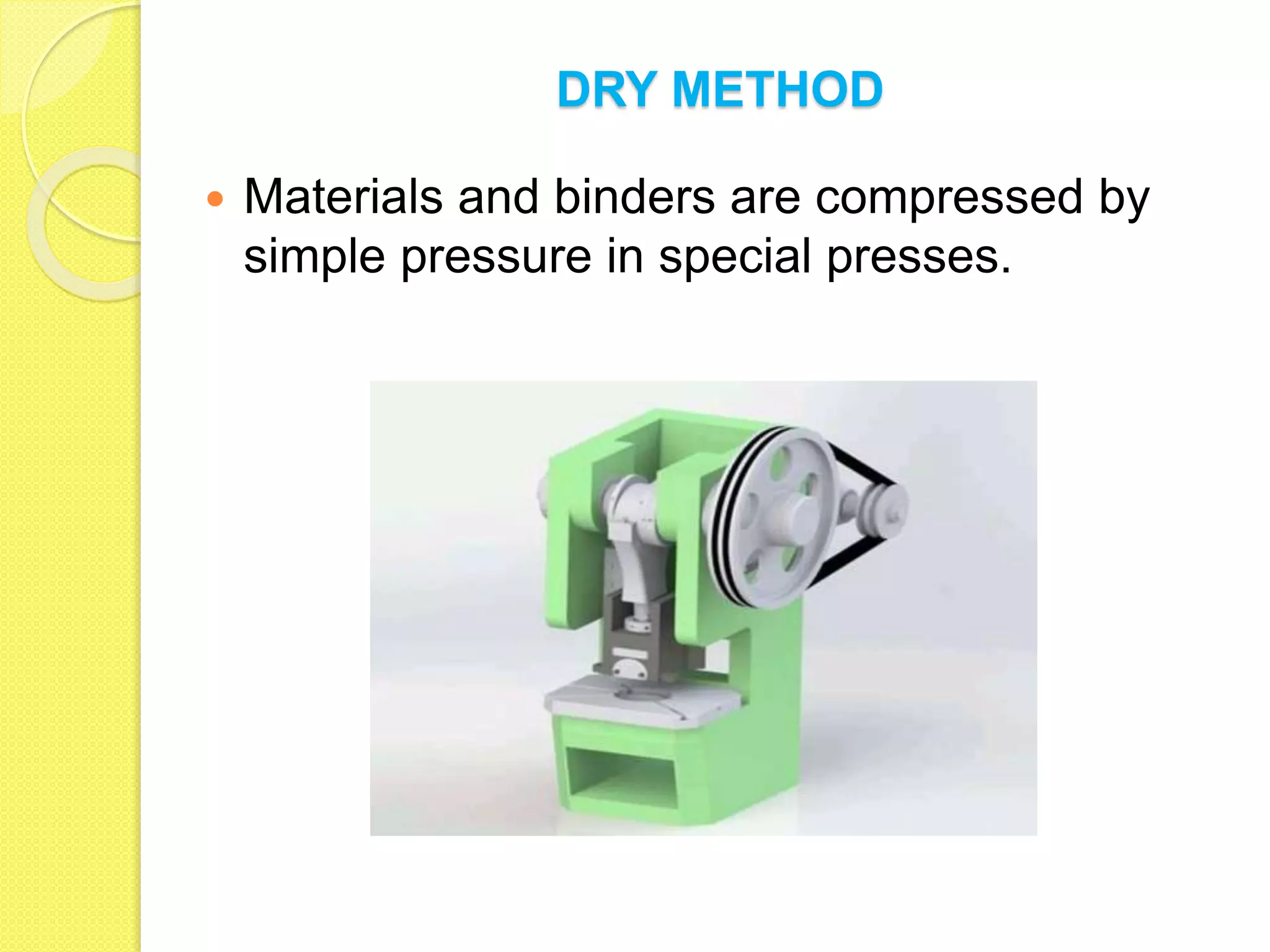
DRY METHOD
 Materials and binders are compressed by
simple pressure in special presses.
DAMP METHOD
 Base powder, color and perfume are mixed uniformly.
 Mixture is then wetted down with liquid binders like
aqueous mucilage and blended until the proper plasticity
of the mass is attained.
 Powder is then screened and compressed by machine
and dried at elevated temp.
 Widely accepted and commercially used method.
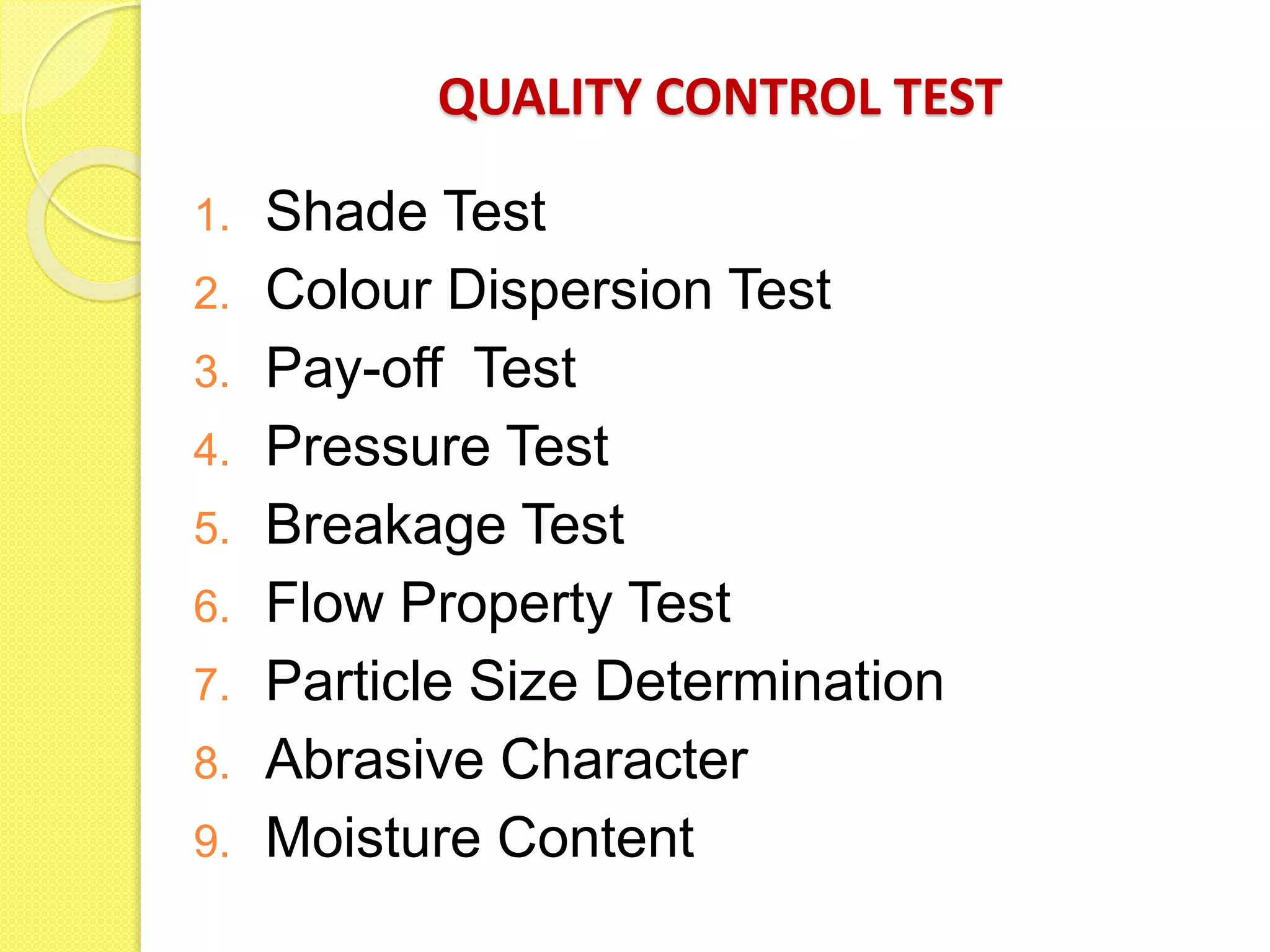
QUALITY CONTROL TEST
1. Shade Test
2. Colour Dispersion Test
3. Pay-off Test
4. Pressure Test
5. Breakage Test
6. Flow Property Test
7. Particle Size Determination
8. Abrasive Character
9. Moisture Content
 Shade Test:
In this test, the variations of colour shade is determined and
controlled. It is carried out by spreading the powder
sample on a white paper and appearance is observed
which is compared with the standard one. Another
method involves, applying powder sample and standard
one with the help of puff on the skin and then comparing
it. The puff used to perform this test is also used for the
final product. Evaluation of colour is carried out by using
artificial light.
 Colour Dispersion Test:
In this test, a sample of powder is spread on a white paper
and with the help of magnifying glass., segregation or
bleeding of the colour is observed. The colour should be
properly distributed in the powder base of the
formulation.
 Pay-off Test:
This test is carried out to check the adhesive property of
powders with the puff. This test is mainly carried out on
compact powders.
 Pressure Test:
For compaction purpose in compact powders, pressure
required. Uniform pressure should be applied to avoid
formation of air pockets, which will lead to either breaking
or cracking of compact powders. This is because low
pressure will make the compact powder soft, whereas high
pressure will lead to formation of hard cake.
 Breakage Test:
In this test, compact powders are allowed to fall on a wooden
surface from a height of about 8-10 inches. This is carried
out several times and then checking is done to see whether
any breakage has occurred on compact powder. If the
compact powder remains unbroken, then it shows the
resistance to travel and normal handling by the users.
 Flow Property Test:
This test is carried out maim} on body powders to determine
their flow property (from the container upon usage). This
intern helps in easy application of powder to skin. In this
method, angle of repose of powder is measured by allowing
the powder product to fall on a plate through a funnel. Then
the height and the radius of heap formed is measured, and
even the time taken for the powder to fall is noted.
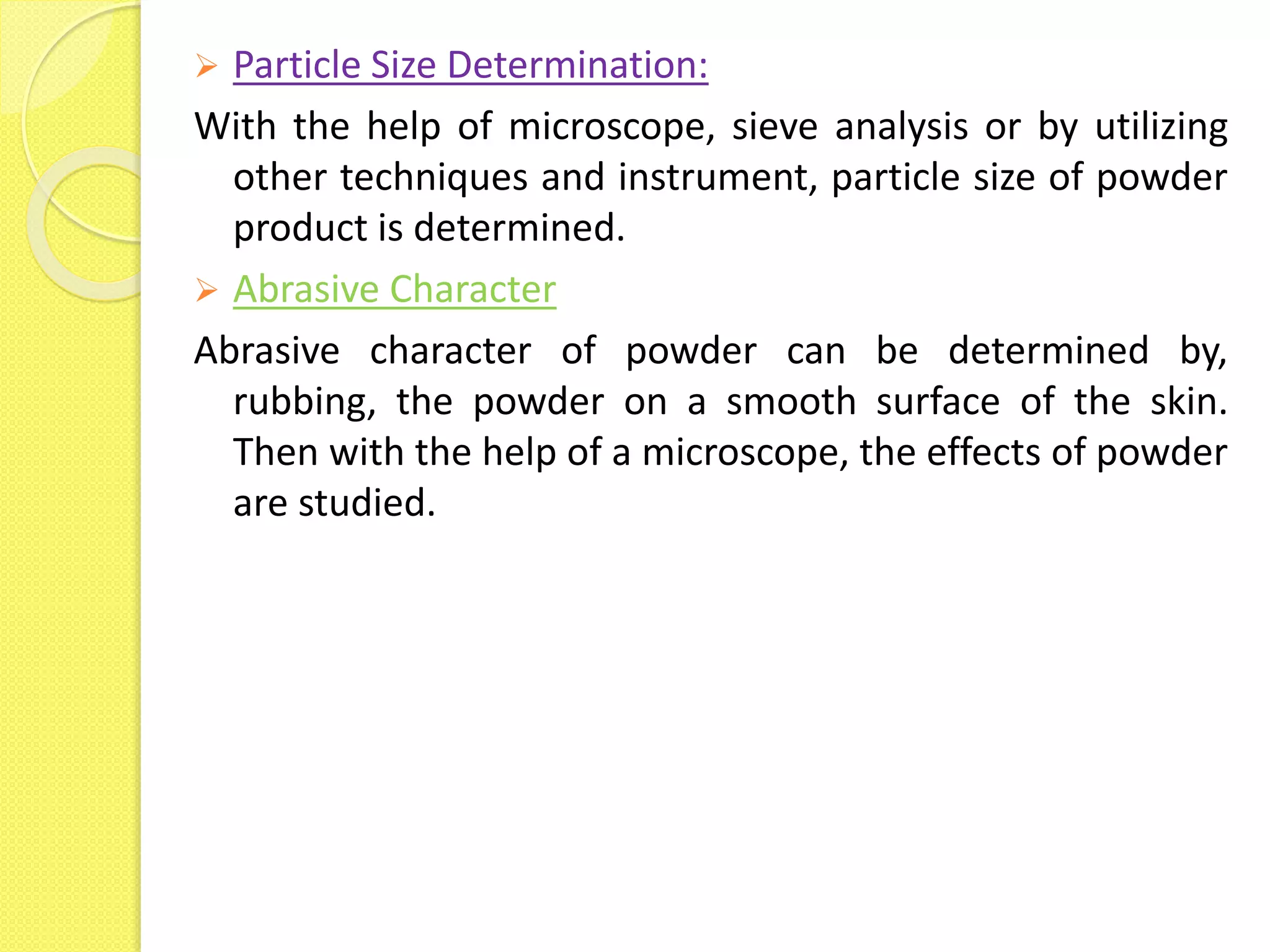
 Particle Size Determination:
With the help of microscope, sieve analysis or by utilizing
other techniques and instrument, particle size of powder
product is determined.
 Abrasive Character
Abrasive character of powder can be determined by,
rubbing, the powder on a smooth surface of the skin.
Then with the help of a microscope, the effects of powder
are studied.
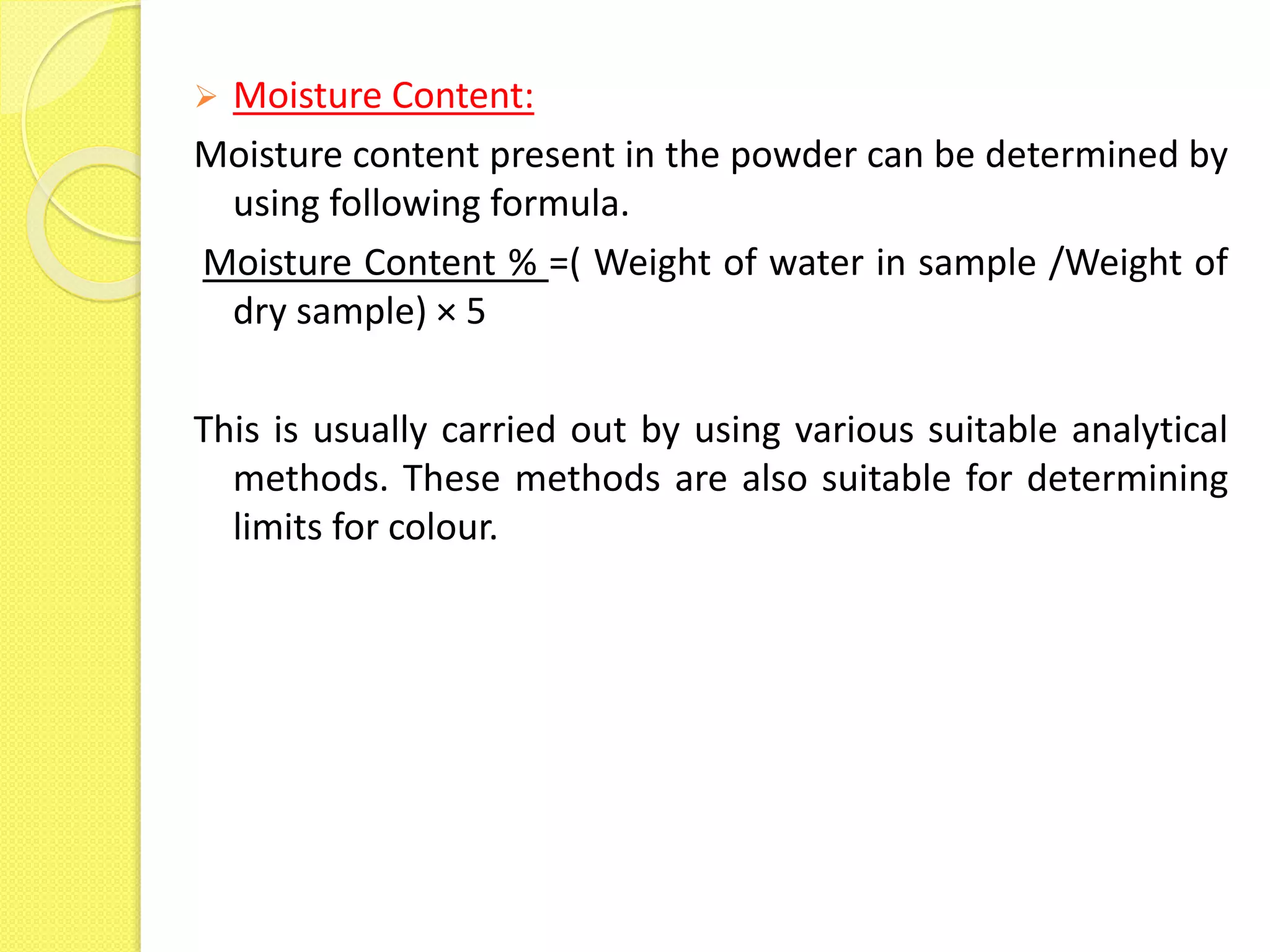
 Moisture Content:
Moisture content present in the powder can be determined by
using following formula.
Moisture Content % =( Weight of water in sample /Weight of
dry sample) × 5
This is usually carried out by using various suitable analytical
methods. These methods are also suitable for determining
limits for colour.
CONCLUSION
 Face powder is a cosmetic product used to provide
a special touch on the skin, to control oil and
combat shines, or, in addition to provide a matt
finishing effect on the skin.
 Powder tones the face and gives an even
appearance. Besides toning the face, some
powders with sunscreen can also reduce skin
damage from sunlight and environmental stress.
 In recent years, the so‐called mineral‐based
foundation products have become increasing
popular in the cosmetic consumer market and can
demand a premium price from the consumer.
REFERENCES
1. Sharma GK, Gadiya J, Dhanawat M. ‘‘ A Text Book of
Cosmetic Formulation’’.2018;29-40
2. Harry GR. ‘‘ Harry’s Cosmeticology ’’ 7th
Edition,1990;474-489
3. Butler H. ‘‘Poucher's Perfumes,Cosmetics and Soaps’’
10th Edition,2010;178-187
4. Sharma PP. ‘‘ Cosmetics-formulation, manufacturing
and quality control ’’ 5th edition ;Vandana Publications,
Delhi, India; 2014;181-191
5. Singh SK. ‘‘ Handbook on Cosmetics (Processes,
Formulae with Testing Methods Asia Pacific Business
Publications,2010;336-353
Quality control test for face powder ppt

Quality control test for face powder ppt

  • 1.
    Seminar on QUALITY CONTROLCHECKING DONE FOR FACE POWDER Presented by AYAN PAL M.PHARM, 2nd SEM ROLL NO-15920320008 DEPARTMENT OF PHARMACEUTICS GGB CALCUTTA INSTITUTE OF PHARMACEUTICAL TECHNOLOGY AND A.H.S, ULUBERIA,HOWRAH
  • 2.
    CONTENTS  INTRODUCTION  DEFINITION IDEAL PROPERTIES  IDEAL CHARACTERISTICS  TYPES OF FACE POWDER  METHOD OF PREPARATION  QUALITY CONTROL TEST  CONCLUSION  REFERENCES
  • 3.
    INTRODUCTION  A powderis a dry, bulk solid composed of a large number of very fine particles that may flow freely when shaken.  Various types of powders are body powder, face powders, compacts medicated powders, deodorant powders and foot powders for treatment purposes.  Powders have different physical properties when compared to the liquid preparations.  They have very fine particle size, which helps in producing large surface area per unit weight.
  • 4.
    FACE POWDER  Aface powder is basically a cosmetic product which has as its prime function the ability to complement skin color by imparting a velvet finish to it.  They are required to give a matt, smooth finish to the skin and remain this way for as long as possible.
  • 5.
    A Survey ShowsThat…… Category Percentage Male 11 Female 89 %USE BY Male Femal e
  • 6.
    IDEAL PROPERTIES  Shouldproduce a smooth finish to the facial skin.  Masking small visible imperfection of the face & shine due to moisture or secretion of sebaceous and sweat glands.  Must produce a lasting effect , so that frequent application is unnecessary.  Should make face pleasant to look and touch.  Must adhere to skin.
  • 7.
    IDEAL CHARACTERISTICS(When applied) Covering Power  Slip  Adhesiveness  Absorbency  Bloom  Coloring  Perfuming
  • 8.
  • 9.
    Depends on Natureof Skin Types of Skin Types of Powder Characteristics Dry Light Slight covering power Contain large quantity of talc Normal or Moderately Oily Medium •Comparatively higher covering power •Lesser talc and balanced by zinc oxide Very Oily Heavy •High covering power •Lower quantity of talc and high quantity of Zinc oxide
  • 10.
    Depends on Texture Loose: Powder particles are finer and tend to set makeup better than pressed powder. Finely milled texture means the powder is easier to layer.  Loose powder is applied with a brush or a puff. This makes it less portable and more difficult to apply on the go. Pressed:  Pressed powder comes in cake form, providing better and longer- lasting coverage.  Pressed powder is applied with a dense puff or makeup sponge, simplifying application whenever needed.
  • 11.
    Continue Translucent: o Translucent powderis unpigmented, sheer powder used mainly to control oily zones. o Translucent powder can be pressed or loose powder. Tinted: o Tinted powder is pigmented and is usually worn without foundation. o Tinted powder can be pressed or loose powder.
  • 12.
  • 13.
    Key Ingredients Ingredient CategoryUse Talc Base/Mineral Naturally occurring mineral added in safe amount Mica Covering Agent It helps the powder to stay on the skin longer Kaolin Slip/Absorbent Enhance coverage while reducing the sheen provided by talc Magnesium Stearate Adhesive Improves the consistency of face powder, ensuring a smooth application Calcium Carbonate Absorbent Absorbs moisture to minimize oil ness and create a matt finish Inorganic and organic pigments Colorant Added to the formula to create the desired tint Triclosan Perfumes Enhance the intrinsic appeal
  • 14.
    General Preparation  Thepreparation of powder is simple as it is simply a matter of dry mixing of finely powdered materials.  Add perfume with a part of absorbent materials like calcium carbonate or with magnesium carbonate and keep it aside for some time.  Mix the color with part of the talc properly and add the other powders and then the perfume mixture.  Mix and sieve the powder mixture using a silk mesh or an old washed nylon cloth.
  • 15.
    METHOD OF PREPARATION Wet Method  Dry Method  Damp Method
  • 16.
    WET METHOD  Basicmaterials , colors and binders are kneaded into a paste with water, pressed into mould and air dried slowly.  Not much used as it can produce cracks.
  • 17.
    DRY METHOD  Materialsand binders are compressed by simple pressure in special presses.
  • 18.
    DAMP METHOD  Basepowder, color and perfume are mixed uniformly.  Mixture is then wetted down with liquid binders like aqueous mucilage and blended until the proper plasticity of the mass is attained.  Powder is then screened and compressed by machine and dried at elevated temp.  Widely accepted and commercially used method.
  • 19.
    QUALITY CONTROL TEST 1.Shade Test 2. Colour Dispersion Test 3. Pay-off Test 4. Pressure Test 5. Breakage Test 6. Flow Property Test 7. Particle Size Determination 8. Abrasive Character 9. Moisture Content
  • 20.
     Shade Test: Inthis test, the variations of colour shade is determined and controlled. It is carried out by spreading the powder sample on a white paper and appearance is observed which is compared with the standard one. Another method involves, applying powder sample and standard one with the help of puff on the skin and then comparing it. The puff used to perform this test is also used for the final product. Evaluation of colour is carried out by using artificial light.  Colour Dispersion Test: In this test, a sample of powder is spread on a white paper and with the help of magnifying glass., segregation or bleeding of the colour is observed. The colour should be properly distributed in the powder base of the formulation.
  • 21.
     Pay-off Test: Thistest is carried out to check the adhesive property of powders with the puff. This test is mainly carried out on compact powders.  Pressure Test: For compaction purpose in compact powders, pressure required. Uniform pressure should be applied to avoid formation of air pockets, which will lead to either breaking or cracking of compact powders. This is because low pressure will make the compact powder soft, whereas high pressure will lead to formation of hard cake.
  • 22.
     Breakage Test: Inthis test, compact powders are allowed to fall on a wooden surface from a height of about 8-10 inches. This is carried out several times and then checking is done to see whether any breakage has occurred on compact powder. If the compact powder remains unbroken, then it shows the resistance to travel and normal handling by the users.  Flow Property Test: This test is carried out maim} on body powders to determine their flow property (from the container upon usage). This intern helps in easy application of powder to skin. In this method, angle of repose of powder is measured by allowing the powder product to fall on a plate through a funnel. Then the height and the radius of heap formed is measured, and even the time taken for the powder to fall is noted.
  • 23.
     Particle SizeDetermination: With the help of microscope, sieve analysis or by utilizing other techniques and instrument, particle size of powder product is determined.  Abrasive Character Abrasive character of powder can be determined by, rubbing, the powder on a smooth surface of the skin. Then with the help of a microscope, the effects of powder are studied.
  • 24.
     Moisture Content: Moisturecontent present in the powder can be determined by using following formula. Moisture Content % =( Weight of water in sample /Weight of dry sample) × 5 This is usually carried out by using various suitable analytical methods. These methods are also suitable for determining limits for colour.
  • 25.
    CONCLUSION  Face powderis a cosmetic product used to provide a special touch on the skin, to control oil and combat shines, or, in addition to provide a matt finishing effect on the skin.  Powder tones the face and gives an even appearance. Besides toning the face, some powders with sunscreen can also reduce skin damage from sunlight and environmental stress.  In recent years, the so‐called mineral‐based foundation products have become increasing popular in the cosmetic consumer market and can demand a premium price from the consumer.
  • 26.
    REFERENCES 1. Sharma GK,Gadiya J, Dhanawat M. ‘‘ A Text Book of Cosmetic Formulation’’.2018;29-40 2. Harry GR. ‘‘ Harry’s Cosmeticology ’’ 7th Edition,1990;474-489 3. Butler H. ‘‘Poucher's Perfumes,Cosmetics and Soaps’’ 10th Edition,2010;178-187 4. Sharma PP. ‘‘ Cosmetics-formulation, manufacturing and quality control ’’ 5th edition ;Vandana Publications, Delhi, India; 2014;181-191 5. Singh SK. ‘‘ Handbook on Cosmetics (Processes, Formulae with Testing Methods Asia Pacific Business Publications,2010;336-353