The document provides an overview of lipid profiles, explaining the nature and importance of lipids, as well as the classification and metabolism of different types of lipoproteins (chylomicrons, VLDL, LDL, HDL). It discusses the roles and functions of these lipoproteins in transporting lipids and cholesterol within the body, their clinical significance relating to cardiovascular diseases, and the importance of maintaining healthy cholesterol and triglyceride levels. High cholesterol levels are associated with increased risk of heart disease and other health issues, while HDL is described as 'good cholesterol' and LDL as 'bad cholesterol.'
INTRODUCTION
DEFINITION- Lipidsare group of organic substances of
fatty nature which are insoluble in water, soluble in fat
solvents and which are related to fatty acids.
3.
IMPORTANCE OF LIPIDS.
1.Reservoir of energy.
2. Constituents of cell membrane.
3. As a insulater and protective coating.
4. Constituents of neural tissue.
4.
LIPOPROTEINS
They arespherical complexes of lipids and proteins.
Transport various lipids and fat soluble vitamins to and
from tissues.
Contain core of hydrophobic lipids surrounded by
hydrophilic lipids and proteins.
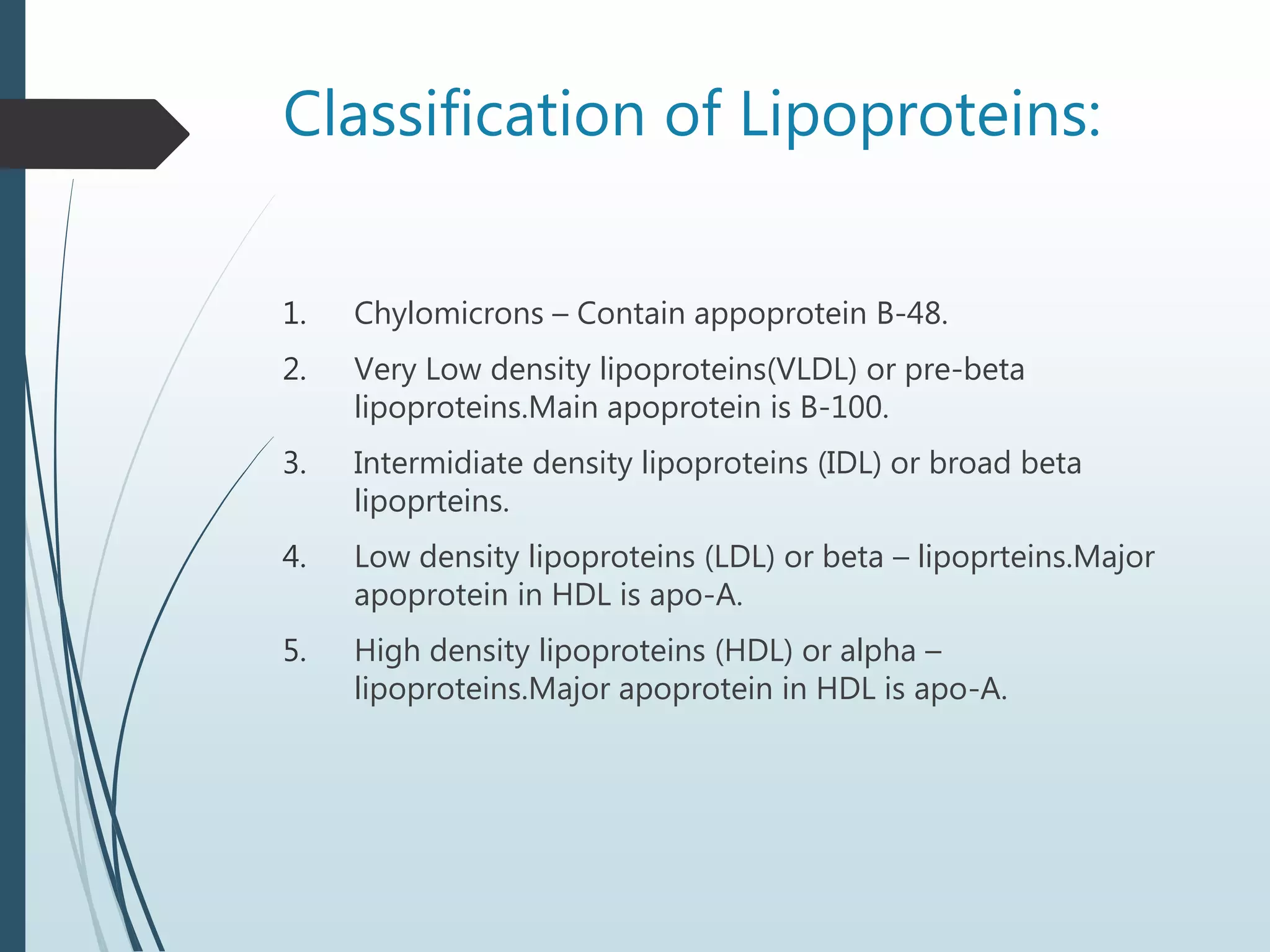
Classification of Lipoproteins:
1.Chylomicrons – Contain appoprotein B-48.
2. Very Low density lipoproteins(VLDL) or pre-beta
lipoproteins.Main apoprotein is B-100.
3. Intermidiate density lipoproteins (IDL) or broad beta
lipoprteins.
4. Low density lipoproteins (LDL) or beta – lipoprteins.Major
apoprotein in HDL is apo-A.
5. High density lipoproteins (HDL) or alpha –
lipoproteins.Major apoprotein in HDL is apo-A.
7.
CHYLOMICRONS:
SYNTHESIS OFCHYLOMICRONS-
Chylomcrons are formed in the intestinal mucosal cells,and
secreted into the lacteals of lymphatic system.
They are rich in triglyceride.
When the chylomicrons are synthesized by the intestinal
mucusa,they contain only apo-48 and apo-A
8.
Metabolism of Chylomicrons:
Main sites of metabolism of chylomicrons are adipose tissue
and skeletal muscle.
The enzyme lipoprotein lipase(LPL) is located at the
endothelial layer of capillaries of adipose tissue ,muscles
and heart;but not in liver.
Apo –C-II present in the chylomicrons activates the LPL.
The LPL hydrolyses triglycerides present in chylomicrons
into fatty acids and glycerol.
9.
Function of Chylomicrons:
Chylomicrons are the transport form of dietary triglycerides
from intestines to the adipose tissue for storage; and to
muscle or heart for their energy needs.
10.
VERY LOW DENSITY
LIPOPROTEINS:
SYNTHESIS OF VLDL :Triacylglycerol synthesized in liver is
incorporated into VLDL when it is secreted.
METABOLISM OF VLDL:When they reach the peripheral
tissues,apo-C-II activates LPL which liberates fatty acids that
are taken up by adipose tissue and muscle.
The remnant is now designated as IDL(intermediate density
lipoprotein ) and contain less of TAG and more of
cholestrol.
FUNCTION OF VLDL:The VLDL carries endogenous TAG
from liver to peripheral tissues for energy needs.
11.
LOW DENSITY LIPOPROTEINS:
Low density lipoproteins (LDL) transports cholestrol from
liver to peripheral tissues.
The only apoprotein present in LDL is apo-B-100.
Most of the LDL in blood is about 2 days.
12.
METABOLISM OF LDLAND LDL
RECEPTORS:
The LDL is taken up by peripheral tissues by receptor-
mediated endoytosis.
LDL receptors are located in specialized regions called
CLATHRIN-COATED PITS.
Binding of LDL to the receptor is by apo-B-100 receptor ,the
receptor –LDL complex is intenalized by endocytosis.
The LDL particle,along with apoproteins and cholestrol
ester are hydrolysed to form free cholestrol.
The free cholestrol is either incorporated into plasma
membranes or esterified and stored within the cell.
13.
FUNCTION OF LDL:
About 75% of the plasma cholestrol is incorporated into the
LDL particles.
LDL transports cholestrol from liver to the peripheral tissues.
It is used for the synthesis of other steroids like steroid
hormones.
Cholesterol may be incorporated into the membranes.
14.
LDL and ClinicalAppliances:
The LDL concentration in blood has positive correlation with
incidence of cardiovascular diseases.
A fraction of cholestrol is taken up by macrophages.
Increased levels of LDL or oxidation of LDL increases uptake of
cholestrol by macrophages.
When macrophages are filled with cholestrol,foam cells are
formed.
They get deposited in the subendothelial space and leads to
the formation of atheromatous plaque.
Since LDL – cholestrol is thus deposited in tissues, the LDL
variety is called ‘BAD CHOLESTEROL’ in common parlance.
Insulin and tri-iodothyronine (T3) increase the binding of LDL
to liver cells.
15.
HIGH DENSITY LIPOPROTEIN:
High density lipoproteins (HDL) transport cholestrol from
peripheral tissues to the liver.
METABOLISM OF HDL: The intestinal cells synthesize
components of HDL and release into blood.
The nascent HDL in plasma are discoid in shape.
The free cholestrol derived from peripheral tissue cells are
taken cells are taken up by the HDL.
The apo-A-I of HDL activates LCAT(lecithin cholestrol acyl
tranferase) present in the plasma.
The LCAT then binds to the HDL disk.
16.
FUNCTIONS OF HDL:
I.HDL is the main transport form of cholestrol from
peripheral tissue to liver which is later excreted through
bile.This is called reverse cholestrol transport by HDL.
II. The only excretory route of cholestrol from the body is
the bile.
III. Excretion of cholestrol needs prior esterifications with
PUFA (POLYUNSATURATED FATTY ACID).Thus PUFA will
help in lowering of cholestrol in the body,and so PUFA is
antiatherogenic.
17.
CLINICAL SIGNIFICANCE OF
HDL:
The level of HDL in serum is inversely related to the
incidence of myocardial infarction.
As it is ‘antiatherogenic’ or ‘protective’ in nature,HDL is
known as ‘GOOD CHOLESTROL’ in common parlance.
It is cinvenient to remember that ‘H’ in ‘HDL’ stands for
‘healthy’.
HDL level below 35 mg/dl increases the risk,while level
above 60 mg/dl protects the person from coronary artery
diseases.
18.
TOTAL CHOLESTROL:
Totalcholestrol measure the combination of LDL,HDL,and
VLDL in your bloodstream.
VLDL is a precursor of LDL,the bad cholestrol.
A total cholestrol score of 200 is considered healthy in most
cases.
People who score in the ‘high’ range have an increased risk
of developing heart disease compared to those who score
below 200.
19.
WHY HIGH CHOLESTROL
MATTERS?
High cholestrol is one of the major risk factos for coronary
artery disease,heart attacks,and strokes.
It also appears to boost the risk of Alzheimer’s disease.
As we know that ,high cholestrol leads to a buildup of
plaque that narrows the arteries.
This is dangerous because it can restrict blood flow
If the blood supply to a part of the heart or brain is
completely cut off,the result is a heart attack or stroke.
20.
TRIGLYCERIDES:
The bodyconverts excess calories,sugar,and alcohol into
triglycerides,a type of fat that is carried in the blood and
stored in fat cells throughout the body.
People who are overweight,inactive ,smokers ,or heavy
drinkers tend to have high triglycerides,as do those who eat
a very high –carb diet.
A triglycerides score of 150 or higher puts you at risk for
metabolic syndrome,which is linked to heart disease and
diabetes.



![Lipoprotein metabolism and CAD[1].pptx..](https://cdn.slidesharecdn.com/ss_thumbnails/lipoproteinmetabolismandcad1-250223181828-e4e0a658-thumbnail.jpg?width=640&height=640&fit=bounds)


