PRESENTED BY:
Ms. Noopur Joshi
DEPARTMENT :
Biotechnology
LIPIDS-A BRIEF INTRODUCTION
• Lipids are heterogeneous group of
compounds related to fatty acids and
include fats, oils, waxes and other related
substances.
• They are relatively insoluble in water and
considerably soluble in organic solvents like
ether, chloroform and benzene. Thus,
exhibiting their “HYDROPHOBIC” nature.
The basic structure of lipids consist of a glycerol moiety, attached
to a fatty acid group(saturated/unsaturated).
These two attach to different biomolecules resulting into different
complexes of lipids. One of them being Lipoproteins.
A phospholipid bilayer is one of the most important structural
lipid molecule as it holds firmly the structure of the cell
membranes and its permeability.
These lipid molecules consist of a polar as well as a non-polar
unit.
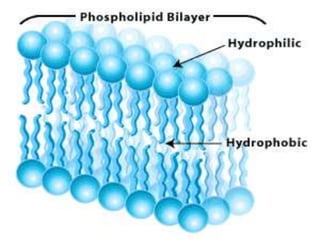
• Hydrophobic part of the lipoproteins is called as the
“Tail” and it doesn’t have the affinity towards water;
and thus stay in the core of the bilayer.
• Hydrophilic part of the phospholipid bilayer is called as
the “HEAD”, and it has greater affinity for water
molecule because of its polar nature.
• The lipid bilayer arranges itself in such a manner that
the tail lies inside and the heads float outwards.
INTRODUCTION TO
LIPOPROTEINS
• Lipoprotiens are globular micelle-like
particles that consist of non-polar core of
triacylglycerols and cholestrol esters
surrounded by an amphiphilic coating of
proteins, phospholipids and cholestrol.
CLASSIFICATION OF LIPOPROTEINS
Lipoproteins have 5 classes which vary in their
physiological functions and composition.
They are namely:
• Chylomicrons
• Very low density lipoproteins (VLDL)
• Intermediate density lipoproteins(IDL)
• Low density lipoproteins (LDL)
• High density lipoproteins(HDL)
STRUCTURE OF LIPOPROTEINS
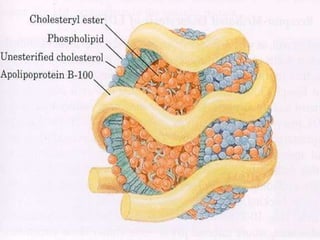
• Each lipoprotein contains just enough protein,
phospholipid, and cholestrol to form the ~20Å
thick monolayer of these substances on the
particle surface.
• Lipoprotein density increases with the decrease in
particle diameter; b’coz the density of their outer
coating is greater than that of the inner core. (
Thus HDL which are the most dense are also the
smallest).
• The protein entity that coats the lipoprotiens are
called as “apolipoproteins or apoproteins”.
Human lipoproteins have at least 9 types of
apolipoproteins distributed throughout in
different amounts.
APOLIPOPROTIENS
• The protein entity that coats the
lipoprotiens are called as “apolipoproteins
or apoproteins”.
Human lipoproteins have at least 9 types of
apolipoproteins distributed throughout in
different amounts.
• Apolipoproteins other than apoB-100 are H2O
soluble & associate rather weakly with proteins.
• These apoproteins have “high helix content”.
• The contact with a hydrophobic surface
apparently favors formation of helices which
satisfy the H-bonding potential of the protien’s
polar backbone groups.
• Helices of apolipoprotiens have hydrophilic and
hydrophobic side chains on opposite sides of the
helical cylinder, suggesting that lipoprotien’s α-
helices are amphipathic and float on phospholipid
surface, much like logs on water.
• The charged head groups of lipids presumably bind
to oppositely charged residue on the helix, which the
first few groups of methylene fatty acyl chains
associate with non-polar face of helix.
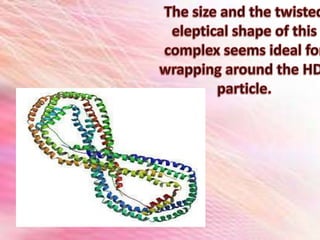
Example: apoA-I
• Occurs in chylomicrons and HDL.
• Has 243 residues and 29kD polypeptide.
• Has largely tandem 22 residue segments of
similar sequence.
• X-Ray structure of truncated apoA-I (lacking
residues 1 to 43) reveals that polypeptide chain
forms a pseudocontinuous α-helix that is
punctuated by kinks at pro residues spaced about
every 22 residues.
• 4 monomers associate to form the structure.
Example: apoB-100
• Is present in LDL
• Has 4536 residue monomers
• Is the largest monomeric protien known.
• Has a hydrophobicity approaching that of the
integral membrane protiens.
• Each LDL particle has 1 molecule of apoB-100.
• It covers almost ½ of the particle surface.
LIPIDS ARE TRANSPORTED AS
LIPOPROTIENS
• The fatty acid product of lipid digestion that
are absorbed by the intestinal mucosa to
make their way to other tissues for
catabolism or storage.
• But b’coz they are sparingly soluble in
aqueous solution, lipids are transported by
circulation in complex with proteins.
• Intestinal mucosal cells convert dietary fatty acids to
triacylglycerolsand package them along with dietary
cholestrol into lipoproteina called as
“chylomicrons”.
These particles are released in the intestinal lymph and
are transported through the lypmhatic vessels b’fore
draining into large veins.
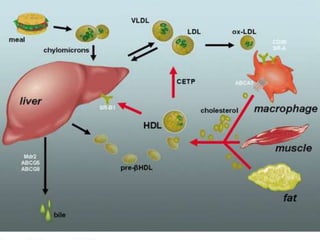
• Blood stream then delivers chylomicrons throughout
the body.
Other lipoprotiens such as VLDL, IDL, LDL are
synthesized by liver to transport endogenous
triacylglycerols and cholestrol from LIVER TO
TISSUES.
HDL transports cholestrol and other lipids from
TISSUES BACK TO LIVER.
CHYLOMICRONS:
Are depleted in the capillaries of
peripheral tissues.
• Chylomicrons adhere to endotehlium of
capillarieson skeletal muscles and adipose tissue.
Its triglyecrols are hydrolysed by action of
“lipoprotein lipase”.
Monoacylglycerols and fatty acids are then taken
up tissues.
• progressive hydrolysis of chylomicrons leads to
loss of its triacylglycerols
• Finally, they are reduced to “ cholestrol enriched
chylomicron remnants.”
• Remnants disassociate from capillarie’s
endothelium & re-enter the circulation to be
taken up by the liver.
SIGNIFICANCE OF CHYLOMICRONS
THEY DELIVER DIETARY
TRYACYLGLYCEROLS TO MUSCLE AND
ADIPOSE TISSUE AND DIETARY
CHOLESTROL TO LIVER.
VLDLAre Gradually
Degraded
HDL TRANSPORTS
CHOLESTROL FROM
TISSUES BACK TO LIVER
Krieger 1999 Annu Rev Biochem 68:523
HDL receptor SR-BI
and cholesterol transport
HDL are assembled in plasma from components
largely obtained through degradation of other
lipoproteins.
Circulating HDL particle acquires by its extraction
from cell surface.
Cholesterol Cholesteryl esters by action of
HDL associates LCAT.
LCAT is activated by apoA-I.
• HDL is Cholesterol scavenger
• Liver is the only organ capable of disposing off
significant quantities of cholesterol by its conversion
into bile acids.
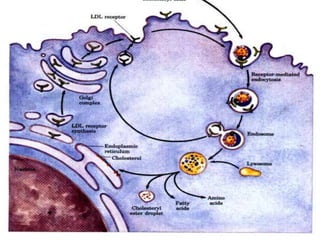
• About ½ of VLDL, after degradation into IDL and
LDL, are taken up by liver via LDL receptor
mediated endocytosis.
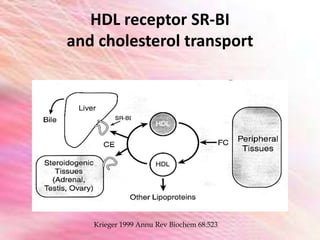
• Liver cells take up HDL by n entirely different
mechanism:
• HDL particles are neither engulfed or degraded; but
bind to a cell surface receptor SR-BI and selectively
tranfers its component lipids to the cells.
• SR-BI : scavenger receptor class B type I
• Lipid depleted HDL particle then dissociate from
cell and re-enters the circulation.

Lipoproteins

  • 1.
    PRESENTED BY: Ms. NoopurJoshi DEPARTMENT : Biotechnology
  • 2.
    LIPIDS-A BRIEF INTRODUCTION •Lipids are heterogeneous group of compounds related to fatty acids and include fats, oils, waxes and other related substances. • They are relatively insoluble in water and considerably soluble in organic solvents like ether, chloroform and benzene. Thus, exhibiting their “HYDROPHOBIC” nature.
  • 3.
    The basic structureof lipids consist of a glycerol moiety, attached to a fatty acid group(saturated/unsaturated). These two attach to different biomolecules resulting into different complexes of lipids. One of them being Lipoproteins. A phospholipid bilayer is one of the most important structural lipid molecule as it holds firmly the structure of the cell membranes and its permeability. These lipid molecules consist of a polar as well as a non-polar unit.
  • 4.
    • Hydrophobic partof the lipoproteins is called as the “Tail” and it doesn’t have the affinity towards water; and thus stay in the core of the bilayer. • Hydrophilic part of the phospholipid bilayer is called as the “HEAD”, and it has greater affinity for water molecule because of its polar nature. • The lipid bilayer arranges itself in such a manner that the tail lies inside and the heads float outwards.
  • 6.
    INTRODUCTION TO LIPOPROTEINS • Lipoprotiensare globular micelle-like particles that consist of non-polar core of triacylglycerols and cholestrol esters surrounded by an amphiphilic coating of proteins, phospholipids and cholestrol.
  • 7.
    CLASSIFICATION OF LIPOPROTEINS Lipoproteinshave 5 classes which vary in their physiological functions and composition. They are namely: • Chylomicrons • Very low density lipoproteins (VLDL) • Intermediate density lipoproteins(IDL) • Low density lipoproteins (LDL) • High density lipoproteins(HDL)
  • 8.
    STRUCTURE OF LIPOPROTEINS •Each lipoprotein contains just enough protein, phospholipid, and cholestrol to form the ~20Å thick monolayer of these substances on the particle surface. • Lipoprotein density increases with the decrease in particle diameter; b’coz the density of their outer coating is greater than that of the inner core. ( Thus HDL which are the most dense are also the smallest).
  • 9.
    • The proteinentity that coats the lipoprotiens are called as “apolipoproteins or apoproteins”. Human lipoproteins have at least 9 types of apolipoproteins distributed throughout in different amounts.
  • 11.
    APOLIPOPROTIENS • The proteinentity that coats the lipoprotiens are called as “apolipoproteins or apoproteins”. Human lipoproteins have at least 9 types of apolipoproteins distributed throughout in different amounts.
  • 12.
    • Apolipoproteins otherthan apoB-100 are H2O soluble & associate rather weakly with proteins. • These apoproteins have “high helix content”. • The contact with a hydrophobic surface apparently favors formation of helices which satisfy the H-bonding potential of the protien’s polar backbone groups.
  • 13.
    • Helices ofapolipoprotiens have hydrophilic and hydrophobic side chains on opposite sides of the helical cylinder, suggesting that lipoprotien’s α- helices are amphipathic and float on phospholipid surface, much like logs on water. • The charged head groups of lipids presumably bind to oppositely charged residue on the helix, which the first few groups of methylene fatty acyl chains associate with non-polar face of helix.
  • 14.
    Example: apoA-I • Occursin chylomicrons and HDL. • Has 243 residues and 29kD polypeptide. • Has largely tandem 22 residue segments of similar sequence. • X-Ray structure of truncated apoA-I (lacking residues 1 to 43) reveals that polypeptide chain forms a pseudocontinuous α-helix that is punctuated by kinks at pro residues spaced about every 22 residues. • 4 monomers associate to form the structure.
  • 16.
    Example: apoB-100 • Ispresent in LDL • Has 4536 residue monomers • Is the largest monomeric protien known. • Has a hydrophobicity approaching that of the integral membrane protiens. • Each LDL particle has 1 molecule of apoB-100. • It covers almost ½ of the particle surface.
  • 17.
    LIPIDS ARE TRANSPORTEDAS LIPOPROTIENS • The fatty acid product of lipid digestion that are absorbed by the intestinal mucosa to make their way to other tissues for catabolism or storage. • But b’coz they are sparingly soluble in aqueous solution, lipids are transported by circulation in complex with proteins.
  • 18.
    • Intestinal mucosalcells convert dietary fatty acids to triacylglycerolsand package them along with dietary cholestrol into lipoproteina called as “chylomicrons”. These particles are released in the intestinal lymph and are transported through the lypmhatic vessels b’fore draining into large veins.
  • 19.
    • Blood streamthen delivers chylomicrons throughout the body. Other lipoprotiens such as VLDL, IDL, LDL are synthesized by liver to transport endogenous triacylglycerols and cholestrol from LIVER TO TISSUES. HDL transports cholestrol and other lipids from TISSUES BACK TO LIVER.
  • 20.
    CHYLOMICRONS: Are depleted inthe capillaries of peripheral tissues. • Chylomicrons adhere to endotehlium of capillarieson skeletal muscles and adipose tissue. Its triglyecrols are hydrolysed by action of “lipoprotein lipase”. Monoacylglycerols and fatty acids are then taken up tissues.
  • 21.
    • progressive hydrolysisof chylomicrons leads to loss of its triacylglycerols • Finally, they are reduced to “ cholestrol enriched chylomicron remnants.” • Remnants disassociate from capillarie’s endothelium & re-enter the circulation to be taken up by the liver.
  • 22.
    SIGNIFICANCE OF CHYLOMICRONS THEYDELIVER DIETARY TRYACYLGLYCEROLS TO MUSCLE AND ADIPOSE TISSUE AND DIETARY CHOLESTROL TO LIVER.
  • 24.
  • 26.
  • 27.
    Krieger 1999 AnnuRev Biochem 68:523 HDL receptor SR-BI and cholesterol transport
  • 28.
    HDL are assembledin plasma from components largely obtained through degradation of other lipoproteins. Circulating HDL particle acquires by its extraction from cell surface. Cholesterol Cholesteryl esters by action of HDL associates LCAT. LCAT is activated by apoA-I.
  • 29.
    • HDL isCholesterol scavenger • Liver is the only organ capable of disposing off significant quantities of cholesterol by its conversion into bile acids. • About ½ of VLDL, after degradation into IDL and LDL, are taken up by liver via LDL receptor mediated endocytosis.
  • 30.
    • Liver cellstake up HDL by n entirely different mechanism: • HDL particles are neither engulfed or degraded; but bind to a cell surface receptor SR-BI and selectively tranfers its component lipids to the cells. • SR-BI : scavenger receptor class B type I • Lipid depleted HDL particle then dissociate from cell and re-enters the circulation.