

LIPOPROTEINS
--BY:SABINA TIMALSINA
• When was the last time you ordered a Double Bacon Cheeseburger,
Supersized French Fries, a large shake and an fired apple turnover?
• Did you wonder how all that fat got dissolved into your blood? …
Try dissolving a stick of butter in a glass of water.
• Whenever it was, thank your LIPOPROTEINS!
• It’s your Lipoproteins that allow all the disgusting fat you eat to enter your
plasma without “cloging” things up.
• Lipoproteins provide the transportation system for different types of water
insoluble fatty crap
• Actually, sometimes things do get clogged up - It’s called a Heart Attack!!!
We need to study lipoproteins because of their relationship to heart disease
- The #1 cause of death in the United States
WHAT IS LIPOPROTEIN???
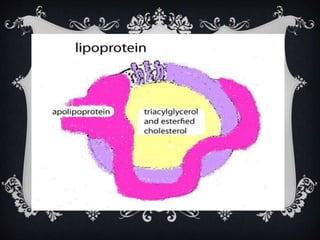
 A lipoprotein is a biochemical assembly that contains both
proteins and lipids, bound to proteins, which allows fats to move
through the water inside and outside cells.
 A complex of lipids and alipoproteins , the form in which lipids
are transported in the blood.
Lipoprotein Structure
Protein part: Apoproteins or apolipoproteins
These proteins may be structural or transferred
Lipid part:
• According to the type of lipoproteins
• Different lipid components in various combinations
Lipoprotein Structure
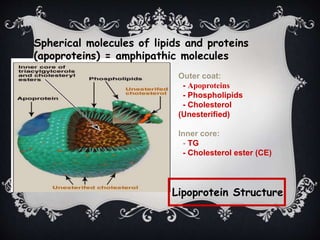
Spherical molecules of lipids and proteins
(apoproteins) = amphipathic molecules
Outer coat:
- Apoproteins
- Phospholipids
- Cholesterol
(Unesterified)
Inner core:
- TG
- Cholesterol ester (CE)
WHY DO WE NEED THEM??
• Lipoproteins are a handful of different molecules that
interact with water insoluble fat molecules, and transports
those fats in the plasma
• The textbook describes the lipoproteins as “oil tankers”
• Different lipoproteins are responsible for the transportation
of different fats
• Lipoproteins allow fat to be dissolved into the plasma
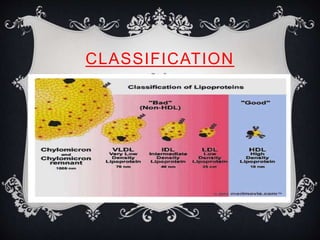
CLASSIFICATION
1) Chylomicrons
2) Very Low Density Lipoproteins (VLDL)
3) Low Density Lipoproteins (LDL)
4) High Density Lipoproteins (HDL)
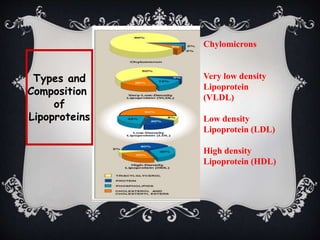
Types and
Composition
of
Lipoproteins
Chylomicrons
Very low density
Lipoprotein
(VLDL)
Low density
Lipoprotein (LDL)
High density
Lipoprotein (HDL)
CLASSIFICATION
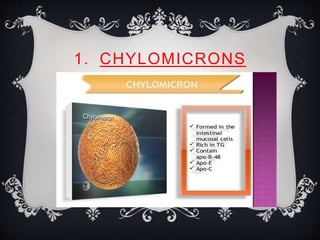
1. CHYLOMICRONS
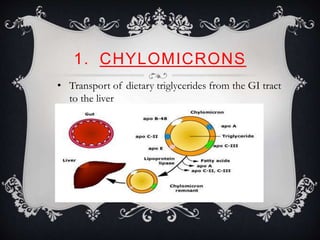
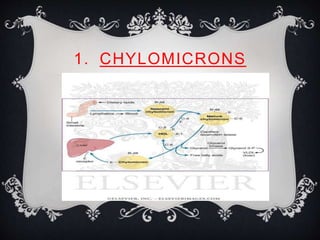
1. CHYLOMICRONS
• Transport of dietary triglycerides from the GI tract
to the liver
1. CHYLOMICRONS
• Made by: the small intestines in the fed state
• Absorbed into: the lymph vessels, then --> moves into the blood
• Rich in: TGs
• Function: Deliver TG’s to body cells to be used as fuel
1. CHYLOMICRONS
1. CHYLOMICRONS
• Transports exogeneous ( dietary ) triglycerides
• 90 - 95 % by weight is triglycerides
• Absent from fasting plasma
• Removed from the plasma within 6 hours by the liver
• Inadequate clearance produces a creamy layer on the plasma
VERY LOW DENSITY
LIPOPROTEINS (VLDL)
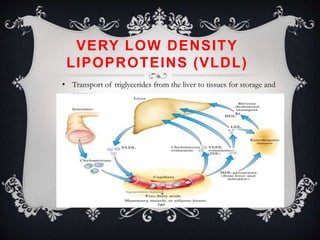
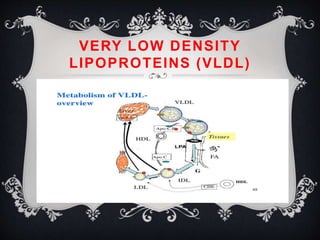
• Transport of triglycerides from the liver to tissues for storage and
energy
VERY LOW DENSITY
LIPOPROTEINS (VLDL)
• Made in: the liver from excess dietary carbohydrate and protein along with the
Chylomicron remnant
• Secreted into: the bloodstream
• Rich in: TGs
• Function: Deliver TGs to body cells
• Contains apo B100
• Similar to Chylomicrons, but made by different tissues
VERY LOW DENSITY
LIPOPROTEINS (VLDL)
VERY LOW DENSITY
LIPOPROTEINS (VLDL)
• Transports endogeneous triglycerides from liver to
tissues
• 50 - 65 % by weight is triglycerides
• Excess dietary carbohydrates are converted to
triglycerides by the liver
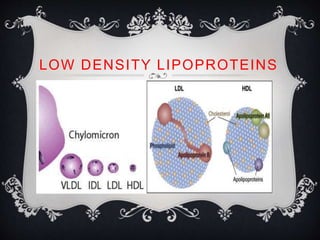
LOW DENSITY LIPOPROTEINS
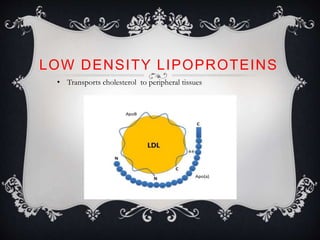
• Transports cholesterol to peripheral tissues
LOW DENSITY LIPOPROTEINS
• Made in: the Liver as VLDL
• Arise from: VLDL once it has lost a lot of its
TG’s
• Secreted into: the bloodstream
• Rich in: Cholesterol
• Function: Deliver cholesterol to all body cells
LOW DENSITY LIPOPROTEINS
• Transports cholesterol from liver to the tissues
• Synthesized in the liver
• Approximately 50 % by weight cholesterol
• Most atherogenic lipoprotein … “ Bad
Cholesterol “
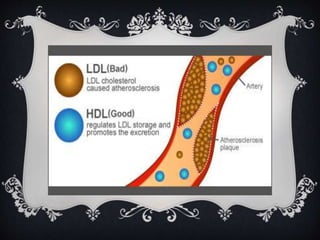
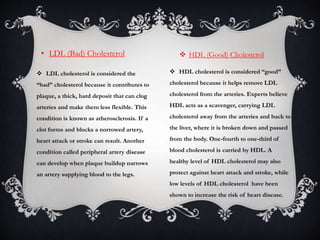
• LDL (Bad) Cholesterol  HDL (Good) Cholesterol
 LDL cholesterol is considered the
“bad” cholesterol because it contributes to
plaque, a thick, hard deposit that can clog
arteries and make them less flexible. This
condition is known as atherosclerosis. If a
clot forms and blocks a norrowed artery,
heart attack or stroke can result. Another
condition called peripheral artery disease
can develop when plaque buildup narrows
an artery supplying blood to the legs.
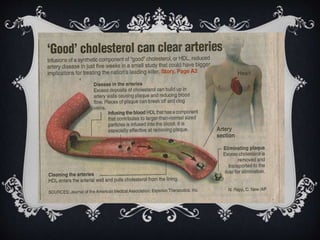
 HDL cholesterol is considered “good”
cholesterol because it helps remove LDL
cholesterol from the arteries. Experts believe
HDL acts as a scavenger, carrying LDL
cholesterol away from the arteries and back to
the liver, where it is broken down and passed
from the body. One-fourth to one-third of
blood cholesterol is carried by HDL. A
healthy level of HDL cholesterol may also
protect against heart attack and stroke, while
low levels of HDL cholesterol have been
shown to increase the risk of heart disease.
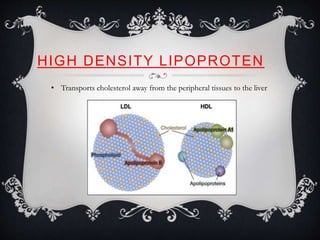
HIGH DENSITY LIPOPROTEN
• Transports cholesterol away from the peripheral tissues to the liver
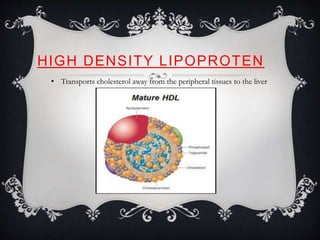
HIGH DENSITY LIPOPROTEN
• Transports cholesterol away from the peripheral tissues to the liver
HIGH DENSITY LIPOPROTEN
• Made in: the Liver and Small Intestine
• Secreted into: the bloodstream
• Function: Pick up cholesterol from body cells and take it back to
the liver = “reverse cholesterol transport”
• Potential to help reverse heart disease
THANK you.

Lipoprotiens

  • 1.
  • 2.
    • When wasthe last time you ordered a Double Bacon Cheeseburger, Supersized French Fries, a large shake and an fired apple turnover? • Did you wonder how all that fat got dissolved into your blood? … Try dissolving a stick of butter in a glass of water. • Whenever it was, thank your LIPOPROTEINS! • It’s your Lipoproteins that allow all the disgusting fat you eat to enter your plasma without “cloging” things up. • Lipoproteins provide the transportation system for different types of water insoluble fatty crap • Actually, sometimes things do get clogged up - It’s called a Heart Attack!!! We need to study lipoproteins because of their relationship to heart disease - The #1 cause of death in the United States
  • 3.
    WHAT IS LIPOPROTEIN??? A lipoprotein is a biochemical assembly that contains both proteins and lipids, bound to proteins, which allows fats to move through the water inside and outside cells.  A complex of lipids and alipoproteins , the form in which lipids are transported in the blood.
  • 4.
    Lipoprotein Structure Protein part:Apoproteins or apolipoproteins These proteins may be structural or transferred Lipid part: • According to the type of lipoproteins • Different lipid components in various combinations
  • 5.
    Lipoprotein Structure Spherical moleculesof lipids and proteins (apoproteins) = amphipathic molecules Outer coat: - Apoproteins - Phospholipids - Cholesterol (Unesterified) Inner core: - TG - Cholesterol ester (CE)
  • 7.
    WHY DO WENEED THEM?? • Lipoproteins are a handful of different molecules that interact with water insoluble fat molecules, and transports those fats in the plasma • The textbook describes the lipoproteins as “oil tankers” • Different lipoproteins are responsible for the transportation of different fats • Lipoproteins allow fat to be dissolved into the plasma
  • 8.
    CLASSIFICATION 1) Chylomicrons 2) VeryLow Density Lipoproteins (VLDL) 3) Low Density Lipoproteins (LDL) 4) High Density Lipoproteins (HDL)
  • 9.
    Types and Composition of Lipoproteins Chylomicrons Very lowdensity Lipoprotein (VLDL) Low density Lipoprotein (LDL) High density Lipoprotein (HDL)
  • 10.
  • 11.
  • 12.
    1. CHYLOMICRONS • Transportof dietary triglycerides from the GI tract to the liver
  • 13.
    1. CHYLOMICRONS • Madeby: the small intestines in the fed state • Absorbed into: the lymph vessels, then --> moves into the blood • Rich in: TGs • Function: Deliver TG’s to body cells to be used as fuel
  • 14.
  • 15.
    1. CHYLOMICRONS • Transportsexogeneous ( dietary ) triglycerides • 90 - 95 % by weight is triglycerides • Absent from fasting plasma • Removed from the plasma within 6 hours by the liver • Inadequate clearance produces a creamy layer on the plasma
  • 16.
    VERY LOW DENSITY LIPOPROTEINS(VLDL) • Transport of triglycerides from the liver to tissues for storage and energy
  • 17.
    VERY LOW DENSITY LIPOPROTEINS(VLDL) • Made in: the liver from excess dietary carbohydrate and protein along with the Chylomicron remnant • Secreted into: the bloodstream • Rich in: TGs • Function: Deliver TGs to body cells • Contains apo B100 • Similar to Chylomicrons, but made by different tissues
  • 18.
  • 19.
    VERY LOW DENSITY LIPOPROTEINS(VLDL) • Transports endogeneous triglycerides from liver to tissues • 50 - 65 % by weight is triglycerides • Excess dietary carbohydrates are converted to triglycerides by the liver
  • 20.
    LOW DENSITY LIPOPROTEINS •Transports cholesterol to peripheral tissues
  • 21.
  • 22.
    LOW DENSITY LIPOPROTEINS •Made in: the Liver as VLDL • Arise from: VLDL once it has lost a lot of its TG’s • Secreted into: the bloodstream • Rich in: Cholesterol • Function: Deliver cholesterol to all body cells
  • 23.
    LOW DENSITY LIPOPROTEINS •Transports cholesterol from liver to the tissues • Synthesized in the liver • Approximately 50 % by weight cholesterol • Most atherogenic lipoprotein … “ Bad Cholesterol “
  • 25.
    • LDL (Bad)Cholesterol  HDL (Good) Cholesterol  LDL cholesterol is considered the “bad” cholesterol because it contributes to plaque, a thick, hard deposit that can clog arteries and make them less flexible. This condition is known as atherosclerosis. If a clot forms and blocks a norrowed artery, heart attack or stroke can result. Another condition called peripheral artery disease can develop when plaque buildup narrows an artery supplying blood to the legs.  HDL cholesterol is considered “good” cholesterol because it helps remove LDL cholesterol from the arteries. Experts believe HDL acts as a scavenger, carrying LDL cholesterol away from the arteries and back to the liver, where it is broken down and passed from the body. One-fourth to one-third of blood cholesterol is carried by HDL. A healthy level of HDL cholesterol may also protect against heart attack and stroke, while low levels of HDL cholesterol have been shown to increase the risk of heart disease.
  • 26.
    HIGH DENSITY LIPOPROTEN •Transports cholesterol away from the peripheral tissues to the liver
  • 27.
    HIGH DENSITY LIPOPROTEN •Transports cholesterol away from the peripheral tissues to the liver
  • 28.
    HIGH DENSITY LIPOPROTEN •Made in: the Liver and Small Intestine • Secreted into: the bloodstream • Function: Pick up cholesterol from body cells and take it back to the liver = “reverse cholesterol transport” • Potential to help reverse heart disease
  • 34.