By the name of allah
By :
Dania Mohammed Abunawas
Immunology and allergy / MRI
Chemical pathology elective /spring 2020
Lipoproteins
Definition:
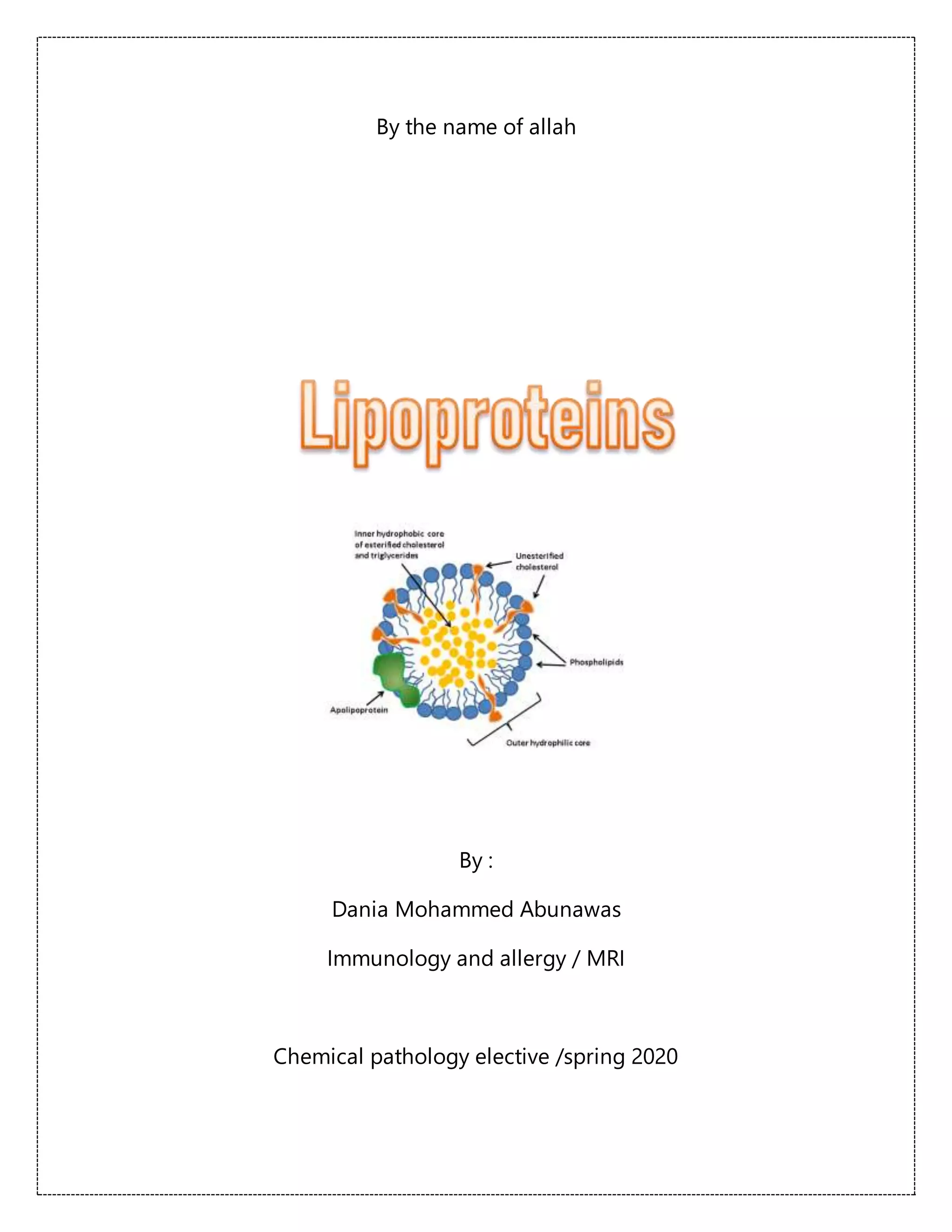
A lipoprotein is a biochemical assemblythat contains both proteins
and lipids , bound to the proteins , which allow fats to move through
the water inside and outside cells.
**The proteins serve to emulsifythe lipid molecules. Many enzymes,
transporters, structural proteins, antigens, and toxins are lipoproteins.
Calssification :
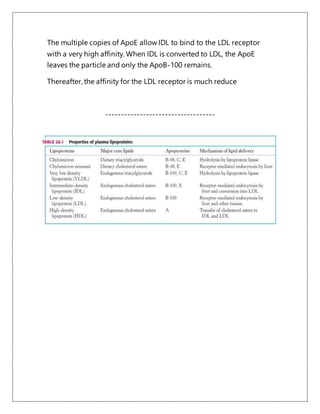
Lipoproteins differ in the ratio of protein to lipids, and in the
particular apoproteins andlipids that they contain.
They are classifiedbased on their density:
1-LDL (low density lipoprotein, highest in cholesteryl esters as % of
weight).
2-HDL (high density lipoprotein, highestin density due to high
protein/lipidratio).
3-Chylomicron (largest; lowest in density due to high lipid/protein
ratio; highest in triacylglycerols as % of weight).
4-VLDL (very low density lipoprotein; 2nd highest in triacylglycerols as
% of weight).
5-IDL (intermediate densitylipoprotein).
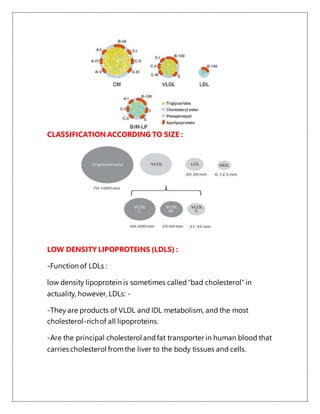
CLASSIFICATION ACCORDING TO SIZE :
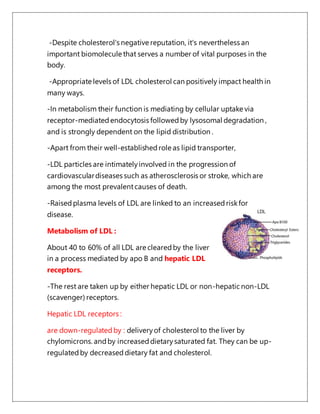
LOW DENSITY LIPOPROTEINS (LDLS) :
-Function of LDLs :
low density lipoprotein is sometimes called"bad cholesterol"in
actuality, however, LDLs: -
-They are products of VLDL and IDL metabolism, and the most
cholesterol-richof all lipoproteins.
-Are the principal cholesterol andfat transporter in human blood that
carries cholesterol fromthe liver to the body tissues and cells.
-Despite cholesterol's negative reputation, it's nevertheless an
important biomolecule that serves a number of vital purposes in the
body.
-Appropriate levels of LDL cholesterol can positively impact health in
many ways.
-In metabolism their function is mediating by cellular uptake via
receptor-mediatedendocytosis followedby lysosomal degradation ,
and is strongly dependent on the lipid distribution .
-Apart from their well-establishedrole as lipid transporter,
-LDL particles are intimatelyinvolved in the progression of
cardiovasculardiseases such as atherosclerosis or stroke, which are
among the most prevalentcauses of death.
-Raisedplasma levels of LDL are linked to an increasedriskfor
disease.
Metabolism of LDL :
About 40 to 60% of all LDL are clearedby the liver
in a process mediated by apo B and hepatic LDL
receptors.
-The rest are taken up by either hepatic LDL or non-hepatic non-LDL
(scavenger) receptors.
Hepatic LDL receptors :
are down-regulatedby : deliveryof cholesterol to the liver by
chylomicrons. andby increaseddietarysaturated fat. They can be up-
regulatedby decreaseddietary fat and cholesterol.
Non-hepatic scavenger receptors, :
most notably on macrophages.
take up excess oxidizedcirculatingLDL not processed by hepatic
receptors.
Monocytes rich in oxidizedLDL migrate into the sub-endothelial
space and become macrophages.
These macrophages are then take up more oxidizedLDL and form
foam cells within atherosclerotic plaques .
Small, dense LDL is especiallyrich in cholesterol esters, It is associated
with metabolic disturbances such as hypertriglyceridemiaandinsulin
resistance
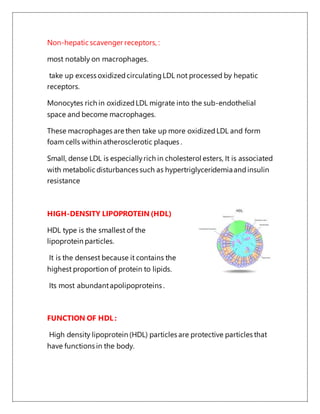
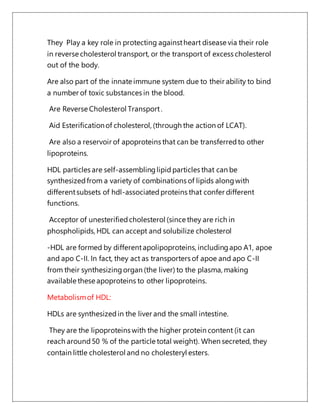
HIGH-DENSITY LIPOPROTEIN (HDL)
HDL type is the smallest of the
lipoprotein particles.
It is the densest because it contains the
highest proportion of protein to lipids.
Its most abundantapolipoproteins .
FUNCTION OF HDL :
High density lipoprotein (HDL) particles are protective particles that
have functions in the body.
They Play a key role in protecting againstheart disease via their role
in reverse cholesterol transport, or the transport of excess cholesterol
out of the body.
Are also part of the innate immune system due to their ability to bind
a number of toxic substances in the blood.
Are Reverse Cholesterol Transport.
Aid Esterificationof cholesterol, (through the action of LCAT).
Are also a reservoir of apoproteins that can be transferredto other
lipoproteins.
HDL particles are self-assemblinglipid particles that can be
synthesizedfrom a variety of combinations of lipids alongwith
differentsubsets of hdl-associatedproteins that confer different
functions.
Acceptor of unesterifiedcholesterol (since they are rich in
phospholipids, HDL can accept and solubilize cholesterol
-HDL are formed by differentapolipoproteins, includingapo A1, apoe
and apo C-II. In fact, they act as transporters of apoe and apo C-II
from their synthesizingorgan (the liver) to the plasma, making
available these apoproteins to other lipoproteins.
Metabolismof HDL:
HDLs are synthesizedin the liver and the small intestine.
They are the lipoproteins with the higher protein content (it can
reach around50 % of the particle total weight). When secreted, they
contain little cholesterol and no cholesteryl esters.
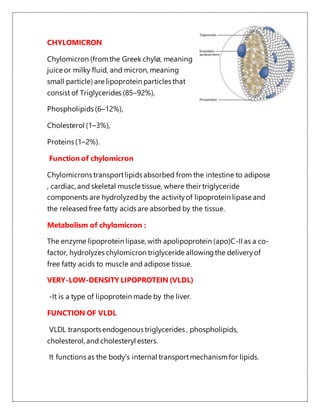
CHYLOMICRON
Chylomicron (fromthe Greek chylø, meaning
juice or milky fluid, and micron, meaning
small particle) are lipoprotein particles that
consist of Triglycerides (85–92%),
Phospholipids (6–12%),
Cholesterol (1–3%),
Proteins (1–2%).
Function of chylomicron
Chylomicrons transportlipids absorbed from the intestine to adipose
, cardiac, and skeletal muscle tissue, where their triglyceride
components are hydrolyzedby the activityof lipoprotein lipase and
the releasedfree fatty acids are absorbed by the tissue.
Metabolism of chylomicron :
The enzyme lipoprotein lipase, with apolipoprotein (apo)C-II as a co-
factor, hydrolyzes chylomicron triglyceride allowingthe deliveryof
free fatty acids to muscle and adipose tissue.
VERY-LOW-DENSITY LIPOPROTEIN (VLDL)
-It is a type of lipoprotein made by the liver.
FUNCTION OF VLDL
VLDL transports endogenous triglycerides , phospholipids,
cholesterol, and cholesteryl esters.
It functions as the body's internal transportmechanismfor lipids.
In addition it serves for long-range transportof hydrophobic
intercellularmessengers, like the morphogen.
. METABOLISM OF VLDL
VLDL metabolism is very similar to Chylomicrons metabolism. the
main lipidfound in VLDL is also triacylglycerol, but in this case
triacylglycerols come from excess fatty acids on diet or an increase in
the hepatic synthesis of fatty acids as a consequence of excess
carbohydrates in diet.
Fats coming from the hepatocytes uptake of Chylomicrons remnants
are also a source of triacylglycerols for VLDL.
Additionallyto triacylglycerols, VLDL contains around35 % of free
and esterifiedcholesterol, 35 % of phospholipids, and various
apoproteins, includingApoB-
Chylomicrons, acquires in the blood stream Apo C-II and Apo E. The
functions of these apoproteins in VLDL are similar to their functions in
Chylomicrons: Apo C-II activates Lipoprotein Lipase and as a
consequence, VLDL triacylglycerols are hydrolyzed, so the proportion
of cholesterol increases.
The VLDL remnantis calledIDL, or Intermediate Density Lipoprotein.
IDL (INTERMEDIATE DENSITY LIPOPROTEIN)
-It’s formed from the degradation of very low- density lipoproteins.
Their size is, in general, 25 to 35 nm in diameter, and they contain
primarilya range of triacylglycerols andcholesterol esters.
FUNCTION OF IDL
It enables fats and cholesterol to move within the water-based
solution of the bloodstream. Each native IDL particle consists of
protein that encircles various fatty acids, enabling, as a water-soluble
particle, these fatty acids to travel in the aqueous blood environment
as part of the fat transport system within the body.
In general, IDL, somewhat similar to low-densitylipoprotein (LDL),
transports a variety of triglyceride fats and cholesterol and, like LDL,
can also promote the growth of atheroma.
METABOLISM OF ILDL
VLDL is a large, triglyceride-rich lipoprotein secretedby the liver that
transports triglyceride to adipose tissue and muscle.
The triglycerides in VLDL are removed in capillaries by the enzyme
lipoprotein lipase, and the VLDL returns to the circulationas a smaller
particle with a new name, intermediate-densitylipoprotein (IDL).
The IDL particles have lost most of their triglyceride, but they retain
cholesteryl esters. Some of the IDL particles are rapidlytaken up by
the liver; others remain in circulation, where they undergo further
triglyceride hydrolysis andare converted to LDL.
A distinguishingfeature of the IDL particle is their content of multiple
copies of the receptor ligandApoE in addition to a single copy of
ApoB- 100.
The multiple copies of ApoE allow IDL to bind to the LDL receptor
with a very high affinity. When IDL is converted to LDL, the ApoE
leaves the particle and only the ApoB-100 remains.
Thereafter, the affinity for the LDL receptor is much reduce
-----------------------------------

lipoprotein

  • 1.
    By the nameof allah By : Dania Mohammed Abunawas Immunology and allergy / MRI Chemical pathology elective /spring 2020
  • 2.
    Lipoproteins Definition: A lipoprotein isa biochemical assemblythat contains both proteins and lipids , bound to the proteins , which allow fats to move through the water inside and outside cells. **The proteins serve to emulsifythe lipid molecules. Many enzymes, transporters, structural proteins, antigens, and toxins are lipoproteins. Calssification : Lipoproteins differ in the ratio of protein to lipids, and in the particular apoproteins andlipids that they contain. They are classifiedbased on their density: 1-LDL (low density lipoprotein, highest in cholesteryl esters as % of weight). 2-HDL (high density lipoprotein, highestin density due to high protein/lipidratio). 3-Chylomicron (largest; lowest in density due to high lipid/protein ratio; highest in triacylglycerols as % of weight). 4-VLDL (very low density lipoprotein; 2nd highest in triacylglycerols as % of weight). 5-IDL (intermediate densitylipoprotein).
  • 3.
    CLASSIFICATION ACCORDING TOSIZE : LOW DENSITY LIPOPROTEINS (LDLS) : -Function of LDLs : low density lipoprotein is sometimes called"bad cholesterol"in actuality, however, LDLs: - -They are products of VLDL and IDL metabolism, and the most cholesterol-richof all lipoproteins. -Are the principal cholesterol andfat transporter in human blood that carries cholesterol fromthe liver to the body tissues and cells.
  • 4.
    -Despite cholesterol's negativereputation, it's nevertheless an important biomolecule that serves a number of vital purposes in the body. -Appropriate levels of LDL cholesterol can positively impact health in many ways. -In metabolism their function is mediating by cellular uptake via receptor-mediatedendocytosis followedby lysosomal degradation , and is strongly dependent on the lipid distribution . -Apart from their well-establishedrole as lipid transporter, -LDL particles are intimatelyinvolved in the progression of cardiovasculardiseases such as atherosclerosis or stroke, which are among the most prevalentcauses of death. -Raisedplasma levels of LDL are linked to an increasedriskfor disease. Metabolism of LDL : About 40 to 60% of all LDL are clearedby the liver in a process mediated by apo B and hepatic LDL receptors. -The rest are taken up by either hepatic LDL or non-hepatic non-LDL (scavenger) receptors. Hepatic LDL receptors : are down-regulatedby : deliveryof cholesterol to the liver by chylomicrons. andby increaseddietarysaturated fat. They can be up- regulatedby decreaseddietary fat and cholesterol.
  • 5.
    Non-hepatic scavenger receptors,: most notably on macrophages. take up excess oxidizedcirculatingLDL not processed by hepatic receptors. Monocytes rich in oxidizedLDL migrate into the sub-endothelial space and become macrophages. These macrophages are then take up more oxidizedLDL and form foam cells within atherosclerotic plaques . Small, dense LDL is especiallyrich in cholesterol esters, It is associated with metabolic disturbances such as hypertriglyceridemiaandinsulin resistance HIGH-DENSITY LIPOPROTEIN (HDL) HDL type is the smallest of the lipoprotein particles. It is the densest because it contains the highest proportion of protein to lipids. Its most abundantapolipoproteins . FUNCTION OF HDL : High density lipoprotein (HDL) particles are protective particles that have functions in the body.
  • 6.
    They Play akey role in protecting againstheart disease via their role in reverse cholesterol transport, or the transport of excess cholesterol out of the body. Are also part of the innate immune system due to their ability to bind a number of toxic substances in the blood. Are Reverse Cholesterol Transport. Aid Esterificationof cholesterol, (through the action of LCAT). Are also a reservoir of apoproteins that can be transferredto other lipoproteins. HDL particles are self-assemblinglipid particles that can be synthesizedfrom a variety of combinations of lipids alongwith differentsubsets of hdl-associatedproteins that confer different functions. Acceptor of unesterifiedcholesterol (since they are rich in phospholipids, HDL can accept and solubilize cholesterol -HDL are formed by differentapolipoproteins, includingapo A1, apoe and apo C-II. In fact, they act as transporters of apoe and apo C-II from their synthesizingorgan (the liver) to the plasma, making available these apoproteins to other lipoproteins. Metabolismof HDL: HDLs are synthesizedin the liver and the small intestine. They are the lipoproteins with the higher protein content (it can reach around50 % of the particle total weight). When secreted, they contain little cholesterol and no cholesteryl esters.
  • 7.
    CHYLOMICRON Chylomicron (fromthe Greekchylø, meaning juice or milky fluid, and micron, meaning small particle) are lipoprotein particles that consist of Triglycerides (85–92%), Phospholipids (6–12%), Cholesterol (1–3%), Proteins (1–2%). Function of chylomicron Chylomicrons transportlipids absorbed from the intestine to adipose , cardiac, and skeletal muscle tissue, where their triglyceride components are hydrolyzedby the activityof lipoprotein lipase and the releasedfree fatty acids are absorbed by the tissue. Metabolism of chylomicron : The enzyme lipoprotein lipase, with apolipoprotein (apo)C-II as a co- factor, hydrolyzes chylomicron triglyceride allowingthe deliveryof free fatty acids to muscle and adipose tissue. VERY-LOW-DENSITY LIPOPROTEIN (VLDL) -It is a type of lipoprotein made by the liver. FUNCTION OF VLDL VLDL transports endogenous triglycerides , phospholipids, cholesterol, and cholesteryl esters. It functions as the body's internal transportmechanismfor lipids.
  • 8.
    In addition itserves for long-range transportof hydrophobic intercellularmessengers, like the morphogen. . METABOLISM OF VLDL VLDL metabolism is very similar to Chylomicrons metabolism. the main lipidfound in VLDL is also triacylglycerol, but in this case triacylglycerols come from excess fatty acids on diet or an increase in the hepatic synthesis of fatty acids as a consequence of excess carbohydrates in diet. Fats coming from the hepatocytes uptake of Chylomicrons remnants are also a source of triacylglycerols for VLDL. Additionallyto triacylglycerols, VLDL contains around35 % of free and esterifiedcholesterol, 35 % of phospholipids, and various apoproteins, includingApoB- Chylomicrons, acquires in the blood stream Apo C-II and Apo E. The functions of these apoproteins in VLDL are similar to their functions in Chylomicrons: Apo C-II activates Lipoprotein Lipase and as a consequence, VLDL triacylglycerols are hydrolyzed, so the proportion of cholesterol increases. The VLDL remnantis calledIDL, or Intermediate Density Lipoprotein. IDL (INTERMEDIATE DENSITY LIPOPROTEIN) -It’s formed from the degradation of very low- density lipoproteins. Their size is, in general, 25 to 35 nm in diameter, and they contain primarilya range of triacylglycerols andcholesterol esters.
  • 9.
    FUNCTION OF IDL Itenables fats and cholesterol to move within the water-based solution of the bloodstream. Each native IDL particle consists of protein that encircles various fatty acids, enabling, as a water-soluble particle, these fatty acids to travel in the aqueous blood environment as part of the fat transport system within the body. In general, IDL, somewhat similar to low-densitylipoprotein (LDL), transports a variety of triglyceride fats and cholesterol and, like LDL, can also promote the growth of atheroma. METABOLISM OF ILDL VLDL is a large, triglyceride-rich lipoprotein secretedby the liver that transports triglyceride to adipose tissue and muscle. The triglycerides in VLDL are removed in capillaries by the enzyme lipoprotein lipase, and the VLDL returns to the circulationas a smaller particle with a new name, intermediate-densitylipoprotein (IDL). The IDL particles have lost most of their triglyceride, but they retain cholesteryl esters. Some of the IDL particles are rapidlytaken up by the liver; others remain in circulation, where they undergo further triglyceride hydrolysis andare converted to LDL. A distinguishingfeature of the IDL particle is their content of multiple copies of the receptor ligandApoE in addition to a single copy of ApoB- 100.
  • 10.
    The multiple copiesof ApoE allow IDL to bind to the LDL receptor with a very high affinity. When IDL is converted to LDL, the ApoE leaves the particle and only the ApoB-100 remains. Thereafter, the affinity for the LDL receptor is much reduce -----------------------------------