Post-tensioned (PT) slabs
A PRESENTATION ON
Department of
Civil Engineering.
Leading University, Sylhet
Presented by
FOYSOL MAHMUD
Batch: 10th ; Section: B
Department of
Civil Engineering.
Leading University, Sylhet
Introduction
Post-tensioned (PT) slabs are typically flat slabs. PT slabs offer the thinnest slab type,
as concrete is worked to its strengths, mostly being kept in compression. Longer
spans can be achieved due to pre-stress, which can also be used to counteract
deflections.
Post-tensioned slabs use high-strength tensioned steel strands to compress the slabs,
keeping the majority of the concrete in compression. This gives a very efficient
structure which minimizes material usages and decreases the economic span range
when compared to reinforced concrete.
Sustainable Construction with Post-Tensioned Slabs
Embodied Energy and Embodied Carbon
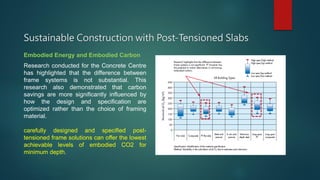
Research conducted for the Concrete Centre
has highlighted that the difference between
frame systems is not substantial. This
research also demonstrated that carbon
savings are more significantly influenced by
how the design and specification are
optimized rather than the choice of framing
material.
carefully designed and specified post-
tensioned frame solutions can offer the lowest
achievable levels of embodied CO2 for
minimum depth.
Opportunities for the use of post-tensioning
Resource efficiency
 Typically 20% reduction in concrete volume.
 The reinforcement requirement of a typical PT slab is 40% of the equivalent RC slab.
Carbon/Low Waste
 100% secondary aggregate is also viable.
 Reinforcing bar itself is typically from 95-100% recycled sources while the strand
content may be as much as 30% recycled.
Flexibility and Adaptability
 Allow high thermal mass.
 Long spans allow for future flexibility and adaptation.
What is post-tensioning?
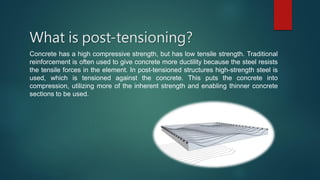
Concrete has a high compressive strength, but has low tensile strength. Traditional
reinforcement is often used to give concrete more ductility because the steel resists
the tensile forces in the element. In post-tensioned structures high-strength steel is
used, which is tensioned against the concrete. This puts the concrete into
compression, utilizing more of the inherent strength and enabling thinner concrete
sections to be used.
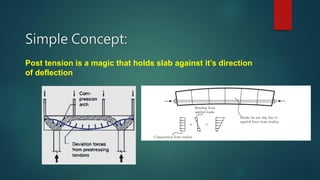
Simple Concept:
Post tension is a magic that holds slab against it’s direction
of deflection
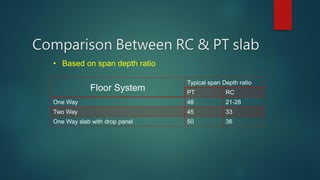
Comparison Between RC & PT slab
• Based on span depth ratio
Floor System
Typical span Depth ratio
PT RC
One Way 48 21-28
Two Way 45 33
One Way slab with drop panel 50 36
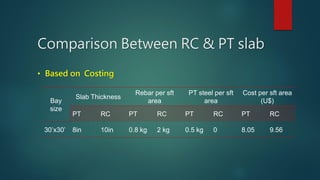
Comparison Between RC & PT slab
• Based on Costing
Bay
size
Slab Thickness
Rebar per sft
area
PT steel per sft
area
Cost per sft area
(U$)
PT RC PT RC PT RC PT RC
30’x30’ 8in 10in 0.8 kg 2 kg 0.5 kg 0 8.05 9.56
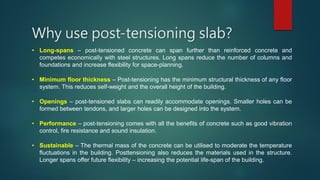
Why use post-tensioning slab?
• Long-spans – post-tensioned concrete can span further than reinforced concrete and
competes economically with steel structures. Long spans reduce the number of columns and
foundations and increase flexibility for space-planning.
• Minimum floor thickness – Post-tensioning has the minimum structural thickness of any floor
system. This reduces self-weight and the overall height of the building.
• Openings – post-tensioned slabs can readily accommodate openings. Smaller holes can be
formed between tendons, and larger holes can be designed into the system.
• Performance – post-tensioning comes with all the benefits of concrete such as good vibration
control, fire resistance and sound insulation.
• Sustainable – The thermal mass of the concrete can be utilised to moderate the temperature
fluctuations in the building. Posttensioning also reduces the materials used in the structure.
Longer spans offer future flexibility – increasing the potential life-span of the building.
Post-tensioning market
The use of post-tensioning (PT) has
increased dramatically over the last
decade. There are now many companies
which offer postn tensioning supply and
installation services in many countries.
Some Case Studies
Whitmore High School, UK
The new 9,550m² secondary school building has
been constructed with three storey structure has
300mm thick PT slabs.
Whitestown Way Shopping Centre, Dublin
Originally conceived as RC, the decision to
switch to post-tensioned concrete has saved
in excess of €1M, principally in reduced
reinforced tonnage, decreased concrete
volumes and simplified formwork.
Some Case Studies
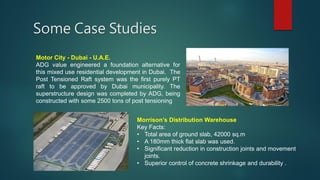
Motor City - Dubai - U.A.E.
ADG value engineered a foundation alternative for
this mixed use residential development in Dubai. The
Post Tensioned Raft system was the first purely PT
raft to be approved by Dubai municipality. The
superstructure design was completed by ADG, being
constructed with some 2500 tons of post tensioning
Morrison’s Distribution Warehouse
Key Facts:
• Total area of ground slab, 42000 sq.m
• A 180mm thick flat slab was used.
• Significant reduction in construction joints and movement
joints.
• Superior control of concrete shrinkage and durability .
How it works….!
References
• The Structural Engineer: Volume 90, issue 5, may 2012, pp32-40
• www.pta.uk.com
• The post tensioning Association, GN04
• The post tensioning Association, GN03

Post tensioned (PT) slabs

  • 1.
    Post-tensioned (PT) slabs APRESENTATION ON Department of Civil Engineering. Leading University, Sylhet
  • 2.
    Presented by FOYSOL MAHMUD Batch:10th ; Section: B Department of Civil Engineering. Leading University, Sylhet
  • 3.
    Introduction Post-tensioned (PT) slabsare typically flat slabs. PT slabs offer the thinnest slab type, as concrete is worked to its strengths, mostly being kept in compression. Longer spans can be achieved due to pre-stress, which can also be used to counteract deflections. Post-tensioned slabs use high-strength tensioned steel strands to compress the slabs, keeping the majority of the concrete in compression. This gives a very efficient structure which minimizes material usages and decreases the economic span range when compared to reinforced concrete.
  • 4.
    Sustainable Construction withPost-Tensioned Slabs Embodied Energy and Embodied Carbon Research conducted for the Concrete Centre has highlighted that the difference between frame systems is not substantial. This research also demonstrated that carbon savings are more significantly influenced by how the design and specification are optimized rather than the choice of framing material. carefully designed and specified post- tensioned frame solutions can offer the lowest achievable levels of embodied CO2 for minimum depth.
  • 5.
    Opportunities for theuse of post-tensioning Resource efficiency  Typically 20% reduction in concrete volume.  The reinforcement requirement of a typical PT slab is 40% of the equivalent RC slab. Carbon/Low Waste  100% secondary aggregate is also viable.  Reinforcing bar itself is typically from 95-100% recycled sources while the strand content may be as much as 30% recycled. Flexibility and Adaptability  Allow high thermal mass.  Long spans allow for future flexibility and adaptation.
  • 6.
    What is post-tensioning? Concretehas a high compressive strength, but has low tensile strength. Traditional reinforcement is often used to give concrete more ductility because the steel resists the tensile forces in the element. In post-tensioned structures high-strength steel is used, which is tensioned against the concrete. This puts the concrete into compression, utilizing more of the inherent strength and enabling thinner concrete sections to be used.
  • 7.
    Simple Concept: Post tensionis a magic that holds slab against it’s direction of deflection
  • 8.
    Comparison Between RC& PT slab • Based on span depth ratio Floor System Typical span Depth ratio PT RC One Way 48 21-28 Two Way 45 33 One Way slab with drop panel 50 36
  • 9.
    Comparison Between RC& PT slab • Based on Costing Bay size Slab Thickness Rebar per sft area PT steel per sft area Cost per sft area (U$) PT RC PT RC PT RC PT RC 30’x30’ 8in 10in 0.8 kg 2 kg 0.5 kg 0 8.05 9.56
  • 10.
    Why use post-tensioningslab? • Long-spans – post-tensioned concrete can span further than reinforced concrete and competes economically with steel structures. Long spans reduce the number of columns and foundations and increase flexibility for space-planning. • Minimum floor thickness – Post-tensioning has the minimum structural thickness of any floor system. This reduces self-weight and the overall height of the building. • Openings – post-tensioned slabs can readily accommodate openings. Smaller holes can be formed between tendons, and larger holes can be designed into the system. • Performance – post-tensioning comes with all the benefits of concrete such as good vibration control, fire resistance and sound insulation. • Sustainable – The thermal mass of the concrete can be utilised to moderate the temperature fluctuations in the building. Posttensioning also reduces the materials used in the structure. Longer spans offer future flexibility – increasing the potential life-span of the building.
  • 11.
    Post-tensioning market The useof post-tensioning (PT) has increased dramatically over the last decade. There are now many companies which offer postn tensioning supply and installation services in many countries.
  • 12.
    Some Case Studies WhitmoreHigh School, UK The new 9,550m² secondary school building has been constructed with three storey structure has 300mm thick PT slabs. Whitestown Way Shopping Centre, Dublin Originally conceived as RC, the decision to switch to post-tensioned concrete has saved in excess of €1M, principally in reduced reinforced tonnage, decreased concrete volumes and simplified formwork.
  • 13.
    Some Case Studies MotorCity - Dubai - U.A.E. ADG value engineered a foundation alternative for this mixed use residential development in Dubai. The Post Tensioned Raft system was the first purely PT raft to be approved by Dubai municipality. The superstructure design was completed by ADG, being constructed with some 2500 tons of post tensioning Morrison’s Distribution Warehouse Key Facts: • Total area of ground slab, 42000 sq.m • A 180mm thick flat slab was used. • Significant reduction in construction joints and movement joints. • Superior control of concrete shrinkage and durability .
  • 14.
  • 15.
    References • The StructuralEngineer: Volume 90, issue 5, may 2012, pp32-40 • www.pta.uk.com • The post tensioning Association, GN04 • The post tensioning Association, GN03