Arches And Lintels
BUILDING CONSTRUCTION MATERIALS II
Unit 5: Introduction to openings, spanning of
openings by types of arches and lintels, principles and
terminology of arch construction spanning of openings
using materials mentioned in unit II.
Presented by,
Er. Dhanashri Dhamdhere
By Er. Dhanashri Dhamdhere Arches and Linrels
D Y Patil College of Architecture, Akurdi, Pune-44
FY B.Arch. Term I, Acadamic Year 2021-22
Lintels
A 'Lintel' is a horizontal structural member which is fixed over the
openings, viz., doors, windows recesses, etc. to support the
structure over the openings. Lintels are usually rectangular in
shape and they afford facilities for fixing the door and window,
frames, wherever they are used.
Lintels may be made of several materials such as wood, stone,
brick, reinforced brickwork, reinforced concrete or rolled steel
sections embedded in cement concrete.
Reinforced concrete lintels are most widely used these
days to span the openings, because the other materials have
become outdated due to the following drawbacks.
By Er. Dhanashri Dhamdhere Arches and Linrels
Types of Lintels
On the basis of materials used in construction, the lintels are
classifiedinto following types-
1.Wooden Lintels
2. Stone Lintels
3. Brick Lintels
4. Steel Lintels
5. Reinforced Cement Concrete Lintels (i.e., R.C.C. Lintels)
6. Reinforced Brick Lintels (i.e., R.B. Lintels)
By Er. Dhanashri Dhamdhere Arches and Linrels
1.Wooden Lintels
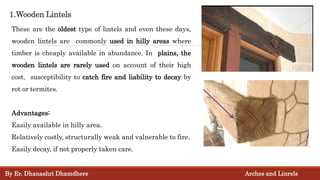
These are the oldest type of lintels and even these days,
wooden lintels are commonly used in hilly areas where
timber is cheaply available in abundance. In plains, the
wooden lintels are rarely used on account of their high
cost, susceptibility to catch fire and liability to decay by
rot or termites.
Advantages:
Easily available in hilly area.
Relatively costly, structurally weak and valnerable to fire.
Easily decay, if not properly taken care.
By Er. Dhanashri Dhamdhere Arches and Linrels
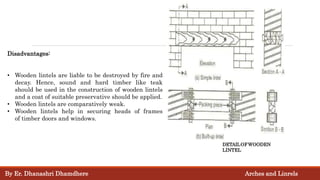
DETAILOFWOODEN
LINTEL
Disadvantages:
• Wooden lintels are liable to be destroyed by fire and
decay. Hence, sound and hard timber like teak
should be used in the construction of wooden lintels
and a coat of suitable preservative should be applied.
• Wooden lintels are comparatively weak.
• Wooden lintels help in securing heads of frames
of timber doors and windows.
By Er. Dhanashri Dhamdhere Arches and Linrels
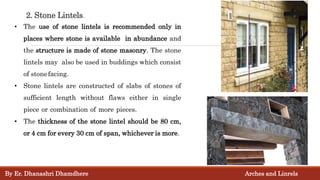
2. Stone Lintels.
• The use of stone lintels is recommended only in
places where stone is available in abundance and
the structure is made of stone masonry. The stone
lintels may also be used in buddings which consist
of stonefacing.
• Stone lintels are constructed of slabs of stones of
sufficient length without flaws either in single
piece or combination of more pieces.
• The thickness of the stone lintel should be 80 cm,
or 4 cm for every 30 cm of span, whichever is more.
By Er. Dhanashri Dhamdhere Arches and Linrels
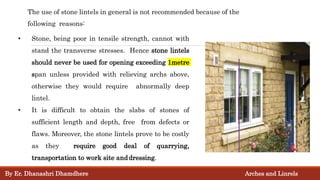
The use of stone lintels in general is not recommended because of the
following reasons:
• Stone, being poor in tensile strength, cannot with
stand the transverse stresses. Hence stone lintels
should never be used for opening exceeding 1metre
span unless provided with relieving archs above,
otherwise they would require abnormally deep
lintel.
• It is difficult to obtain the slabs of stones of
sufficient length and depth, free from defects or
flaws. Moreover, the stone lintels prove to be costly
as they require good deal of quarrying,
transportation to work site anddressing.
By Er. Dhanashri Dhamdhere Arches and Linrels
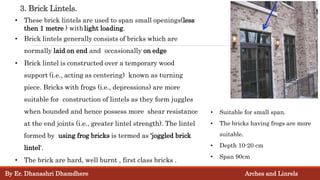
3. Brick Lintels.
• These brick lintels are used to span small openings(less
then 1 metre ) withlight loading.
• Brick lintels generally consists of bricks which are
normally laid on end and occasionally on edge
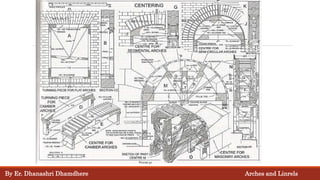
• Brick lintel is constructed over a temporary wood
support (i.e., acting as centering) known as turning
piece. Bricks with frogs (i.e., depressions) are more
suitable for construction of lintels as they form juggles
when bounded and hence possess more shear resistance
at the end joints (i.e., greater lintel strength). The lintel
formed by using frog bricks is termed as 'joggled brick
lintel'.
• The brick are hard, well burnt , first class bricks .
• Suitable for small span.
• The bricks having frogs are more
suitable.
• Depth 10-20 cm
• Span 90cm
By Er. Dhanashri Dhamdhere Arches and Linrels
(i)Bricks should be hard, well-burnt, free from defects such as lumps, cracks, flaws
etc. and with sharp and square edges.
(ii)The depth of the brick lintels, which varies with the size of opening and
appearance of brickwork, should be multiple of brick courses, viz., usually 10 cm, 20
cm, etc.
(iii)For bonding frog bricks, the cement mortar with mix proportions 1: 3should be
used.
(iv)Brick lintels, being weak in strength, cannot be used for supporting heavy
loads.
(v)Door and window frames should be fixed with a setback of 2.5 cm from
external face of the wall.
The following points regarding brick lintels should be given due
consideration:
By Er. Dhanashri Dhamdhere Arches and Linrels
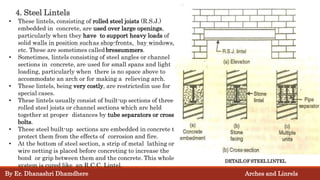
4. Steel Lintels
• These lintels, consisting of rolled steel joists (R.S.J.)
embedded in concrete, are used over large openings,
particularly when they have to support heavy loads of
solid walls in position suchas shop-fronts, bay windows,
etc. These are sometimes called bressummers.
• Sometimes, lintels consisting of steel angles or channel
sections in concrete, are used for small spans and light
loading, particularly when there is no space above to
accommodate an arch or for making a relieving arch.
• These lintels, being very costly, are restrictedin use for
special cases.
• These lintels usually consist of built-up sections of three
rolled steel joists or channel sections which are held
together at proper distances by tube separators or cross-
bolts.
• These steel built-up sections are embedded in concrete to
protect them from the effects of corrosion and fire.
• At the bottom of steel section, a strip of metal lathing or
wire netting is placed before concreting to increase the
bond or grip between them and the concrete. This whole
system is cured like an R.C.C. Lintel.
DETAILOF STEELLINTEL
By Er. Dhanashri Dhamdhere Arches and Linrels
5. Reinforced Cement Concrete Lintels & Projection
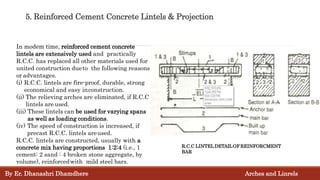
In modem time, reinforced cement concrete
lintels are extensively used and practically
R.C.C. has replaced all other materials used for
united construction dueto the following reasons
or advantages.
(i) R.C.C. lintels are fire-proof, durable, strong
economical and easy inconstruction.
(ii) The relieving arches are eliminated, if R.C.C
lintels are used.
(iii) These lintels can be used for varying spans
as well as loading conditions.
(iv) The speed of construction is increased, if
precast R.C.C. lintels areused.
R.C.C. lintels are constructed, usually with a
concrete mix having proportions 1:2:4 (i.e., 1
cement: 2 sand : 4 broken stone aggregate, by
volume), reinforcedwith mild steel bars.
R.C.C LINTELDETAILOF REINFORCMENT
BAR
By Er. Dhanashri Dhamdhere Arches and Linrels
Types of Lintels
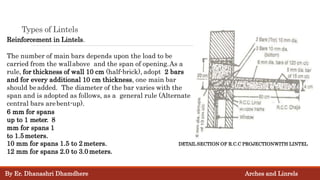
Reinforcement in Lintels.
The number of main bars depends upon the load to be
carried from the wallabove and the span of opening.As a
rule, for thickness of wall 10 cm (half-brick), adopt 2 bars
and for every additional 10 cm thickness, one main bar
should beadded. The diameter of the bar varies with the
span and is adopted as follows, as a general rule (Alternate
central bars arebent-up).
6 mm for spans
up to 1 meter. 8
mm for spans 1
to 1.5meters.
10 mm for spans 1.5 to 2 meters.
12 mm for spans 2.0 to 3.0meters.
DETAIL SECTION OF R.C.C PROJECTIONWITH LINTEL
By Er. Dhanashri Dhamdhere Arches and Linrels
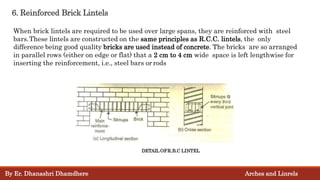
When brick lintels are required to be used over large spans, they are reinforced with steel
bars.These lintels are constructed on the same principles as R.C.C. lintels, the only
difference being good quality bricks are used instead of concrete. The bricks are so arranged
in parallel rows (either on edge or flat) that a 2 cm to 4 cm wide space is left lengthwise for
inserting the reinforcement, i.e., steel bars or rods
DETAIL OFR.B.C LINTEL
6. Reinforced Brick Lintels
By Er. Dhanashri Dhamdhere Arches and Linrels
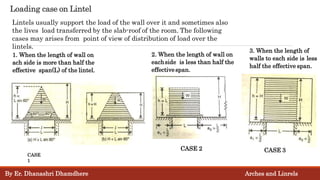
Loading case on Lintel
Lintels usually support the load of the wall over it and sometimes also
the lives load transferred by the slab-roof of the room. The following
cases may arises from point of view of distribution of load over the
lintels.
CASE
1
1. When the length of wall on
ach side is more than half the
effective span(L) of the lintel.
2. When the length of wall on
eachside is less than half the
effectivespan.
CASE 2
3. When the length of
walls to each side is less
half the effective span.
CASE 3
By Er. Dhanashri Dhamdhere Arches and Linrels
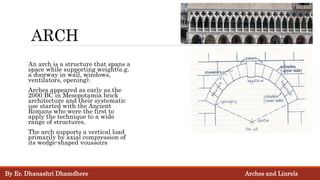
ARCH
An arch is a structure that spans a
space while supporting weight(e.g.
a doorway in wall, windows,
ventilators, opening).
Arches appeared as early as the
2000 BC in Mesopotamia brick
architecture and their systematic
use started with the Ancient
Romans who were the first to
apply the technique to a wide
range of structures.
The arch supports a vertical load
primarily by axial compression of
its wedge-shaped voussoirs
By Er. Dhanashri Dhamdhere Arches and Linrels
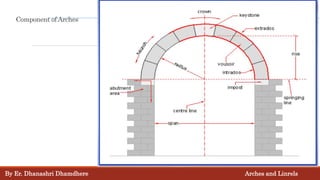
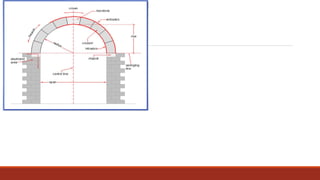
Component of Arches
By Er. Dhanashri Dhamdhere Arches and Linrels
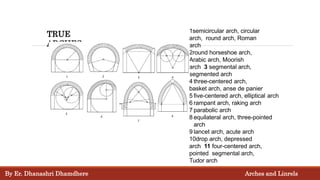
1semicircular arch, circular
arch, round arch, Roman
arch
2round horseshoe arch,
Arabic arch, Moorish
arch 3 segmental arch,
segmented arch
4 three-centered arch,
basket arch, anse de panier
5 five-centered arch, elliptical arch
6 rampant arch, raking arch
7 parabolic arch
8 equilateral arch, three-pointed
arch
9 lancet arch, acute arch
10drop arch, depressed
arch 11 four-centered arch,
pointed segmental arch,
Tudor arch
TRUE
ARCHES
By Er. Dhanashri Dhamdhere Arches and Linrels
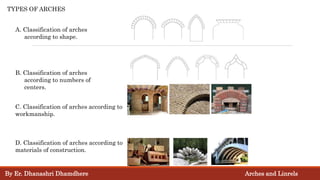
TYPES OF ARCHES
A. Classification of arches
according to shape.
B. Classification of arches
according to numbers of
centers.
C. Classification of arches according to
workmanship.
D. Classification of arches according to
materials of construction.
By Er. Dhanashri Dhamdhere Arches and Linrels
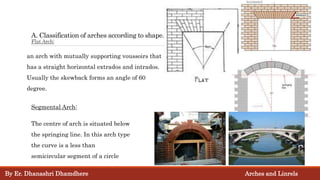
A. Classification of arches according to shape.
Flat Arch:
2. TYPES OF ARCHES (continue……)
an arch with mutually supporting voussoirs that
has a straight horizontal extrados and intrados.
Usually the skewback forms an angle of 60
degree.
Segmental Arch:
The centre of arch is situated below
the springing line. In this arch type
the curve is a less than
semicircular segment of a circle
By Er. Dhanashri Dhamdhere Arches and Linrels
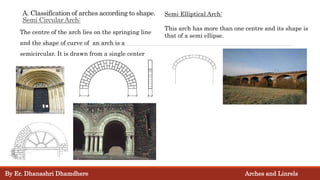
A. Classification of arches according to shape.
Semi CircularArch:
The centre of the arch lies on the springing line
and the shape of curve of an arch is a
semicircular. It is drawn from a single center
Semi Elliptical Arch:
This arch has more than one centre and its shape is
that of a semi ellipse.
By Er. Dhanashri Dhamdhere Arches and Linrels
A. Classification of arches according to shape.
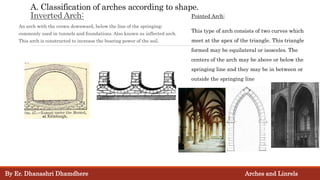
Inverted Arch:
An arch with the crown downward, below the line of the springing;
commonly used in tunnels and foundations. Also known as inflected arch.
This arch is constructed to increase the bearing power of the soil.
Pointed Arch:
This type of arch consists of two curves which
meet at the apex of the triangle. This triangle
formed may be equilateral or isosceles. The
centers of the arch may be above or below the
springing line and they may be in between or
outside the springing line
By Er. Dhanashri Dhamdhere Arches and Linrels
A. Classification of arches according to shape.
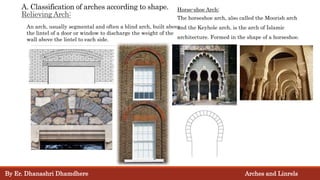
Relieving Arch:
An arch, usually segmental and often a blind arch, built above
the lintel of a door or window to discharge the weight of the
wall above the lintel to each side.
Horse-shoe Arch:
The horseshoe arch, also called the Moorish arch
and the Keyhole arch, is the arch of Islamic
architecture. Formed in the shape of a horseshoe.
By Er. Dhanashri Dhamdhere Arches and Linrels
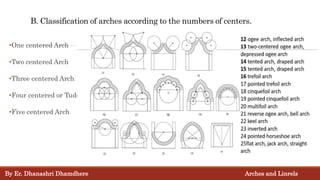
B. Classification of arches according to the numbers of centers.
•One centered Arch
•Two centered Arch
•Three centered Arch
•Four centered or Tudor Arch
•Five centered Arch
By Er. Dhanashri Dhamdhere Arches and Linrels
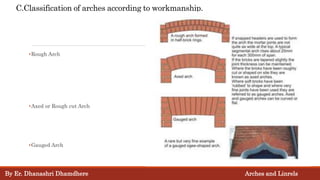
C.Classification of arches according to workmanship.
•Rough Arch
•Axed or Rough cut Arch
•Gauged Arch
By Er. Dhanashri Dhamdhere Arches and Linrels
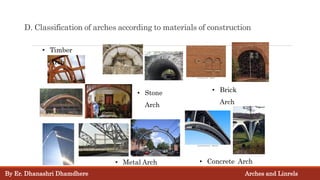
D. Classification of arches according to materials of construction.
• Brick
Arch
• Stone
Arch
• Concrete Arch
• Metal Arch
• Timber
Arch
By Er. Dhanashri Dhamdhere Arches and Linrels
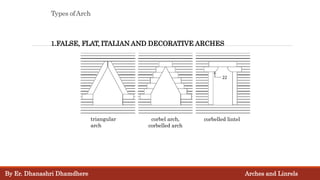
Types ofArch
1.FALSE, FLAT, ITALIAN AND DECORATIVE ARCHES
triangular
arch
corbel arch,
corbelled arch
corbelled lintel
By Er. Dhanashri Dhamdhere Arches and Linrels
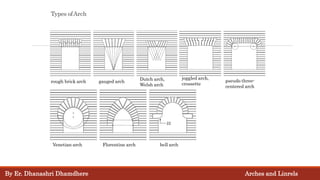
Types ofArch
rough brick arch gauged arch Dutch arch,
Welsh arch
joggled arch,
crossette
pseudo three-
centered arch
Venetian arch Florentine arch bell arch
By Er. Dhanashri Dhamdhere Arches and Linrels
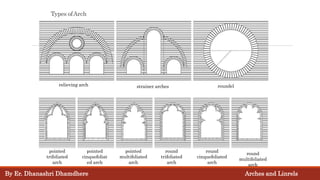
Types ofArch
relieving arch strainer arches roundel
pointed
trifoliated
arch
pointed
cinquefoliat
ed arch
pointed
multifoliated
arch
round
trifoliated
arch
round
cinquefoliated
arch
round
multifoliated
arch
By Er. Dhanashri Dhamdhere Arches and Linrels
Sheets
Arches
Components of arches
Types of arches
One arch in 3D/2D
By Er. Dhanashri Dhamdhere Arches and Lintels
References
4
.
5
.
6
.
7
.
1. Singh Gurucharan, Building Construction and Material, 2010, Pageno-
293-
309
2. Punmia B.C, Building Construction,2013, Page no-293-296
3. Arora S.P,Bindra S.P, The text book of building construction, 2015,
11.13- 11.18
Standard Method of Detailing Structural Concrete,2006
Frederick S. Merritt, BUILDING DESIGNAND
CONSTRUCTION HANDBOOK
Manual for the design of reinforced concrete buildingstructures
Barry. R, The construction of building vol-2
1. Design and Construction in RomanesqueArchitecture
2. Dictionary of Architecture & Construction
3. Dictionary of Architecture and Building Construction
4. Introduction ToArchitecture - Architectural Dictionary OfTerm,
movements
and architects
• W. B McKay, Building Construction, Vol-1
By Er. Dhanashri Dhamdhere Arches and Linrels
Thanks……………
“There is no end to education. It is not that you read a book, pass an examination,
and finish with education. The whole of life, from the moment you are born to the
moment you die, is a process of learning.”
– Jiddu Krishnamurti
By Er. Dhanashri Dhamdhere Arches and Linrels

Arches and lintels

  • 1.
    Arches And Lintels BUILDINGCONSTRUCTION MATERIALS II Unit 5: Introduction to openings, spanning of openings by types of arches and lintels, principles and terminology of arch construction spanning of openings using materials mentioned in unit II. Presented by, Er. Dhanashri Dhamdhere By Er. Dhanashri Dhamdhere Arches and Linrels D Y Patil College of Architecture, Akurdi, Pune-44 FY B.Arch. Term I, Acadamic Year 2021-22
  • 2.
    Lintels A 'Lintel' isa horizontal structural member which is fixed over the openings, viz., doors, windows recesses, etc. to support the structure over the openings. Lintels are usually rectangular in shape and they afford facilities for fixing the door and window, frames, wherever they are used. Lintels may be made of several materials such as wood, stone, brick, reinforced brickwork, reinforced concrete or rolled steel sections embedded in cement concrete. Reinforced concrete lintels are most widely used these days to span the openings, because the other materials have become outdated due to the following drawbacks. By Er. Dhanashri Dhamdhere Arches and Linrels
  • 3.
    Types of Lintels Onthe basis of materials used in construction, the lintels are classifiedinto following types- 1.Wooden Lintels 2. Stone Lintels 3. Brick Lintels 4. Steel Lintels 5. Reinforced Cement Concrete Lintels (i.e., R.C.C. Lintels) 6. Reinforced Brick Lintels (i.e., R.B. Lintels) By Er. Dhanashri Dhamdhere Arches and Linrels
  • 4.
    1.Wooden Lintels These arethe oldest type of lintels and even these days, wooden lintels are commonly used in hilly areas where timber is cheaply available in abundance. In plains, the wooden lintels are rarely used on account of their high cost, susceptibility to catch fire and liability to decay by rot or termites. Advantages: Easily available in hilly area. Relatively costly, structurally weak and valnerable to fire. Easily decay, if not properly taken care. By Er. Dhanashri Dhamdhere Arches and Linrels
  • 5.
    DETAILOFWOODEN LINTEL Disadvantages: • Wooden lintelsare liable to be destroyed by fire and decay. Hence, sound and hard timber like teak should be used in the construction of wooden lintels and a coat of suitable preservative should be applied. • Wooden lintels are comparatively weak. • Wooden lintels help in securing heads of frames of timber doors and windows. By Er. Dhanashri Dhamdhere Arches and Linrels
  • 6.
    2. Stone Lintels. •The use of stone lintels is recommended only in places where stone is available in abundance and the structure is made of stone masonry. The stone lintels may also be used in buddings which consist of stonefacing. • Stone lintels are constructed of slabs of stones of sufficient length without flaws either in single piece or combination of more pieces. • The thickness of the stone lintel should be 80 cm, or 4 cm for every 30 cm of span, whichever is more. By Er. Dhanashri Dhamdhere Arches and Linrels
  • 7.
    The use ofstone lintels in general is not recommended because of the following reasons: • Stone, being poor in tensile strength, cannot with stand the transverse stresses. Hence stone lintels should never be used for opening exceeding 1metre span unless provided with relieving archs above, otherwise they would require abnormally deep lintel. • It is difficult to obtain the slabs of stones of sufficient length and depth, free from defects or flaws. Moreover, the stone lintels prove to be costly as they require good deal of quarrying, transportation to work site anddressing. By Er. Dhanashri Dhamdhere Arches and Linrels
  • 8.
    3. Brick Lintels. •These brick lintels are used to span small openings(less then 1 metre ) withlight loading. • Brick lintels generally consists of bricks which are normally laid on end and occasionally on edge • Brick lintel is constructed over a temporary wood support (i.e., acting as centering) known as turning piece. Bricks with frogs (i.e., depressions) are more suitable for construction of lintels as they form juggles when bounded and hence possess more shear resistance at the end joints (i.e., greater lintel strength). The lintel formed by using frog bricks is termed as 'joggled brick lintel'. • The brick are hard, well burnt , first class bricks . • Suitable for small span. • The bricks having frogs are more suitable. • Depth 10-20 cm • Span 90cm By Er. Dhanashri Dhamdhere Arches and Linrels
  • 9.
    (i)Bricks should behard, well-burnt, free from defects such as lumps, cracks, flaws etc. and with sharp and square edges. (ii)The depth of the brick lintels, which varies with the size of opening and appearance of brickwork, should be multiple of brick courses, viz., usually 10 cm, 20 cm, etc. (iii)For bonding frog bricks, the cement mortar with mix proportions 1: 3should be used. (iv)Brick lintels, being weak in strength, cannot be used for supporting heavy loads. (v)Door and window frames should be fixed with a setback of 2.5 cm from external face of the wall. The following points regarding brick lintels should be given due consideration: By Er. Dhanashri Dhamdhere Arches and Linrels
  • 10.
    4. Steel Lintels •These lintels, consisting of rolled steel joists (R.S.J.) embedded in concrete, are used over large openings, particularly when they have to support heavy loads of solid walls in position suchas shop-fronts, bay windows, etc. These are sometimes called bressummers. • Sometimes, lintels consisting of steel angles or channel sections in concrete, are used for small spans and light loading, particularly when there is no space above to accommodate an arch or for making a relieving arch. • These lintels, being very costly, are restrictedin use for special cases. • These lintels usually consist of built-up sections of three rolled steel joists or channel sections which are held together at proper distances by tube separators or cross- bolts. • These steel built-up sections are embedded in concrete to protect them from the effects of corrosion and fire. • At the bottom of steel section, a strip of metal lathing or wire netting is placed before concreting to increase the bond or grip between them and the concrete. This whole system is cured like an R.C.C. Lintel. DETAILOF STEELLINTEL By Er. Dhanashri Dhamdhere Arches and Linrels
  • 11.
    5. Reinforced CementConcrete Lintels & Projection In modem time, reinforced cement concrete lintels are extensively used and practically R.C.C. has replaced all other materials used for united construction dueto the following reasons or advantages. (i) R.C.C. lintels are fire-proof, durable, strong economical and easy inconstruction. (ii) The relieving arches are eliminated, if R.C.C lintels are used. (iii) These lintels can be used for varying spans as well as loading conditions. (iv) The speed of construction is increased, if precast R.C.C. lintels areused. R.C.C. lintels are constructed, usually with a concrete mix having proportions 1:2:4 (i.e., 1 cement: 2 sand : 4 broken stone aggregate, by volume), reinforcedwith mild steel bars. R.C.C LINTELDETAILOF REINFORCMENT BAR By Er. Dhanashri Dhamdhere Arches and Linrels
  • 12.
    Types of Lintels Reinforcementin Lintels. The number of main bars depends upon the load to be carried from the wallabove and the span of opening.As a rule, for thickness of wall 10 cm (half-brick), adopt 2 bars and for every additional 10 cm thickness, one main bar should beadded. The diameter of the bar varies with the span and is adopted as follows, as a general rule (Alternate central bars arebent-up). 6 mm for spans up to 1 meter. 8 mm for spans 1 to 1.5meters. 10 mm for spans 1.5 to 2 meters. 12 mm for spans 2.0 to 3.0meters. DETAIL SECTION OF R.C.C PROJECTIONWITH LINTEL By Er. Dhanashri Dhamdhere Arches and Linrels
  • 13.
    When brick lintelsare required to be used over large spans, they are reinforced with steel bars.These lintels are constructed on the same principles as R.C.C. lintels, the only difference being good quality bricks are used instead of concrete. The bricks are so arranged in parallel rows (either on edge or flat) that a 2 cm to 4 cm wide space is left lengthwise for inserting the reinforcement, i.e., steel bars or rods DETAIL OFR.B.C LINTEL 6. Reinforced Brick Lintels By Er. Dhanashri Dhamdhere Arches and Linrels
  • 14.
    Loading case onLintel Lintels usually support the load of the wall over it and sometimes also the lives load transferred by the slab-roof of the room. The following cases may arises from point of view of distribution of load over the lintels. CASE 1 1. When the length of wall on ach side is more than half the effective span(L) of the lintel. 2. When the length of wall on eachside is less than half the effectivespan. CASE 2 3. When the length of walls to each side is less half the effective span. CASE 3 By Er. Dhanashri Dhamdhere Arches and Linrels
  • 15.
    ARCH An arch isa structure that spans a space while supporting weight(e.g. a doorway in wall, windows, ventilators, opening). Arches appeared as early as the 2000 BC in Mesopotamia brick architecture and their systematic use started with the Ancient Romans who were the first to apply the technique to a wide range of structures. The arch supports a vertical load primarily by axial compression of its wedge-shaped voussoirs By Er. Dhanashri Dhamdhere Arches and Linrels
  • 16.
    Component of Arches ByEr. Dhanashri Dhamdhere Arches and Linrels
  • 17.
    1semicircular arch, circular arch,round arch, Roman arch 2round horseshoe arch, Arabic arch, Moorish arch 3 segmental arch, segmented arch 4 three-centered arch, basket arch, anse de panier 5 five-centered arch, elliptical arch 6 rampant arch, raking arch 7 parabolic arch 8 equilateral arch, three-pointed arch 9 lancet arch, acute arch 10drop arch, depressed arch 11 four-centered arch, pointed segmental arch, Tudor arch TRUE ARCHES By Er. Dhanashri Dhamdhere Arches and Linrels
  • 18.
    TYPES OF ARCHES A.Classification of arches according to shape. B. Classification of arches according to numbers of centers. C. Classification of arches according to workmanship. D. Classification of arches according to materials of construction. By Er. Dhanashri Dhamdhere Arches and Linrels
  • 19.
    A. Classification ofarches according to shape. Flat Arch: 2. TYPES OF ARCHES (continue……) an arch with mutually supporting voussoirs that has a straight horizontal extrados and intrados. Usually the skewback forms an angle of 60 degree. Segmental Arch: The centre of arch is situated below the springing line. In this arch type the curve is a less than semicircular segment of a circle By Er. Dhanashri Dhamdhere Arches and Linrels
  • 20.
    A. Classification ofarches according to shape. Semi CircularArch: The centre of the arch lies on the springing line and the shape of curve of an arch is a semicircular. It is drawn from a single center Semi Elliptical Arch: This arch has more than one centre and its shape is that of a semi ellipse. By Er. Dhanashri Dhamdhere Arches and Linrels
  • 21.
    A. Classification ofarches according to shape. Inverted Arch: An arch with the crown downward, below the line of the springing; commonly used in tunnels and foundations. Also known as inflected arch. This arch is constructed to increase the bearing power of the soil. Pointed Arch: This type of arch consists of two curves which meet at the apex of the triangle. This triangle formed may be equilateral or isosceles. The centers of the arch may be above or below the springing line and they may be in between or outside the springing line By Er. Dhanashri Dhamdhere Arches and Linrels
  • 22.
    A. Classification ofarches according to shape. Relieving Arch: An arch, usually segmental and often a blind arch, built above the lintel of a door or window to discharge the weight of the wall above the lintel to each side. Horse-shoe Arch: The horseshoe arch, also called the Moorish arch and the Keyhole arch, is the arch of Islamic architecture. Formed in the shape of a horseshoe. By Er. Dhanashri Dhamdhere Arches and Linrels
  • 23.
    B. Classification ofarches according to the numbers of centers. •One centered Arch •Two centered Arch •Three centered Arch •Four centered or Tudor Arch •Five centered Arch By Er. Dhanashri Dhamdhere Arches and Linrels
  • 24.
    C.Classification of archesaccording to workmanship. •Rough Arch •Axed or Rough cut Arch •Gauged Arch By Er. Dhanashri Dhamdhere Arches and Linrels
  • 25.
    D. Classification ofarches according to materials of construction. • Brick Arch • Stone Arch • Concrete Arch • Metal Arch • Timber Arch By Er. Dhanashri Dhamdhere Arches and Linrels
  • 26.
    By Er. DhanashriDhamdhere Arches and Linrels
  • 27.
    Types ofArch 1.FALSE, FLAT,ITALIAN AND DECORATIVE ARCHES triangular arch corbel arch, corbelled arch corbelled lintel By Er. Dhanashri Dhamdhere Arches and Linrels
  • 28.
    Types ofArch rough brickarch gauged arch Dutch arch, Welsh arch joggled arch, crossette pseudo three- centered arch Venetian arch Florentine arch bell arch By Er. Dhanashri Dhamdhere Arches and Linrels
  • 29.
    Types ofArch relieving archstrainer arches roundel pointed trifoliated arch pointed cinquefoliat ed arch pointed multifoliated arch round trifoliated arch round cinquefoliated arch round multifoliated arch By Er. Dhanashri Dhamdhere Arches and Linrels
  • 30.
    Sheets Arches Components of arches Typesof arches One arch in 3D/2D By Er. Dhanashri Dhamdhere Arches and Lintels
  • 32.
    References 4 . 5 . 6 . 7 . 1. Singh Gurucharan,Building Construction and Material, 2010, Pageno- 293- 309 2. Punmia B.C, Building Construction,2013, Page no-293-296 3. Arora S.P,Bindra S.P, The text book of building construction, 2015, 11.13- 11.18 Standard Method of Detailing Structural Concrete,2006 Frederick S. Merritt, BUILDING DESIGNAND CONSTRUCTION HANDBOOK Manual for the design of reinforced concrete buildingstructures Barry. R, The construction of building vol-2 1. Design and Construction in RomanesqueArchitecture 2. Dictionary of Architecture & Construction 3. Dictionary of Architecture and Building Construction 4. Introduction ToArchitecture - Architectural Dictionary OfTerm, movements and architects • W. B McKay, Building Construction, Vol-1 By Er. Dhanashri Dhamdhere Arches and Linrels
  • 33.
    Thanks…………… “There is noend to education. It is not that you read a book, pass an examination, and finish with education. The whole of life, from the moment you are born to the moment you die, is a process of learning.” – Jiddu Krishnamurti By Er. Dhanashri Dhamdhere Arches and Linrels