CIVIL ENGINEERING MATERIALS
Department of Mechanical Engineering
Prepared By
Mr. S.Maniraj M.E.,(Ph.D)
Assistant Professor
Paavai Engineering College
INTRODUCTION
 As an engineer, one must know about the materials
used in the construction site. Engineering
structures are composed of materials. These
materials are known as Engineering materials or
Construction materials.
 The fields of application of a particular building
material depend on the various characteristics and
properties of that construction material. Some of
the materials are:
 BRICK
 STONE
 SAND
 CEMENT
BRICKS
 The brick is one of the oldest building materials
and it is extensively used as a leading building
material of construction because of its durability,
strength, low cost, easy availability etc.
 The bricks are obtained by moulding clay in
rectangular blocks of uniform size and then by
drying and burning these blocks to form a dense
and hard product.
Constituents of good brick
Following are the constituents of good brick
are.
(1) Alumina
(2) Silica
(3) Lime
(4) Oxide of Iron
(5) Magnesia
Qualities of Good Bricks:
(1) Bricks should have even surface with
sharp and square edges.
(2) Bricks should be free from cracks.
(3) Bricks should have low thermal
conductivity.
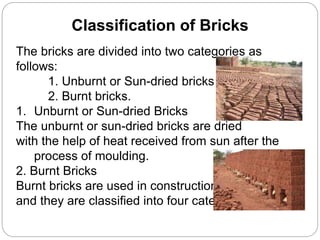
Classification of Bricks
The bricks are divided into two categories as
follows:
1. Unburnt or Sun-dried bricks
2. Burnt bricks.
1. Unburnt or Sun-dried Bricks
The unburnt or sun-dried bricks are dried
with the help of heat received from sun after the
process of moulding.
2. Burnt Bricks
Burnt bricks are used in construction works
and they are classified into four categories.
STONES
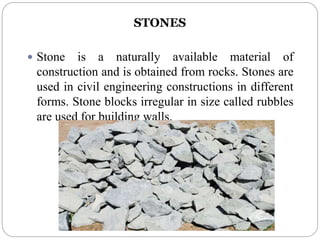
 Stone is a naturally available material of
construction and is obtained from rocks. Stones are
used in civil engineering constructions in different
forms. Stone blocks irregular in size called rubbles
are used for building walls.
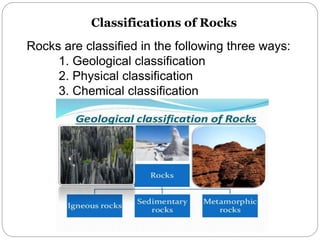
Classifications of Rocks
Rocks are classified in the following three ways:
1. Geological classification
2. Physical classification
3. Chemical classification
Classifications of Rocks
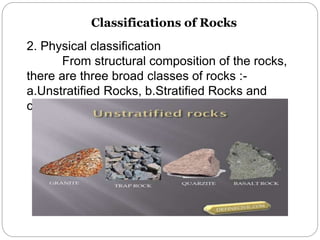
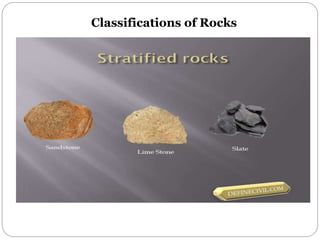
2. Physical classification
From structural composition of the rocks,
there are three broad classes of rocks :-
a.Unstratified Rocks, b.Stratified Rocks and
c.Foliated Rocks
Classifications of Rocks
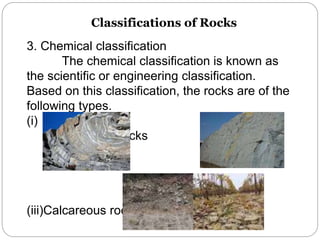
3. Chemical classification
The chemical classification is known as
the scientific or engineering classification.
Based on this classification, the rocks are of the
following types.
(i) Silicious rocks (ii)
Argillaceous rocks
(iii)Calcareous rocks
Stone
Requirements of Stone
 Structure
 Appearance-Colour Texture
 Weight
 Fineness of Grains
 Durability
 Strength
 Hardness
Uses of Stone
 They are used in hydraulic structures like dams
and bridges.
 They are used in retaining wall masonry to retain
soil.
 They are used as road metal in road construction.
 They are used as ballast for permanent way in
railways.
 They are used to make concrete in the form of
coarse aggregate.
Thank you

Civil Engineering Materials

  • 1.
    CIVIL ENGINEERING MATERIALS Departmentof Mechanical Engineering Prepared By Mr. S.Maniraj M.E.,(Ph.D) Assistant Professor Paavai Engineering College
  • 2.
    INTRODUCTION  As anengineer, one must know about the materials used in the construction site. Engineering structures are composed of materials. These materials are known as Engineering materials or Construction materials.  The fields of application of a particular building material depend on the various characteristics and properties of that construction material. Some of the materials are:  BRICK  STONE  SAND  CEMENT
  • 3.
    BRICKS  The brickis one of the oldest building materials and it is extensively used as a leading building material of construction because of its durability, strength, low cost, easy availability etc.  The bricks are obtained by moulding clay in rectangular blocks of uniform size and then by drying and burning these blocks to form a dense and hard product.
  • 4.
    Constituents of goodbrick Following are the constituents of good brick are. (1) Alumina (2) Silica (3) Lime (4) Oxide of Iron (5) Magnesia Qualities of Good Bricks: (1) Bricks should have even surface with sharp and square edges. (2) Bricks should be free from cracks. (3) Bricks should have low thermal conductivity.
  • 5.
    Classification of Bricks Thebricks are divided into two categories as follows: 1. Unburnt or Sun-dried bricks 2. Burnt bricks. 1. Unburnt or Sun-dried Bricks The unburnt or sun-dried bricks are dried with the help of heat received from sun after the process of moulding. 2. Burnt Bricks Burnt bricks are used in construction works and they are classified into four categories.
  • 6.
    STONES  Stone isa naturally available material of construction and is obtained from rocks. Stones are used in civil engineering constructions in different forms. Stone blocks irregular in size called rubbles are used for building walls.
  • 7.
    Classifications of Rocks Rocksare classified in the following three ways: 1. Geological classification 2. Physical classification 3. Chemical classification
  • 8.
    Classifications of Rocks 2.Physical classification From structural composition of the rocks, there are three broad classes of rocks :- a.Unstratified Rocks, b.Stratified Rocks and c.Foliated Rocks
  • 9.
  • 10.
  • 11.
    Classifications of Rocks 3.Chemical classification The chemical classification is known as the scientific or engineering classification. Based on this classification, the rocks are of the following types. (i) Silicious rocks (ii) Argillaceous rocks (iii)Calcareous rocks
  • 12.
    Stone Requirements of Stone Structure  Appearance-Colour Texture  Weight  Fineness of Grains  Durability  Strength  Hardness
  • 13.
    Uses of Stone They are used in hydraulic structures like dams and bridges.  They are used in retaining wall masonry to retain soil.  They are used as road metal in road construction.  They are used as ballast for permanent way in railways.  They are used to make concrete in the form of coarse aggregate.
  • 14.