09/01/202
4
1
LINTELS AND ARCHES
Prepared by:
S. M. Rahat Rahman
Faculty Member
Port City International University
09/01/202
4
2
LINTELS
• Introduction
• Classification of lintels
ARCHES
• Arches : Terms to be used
• Classification of an arches
TOPICS TO BE COVERED
09/01/202
4
3
Lintels
 Introduction
Classification of lintels
09/01/202
4
4
DEFINITION
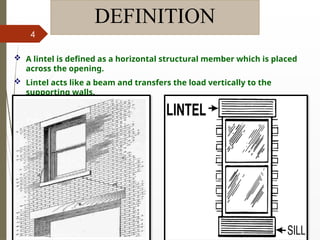
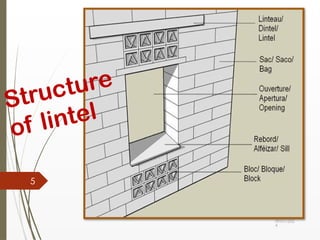
 A lintel is defined as a horizontal structural member which is placed
across the opening.
 Lintel acts like a beam and transfers the load vertically to the
supporting walls.
09/01/202
4
5
Structure
of lintel
09/01/202
4
6
Classification of lintel
Lintels are classified into the following types, according to
the materials of their construction:
 [1] Timber lintels
 [2] Stone lintels
 [3] Brick lintels
 [4] Reinforced Brick lintels
 [5] Steel lintels
 [6] Reinforced cement concrete lintels
09/01/202
4
7
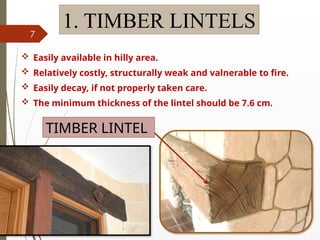
1. TIMBER LINTELS
 Easily available in hilly area.
 Relatively costly, structurally weak and valnerable to fire.
 Easily decay, if not properly taken care.
 The minimum thickness of the lintel should be 7.6 cm.
TIMBER LINTEL
09/01/202
4
8
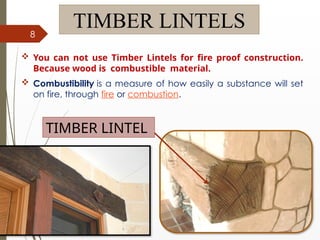
TIMBER LINTELS
 You can not use Timber Lintels for fire proof construction.
Because wood is combustible material.
 Combustibility is a measure of how easily a substance will set
on fire, through fire or combustion.
TIMBER LINTEL
09/01/202
4
9
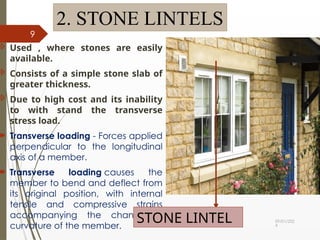
2. STONE LINTELS
 Used , where stones are easily
available.
 Consists of a simple stone slab of
greater thickness.
 Due to high cost and its inability
to with stand the transverse
stress load.
 Transverse loading - Forces applied
perpendicular to the longitudinal
axis of a member.
 Transverse loading causes the
member to bend and deflect from
its original position, with internal
tensile and compressive strains
accompanying the change in
curvature of the member.
STONE LINTEL
09/01/202
4
10
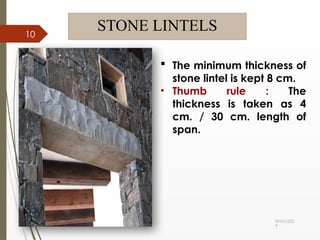
STONE LINTELS
 The minimum thickness of
stone lintel is kept 8 cm.
• Thumb rule : The
thickness is taken as 4
cm. / 30 cm. length of
span.
09/01/202
4
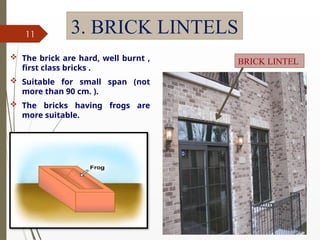
11 3. BRICK LINTELS
 The brick are hard, well burnt ,
first class bricks .
 Suitable for small span (not
more than 90 cm. ).
 The bricks having frogs are
more suitable.
BRICK LINTEL
09/01/202
4
12
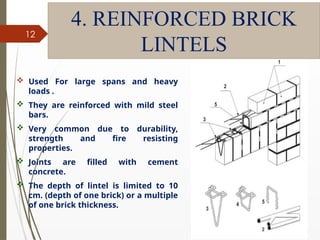
4. REINFORCED BRICK
LINTELS
 Used For large spans and heavy
loads .
 They are reinforced with mild steel
bars.
 Very common due to durability,
strength and fire resisting
properties.
 Joints are filled with cement
concrete.
 The depth of lintel is limited to 10
cm. (depth of one brick) or a multiple

of one brick thickness.
09/01/202
4
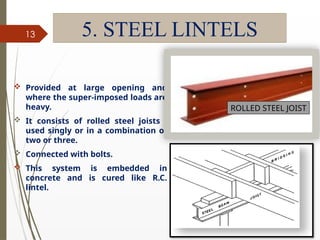
13 5. STEEL LINTELS
 Provided at large opening and
where the super-imposed loads are
heavy.
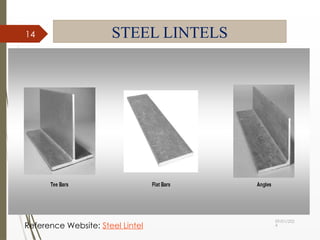
 It consists of rolled steel joists ,
used singly or in a combination of
two or three.
 Connected with bolts.
 This system is embedded in
concrete and is cured like R.C.
lintel.
ROLLED STEEL JOIST
09/01/202
4
14 STEEL LINTELS
Reference Website: Steel Lintel
09/01/202
4
15
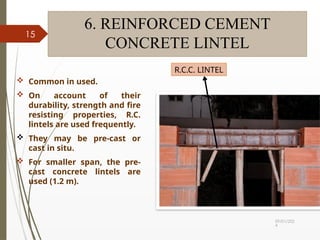
6. REINFORCED CEMENT
CONCRETE LINTEL
 Common in used.
 On account of their
durability, strength and fire
resisting properties, R.C.
lintels are used frequently.
 They may be pre-cast or
cast in situ.
 For smaller span, the pre-
cast concrete lintels are
used (1.2 m).
R.C.C. LINTEL
09/01/202
4
16
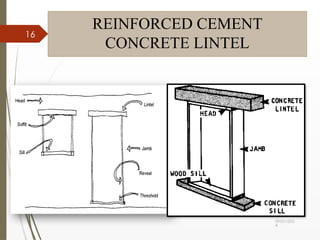
REINFORCED CEMENT
CONCRETE LINTEL
09/01/202
4
17
09/01/202
4
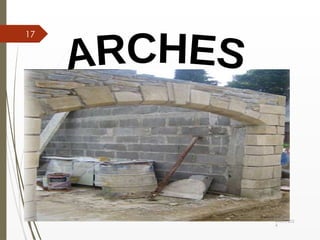
18 ARCHES
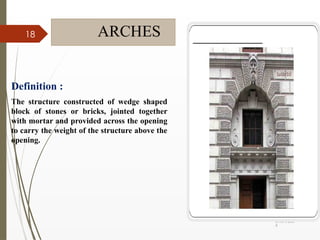
Definition :
The structure constructed of wedge shaped
block of stones or bricks, jointed together
with mortar and provided across the opening
to carry the weight of the structure above the
opening.
09/01/202
4
19
CONSTRUCTION OF AN ARCH
Since it is a pure compression form, the arch is useful because many building
materials, including stone and unreinforced concrete can resist compression but are
weak when tensile stress is applied to them.
An arch is held in place by the weight of all of its members, making construction
problematic. One answer is to build a frame (historically, of wood) which exactly
follows the form of the underside of the arch. This is known as a centre or centering.
The voussoirs are laid on it until the arch is complete and self-supporting. For an arch
higher than head height, scaffolding would in any case be required by the builders,
so the scaffolding can be combined with the arch support. Occasionally arches
would fall down when the frame was removed if construction or planning had been
incorrect. ( The A85 bridge at Dalmally, Scotland suffered this fate on its first attempt,
in the 1940s ). The interior and lower line or curve of an arch is known as the intrados.
Old arches sometimes need reinforcement due to decay of the keystones, forming
what is known as bald arch.
In reinforced concrete construction, the principle of the arch is used so as to benefit
from the concrete's strength in resisting compressive stress. Where any other form of
stress is raised, such as tensile or torsional stress, it has to be resisted by carefully
placed reinforcement rods or fibres.
09/01/202
4
20
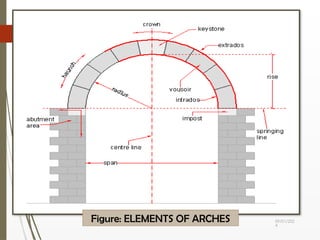
Figure: ELEMENTS OF ARCHES
09/01/202
4
21
TECHNICAL
TERMS
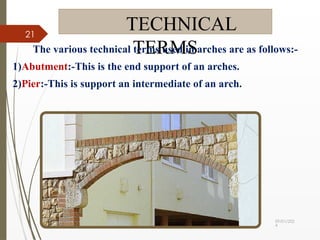
The various technical terms used in arches are as follows:-
1)Abutment:-This is the end support of an arches.
2)Pier:-This is support an intermediate of an arch.
09/01/202
4
22
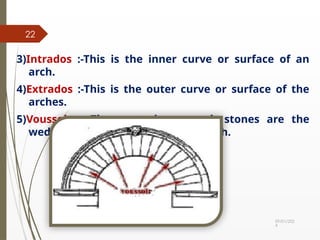
3)Intrados :-This is the inner curve or surface of an
arch.
4)Extrados :-This is the outer curve or surface of the
arches.
5)Voussoirs :-The voussoirs or arch stones are the
wedge shaped units forming the arch.
09/01/202
4
23
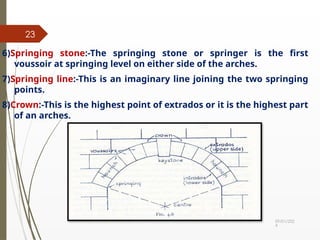
6)Springing stone:-The springing stone or springer is the first
voussoir at springing level on either side of the arches.
7)Springing line:-This is an imaginary line joining the two springing
points.
8)Crown:-This is the highest point of extrados or it is the highest part
of an arches.
09/01/202
4
24
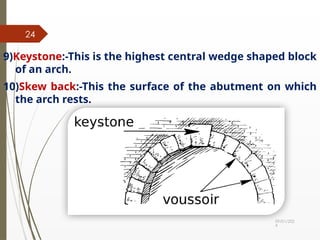
9)Keystone:-This is the highest central wedge shaped block
of an arch.
10)Skew back:-This the surface of the abutment on which
the arch rests.
09/01/202
4
25
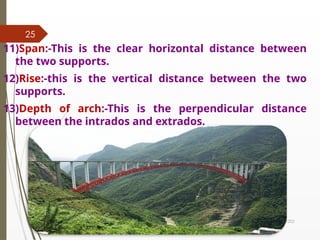
11)Span:-This is the clear horizontal distance between
the two supports.
12)Rise:-this is the vertical distance between the two
supports.
13)Depth of arch:-This is the perpendicular distance
between the intrados and extrados.
09/01/202
4
26
14)Haunch of an arch:-This is the portion of arch
situated centrally between the key and skew
backs.
15)Spandril:-This is the triangular walling
enclosed by the extrados of the arch, a
horizontal line from the crown of the arch and
perpendicular line from the springing of the
outer curves.
09/01/202
4
27
CLASSIFICATION OF ARCHES
09/01/202
4
28
CLASSIFICATION OF
ARCHES
An arch may be classified according to their:
1)Material of construction and workmanship
2)Shape of curve formed by their soffit or
intrados
09/01/202
4
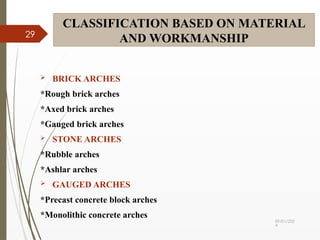
29
 BRICK ARCHES
*Rough brick arches
*Axed brick arches
*Gauged brick arches
 STONE ARCHES
*Rubble arches
*Ashlar arches
 GAUGED ARCHES
*Precast concrete block arches
*Monolithic concrete arches
CLASSIFICATION BASED ON MATERIAL
AND WORKMANSHIP
09/01/202
4
30
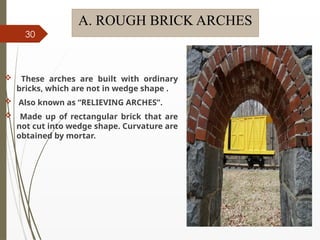
A. ROUGH BRICK ARCHES
 These arches are built with ordinary
bricks, which are not in wedge shape .
 Also known as “RELIEVING ARCHES”.
 Made up of rectangular brick that are
not cut into wedge shape. Curvature are
obtained by mortar.
09/01/202
4
31
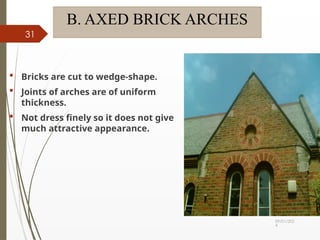
B. AXED BRICK ARCHES
 Bricks are cut to wedge-shape.
 Joints of arches are of uniform
thickness.
 Not dress finely so it does not give
much attractive appearance.
09/01/202
4
32
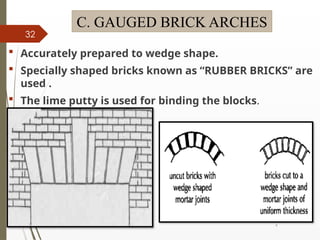
C. GAUGED BRICK ARCHES
 Accurately prepared to wedge shape.
 Specially shaped bricks known as “RUBBER BRICKS” are
used .
 The lime putty is used for binding the blocks.
09/01/202
4
33
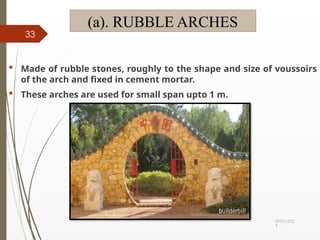
(a). RUBBLE ARCHES
 Made of rubble stones, roughly to the shape and size of voussoirs
of the arch and fixed in cement mortar.
 These arches are used for small span upto 1 m.
09/01/202
4
34
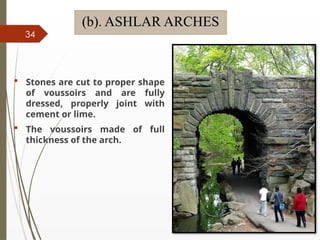
(b). ASHLAR ARCHES
 Stones are cut to proper shape
of voussoirs and are fully
dressed, properly joint with
cement or lime.
 The voussoirs made of full
thickness of the arch.
09/01/202
4
35
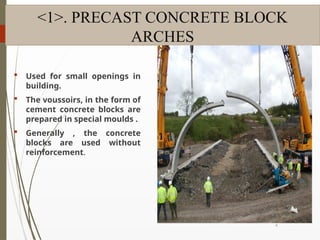
<1>. PRECAST CONCRETE BLOCK
ARCHES
 Used for small openings in
building.
 The voussoirs, in the form of
cement concrete blocks are
prepared in special moulds .
 Generally , the concrete
blocks are used without
reinforcement.
09/01/202
4
36
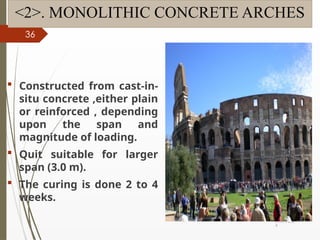
<2>. MONOLITHIC CONCRETE ARCHES
 Constructed from cast-in-
situ concrete ,either plain
or reinforced , depending
upon the span and
magnitude of loading.
 Quit suitable for larger
span (3.0 m).
 The curing is done 2 to 4
weeks.
09/01/202
4
37 Classification According to Shape
Flat arch
Segmental arch
Semi-circular arch
Relieving arch
Dutch or French arch
09/01/202
4
38
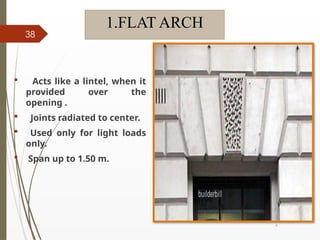
1.FLAT ARCH
 Acts like a lintel, when it
provided over the
opening .
 Joints radiated to center.
 Used only for light loads
only.
 Span up to 1.50 m.
09/01/202
4
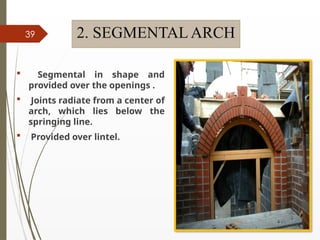
39 2. SEGMENTAL ARCH
 Segmental in shape and
provided over the openings .
 Joints radiate from a center of
arch, which lies below the
springing line.
 Provided over lintel.
09/01/202
4
40
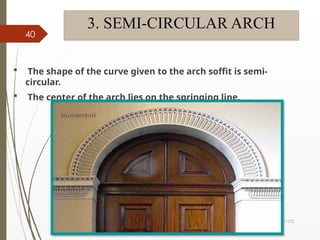
3. SEMI-CIRCULAR ARCH
 The shape of the curve given to the arch soffit is semi-
circular.
 The center of the arch lies on the springing line.
09/01/202
4
41
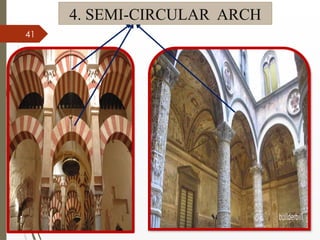
4. SEMI-CIRCULAR ARCH
09/01/202
4
42
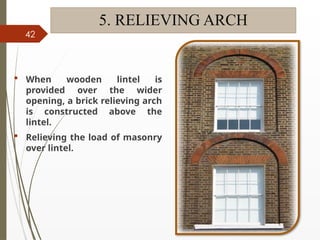
5. RELIEVING ARCH
 When wooden lintel is
provided over the wider
opening, a brick relieving arch
is constructed above the
lintel.
 Relieving the load of masonry
over lintel.
09/01/202
4
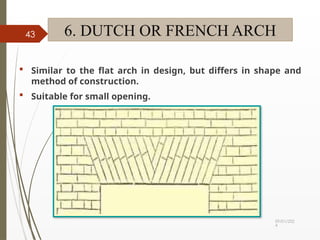
43 6. DUTCH OR FRENCH ARCH
 Similar to the flat arch in design, but differs in shape and
method of construction.
 Suitable for small opening.
09/01/202
4
44 reference
 BOOKS : -“BUILDING CONSTRUCTION” by
A.S.Kotadia ( mahajan publication)
-B.C.POONMIA
 INTERNET : - www.google.com
09/01/202
4
45

Lintel and Arches Interrior details arches

  • 1.
    09/01/202 4 1 LINTELS AND ARCHES Preparedby: S. M. Rahat Rahman Faculty Member Port City International University
  • 2.
    09/01/202 4 2 LINTELS • Introduction • Classificationof lintels ARCHES • Arches : Terms to be used • Classification of an arches TOPICS TO BE COVERED
  • 3.
  • 4.
    09/01/202 4 4 DEFINITION  A lintelis defined as a horizontal structural member which is placed across the opening.  Lintel acts like a beam and transfers the load vertically to the supporting walls.
  • 5.
  • 6.
    09/01/202 4 6 Classification of lintel Lintelsare classified into the following types, according to the materials of their construction:  [1] Timber lintels  [2] Stone lintels  [3] Brick lintels  [4] Reinforced Brick lintels  [5] Steel lintels  [6] Reinforced cement concrete lintels
  • 7.
    09/01/202 4 7 1. TIMBER LINTELS Easily available in hilly area.  Relatively costly, structurally weak and valnerable to fire.  Easily decay, if not properly taken care.  The minimum thickness of the lintel should be 7.6 cm. TIMBER LINTEL
  • 8.
    09/01/202 4 8 TIMBER LINTELS  Youcan not use Timber Lintels for fire proof construction. Because wood is combustible material.  Combustibility is a measure of how easily a substance will set on fire, through fire or combustion. TIMBER LINTEL
  • 9.
    09/01/202 4 9 2. STONE LINTELS Used , where stones are easily available.  Consists of a simple stone slab of greater thickness.  Due to high cost and its inability to with stand the transverse stress load.  Transverse loading - Forces applied perpendicular to the longitudinal axis of a member.  Transverse loading causes the member to bend and deflect from its original position, with internal tensile and compressive strains accompanying the change in curvature of the member. STONE LINTEL
  • 10.
    09/01/202 4 10 STONE LINTELS  Theminimum thickness of stone lintel is kept 8 cm. • Thumb rule : The thickness is taken as 4 cm. / 30 cm. length of span.
  • 11.
    09/01/202 4 11 3. BRICKLINTELS  The brick are hard, well burnt , first class bricks .  Suitable for small span (not more than 90 cm. ).  The bricks having frogs are more suitable. BRICK LINTEL
  • 12.
    09/01/202 4 12 4. REINFORCED BRICK LINTELS Used For large spans and heavy loads .  They are reinforced with mild steel bars.  Very common due to durability, strength and fire resisting properties.  Joints are filled with cement concrete.  The depth of lintel is limited to 10 cm. (depth of one brick) or a multiple of one brick thickness.
  • 13.
    09/01/202 4 13 5. STEELLINTELS  Provided at large opening and where the super-imposed loads are heavy.  It consists of rolled steel joists , used singly or in a combination of two or three.  Connected with bolts.  This system is embedded in concrete and is cured like R.C. lintel. ROLLED STEEL JOIST
  • 14.
  • 15.
    09/01/202 4 15 6. REINFORCED CEMENT CONCRETELINTEL  Common in used.  On account of their durability, strength and fire resisting properties, R.C. lintels are used frequently.  They may be pre-cast or cast in situ.  For smaller span, the pre- cast concrete lintels are used (1.2 m). R.C.C. LINTEL
  • 16.
  • 17.
  • 18.
    09/01/202 4 18 ARCHES Definition : Thestructure constructed of wedge shaped block of stones or bricks, jointed together with mortar and provided across the opening to carry the weight of the structure above the opening.
  • 19.
    09/01/202 4 19 CONSTRUCTION OF ANARCH Since it is a pure compression form, the arch is useful because many building materials, including stone and unreinforced concrete can resist compression but are weak when tensile stress is applied to them. An arch is held in place by the weight of all of its members, making construction problematic. One answer is to build a frame (historically, of wood) which exactly follows the form of the underside of the arch. This is known as a centre or centering. The voussoirs are laid on it until the arch is complete and self-supporting. For an arch higher than head height, scaffolding would in any case be required by the builders, so the scaffolding can be combined with the arch support. Occasionally arches would fall down when the frame was removed if construction or planning had been incorrect. ( The A85 bridge at Dalmally, Scotland suffered this fate on its first attempt, in the 1940s ). The interior and lower line or curve of an arch is known as the intrados. Old arches sometimes need reinforcement due to decay of the keystones, forming what is known as bald arch. In reinforced concrete construction, the principle of the arch is used so as to benefit from the concrete's strength in resisting compressive stress. Where any other form of stress is raised, such as tensile or torsional stress, it has to be resisted by carefully placed reinforcement rods or fibres.
  • 20.
  • 21.
    09/01/202 4 21 TECHNICAL TERMS The various technicalterms used in arches are as follows:- 1)Abutment:-This is the end support of an arches. 2)Pier:-This is support an intermediate of an arch.
  • 22.
    09/01/202 4 22 3)Intrados :-This isthe inner curve or surface of an arch. 4)Extrados :-This is the outer curve or surface of the arches. 5)Voussoirs :-The voussoirs or arch stones are the wedge shaped units forming the arch.
  • 23.
    09/01/202 4 23 6)Springing stone:-The springingstone or springer is the first voussoir at springing level on either side of the arches. 7)Springing line:-This is an imaginary line joining the two springing points. 8)Crown:-This is the highest point of extrados or it is the highest part of an arches.
  • 24.
    09/01/202 4 24 9)Keystone:-This is thehighest central wedge shaped block of an arch. 10)Skew back:-This the surface of the abutment on which the arch rests.
  • 25.
    09/01/202 4 25 11)Span:-This is theclear horizontal distance between the two supports. 12)Rise:-this is the vertical distance between the two supports. 13)Depth of arch:-This is the perpendicular distance between the intrados and extrados.
  • 26.
    09/01/202 4 26 14)Haunch of anarch:-This is the portion of arch situated centrally between the key and skew backs. 15)Spandril:-This is the triangular walling enclosed by the extrados of the arch, a horizontal line from the crown of the arch and perpendicular line from the springing of the outer curves.
  • 27.
  • 28.
    09/01/202 4 28 CLASSIFICATION OF ARCHES An archmay be classified according to their: 1)Material of construction and workmanship 2)Shape of curve formed by their soffit or intrados
  • 29.
    09/01/202 4 29  BRICK ARCHES *Roughbrick arches *Axed brick arches *Gauged brick arches  STONE ARCHES *Rubble arches *Ashlar arches  GAUGED ARCHES *Precast concrete block arches *Monolithic concrete arches CLASSIFICATION BASED ON MATERIAL AND WORKMANSHIP
  • 30.
    09/01/202 4 30 A. ROUGH BRICKARCHES  These arches are built with ordinary bricks, which are not in wedge shape .  Also known as “RELIEVING ARCHES”.  Made up of rectangular brick that are not cut into wedge shape. Curvature are obtained by mortar.
  • 31.
    09/01/202 4 31 B. AXED BRICKARCHES  Bricks are cut to wedge-shape.  Joints of arches are of uniform thickness.  Not dress finely so it does not give much attractive appearance.
  • 32.
    09/01/202 4 32 C. GAUGED BRICKARCHES  Accurately prepared to wedge shape.  Specially shaped bricks known as “RUBBER BRICKS” are used .  The lime putty is used for binding the blocks.
  • 33.
    09/01/202 4 33 (a). RUBBLE ARCHES Made of rubble stones, roughly to the shape and size of voussoirs of the arch and fixed in cement mortar.  These arches are used for small span upto 1 m.
  • 34.
    09/01/202 4 34 (b). ASHLAR ARCHES Stones are cut to proper shape of voussoirs and are fully dressed, properly joint with cement or lime.  The voussoirs made of full thickness of the arch.
  • 35.
    09/01/202 4 35 <1>. PRECAST CONCRETEBLOCK ARCHES  Used for small openings in building.  The voussoirs, in the form of cement concrete blocks are prepared in special moulds .  Generally , the concrete blocks are used without reinforcement.
  • 36.
    09/01/202 4 36 <2>. MONOLITHIC CONCRETEARCHES  Constructed from cast-in- situ concrete ,either plain or reinforced , depending upon the span and magnitude of loading.  Quit suitable for larger span (3.0 m).  The curing is done 2 to 4 weeks.
  • 37.
    09/01/202 4 37 Classification Accordingto Shape Flat arch Segmental arch Semi-circular arch Relieving arch Dutch or French arch
  • 38.
    09/01/202 4 38 1.FLAT ARCH  Actslike a lintel, when it provided over the opening .  Joints radiated to center.  Used only for light loads only.  Span up to 1.50 m.
  • 39.
    09/01/202 4 39 2. SEGMENTALARCH  Segmental in shape and provided over the openings .  Joints radiate from a center of arch, which lies below the springing line.  Provided over lintel.
  • 40.
    09/01/202 4 40 3. SEMI-CIRCULAR ARCH The shape of the curve given to the arch soffit is semi- circular.  The center of the arch lies on the springing line.
  • 41.
  • 42.
    09/01/202 4 42 5. RELIEVING ARCH When wooden lintel is provided over the wider opening, a brick relieving arch is constructed above the lintel.  Relieving the load of masonry over lintel.
  • 43.
    09/01/202 4 43 6. DUTCHOR FRENCH ARCH  Similar to the flat arch in design, but differs in shape and method of construction.  Suitable for small opening.
  • 44.
    09/01/202 4 44 reference  BOOKS: -“BUILDING CONSTRUCTION” by A.S.Kotadia ( mahajan publication) -B.C.POONMIA  INTERNET : - www.google.com
  • 45.