LING on MIPS architecture
Cloudozer, 26 Jun 2015
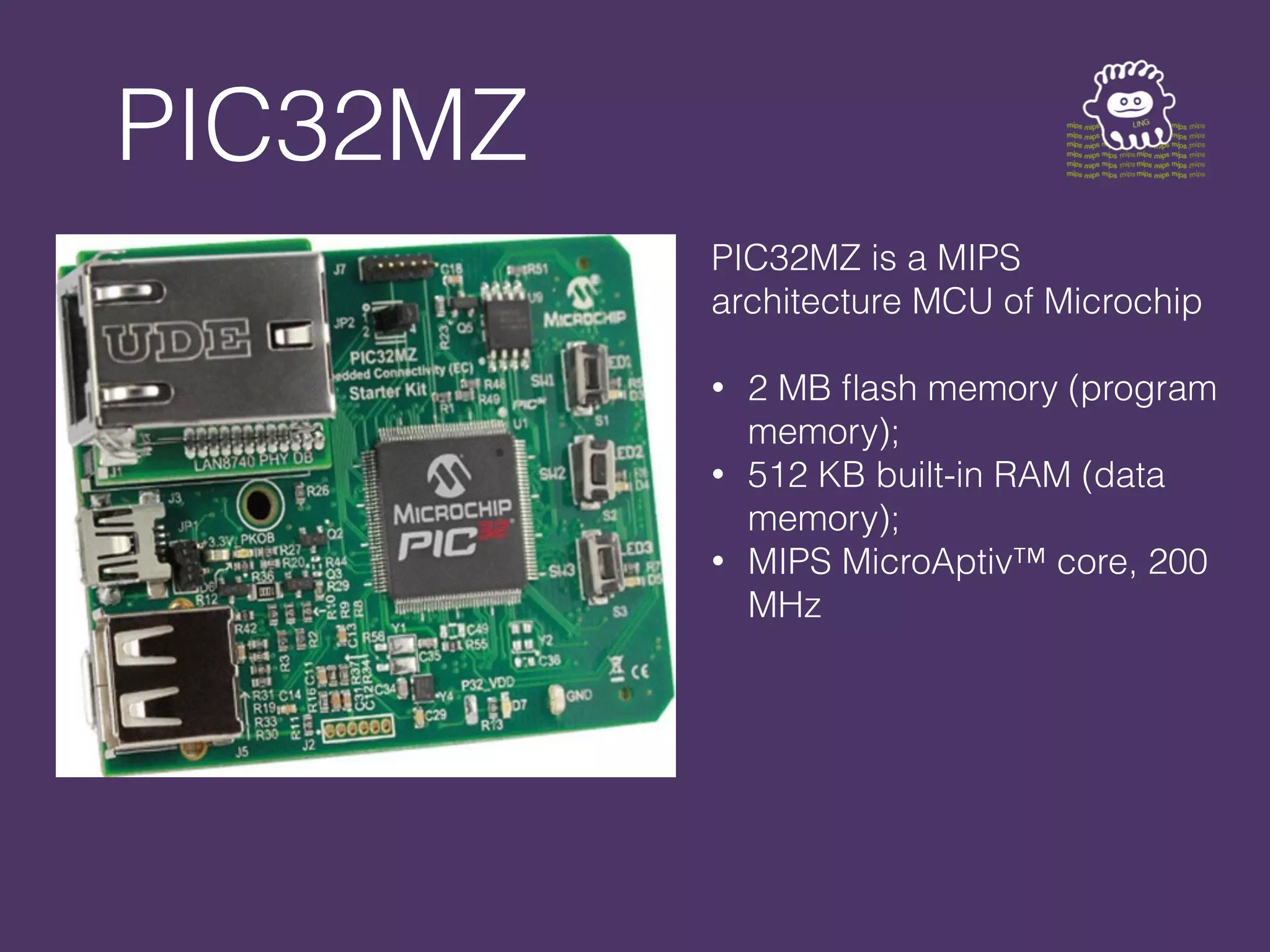
PIC32MZ
PIC32MZ is a MIPS
architecture MCU of Microchip
• 2 MB flash memory (program
memory);
• 512 KB built-in RAM (data
memory);
• MIPS MicroAptiv™ core, 200
MHz
LING: porting


https://github.com/EarlGray/ling
• LING core without libraries: 36 kloc of C code;
• Different toolchain: xc32-gcc; we have to flash an IHEX
image to a microcontroller to run the VM or to simulate
PIC32 using MPLABX IDE tools.
• the xc32 toolchain and its header files 

do not support C99 properly; 

moved to C89 (mostly correcting 

variable declarations in for clauses);
LING: porting
• Platform-specific parts have already been separated in
LING code (mostly), but the core code still needed some
adjusting like #ifdef-ing LWIP calls and changing C99
code to C89;
• The platform-specific code has been mostly rewritten
(~600 loc);
• There are numerous stubs at the moment: fake timers,
bif_not_implemented for regular expression 

BIFs, stubs for MD5 and SHA BIFs; 

domain_poweroff() just hangs 

the processor; there are fake Nettle

and LWIP headers to get the VM 

compiled.
LING: I/O
• MPLABX debug output support is unstable (it works for
some PIC32 models and does not for others), can’t be
used in a simulator);
• Initially used a ring buffer in memory for logging +
debugger;
• we have an UART driver now for debug output; 

thanks a lot to Serge Vakulenko’s 

work on PIC32 emulation in Qemu

and his LiteBSD source code;
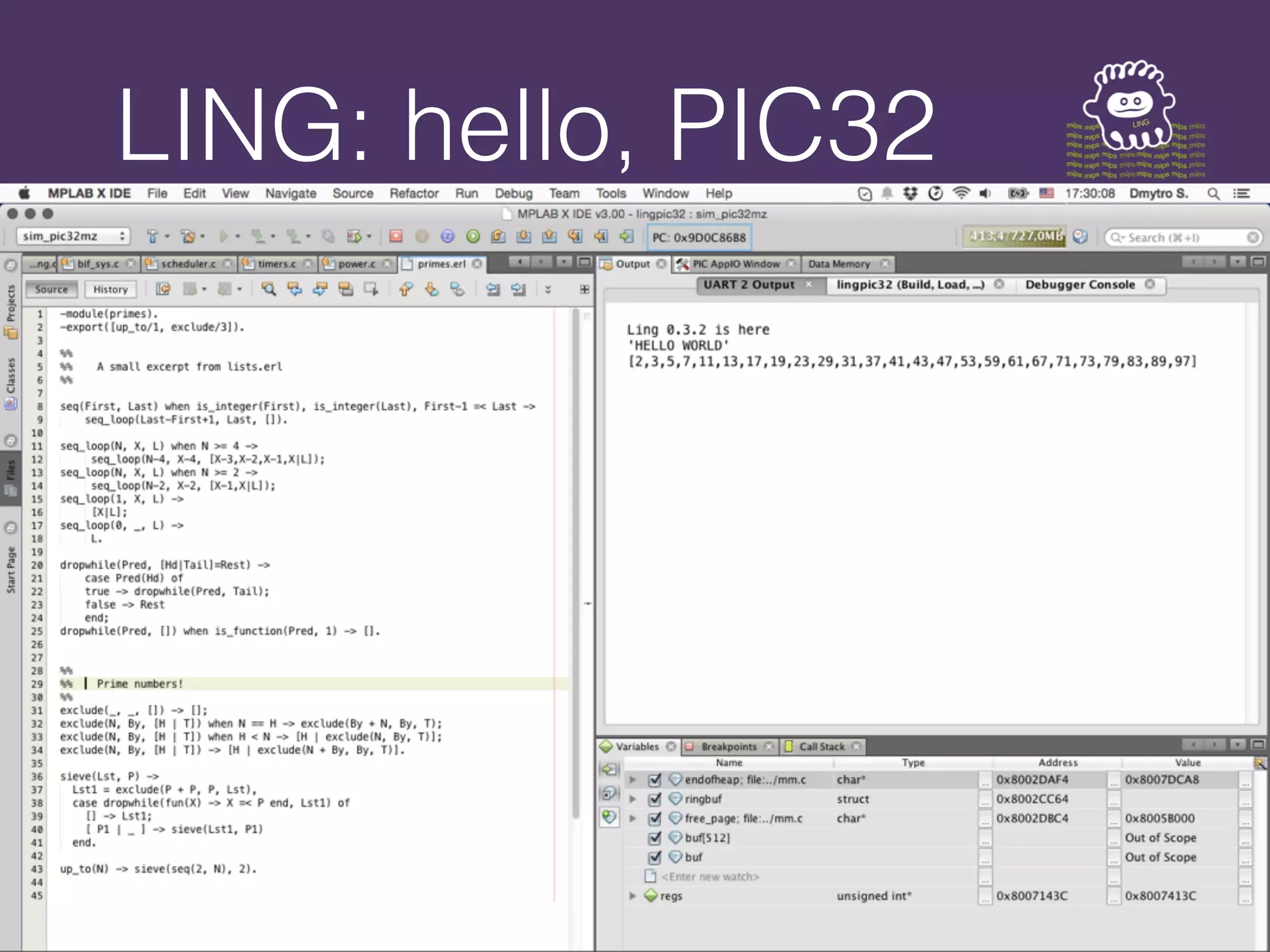
LING: hello, PIC32
LING: our plans
• Making it work properly: real timers, I/O, power
management, crypto; improving GC for PIC32;
• support for Erlang stdlib and loadable LING modules; 9p;
• optimizing memory usage; at the moment:

Data RAM: 46 memory pages used at startup out of 128;

Program RAM: 1.1 MB out of 2 MB;
• A testbed for driver construction in Erlang;
• An Ethernet driver in Erlang;

Ling on PIC32 microcontroller

  • 1.
    LING on MIPSarchitecture Cloudozer, 26 Jun 2015
  • 2.
    PIC32MZ PIC32MZ is aMIPS architecture MCU of Microchip • 2 MB flash memory (program memory); • 512 KB built-in RAM (data memory); • MIPS MicroAptiv™ core, 200 MHz
  • 3.
    LING: porting 
 https://github.com/EarlGray/ling • LINGcore without libraries: 36 kloc of C code; • Different toolchain: xc32-gcc; we have to flash an IHEX image to a microcontroller to run the VM or to simulate PIC32 using MPLABX IDE tools. • the xc32 toolchain and its header files 
 do not support C99 properly; 
 moved to C89 (mostly correcting 
 variable declarations in for clauses);
  • 4.
    LING: porting • Platform-specificparts have already been separated in LING code (mostly), but the core code still needed some adjusting like #ifdef-ing LWIP calls and changing C99 code to C89; • The platform-specific code has been mostly rewritten (~600 loc); • There are numerous stubs at the moment: fake timers, bif_not_implemented for regular expression 
 BIFs, stubs for MD5 and SHA BIFs; 
 domain_poweroff() just hangs 
 the processor; there are fake Nettle
 and LWIP headers to get the VM 
 compiled.
  • 5.
    LING: I/O • MPLABXdebug output support is unstable (it works for some PIC32 models and does not for others), can’t be used in a simulator); • Initially used a ring buffer in memory for logging + debugger; • we have an UART driver now for debug output; 
 thanks a lot to Serge Vakulenko’s 
 work on PIC32 emulation in Qemu
 and his LiteBSD source code;
  • 6.
  • 7.
    LING: our plans •Making it work properly: real timers, I/O, power management, crypto; improving GC for PIC32; • support for Erlang stdlib and loadable LING modules; 9p; • optimizing memory usage; at the moment:
 Data RAM: 46 memory pages used at startup out of 128;
 Program RAM: 1.1 MB out of 2 MB; • A testbed for driver construction in Erlang; • An Ethernet driver in Erlang;