Dr A Sahu
Dept of Computer Science &
Engineering
IIT Guwahati
• Review of 8086 Architecture
– Block diagram (Data Path)
• Similarity with x86 (i386, Pentium, etc)
– Very IMP for interview/knowledge
– Not part of Examination
• x86 Assembly language program
– Memory model
– Example programs
– Data Segment
– Loop and Nested Loop
• Next Class: Detail of assembly language
– Summary of 8085/8086/i386 Arch & programming
• 16 bit Microprocessor
• All internal registers as well as internal and
external data buses were 16 bits wide
• 4 Main Register, 4 Index Register, 4 Segment
Register, Status Reg, Instr Ptr.
• Not compatible with 8085, but with successors
• Two Unit works in parallel:
– Bus Interface Unit (BIU)
– Execution Unit (EI)
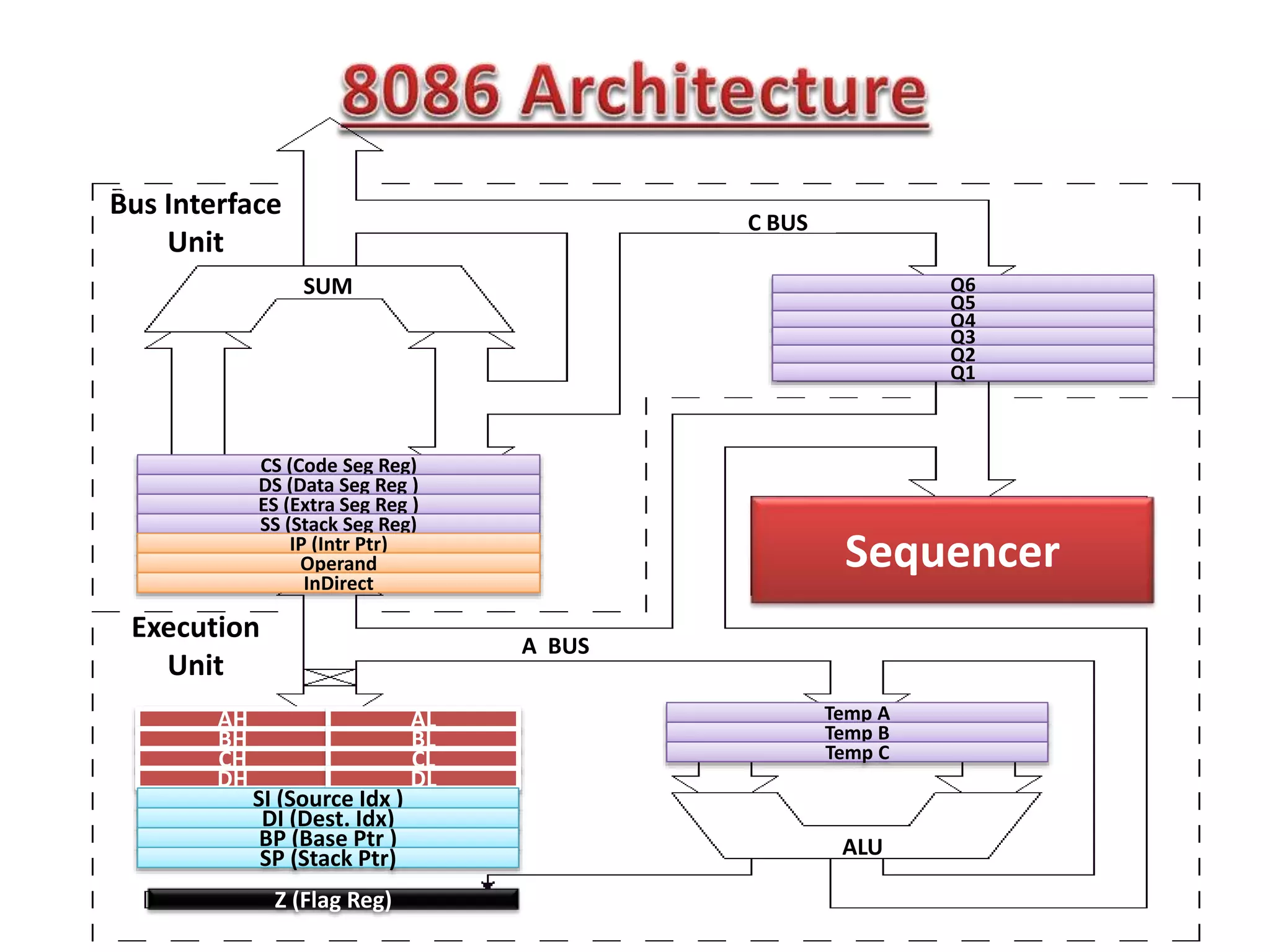
AH AL
BH BL
CH CL
DH DL
SI (Source Idx )
DI (Dest. Idx)
BP (Base Ptr )
SP (Stack Ptr)
Z (Flag Reg)
CS (Code Seg Reg)
DS (Data Seg Reg )
ES (Extra Seg Reg )
SS (Stack Seg Reg)
IP (Intr Ptr)
Operand
InDirect
Temp A
Temp B
Temp C
Q6
Q5
Q4
Q3
Q2
Q1
Sequencer
Bus Interface
Unit
Execution
Unit
SUM
C BUS
A BUS
ALU
• Execution Unit :
– ALU may be loaded from three temp registers (TMPA, TMPB,
TMPC)
– Execute operations on bytes or 16-bit words.
– The result stored into temp reg or registers connected to the
internal data bus.
• Bus Interface Unit
– BIU is intended to compute the addresses.
– Two temporary registers
– indirect addressing
– four segment registers (DS, CS, SS and ES),
– Program counter (IP - Instruction Pointer),
– A 6-byte Queue Buffer to store the pre-fetched opcodes and data.
– This Prefetch Queue optimize the bus usage.
– To execute a jump instruction the queue has to be flushed since the
pre-fetched instructions do not have to be executed.
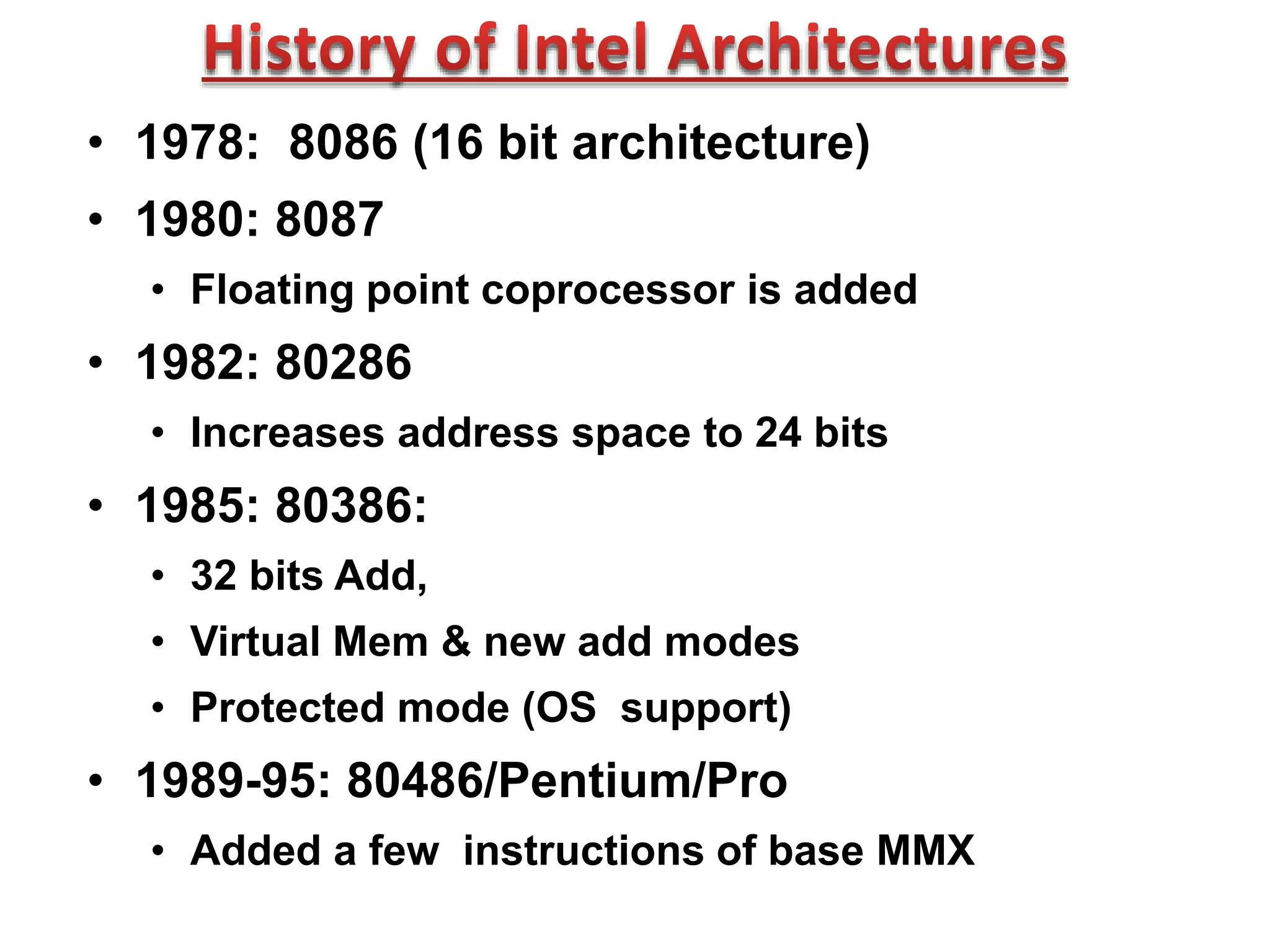
• 1978: 8086 (16 bit architecture)
• 1980: 8087
• Floating point coprocessor is added
• 1982: 80286
• Increases address space to 24 bits
• 1985: 80386:
• 32 bits Add,
• Virtual Mem & new add modes
• Protected mode (OS support)
• 1989-95: 80486/Pentium/Pro
• Added a few instructions of base MMX
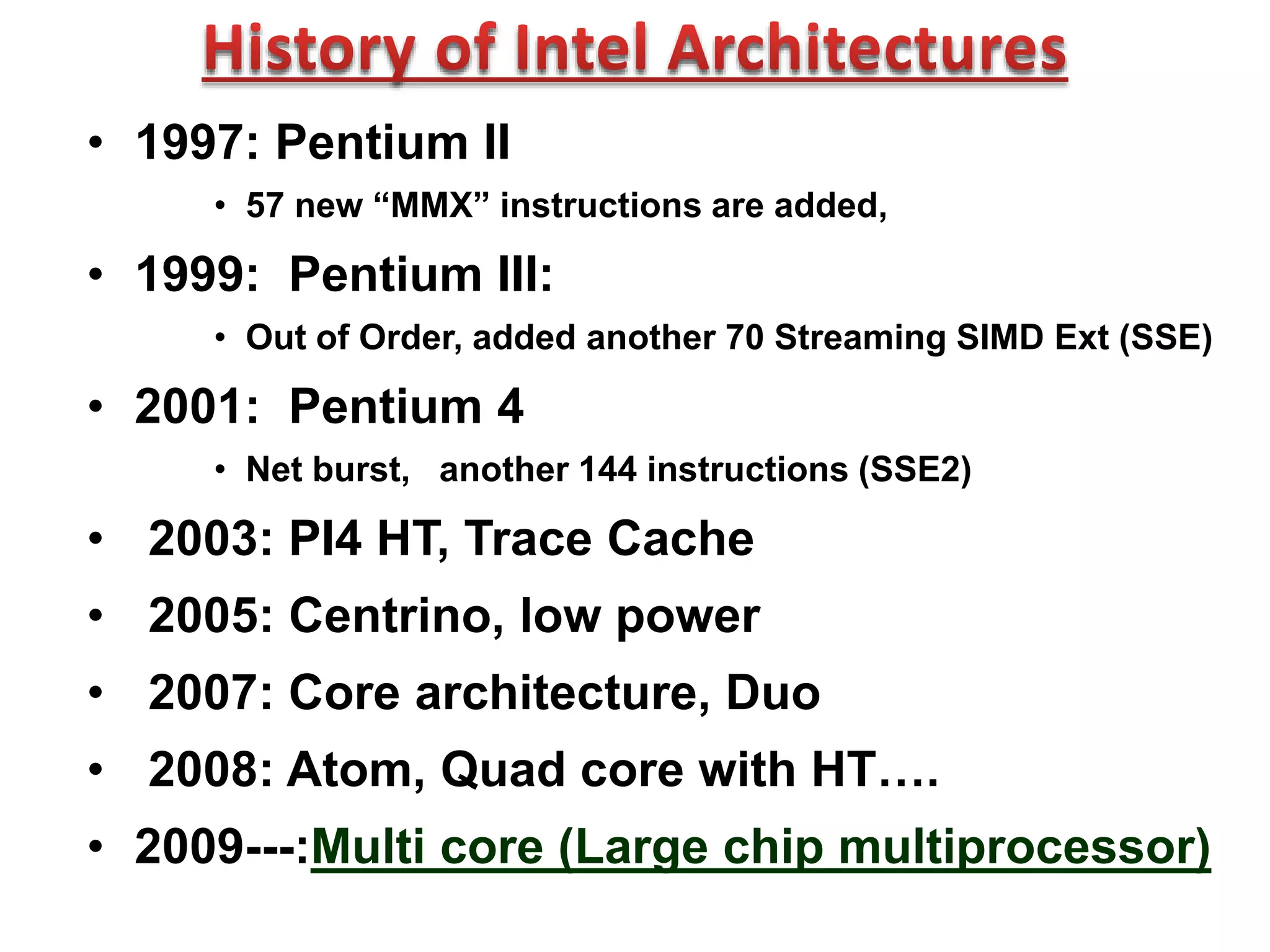
• 1997: Pentium II
• 57 new “MMX” instructions are added,
• 1999: Pentium III:
• Out of Order, added another 70 Streaming SIMD Ext (SSE)
• 2001: Pentium 4
• Net burst, another 144 instructions (SSE2)
• 2003: PI4 HT, Trace Cache
• 2005: Centrino, low power
• 2007: Core architecture, Duo
• 2008: Atom, Quad core with HT….
• 2009---:Multi core (Large chip multiprocessor)
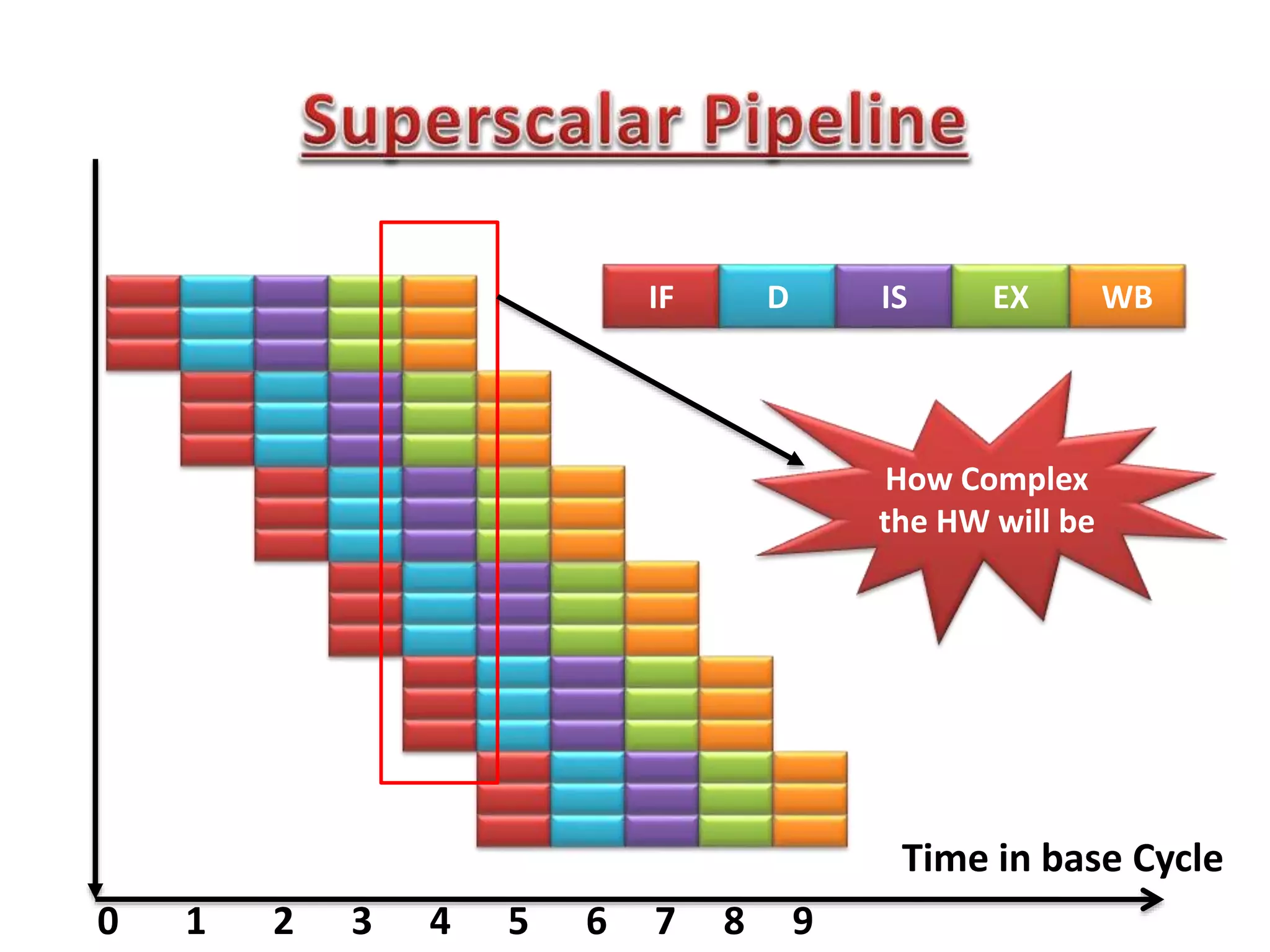
IF
Time in base Cycle
0 1 2 3 4 5 6 7 8 9
D IS WBEX
How Complex
the HW will be
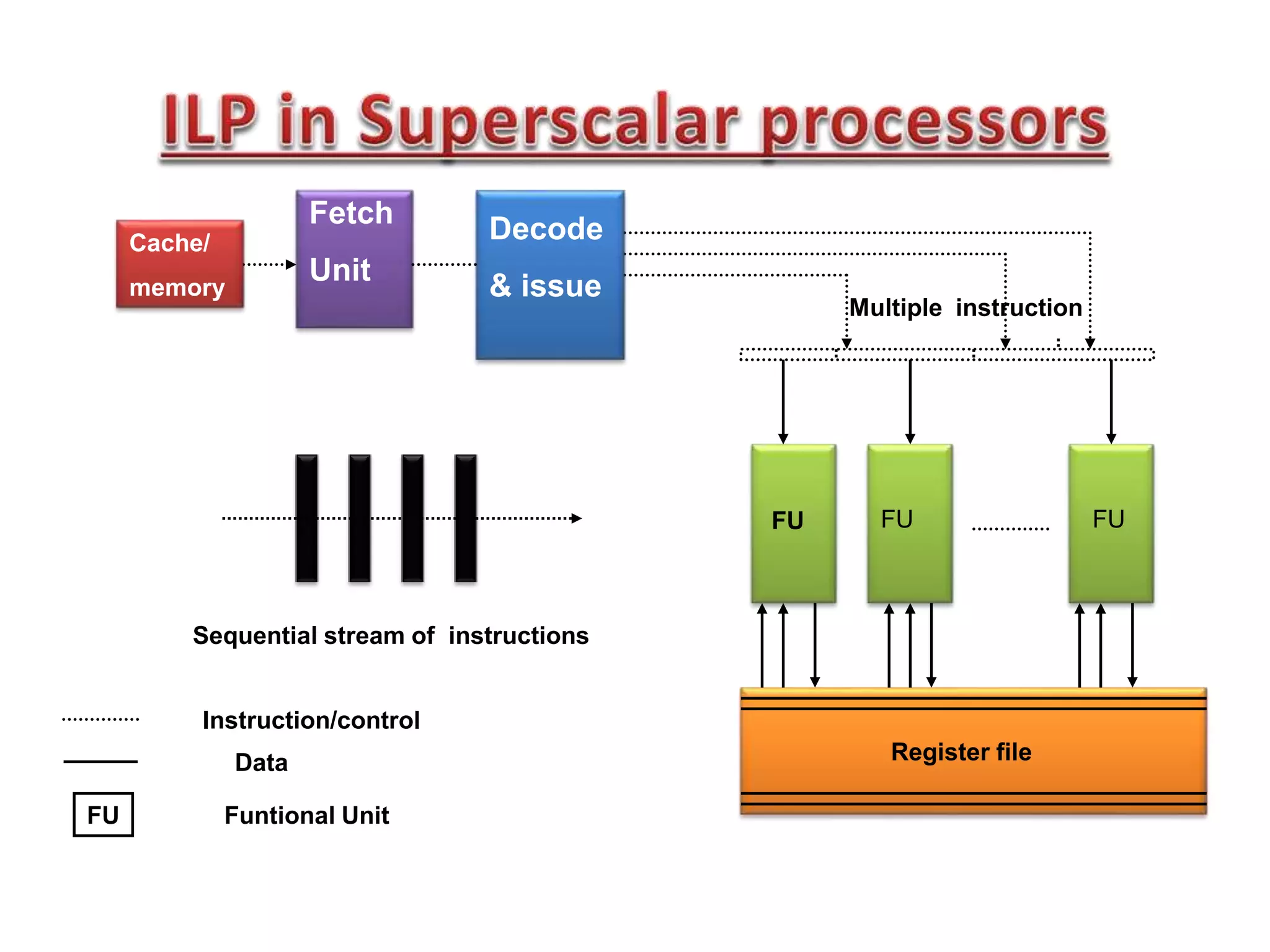
Fetch
Unit
Cache/
memory
Multiple instruction
Sequential stream of instructions
FU FU FU
Register file
Decode
& issue
Instruction/control
Data
FU Funtional Unit
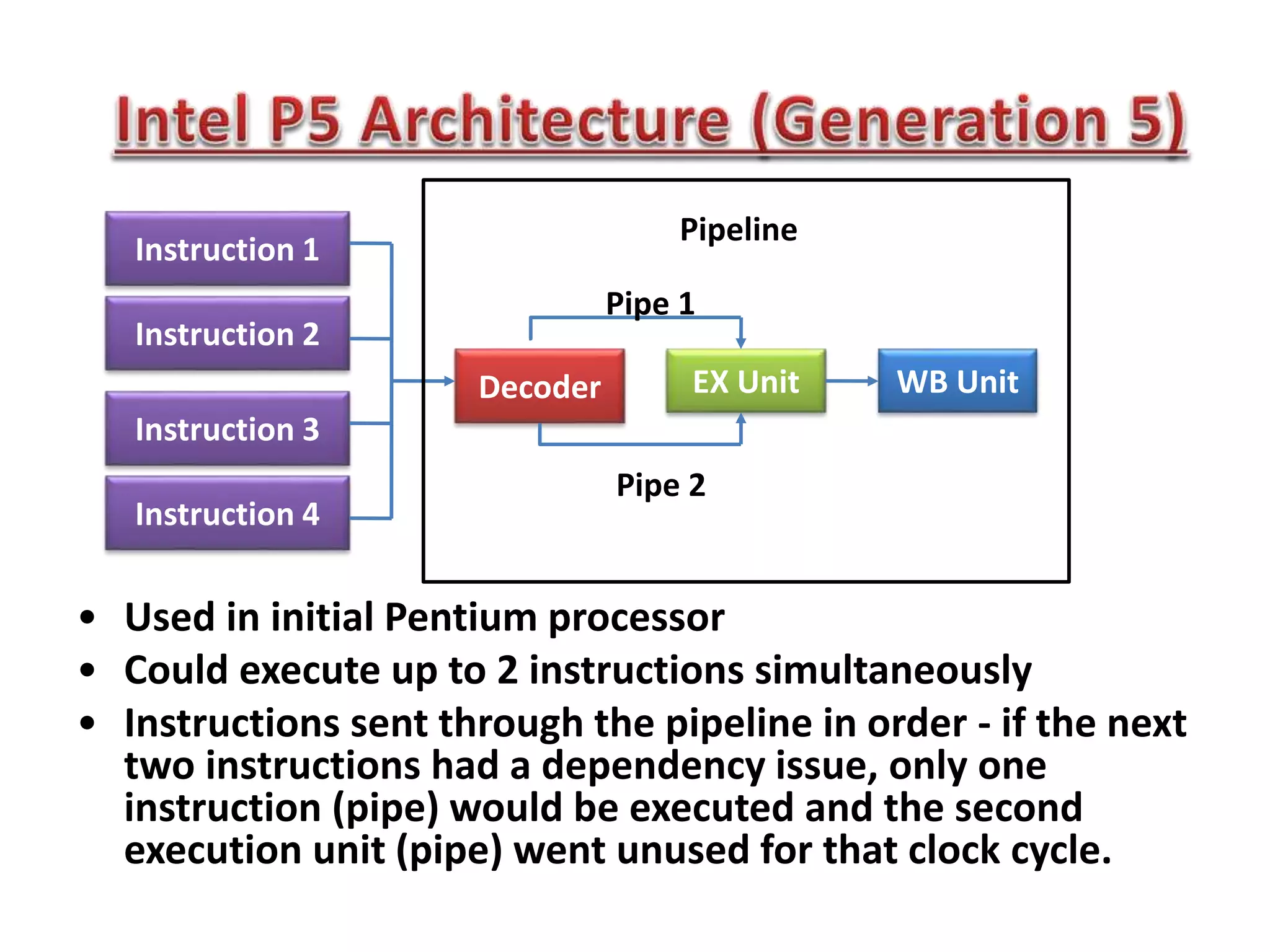
Instruction 1
Instruction 2
Instruction 3
Instruction 4
Decoder EX Unit WB Unit
Pipeline
Pipe 1
Pipe 2
• Used in initial Pentium processor
• Could execute up to 2 instructions simultaneously
• Instructions sent through the pipeline in order - if the next
two instructions had a dependency issue, only one
instruction (pipe) would be executed and the second
execution unit (pipe) went unused for that clock cycle.
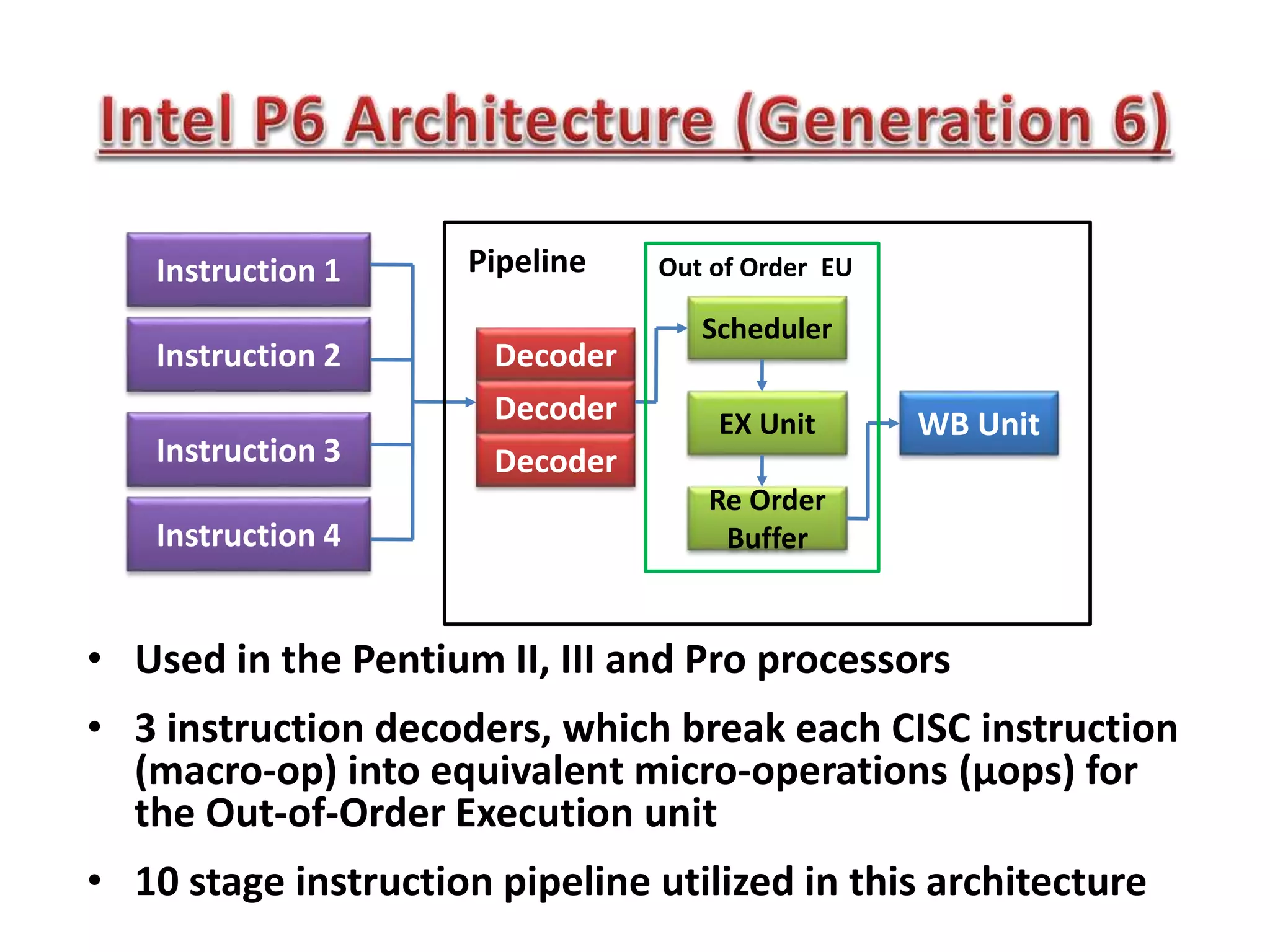
Instruction 1
Instruction 2
Instruction 3
Instruction 4
Pipeline
Decoder
Decoder
Decoder
WB Unit
Scheduler
EX Unit
Re Order
Buffer
Out of Order EU
• Used in the Pentium II, III and Pro processors
• 3 instruction decoders, which break each CISC instruction
(macro-op) into equivalent micro-operations (µops) for
the Out-of-Order Execution unit
• 10 stage instruction pipeline utilized in this architecture
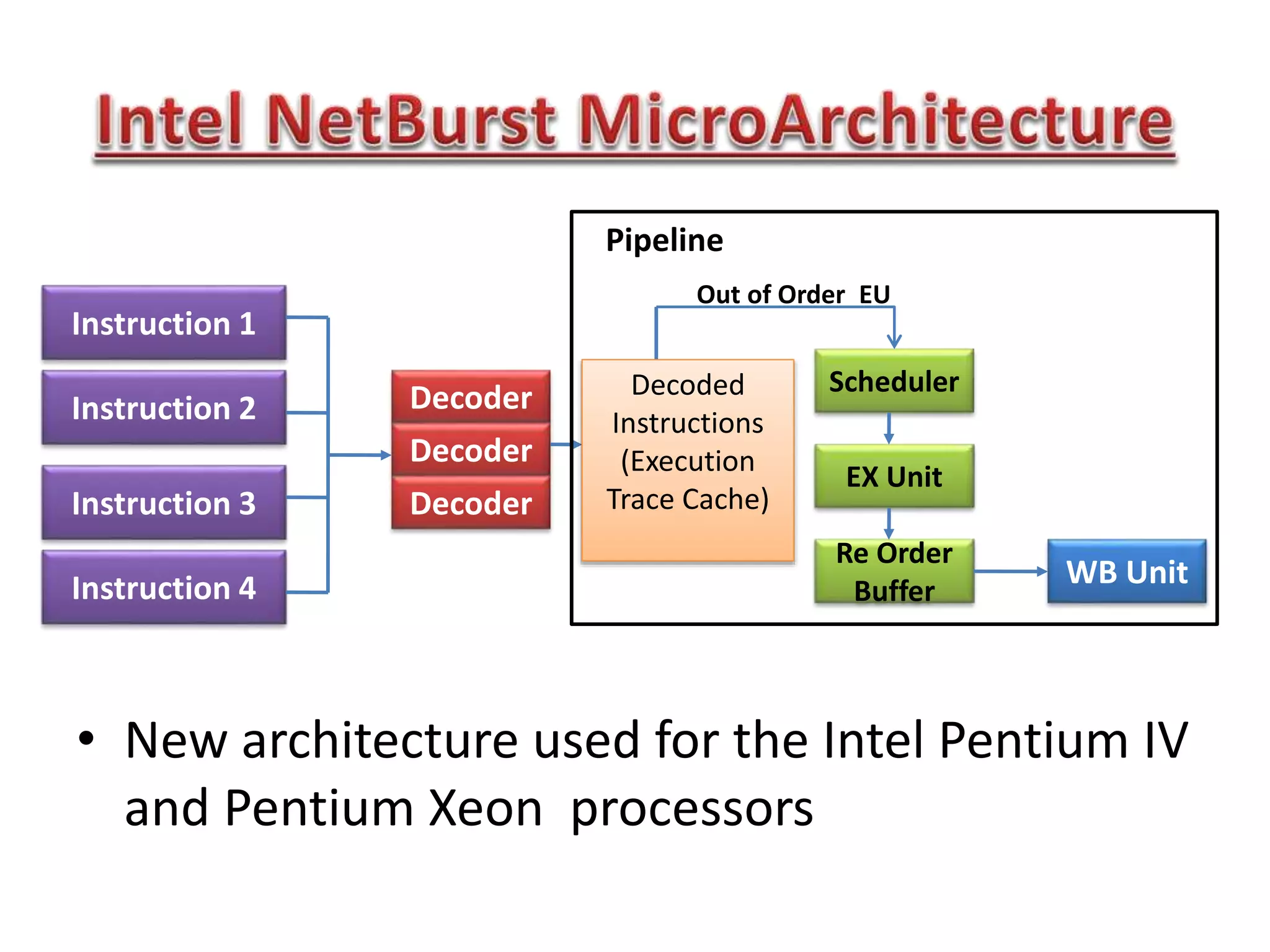
Instruction 1
Instruction 2
Instruction 3
Instruction 4
Decoder
Decoder
Decoder
Scheduler
EX Unit
Re Order
Buffer
WB Unit
Decoded
Instructions
(Execution
Trace Cache)
• New architecture used for the Intel Pentium IV
and Pentium Xeon processors
Pipeline
Out of Order EU
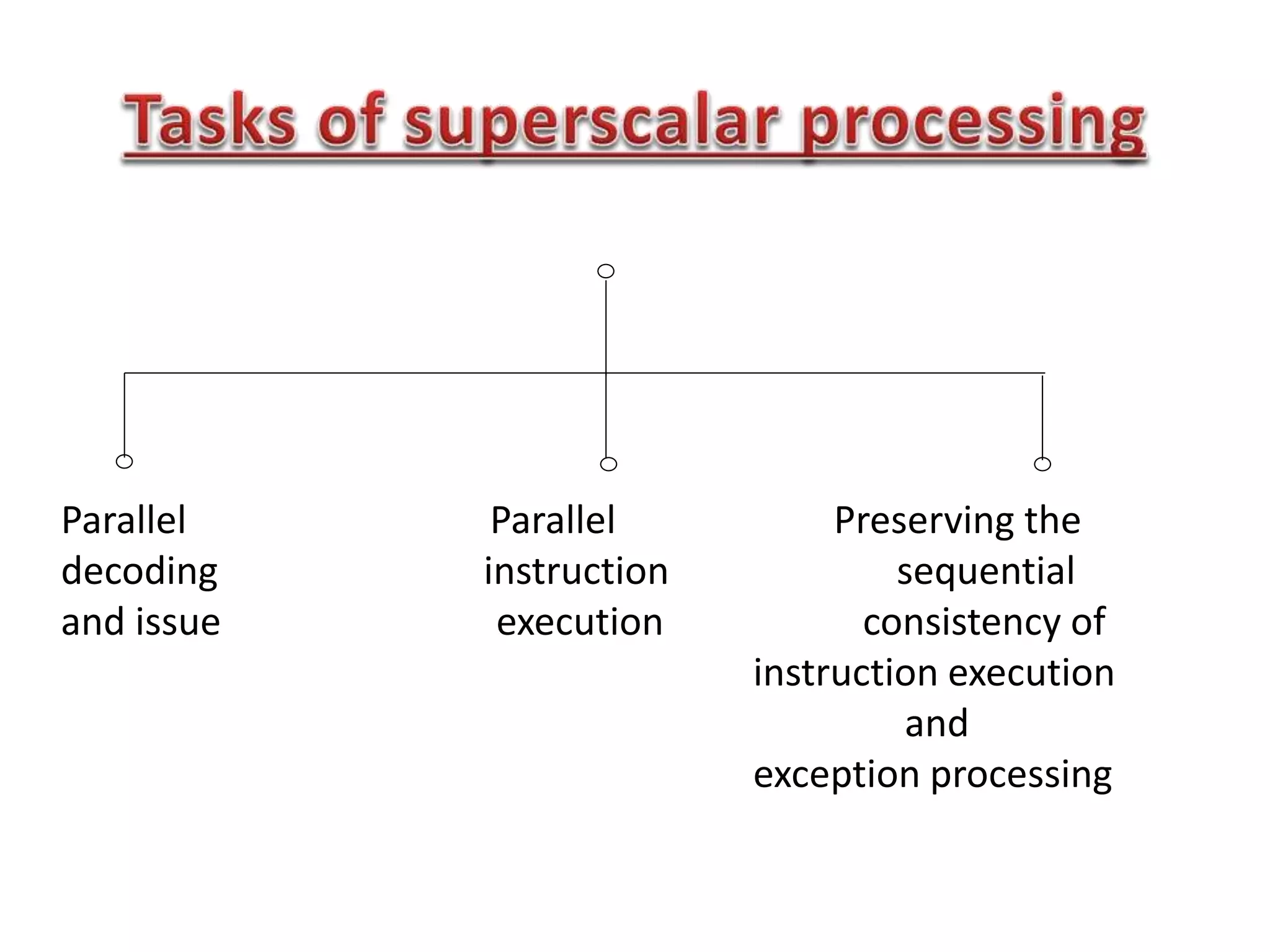
Parallel Parallel Preserving the
decoding instruction sequential
and issue execution consistency of
instruction execution
and
exception processing
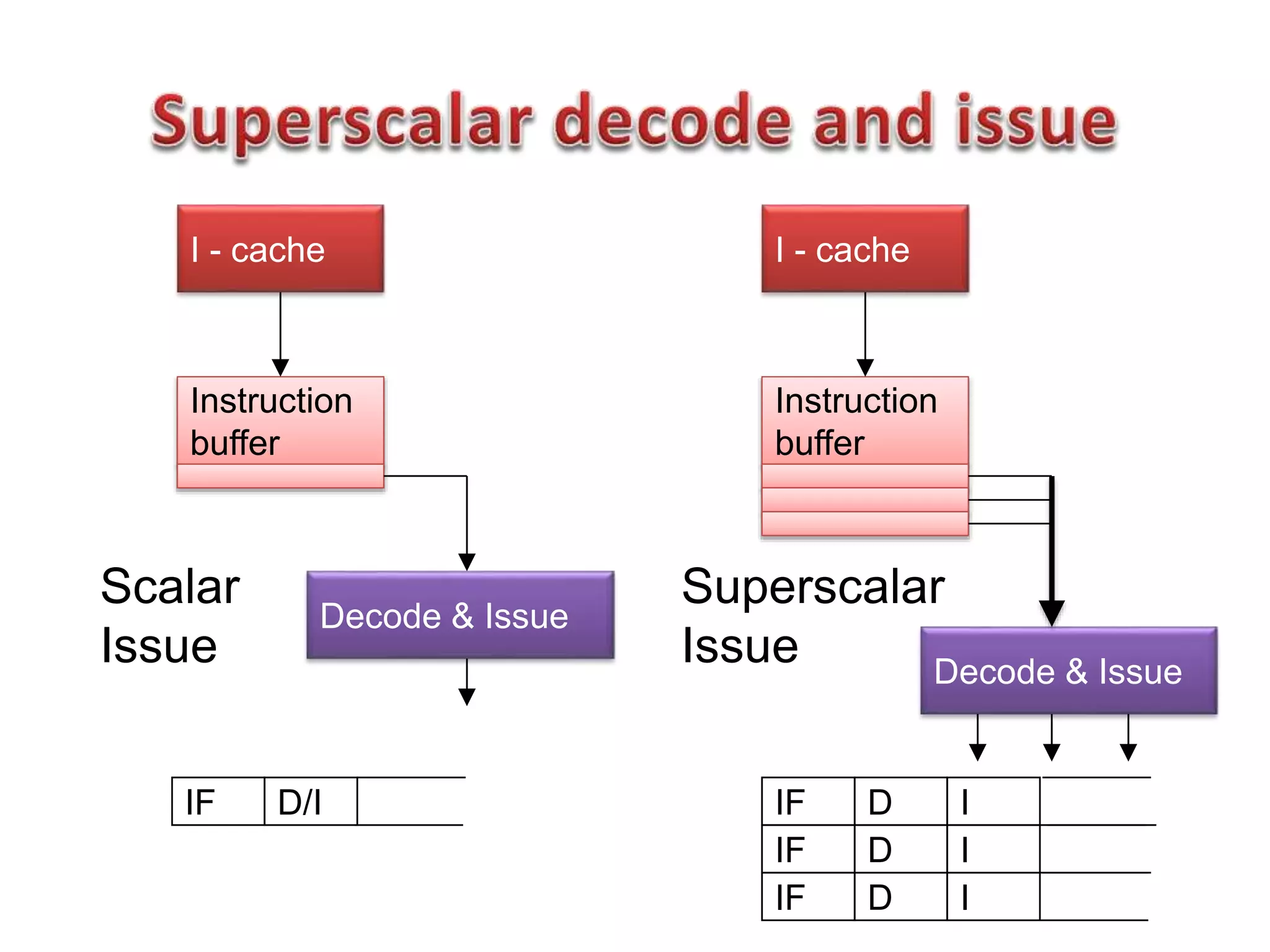
I - cache
Instruction
buffer
Decode & Issue
IF D/I
I - cache
Instruction
buffer
Decode & Issue
IF D I
Scalar
Issue
Superscalar
Issue
IF D I
IF D I
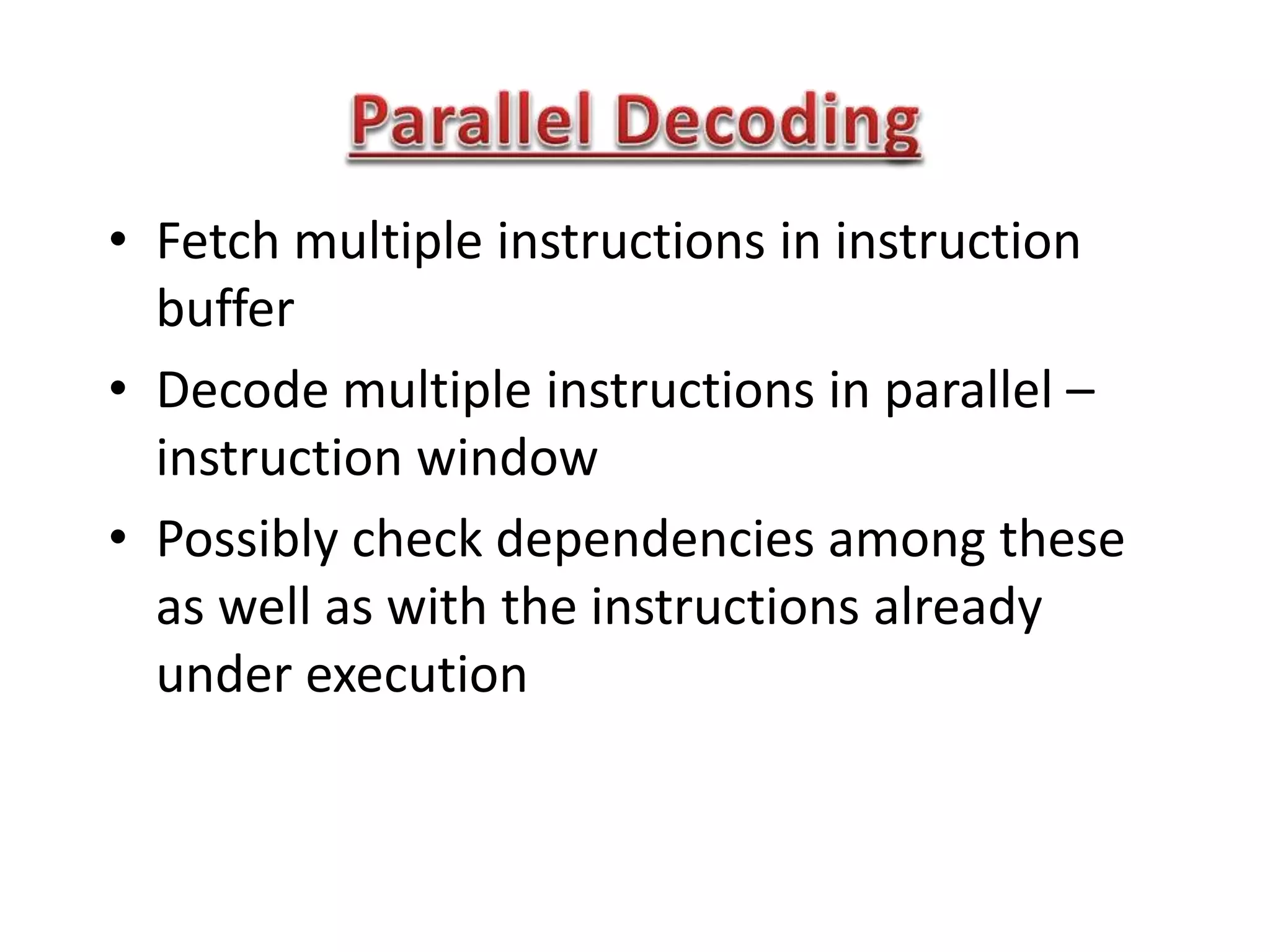
• Fetch multiple instructions in instruction
buffer
• Decode multiple instructions in parallel –
instruction window
• Possibly check dependencies among these
as well as with the instructions already
under execution
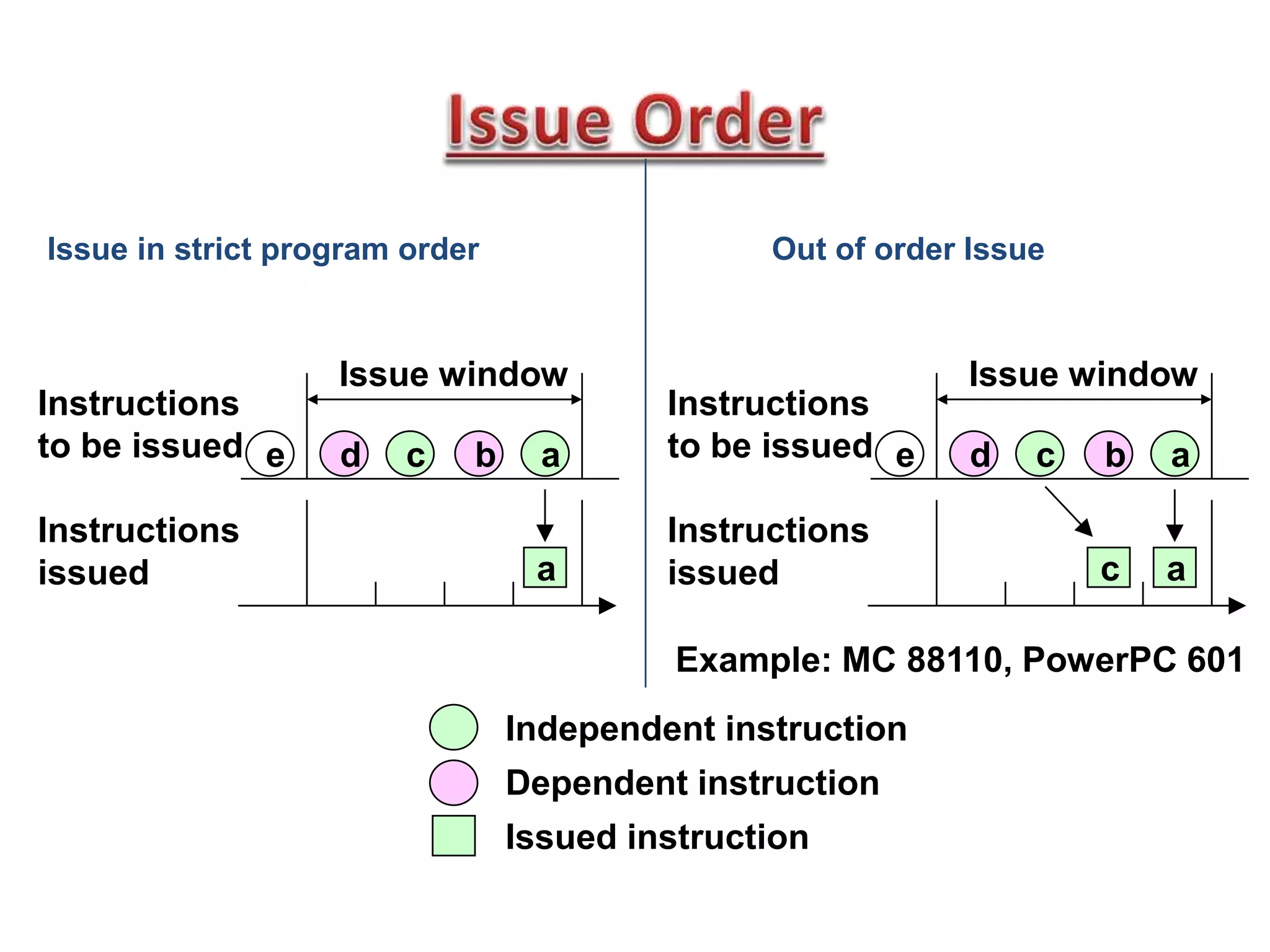
• ADD T A B T= A+B
• ADD W C D W= C+D
• LD A, 0(W) A=M[W]
• ST C, 0(B) M[B]=C
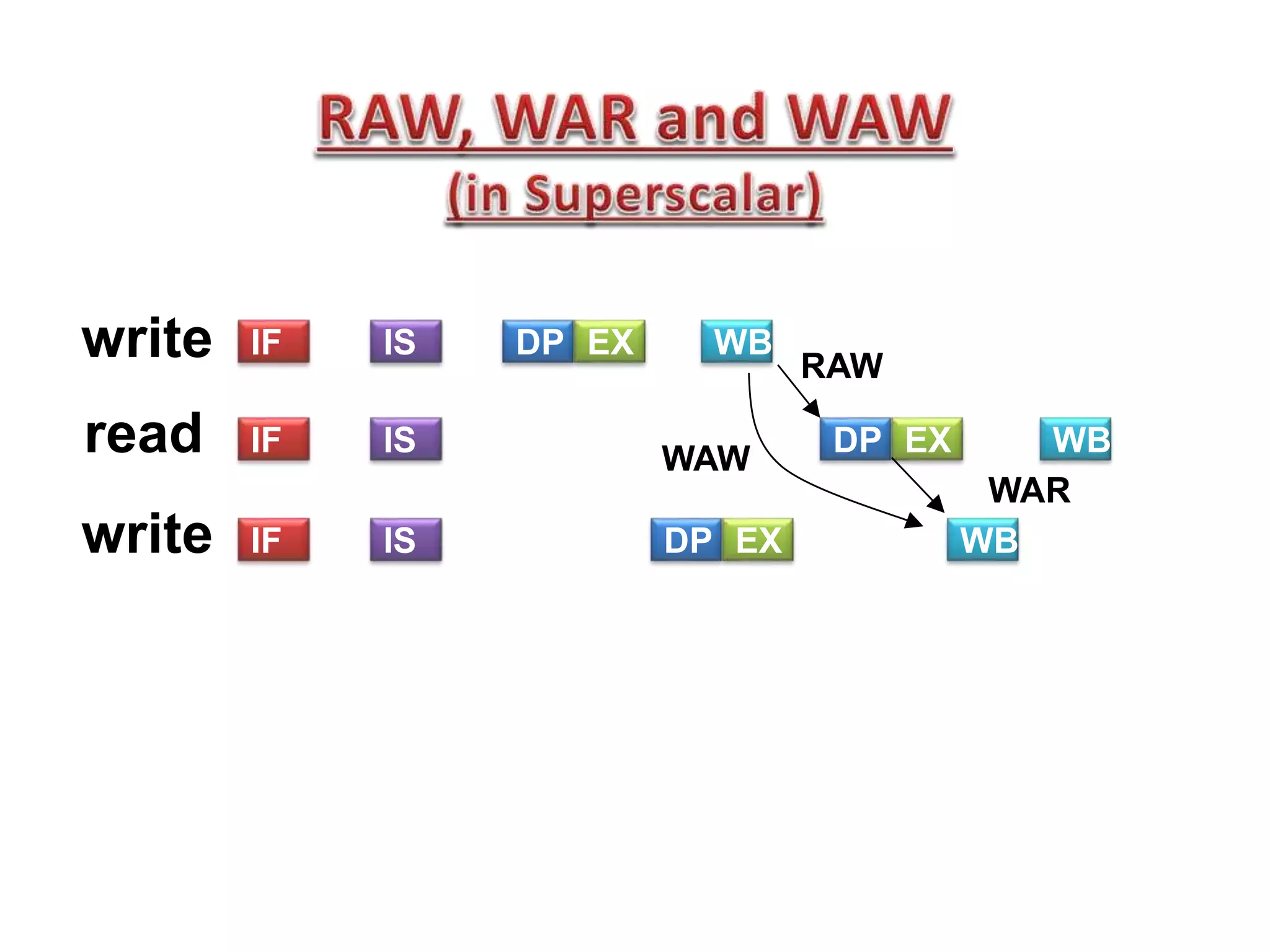
Read After Write (RAW), W after W, W after R
RAW (Ins2-Ins3): True dependency
WAW, WAR (Ins1 ot Ins3) : false dependency
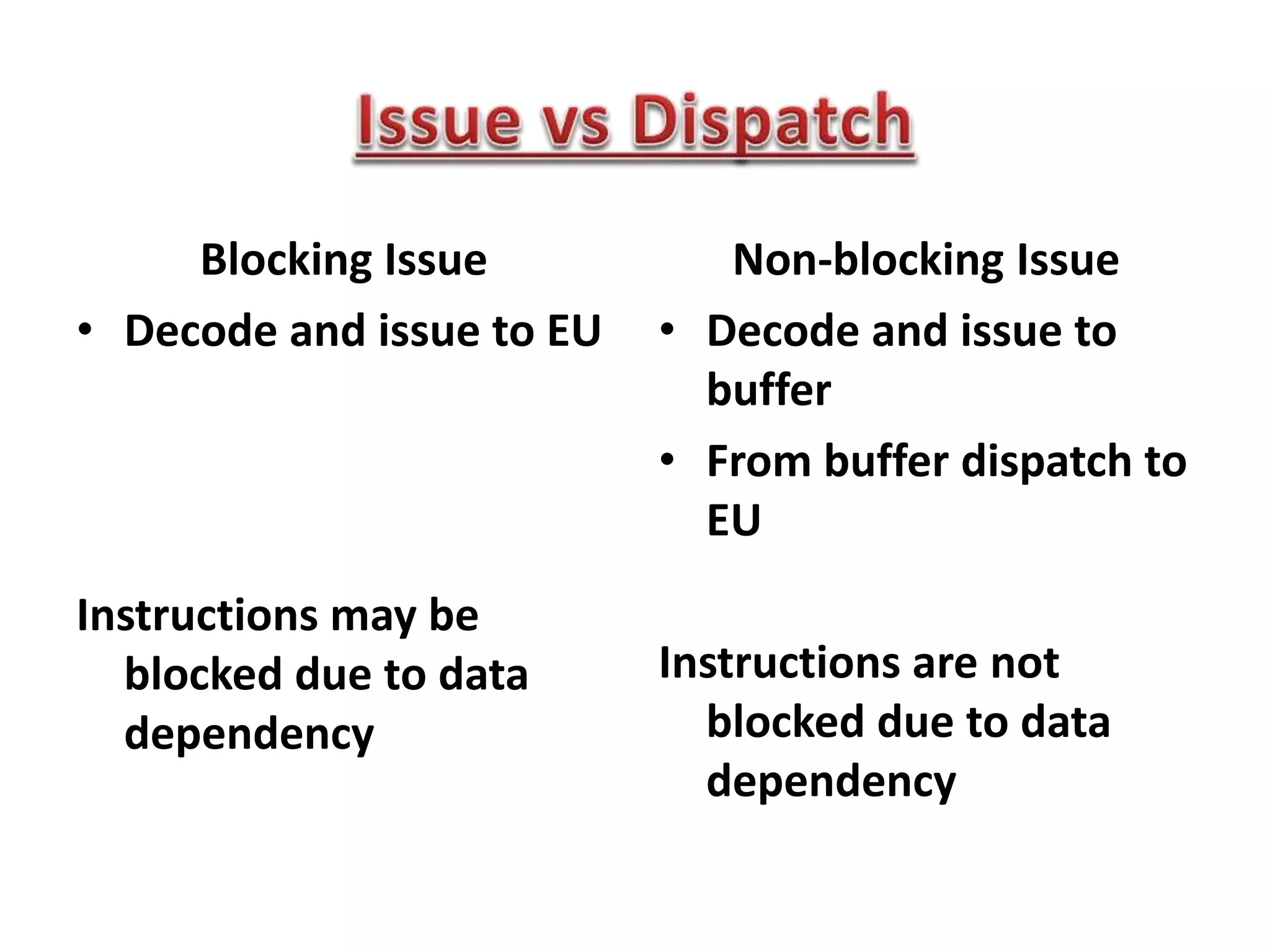
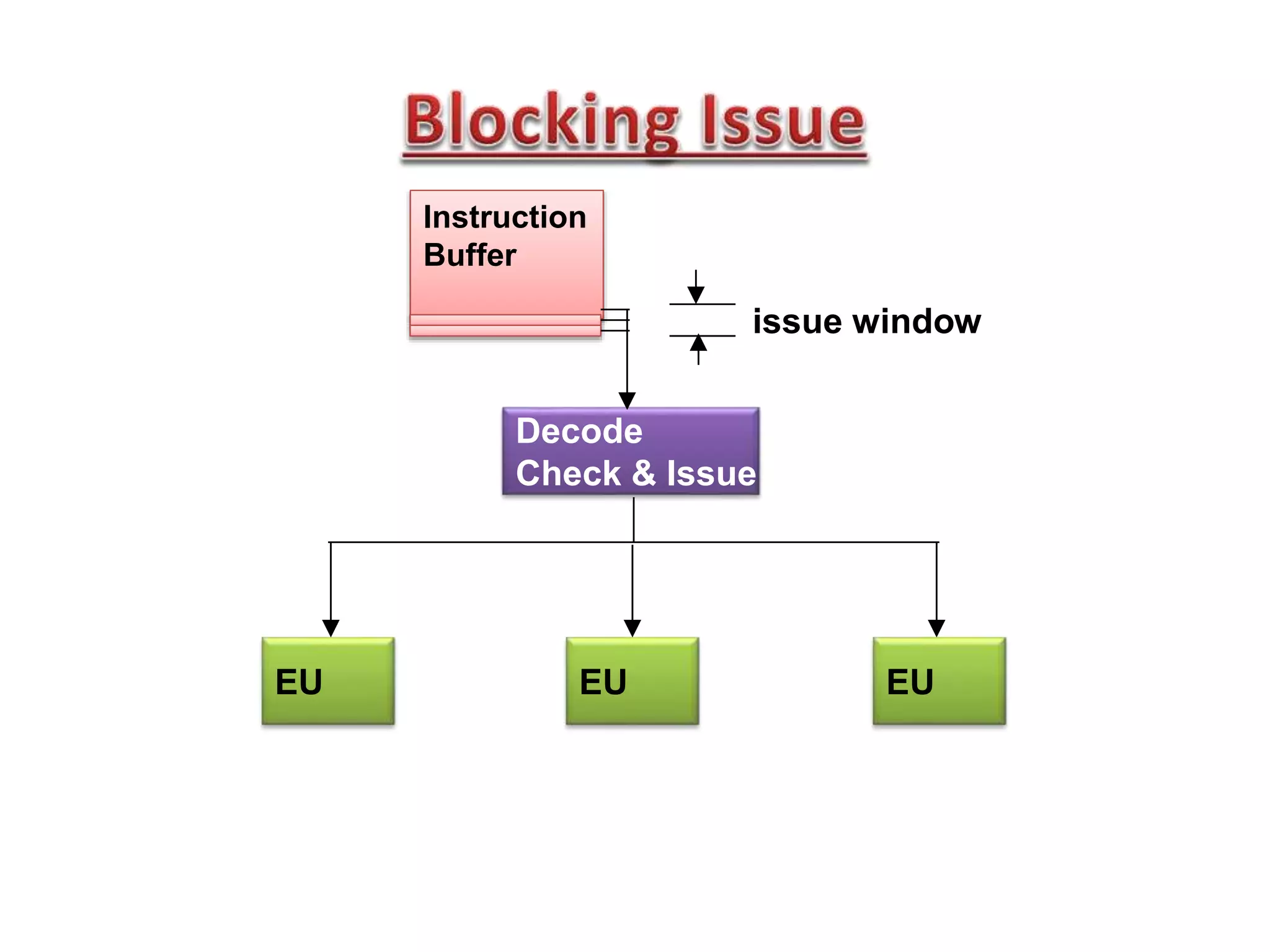
Blocking Issue
• Decode and issue to EU
Instructions may be
blocked due to data
dependency
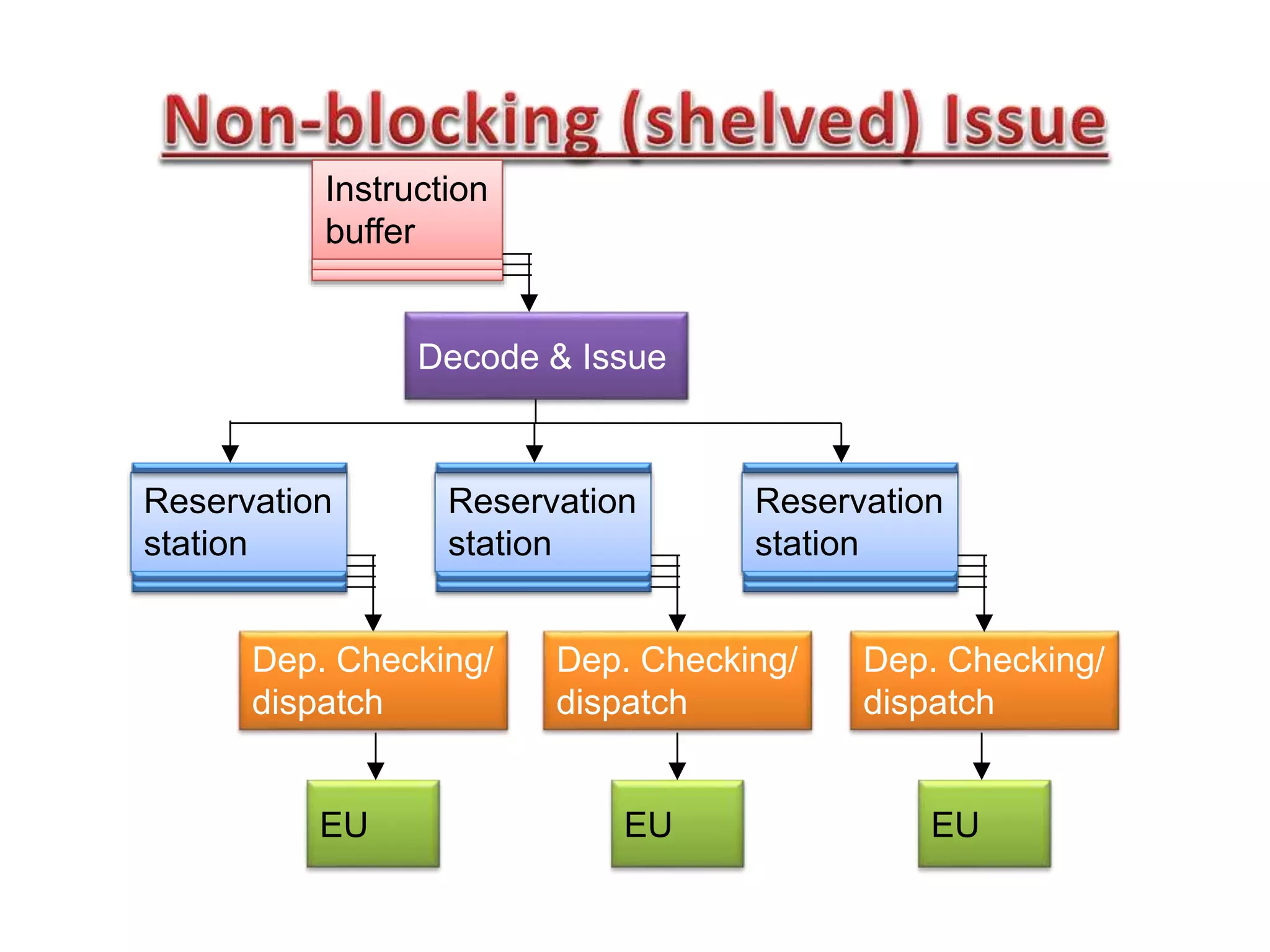
Non-blocking Issue
• Decode and issue to
buffer
• From buffer dispatch to
EU
Instructions are not
blocked due to data
dependency
EU EU EU
Decode
Check & Issue
Instruction
Buffer
issue window
Reservation
station
Dep. Checking/
dispatch
EU
Reservation
station
Dep. Checking/
dispatch
EU
Reservation
station
Dep. Checking/
dispatch
EU
Decode & Issue
Instruction
buffer
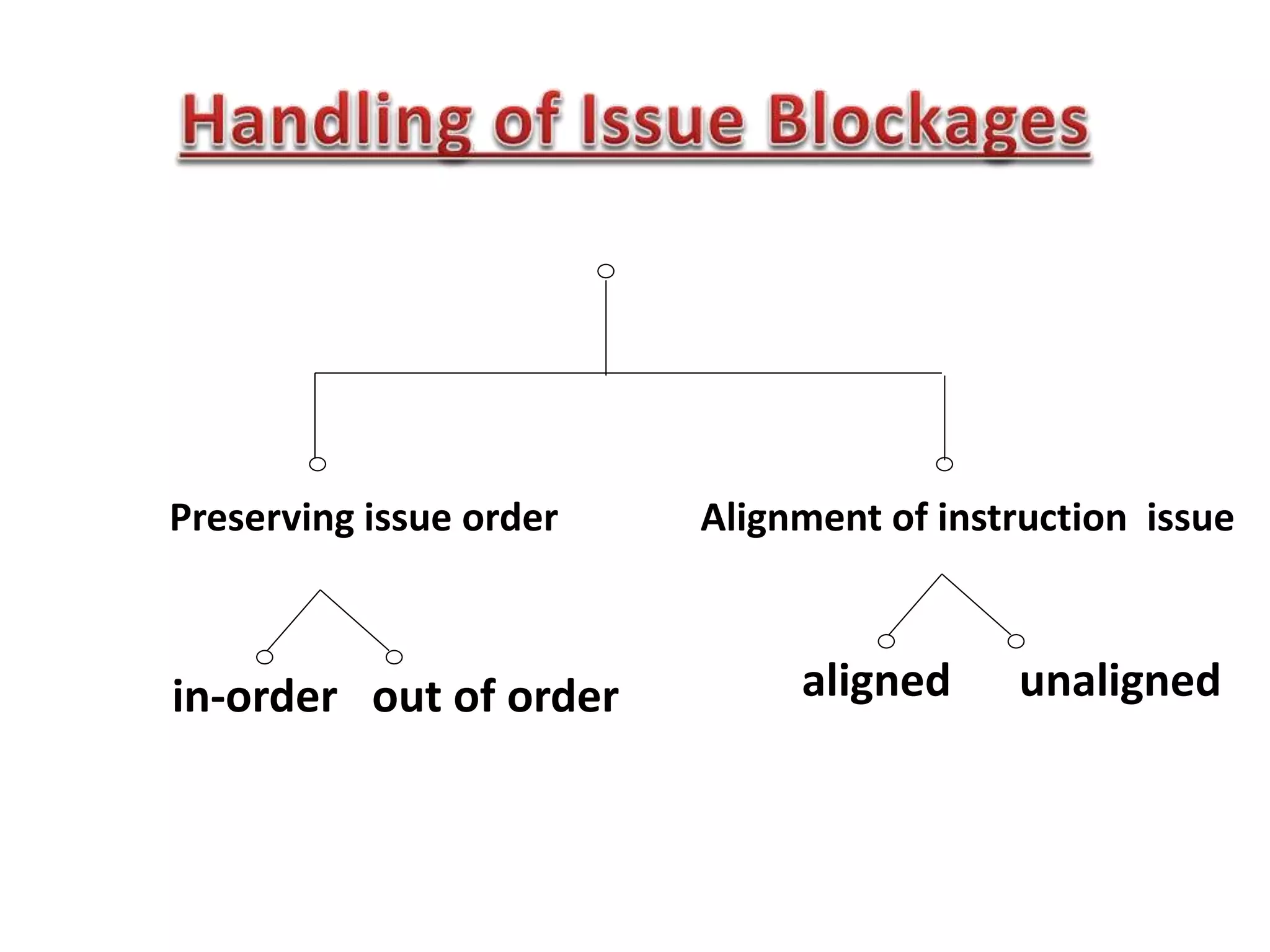
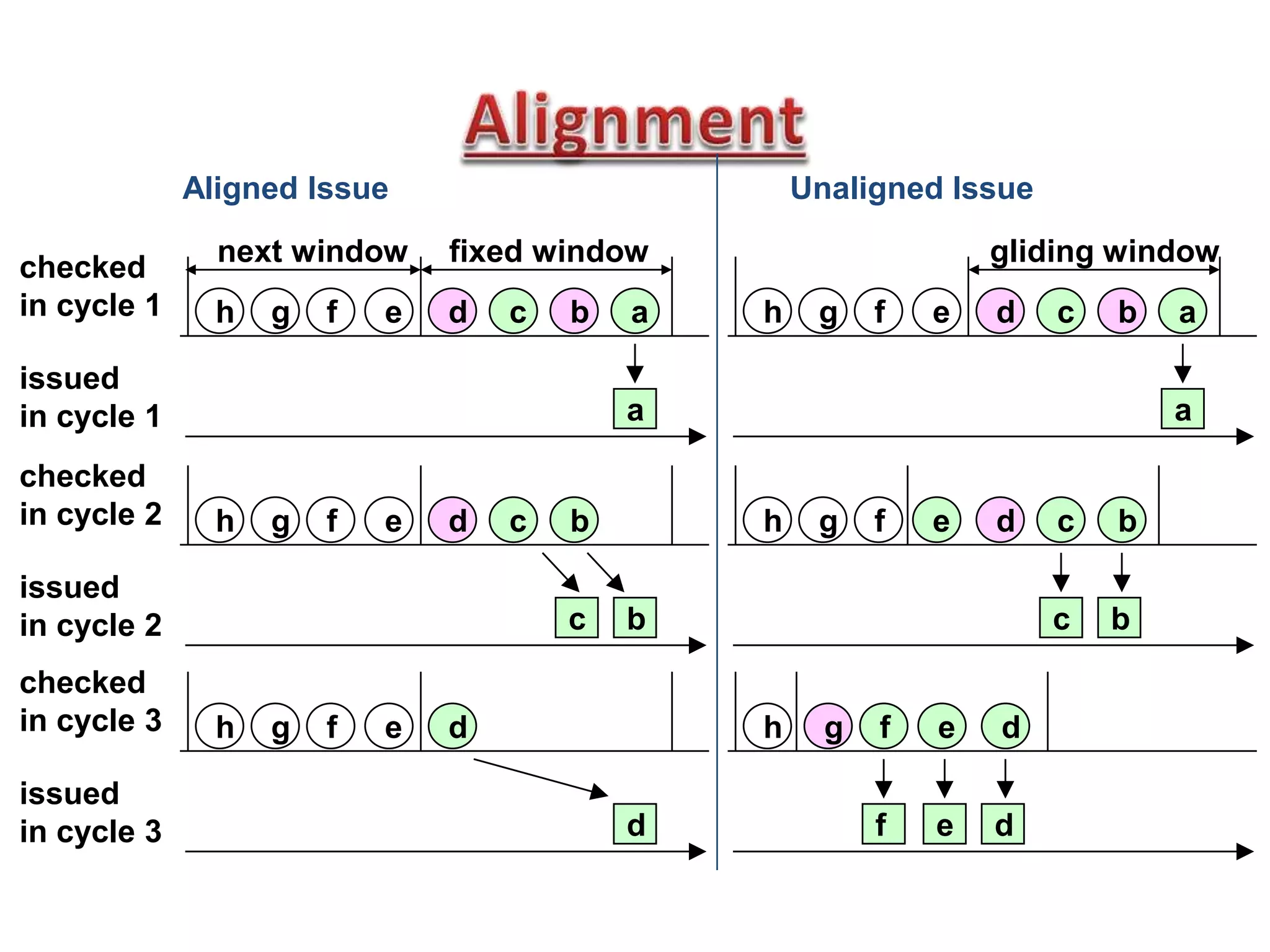
Preserving issue order Alignment of instruction issue
aligned unalignedin-order out of order
• ADD T A B T= A+B
• ADD W C D W= C+D
• LD A, 0(W) A=M[W]
• ST C, 0(B) M[B]=C
cd abe
a
Issue window
Instructions
to be issued
Instructions
issued
cd abe
a
Issue window
Instructions
to be issued
Instructions
issued
Issue in strict program order Out of order Issue
c
Example: MC 88110, PowerPC 601
Independent instruction
Dependent instruction
Issued instruction
cd abe
a
fixed window
checked
in cycle 1
Aligned Issue Unaligned Issue
issued
in cycle 1
fgh
next window
cd be
b
checked
in cycle 2
issued
in cycle 2
fgh
de
d
checked
in cycle 3
issued
in cycle 3
fgh
c
cd abe
a
gliding window
fgh
cd be
b
fgh
defgh
c
def
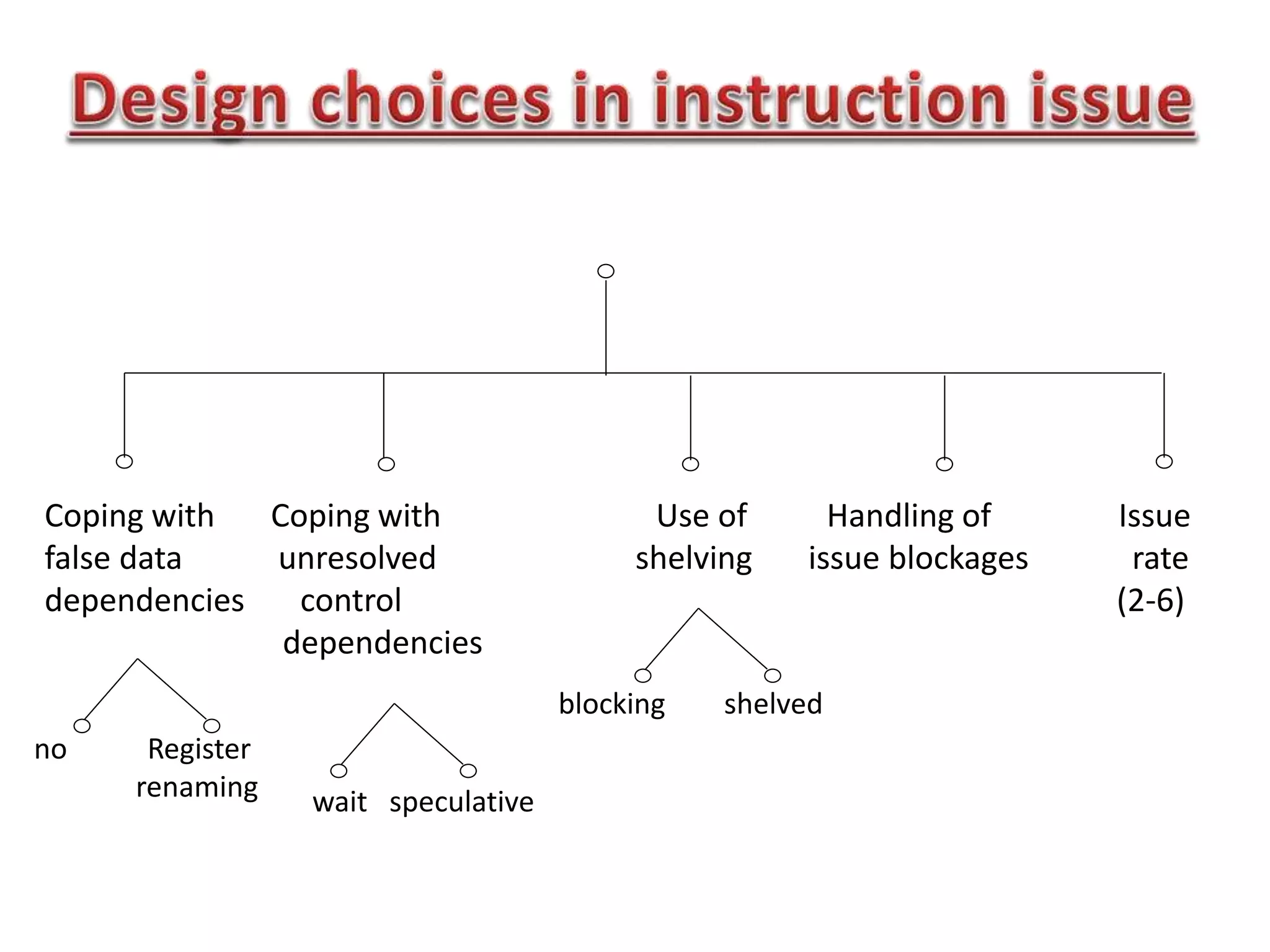
Coping with Coping with Use of Handling of Issue
false data unresolved shelving issue blockages rate
dependencies control (2-6)
dependencies
no Register
renaming wait speculative
blocking shelved
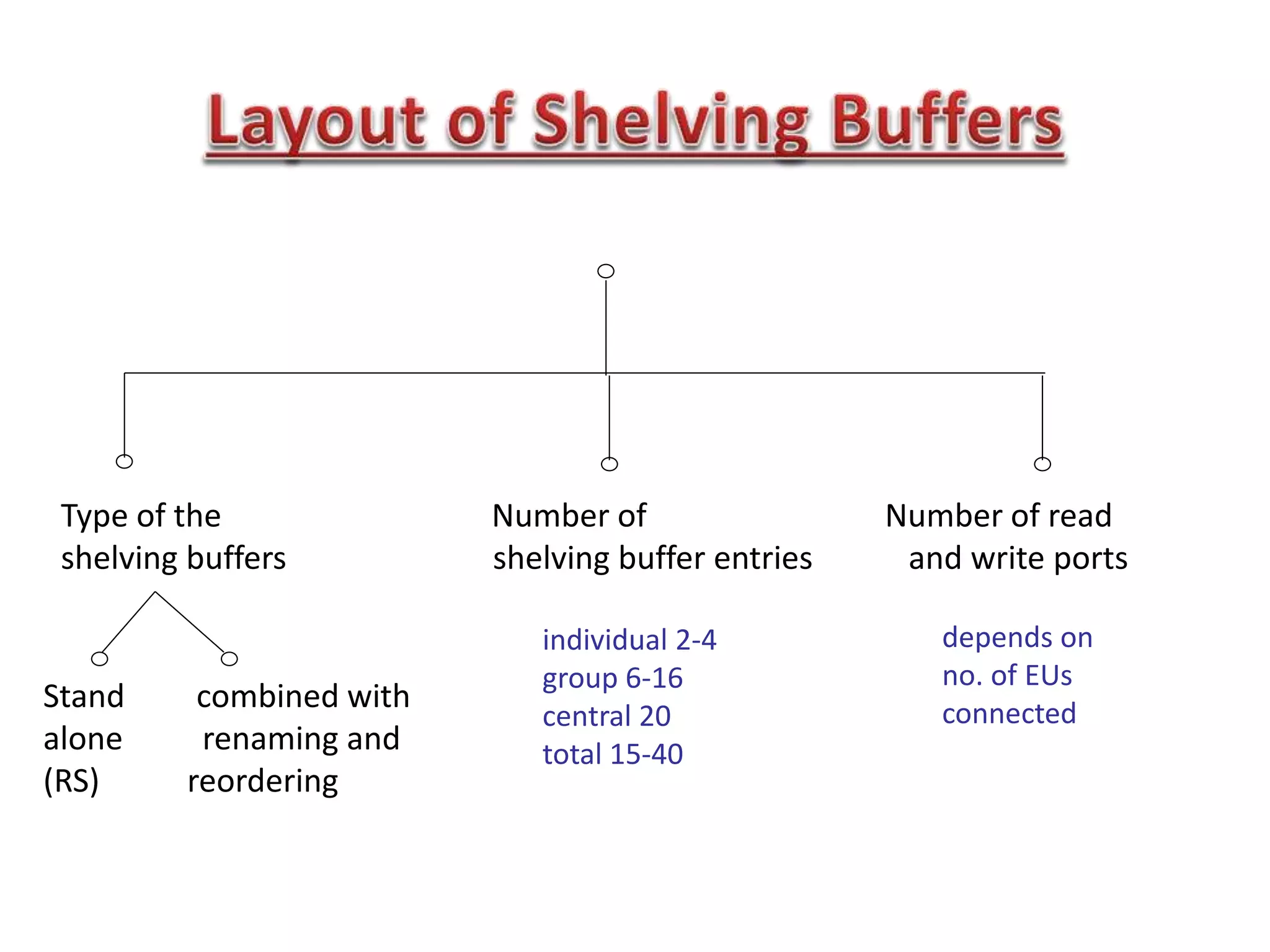
Type of the Number of Number of read
shelving buffers shelving buffer entries and write ports
Stand combined with
alone renaming and
(RS) reordering
individual 2-4
group 6-16
central 20
total 15-40
depends on
no. of EUs
connected
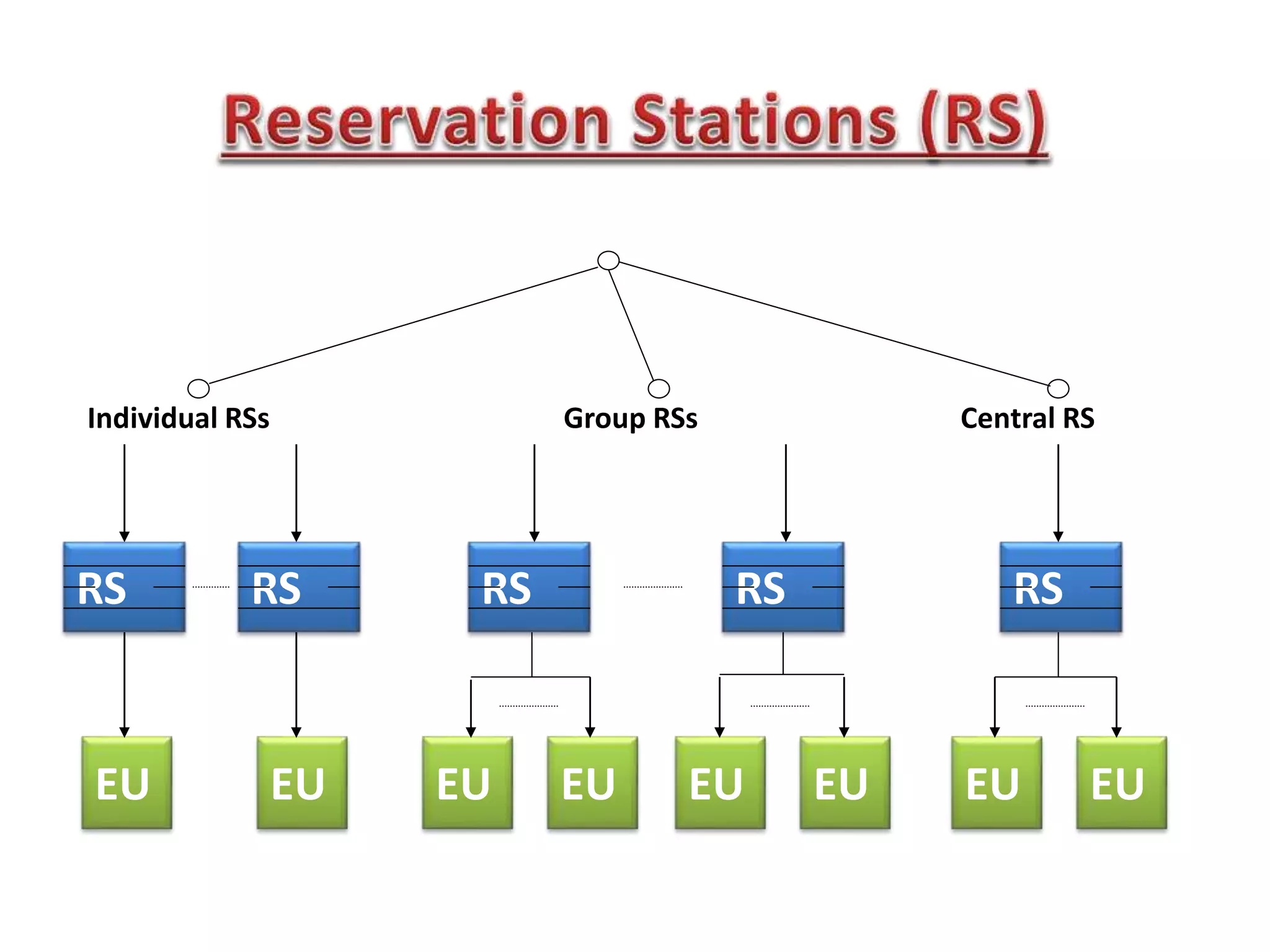
EU EU EU EU EU EU EU EU
RS RS RS RS RS
Individual RSs Group RSs Central RS
EU EU
RS RS
EU EU
RS RS
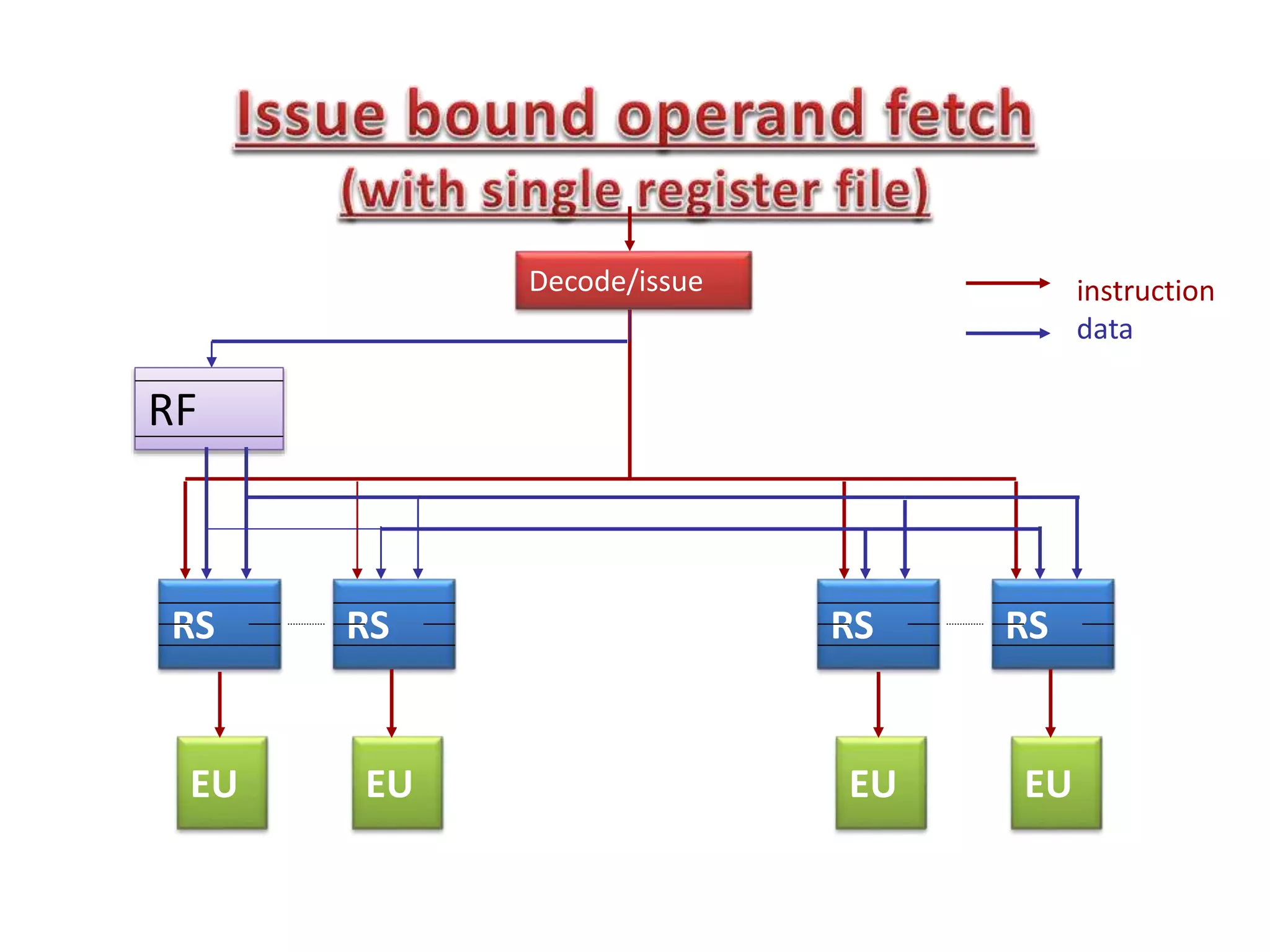
Decode/issue
RF
instruction
data
EU EU
RS RS
EU EU
RS RS
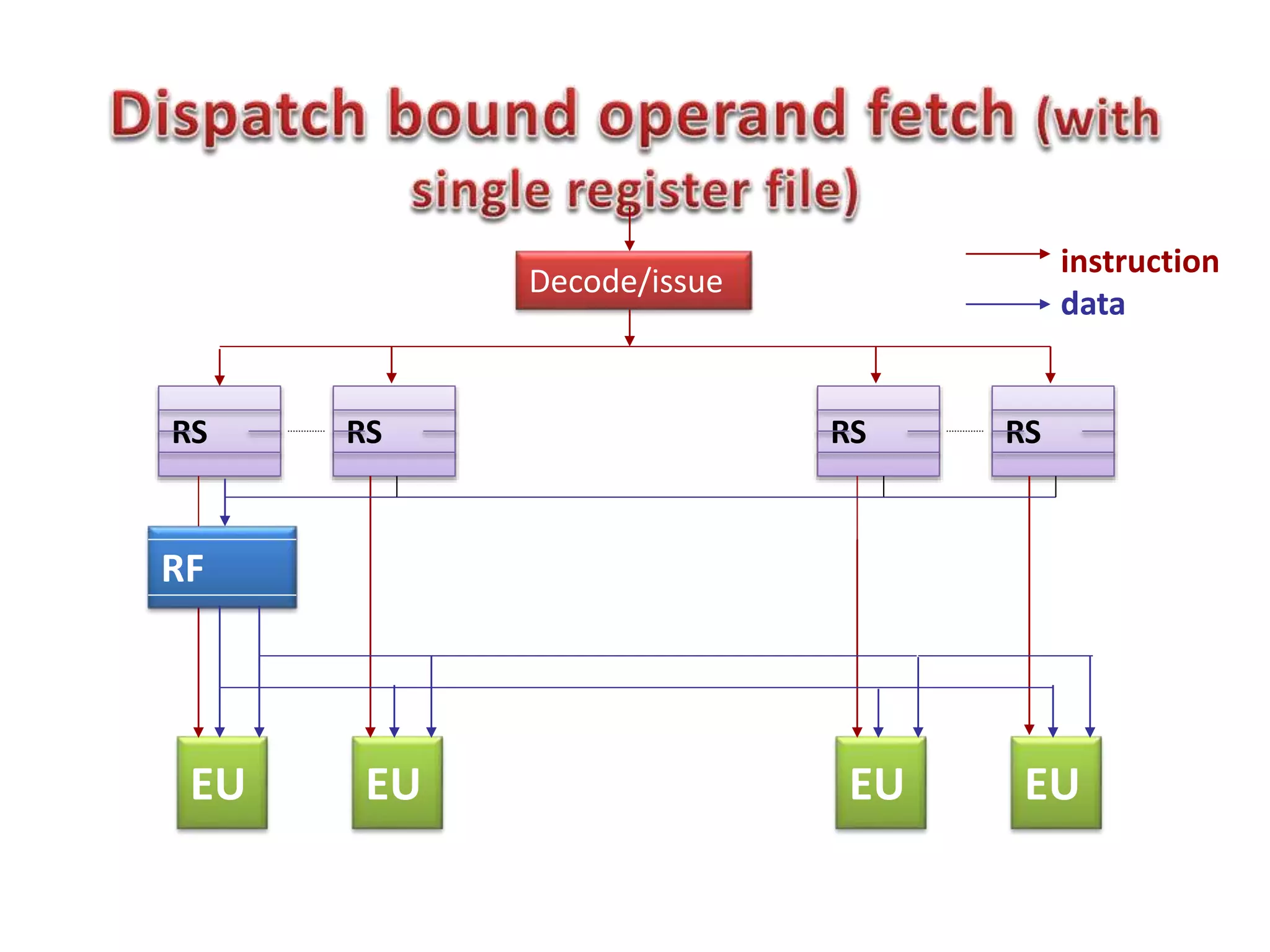
Decode/issue
instruction
data
RF
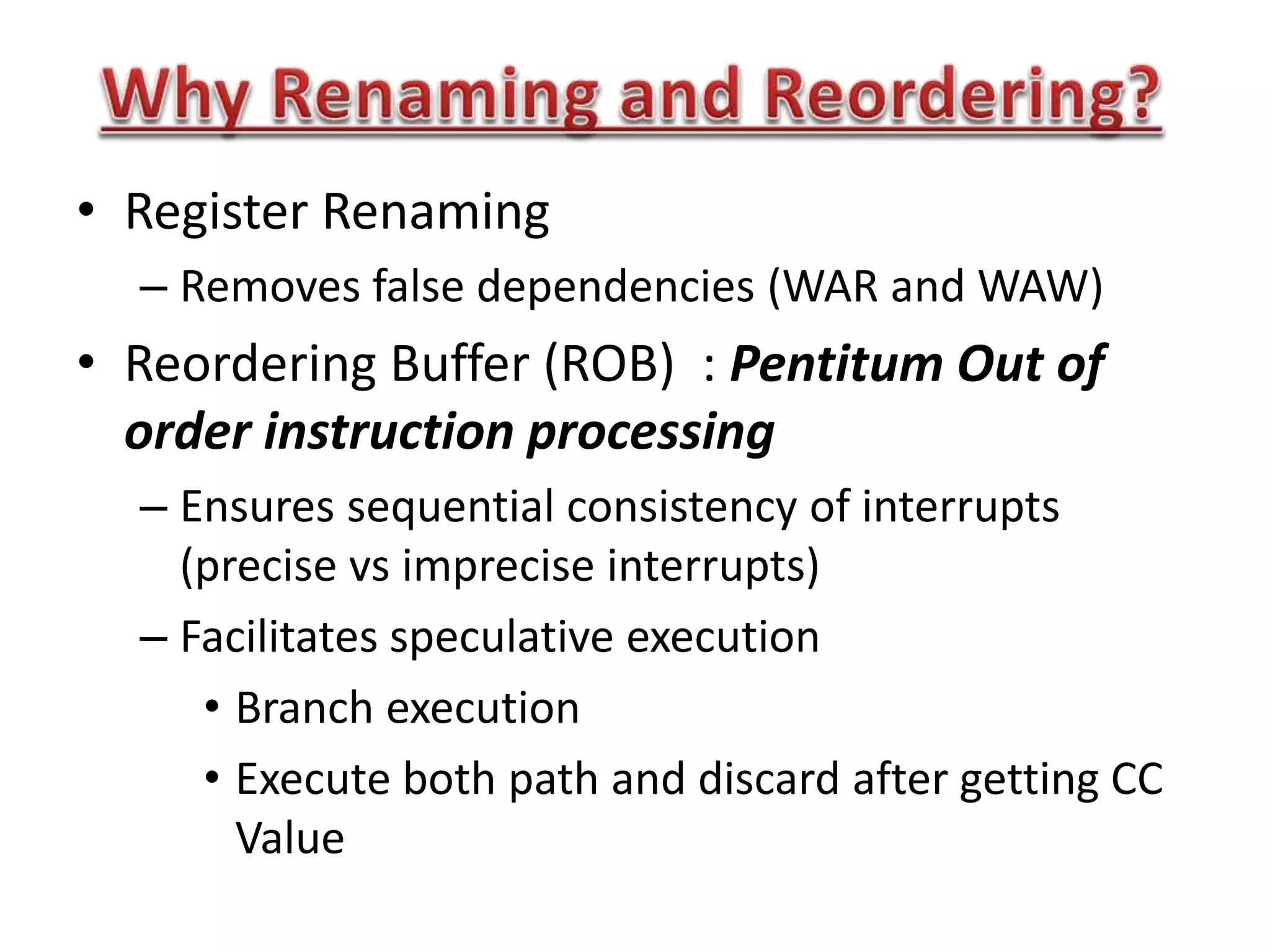
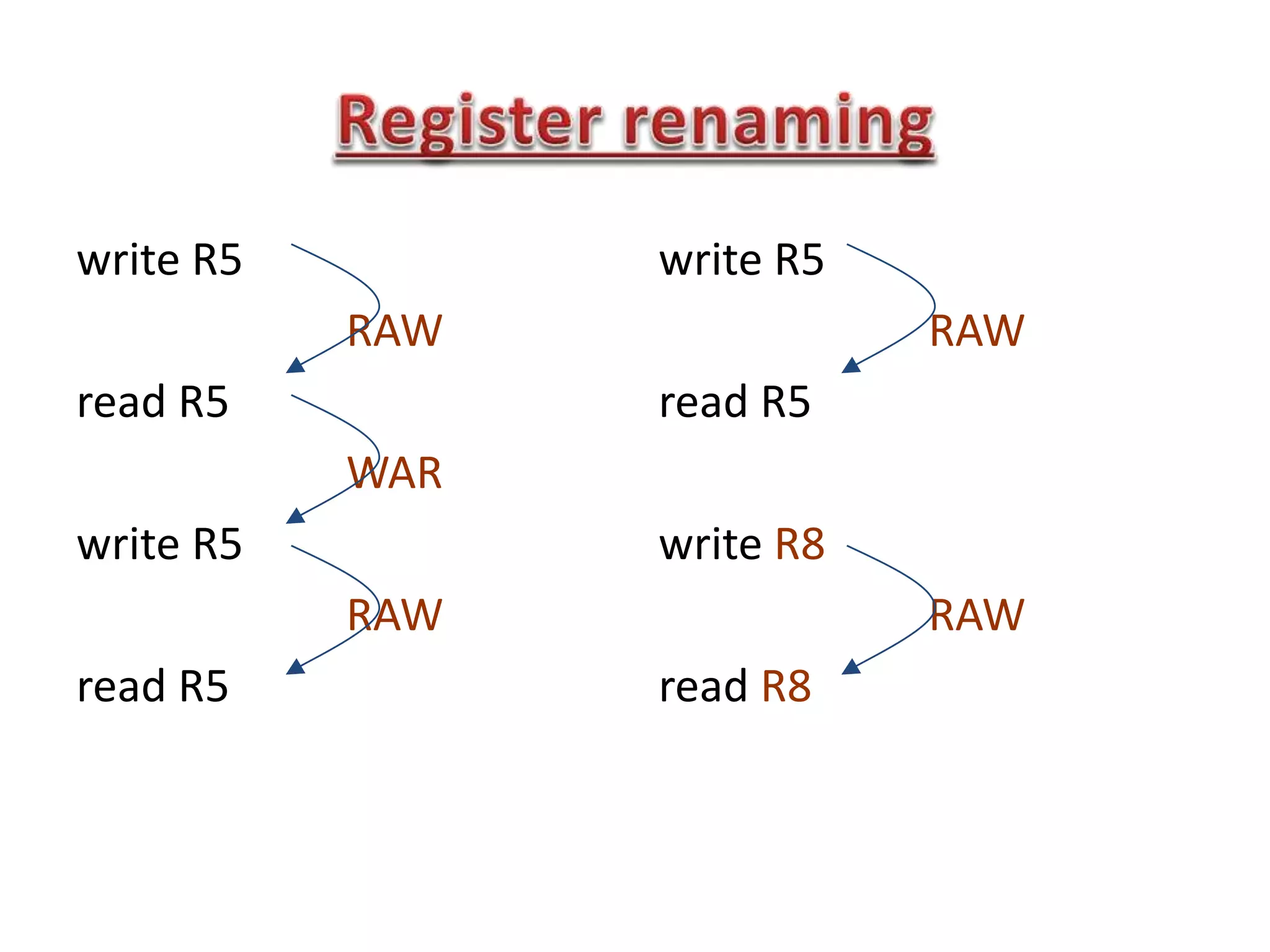
• Register Renaming
– Removes false dependencies (WAR and WAW)
• Reordering Buffer (ROB) : Pentitum Out of
order instruction processing
– Ensures sequential consistency of interrupts
(precise vs imprecise interrupts)
– Facilitates speculative execution
• Branch execution
• Execute both path and discard after getting CC
Value
IF IS DP EX WB
IF IS DP EX WB
IF IS DP EX WB
write
read
write
RAW
WAR
WAW
write R5
RAW
read R5
WAR
write R5
RAW
read R5
write R5
RAW
read R5
write R8
RAW
read R8
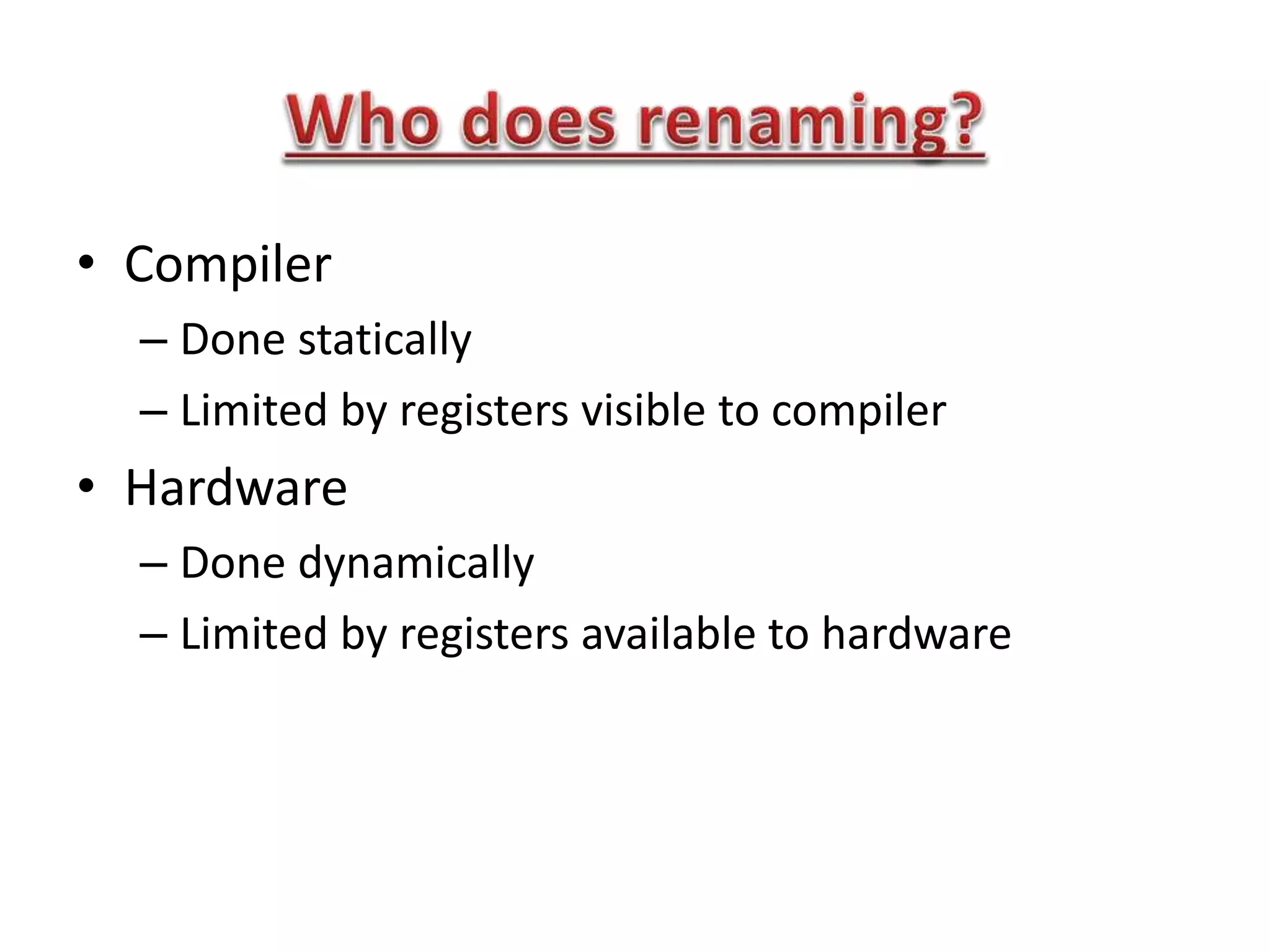
• Compiler
– Done statically
– Limited by registers visible to compiler
• Hardware
– Done dynamically
– Limited by registers available to hardware
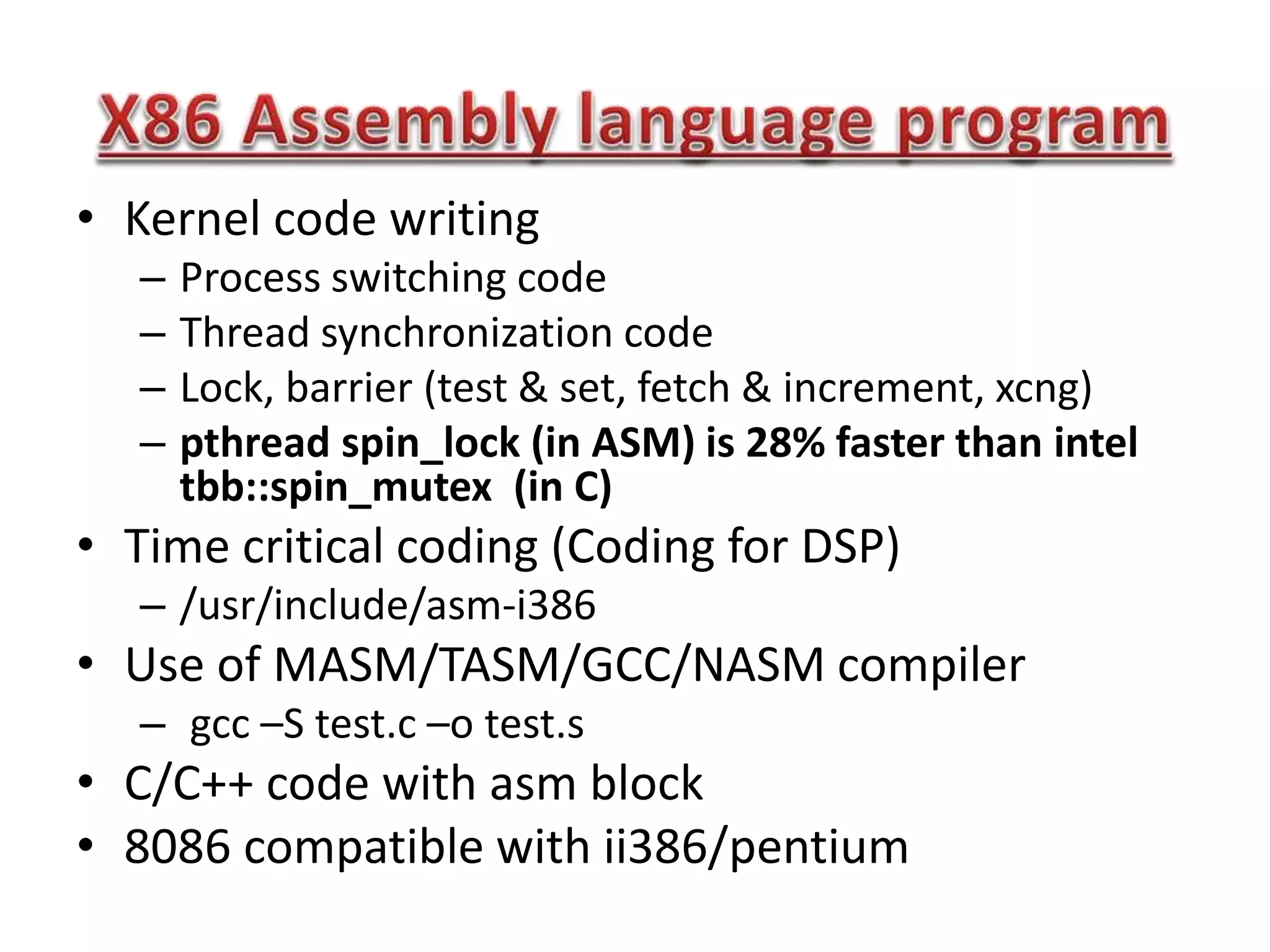
• Kernel code writing
– Process switching code
– Thread synchronization code
– Lock, barrier (test & set, fetch & increment, xcng)
– pthread spin_lock (in ASM) is 28% faster than intel
tbb::spin_mutex (in C)
• Time critical coding (Coding for DSP)
– /usr/include/asm-i386
• Use of MASM/TASM/GCC/NASM compiler
– gcc –S test.c –o test.s
• C/C++ code with asm block
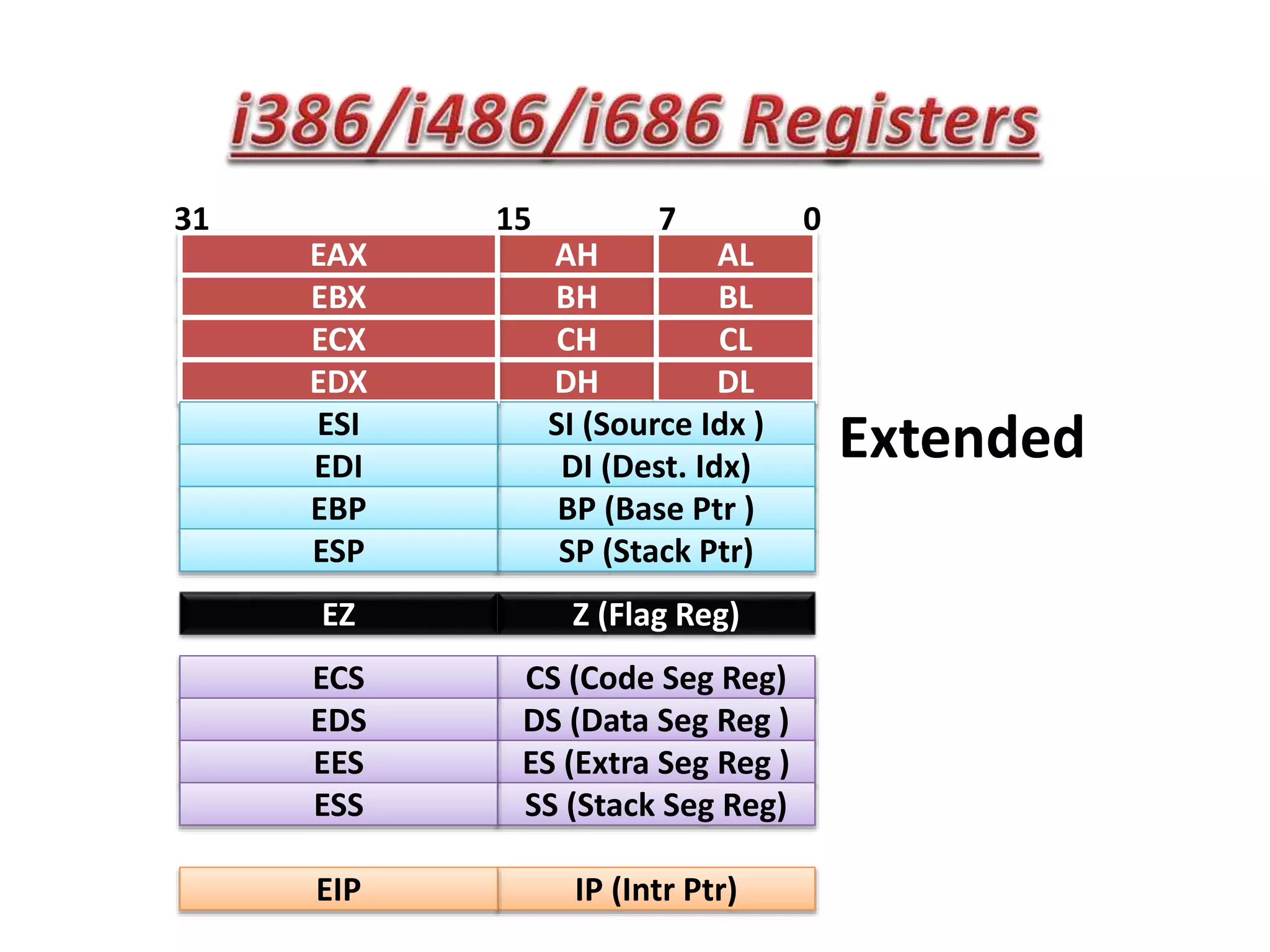
• 8086 compatible with ii386/pentium
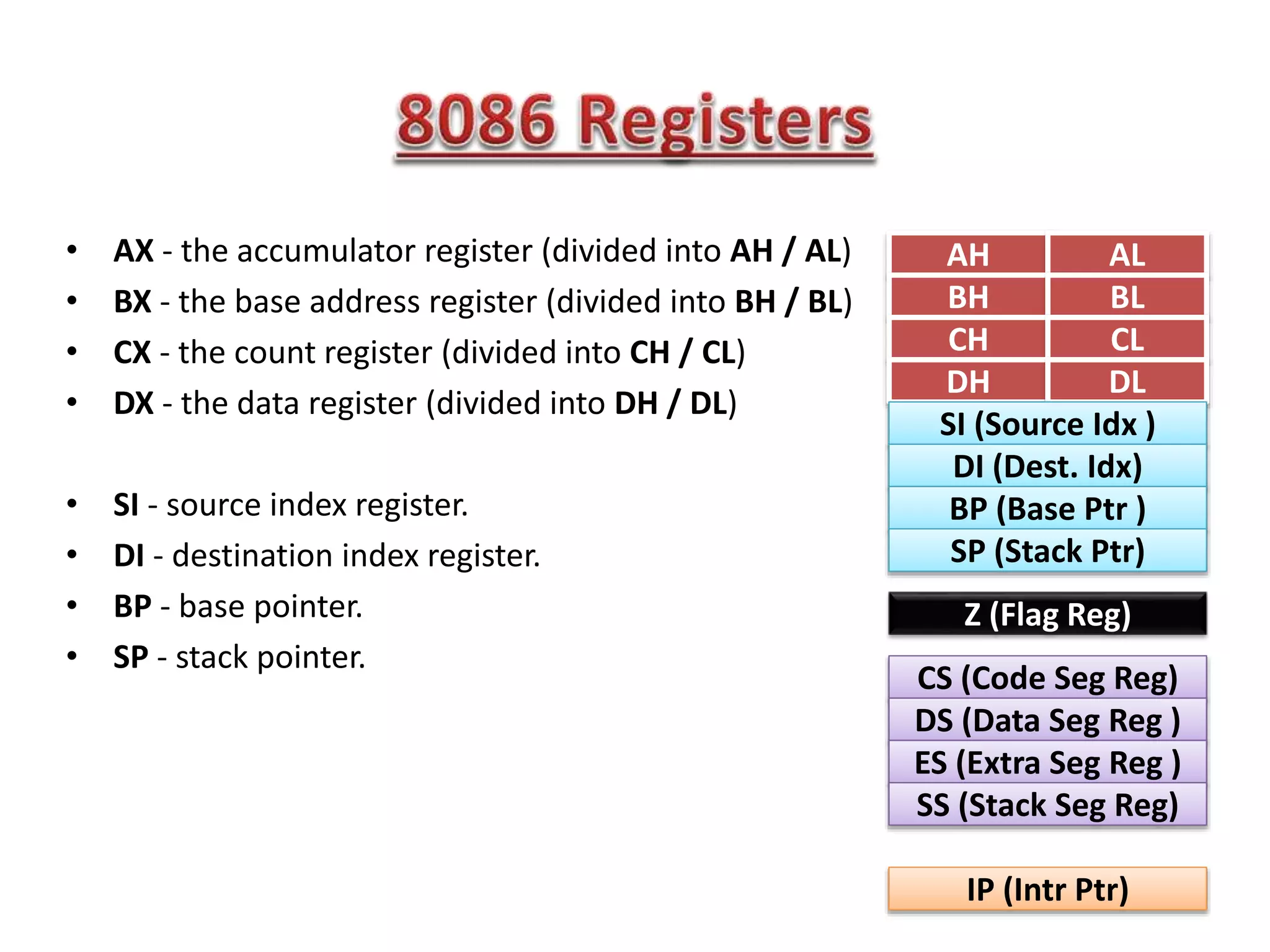
• AX - the accumulator register (divided into AH / AL)
• BX - the base address register (divided into BH / BL)
• CX - the count register (divided into CH / CL)
• DX - the data register (divided into DH / DL)
• SI - source index register.
• DI - destination index register.
• BP - base pointer.
• SP - stack pointer.
AH AL
BH BL
CH CL
DH DL
SI (Source Idx )
DI (Dest. Idx)
BP (Base Ptr )
SP (Stack Ptr)
CS (Code Seg Reg)
DS (Data Seg Reg )
ES (Extra Seg Reg )
SS (Stack Seg Reg)
IP (Intr Ptr)
Z (Flag Reg)
AH AL
BH BL
CH CL
DH DL
SI (Source Idx )
DI (Dest. Idx)
BP (Base Ptr )
SP (Stack Ptr)
CS (Code Seg Reg)
DS (Data Seg Reg )
ES (Extra Seg Reg )
SS (Stack Seg Reg)
IP (Intr Ptr)
Z (Flag Reg)
EAX
EBX
ECX
EDX
ESI
EDI
EBP
ESP
ECS
EDS
EES
ESS
EIP
EZ
31 15 7 0
Extended
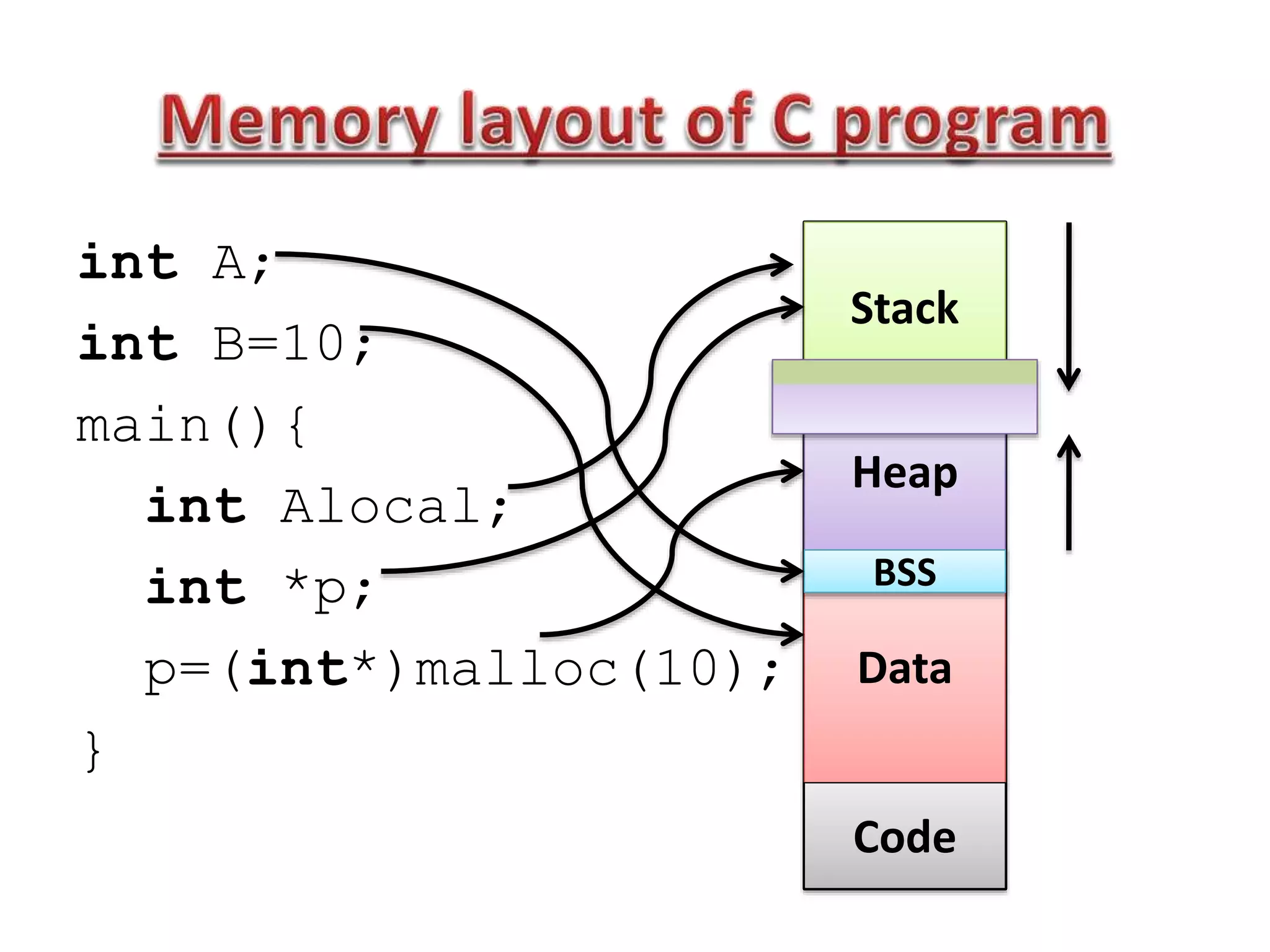
• Stack
– automatic (default), local
– Initialized/uninitialized
• Data
– Global, static, extern
– BSS: Block Started by Symbol
– BBS: Uninitialized Data Seg.
• Code
– program instructions
• Heap
– malloc, calloc
Data
Code
Heap
Stack
BSS
int A;
int B=10;
main(){
int Alocal;
int *p;
p=(int*)malloc(10);
}
Data
Code
Heap
Stack
BSS
.model small
.stack 100h ; reserve 256 bytes of stack space
.data
message db "Hello world, I'm learning Assembly$”
.code
main proc
mov ax, seg message
mov ds, ax
mov ah, 09 // 9 in the AH reg indicates Procedure
//should write a bit-string to the screen.
lea dx, message // Load Eff Address
int 21h
mov ax,4c00h // Halt for DOS routine (Exit Program)
int 21h
main endp
end main
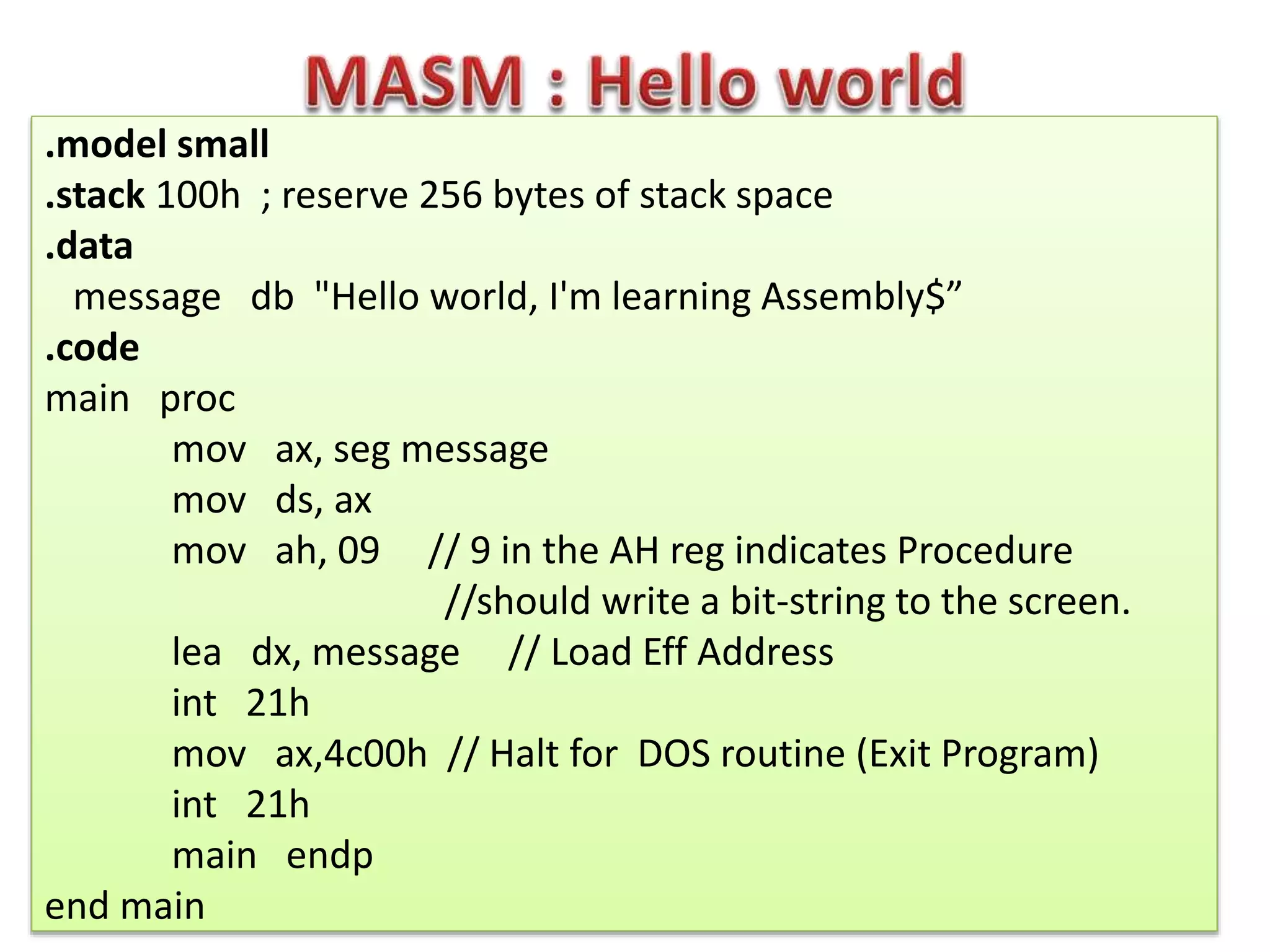
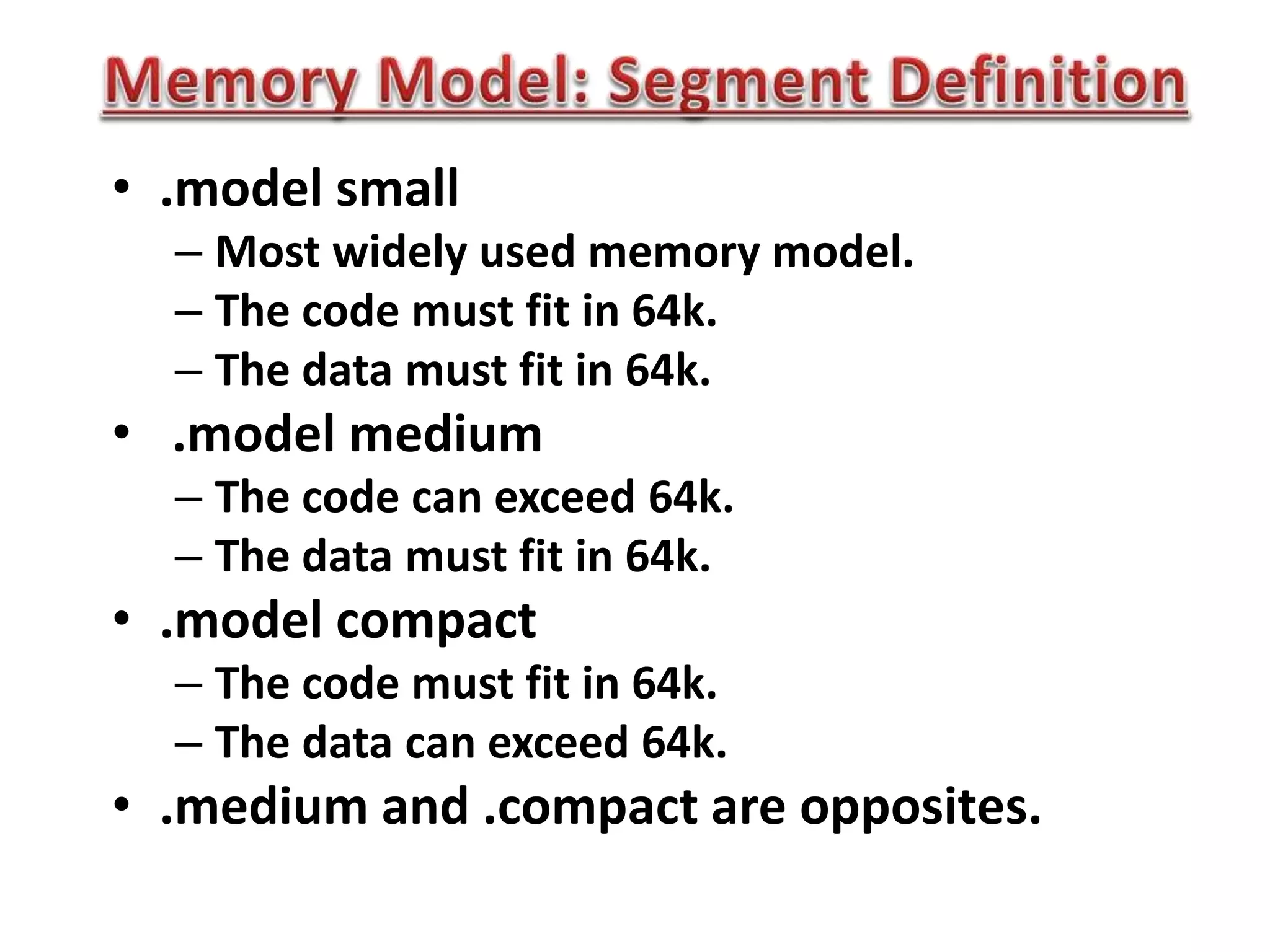
• .model small
– Most widely used memory model.
– The code must fit in 64k.
– The data must fit in 64k.
• .model medium
– The code can exceed 64k.
– The data must fit in 64k.
• .model compact
– The code must fit in 64k.
– The data can exceed 64k.
• .medium and .compact are opposites.
• db : define byte dw: def. word (2 bytes)
• dd: def double word (4) dq : def quad word (8)
• equ : equate assign numeric expr to a name
.data
db A 100 dup (?) ; define 100 bytes, with no initial
values for bytes
db “Hello” ; define 5 bytes, ASCII equivalent of “Hello”.
dd PtrArray 4 dup (?) ;array[0..3] of dword
maxint equ 32767 ; define maxint=32767
count equ 10 * 20 ; calculate a value (200)
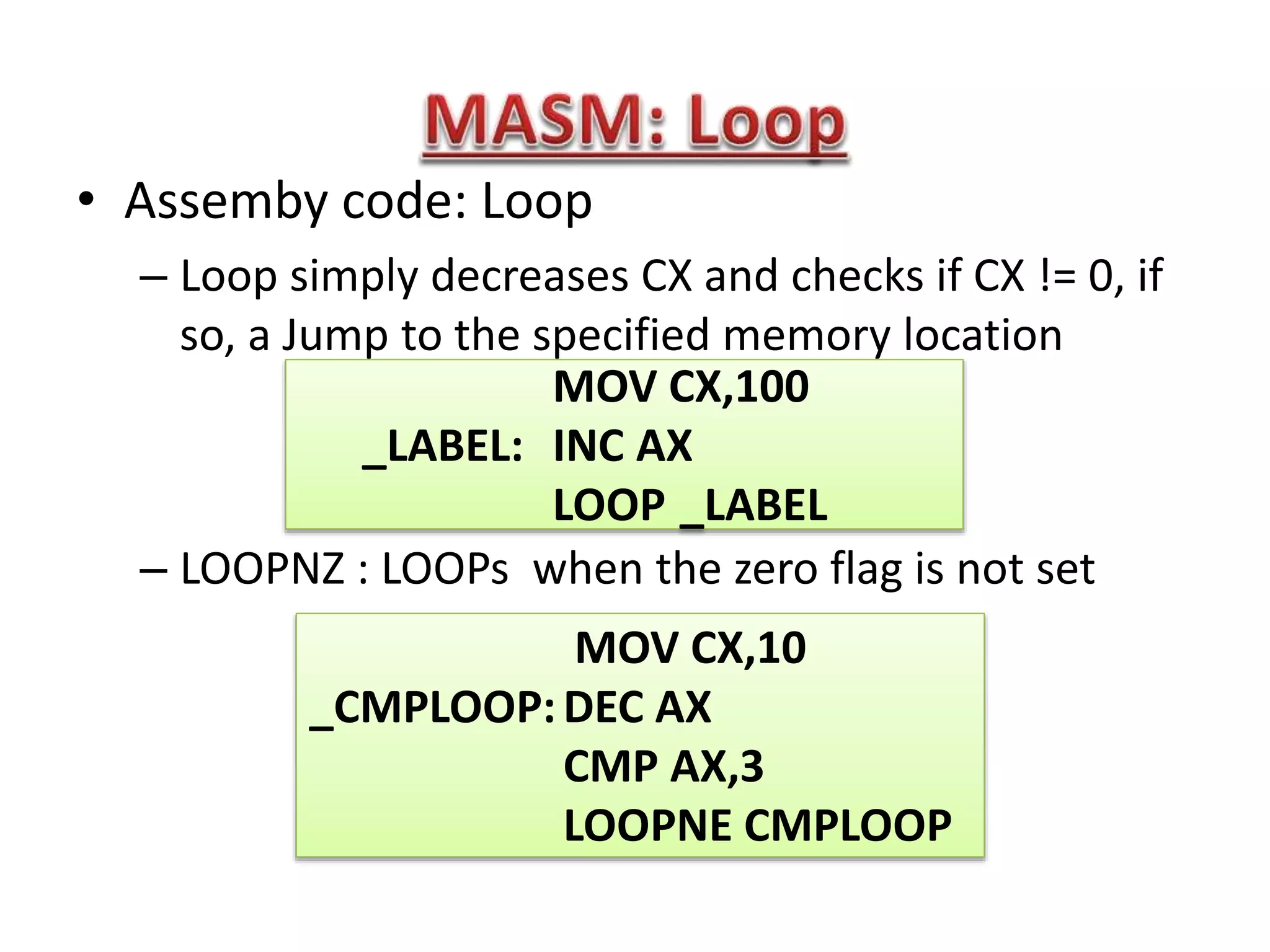
• Assemby code: Loop
– Loop simply decreases CX and checks if CX != 0, if
so, a Jump to the specified memory location
– LOOPNZ : LOOPs when the zero flag is not set
MOV CX,100
_LABEL: INC AX
LOOP _LABEL
MOV CX,10
_CMPLOOP:DEC AX
CMP AX,3
LOOPNE CMPLOOP
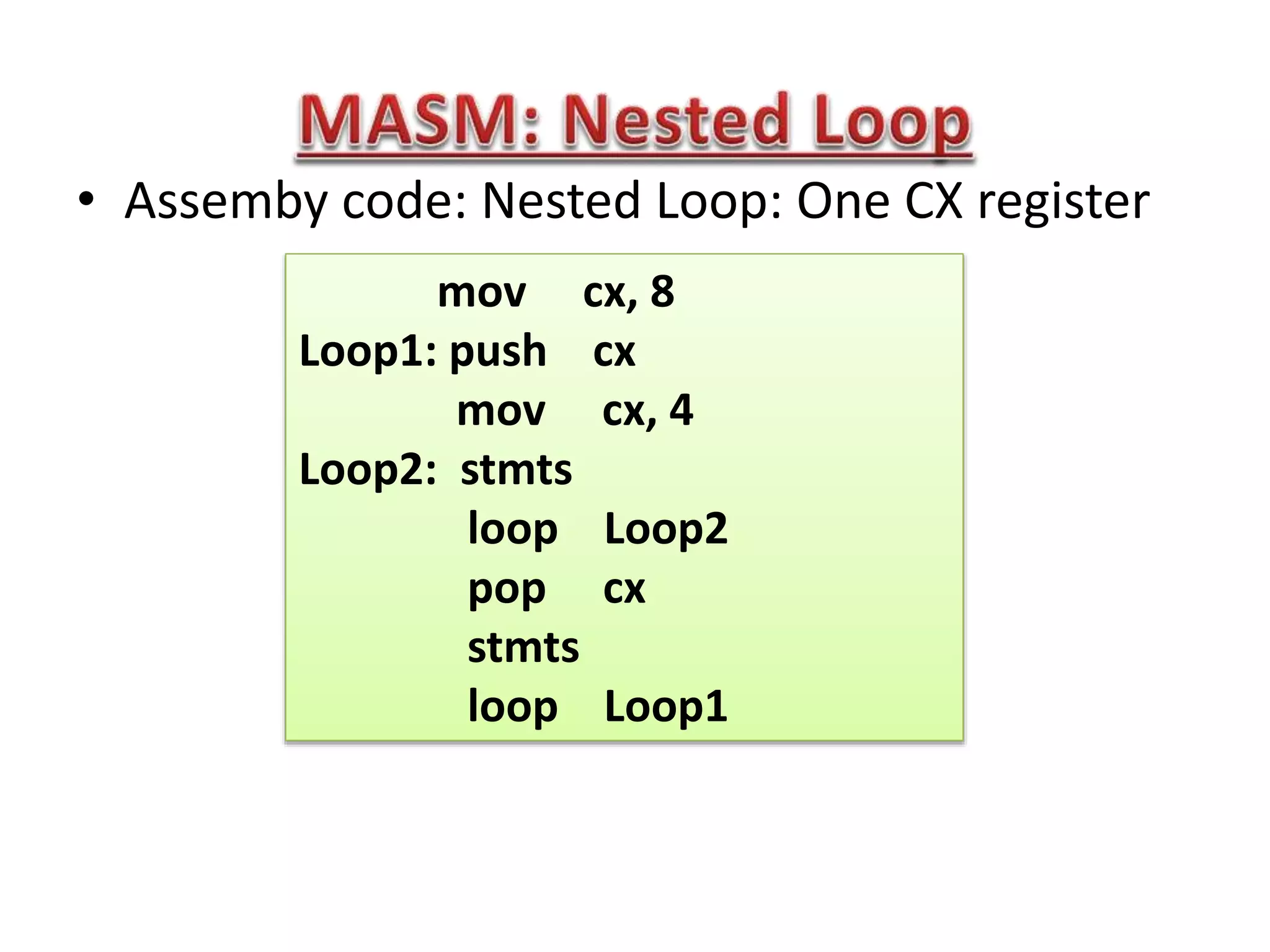
• Assemby code: Nested Loop: One CX register
mov cx, 8
Loop1: push cx
mov cx, 4
Loop2: stmts
loop Loop2
pop cx
stmts
loop Loop1
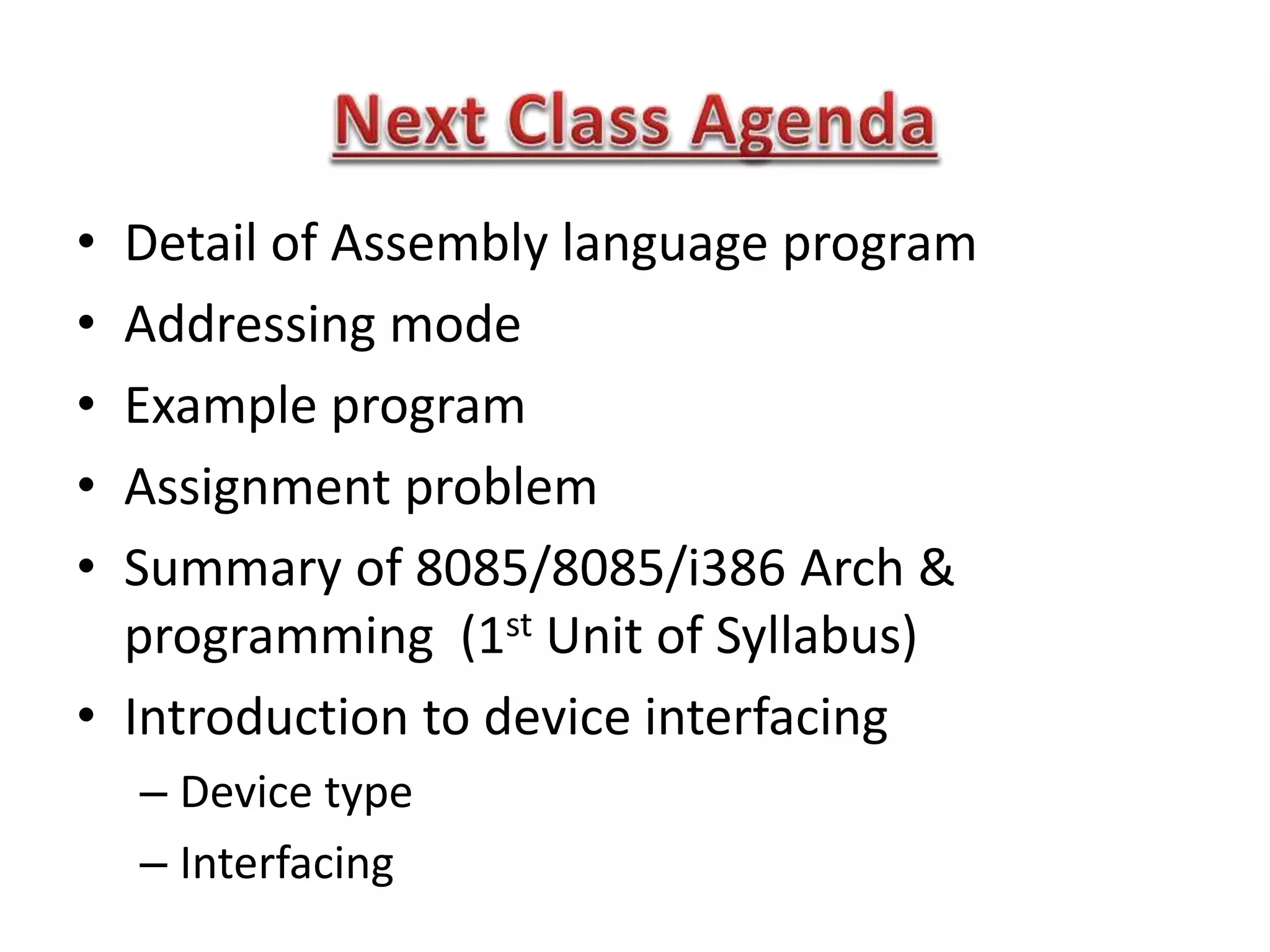
• Detail of Assembly language program
• Addressing mode
• Example program
• Assignment problem
• Summary of 8085/8085/i386 Arch &
programming (1st Unit of Syllabus)
• Introduction to device interfacing
– Device type
– Interfacing
Lec05

Lec05

  • 1.
    Dr A Sahu Deptof Computer Science & Engineering IIT Guwahati
  • 2.
    • Review of8086 Architecture – Block diagram (Data Path) • Similarity with x86 (i386, Pentium, etc) – Very IMP for interview/knowledge – Not part of Examination • x86 Assembly language program – Memory model – Example programs – Data Segment – Loop and Nested Loop • Next Class: Detail of assembly language – Summary of 8085/8086/i386 Arch & programming
  • 3.
    • 16 bitMicroprocessor • All internal registers as well as internal and external data buses were 16 bits wide • 4 Main Register, 4 Index Register, 4 Segment Register, Status Reg, Instr Ptr. • Not compatible with 8085, but with successors • Two Unit works in parallel: – Bus Interface Unit (BIU) – Execution Unit (EI)
  • 4.
    AH AL BH BL CHCL DH DL SI (Source Idx ) DI (Dest. Idx) BP (Base Ptr ) SP (Stack Ptr) Z (Flag Reg) CS (Code Seg Reg) DS (Data Seg Reg ) ES (Extra Seg Reg ) SS (Stack Seg Reg) IP (Intr Ptr) Operand InDirect Temp A Temp B Temp C Q6 Q5 Q4 Q3 Q2 Q1 Sequencer Bus Interface Unit Execution Unit SUM C BUS A BUS ALU
  • 5.
    • Execution Unit: – ALU may be loaded from three temp registers (TMPA, TMPB, TMPC) – Execute operations on bytes or 16-bit words. – The result stored into temp reg or registers connected to the internal data bus. • Bus Interface Unit – BIU is intended to compute the addresses. – Two temporary registers – indirect addressing – four segment registers (DS, CS, SS and ES), – Program counter (IP - Instruction Pointer), – A 6-byte Queue Buffer to store the pre-fetched opcodes and data. – This Prefetch Queue optimize the bus usage. – To execute a jump instruction the queue has to be flushed since the pre-fetched instructions do not have to be executed.
  • 6.
    • 1978: 8086(16 bit architecture) • 1980: 8087 • Floating point coprocessor is added • 1982: 80286 • Increases address space to 24 bits • 1985: 80386: • 32 bits Add, • Virtual Mem & new add modes • Protected mode (OS support) • 1989-95: 80486/Pentium/Pro • Added a few instructions of base MMX
  • 7.
    • 1997: PentiumII • 57 new “MMX” instructions are added, • 1999: Pentium III: • Out of Order, added another 70 Streaming SIMD Ext (SSE) • 2001: Pentium 4 • Net burst, another 144 instructions (SSE2) • 2003: PI4 HT, Trace Cache • 2005: Centrino, low power • 2007: Core architecture, Duo • 2008: Atom, Quad core with HT…. • 2009---:Multi core (Large chip multiprocessor)
  • 8.
    IF Time in baseCycle 0 1 2 3 4 5 6 7 8 9 D IS WBEX How Complex the HW will be
  • 9.
    Fetch Unit Cache/ memory Multiple instruction Sequential streamof instructions FU FU FU Register file Decode & issue Instruction/control Data FU Funtional Unit
  • 10.
    Instruction 1 Instruction 2 Instruction3 Instruction 4 Decoder EX Unit WB Unit Pipeline Pipe 1 Pipe 2 • Used in initial Pentium processor • Could execute up to 2 instructions simultaneously • Instructions sent through the pipeline in order - if the next two instructions had a dependency issue, only one instruction (pipe) would be executed and the second execution unit (pipe) went unused for that clock cycle.
  • 11.
    Instruction 1 Instruction 2 Instruction3 Instruction 4 Pipeline Decoder Decoder Decoder WB Unit Scheduler EX Unit Re Order Buffer Out of Order EU • Used in the Pentium II, III and Pro processors • 3 instruction decoders, which break each CISC instruction (macro-op) into equivalent micro-operations (µops) for the Out-of-Order Execution unit • 10 stage instruction pipeline utilized in this architecture
  • 12.
    Instruction 1 Instruction 2 Instruction3 Instruction 4 Decoder Decoder Decoder Scheduler EX Unit Re Order Buffer WB Unit Decoded Instructions (Execution Trace Cache) • New architecture used for the Intel Pentium IV and Pentium Xeon processors Pipeline Out of Order EU
  • 13.
    Parallel Parallel Preservingthe decoding instruction sequential and issue execution consistency of instruction execution and exception processing
  • 14.
    I - cache Instruction buffer Decode& Issue IF D/I I - cache Instruction buffer Decode & Issue IF D I Scalar Issue Superscalar Issue IF D I IF D I
  • 15.
    • Fetch multipleinstructions in instruction buffer • Decode multiple instructions in parallel – instruction window • Possibly check dependencies among these as well as with the instructions already under execution
  • 16.
    • ADD TA B T= A+B • ADD W C D W= C+D • LD A, 0(W) A=M[W] • ST C, 0(B) M[B]=C Read After Write (RAW), W after W, W after R RAW (Ins2-Ins3): True dependency WAW, WAR (Ins1 ot Ins3) : false dependency
  • 17.
    Blocking Issue • Decodeand issue to EU Instructions may be blocked due to data dependency Non-blocking Issue • Decode and issue to buffer • From buffer dispatch to EU Instructions are not blocked due to data dependency
  • 18.
    EU EU EU Decode Check& Issue Instruction Buffer issue window
  • 19.
  • 20.
    Preserving issue orderAlignment of instruction issue aligned unalignedin-order out of order
  • 21.
    • ADD TA B T= A+B • ADD W C D W= C+D • LD A, 0(W) A=M[W] • ST C, 0(B) M[B]=C
  • 22.
    cd abe a Issue window Instructions tobe issued Instructions issued cd abe a Issue window Instructions to be issued Instructions issued Issue in strict program order Out of order Issue c Example: MC 88110, PowerPC 601 Independent instruction Dependent instruction Issued instruction
  • 23.
    cd abe a fixed window checked incycle 1 Aligned Issue Unaligned Issue issued in cycle 1 fgh next window cd be b checked in cycle 2 issued in cycle 2 fgh de d checked in cycle 3 issued in cycle 3 fgh c cd abe a gliding window fgh cd be b fgh defgh c def
  • 24.
    Coping with Copingwith Use of Handling of Issue false data unresolved shelving issue blockages rate dependencies control (2-6) dependencies no Register renaming wait speculative blocking shelved
  • 25.
    Type of theNumber of Number of read shelving buffers shelving buffer entries and write ports Stand combined with alone renaming and (RS) reordering individual 2-4 group 6-16 central 20 total 15-40 depends on no. of EUs connected
  • 26.
    EU EU EUEU EU EU EU EU RS RS RS RS RS Individual RSs Group RSs Central RS
  • 27.
    EU EU RS RS EUEU RS RS Decode/issue RF instruction data
  • 28.
    EU EU RS RS EUEU RS RS Decode/issue instruction data RF
  • 29.
    • Register Renaming –Removes false dependencies (WAR and WAW) • Reordering Buffer (ROB) : Pentitum Out of order instruction processing – Ensures sequential consistency of interrupts (precise vs imprecise interrupts) – Facilitates speculative execution • Branch execution • Execute both path and discard after getting CC Value
  • 30.
    IF IS DPEX WB IF IS DP EX WB IF IS DP EX WB write read write RAW WAR WAW
  • 31.
    write R5 RAW read R5 WAR writeR5 RAW read R5 write R5 RAW read R5 write R8 RAW read R8
  • 32.
    • Compiler – Donestatically – Limited by registers visible to compiler • Hardware – Done dynamically – Limited by registers available to hardware
  • 33.
    • Kernel codewriting – Process switching code – Thread synchronization code – Lock, barrier (test & set, fetch & increment, xcng) – pthread spin_lock (in ASM) is 28% faster than intel tbb::spin_mutex (in C) • Time critical coding (Coding for DSP) – /usr/include/asm-i386 • Use of MASM/TASM/GCC/NASM compiler – gcc –S test.c –o test.s • C/C++ code with asm block • 8086 compatible with ii386/pentium
  • 34.
    • AX -the accumulator register (divided into AH / AL) • BX - the base address register (divided into BH / BL) • CX - the count register (divided into CH / CL) • DX - the data register (divided into DH / DL) • SI - source index register. • DI - destination index register. • BP - base pointer. • SP - stack pointer. AH AL BH BL CH CL DH DL SI (Source Idx ) DI (Dest. Idx) BP (Base Ptr ) SP (Stack Ptr) CS (Code Seg Reg) DS (Data Seg Reg ) ES (Extra Seg Reg ) SS (Stack Seg Reg) IP (Intr Ptr) Z (Flag Reg)
  • 35.
    AH AL BH BL CHCL DH DL SI (Source Idx ) DI (Dest. Idx) BP (Base Ptr ) SP (Stack Ptr) CS (Code Seg Reg) DS (Data Seg Reg ) ES (Extra Seg Reg ) SS (Stack Seg Reg) IP (Intr Ptr) Z (Flag Reg) EAX EBX ECX EDX ESI EDI EBP ESP ECS EDS EES ESS EIP EZ 31 15 7 0 Extended
  • 36.
    • Stack – automatic(default), local – Initialized/uninitialized • Data – Global, static, extern – BSS: Block Started by Symbol – BBS: Uninitialized Data Seg. • Code – program instructions • Heap – malloc, calloc Data Code Heap Stack BSS
  • 37.
    int A; int B=10; main(){ intAlocal; int *p; p=(int*)malloc(10); } Data Code Heap Stack BSS
  • 38.
    .model small .stack 100h; reserve 256 bytes of stack space .data message db "Hello world, I'm learning Assembly$” .code main proc mov ax, seg message mov ds, ax mov ah, 09 // 9 in the AH reg indicates Procedure //should write a bit-string to the screen. lea dx, message // Load Eff Address int 21h mov ax,4c00h // Halt for DOS routine (Exit Program) int 21h main endp end main
  • 39.
    • .model small –Most widely used memory model. – The code must fit in 64k. – The data must fit in 64k. • .model medium – The code can exceed 64k. – The data must fit in 64k. • .model compact – The code must fit in 64k. – The data can exceed 64k. • .medium and .compact are opposites.
  • 40.
    • db :define byte dw: def. word (2 bytes) • dd: def double word (4) dq : def quad word (8) • equ : equate assign numeric expr to a name .data db A 100 dup (?) ; define 100 bytes, with no initial values for bytes db “Hello” ; define 5 bytes, ASCII equivalent of “Hello”. dd PtrArray 4 dup (?) ;array[0..3] of dword maxint equ 32767 ; define maxint=32767 count equ 10 * 20 ; calculate a value (200)
  • 41.
    • Assemby code:Loop – Loop simply decreases CX and checks if CX != 0, if so, a Jump to the specified memory location – LOOPNZ : LOOPs when the zero flag is not set MOV CX,100 _LABEL: INC AX LOOP _LABEL MOV CX,10 _CMPLOOP:DEC AX CMP AX,3 LOOPNE CMPLOOP
  • 42.
    • Assemby code:Nested Loop: One CX register mov cx, 8 Loop1: push cx mov cx, 4 Loop2: stmts loop Loop2 pop cx stmts loop Loop1
  • 43.
    • Detail ofAssembly language program • Addressing mode • Example program • Assignment problem • Summary of 8085/8085/i386 Arch & programming (1st Unit of Syllabus) • Introduction to device interfacing – Device type – Interfacing