工業技術研究院機密資料 禁止複製、轉載、外流 ITRI CONFIDENTIAL DOCUMENT DO NOT COPY OR DISTRIBUTE
Machine Learning, Deep
Learning and Data Analysis
簡介
劉得彥
teyen.liu@gmail.com
Outline
2
• Overview of ML, DL and Data Analysis
• What is Machine Learning
▪ Take a Look At Linear Regression
▪ Other ML Algorithms at a Glance
▪ What is Neural Network?
• What is Deep Learning?
• Deep Learning using TensorFlow
• Data Analysis
▪ Case 1, 2 and 3
▪ Multivariate Analysis
My Experience for Machine Learning
3
• 學習過程走了一些冤望路!!
▪ Hope giving you an experience and guideline
• Take courses:
▪ Coursera: Machine Learning ( Got Certificate )
▪ Udemy: Data Science: Deep Learning in Python ( ongoing)
• Study on-line resources:
▪ Youtube、ML/DL tutorials … and so on
▪ https://morvanzhou.github.io/
▪ http://bangqu.com/gpu/blog
▪ http://www.jiqizhixin.com/insights
• Get you hands dirty
▪ Python programming
a. TensorFlow Deep Learning Library
b. Scikit-Learn Library
c. Numby, Pandas, matplotlib, …
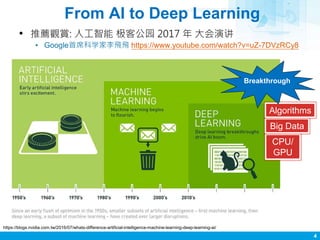
From AI to Deep Learning
4
• 推薦觀賞: 人工智能 极客公园 2017 年 大会演讲
▪ Google首席科学家李飛飛 https://www.youtube.com/watch?v=uZ-7DVzRCy8
https://blogs.nvidia.com.tw/2016/07/whats-difference-artificial-intelligence-machine-learning-deep-learning-ai/
CPU/
GPU
Big Data
Algorithms
Breakthrough
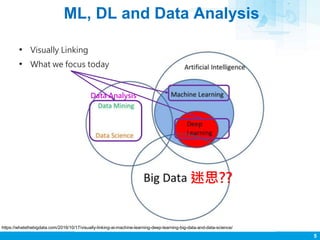
ML, DL and Data Analysis
5
• Visually Linking
• What we focus today
https://whatsthebigdata.com/2016/10/17/visually-linking-ai-machine-learning-deep-learning-big-data-and-data-science/
迷思??
Data Analysis
WHAT IS MACHINE
LEARNING
6
Machine Learning definition
7
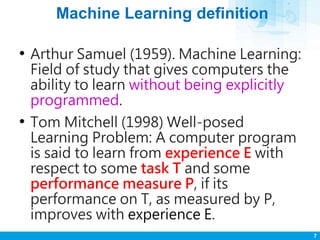
• Arthur Samuel (1959). Machine Learning:
Field of study that gives computers the
ability to learn without being explicitly
programmed.
• Tom Mitchell (1998) Well-posed
Learning Problem: A computer program
is said to learn from experience E with
respect to some task T and some
performance measure P, if its
performance on T, as measured by P,
improves with experience E.
Machine Learning definition
8
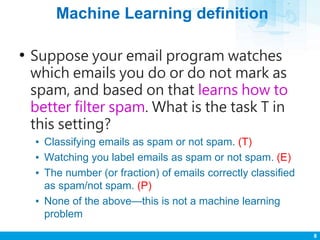
• Suppose your email program watches
which emails you do or do not mark as
spam, and based on that learns how to
better filter spam. What is the task T in
this setting?
▪ Classifying emails as spam or not spam. (T)
▪ Watching you label emails as spam or not spam. (E)
▪ The number (or fraction) of emails correctly classified
as spam/not spam. (P)
▪ None of the above—this is not a machine learning
problem
What is Machine Learning ?
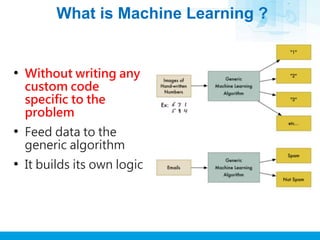
• Without writing any
custom code
specific to the
problem
• Feed data to the
generic algorithm
• It builds its own logic
Two styles of Machine Learning
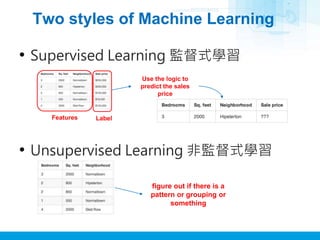
• Supervised Learning 監督式學習
• Unsupervised Learning 非監督式學習
Use the logic to
predict the sales
price
figure out if there is a
pattern or grouping or
something
Features Label
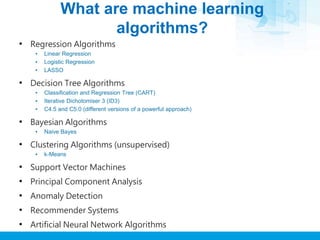
What are machine learning
algorithms?
• Regression Algorithms
▪ Linear Regression
▪ Logistic Regression
▪ LASSO
• Decision Tree Algorithms
▪ Classification and Regression Tree (CART)
▪ Iterative Dichotomiser 3 (ID3)
▪ C4.5 and C5.0 (different versions of a powerful approach)
• Bayesian Algorithms
▪ Naive Bayes
• Clustering Algorithms (unsupervised)
▪ k-Means
• Support Vector Machines
• Principal Component Analysis
• Anomaly Detection
• Recommender Systems
• Artificial Neural Network Algorithms
LET’S TAKE A LOOK AT
LINEAR REGRESSION
12
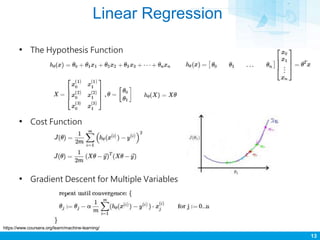
Linear Regression
13
• The Hypothesis Function
• Cost Function
• Gradient Descent for Multiple Variables
https://www.coursera.org/learn/machine-learning/
Gradient Descent
14
• How to choose learning α
https://www.coursera.org/learn/machine-learning/
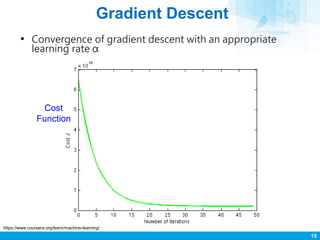
Gradient Descent
15
• Convergence of gradient descent with an appropriate
learning rate α
Cost
Function
https://www.coursera.org/learn/machine-learning/
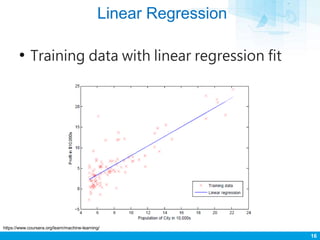
Linear Regression
16
• Training data with linear regression fit
https://www.coursera.org/learn/machine-learning/
OTHER ML ALGORITHMS
AT A GLANCE
17
Logistic Regression
18
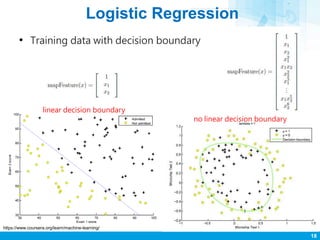
• Training data with decision boundary
linear decision boundary
no linear decision boundary
https://www.coursera.org/learn/machine-learning/
Support Vector Machines
19
• The difference between the kernels in SVM
▪ Linear
▪ Polynomial
▪ Gaussian (RBF)
▪ Sigmoid
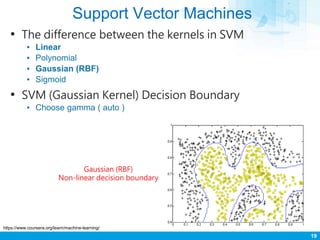
• SVM (Gaussian Kernel) Decision Boundary
▪ Choose gamma ( auto )
Gaussian (RBF)
Non-linear decision boundary
https://www.coursera.org/learn/machine-learning/
K-Means
20
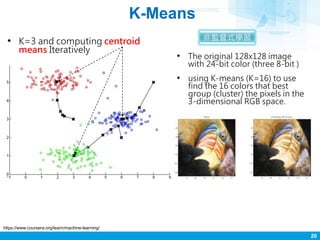
• The original 128x128 image
with 24-bit color (three 8-bit )
• using K-means (K=16) to use
find the 16 colors that best
group (cluster) the pixels in the
3-dimensional RGB space.
• K=3 and computing centroid
means Iteratively
https://www.coursera.org/learn/machine-learning/
非監督式學習
Principal Component Analysis
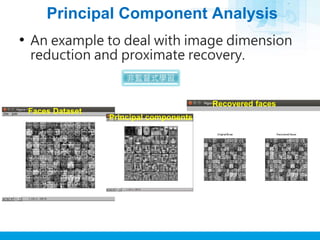
• An example to deal with image dimension
reduction and proximate recovery.
Faces Dataset
Recovered faces
Principal components
非監督式學習
WHAT IS NEURAL
NETWORK
(We will review the previous concepts a little bit)
22
ML -- write that program by
ourselves
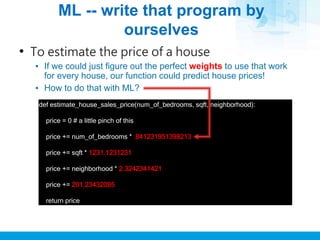
• To estimate the price of a house
▪ If we could just figure out the perfect weights to use that work
for every house, our function could predict house prices!
▪ How to do that with ML?
def estimate_house_sales_price(num_of_bedrooms, sqft, neighborhood):
price = 0 # a little pinch of this
price += num_of_bedrooms * .841231951398213
price += sqft * 1231.1231231
price += neighborhood * 2.3242341421
price += 201.23432095
return price
ML -- write that program by
ourselves
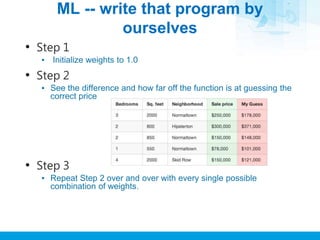
• Step 1
▪ Initialize weights to 1.0
• Step 2
▪ See the difference and how far off the function is at guessing the
correct price
• Step 3
▪ Repeat Step 2 over and over with every single possible
combination of weights.
ML -- What about that whole “try
every number” bit in Step 3?
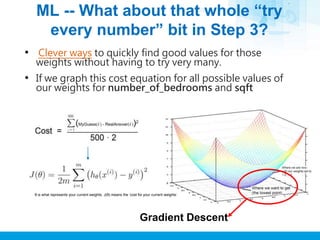
θ is what represents your current weights. J(θ) means the ‘cost for your current weights’.
• Clever ways to quickly find good values for those
weights without having to try very many.
• If we graph this cost equation for all possible values of
our weights for number_of_bedrooms and sqft
Gradient Descent
Making Smarter Guesses
26
• We ended up with this simple estimation function
def estimate_house_sales_price(num_of_bedrooms, sqft, neighborhood):
price = 0 # a little pinch of this
price += num_of_bedrooms * 0.123
price += sqft * 0.41
price += neighborhood * 0.57
return price
a linear relationship with the input
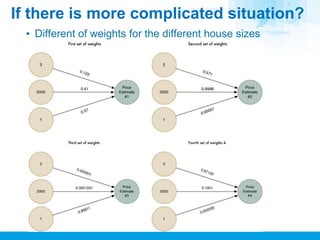
If there is more complicated situation?
▪ Different of weights for the different house sizes
What is a Neural Network
• Now we have four different price estimates.
• Let’s combine those four price estimates
into one final estimate.
neurons
This is a neural network
What is a Neural Network
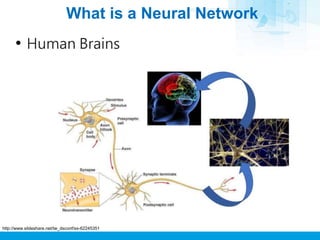
• Human Brains
http://www.slideshare.net/tw_dsconf/ss-62245351
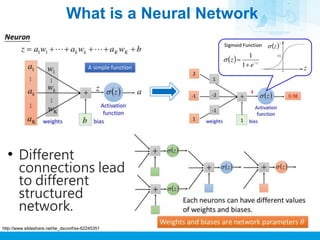
What is a Neural Network
• Different
connections lead
to different
structured
network.
http://www.slideshare.net/tw_dsconf/ss-62245351
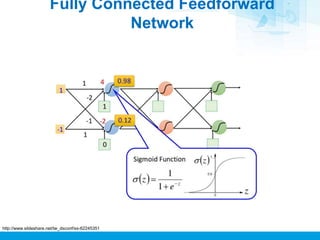
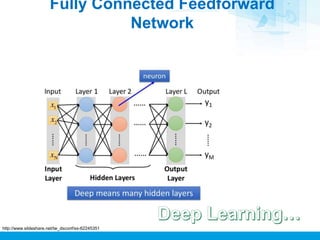
Fully Connected Feedforward
Network
http://www.slideshare.net/tw_dsconf/ss-62245351
Fully Connected Feedforward
Network
http://www.slideshare.net/tw_dsconf/ss-62245351
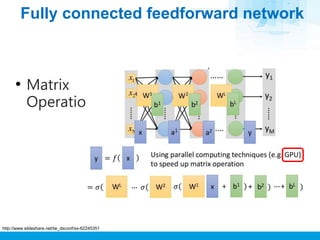
Fully connected feedforward network
• Matrix
Operation
http://www.slideshare.net/tw_dsconf/ss-62245351
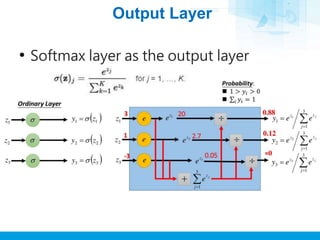
Output Layer
• Softmax layer as the output layer
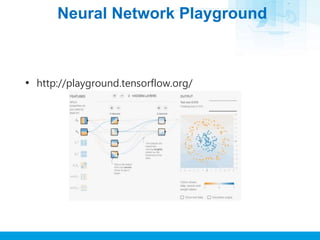
Neural Network Playground
• http://playground.tensorflow.org/
WHAT IS DEEP
LEARNING?
36
What is Deep Learning?
37
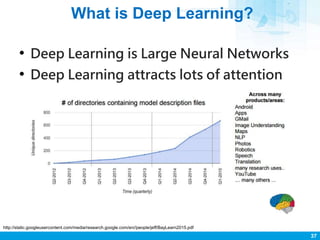
• Deep Learning is Large Neural Networks
• Deep Learning attracts lots of attention
http://static.googleusercontent.com/media/research.google.com/en//people/jeff/BayLearn2015.pdf
Why Deep Learning?
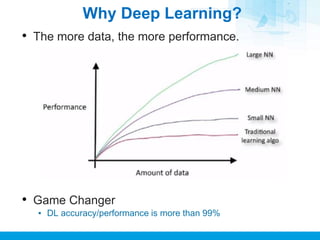
• The more data, the more performance.
• Game Changer
▪ DL accuracy/performance is more than 99%
Deep Learning Models
39
• Convolutional Neural Network
▪ Inception-V3
• Recurrent Neural Network
▪ LSTM
• Auto-encoder
• Reinforcement Learning
▪ Q-Learning
▪ Policy Gradient
• Wide and Deep Learning
▪ Recommender system
Deep Learning is not so simple
• Backpropagation
▪ an efficient way to compute Gradient Descent
• Overfitting
• Choosing Loss function
▪ Square Error, Cross Entropy, and so on…
• Mini-Batch
• Too deep ( many hidden layers )
▪ ReLU, MaxOut, …
• Learning Rates
• Momentum
▪ Adam ( optimizer )
• Weight Decay
• Dropout
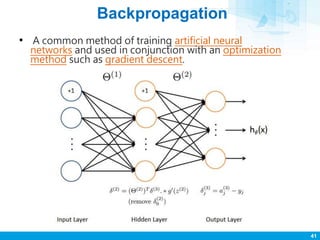
Backpropagation
41
• A common method of training artificial neural
networks and used in conjunction with an optimization
method such as gradient descent.
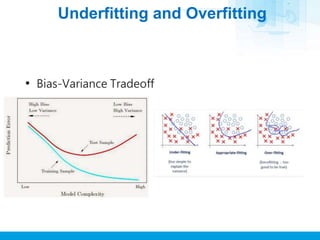
Underfitting and Overfitting
• Bias-Variance Tradeoff
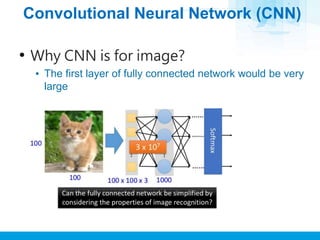
Convolutional Neural Network (CNN)
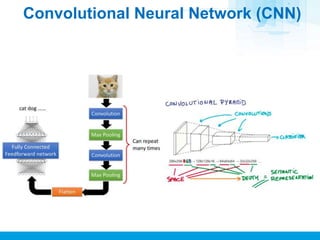
• Why CNN is for image?
▪ The first layer of fully connected network would be very
large
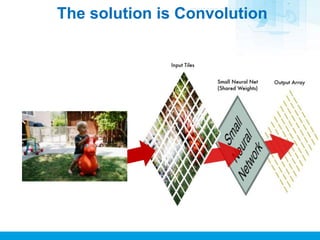
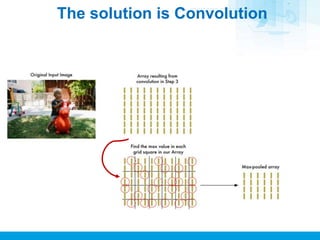
The solution is Convolution
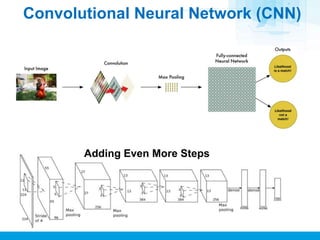
Convolutional Neural Network (CNN)
Adding Even More Steps
Convolutional Neural Network (CNN)
DEEP LEARNING USING
TENSORFLOW
48
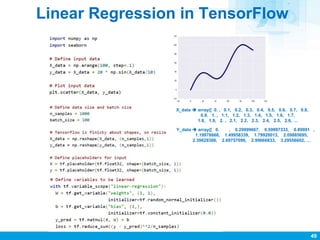
Linear Regression in TensorFlow
49
X_data  array([ 0. , 0.1, 0.2, 0.3, 0.4, 0.5, 0.6, 0.7, 0.8,
0.9, 1. , 1.1, 1.2, 1.3, 1.4, 1.5, 1.6, 1.7,
1.8, 1.9, 2. , 2.1, 2.2, 2.3, 2.4, 2.5, 2.6, …
Y_data  array([ 0. , 0.29999667, 0.59997333, 0.89991 ,
1.19978668, 1.49958339, 1.79928013, 2.09885695,
2.39829388, 2.69757098, 2.99666833, 3.29556602, …
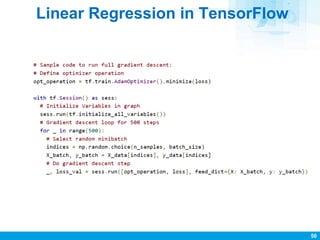
Linear Regression in TensorFlow
50
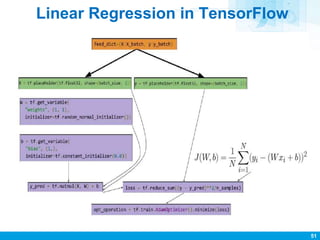
Linear Regression in TensorFlow
51
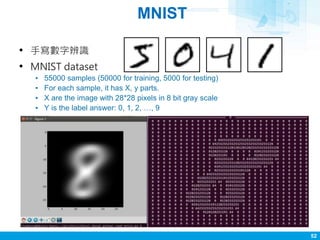
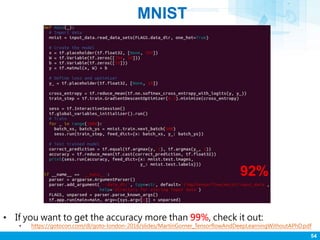
MNIST
52
• 手寫數字辨識
• MNIST dataset
▪ 55000 samples (50000 for training, 5000 for testing)
▪ For each sample, it has X, y parts.
▪ X are the image with 28*28 pixels in 8 bit gray scale
▪ Y is the label answer: 0, 1, 2, …, 9
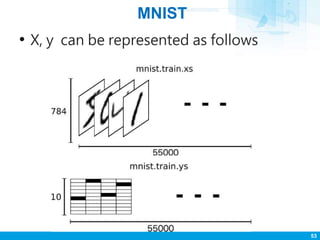
MNIST
53
• X, y can be represented as follows
MNIST
54
• If you want to get the accuracy more than 99%, check it out:
• https://gotocon.com/dl/goto-london-2016/slides/MartinGorner_TensorflowAndDeepLearningWithoutAPhD.pdf
92%
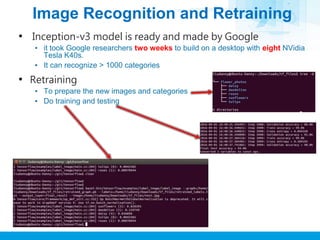
Image Recognition and Retraining
• Inception-v3 model is ready and made by Google
▪ it took Google researchers two weeks to build on a desktop with eight NVidia
Tesla K40s.
▪ It can recognize > 1000 categories
• Retraining
▪ To prepare the new images and categories
▪ Do training and testing
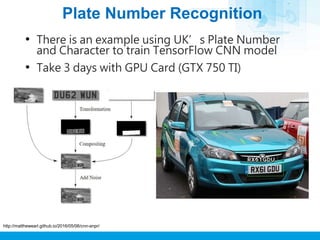
Plate Number Recognition
• There is an example using UK’s Plate Number
and Character to train TensorFlow CNN model
• Take 3 days with GPU Card (GTX 750 TI)
http://matthewearl.github.io/2016/05/06/cnn-anpr/
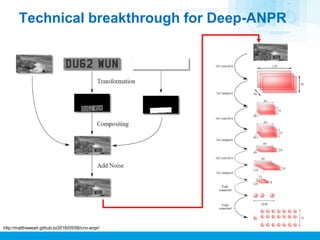
Technical breakthrough for Deep-ANPR
http://matthewearl.github.io/2016/05/06/cnn-anpr/
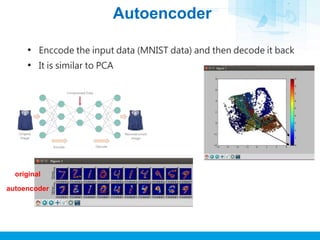
Autoencoder
• Enccode the input data (MNIST data) and then decode it back
• It is similar to PCA
autoencoder
original
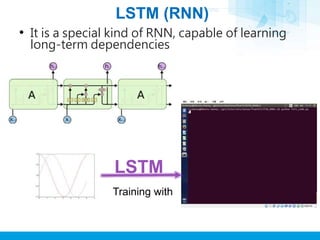
LSTM (RNN)
• It is a special kind of RNN, capable of learning
long-term dependencies
LSTM
Training with
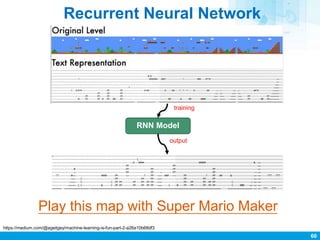
Recurrent Neural Network
60
RNN Model
training
output
Play this map with Super Mario Maker
https://medium.com/@ageitgey/machine-learning-is-fun-part-2-a26a10b68df3
(BIG) DATA ANALYSIS
61
Data Analysis
62
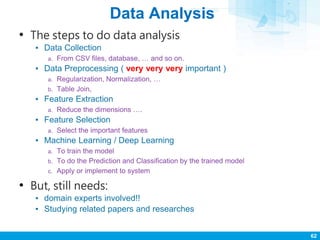
• The steps to do data analysis
▪ Data Collection
a. From CSV files, database, … and so on.
▪ Data Preprocessing ( very very very important )
a. Regularization, Normalization, …
b. Table Join,
▪ Feature Extraction
a. Reduce the dimensions ….
▪ Feature Selection
a. Select the important features
▪ Machine Learning / Deep Learning
a. To train the model
b. To do the Prediction and Classification by the trained model
c. Apply or implement to system
• But, still needs:
▪ domain experts involved!!
▪ Studying related papers and researches
Analysis Tools and Libraries
63
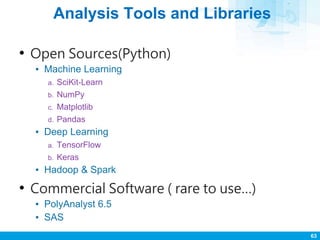
• Open Sources(Python)
▪ Machine Learning
a. SciKit-Learn
b. NumPy
c. Matplotlib
d. Pandas
▪ Deep Learning
a. TensorFlow
b. Keras
▪ Hadoop & Spark
• Commercial Software ( rare to use…)
▪ PolyAnalyst 6.5
▪ SAS
Data Analysis
64
• In my experience with data analysis, I
belong to a “Rookie”…
• 製造資料科學:從預測性思維到處方性決策
▪ http://www.slideshare.net/tw_dsconf/ss-71780267
Reference
• Machine Learning is Fun! – Medium
• Machine Learning is Fun! Part 2 – Medium
• Machine Learning is Fun! Part 3: Deep Learning and ... - Medium
• Deep Learning Tutorial
• FIRST CONTACT WITH TENSORFLOW
• https://ireneli.eu/2016/02/03/deep-learning-05-talk-about-convolutional-neural-
network%EF%BC%88cnn%EF%BC%89/
• http://www.slideshare.net/tw_dsconf/ss-71780267
• https://morvanzhou.github.io/tutorials/python-basic/
• https://media.readthedocs.org/pdf/python-for-multivariate-analysis/latest/python-for-
multivariate-analysis.pdf
• http://blog.topspeedsnail.com/
• http://www.leiphone.com/news/201702/vJpJqREn7EyoAd09.html
• Python 之機器學習套件 scikit-learn
▪ https://machine-learning-python.kspax.io/
▪ version >= 0.17
Thank You
66
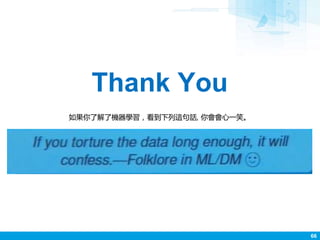
如果你了解了機器學習,看到下列這句話, 你會會心一笑。

Machine Learning, Deep Learning and Data Analysis Introduction

  • 1.
    工業技術研究院機密資料 禁止複製、轉載、外流 ITRICONFIDENTIAL DOCUMENT DO NOT COPY OR DISTRIBUTE Machine Learning, Deep Learning and Data Analysis 簡介 劉得彥 teyen.liu@gmail.com
  • 2.
    Outline 2 • Overview ofML, DL and Data Analysis • What is Machine Learning ▪ Take a Look At Linear Regression ▪ Other ML Algorithms at a Glance ▪ What is Neural Network? • What is Deep Learning? • Deep Learning using TensorFlow • Data Analysis ▪ Case 1, 2 and 3 ▪ Multivariate Analysis
  • 3.
    My Experience forMachine Learning 3 • 學習過程走了一些冤望路!! ▪ Hope giving you an experience and guideline • Take courses: ▪ Coursera: Machine Learning ( Got Certificate ) ▪ Udemy: Data Science: Deep Learning in Python ( ongoing) • Study on-line resources: ▪ Youtube、ML/DL tutorials … and so on ▪ https://morvanzhou.github.io/ ▪ http://bangqu.com/gpu/blog ▪ http://www.jiqizhixin.com/insights • Get you hands dirty ▪ Python programming a. TensorFlow Deep Learning Library b. Scikit-Learn Library c. Numby, Pandas, matplotlib, …
  • 4.
    From AI toDeep Learning 4 • 推薦觀賞: 人工智能 极客公园 2017 年 大会演讲 ▪ Google首席科学家李飛飛 https://www.youtube.com/watch?v=uZ-7DVzRCy8 https://blogs.nvidia.com.tw/2016/07/whats-difference-artificial-intelligence-machine-learning-deep-learning-ai/ CPU/ GPU Big Data Algorithms Breakthrough
  • 5.
    ML, DL andData Analysis 5 • Visually Linking • What we focus today https://whatsthebigdata.com/2016/10/17/visually-linking-ai-machine-learning-deep-learning-big-data-and-data-science/ 迷思?? Data Analysis
  • 6.
  • 7.
    Machine Learning definition 7 •Arthur Samuel (1959). Machine Learning: Field of study that gives computers the ability to learn without being explicitly programmed. • Tom Mitchell (1998) Well-posed Learning Problem: A computer program is said to learn from experience E with respect to some task T and some performance measure P, if its performance on T, as measured by P, improves with experience E.
  • 8.
    Machine Learning definition 8 •Suppose your email program watches which emails you do or do not mark as spam, and based on that learns how to better filter spam. What is the task T in this setting? ▪ Classifying emails as spam or not spam. (T) ▪ Watching you label emails as spam or not spam. (E) ▪ The number (or fraction) of emails correctly classified as spam/not spam. (P) ▪ None of the above—this is not a machine learning problem
  • 9.
    What is MachineLearning ? • Without writing any custom code specific to the problem • Feed data to the generic algorithm • It builds its own logic
  • 10.
    Two styles ofMachine Learning • Supervised Learning 監督式學習 • Unsupervised Learning 非監督式學習 Use the logic to predict the sales price figure out if there is a pattern or grouping or something Features Label
  • 11.
    What are machinelearning algorithms? • Regression Algorithms ▪ Linear Regression ▪ Logistic Regression ▪ LASSO • Decision Tree Algorithms ▪ Classification and Regression Tree (CART) ▪ Iterative Dichotomiser 3 (ID3) ▪ C4.5 and C5.0 (different versions of a powerful approach) • Bayesian Algorithms ▪ Naive Bayes • Clustering Algorithms (unsupervised) ▪ k-Means • Support Vector Machines • Principal Component Analysis • Anomaly Detection • Recommender Systems • Artificial Neural Network Algorithms
  • 12.
    LET’S TAKE ALOOK AT LINEAR REGRESSION 12
  • 13.
    Linear Regression 13 • TheHypothesis Function • Cost Function • Gradient Descent for Multiple Variables https://www.coursera.org/learn/machine-learning/
  • 14.
    Gradient Descent 14 • Howto choose learning α https://www.coursera.org/learn/machine-learning/
  • 15.
    Gradient Descent 15 • Convergenceof gradient descent with an appropriate learning rate α Cost Function https://www.coursera.org/learn/machine-learning/
  • 16.
    Linear Regression 16 • Trainingdata with linear regression fit https://www.coursera.org/learn/machine-learning/
  • 17.
  • 18.
    Logistic Regression 18 • Trainingdata with decision boundary linear decision boundary no linear decision boundary https://www.coursera.org/learn/machine-learning/
  • 19.
    Support Vector Machines 19 •The difference between the kernels in SVM ▪ Linear ▪ Polynomial ▪ Gaussian (RBF) ▪ Sigmoid • SVM (Gaussian Kernel) Decision Boundary ▪ Choose gamma ( auto ) Gaussian (RBF) Non-linear decision boundary https://www.coursera.org/learn/machine-learning/
  • 20.
    K-Means 20 • The original128x128 image with 24-bit color (three 8-bit ) • using K-means (K=16) to use find the 16 colors that best group (cluster) the pixels in the 3-dimensional RGB space. • K=3 and computing centroid means Iteratively https://www.coursera.org/learn/machine-learning/ 非監督式學習
  • 21.
    Principal Component Analysis •An example to deal with image dimension reduction and proximate recovery. Faces Dataset Recovered faces Principal components 非監督式學習
  • 22.
    WHAT IS NEURAL NETWORK (Wewill review the previous concepts a little bit) 22
  • 23.
    ML -- writethat program by ourselves • To estimate the price of a house ▪ If we could just figure out the perfect weights to use that work for every house, our function could predict house prices! ▪ How to do that with ML? def estimate_house_sales_price(num_of_bedrooms, sqft, neighborhood): price = 0 # a little pinch of this price += num_of_bedrooms * .841231951398213 price += sqft * 1231.1231231 price += neighborhood * 2.3242341421 price += 201.23432095 return price
  • 24.
    ML -- writethat program by ourselves • Step 1 ▪ Initialize weights to 1.0 • Step 2 ▪ See the difference and how far off the function is at guessing the correct price • Step 3 ▪ Repeat Step 2 over and over with every single possible combination of weights.
  • 25.
    ML -- Whatabout that whole “try every number” bit in Step 3? θ is what represents your current weights. J(θ) means the ‘cost for your current weights’. • Clever ways to quickly find good values for those weights without having to try very many. • If we graph this cost equation for all possible values of our weights for number_of_bedrooms and sqft Gradient Descent
  • 26.
    Making Smarter Guesses 26 •We ended up with this simple estimation function def estimate_house_sales_price(num_of_bedrooms, sqft, neighborhood): price = 0 # a little pinch of this price += num_of_bedrooms * 0.123 price += sqft * 0.41 price += neighborhood * 0.57 return price a linear relationship with the input
  • 27.
    If there ismore complicated situation? ▪ Different of weights for the different house sizes
  • 28.
    What is aNeural Network • Now we have four different price estimates. • Let’s combine those four price estimates into one final estimate. neurons This is a neural network
  • 29.
    What is aNeural Network • Human Brains http://www.slideshare.net/tw_dsconf/ss-62245351
  • 30.
    What is aNeural Network • Different connections lead to different structured network. http://www.slideshare.net/tw_dsconf/ss-62245351
  • 31.
  • 32.
  • 33.
    Fully connected feedforwardnetwork • Matrix Operation http://www.slideshare.net/tw_dsconf/ss-62245351
  • 34.
    Output Layer • Softmaxlayer as the output layer
  • 35.
    Neural Network Playground •http://playground.tensorflow.org/
  • 36.
  • 37.
    What is DeepLearning? 37 • Deep Learning is Large Neural Networks • Deep Learning attracts lots of attention http://static.googleusercontent.com/media/research.google.com/en//people/jeff/BayLearn2015.pdf
  • 38.
    Why Deep Learning? •The more data, the more performance. • Game Changer ▪ DL accuracy/performance is more than 99%
  • 39.
    Deep Learning Models 39 •Convolutional Neural Network ▪ Inception-V3 • Recurrent Neural Network ▪ LSTM • Auto-encoder • Reinforcement Learning ▪ Q-Learning ▪ Policy Gradient • Wide and Deep Learning ▪ Recommender system
  • 40.
    Deep Learning isnot so simple • Backpropagation ▪ an efficient way to compute Gradient Descent • Overfitting • Choosing Loss function ▪ Square Error, Cross Entropy, and so on… • Mini-Batch • Too deep ( many hidden layers ) ▪ ReLU, MaxOut, … • Learning Rates • Momentum ▪ Adam ( optimizer ) • Weight Decay • Dropout
  • 41.
    Backpropagation 41 • A commonmethod of training artificial neural networks and used in conjunction with an optimization method such as gradient descent.
  • 42.
    Underfitting and Overfitting •Bias-Variance Tradeoff
  • 43.
    Convolutional Neural Network(CNN) • Why CNN is for image? ▪ The first layer of fully connected network would be very large
  • 44.
    The solution isConvolution
  • 45.
    The solution isConvolution
  • 46.
    Convolutional Neural Network(CNN) Adding Even More Steps
  • 47.
  • 48.
  • 49.
    Linear Regression inTensorFlow 49 X_data  array([ 0. , 0.1, 0.2, 0.3, 0.4, 0.5, 0.6, 0.7, 0.8, 0.9, 1. , 1.1, 1.2, 1.3, 1.4, 1.5, 1.6, 1.7, 1.8, 1.9, 2. , 2.1, 2.2, 2.3, 2.4, 2.5, 2.6, … Y_data  array([ 0. , 0.29999667, 0.59997333, 0.89991 , 1.19978668, 1.49958339, 1.79928013, 2.09885695, 2.39829388, 2.69757098, 2.99666833, 3.29556602, …
  • 50.
    Linear Regression inTensorFlow 50
  • 51.
    Linear Regression inTensorFlow 51
  • 52.
    MNIST 52 • 手寫數字辨識 • MNISTdataset ▪ 55000 samples (50000 for training, 5000 for testing) ▪ For each sample, it has X, y parts. ▪ X are the image with 28*28 pixels in 8 bit gray scale ▪ Y is the label answer: 0, 1, 2, …, 9
  • 53.
    MNIST 53 • X, ycan be represented as follows
  • 54.
    MNIST 54 • If youwant to get the accuracy more than 99%, check it out: • https://gotocon.com/dl/goto-london-2016/slides/MartinGorner_TensorflowAndDeepLearningWithoutAPhD.pdf 92%
  • 55.
    Image Recognition andRetraining • Inception-v3 model is ready and made by Google ▪ it took Google researchers two weeks to build on a desktop with eight NVidia Tesla K40s. ▪ It can recognize > 1000 categories • Retraining ▪ To prepare the new images and categories ▪ Do training and testing
  • 56.
    Plate Number Recognition •There is an example using UK’s Plate Number and Character to train TensorFlow CNN model • Take 3 days with GPU Card (GTX 750 TI) http://matthewearl.github.io/2016/05/06/cnn-anpr/
  • 57.
    Technical breakthrough forDeep-ANPR http://matthewearl.github.io/2016/05/06/cnn-anpr/
  • 58.
    Autoencoder • Enccode theinput data (MNIST data) and then decode it back • It is similar to PCA autoencoder original
  • 59.
    LSTM (RNN) • Itis a special kind of RNN, capable of learning long-term dependencies LSTM Training with
  • 60.
    Recurrent Neural Network 60 RNNModel training output Play this map with Super Mario Maker https://medium.com/@ageitgey/machine-learning-is-fun-part-2-a26a10b68df3
  • 61.
  • 62.
    Data Analysis 62 • Thesteps to do data analysis ▪ Data Collection a. From CSV files, database, … and so on. ▪ Data Preprocessing ( very very very important ) a. Regularization, Normalization, … b. Table Join, ▪ Feature Extraction a. Reduce the dimensions …. ▪ Feature Selection a. Select the important features ▪ Machine Learning / Deep Learning a. To train the model b. To do the Prediction and Classification by the trained model c. Apply or implement to system • But, still needs: ▪ domain experts involved!! ▪ Studying related papers and researches
  • 63.
    Analysis Tools andLibraries 63 • Open Sources(Python) ▪ Machine Learning a. SciKit-Learn b. NumPy c. Matplotlib d. Pandas ▪ Deep Learning a. TensorFlow b. Keras ▪ Hadoop & Spark • Commercial Software ( rare to use…) ▪ PolyAnalyst 6.5 ▪ SAS
  • 64.
    Data Analysis 64 • Inmy experience with data analysis, I belong to a “Rookie”… • 製造資料科學:從預測性思維到處方性決策 ▪ http://www.slideshare.net/tw_dsconf/ss-71780267
  • 65.
    Reference • Machine Learningis Fun! – Medium • Machine Learning is Fun! Part 2 – Medium • Machine Learning is Fun! Part 3: Deep Learning and ... - Medium • Deep Learning Tutorial • FIRST CONTACT WITH TENSORFLOW • https://ireneli.eu/2016/02/03/deep-learning-05-talk-about-convolutional-neural- network%EF%BC%88cnn%EF%BC%89/ • http://www.slideshare.net/tw_dsconf/ss-71780267 • https://morvanzhou.github.io/tutorials/python-basic/ • https://media.readthedocs.org/pdf/python-for-multivariate-analysis/latest/python-for- multivariate-analysis.pdf • http://blog.topspeedsnail.com/ • http://www.leiphone.com/news/201702/vJpJqREn7EyoAd09.html • Python 之機器學習套件 scikit-learn ▪ https://machine-learning-python.kspax.io/ ▪ version >= 0.17
  • 66.