E-mail: hogijung@hanyang.ac.kr
http://web.yonsei.ac.kr/hgjung
8. Diagonalization
8. Diagonalization
E-mail: hogijung@hanyang.ac.kr
http://web.yonsei.ac.kr/hgjung
8.1. Matrix Representations of Linear Transformations
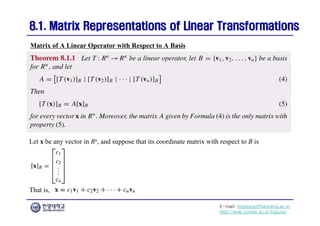
We know that every linear transformation T: RnRm has an associated standard matrix
Matrix of A Linear Operator with Respect to A Basis
with the property that
for every vector x in Rn. For the moment we will focus on the case where T is a linear operator
on Rn, so the standard matrix [T] is a square matrix of size n×n.
Sometimes the form of the standard matrix fully reveals the geometric properties of a linear
operator and sometimes it does not.
Our primary goal in this section is to develop a way of using bases other than the standard
basis to create matrices that describe the geometric behavior of a linear transformation better
than the standard matrix.
E-mail: hogijung@hanyang.ac.kr
http://web.yonsei.ac.kr/hgjung
8.1. Matrix Representations of Linear Transformations
Matrix of A Linear Operator with Respect to A Basis
Suppose that
is a linear operator on Rn and B is a basis for Rn. In the course of mapping x into T(x) this
operator creates a companion operator
that maps the coordinate matrix [x]B into the coordinate matrix [T(x)]B.
There must be a matrix A such that
E-mail: hogijung@hanyang.ac.kr
http://web.yonsei.ac.kr/hgjung
8.1. Matrix Representations of Linear Transformations
Let x be any vector in Rn, and suppose that its coordinate matrix with respect to B is
Matrix of A Linear Operator with Respect to A Basis
That is,
E-mail: hogijung@hanyang.ac.kr
http://web.yonsei.ac.kr/hgjung
8.1. Matrix Representations of Linear Transformations
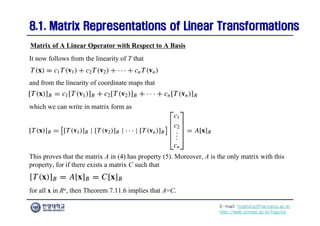
It now follows from the linearity of T that
Matrix of A Linear Operator with Respect to A Basis
and from the linearity of coordinate maps that
which we can write in matrix form as
This proves that the matrix A in (4) has property (5). Moreover, A is the only matrix with this
property, for if there exists a matrix C such that
for all x in Rn, then Theorem 7.11.6 implies that A=C.
E-mail: hogijung@hanyang.ac.kr
http://web.yonsei.ac.kr/hgjung
8.1. Matrix Representations of Linear Transformations
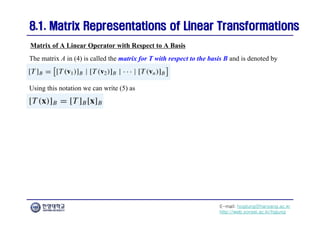
The matrix A in (4) is called the matrix for T with respect to the basis B and is denoted by
Matrix of A Linear Operator with Respect to A Basis
Using this notation we can write (5) as
E-mail: hogijung@hanyang.ac.kr
http://web.yonsei.ac.kr/hgjung
8.1. Matrix Representations of Linear Transformations
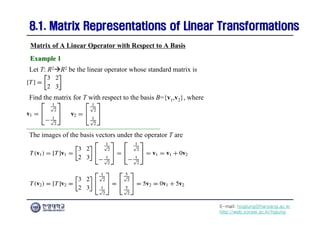
Let T: R2R2 be the linear operator whose standard matrix is
Matrix of A Linear Operator with Respect to A Basis
Example 1
Example 1
Find the matrix for T with respect to the basis B={v1,v2}, where
The images of the basis vectors under the operator T are
E-mail: hogijung@hanyang.ac.kr
http://web.yonsei.ac.kr/hgjung
8.1. Matrix Representations of Linear Transformations
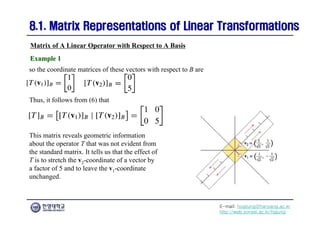
so the coordinate matrices of these vectors with respect to B are
Matrix of A Linear Operator with Respect to A Basis
Example 1
Example 1
Thus, it follows from (6) that
This matrix reveals geometric information
about the operator T that was not evident from
the standard matrix. It tells us that the effect of
T is to stretch the v2-coordinate of a vector by
a factor of 5 and to leave the v1-coordinate
unchanged.
E-mail: hogijung@hanyang.ac.kr
http://web.yonsei.ac.kr/hgjung
8.1. Matrix Representations of Linear Transformations
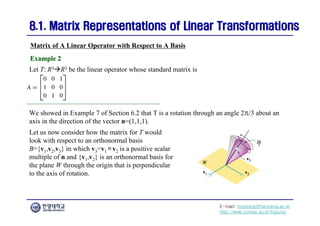
Let T: R3R3 be the linear operator whose standard matrix is
Matrix of A Linear Operator with Respect to A Basis
Example 2
Example 2
Let us now consider how the matrix for T would
look with respect to an orthonormal basis
B={v1,v2,v3} in which v3=v1×v2 is a positive scalar
multiple of n and {v1,v2} is an orthonormal basis for
the plane W through the origin that is perpendicular
to the axis of rotation.
We showed in Example 7 of Section 6.2 that T is a rotation through an angle 2π/3 about an
axis in the direction of the vector n=(1,1,1).
E-mail: hogijung@hanyang.ac.kr
http://web.yonsei.ac.kr/hgjung
8.1. Matrix Representations of Linear Transformations
The rotation leaves the vector v3 fixed, so
Matrix of A Linear Operator with Respect to A Basis
Example 2
Example 2
and hence
Also, T(v1) and T(v2) are linear combinations of v1 and v2, since these vectors lie in W. This
implies that the third coordinate of both [T(v1)]B and [T(v2)]B must be zero, and the matrix for
T with respect to the basis B must be of the form
E-mail: hogijung@hanyang.ac.kr
http://web.yonsei.ac.kr/hgjung
8.1. Matrix Representations of Linear Transformations
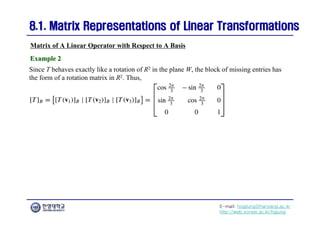
Since T behaves exactly like a rotation of R2 in the plane W, the block of missing entries has
the form of a rotation matrix in R2. Thus,
Matrix of A Linear Operator with Respect to A Basis
Example 2
Example 2
E-mail: hogijung@hanyang.ac.kr
http://web.yonsei.ac.kr/hgjung
8.1. Matrix Representations of Linear Transformations
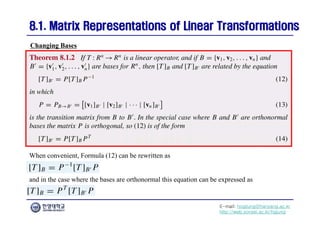
Suppose that T: RnRn is a linear operator and that B={v1,v2,…,vn} and B’={v’1,v’2,…,v’n}
are bases for Rn. Also, let P=PBB’ be the transition matrix from B to B’ (so P-1=PB’B is the
transition matrix from B’ to B).
Changing Bases
The diagram shows two different paths from [x]B’ to [T(x)]B’:
(11)
(10)
1.
2.
Thus, (10) and (11) together imply that
Since this holds for all x in Rn, it follows from Theorem 7.11.6 that
E-mail: hogijung@hanyang.ac.kr
http://web.yonsei.ac.kr/hgjung
8.1. Matrix Representations of Linear Transformations
When convenient, Formula (12) can be rewritten as
Changing Bases
and in the case where the bases are orthonormal this equation can be expressed as
E-mail: hogijung@hanyang.ac.kr
http://web.yonsei.ac.kr/hgjung
8.1. Matrix Representations of Linear Transformations
Since many linear operators are defined by their standard matrices, it is important to consider
the special case of Theorem 8.1.2 in which B’=S is the standard basis for Rn.
In this case [T]B’=[T]S=[T], and the transition matrix P from B to B’ has the simplified form
Changing Bases
E-mail: hogijung@hanyang.ac.kr
http://web.yonsei.ac.kr/hgjung
8.1. Matrix Representations of Linear Transformations
Changing Bases
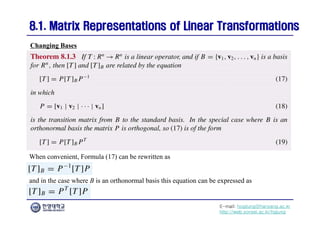
When convenient, Formula (17) can be rewritten as
and in the case where B is an orthonormal basis this equation can be expressed as
E-mail: hogijung@hanyang.ac.kr
http://web.yonsei.ac.kr/hgjung
8.1. Matrix Representations of Linear Transformations
Formula (17) [or (19) in the orthogonal case] tells us that the process of changing from the
standard basis for Rn to a basis B produces a factorization of the standard matrix for T as
Changing Bases
in which P is the transition matrix from the basis B to the standard basis S. To understand the
geometric significance of this factorization, let us use it to compute T(x) by writing
Reading from right to left, this equation tells us that T(x) can be obtained by first mapping the
standard coordinates of x to B-coordinates using the matrix P-1, then performing the operation
on the B-coordinates using the matrix [T]B, and then using the matrix P to map the resulting
vector back to standard coordinates.
E-mail: hogijung@hanyang.ac.kr
http://web.yonsei.ac.kr/hgjung
8.1. Matrix Representations of Linear Transformations
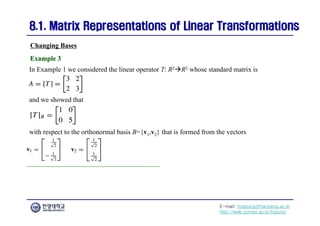
In Example 1 we considered the linear operator T: R2R2 whose standard matrix is
Changing Bases
Example 3
Example 3
and we showed that
with respect to the orthonormal basis B={v1,v2} that is formed from the vectors
E-mail: hogijung@hanyang.ac.kr
http://web.yonsei.ac.kr/hgjung
8.1. Matrix Representations of Linear Transformations
In this case the transition matrix from B to S is
Changing Bases
Example 3
Example 3
so it follows from (17) that [T] can be factored as
E-mail: hogijung@hanyang.ac.kr
http://web.yonsei.ac.kr/hgjung
8.1. Matrix Representations of Linear Transformations
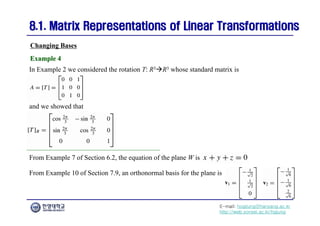
In Example 2 we considered the rotation T: R3R3 whose standard matrix is
Changing Bases
Example 4
Example 4
and we showed that
From Example 7 of Section 6.2, the equation of the plane W is
From Example 10 of Section 7.9, an orthonormal basis for the plane is
E-mail: hogijung@hanyang.ac.kr
http://web.yonsei.ac.kr/hgjung
8.1. Matrix Representations of Linear Transformations
Since v3=v1×v2,
Changing Bases
Example 4
Example 4
The transition matrix from B={v1,v2,v3} to the standard basis is
Since this matrix is orthogonal, it follows from (19) that [T] can be factored as
E-mail: hogijung@hanyang.ac.kr
http://web.yonsei.ac.kr/hgjung
8.1. Matrix Representations of Linear Transformations
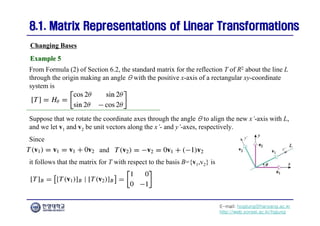
From Formula (2) of Section 6.2, the standard matrix for the reflection T of R2 about the line L
through the origin making an angle θ with the positive x-axis of a rectangular xy-coordinate
system is
Changing Bases
Example 5
Example 5
Suppose that we rotate the coordinate axes through the angle θ to align the new x’-axis with L,
and we let v1 and v2 be unit vectors along the x’- and y’-axes, respectively.
Since
and
it follows that the matrix for T with respect to the basis B={v1,v2} is
E-mail: hogijung@hanyang.ac.kr
http://web.yonsei.ac.kr/hgjung
8.1. Matrix Representations of Linear Transformations
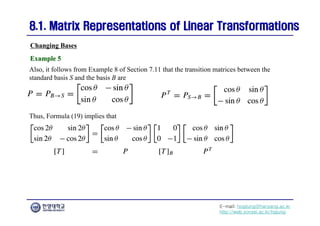
Also, it follows from Example 8 of Section 7.11 that the transition matrices between the
standard basis S and the basis B are
Changing Bases
Example 5
Example 5
Thus, Formula (19) implies that
E-mail: hogijung@hanyang.ac.kr
http://web.yonsei.ac.kr/hgjung
8.1. Matrix Representations of Linear Transformations
Recall that every linear transformation T: RnRm has an associated m×n standard matrix
Matrix of A Linear Transformation with Respect to A Pair of Bases
with the property that
If B and B’ are bases for Rn and Rm, respectively, then the transformation
creates an associated transformation
that maps the coordinate matrix [x]B into the coordinate matrix [T(x)]B’. As in the operator
case, this associated transformation is linear and hence must be a matrix transformation; that is,
there must be a matrix A such that
E-mail: hogijung@hanyang.ac.kr
http://web.yonsei.ac.kr/hgjung
8.1. Matrix Representations of Linear Transformations
The matrix A in (23) is called the matrix for T with respect to the bases B and B’ and is
denoted by the symbol [T]B’,B.
Matrix of A Linear Transformation with Respect to A Pair of Bases
E-mail: hogijung@hanyang.ac.kr
http://web.yonsei.ac.kr/hgjung
8.1. Matrix Representations of Linear Transformations
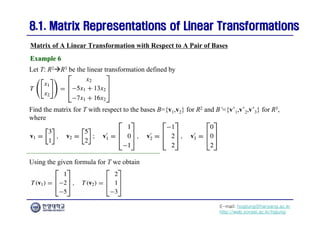
Let T: R2R3 be the linear transformation defined by
Matrix of A Linear Transformation with Respect to A Pair of Bases
Example 6
Example 6
Find the matrix for T with respect to the bases B={v1,v2} for R2 and B’={v’1,v’2,v’3} for R3,
where
Using the given formula for T we obtain
E-mail: hogijung@hanyang.ac.kr
http://web.yonsei.ac.kr/hgjung
8.1. Matrix Representations of Linear Transformations
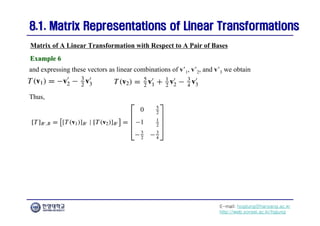
and expressing these vectors as linear combinations of v’1, v’2, and v’3 we obtain
Matrix of A Linear Transformation with Respect to A Pair of Bases
Example 6
Example 6
Thus,
E-mail: hogijung@hanyang.ac.kr
http://web.yonsei.ac.kr/hgjung
8.1. Matrix Representations of Linear Transformations
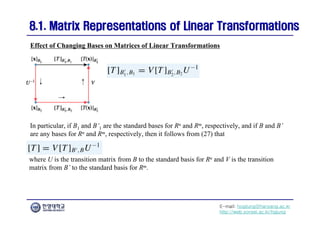
In particular, if B1 and B’1 are the standard bases for Rn and Rm, respectively, and if B and B’
are any bases for Rn and Rm, respectively, then it follows from (27) that
Effect of Changing Bases on Matrices of Linear Transformations
where U is the transition matrix from B to the standard basis for Rn and V is the transition
matrix from B’ to the standard basis for Rm.
E-mail: hogijung@hanyang.ac.kr
http://web.yonsei.ac.kr/hgjung
8.1. Matrix Representations of Linear Transformations
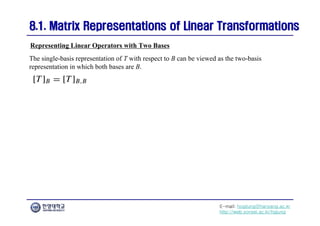
The single-basis representation of T with respect to B can be viewed as the two-basis
representation in which both bases are B.
Representing Linear Operators with Two Bases
E-mail: hogijung@hanyang.ac.kr
http://web.yonsei.ac.kr/hgjung
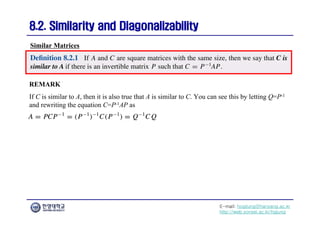
8.2. Similarity and Diagonalizability
REMARK
If C is similar to A, then it is also true that A is similar to C. You can see this by letting Q=P-1
and rewriting the equation C=P-1AP as
Similar Matrices
E-mail: hogijung@hanyang.ac.kr
http://web.yonsei.ac.kr/hgjung
8.2. Similarity and Diagonalizability
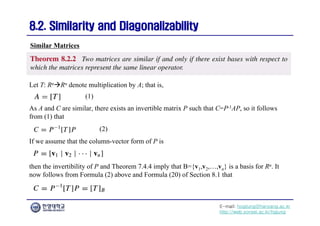
Let T: RnRn denote multiplication by A; that is,
Similar Matrices
As A and C are similar, there exists an invertible matrix P such that C=P-1AP, so it follows
from (1) that
(1)
If we assume that the column-vector form of P is
then the invertibility of P and Theorem 7.4.4 imply that B={v1,v2,…,vn} is a basis for Rn. It
now follows from Formula (2) above and Formula (20) of Section 8.1 that
(2)
E-mail: hogijung@hanyang.ac.kr
http://web.yonsei.ac.kr/hgjung
8.2. Similarity and Diagonalizability
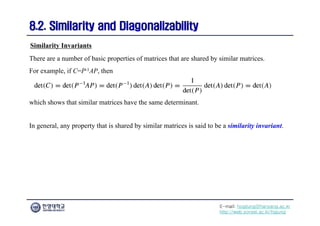
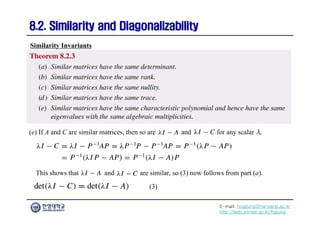
There are a number of basic properties of matrices that are shared by similar matrices.
For example, if C=P-1AP, then
Similarity Invariants
which shows that similar matrices have the same determinant.
In general, any property that is shared by similar matrices is said to be a similarity invariant.
E-mail: hogijung@hanyang.ac.kr
http://web.yonsei.ac.kr/hgjung
8.2. Similarity and Diagonalizability
Similarity Invariants
(e) If A and C are similar matrices, then so are and for any scalar λ.
This shows that and are similar, so (3) now follows from part (a).
(3)
E-mail: hogijung@hanyang.ac.kr
http://web.yonsei.ac.kr/hgjung
8.2. Similarity and Diagonalizability
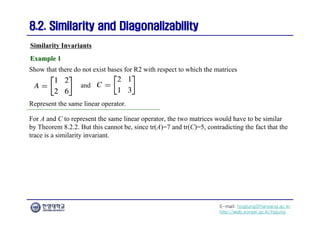
Show that there do not exist bases for R2 with respect to which the matrices
Similarity Invariants
Example 1
Example 1
and
Represent the same linear operator.
For A and C to represent the same linear operator, the two matrices would have to be similar
by Theorem 8.2.2. But this cannot be, since tr(A)=7 and tr(C)=5, contradicting the fact that the
trace is a similarity invariant.
E-mail: hogijung@hanyang.ac.kr
http://web.yonsei.ac.kr/hgjung
8.2. Similarity and Diagonalizability
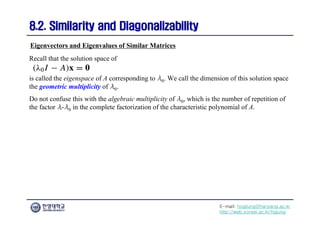
Recall that the solution space of
Eigenvectors and Eigenvalues of Similar Matrices
is called the eigenspace of A corresponding to λ0. We call the dimension of this solution space
the geometric multiplicity of λ0.
Do not confuse this with the algebraic multiplicity of λ0, which is the number of repetition of
the factor λ-λ0 in the complete factorization of the characteristic polynomial of A.
E-mail: hogijung@hanyang.ac.kr
http://web.yonsei.ac.kr/hgjung
8.2. Similarity and Diagonalizability
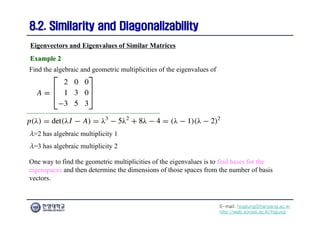
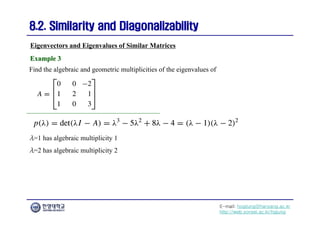
Find the algebraic and geometric multiplicities of the eigenvalues of
Eigenvectors and Eigenvalues of Similar Matrices
Example 2
Example 2
λ=2 has algebraic multiplicity 1
λ=3 has algebraic multiplicity 2
One way to find the geometric multiplicities of the eigenvalues is to find bases for the
eigenspaces and then determine the dimensions of those spaces from the number of basis
vectors.
E-mail: hogijung@hanyang.ac.kr
http://web.yonsei.ac.kr/hgjung
8.2. Similarity and Diagonalizability
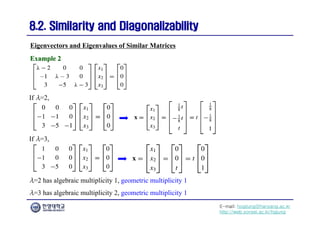
If λ=2,
Eigenvectors and Eigenvalues of Similar Matrices
Example 2
Example 2
If λ=3,
λ=2 has algebraic multiplicity 1, geometric multiplicity 1
λ=3 has algebraic multiplicity 2, geometric multiplicity 1
E-mail: hogijung@hanyang.ac.kr
http://web.yonsei.ac.kr/hgjung
8.2. Similarity and Diagonalizability
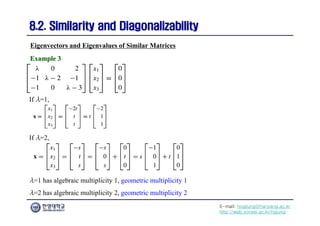
Find the algebraic and geometric multiplicities of the eigenvalues of
Eigenvectors and Eigenvalues of Similar Matrices
Example 3
Example 3
λ=1 has algebraic multiplicity 1
λ=2 has algebraic multiplicity 2
E-mail: hogijung@hanyang.ac.kr
http://web.yonsei.ac.kr/hgjung
8.2. Similarity and Diagonalizability
Eigenvectors and Eigenvalues of Similar Matrices
Example 3
Example 3
If λ=1,
If λ=2,
λ=1 has algebraic multiplicity 1, geometric multiplicity 1
λ=2 has algebraic multiplicity 2, geometric multiplicity 2
E-mail: hogijung@hanyang.ac.kr
http://web.yonsei.ac.kr/hgjung
8.2. Similarity and Diagonalizability
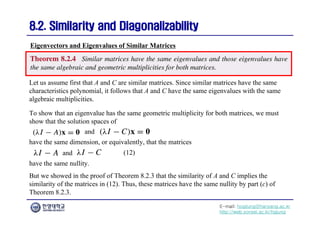
Let us assume first that A and C are similar matrices. Since similar matrices have the same
characteristics polynomial, it follows that A and C have the same eigenvalues with the same
algebraic multiplicities.
Eigenvectors and Eigenvalues of Similar Matrices
To show that an eigenvalue has the same geometric multiplicity for both matrices, we must
show that the solution spaces of
and
have the same nullity.
But we showed in the proof of Theorem 8.2.3 that the similarity of A and C implies the
similarity of the matrices in (12). Thus, these matrices have the same nullity by part (c) of
Theorem 8.2.3.
have the same dimension, or equivalently, that the matrices
and
(12)
E-mail: hogijung@hanyang.ac.kr
http://web.yonsei.ac.kr/hgjung
8.2. Similarity and Diagonalizability
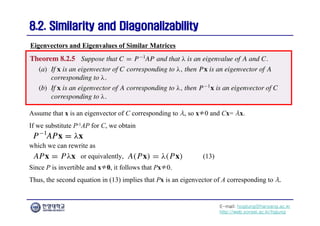
Assume that x is an eigenvector of C corresponding to λ, so x≠0 and Cx= λx.
If we substitute P-1AP for C, we obtain
Eigenvectors and Eigenvalues of Similar Matrices
which we can rewrite as
or equivalently,
Since P is invertible and x≠0, it follows that Px≠0.
Thus, the second equation in (13) implies that Px is an eigenvector of A corresponding to λ.
(13)
E-mail: hogijung@hanyang.ac.kr
http://web.yonsei.ac.kr/hgjung
8.2. Similarity and Diagonalizability
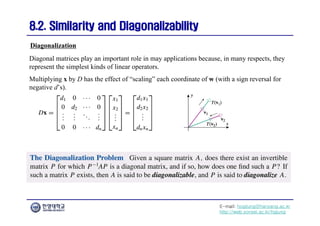
Diagonal matrices play an important role in may applications because, in many respects, they
represent the simplest kinds of linear operators.
Multiplying x by D has the effect of “scaling” each coordinate of w (with a sign reversal for
negative d’s).
Diagonalization
E-mail: hogijung@hanyang.ac.kr
http://web.yonsei.ac.kr/hgjung
8.2. Similarity and Diagonalizability
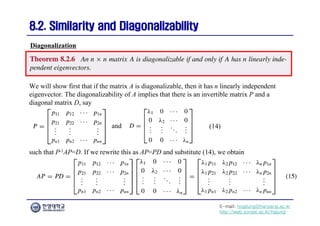
We will show first that if the matrix A is diagonalizable, then it has n linearly independent
eigenvector. The diagonalizability of A implies that there is an invertible matrix P and a
diagonal matrix D, say
Diagonalization
and
such that P-1AP=D. If we rewrite this as AP=PD and substitute (14), we obtain
(14)
E-mail: hogijung@hanyang.ac.kr
http://web.yonsei.ac.kr/hgjung
8.2. Similarity and Diagonalizability
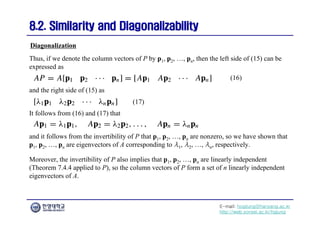
Thus, if we denote the column vectors of P by p1, p2, …, pn, then the left side of (15) can be
expressed as
Diagonalization
(16)
and the right side of (15) as
(17)
It follows from (16) and (17) that
and it follows from the invertibility of P that p1, p2, …, pn are nonzero, so we have shown that
p1, p2, …, pn are eigenvectors of A corresponding to λ1, λ2, …, λn, respectively.
Moreover, the invertibility of P also implies that p1, p2, …, pn are linearly independent
(Theorem 7.4.4 applied to P), so the column vectors of P form a set of n linearly independent
eigenvectors of A.
E-mail: hogijung@hanyang.ac.kr
http://web.yonsei.ac.kr/hgjung
8.2. Similarity and Diagonalizability
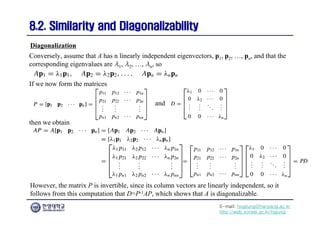
Conversely, assume that A has n linearly independent eigenvectors, p1, p2, …, pn, and that the
corresponding eigenvalues are λ1, λ2, …, λn, so
Diagonalization
If we now form the matrices
and
then we obtain
However, the matrix P is invertible, since its column vectors are linearly independent, so it
follows from this computation that D=P-1AP, which shows that A is diagonalizable.
E-mail: hogijung@hanyang.ac.kr
http://web.yonsei.ac.kr/hgjung
8.2. Similarity and Diagonalizability
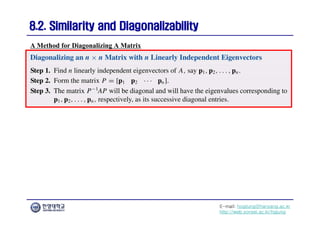
A Method for Diagonalizing A Matrix
E-mail: hogijung@hanyang.ac.kr
http://web.yonsei.ac.kr/hgjung
8.2. Similarity and Diagonalizability
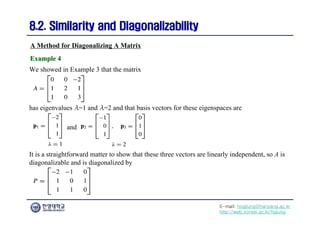
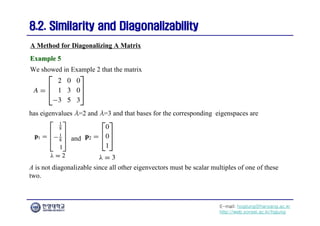
We showed in Example 3 that the matrix
A Method for Diagonalizing A Matrix
Example 4
Example 4
has eigenvalues λ=1 and λ=2 and that basis vectors for these eigenspaces are
and
It is a straightforward matter to show that these three vectors are linearly independent, so A is
diagonalizable and is diagonalized by
E-mail: hogijung@hanyang.ac.kr
http://web.yonsei.ac.kr/hgjung
8.2. Similarity and Diagonalizability
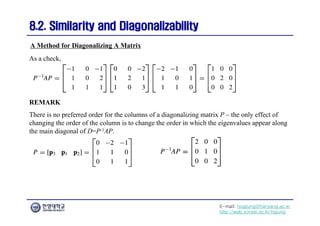
As a check,
A Method for Diagonalizing A Matrix
REMARK
There is no preferred order for the columns of a diagonalizing matrix P – the only effect of
changing the order of the column is to change the order in which the eigenvalues appear along
the main diagonal of D=P-1AP.
E-mail: hogijung@hanyang.ac.kr
http://web.yonsei.ac.kr/hgjung
8.2. Similarity and Diagonalizability
We showed in Example 2 that the matrix
A Method for Diagonalizing A Matrix
Example 5
Example 5
has eigenvalues λ=2 and λ=3 and that bases for the corresponding eigenspaces are
and
A is not diagonalizable since all other eigenvectors must be scalar multiples of one of these
two.
E-mail: hogijung@hanyang.ac.kr
http://web.yonsei.ac.kr/hgjung
8.2. Similarity and Diagonalizability
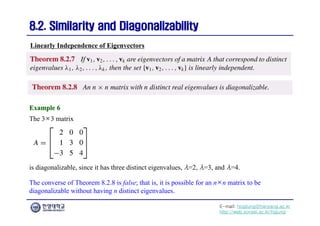
The 3×3 matrix
Linearly Independence of Eigenvectors
Example 6
Example 6
is diagonalizable, since it has three distinct eigenvalues, λ=2, λ=3, and λ=4.
The converse of Theorem 8.2.8 is false; that is, it is possible for an n×n matrix to be
diagonalizable without having n distinct eigenvalues.
E-mail: hogijung@hanyang.ac.kr
http://web.yonsei.ac.kr/hgjung
8.2. Similarity and Diagonalizability
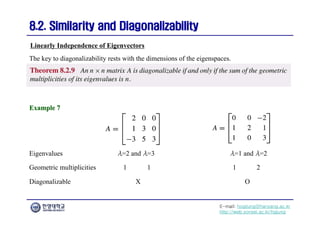
The key to diagonalizability rests with the dimensions of the eigenspaces.
Linearly Independence of Eigenvectors
Example 7
Example 7
Eigenvalues λ=2 and λ=3 λ=1 and λ=2
Geometric multiplicities 1 1 1 2
Diagonalizable X O
E-mail: hogijung@hanyang.ac.kr
http://web.yonsei.ac.kr/hgjung
8.2. Similarity and Diagonalizability
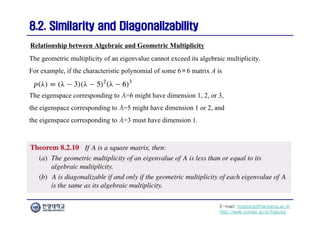
The geometric multiplicity of an eigenvalue cannot exceed its algebraic multiplicity.
For example, if the characteristic polynomial of some 6×6 matrix A is
Relationship between Algebraic and Geometric Multiplicity
The eigenspace corresponding to λ=6 might have dimension 1, 2, or 3,
the eigenspace corresponding to λ=5 might have dimension 1 or 2, and
the eigenspace corresponding to λ=3 must have dimension 1.
E-mail: hogijung@hanyang.ac.kr
http://web.yonsei.ac.kr/hgjung
8.2. Similarity and Diagonalizability
A Unifying Theorem on Diagonalizability
E-mail: hogijung@hanyang.ac.kr
http://web.yonsei.ac.kr/hgjung
8.3. Orthogonal Diagonalizability; Functions of a Matrix
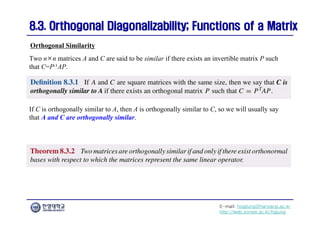
Two n×n matrices A and C are said to be similar if there exists an invertible matrix P such
that C=P-1AP.
Orthogonal Similarity
If C is orthogonally similar to A, then A is orthogonally similar to C, so we will usually say
that A and C are orthogonally similar.
E-mail: hogijung@hanyang.ac.kr
http://web.yonsei.ac.kr/hgjung
8.3. Orthogonal Diagonalizability; Functions of a Matrix
Orthogonal Similarity
E-mail: hogijung@hanyang.ac.kr
http://web.yonsei.ac.kr/hgjung
8.3. Orthogonal Diagonalizability; Functions of a Matrix
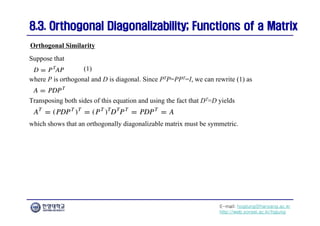
Suppose that
Orthogonal Similarity
where P is orthogonal and D is diagonal. Since PTP=PPT=I, we can rewrite (1) as
(1)
Transposing both sides of this equation and using the fact that DT=D yields
which shows that an orthogonally diagonalizable matrix must be symmetric.
E-mail: hogijung@hanyang.ac.kr
http://web.yonsei.ac.kr/hgjung
8.3. Orthogonal Diagonalizability; Functions of a Matrix
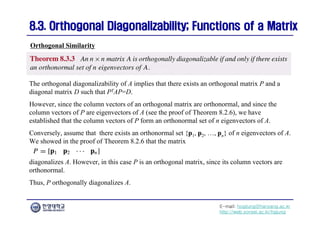
The orthogonal diagonalizability of A implies that there exists an orthogonal matrix P and a
diagonal matrix D such that PTAP=D.
However, since the column vectors of an orthogonal matrix are orthonormal, and since the
column vectors of P are eigenvectors of A (see the proof of Theorem 8.2.6), we have
established that the column vectors of P form an orthonormal set of n eigenvectors of A.
Conversely, assume that there exists an orthonormal set {p1, p2, …, pn} of n eigenvectors of A.
We showed in the proof of Theorem 8.2.6 that the matrix
Orthogonal Similarity
diagonalizes A. However, in this case P is an orthogonal matrix, since its column vectors are
orthonormal.
Thus, P orthogonally diagonalizes A.
E-mail: hogijung@hanyang.ac.kr
http://web.yonsei.ac.kr/hgjung
8.3. Orthogonal Diagonalizability; Functions of a Matrix
(b) Let v1 and v2 be eigenvectors corresponding to distinct eigenvalues λ1 and λ2, respectively.
The proof that v1·v2=0 will be facilitated by using Formula (26) of Section 3.1 to write
λ1 (v1·v2)=(λ1v1)·v2 as the matrix product (λ1v1)Tv2. The rest of the proof now consists of
manipulating this expression in the right way:
Orthogonal Similarity
[v1 is an eigenvector corresponding to λ1]
[symmetry of A]
[v2 is an eigenvector corresponding to λ2]
[Formula (26) of Section 3.1]
This implies that (λ1- λ2)(v1·v2)=0, so v1·v2=0 as a result of the fact that λ1≠λ2.
E-mail: hogijung@hanyang.ac.kr
http://web.yonsei.ac.kr/hgjung
8.3. Orthogonal Diagonalizability; Functions of a Matrix
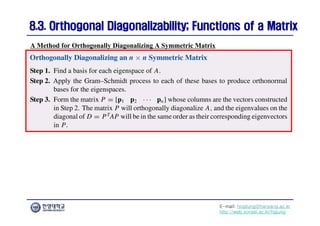
A Method for Orthogonally Diagonalizing A Symmetric Matrix
E-mail: hogijung@hanyang.ac.kr
http://web.yonsei.ac.kr/hgjung
8.3. Orthogonal Diagonalizability; Functions of a Matrix
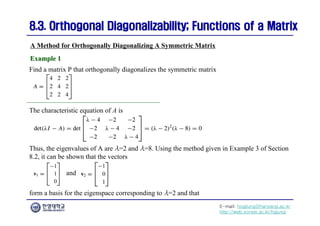
Find a matrix P that orthogonally diagonalizes the symmetric matrix
A Method for Orthogonally Diagonalizing A Symmetric Matrix
Example 1
Example 1
The characteristic equation of A is
Thus, the eigenvalues of A are λ=2 and λ=8. Using the method given in Example 3 of Section
8.2, it can be shown that the vectors
and
form a basis for the eigenspace corresponding to λ=2 and that
E-mail: hogijung@hanyang.ac.kr
http://web.yonsei.ac.kr/hgjung
8.3. Orthogonal Diagonalizability; Functions of a Matrix
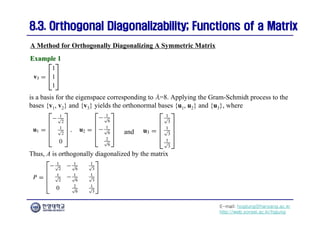
is a basis for the eigenspace corresponding to λ=8. Applying the Gram-Schmidt process to the
bases {v1, v2} and {v3} yields the orthonormal bases {u1, u2} and {u3}, where
A Method for Orthogonally Diagonalizing A Symmetric Matrix
Example 1
Example 1
and
Thus, A is orthogonally diagonalized by the matrix
E-mail: hogijung@hanyang.ac.kr
http://web.yonsei.ac.kr/hgjung
8.3. Orthogonal Diagonalizability; Functions of a Matrix
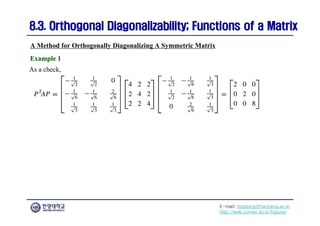
As a check,
A Method for Orthogonally Diagonalizing A Symmetric Matrix
Example 1
Example 1
E-mail: hogijung@hanyang.ac.kr
http://web.yonsei.ac.kr/hgjung
8.3. Orthogonal Diagonalizability; Functions of a Matrix
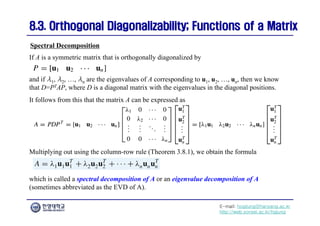
If A is a symmetric matrix that is orthogonally diagonalized by
Spectral Decomposition
and if λ1, λ2, …, λn are the eigenvalues of A corresponding to u1, u2, …, un, then we know
that D=PTAP, where D is a diagonal matrix with the eigenvalues in the diagonal positions.
It follows from this that the matrix A can be expressed as
Multiplying out using the column-row rule (Theorem 3.8.1), we obtain the formula
which is called a spectral decomposition of A or an eigenvalue decomposition of A
(sometimes abbreviated as the EVD of A).
E-mail: hogijung@hanyang.ac.kr
http://web.yonsei.ac.kr/hgjung
8.3. Orthogonal Diagonalizability; Functions of a Matrix
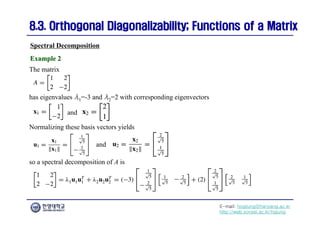
The matrix
Spectral Decomposition
Example 2
Example 2
has eigenvalues λ1=-3 and λ2=2 with corresponding eigenvectors
and
Normalizing these basis vectors yields
and
so a spectral decomposition of A is
E-mail: hogijung@hanyang.ac.kr
http://web.yonsei.ac.kr/hgjung
8.3. Orthogonal Diagonalizability; Functions of a Matrix
Spectral Decomposition
Example 2
Example 2
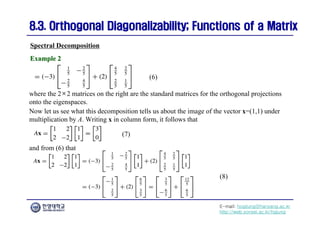
where the 2×2 matrices on the right are the standard matrices for the orthogonal projections
onto the eigenspaces.
Now let us see what this decomposition tells us about the image of the vector x=(1,1) under
multiplication by A. Writing x in column form, it follows that
(7)
(8)
(6)
and from (6) that
E-mail: hogijung@hanyang.ac.kr
http://web.yonsei.ac.kr/hgjung
8.3. Orthogonal Diagonalizability; Functions of a Matrix
Spectral Decomposition
Example 2
Example 2
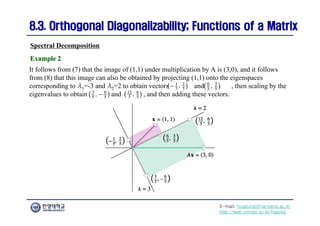
It follows from (7) that the image of (1,1) under multiplication by A is (3,0), and it follows
from (8) that this image can also be obtained by projecting (1,1) onto the eigenspaces
corresponding to λ1=-3 and λ2=2 to obtain vectors and , then scaling by the
eigenvalues to obtain and , and then adding these vectors.
E-mail: hogijung@hanyang.ac.kr
http://web.yonsei.ac.kr/hgjung
8.3. Orthogonal Diagonalizability; Functions of a Matrix
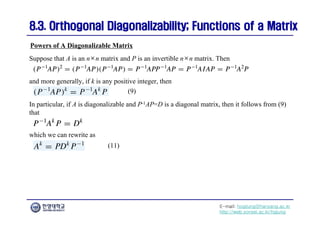
Suppose that A is an n×n matrix and P is an invertible n×n matrix. Then
Powers of A Diagonalizable Matrix
and more generally, if k is any positive integer, then
In particular, if A is diagonalizable and P-1AP=D is a diagonal matrix, then it follows from (9)
that
(9)
which we can rewrite as
(11)
E-mail: hogijung@hanyang.ac.kr
http://web.yonsei.ac.kr/hgjung
8.3. Orthogonal Diagonalizability; Functions of a Matrix
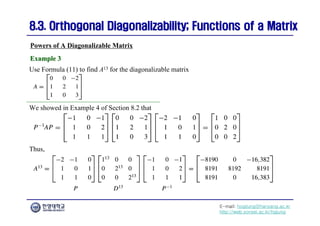
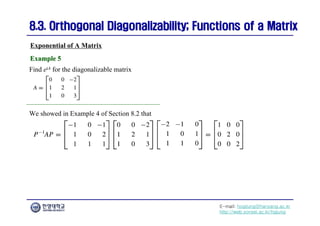
Use Formula (11) to find A13 for the diagonalizable matrix
Powers of A Diagonalizable Matrix
Example 3
Example 3
We showed in Example 4 of Section 8.2 that
Thus,
E-mail: hogijung@hanyang.ac.kr
http://web.yonsei.ac.kr/hgjung
8.3. Orthogonal Diagonalizability; Functions of a Matrix
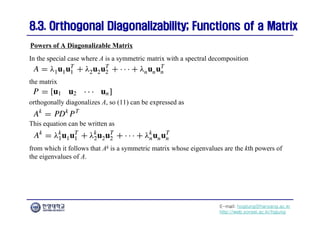
In the special case where A is a symmetric matrix with a spectral decomposition
Powers of A Diagonalizable Matrix
the matrix
orthogonally diagonalizes A, so (11) can be expressed as
This equation can be written as
from which it follows that Ak is a symmetric matrix whose eigenvalues are the kth powers of
the eigenvalues of A.
E-mail: hogijung@hanyang.ac.kr
http://web.yonsei.ac.kr/hgjung
8.3. Orthogonal Diagonalizability; Functions of a Matrix
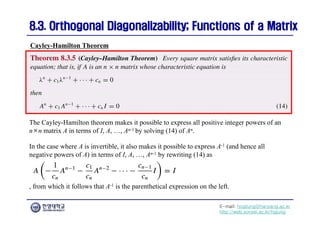
The Cayley-Hamilton theorem makes it possible to express all positive integer powers of an
n×n matrix A in terms of I, A, …, An-1 by solving (14) of An.
Cayley-Hamilton Theorem
In the case where A is invertible, it also makes it possible to express A-1 (and hence all
negative powers of A) in terms of I, A, …, An-1 by rewriting (14) as
, from which it follows that A-1 is the parenthetical expression on the left.
E-mail: hogijung@hanyang.ac.kr
http://web.yonsei.ac.kr/hgjung
8.3. Orthogonal Diagonalizability; Functions of a Matrix
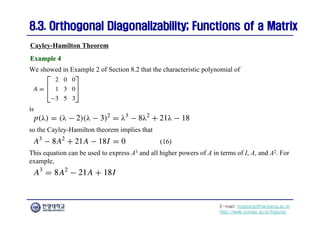
We showed in Example 2 of Section 8.2 that the characteristic polynomial of
Cayley-Hamilton Theorem
Example 4
Example 4
is
so the Cayley-Hamilton theorem implies that
This equation can be used to express A3 and all higher powers of A in terms of I, A, and A2. For
example,
(16)
E-mail: hogijung@hanyang.ac.kr
http://web.yonsei.ac.kr/hgjung
8.3. Orthogonal Diagonalizability; Functions of a Matrix
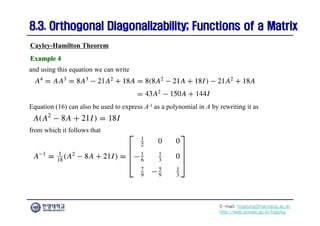
and using this equation we can write
Cayley-Hamilton Theorem
Example 4
Example 4
Equation (16) can also be used to express A-1 as a polynomial in A by rewriting it as
from which it follows that
E-mail: hogijung@hanyang.ac.kr
http://web.yonsei.ac.kr/hgjung
8.3. Orthogonal Diagonalizability; Functions of a Matrix
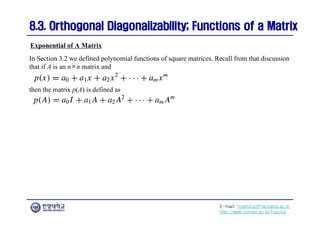
In Section 3.2 we defined polynomial functions of square matrices. Recall from that discussion
that if A is an n×n matrix and
Exponential of A Matrix
then the matrix p(A) is defined as
E-mail: hogijung@hanyang.ac.kr
http://web.yonsei.ac.kr/hgjung
8.3. Orthogonal Diagonalizability; Functions of a Matrix
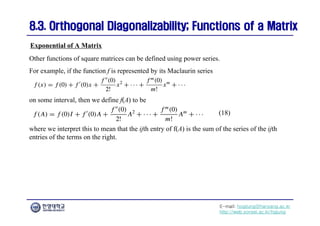
Other functions of square matrices can be defined using power series.
For example, if the function f is represented by its Maclaurin series
Exponential of A Matrix
on some interval, then we define f(A) to be
where we interpret this to mean that the ijth entry of f(A) is the sum of the series of the ijth
entries of the terms on the right.
(18)
E-mail: hogijung@hanyang.ac.kr
http://web.yonsei.ac.kr/hgjung
8.3. Orthogonal Diagonalizability; Functions of a Matrix
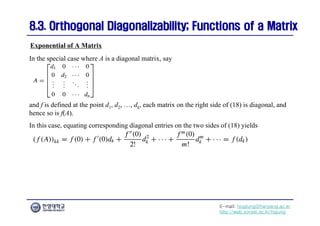
In the special case where A is a diagonal matrix, say
Exponential of A Matrix
and f is defined at the point d1, d2, …, dk, each matrix on the right side of (18) is diagonal, and
hence so is f(A).
In this case, equating corresponding diagonal entries on the two sides of (18) yields
E-mail: hogijung@hanyang.ac.kr
http://web.yonsei.ac.kr/hgjung
8.3. Orthogonal Diagonalizability; Functions of a Matrix
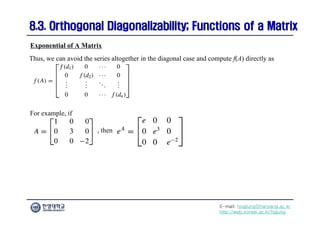
Thus, we can avoid the series altogether in the diagonal case and compute f(A) directly as
Exponential of A Matrix
For example, if
, then
E-mail: hogijung@hanyang.ac.kr
http://web.yonsei.ac.kr/hgjung
8.3. Orthogonal Diagonalizability; Functions of a Matrix
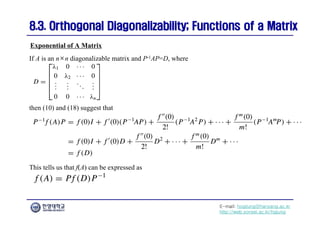
If A is an n×n diagonalizable matrix and P-1AP=D, where
Exponential of A Matrix
then (10) and (18) suggest that
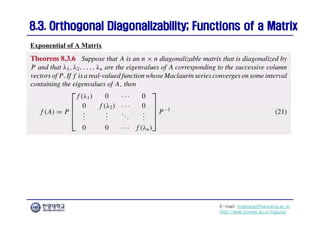
This tells us that f(A) can be expressed as
E-mail: hogijung@hanyang.ac.kr
http://web.yonsei.ac.kr/hgjung
8.3. Orthogonal Diagonalizability; Functions of a Matrix
Exponential of A Matrix
E-mail: hogijung@hanyang.ac.kr
http://web.yonsei.ac.kr/hgjung
8.3. Orthogonal Diagonalizability; Functions of a Matrix
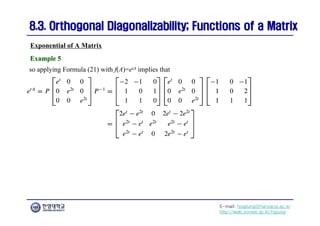
Find etA for the diagonalizable matrix
Exponential of A Matrix
Example 5
Example 5
We showed in Example 4 of Section 8.2 that
E-mail: hogijung@hanyang.ac.kr
http://web.yonsei.ac.kr/hgjung
8.3. Orthogonal Diagonalizability; Functions of a Matrix
so applying Formula (21) with f(A)=etA implies that
Exponential of A Matrix
Example 5
Example 5
E-mail: hogijung@hanyang.ac.kr
http://web.yonsei.ac.kr/hgjung
8.3. Orthogonal Diagonalizability; Functions of a Matrix
Exponential of A Matrix
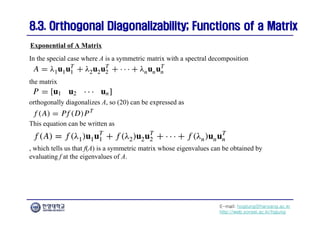
In the special case where A is a symmetric matrix with a spectral decomposition
the matrix
orthogonally diagonalizes A, so (20) can be expressed as
This equation can be written as
, which tells us that f(A) is a symmetric matrix whose eigenvalues can be obtained by
evaluating f at the eigenvalues of A.
E-mail: hogijung@hanyang.ac.kr
http://web.yonsei.ac.kr/hgjung
8.3. Orthogonal Diagonalizability; Functions of a Matrix
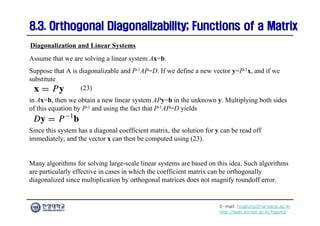
Assume that we are solving a linear system Ax=b.
Suppose that A is diagonalizable and P-1AP=D. If we define a new vector y=P-1x, and if we
substitute
Diagonalization and Linear Systems
in Ax=b, then we obtain a new linear system APy=b in the unknown y. Multiplying both sides
of this equation by P-1 and using the fact that P-1AP=D yields
(23)
Since this system has a diagonal coefficient matrix, the solution for y can be read off
immediately, and the vector x can then be computed using (23).
Many algorithms for solving large-scale linear systems are based on this idea. Such algorithms
are particularly effective in cases in which the coefficient matrix can be orthogonally
diagonalized since multiplication by orthogonal matrices does not magnify roundoff error.
E-mail: hogijung@hanyang.ac.kr
http://web.yonsei.ac.kr/hgjung
8.3. Orthogonal Diagonalizability; Functions of a Matrix
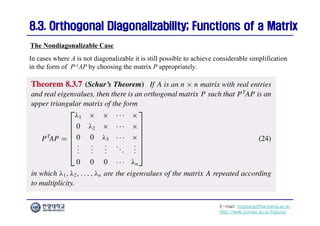
In cases where A is not diagonalizable it is still possible to achieve considerable simplification
in the form of P-1AP by choosing the matrix P appropriately.
The Nondiagonalizable Case
E-mail: hogijung@hanyang.ac.kr
http://web.yonsei.ac.kr/hgjung
8.3. Orthogonal Diagonalizability; Functions of a Matrix
The Nondiagonalizable Case
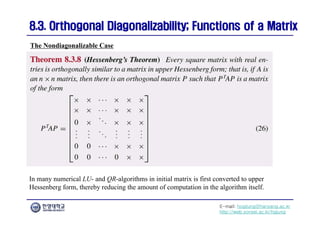
In many numerical LU- and QR-algorithms in initial matrix is first converted to upper
Hessenberg form, thereby reducing the amount of computation in the algorithm itself.
E-mail: hogijung@hanyang.ac.kr
http://web.yonsei.ac.kr/hgjung
8.4. Quadratic Forms
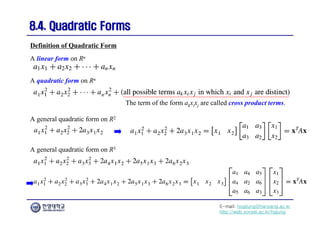
A linear form on Rn
Definition of Quadratic Form
A quadratic form on Rn
The term of the form akxixj are called cross product terms.
A general quadratic form on R2
A general quadratic form on R3
E-mail: hogijung@hanyang.ac.kr
http://web.yonsei.ac.kr/hgjung
8.4. Quadratic Forms
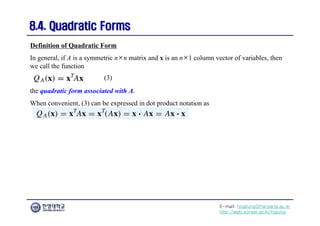
In general, if A is a symmetric n×n matrix and x is an n×1 column vector of variables, then
we call the function
Definition of Quadratic Form
the quadratic form associated with A.
When convenient, (3) can be expressed in dot product notation as
(3)
E-mail: hogijung@hanyang.ac.kr
http://web.yonsei.ac.kr/hgjung
8.4. Quadratic Forms
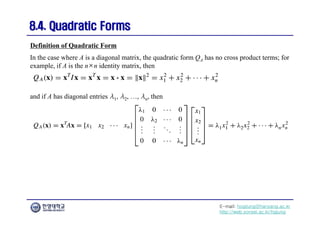
In the case where A is a diagonal matrix, the quadratic form QA has no cross product terms; for
example, if A is the n×n identity matrix, then
Definition of Quadratic Form
and if A has diagonal entries λ1, λ2, …, λn, then
E-mail: hogijung@hanyang.ac.kr
http://web.yonsei.ac.kr/hgjung
8.4. Quadratic Forms
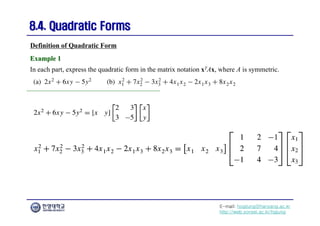
In each part, express the quadratic form in the matrix notation xTAx, where A is symmetric.
Definition of Quadratic Form
Example 1
Example 1
E-mail: hogijung@hanyang.ac.kr
http://web.yonsei.ac.kr/hgjung
8.4. Quadratic Forms
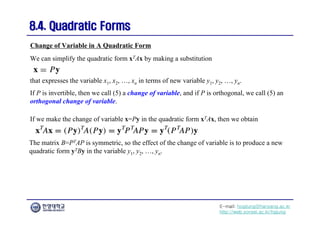
We can simplify the quadratic form xTAx by making a substitution
Change of Variable in A Quadratic Form
that expresses the variable x1, x2, …, xn in terms of new variable y1, y2, …, yn.
If P is invertible, then we call (5) a change of variable, and if P is orthogonal, we call (5) an
orthogonal change of variable.
If we make the change of variable x=Py in the quadratic form xTAx, then we obtain
The matrix B=PTAP is symmetric, so the effect of the change of variable is to produce a new
quadratic form yTBy in the variable y1, y2, …, yn.
E-mail: hogijung@hanyang.ac.kr
http://web.yonsei.ac.kr/hgjung
8.4. Quadratic Forms
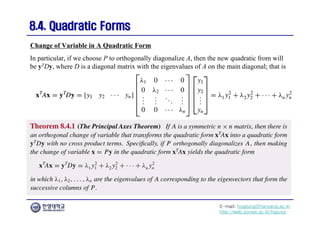
In particular, if we choose P to orthogonally diagonalize A, then the new quadratic from will
be yTDy, where D is a diagonal matrix with the eigenvalues of A on the main diagonal; that is
Change of Variable in A Quadratic Form
E-mail: hogijung@hanyang.ac.kr
http://web.yonsei.ac.kr/hgjung
8.4. Quadratic Forms
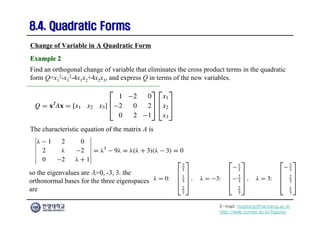
Find an orthogonal change of variable that eliminates the cross product terms in the quadratic
form Q=x1
2-x3
2-4x1x2+4x2x3, and express Q in terms of the new variables.
Change of Variable in A Quadratic Form
Example 2
Example 2
The characteristic equation of the matrix A is
so the eigenvalues are λ=0, -3, 3. the
orthonormal bases for the three eigenspaces
are
E-mail: hogijung@hanyang.ac.kr
http://web.yonsei.ac.kr/hgjung
8.4. Quadratic Forms
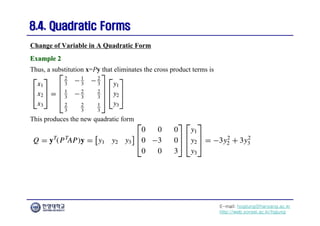
Thus, a substitution x=Py that eliminates the cross product terms is
Change of Variable in A Quadratic Form
Example 2
Example 2
This produces the new quadratic form
E-mail: hogijung@hanyang.ac.kr
http://web.yonsei.ac.kr/hgjung
8.4. Quadratic Forms
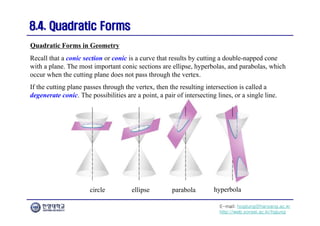
Recall that a conic section or conic is a curve that results by cutting a double-napped cone
with a plane. The most important conic sections are ellipse, hyperbolas, and parabolas, which
occur when the cutting plane does not pass through the vertex.
If the cutting plane passes through the vertex, then the resulting intersection is called a
degenerate conic. The possibilities are a point, a pair of intersecting lines, or a single line.
Quadratic Forms in Geometry
circle ellipse parabola hyperbola
E-mail: hogijung@hanyang.ac.kr
http://web.yonsei.ac.kr/hgjung
8.4. Quadratic Forms
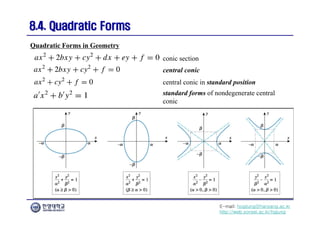
conic section
Quadratic Forms in Geometry
central conic
central conic in standard position
standard forms of nondegenerate central
conic
E-mail: hogijung@hanyang.ac.kr
http://web.yonsei.ac.kr/hgjung
8.4. Quadratic Forms
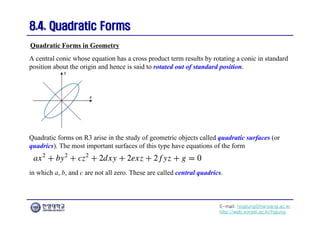
A central conic whose equation has a cross product term results by rotating a conic in standard
position about the origin and hence is said to rotated out of standard position.
Quadratic Forms in Geometry
Quadratic forms on R3 arise in the study of geometric objects called quadratic surfaces (or
quadrics). The most important surfaces of this type have equations of the form
in which a, b, and c are not all zero. These are called central quadrics.
E-mail: hogijung@hanyang.ac.kr
http://web.yonsei.ac.kr/hgjung
8.4. Quadratic Forms
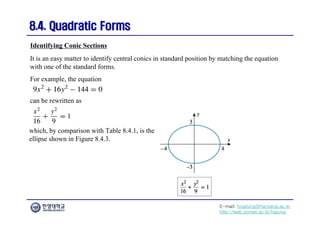
It is an easy matter to identify central conics in standard position by matching the equation
with one of the standard forms.
For example, the equation
Identifying Conic Sections
can be rewritten as
which, by comparison with Table 8.4.1, is the
ellipse shown in Figure 8.4.3.
E-mail: hogijung@hanyang.ac.kr
http://web.yonsei.ac.kr/hgjung
8.4. Quadratic Forms
If a central conic is rotated out of standard position, then it can be identified by first rotating
the coordinate axes to put it in standard position and then matching the resulting equation with
one of the standard forms in Table 8.4.1.
Identifying Conic Sections
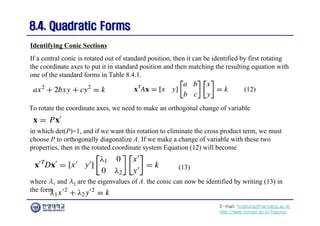
To rotate the coordinate axes, we need to make an orthogonal change of variable
in which det(P)=1, and if we want this rotation to eliminate the cross product term, we must
choose P to orthogonally diagonalize A. If we make a change of variable with these two
properties, then in the rotated coordinate system Equation (12) will become
(12)
where λ1 and λ2 are the eigenvalues of A. the conic can now be identified by writing (13) in
the form
(13)
E-mail: hogijung@hanyang.ac.kr
http://web.yonsei.ac.kr/hgjung
8.4. Quadratic Forms
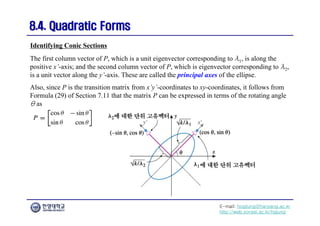
The first column vector of P, which is a unit eigenvector corresponding to λ1, is along the
positive x’-axis; and the second column vector of P, which is eigenvector corresponding to λ2,
is a unit vector along the y’-axis. These are called the principal axes of the ellipse.
Also, since P is the transition matrix from x’y’-coordinates to xy-coordinates, it follows from
Formula (29) of Section 7.11 that the matrix P can be expressed in terms of the rotating angle
θ as
Identifying Conic Sections
E-mail: hogijung@hanyang.ac.kr
http://web.yonsei.ac.kr/hgjung
8.4. Quadratic Forms
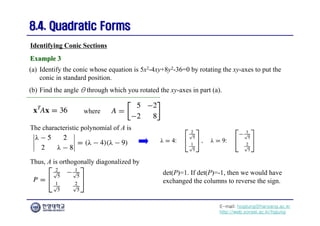
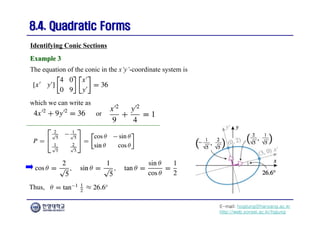
(a) Identify the conic whose equation is 5x2-4xy+8y2-36=0 by rotating the xy-axes to put the
conic in standard position.
(b) Find the angle θ through which you rotated the xy-axes in part (a).
Identifying Conic Sections
Example 3
Example 3
where
The characteristic polynomial of A is
Thus, A is orthogonally diagonalized by
det(P)=1. If det(P)=-1, then we would have
exchanged the columns to reverse the sign.
E-mail: hogijung@hanyang.ac.kr
http://web.yonsei.ac.kr/hgjung
8.4. Quadratic Forms
Identifying Conic Sections
Example 3
Example 3
The equation of the conic in the x’y’-coordinate system is
which we can write as
or
Thus,
E-mail: hogijung@hanyang.ac.kr
http://web.yonsei.ac.kr/hgjung
8.4. Quadratic Forms
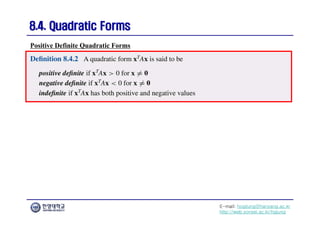
Positive Definite Quadratic Forms
E-mail: hogijung@hanyang.ac.kr
http://web.yonsei.ac.kr/hgjung
8.4. Quadratic Forms
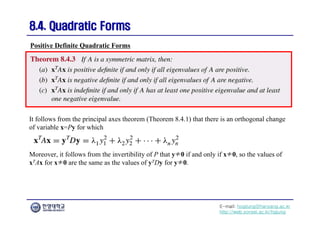
It follows from the principal axes theorem (Theorem 8.4.1) that there is an orthogonal change
of variable x=Py for which
Positive Definite Quadratic Forms
Moreover, it follows from the invertibility of P that y≠0 if and only if x≠0, so the values of
xTAx for x≠0 are the same as the values of yTDy for y≠0.
E-mail: hogijung@hanyang.ac.kr
http://web.yonsei.ac.kr/hgjung
8.4. Quadratic Forms
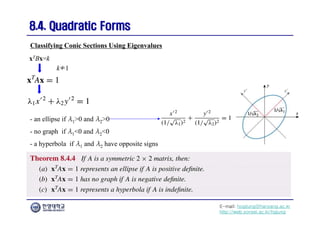
xTBx=k
Classifying Conic Sections Using Eigenvalues
k≠1
- an ellipse if λ1>0 and λ2>0
- no graph if λ1<0 and λ2<0
- a hyperbola if λ1 and λ2 have opposite signs
E-mail: hogijung@hanyang.ac.kr
http://web.yonsei.ac.kr/hgjung
8.4. Quadratic Forms
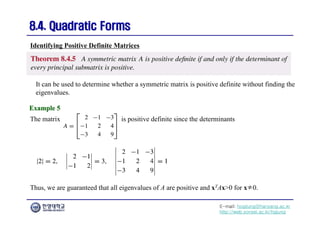
It can be used to determine whether a symmetric matrix is positive definite without finding the
eigenvalues.
Identifying Positive Definite Matrices
Example 5
Example 5
The matrix is positive definite since the determinants
Thus, we are guaranteed that all eigenvalues of A are positive and xTAx>0 for x≠0.
E-mail: hogijung@hanyang.ac.kr
http://web.yonsei.ac.kr/hgjung
8.4. Quadratic Forms
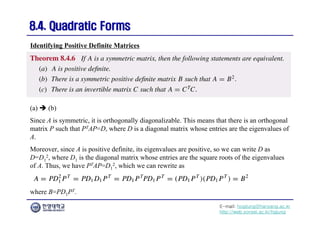
(a)  (b)
Since A is symmetric, it is orthogonally diagonalizable. This means that there is an orthogonal
matrix P such that PTAP=D, where D is a diagonal matrix whose entries are the eigenvalues of
A.
Moreover, since A is positive definite, its eigenvalues are positive, so we can write D as
D=D1
2, where D1 is the diagonal matrix whose entries are the square roots of the eigenvalues
of A. Thus, we have PTAP=D1
2, which we can rewrite as
Identifying Positive Definite Matrices
where B=PD1PT.
E-mail: hogijung@hanyang.ac.kr
http://web.yonsei.ac.kr/hgjung
8.4. Quadratic Forms
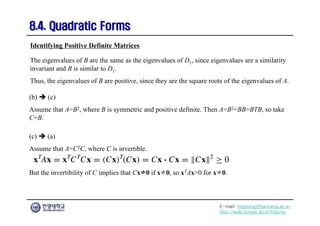
The eigenvalues of B are the same as the eigenvalues of D1, since eigenvalues are a similarity
invariant and B is similar to D1.
Thus, the eigenvalues of B are positive, since they are the square roots of the eigenvalues of A.
Identifying Positive Definite Matrices
(b)  (c)
Assume that A=B2, where B is symmetric and positive definite. Then A=B2=BB=BTB, so take
C=B.
(c)  (a)
Assume that A=CTC, where C is invertible.
But the invertibility of C implies that Cx≠0 if x≠0, so xTAx>0 for x≠0.
E-mail: hogijung@hanyang.ac.kr
http://web.yonsei.ac.kr/hgjung
8.5. Application of Quadratic Forms to Optimization
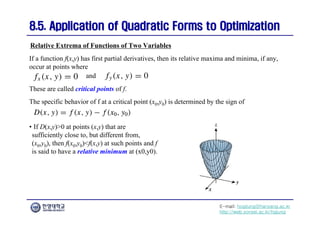
If a function f(x,y) has first partial derivatives, then its relative maxima and minima, if any,
occur at points where
Relative Extrema of Functions of Two Variables
and
These are called critical points of f.
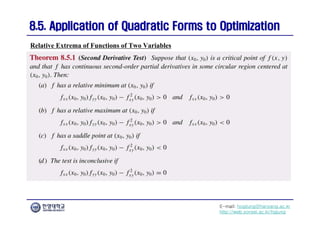
The specific behavior of f at a critical point (x0,y0) is determined by the sign of
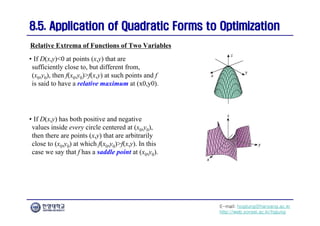
• If D(x,y)>0 at points (x,y) that are
sufficiently close to, but different from,
(x0,y0), then f(x0,y0)<f(x,y) at such points and f
is said to have a relative minimum at (x0,y0).
E-mail: hogijung@hanyang.ac.kr
http://web.yonsei.ac.kr/hgjung
8.5. Application of Quadratic Forms to Optimization
Relative Extrema of Functions of Two Variables
• If D(x,y)<0 at points (x,y) that are
sufficiently close to, but different from,
(x0,y0), then f(x0,y0)>f(x,y) at such points and f
is said to have a relative maximum at (x0,y0).
• If D(x,y) has both positive and negative
values inside every circle centered at (x0,y0),
then there are points (x,y) that are arbitrarily
close to (x0,y0) at which f(x0,y0)>f(x,y). In this
case we say that f has a saddle point at (x0,y0).
E-mail: hogijung@hanyang.ac.kr
http://web.yonsei.ac.kr/hgjung
8.5. Application of Quadratic Forms to Optimization
Relative Extrema of Functions of Two Variables
E-mail: hogijung@hanyang.ac.kr
http://web.yonsei.ac.kr/hgjung
8.5. Application of Quadratic Forms to Optimization
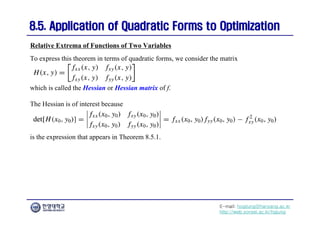
To express this theorem in terms of quadratic forms, we consider the matrix
Relative Extrema of Functions of Two Variables
which is called the Hessian or Hessian matrix of f.
The Hessian is of interest because
is the expression that appears in Theorem 8.5.1.
E-mail: hogijung@hanyang.ac.kr
http://web.yonsei.ac.kr/hgjung
8.5. Application of Quadratic Forms to Optimization
Relative Extrema of Functions of Two Variables
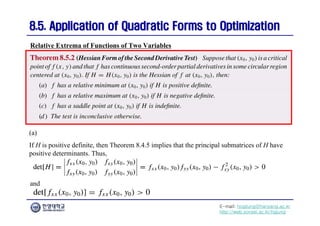
(a)
If H is positive definite, then Theorem 8.4.5 implies that the principal submatrices of H have
positive determinants. Thus,
and
E-mail: hogijung@hanyang.ac.kr
http://web.yonsei.ac.kr/hgjung
8.5. Application of Quadratic Forms to Optimization
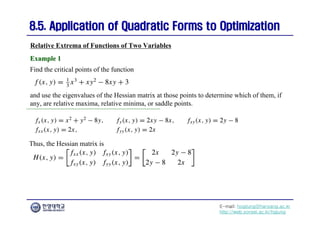
Find the critical points of the function
Relative Extrema of Functions of Two Variables
Example 1
Example 1
and use the eigenvalues of the Hessian matrix at those points to determine which of them, if
any, are relative maxima, relative minima, or saddle points.
Thus, the Hessian matrix is
E-mail: hogijung@hanyang.ac.kr
http://web.yonsei.ac.kr/hgjung
8.5. Application of Quadratic Forms to Optimization
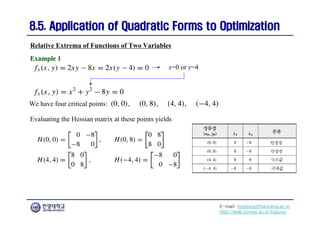
We have four critical points:
Relative Extrema of Functions of Two Variables
Example 1
Example 1
x=0 or y=4
Evaluating the Hessian matrix at these points yields
E-mail: hogijung@hanyang.ac.kr
http://web.yonsei.ac.kr/hgjung
8.5. Application of Quadratic Forms to Optimization
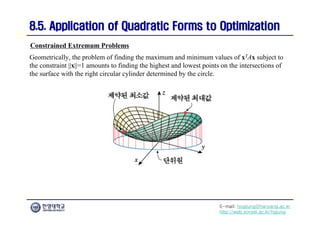
Geometrically, the problem of finding the maximum and minimum values of xTAx subject to
the constraint ||x||=1 amounts to finding the highest and lowest points on the intersections of
the surface with the right circular cylinder determined by the circle.
Constrained Extremum Problems
E-mail: hogijung@hanyang.ac.kr
http://web.yonsei.ac.kr/hgjung
8.5. Application of Quadratic Forms to Optimization
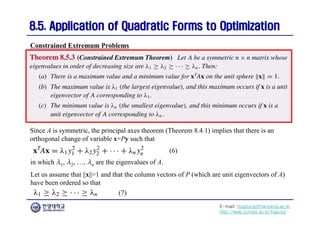
Since A is symmetric, the principal axes theorem (Theorem 8.4.1) implies that there is an
orthogonal change of variable x=Py such that
Constrained Extremum Problems
(6)
in which λ1, λ2, …, λn are the eigenvalues of A.
Let us assume that ||x||=1 and that the column vectors of P (which are unit eigenvectors of A)
have been ordered so that
(7)
E-mail: hogijung@hanyang.ac.kr
http://web.yonsei.ac.kr/hgjung
8.5. Application of Quadratic Forms to Optimization
Since P is an orthogonal matrix, multiplication by P is length preserving, so ||y||=||x||=1; that is,
Constrained Extremum Problems
It follows from this equation and (7) that
and hence from (6) that
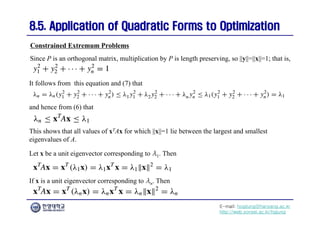
This shows that all values of xTAx for which ||x||=1 lie between the largest and smallest
eigenvalues of A.
Let x be a unit eigenvector corresponding to λ1. Then
If x is a unit eigenvector corresponding to λn. Then
E-mail: hogijung@hanyang.ac.kr
http://web.yonsei.ac.kr/hgjung
8.5. Application of Quadratic Forms to Optimization
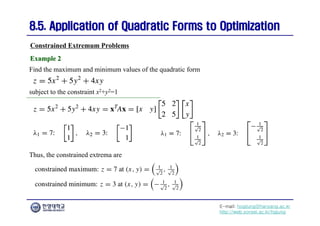
Find the maximum and minimum values of the quadratic form
Constrained Extremum Problems
Example 2
Example 2
subject to the constraint x2+y2=1
Thus, the constrained extrema are
E-mail: hogijung@hanyang.ac.kr
http://web.yonsei.ac.kr/hgjung
8.5. Application of Quadratic Forms to Optimization
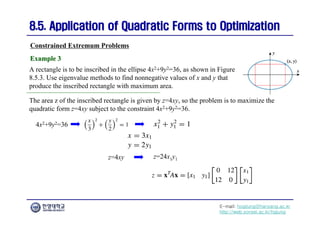
A rectangle is to be inscribed in the ellipse 4x2+9y2=36, as shown in Figure
8.5.3. Use eigenvalue methods to find nonnegative values of x and y that
produce the inscribed rectangle with maximum area.
Constrained Extremum Problems
Example 3
Example 3
The area z of the inscribed rectangle is given by z=4xy, so the problem is to maximize the
quadratic form z=4xy subject to the constraint 4x2+9y2=36.
4x2+9y2=36
z=4xy z=24x1y1
E-mail: hogijung@hanyang.ac.kr
http://web.yonsei.ac.kr/hgjung
8.5. Application of Quadratic Forms to Optimization
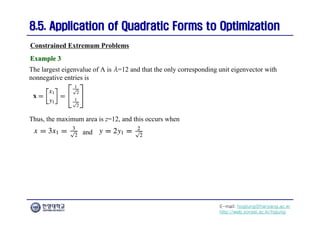
The largest eigenvalue of A is λ=12 and that the only corresponding unit eigenvector with
nonnegative entries is
Constrained Extremum Problems
Example 3
Example 3
Thus, the maximum area is z=12, and this occurs when
and
E-mail: hogijung@hanyang.ac.kr
http://web.yonsei.ac.kr/hgjung
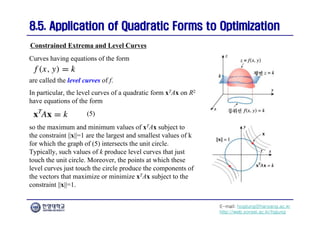
8.5. Application of Quadratic Forms to Optimization
are called the level curves of f.
In particular, the level curves of a quadratic form xTAx on R2
have equations of the form
Constrained Extrema and Level Curves
Curves having equations of the form
so the maximum and minimum values of xTAx subject to
the constraint ||x||=1 are the largest and smallest values of k
for which the graph of (5) intersects the unit circle.
Typically, such values of k produce level curves that just
touch the unit circle. Moreover, the points at which these
level curves just touch the circle produce the components of
the vectors that maximize or minimize xTAx subject to the
constraint ||x||=1.
(5)
E-mail: hogijung@hanyang.ac.kr
http://web.yonsei.ac.kr/hgjung
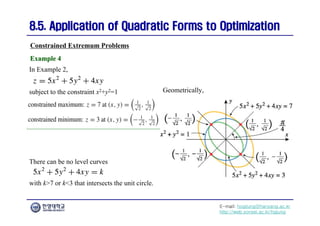
8.5. Application of Quadratic Forms to Optimization
Geometrically,
Constrained Extremum Problems
Example 4
Example 4
subject to the constraint x2+y2=1
In Example 2,
There can be no level curves
with k>7 or k<3 that intersects the unit circle.
E-mail: hogijung@hanyang.ac.kr
http://web.yonsei.ac.kr/hgjung
8.6. Singular Value Decomposition
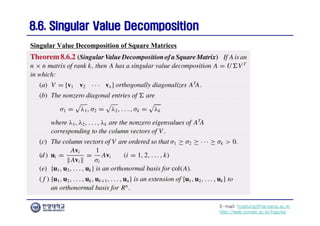
We know from our work in Section 8.3 that symmetric matrices are orthogonally
diagonalizable and are the only matrices with this property (Theorem 8.3.4).
The orthogonal diagonalizability of an n×n symmetric matrix A means it can be factored as
A=PDPT (1)
where P is an n×n orthogonal matrix of eigenvectors of A, and D is the diagonal matrix whose
diagonal entries are the eigenvalues corresponding to the column vectors of P.
In this section we will call (1) an eigenvalue decomposition of A (abbreviated EVD of A).
Singular Value Decomposition of Square Matrices
E-mail: hogijung@hanyang.ac.kr
http://web.yonsei.ac.kr/hgjung
8.6. Singular Value Decomposition
If an n×n matrix A is not symmetric, then it does not have an eigenvalue decomposition, but it
does have a Hessenberg decomposition
A=PHPT
in which P is an orthogonal matrix and H is in upper Hessenberg form (Theorem 8.3.8).
Moreover, if A has real eigenvalues, then it has a Schur decomposition
A=PSPT
in which P is an orthogonal matrix and S is upper triangular (Theorem 8.3.7).
Singular Value Decomposition of Square Matrices
E-mail: hogijung@hanyang.ac.kr
http://web.yonsei.ac.kr/hgjung
8.6. Singular Value Decomposition
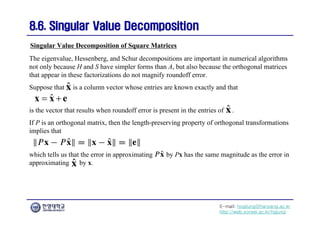
The eigenvalue, Hessenberg, and Schur decompositions are important in numerical algorithms
not only because H and S have simpler forms than A, but also because the orthogonal matrices
that appear in these factorizations do not magnify roundoff error.
Suppose that is a column vector whose entries are known exactly and that
Singular Value Decomposition of Square Matrices
ˆ
 
x x e
is the vector that results when roundoff error is present in the entries of .
If P is an orthogonal matrix, then the length-preserving property of orthogonal transformations
implies that
which tells us that the error in approximating by Px has the same magnitude as the error in
approximating by x.
E-mail: hogijung@hanyang.ac.kr
http://web.yonsei.ac.kr/hgjung
8.6. Singular Value Decomposition
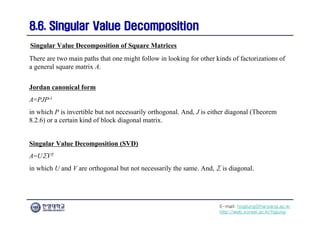
There are two main paths that one might follow in looking for other kinds of factorizations of
a general square matrix A.
Singular Value Decomposition of Square Matrices
Jordan canonical form
A=PJP-1
in which P is invertible but not necessarily orthogonal. And, J is either diagonal (Theorem
8.2.6) or a certain kind of block diagonal matrix.
Singular Value Decomposition (SVD)
A=UΣVT
in which U and V are orthogonal but not necessarily the same. And, Σ is diagonal.
E-mail: hogijung@hanyang.ac.kr
http://web.yonsei.ac.kr/hgjung
8.6. Singular Value Decomposition
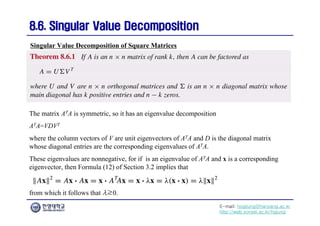
The matrix ATA is symmetric, so it has an eigenvalue decomposition
ATA=VDVT
where the column vectors of V are unit eigenvectors of ATA and D is the diagonal matrix
whose diagonal entries are the corresponding eigenvalues of ATA.
These eigenvalues are nonnegative, for if is an eigenvalue of ATA and x is a corresponding
eigenvector, then Formula (12) of Section 3.2 implies that
Singular Value Decomposition of Square Matrices
from which it follows that λ≥0.
E-mail: hogijung@hanyang.ac.kr
http://web.yonsei.ac.kr/hgjung
8.6. Singular Value Decomposition
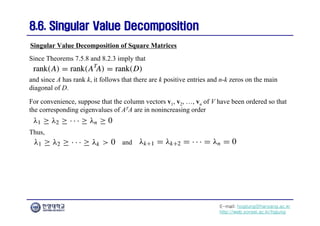
Since Theorems 7.5.8 and 8.2.3 imply that
Singular Value Decomposition of Square Matrices
and since A has rank k, it follows that there are k positive entries and n-k zeros on the main
diagonal of D.
For convenience, suppose that the column vectors v1, v2, …, vn of V have been ordered so that
the corresponding eigenvalues of ATA are in nonincreasing order
Thus,
and
E-mail: hogijung@hanyang.ac.kr
http://web.yonsei.ac.kr/hgjung
8.6. Singular Value Decomposition
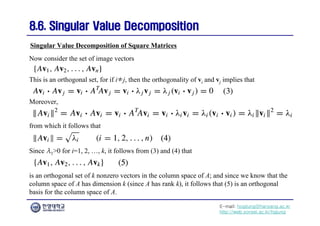
Now consider the set of image vectors
Singular Value Decomposition of Square Matrices
This is an orthogonal set, for if i≠j, then the orthogonality of vi and vj implies that
Moreover,
from which it follows that
Since λ1>0 for i=1, 2, …, k, it follows from (3) and (4) that
is an orthogonal set of k nonzero vectors in the column space of A; and since we know that the
column space of A has dimension k (since A has rank k), it follows that (5) is an orthogonal
basis for the column space of A.
E-mail: hogijung@hanyang.ac.kr
http://web.yonsei.ac.kr/hgjung
8.6. Singular Value Decomposition
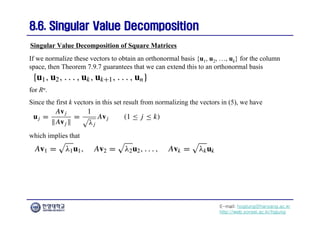
If we normalize these vectors to obtain an orthonormal basis {u1, u2, …, uk} for the column
space, then Theorem 7.9.7 guarantees that we can extend this to an orthonormal basis
Singular Value Decomposition of Square Matrices
for Rn.
Since the first k vectors in this set result from normalizing the vectors in (5), we have
which implies that
E-mail: hogijung@hanyang.ac.kr
http://web.yonsei.ac.kr/hgjung
8.6. Singular Value Decomposition
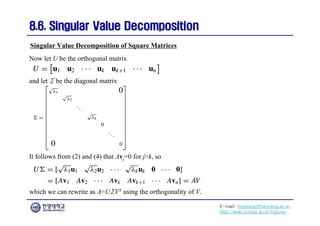
Now let U be the orthogonal matrix
Singular Value Decomposition of Square Matrices
and let Σ be the diagonal matrix
It follows from (2) and (4) that Avj=0 for j>k, so
which we can rewrite as A=UΣVT using the orthogonality of V.
E-mail: hogijung@hanyang.ac.kr
http://web.yonsei.ac.kr/hgjung
8.6. Singular Value Decomposition
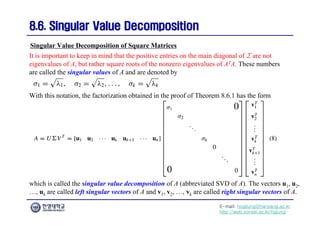
It is important to keep in mind that the positive entries on the main diagonal of Σ are not
eigenvalues of A, but rather square roots of the nonzero eigenvalues of ATA. These numbers
are called the singular values of A and are denoted by
Singular Value Decomposition of Square Matrices
With this notation, the factorization obtained in the proof of Theorem 8.6.1 has the form
which is called the singular value decomposition of A (abbreviated SVD of A). The vectors u1, u2,
…, uk are called left singular vectors of A and v1, v2, …, vk are called right singular vectors of A.
E-mail: hogijung@hanyang.ac.kr
http://web.yonsei.ac.kr/hgjung
8.6. Singular Value Decomposition
Singular Value Decomposition of Square Matrices
E-mail: hogijung@hanyang.ac.kr
http://web.yonsei.ac.kr/hgjung
8.6. Singular Value Decomposition
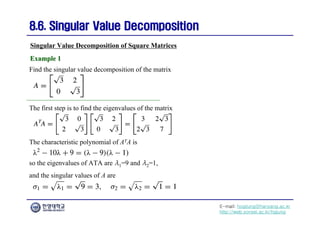
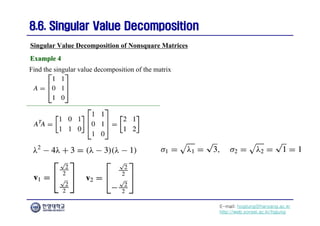
Find the singular value decomposition of the matrix
Singular Value Decomposition of Square Matrices
Example 1
Example 1
The first step is to find the eigenvalues of the matrix
The characteristic polynomial of ATA is
so the eigenvalues of ATA are λ1=9 and λ2=1,
and the singular values of A are
E-mail: hogijung@hanyang.ac.kr
http://web.yonsei.ac.kr/hgjung
8.6. Singular Value Decomposition
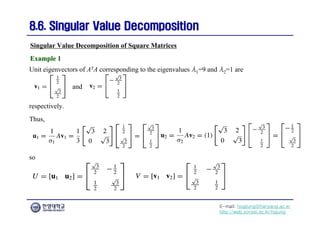
Unit eigenvectors of ATA corresponding to the eigenvalues λ1=9 and λ2=1 are
Singular Value Decomposition of Square Matrices
Example 1
Example 1
and
respectively.
Thus,
so
E-mail: hogijung@hanyang.ac.kr
http://web.yonsei.ac.kr/hgjung
8.6. Singular Value Decomposition
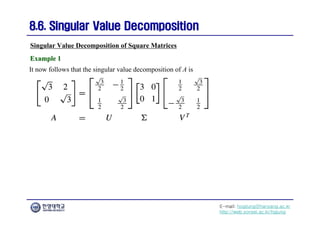
It now follows that the singular value decomposition of A is
Singular Value Decomposition of Square Matrices
Example 1
Example 1
E-mail: hogijung@hanyang.ac.kr
http://web.yonsei.ac.kr/hgjung
8.6. Singular Value Decomposition
In the case where A is symmetric we have ATA=A2, so the eigenvalues of ATA are the squares
of the eigenvalues of A.
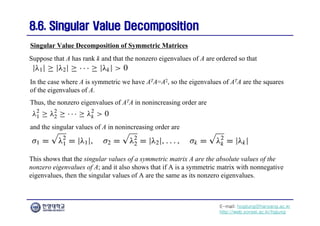
Thus, the nonzero eigenvalues of ATA in nonincreasing order are
Singular Value Decomposition of Symmetric Matrices
and the singular values of A in nonincreasing order are
Suppose that A has rank k and that the nonzero eigenvalues of A are ordered so that
This shows that the singular values of a symmetric matrix A are the absolute values of the
nonzero eigenvalues of A; and it also shows that if A is a symmetric matrix with nonnegative
eigenvalues, then the singular values of A are the same as its nonzero eigenvalues.
E-mail: hogijung@hanyang.ac.kr
http://web.yonsei.ac.kr/hgjung
8.6. Singular Value Decomposition
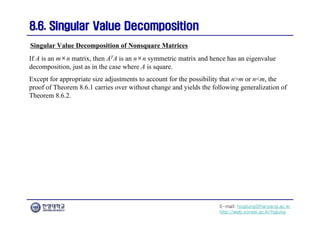
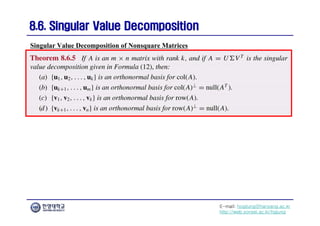
If A is an m×n matrix, then ATA is an n×n symmetric matrix and hence has an eigenvalue
decomposition, just as in the case where A is square.
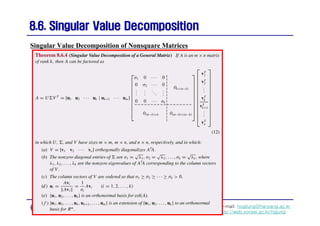
Except for appropriate size adjustments to account for the possibility that n>m or n<m, the
proof of Theorem 8.6.1 carries over without change and yields the following generalization of
Theorem 8.6.2.
Singular Value Decomposition of Nonsquare Matrices
E-mail: hogijung@hanyang.ac.kr
http://web.yonsei.ac.kr/hgjung
8.6. Singular Value Decomposition
Singular Value Decomposition of Nonsquare Matrices
E-mail: hogijung@hanyang.ac.kr
http://web.yonsei.ac.kr/hgjung
8.6. Singular Value Decomposition
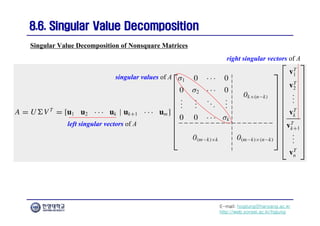
Singular Value Decomposition of Nonsquare Matrices
singular values of A
left singular vectors of A
right singular vectors of A
E-mail: hogijung@hanyang.ac.kr
http://web.yonsei.ac.kr/hgjung
8.6. Singular Value Decomposition
Find the singular value decomposition of the matrix
Singular Value Decomposition of Nonsquare Matrices
Example 4
Example 4
E-mail: hogijung@hanyang.ac.kr
http://web.yonsei.ac.kr/hgjung
8.6. Singular Value Decomposition
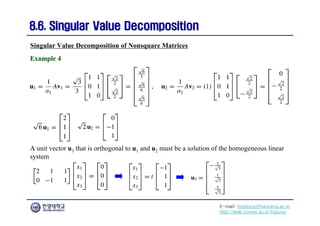
A unit vector u3 that is orthogonal to u1 and u2 must be a solution of the homogeneous linear
system
Singular Value Decomposition of Nonsquare Matrices
Example 4
Example 4
E-mail: hogijung@hanyang.ac.kr
http://web.yonsei.ac.kr/hgjung
8.6. Singular Value Decomposition
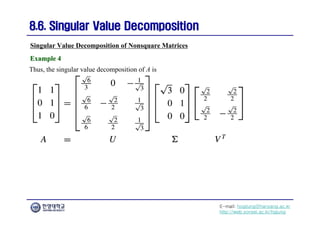
Thus, the singular value decomposition of A is
Singular Value Decomposition of Nonsquare Matrices
Example 4
Example 4
E-mail: hogijung@hanyang.ac.kr
http://web.yonsei.ac.kr/hgjung
8.6. Singular Value Decomposition
Singular Value Decomposition of Nonsquare Matrices
E-mail: hogijung@hanyang.ac.kr
http://web.yonsei.ac.kr/hgjung
8.6. Singular Value Decomposition
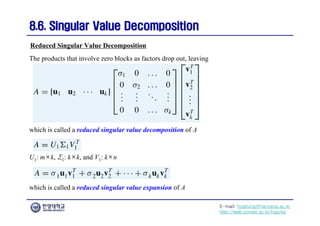
which is called a reduced singular value decomposition of A
Reduced Singular Value Decomposition
The products that involve zero blocks as factors drop out, leaving
U1: m×k, Σ1: k×k, and V1: k×n
which is called a reduced singular value expansion of A
E-mail: hogijung@hanyang.ac.kr
http://web.yonsei.ac.kr/hgjung
8.6. Singular Value Decomposition
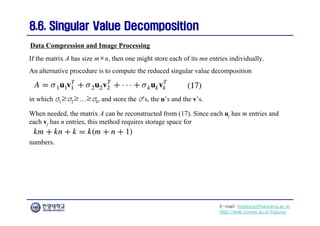
If the matrix A has size m×n, then one might store each of its mn entries individually.
An alternative procedure is to compute the reduced singular value decomposition
Data Compression and Image Processing
in which σ1≥σ2≥…≥σk, and store the σ’s, the u’s and the v’s.
When needed, the matrix A can be reconstructed from (17). Since each uj has m entries and
each vj has n entries, this method requires storage space for
numbers.
E-mail: hogijung@hanyang.ac.kr
http://web.yonsei.ac.kr/hgjung
8.6. Singular Value Decomposition
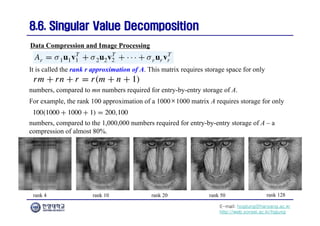
numbers, compared to mn numbers required for entry-by-entry storage of A.
Data Compression and Image Processing
It is called the rank r approximation of A. This matrix requires storage space for only
For example, the rank 100 approximation of a 1000×1000 matrix A requires storage for only
numbers, compared to the 1,000,000 numbers required for entry-by-entry storage of A – a
compression of almost 80%.
rank 4 rank 10 rank 20 rank 50 rank 128
E-mail: hogijung@hanyang.ac.kr
http://web.yonsei.ac.kr/hgjung
8.6. Singular Value Decomposition
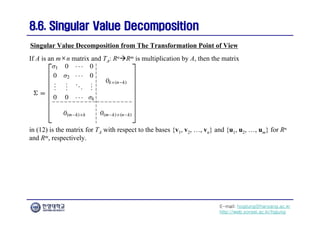
If A is an m×n matrix and TA: RnRm is multiplication by A, then the matrix
Singular Value Decomposition from The Transformation Point of View
in (12) is the matrix for TA with respect to the bases {v1, v2, …, vn} and {u1, u2, …, um} for Rn
and Rm, respectively.
E-mail: hogijung@hanyang.ac.kr
http://web.yonsei.ac.kr/hgjung
8.6. Singular Value Decomposition
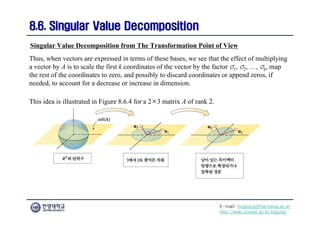
Thus, when vectors are expressed in terms of these bases, we see that the effect of multiplying
a vector by A is to scale the first k coordinates of the vector by the factor σ1, σ2, …, σk, map
the rest of the coordinates to zero, and possibly to discard coordinates or append zeros, if
needed, to account for a decrease or increase in dimension.
Singular Value Decomposition from The Transformation Point of View
This idea is illustrated in Figure 8.6.4 for a 2×3 matrix A of rank 2.
E-mail: hogijung@hanyang.ac.kr
http://web.yonsei.ac.kr/hgjung
8.6. Singular Value Decomposition
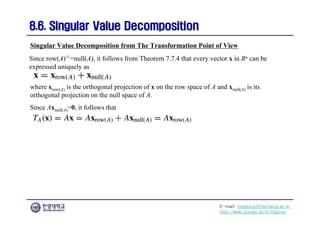
Since row(A)┴=null(A), it follows from Theorem 7.7.4 that every vector x in Rn can be
expressed uniquely as
Singular Value Decomposition from The Transformation Point of View
where xrow(A) is the orthogonal projection of x on the row space of A and xnull(A) is its
orthogonal projection on the null space of A.
Since Axnull(A)=0, it follows that
E-mail: hogijung@hanyang.ac.kr
http://web.yonsei.ac.kr/hgjung
8.6. Singular Value Decomposition
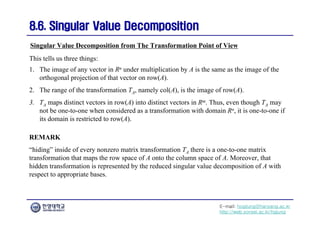
This tells us three things:
Singular Value Decomposition from The Transformation Point of View
1. The image of any vector in Rn under multiplication by A is the same as the image of the
orthogonal projection of that vector on row(A).
2. The range of the transformation TA, namely col(A), is the image of row(A).
3. TA maps distinct vectors in row(A) into distinct vectors in Rm. Thus, even though TA may
not be one-to-one when considered as a transformation with domain Rn, it is one-to-one if
its domain is restricted to row(A).
REMARK
“hiding” inside of every nonzero matrix transformation TA there is a one-to-one matrix
transformation that maps the row space of A onto the column space of A. Moreover, that
hidden transformation is represented by the reduced singular value decomposition of A with
respect to appropriate bases.
E-mail: hogijung@hanyang.ac.kr
http://web.yonsei.ac.kr/hgjung
8.7. The Pseudoinverse
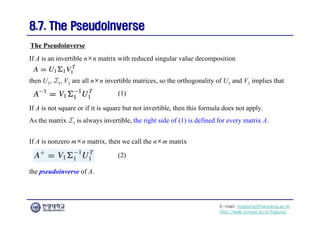
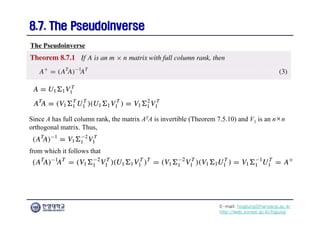
If A is an invertible n×n matrix with reduced singular value decomposition
The Pseudoinverse
then U1, Σ1, V1 are all n×n invertible matrices, so the orthogonality of U1 and V1 implies that
If A is not square or if it is square but not invertible, then this formula does not apply.
As the matrix Σ1 is always invertible, the right side of (1) is defined for every matrix A.
(1)
If A is nonzero m×n matrix, then we call the n×m matrix
the pseudoinverse of A.
(2)
E-mail: hogijung@hanyang.ac.kr
http://web.yonsei.ac.kr/hgjung
8.7. The Pseudoinverse
from which it follows that
The Pseudoinverse
Since A has full column rank, the matrix ATA is invertible (Theorem 7.5.10) and V1 is an n×n
orthogonal matrix. Thus,
E-mail: hogijung@hanyang.ac.kr
http://web.yonsei.ac.kr/hgjung
8.7. The Pseudoinverse
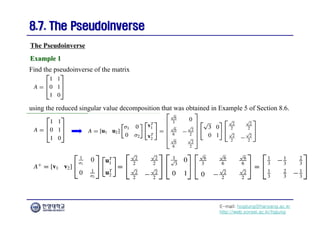
Find the pseudoinverse of the matrix
The Pseudoinverse
Example 1
Example 1
using the reduced singular value decomposition that was obtained in Example 5 of Section 8.6.
E-mail: hogijung@hanyang.ac.kr
http://web.yonsei.ac.kr/hgjung
8.7. The Pseudoinverse
The Pseudoinverse
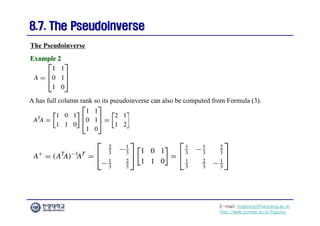
Example 2
Example 2
A has full column rank so its pseudoinverse can also be computed from Formula (3).
E-mail: hogijung@hanyang.ac.kr
http://web.yonsei.ac.kr/hgjung
8.7. The Pseudoinverse
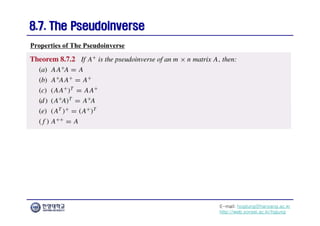
Properties of The Pseudoinverse
E-mail: hogijung@hanyang.ac.kr
http://web.yonsei.ac.kr/hgjung
8.7. The Pseudoinverse
Properties of The Pseudoinverse
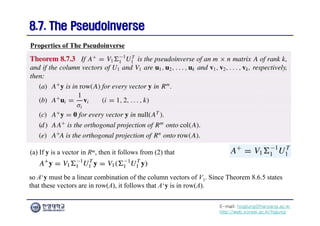
(a) If y is a vector in Rm, then it follows from (2) that
so A+y must be a linear combination of the column vectors of V1. Since Theorem 8.6.5 states
that these vectors are in row(A), it follows that A+y is in row(A).
E-mail: hogijung@hanyang.ac.kr
http://web.yonsei.ac.kr/hgjung
8.7. The Pseudoinverse
(b) Multiplying A+ on the right by U1 yields
Properties of The Pseudoinverse
The result now follows by comparing corresponding column vectors on the two sides of this
equation.
(c) If y is a vector in null(AT), then y is orthogonal to each vector in col(A), and, in particular,
it is orthogonal to each column vector of U1=[u1, u2, …, uk].
This implies that U1
Ty=0, and hence that
E-mail: hogijung@hanyang.ac.kr
http://web.yonsei.ac.kr/hgjung
8.7. The Pseudoinverse
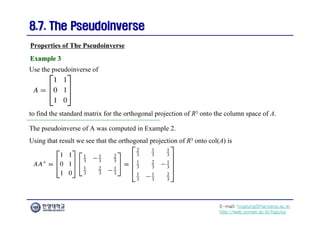
Use the pseudoinverse of
Properties of The Pseudoinverse
Example 3
Example 3
to find the standard matrix for the orthogonal projection of R3 onto the column space of A.
The pseudoinverse of A was computed in Example 2.
Using that result we see that the orthogonal projection of R3 onto col(A) is
E-mail: hogijung@hanyang.ac.kr
http://web.yonsei.ac.kr/hgjung
8.7. The Pseudoinverse
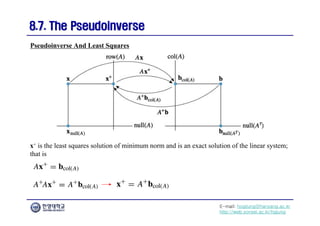
Pseudoinverse And Least Squares
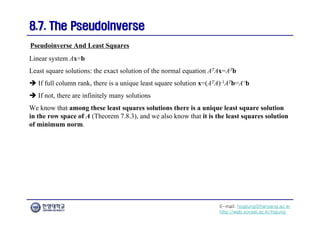
Linear system Ax=b
Least square solutions: the exact solution of the normal equation ATAx=ATb
 If full column rank, there is a unique least square solution x=(ATA)-1ATb=A+b
 If not, there are infinitely many solutions
We know that among these least squares solutions there is a unique least square solution
in the row space of A (Theorem 7.8.3), and we also know that it is the least squares solution
of minimum norm.
E-mail: hogijung@hanyang.ac.kr
http://web.yonsei.ac.kr/hgjung
8.7. The Pseudoinverse
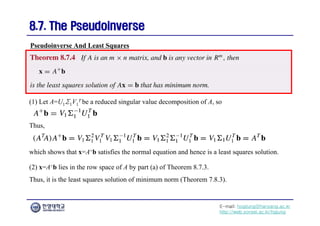
(1) Let A=U1Σ1V1
T be a reduced singular value decomposition of A, so
Pseudoinverse And Least Squares
Thus,
which shows that x=A+b satisfies the normal equation and hence is a least squares solution.
(2) x=A+b lies in the row space of A by part (a) of Theorem 8.7.3.
Thus, it is the least squares solution of minimum norm (Theorem 7.8.3).
E-mail: hogijung@hanyang.ac.kr
http://web.yonsei.ac.kr/hgjung
8.7. The Pseudoinverse
x+ is the least squares solution of minimum norm and is an exact solution of the linear system;
that is
Pseudoinverse And Least Squares
E-mail: hogijung@hanyang.ac.kr
http://web.yonsei.ac.kr/hgjung
8.7. The Pseudoinverse
Ax=b
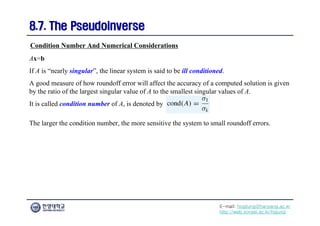
If A is “nearly singular”, the linear system is said to be ill conditioned.
A good measure of how roundoff error will affect the accuracy of a computed solution is given
by the ratio of the largest singular value of A to the smallest singular values of A.
It is called condition number of A, is denoted by
Condition Number And Numerical Considerations
The larger the condition number, the more sensitive the system to small roundoff errors.
E-mail: hogijung@hanyang.ac.kr
http://web.yonsei.ac.kr/hgjung
8.8. Complex Eigenvalues and
8.8. Complex Eigenvalues and EigenVectors
EigenVectors
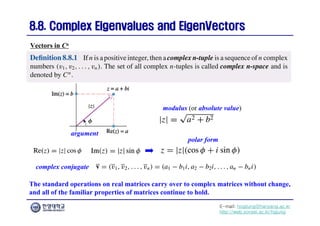
modulus (or absolute value)
Vectors in Cn
argument
polar form
complex conjugate
The standard operations on real matrices carry over to complex matrices without change,
and all of the familiar properties of matrices continue to hold.
E-mail: hogijung@hanyang.ac.kr
http://web.yonsei.ac.kr/hgjung
8.8. Complex Eigenvalues and
8.8. Complex Eigenvalues and EigenVectors
EigenVectors
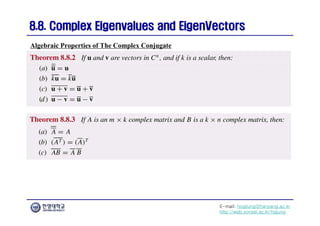
Algebraic Properties of The Complex Conjugate
E-mail: hogijung@hanyang.ac.kr
http://web.yonsei.ac.kr/hgjung
8.8. Complex Eigenvalues and
8.8. Complex Eigenvalues and EigenVectors
EigenVectors
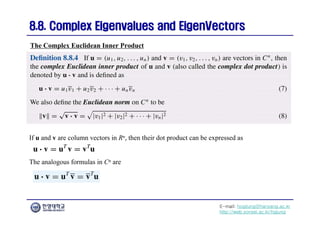
The analogous formulas in Cn are
The Complex Euclidean Inner Product
If u and v are column vectors in Rn, then their dot product can be expressed as
E-mail: hogijung@hanyang.ac.kr
http://web.yonsei.ac.kr/hgjung
8.8. Complex Eigenvalues and
8.8. Complex Eigenvalues and EigenVectors
EigenVectors
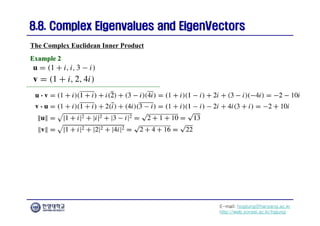
The Complex Euclidean Inner Product
Example 2
Example 2
E-mail: hogijung@hanyang.ac.kr
http://web.yonsei.ac.kr/hgjung
8.8. Complex Eigenvalues and
8.8. Complex Eigenvalues and EigenVectors
EigenVectors
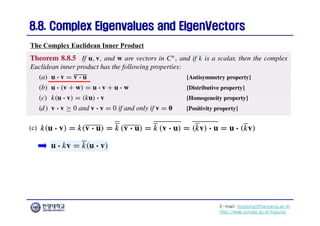
(c)
The Complex Euclidean Inner Product
E-mail: hogijung@hanyang.ac.kr
http://web.yonsei.ac.kr/hgjung
8.8. Complex Eigenvalues and
8.8. Complex Eigenvalues and EigenVectors
EigenVectors
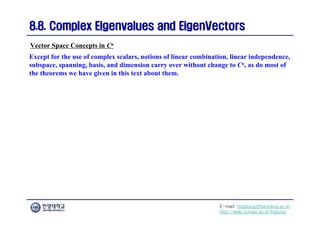
Except for the use of complex scalars, notions of linear combination, linear independence,
subspace, spanning, basis, and dimension carry over without change to Cn, as do most of
the theorems we have given in this text about them.
Vector Space Concepts in Cn
E-mail: hogijung@hanyang.ac.kr
http://web.yonsei.ac.kr/hgjung
8.8. Complex Eigenvalues and
8.8. Complex Eigenvalues and EigenVectors
EigenVectors
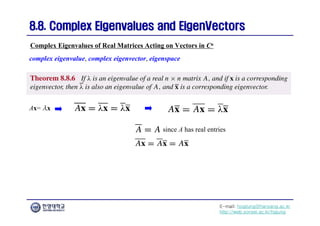
complex eigenvalue, complex eigenvector, eigenspace
Complex Eigenvalues of Real Matrices Acting on Vectors in Cn
Ax= λx
since A has real entries
E-mail: hogijung@hanyang.ac.kr
http://web.yonsei.ac.kr/hgjung
8.8. Complex Eigenvalues and
8.8. Complex Eigenvalues and EigenVectors
EigenVectors
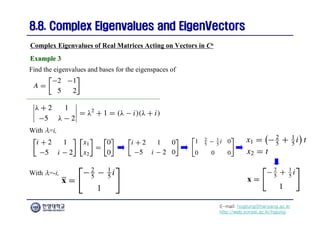
Find the eigenvalues and bases for the eigenspaces of
Complex Eigenvalues of Real Matrices Acting on Vectors in Cn
Example 3
Example 3
With λ=i,
With λ=-i,
E-mail: hogijung@hanyang.ac.kr
http://web.yonsei.ac.kr/hgjung
8.8. Complex Eigenvalues and
8.8. Complex Eigenvalues and EigenVectors
EigenVectors
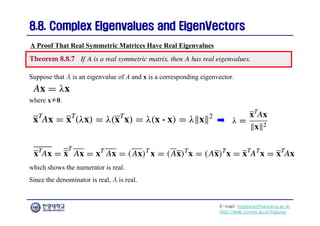
Suppose that λ is an eigenvalue of A and x is a corresponding eigenvector.
A Proof That Real Symmetric Matrices Have Real Eigenvalues
where x≠0.
which shows the numerator is real.
Since the denominator is real, λ is real.
E-mail: hogijung@hanyang.ac.kr
http://web.yonsei.ac.kr/hgjung
8.8. Complex Eigenvalues and
8.8. Complex Eigenvalues and EigenVectors
EigenVectors
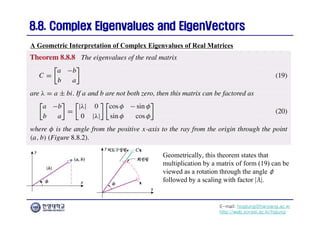
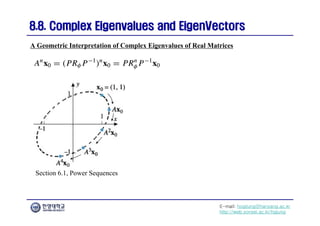
Geometrically, this theorem states that
multiplication by a matrix of form (19) can be
viewed as a rotation through the angle φ
followed by a scaling with factor |λ|.
A Geometric Interpretation of Complex Eigenvalues of Real Matrices
E-mail: hogijung@hanyang.ac.kr
http://web.yonsei.ac.kr/hgjung
8.8. Complex Eigenvalues and
8.8. Complex Eigenvalues and EigenVectors
EigenVectors
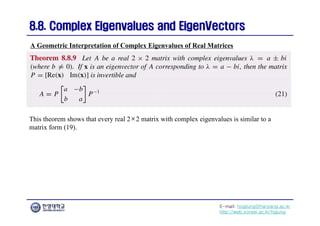
This theorem shows that every real 2×2 matrix with complex eigenvalues is similar to a
matrix form (19).
A Geometric Interpretation of Complex Eigenvalues of Real Matrices
E-mail: hogijung@hanyang.ac.kr
http://web.yonsei.ac.kr/hgjung
8.8. Complex Eigenvalues and
8.8. Complex Eigenvalues and EigenVectors
EigenVectors
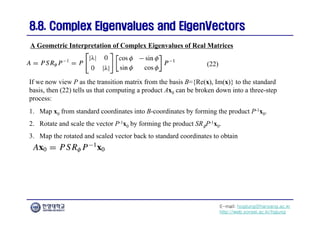
If we now view P as the transition matrix from the basis B={Re(x), Im(x)} to the standard
basis, then (22) tells us that computing a product Ax0 can be broken down into a three-step
process:
A Geometric Interpretation of Complex Eigenvalues of Real Matrices
(22)
1. Map x0 from standard coordinates into B-coordinates by forming the product P-1x0.
2. Rotate and scale the vector P-1x0 by forming the product SRφP-1x0.
3. Map the rotated and scaled vector back to standard coordinates to obtain
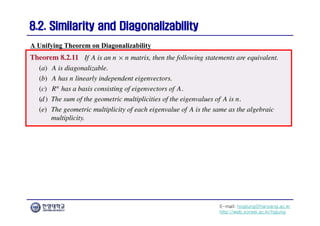
E-mail: hogijung@hanyang.ac.kr
http://web.yonsei.ac.kr/hgjung
8.8. Complex Eigenvalues and
8.8. Complex Eigenvalues and EigenVectors
EigenVectors
A has eigenvalues and that corresponding eigenvectors are
A Geometric Interpretation of Complex Eigenvalues of Real Matrices
Example 5
Example 5
If we take and in (21)
and use the fact that |λ|=1, then
E-mail: hogijung@hanyang.ac.kr
http://web.yonsei.ac.kr/hgjung
8.8. Complex Eigenvalues and
8.8. Complex Eigenvalues and EigenVectors
EigenVectors
The matrix P in (23) is the transition matrix from the basis
A Geometric Interpretation of Complex Eigenvalues of Real Matrices
Example 5
Example 5
to the standard basis, and P-1 is the transition matrix from the standard basis to the basis B.
In B-coordinates each successive multiplication by A causes the point P-1x0 to advance through
an angle , thereby tracing a circular orbit about the origin.
However, the basis B is skewed (not orthogonal), so when the points on the circular orbit are
transformed back to standard coordinates, the effect is to distort the circular orbit into the
elliptical orbit.
E-mail: hogijung@hanyang.ac.kr
http://web.yonsei.ac.kr/hgjung
8.8. Complex Eigenvalues and
8.8. Complex Eigenvalues and EigenVectors
EigenVectors
A Geometric Interpretation of Complex Eigenvalues of Real Matrices
Example 5
Example 5
3 3
1 4
1
2 4 5 5
2
3 3 1
11 4
2
5 10 5 5
0 1
1 1
1
1
1 1
1 0

     
 
   

     
 
   

    
   
   
3
4
1
5 5
2
3 1
4
2
5 5
1
1
1 0

   
 
    
 
   
 
1 1
2 2
1
1 0 1
   
    
   
5
4
1
2
 
  
 
[x0 is mapped to B-coordinates]
[The point (1,1/2) is rotated through the angle φ]
[The point (1/2,1) is mapped to standard coordinates]
E-mail: hogijung@hanyang.ac.kr
http://web.yonsei.ac.kr/hgjung
8.8. Complex Eigenvalues and
8.8. Complex Eigenvalues and EigenVectors
EigenVectors
A Geometric Interpretation of Complex Eigenvalues of Real Matrices
Section 6.1, Power Sequences
E-mail: hogijung@hanyang.ac.kr
http://web.yonsei.ac.kr/hgjung
8.9. Hermitian, Unitary, and Normal Matrices
REMARK
Part (b) of Theorem 8.8.3
The order in which the transpose and conjugate operations are performed in computing
does not matter.
In the case where A has real entries we have A*=AT,
so, A* is the same as AT for real matrices.
Hermitian and Unitary Matrices
E-mail: hogijung@hanyang.ac.kr
http://web.yonsei.ac.kr/hgjung
8.9. Hermitian, Unitary, and Normal Matrices
Find the conjugate transpose A* of the matrix
Hermitian and Unitary Matrices
Example 1
Example 1
*
1 0
2 3 2
1 2
3 2
0
i i
A
i i
i
A i i
i

 
  

 

 
 
 
 
 

 
and hence
E-mail: hogijung@hanyang.ac.kr
http://web.yonsei.ac.kr/hgjung
8.9. Hermitian, Unitary, and Normal Matrices
Formula (9) of
Section 8.8
Hermitian and Unitary Matrices
v*u
E-mail: hogijung@hanyang.ac.kr
http://web.yonsei.ac.kr/hgjung
8.9. Hermitian, Unitary, and Normal Matrices
The unitary matrices are complex generalizations of the real orthogonal matrices and
Hermitian matrices are complex generalization of the real symmetric matrices.
Hermitian and Unitary Matrices
E-mail: hogijung@hanyang.ac.kr
http://web.yonsei.ac.kr/hgjung
8.9. Hermitian, Unitary, and Normal Matrices
Thus, A is Hermitian.
Hermitian and Unitary Matrices
Example 2
Example 2
1 1
5 2
1 2 3
i i
A i i
i i
 
 
 
  
 
 
 
 
*
1 1
5 2
1 2 3
T
i i
A A i i A
i i

 
 
     
 
 
 
 
E-mail: hogijung@hanyang.ac.kr
http://web.yonsei.ac.kr/hgjung
8.9. Hermitian, Unitary, and Normal Matrices
The fact that real symmetric matrices have real eigenvalues is a special case of the more
general result about Hermitian matrices.
Hermitian and Unitary Matrices
Let v1 and v2 be eigenvectors corresponding to distinct eigenvalues λ1 and λ2.
A=A*,
This implies that (λ1- λ2)( )= 0 and hence that =0 (since λ1≠ λ2).
E-mail: hogijung@hanyang.ac.kr
http://web.yonsei.ac.kr/hgjung
8.9. Hermitian, Unitary, and Normal Matrices
Confirm that the Hermitian matrix
Hermitian and Unitary Matrices
Example 3
Example 3
has real eigenvalues and that eigenvectors from different eigenspaces are orthogonal.
1
2
1:
1
1
x i
t
x
 
 
   

   
 
 
 
1
1 2
2
4:
1
1
x i
t
x
 
  
 
  
 
   
1
1
1
i
 
 
  
 
v
 
1
2
2
1
1
i
  
  
 
v
E-mail: hogijung@hanyang.ac.kr
http://web.yonsei.ac.kr/hgjung
8.9. Hermitian, Unitary, and Normal Matrices
Hermitian and Unitary Matrices
E-mail: hogijung@hanyang.ac.kr
http://web.yonsei.ac.kr/hgjung
8.9. Hermitian, Unitary, and Normal Matrices
Use Theorem 8.9.6 show that
Hermitian and Unitary Matrices
Example 4
Example 4
is unitary, and then find A-1.
   
1 1
1 2 2
1 1
i i
  
 
 
r    
1 1
2 2 2
1 1
i i
   
 
 
r
Since we now know that A is unitary, if
follows that
E-mail: hogijung@hanyang.ac.kr
http://web.yonsei.ac.kr/hgjung
8.9. Hermitian, Unitary, and Normal Matrices
Since unitary matrices are the complex analogs of the real orthogonal matrices, the following
definition is a natural generalization of the idea of orthogonal diagonalizability for real
matrices.
Unitary Diagonalizability
E-mail: hogijung@hanyang.ac.kr
http://web.yonsei.ac.kr/hgjung
8.9. Hermitian, Unitary, and Normal Matrices
Recall that a real symmetric n×n matrix A has an orthonormal set of n eigenvectors and is
orthogonally diagonalized by any n×n matrix whose column vectors are an orthonormal set
of eigenvectors of A.
Unitary Diagonalizability
1. Find a basis for each eigenspace of A.
2. Apply the Gram-Schmidt process to each of these bases to obtain orthonormal bases for
the eigenspaces.
3. Form the matrix P whose column vectors are the basis vectors obtained in the last step.
This will be a unitary matrix (Theorem 8.9.6) and will unitarily diagonalize A.
E-mail: hogijung@hanyang.ac.kr
http://web.yonsei.ac.kr/hgjung
8.9. Hermitian, Unitary, and Normal Matrices
Find a matrix P that unitarily diagonalizes the Hermitian matrix
Unitary Diagonalizability
Example 5
Example 5
In Example 3,
1
1:
1
1
i
 
 
 
  
 
v
 
1
2
2
4:
1
1
i
 
  
  
 
v
Since each eigenspace has only one basis vector, the Gram-Schmidt process is simply a matter
of normalizing these basis vectors.
E-mail: hogijung@hanyang.ac.kr
http://web.yonsei.ac.kr/hgjung
8.9. Hermitian, Unitary, and Normal Matrices
A square matrix with complex entries is skew-Hermitian if
A skew-Hermitian matrix must have zero or pure imaginary numbers on the main diagonal,
and the complex conjugates of entries that are symmetrically positioned about the main
diagonal must be negative of one another.
Skew-Hermitian Matrices
E-mail: hogijung@hanyang.ac.kr
http://web.yonsei.ac.kr/hgjung
8.9. Hermitian, Unitary, and Normal Matrices
It can be proved that a square complex matrix A is unitarily diagonalizable if and only if
Normal Matrices
Real symmetric matrices Orthogonally diagonalizable
Hermitian matrices Unitarily diagonalizable
O
×
Matrices with this property are said to normal.
Normal matrices include the Hermitian, skew-Hermitian, and unitary matrices in the complex
case and the symmetric, skew-symmetric, and orthogonal matrices in the real case.
E-mail: hogijung@hanyang.ac.kr
http://web.yonsei.ac.kr/hgjung
8.9. Hermitian, Unitary, and Normal Matrices
A Comparison of Eigenvalues
E-mail: hogijung@hanyang.ac.kr
http://web.yonsei.ac.kr/hgjung
8.10. Systems of Differential Equations
Solve the initial value problem
Terminology
general solution
initial condition
initial value problem
Example 1
Example 1
E-mail: hogijung@hanyang.ac.kr
http://web.yonsei.ac.kr/hgjung
8.10. Systems of Differential Equations
Observe that y=0 is always a solution of (7). This is called the zero solution or the trivial
solution.
Linear Systems of Differential Equations
y’=Ay (7)
homogeneous first-order linear system
A: coefficient matrix
E-mail: hogijung@hanyang.ac.kr
http://web.yonsei.ac.kr/hgjung
8.10. Systems of Differential Equations
Linear Systems of Differential Equations
Example 2
Example 2
E-mail: hogijung@hanyang.ac.kr
http://web.yonsei.ac.kr/hgjung
8.10. Systems of Differential Equations
Every linear combination of solutions of y’=Ay is also a solution.
Closed under addition and scalar multiplication  solution space
Fundamental Solutions
E-mail: hogijung@hanyang.ac.kr
http://web.yonsei.ac.kr/hgjung
8.10. Systems of Differential Equations
We call S a fundamental set of solutions of the system, and we call
Fundamental Solutions
a general solution of the system.
E-mail: hogijung@hanyang.ac.kr
http://web.yonsei.ac.kr/hgjung
8.10. Systems of Differential Equations
Find the fundamental set of solutions.
Fundamental Solutions
Example 3
Example 3
In Example 2,
 A fundamental set of solutions
 A general solution
E-mail: hogijung@hanyang.ac.kr
http://web.yonsei.ac.kr/hgjung
8.10. Systems of Differential Equations
which shows that if there is a solution of the form (17), then λ must be an eigenvalue of A and
x must be a corresponding eigenvector.
Solutions Using Eigenvalues and Eigenvectors
y=ceat
vector x corresponds to coefficient c
(17)
E-mail: hogijung@hanyang.ac.kr
http://web.yonsei.ac.kr/hgjung
8.10. Systems of Differential Equations
Use Theorem 8.10.3 to find a general solution of the system
Solutions Using Eigenvalues and Eigenvectors
Example 4
Example 4
1
1
2:
1

 
   
 
x
1
4
1
3:
1


 
    
 
x
2
1
1
1
t
e
 
  
 
y
1
3 4
2
1
t
e 
 
  
 
y
E-mail: hogijung@hanyang.ac.kr
http://web.yonsei.ac.kr/hgjung
8.10. Systems of Differential Equations
so a general solution of the system is
Solutions Using Eigenvalues and Eigenvectors
Example 4
Example 4
2 3
1
1 1 2
4
t t
y c e c e
  2 3
2 1 2
t t
y c e c e
 
E-mail: hogijung@hanyang.ac.kr
http://web.yonsei.ac.kr/hgjung
8.10. Systems of Differential Equations
If we assume that
Solutions Using Eigenvalues and Eigenvectors
Setting t=0, we obtain
As x1, x2, …, xk are linearly independent, so we must have
which proves that y1, y2, …, yk are linearly independent.
E-mail: hogijung@hanyang.ac.kr
http://web.yonsei.ac.kr/hgjung
8.10. Systems of Differential Equations
An n×n matrix is diagonalizable if and only if it has n linearly independent eigenvectors
(Theorem 8.2.6).
Solutions Using Eigenvalues and Eigenvectors
E-mail: hogijung@hanyang.ac.kr
http://web.yonsei.ac.kr/hgjung
8.10. Systems of Differential Equations
Find a general solution of the system
Solutions Using Eigenvalues and Eigenvectors
Example 5
Example 5
In Example 3 and 4 of Section 8.2, we showed the coefficient matrix is diagonalizable by
showing that it has an eigenvalue λ=1 with geometric multiplicity 1 and an eigenvalue λ=2
with geometric multiplicity 2.
and
E-mail: hogijung@hanyang.ac.kr
http://web.yonsei.ac.kr/hgjung
8.10. Systems of Differential Equations
At time t=0, tank 1 contains 80 liters of water in which 7kg of salt has been dissolved, and
tank 2 contains 80 liters of water in which 10kg of salt has been dissolved.
Find the amount of salt in each tank at time t.
Solutions Using Eigenvalues and Eigenvectors
Example 6
Example 6
Now let
y1(t)=amount of salt in tank 1 at time t
y2(t)=amount of salt in tank 2 at time t
   
   
2 1
1
1 2
2
rate in-rate out
8 2
rate in-rate out
2 2
y t y t
y
y t y t
y
   
   
E-mail: hogijung@hanyang.ac.kr
http://web.yonsei.ac.kr/hgjung
8.10. Systems of Differential Equations
Solutions Using Eigenvalues and Eigenvectors
Example 6
Example 6
E-mail: hogijung@hanyang.ac.kr
http://web.yonsei.ac.kr/hgjung
8.10. Systems of Differential Equations
Exponential Form of A Solution
where the constants c1, c2, …, cn are chosen to satisfy the initial condition.
which is invertible and diagonalizes A.
Setting t=0, we obtain
 
1 1
2 2
0 1 2 n
n n
c c
c c
y P
c c
   
   
   
 
   
   
   
x x x

 
1
2 1
0
n
c
c
P y
c

 
 
  
 
 
 

(25)
(26)
E-mail: hogijung@hanyang.ac.kr
http://web.yonsei.ac.kr/hgjung
8.10. Systems of Differential Equations
Exponential Form of A Solution
y=etAy0
Formula (21) of Section 8.3
E-mail: hogijung@hanyang.ac.kr
http://web.yonsei.ac.kr/hgjung
8.10. Systems of Differential Equations
Exponential Form of A Solution
Use Theorem 8.10.6 to solve the initial value problem
Example 7
Example 7
etA was computed in Example 5 of Section 8.3.
E-mail: hogijung@hanyang.ac.kr
http://web.yonsei.ac.kr/hgjung
8.10. Systems of Differential Equations
The Case Where A Is Not Diagonalizable
If the coefficient matrix A is not diagonalizable, the matrix etA must be obtained or
approximated using the infinite series
: applicable in all cases
Formula (21) of Section 8.3: applicable ONLY with diagonalizable matrices
(29)
E-mail: hogijung@hanyang.ac.kr
http://web.yonsei.ac.kr/hgjung
8.10. Systems of Differential Equations
Exponential Form of A Solution
Solve the initial value problem
Example 8
Example 8
A3=0, from which it follows that (29) reduces to the finite sum
E-mail: hogijung@hanyang.ac.kr
http://web.yonsei.ac.kr/hgjung
8.10. Systems of Differential Equations
Exponential Form of A Solution
or equivalently,
Example 8
Example 8
E-mail: hogijung@hanyang.ac.kr
http://web.yonsei.ac.kr/hgjung
8.10. Systems of Differential Equations
Exponential Form of A Solution
Solve the initial value problem
Example 9
Example 9
A2=-I, from which it follows that
Thus, if we make the substitutions A2k=(-1)kI and A2k+1=(-1)kA (for k=1, 2, …) in (29) and use
the Maclaurin series for sint and cost, we obtain
E-mail: hogijung@hanyang.ac.kr
http://web.yonsei.ac.kr/hgjung
8.10. Systems of Differential Equations
Exponential Form of A Solution
or equivalently,
Example 9
Example 9

Some lecture notes on diagonalization of matrices

  • 1.
  • 2.
    E-mail: hogijung@hanyang.ac.kr http://web.yonsei.ac.kr/hgjung 8.1. MatrixRepresentations of Linear Transformations 8.1. Matrix Representations of Linear Transformations We know that every linear transformation T: RnRm has an associated standard matrix Matrix of A Linear Operator with Respect to A Basis with the property that for every vector x in Rn. For the moment we will focus on the case where T is a linear operator on Rn, so the standard matrix [T] is a square matrix of size n×n. Sometimes the form of the standard matrix fully reveals the geometric properties of a linear operator and sometimes it does not. Our primary goal in this section is to develop a way of using bases other than the standard basis to create matrices that describe the geometric behavior of a linear transformation better than the standard matrix.
  • 3.
    E-mail: hogijung@hanyang.ac.kr http://web.yonsei.ac.kr/hgjung 8.1. MatrixRepresentations of Linear Transformations 8.1. Matrix Representations of Linear Transformations Matrix of A Linear Operator with Respect to A Basis Suppose that is a linear operator on Rn and B is a basis for Rn. In the course of mapping x into T(x) this operator creates a companion operator that maps the coordinate matrix [x]B into the coordinate matrix [T(x)]B. There must be a matrix A such that
  • 4.
    E-mail: hogijung@hanyang.ac.kr http://web.yonsei.ac.kr/hgjung 8.1. MatrixRepresentations of Linear Transformations 8.1. Matrix Representations of Linear Transformations Let x be any vector in Rn, and suppose that its coordinate matrix with respect to B is Matrix of A Linear Operator with Respect to A Basis That is,
  • 5.
    E-mail: hogijung@hanyang.ac.kr http://web.yonsei.ac.kr/hgjung 8.1. MatrixRepresentations of Linear Transformations 8.1. Matrix Representations of Linear Transformations It now follows from the linearity of T that Matrix of A Linear Operator with Respect to A Basis and from the linearity of coordinate maps that which we can write in matrix form as This proves that the matrix A in (4) has property (5). Moreover, A is the only matrix with this property, for if there exists a matrix C such that for all x in Rn, then Theorem 7.11.6 implies that A=C.
  • 6.
    E-mail: hogijung@hanyang.ac.kr http://web.yonsei.ac.kr/hgjung 8.1. MatrixRepresentations of Linear Transformations 8.1. Matrix Representations of Linear Transformations The matrix A in (4) is called the matrix for T with respect to the basis B and is denoted by Matrix of A Linear Operator with Respect to A Basis Using this notation we can write (5) as
  • 7.
    E-mail: hogijung@hanyang.ac.kr http://web.yonsei.ac.kr/hgjung 8.1. MatrixRepresentations of Linear Transformations 8.1. Matrix Representations of Linear Transformations Let T: R2R2 be the linear operator whose standard matrix is Matrix of A Linear Operator with Respect to A Basis Example 1 Example 1 Find the matrix for T with respect to the basis B={v1,v2}, where The images of the basis vectors under the operator T are
  • 8.
    E-mail: hogijung@hanyang.ac.kr http://web.yonsei.ac.kr/hgjung 8.1. MatrixRepresentations of Linear Transformations 8.1. Matrix Representations of Linear Transformations so the coordinate matrices of these vectors with respect to B are Matrix of A Linear Operator with Respect to A Basis Example 1 Example 1 Thus, it follows from (6) that This matrix reveals geometric information about the operator T that was not evident from the standard matrix. It tells us that the effect of T is to stretch the v2-coordinate of a vector by a factor of 5 and to leave the v1-coordinate unchanged.
  • 9.
    E-mail: hogijung@hanyang.ac.kr http://web.yonsei.ac.kr/hgjung 8.1. MatrixRepresentations of Linear Transformations 8.1. Matrix Representations of Linear Transformations Let T: R3R3 be the linear operator whose standard matrix is Matrix of A Linear Operator with Respect to A Basis Example 2 Example 2 Let us now consider how the matrix for T would look with respect to an orthonormal basis B={v1,v2,v3} in which v3=v1×v2 is a positive scalar multiple of n and {v1,v2} is an orthonormal basis for the plane W through the origin that is perpendicular to the axis of rotation. We showed in Example 7 of Section 6.2 that T is a rotation through an angle 2π/3 about an axis in the direction of the vector n=(1,1,1).
  • 10.
    E-mail: hogijung@hanyang.ac.kr http://web.yonsei.ac.kr/hgjung 8.1. MatrixRepresentations of Linear Transformations 8.1. Matrix Representations of Linear Transformations The rotation leaves the vector v3 fixed, so Matrix of A Linear Operator with Respect to A Basis Example 2 Example 2 and hence Also, T(v1) and T(v2) are linear combinations of v1 and v2, since these vectors lie in W. This implies that the third coordinate of both [T(v1)]B and [T(v2)]B must be zero, and the matrix for T with respect to the basis B must be of the form
  • 11.
    E-mail: hogijung@hanyang.ac.kr http://web.yonsei.ac.kr/hgjung 8.1. MatrixRepresentations of Linear Transformations 8.1. Matrix Representations of Linear Transformations Since T behaves exactly like a rotation of R2 in the plane W, the block of missing entries has the form of a rotation matrix in R2. Thus, Matrix of A Linear Operator with Respect to A Basis Example 2 Example 2
  • 12.
    E-mail: hogijung@hanyang.ac.kr http://web.yonsei.ac.kr/hgjung 8.1. MatrixRepresentations of Linear Transformations 8.1. Matrix Representations of Linear Transformations Suppose that T: RnRn is a linear operator and that B={v1,v2,…,vn} and B’={v’1,v’2,…,v’n} are bases for Rn. Also, let P=PBB’ be the transition matrix from B to B’ (so P-1=PB’B is the transition matrix from B’ to B). Changing Bases The diagram shows two different paths from [x]B’ to [T(x)]B’: (11) (10) 1. 2. Thus, (10) and (11) together imply that Since this holds for all x in Rn, it follows from Theorem 7.11.6 that
  • 13.
    E-mail: hogijung@hanyang.ac.kr http://web.yonsei.ac.kr/hgjung 8.1. MatrixRepresentations of Linear Transformations 8.1. Matrix Representations of Linear Transformations When convenient, Formula (12) can be rewritten as Changing Bases and in the case where the bases are orthonormal this equation can be expressed as
  • 14.
    E-mail: hogijung@hanyang.ac.kr http://web.yonsei.ac.kr/hgjung 8.1. MatrixRepresentations of Linear Transformations 8.1. Matrix Representations of Linear Transformations Since many linear operators are defined by their standard matrices, it is important to consider the special case of Theorem 8.1.2 in which B’=S is the standard basis for Rn. In this case [T]B’=[T]S=[T], and the transition matrix P from B to B’ has the simplified form Changing Bases
  • 15.
    E-mail: hogijung@hanyang.ac.kr http://web.yonsei.ac.kr/hgjung 8.1. MatrixRepresentations of Linear Transformations 8.1. Matrix Representations of Linear Transformations Changing Bases When convenient, Formula (17) can be rewritten as and in the case where B is an orthonormal basis this equation can be expressed as
  • 16.
    E-mail: hogijung@hanyang.ac.kr http://web.yonsei.ac.kr/hgjung 8.1. MatrixRepresentations of Linear Transformations 8.1. Matrix Representations of Linear Transformations Formula (17) [or (19) in the orthogonal case] tells us that the process of changing from the standard basis for Rn to a basis B produces a factorization of the standard matrix for T as Changing Bases in which P is the transition matrix from the basis B to the standard basis S. To understand the geometric significance of this factorization, let us use it to compute T(x) by writing Reading from right to left, this equation tells us that T(x) can be obtained by first mapping the standard coordinates of x to B-coordinates using the matrix P-1, then performing the operation on the B-coordinates using the matrix [T]B, and then using the matrix P to map the resulting vector back to standard coordinates.
  • 17.
    E-mail: hogijung@hanyang.ac.kr http://web.yonsei.ac.kr/hgjung 8.1. MatrixRepresentations of Linear Transformations 8.1. Matrix Representations of Linear Transformations In Example 1 we considered the linear operator T: R2R2 whose standard matrix is Changing Bases Example 3 Example 3 and we showed that with respect to the orthonormal basis B={v1,v2} that is formed from the vectors
  • 18.
    E-mail: hogijung@hanyang.ac.kr http://web.yonsei.ac.kr/hgjung 8.1. MatrixRepresentations of Linear Transformations 8.1. Matrix Representations of Linear Transformations In this case the transition matrix from B to S is Changing Bases Example 3 Example 3 so it follows from (17) that [T] can be factored as
  • 19.
    E-mail: hogijung@hanyang.ac.kr http://web.yonsei.ac.kr/hgjung 8.1. MatrixRepresentations of Linear Transformations 8.1. Matrix Representations of Linear Transformations In Example 2 we considered the rotation T: R3R3 whose standard matrix is Changing Bases Example 4 Example 4 and we showed that From Example 7 of Section 6.2, the equation of the plane W is From Example 10 of Section 7.9, an orthonormal basis for the plane is
  • 20.
    E-mail: hogijung@hanyang.ac.kr http://web.yonsei.ac.kr/hgjung 8.1. MatrixRepresentations of Linear Transformations 8.1. Matrix Representations of Linear Transformations Since v3=v1×v2, Changing Bases Example 4 Example 4 The transition matrix from B={v1,v2,v3} to the standard basis is Since this matrix is orthogonal, it follows from (19) that [T] can be factored as
  • 21.
    E-mail: hogijung@hanyang.ac.kr http://web.yonsei.ac.kr/hgjung 8.1. MatrixRepresentations of Linear Transformations 8.1. Matrix Representations of Linear Transformations From Formula (2) of Section 6.2, the standard matrix for the reflection T of R2 about the line L through the origin making an angle θ with the positive x-axis of a rectangular xy-coordinate system is Changing Bases Example 5 Example 5 Suppose that we rotate the coordinate axes through the angle θ to align the new x’-axis with L, and we let v1 and v2 be unit vectors along the x’- and y’-axes, respectively. Since and it follows that the matrix for T with respect to the basis B={v1,v2} is
  • 22.
    E-mail: hogijung@hanyang.ac.kr http://web.yonsei.ac.kr/hgjung 8.1. MatrixRepresentations of Linear Transformations 8.1. Matrix Representations of Linear Transformations Also, it follows from Example 8 of Section 7.11 that the transition matrices between the standard basis S and the basis B are Changing Bases Example 5 Example 5 Thus, Formula (19) implies that
  • 23.
    E-mail: hogijung@hanyang.ac.kr http://web.yonsei.ac.kr/hgjung 8.1. MatrixRepresentations of Linear Transformations 8.1. Matrix Representations of Linear Transformations Recall that every linear transformation T: RnRm has an associated m×n standard matrix Matrix of A Linear Transformation with Respect to A Pair of Bases with the property that If B and B’ are bases for Rn and Rm, respectively, then the transformation creates an associated transformation that maps the coordinate matrix [x]B into the coordinate matrix [T(x)]B’. As in the operator case, this associated transformation is linear and hence must be a matrix transformation; that is, there must be a matrix A such that
  • 24.
    E-mail: hogijung@hanyang.ac.kr http://web.yonsei.ac.kr/hgjung 8.1. MatrixRepresentations of Linear Transformations 8.1. Matrix Representations of Linear Transformations The matrix A in (23) is called the matrix for T with respect to the bases B and B’ and is denoted by the symbol [T]B’,B. Matrix of A Linear Transformation with Respect to A Pair of Bases
  • 25.
    E-mail: hogijung@hanyang.ac.kr http://web.yonsei.ac.kr/hgjung 8.1. MatrixRepresentations of Linear Transformations 8.1. Matrix Representations of Linear Transformations Let T: R2R3 be the linear transformation defined by Matrix of A Linear Transformation with Respect to A Pair of Bases Example 6 Example 6 Find the matrix for T with respect to the bases B={v1,v2} for R2 and B’={v’1,v’2,v’3} for R3, where Using the given formula for T we obtain
  • 26.
    E-mail: hogijung@hanyang.ac.kr http://web.yonsei.ac.kr/hgjung 8.1. MatrixRepresentations of Linear Transformations 8.1. Matrix Representations of Linear Transformations and expressing these vectors as linear combinations of v’1, v’2, and v’3 we obtain Matrix of A Linear Transformation with Respect to A Pair of Bases Example 6 Example 6 Thus,
  • 27.
    E-mail: hogijung@hanyang.ac.kr http://web.yonsei.ac.kr/hgjung 8.1. MatrixRepresentations of Linear Transformations 8.1. Matrix Representations of Linear Transformations In particular, if B1 and B’1 are the standard bases for Rn and Rm, respectively, and if B and B’ are any bases for Rn and Rm, respectively, then it follows from (27) that Effect of Changing Bases on Matrices of Linear Transformations where U is the transition matrix from B to the standard basis for Rn and V is the transition matrix from B’ to the standard basis for Rm.
  • 28.
    E-mail: hogijung@hanyang.ac.kr http://web.yonsei.ac.kr/hgjung 8.1. MatrixRepresentations of Linear Transformations 8.1. Matrix Representations of Linear Transformations The single-basis representation of T with respect to B can be viewed as the two-basis representation in which both bases are B. Representing Linear Operators with Two Bases
  • 29.
    E-mail: hogijung@hanyang.ac.kr http://web.yonsei.ac.kr/hgjung 8.2. Similarityand Diagonalizability 8.2. Similarity and Diagonalizability REMARK If C is similar to A, then it is also true that A is similar to C. You can see this by letting Q=P-1 and rewriting the equation C=P-1AP as Similar Matrices
  • 30.
    E-mail: hogijung@hanyang.ac.kr http://web.yonsei.ac.kr/hgjung 8.2. Similarityand Diagonalizability 8.2. Similarity and Diagonalizability Let T: RnRn denote multiplication by A; that is, Similar Matrices As A and C are similar, there exists an invertible matrix P such that C=P-1AP, so it follows from (1) that (1) If we assume that the column-vector form of P is then the invertibility of P and Theorem 7.4.4 imply that B={v1,v2,…,vn} is a basis for Rn. It now follows from Formula (2) above and Formula (20) of Section 8.1 that (2)
  • 31.
    E-mail: hogijung@hanyang.ac.kr http://web.yonsei.ac.kr/hgjung 8.2. Similarityand Diagonalizability 8.2. Similarity and Diagonalizability There are a number of basic properties of matrices that are shared by similar matrices. For example, if C=P-1AP, then Similarity Invariants which shows that similar matrices have the same determinant. In general, any property that is shared by similar matrices is said to be a similarity invariant.
  • 32.
    E-mail: hogijung@hanyang.ac.kr http://web.yonsei.ac.kr/hgjung 8.2. Similarityand Diagonalizability 8.2. Similarity and Diagonalizability Similarity Invariants (e) If A and C are similar matrices, then so are and for any scalar λ. This shows that and are similar, so (3) now follows from part (a). (3)
  • 33.
    E-mail: hogijung@hanyang.ac.kr http://web.yonsei.ac.kr/hgjung 8.2. Similarityand Diagonalizability 8.2. Similarity and Diagonalizability Show that there do not exist bases for R2 with respect to which the matrices Similarity Invariants Example 1 Example 1 and Represent the same linear operator. For A and C to represent the same linear operator, the two matrices would have to be similar by Theorem 8.2.2. But this cannot be, since tr(A)=7 and tr(C)=5, contradicting the fact that the trace is a similarity invariant.
  • 34.
    E-mail: hogijung@hanyang.ac.kr http://web.yonsei.ac.kr/hgjung 8.2. Similarityand Diagonalizability 8.2. Similarity and Diagonalizability Recall that the solution space of Eigenvectors and Eigenvalues of Similar Matrices is called the eigenspace of A corresponding to λ0. We call the dimension of this solution space the geometric multiplicity of λ0. Do not confuse this with the algebraic multiplicity of λ0, which is the number of repetition of the factor λ-λ0 in the complete factorization of the characteristic polynomial of A.
  • 35.
    E-mail: hogijung@hanyang.ac.kr http://web.yonsei.ac.kr/hgjung 8.2. Similarityand Diagonalizability 8.2. Similarity and Diagonalizability Find the algebraic and geometric multiplicities of the eigenvalues of Eigenvectors and Eigenvalues of Similar Matrices Example 2 Example 2 λ=2 has algebraic multiplicity 1 λ=3 has algebraic multiplicity 2 One way to find the geometric multiplicities of the eigenvalues is to find bases for the eigenspaces and then determine the dimensions of those spaces from the number of basis vectors.
  • 36.
    E-mail: hogijung@hanyang.ac.kr http://web.yonsei.ac.kr/hgjung 8.2. Similarityand Diagonalizability 8.2. Similarity and Diagonalizability If λ=2, Eigenvectors and Eigenvalues of Similar Matrices Example 2 Example 2 If λ=3, λ=2 has algebraic multiplicity 1, geometric multiplicity 1 λ=3 has algebraic multiplicity 2, geometric multiplicity 1
  • 37.
    E-mail: hogijung@hanyang.ac.kr http://web.yonsei.ac.kr/hgjung 8.2. Similarityand Diagonalizability 8.2. Similarity and Diagonalizability Find the algebraic and geometric multiplicities of the eigenvalues of Eigenvectors and Eigenvalues of Similar Matrices Example 3 Example 3 λ=1 has algebraic multiplicity 1 λ=2 has algebraic multiplicity 2
  • 38.
    E-mail: hogijung@hanyang.ac.kr http://web.yonsei.ac.kr/hgjung 8.2. Similarityand Diagonalizability 8.2. Similarity and Diagonalizability Eigenvectors and Eigenvalues of Similar Matrices Example 3 Example 3 If λ=1, If λ=2, λ=1 has algebraic multiplicity 1, geometric multiplicity 1 λ=2 has algebraic multiplicity 2, geometric multiplicity 2
  • 39.
    E-mail: hogijung@hanyang.ac.kr http://web.yonsei.ac.kr/hgjung 8.2. Similarityand Diagonalizability 8.2. Similarity and Diagonalizability Let us assume first that A and C are similar matrices. Since similar matrices have the same characteristics polynomial, it follows that A and C have the same eigenvalues with the same algebraic multiplicities. Eigenvectors and Eigenvalues of Similar Matrices To show that an eigenvalue has the same geometric multiplicity for both matrices, we must show that the solution spaces of and have the same nullity. But we showed in the proof of Theorem 8.2.3 that the similarity of A and C implies the similarity of the matrices in (12). Thus, these matrices have the same nullity by part (c) of Theorem 8.2.3. have the same dimension, or equivalently, that the matrices and (12)
  • 40.
    E-mail: hogijung@hanyang.ac.kr http://web.yonsei.ac.kr/hgjung 8.2. Similarityand Diagonalizability 8.2. Similarity and Diagonalizability Assume that x is an eigenvector of C corresponding to λ, so x≠0 and Cx= λx. If we substitute P-1AP for C, we obtain Eigenvectors and Eigenvalues of Similar Matrices which we can rewrite as or equivalently, Since P is invertible and x≠0, it follows that Px≠0. Thus, the second equation in (13) implies that Px is an eigenvector of A corresponding to λ. (13)
  • 41.
    E-mail: hogijung@hanyang.ac.kr http://web.yonsei.ac.kr/hgjung 8.2. Similarityand Diagonalizability 8.2. Similarity and Diagonalizability Diagonal matrices play an important role in may applications because, in many respects, they represent the simplest kinds of linear operators. Multiplying x by D has the effect of “scaling” each coordinate of w (with a sign reversal for negative d’s). Diagonalization
  • 42.
    E-mail: hogijung@hanyang.ac.kr http://web.yonsei.ac.kr/hgjung 8.2. Similarityand Diagonalizability 8.2. Similarity and Diagonalizability We will show first that if the matrix A is diagonalizable, then it has n linearly independent eigenvector. The diagonalizability of A implies that there is an invertible matrix P and a diagonal matrix D, say Diagonalization and such that P-1AP=D. If we rewrite this as AP=PD and substitute (14), we obtain (14)
  • 43.
    E-mail: hogijung@hanyang.ac.kr http://web.yonsei.ac.kr/hgjung 8.2. Similarityand Diagonalizability 8.2. Similarity and Diagonalizability Thus, if we denote the column vectors of P by p1, p2, …, pn, then the left side of (15) can be expressed as Diagonalization (16) and the right side of (15) as (17) It follows from (16) and (17) that and it follows from the invertibility of P that p1, p2, …, pn are nonzero, so we have shown that p1, p2, …, pn are eigenvectors of A corresponding to λ1, λ2, …, λn, respectively. Moreover, the invertibility of P also implies that p1, p2, …, pn are linearly independent (Theorem 7.4.4 applied to P), so the column vectors of P form a set of n linearly independent eigenvectors of A.
  • 44.
    E-mail: hogijung@hanyang.ac.kr http://web.yonsei.ac.kr/hgjung 8.2. Similarityand Diagonalizability 8.2. Similarity and Diagonalizability Conversely, assume that A has n linearly independent eigenvectors, p1, p2, …, pn, and that the corresponding eigenvalues are λ1, λ2, …, λn, so Diagonalization If we now form the matrices and then we obtain However, the matrix P is invertible, since its column vectors are linearly independent, so it follows from this computation that D=P-1AP, which shows that A is diagonalizable.
  • 45.
    E-mail: hogijung@hanyang.ac.kr http://web.yonsei.ac.kr/hgjung 8.2. Similarityand Diagonalizability 8.2. Similarity and Diagonalizability A Method for Diagonalizing A Matrix
  • 46.
    E-mail: hogijung@hanyang.ac.kr http://web.yonsei.ac.kr/hgjung 8.2. Similarityand Diagonalizability 8.2. Similarity and Diagonalizability We showed in Example 3 that the matrix A Method for Diagonalizing A Matrix Example 4 Example 4 has eigenvalues λ=1 and λ=2 and that basis vectors for these eigenspaces are and It is a straightforward matter to show that these three vectors are linearly independent, so A is diagonalizable and is diagonalized by
  • 47.
    E-mail: hogijung@hanyang.ac.kr http://web.yonsei.ac.kr/hgjung 8.2. Similarityand Diagonalizability 8.2. Similarity and Diagonalizability As a check, A Method for Diagonalizing A Matrix REMARK There is no preferred order for the columns of a diagonalizing matrix P – the only effect of changing the order of the column is to change the order in which the eigenvalues appear along the main diagonal of D=P-1AP.
  • 48.
    E-mail: hogijung@hanyang.ac.kr http://web.yonsei.ac.kr/hgjung 8.2. Similarityand Diagonalizability 8.2. Similarity and Diagonalizability We showed in Example 2 that the matrix A Method for Diagonalizing A Matrix Example 5 Example 5 has eigenvalues λ=2 and λ=3 and that bases for the corresponding eigenspaces are and A is not diagonalizable since all other eigenvectors must be scalar multiples of one of these two.
  • 49.
    E-mail: hogijung@hanyang.ac.kr http://web.yonsei.ac.kr/hgjung 8.2. Similarityand Diagonalizability 8.2. Similarity and Diagonalizability The 3×3 matrix Linearly Independence of Eigenvectors Example 6 Example 6 is diagonalizable, since it has three distinct eigenvalues, λ=2, λ=3, and λ=4. The converse of Theorem 8.2.8 is false; that is, it is possible for an n×n matrix to be diagonalizable without having n distinct eigenvalues.
  • 50.
    E-mail: hogijung@hanyang.ac.kr http://web.yonsei.ac.kr/hgjung 8.2. Similarityand Diagonalizability 8.2. Similarity and Diagonalizability The key to diagonalizability rests with the dimensions of the eigenspaces. Linearly Independence of Eigenvectors Example 7 Example 7 Eigenvalues λ=2 and λ=3 λ=1 and λ=2 Geometric multiplicities 1 1 1 2 Diagonalizable X O
  • 51.
    E-mail: hogijung@hanyang.ac.kr http://web.yonsei.ac.kr/hgjung 8.2. Similarityand Diagonalizability 8.2. Similarity and Diagonalizability The geometric multiplicity of an eigenvalue cannot exceed its algebraic multiplicity. For example, if the characteristic polynomial of some 6×6 matrix A is Relationship between Algebraic and Geometric Multiplicity The eigenspace corresponding to λ=6 might have dimension 1, 2, or 3, the eigenspace corresponding to λ=5 might have dimension 1 or 2, and the eigenspace corresponding to λ=3 must have dimension 1.
  • 52.
    E-mail: hogijung@hanyang.ac.kr http://web.yonsei.ac.kr/hgjung 8.2. Similarityand Diagonalizability 8.2. Similarity and Diagonalizability A Unifying Theorem on Diagonalizability
  • 53.
    E-mail: hogijung@hanyang.ac.kr http://web.yonsei.ac.kr/hgjung 8.3. OrthogonalDiagonalizability; Functions of a Matrix 8.3. Orthogonal Diagonalizability; Functions of a Matrix Two n×n matrices A and C are said to be similar if there exists an invertible matrix P such that C=P-1AP. Orthogonal Similarity If C is orthogonally similar to A, then A is orthogonally similar to C, so we will usually say that A and C are orthogonally similar.
  • 54.
    E-mail: hogijung@hanyang.ac.kr http://web.yonsei.ac.kr/hgjung 8.3. OrthogonalDiagonalizability; Functions of a Matrix 8.3. Orthogonal Diagonalizability; Functions of a Matrix Orthogonal Similarity
  • 55.
    E-mail: hogijung@hanyang.ac.kr http://web.yonsei.ac.kr/hgjung 8.3. OrthogonalDiagonalizability; Functions of a Matrix 8.3. Orthogonal Diagonalizability; Functions of a Matrix Suppose that Orthogonal Similarity where P is orthogonal and D is diagonal. Since PTP=PPT=I, we can rewrite (1) as (1) Transposing both sides of this equation and using the fact that DT=D yields which shows that an orthogonally diagonalizable matrix must be symmetric.
  • 56.
    E-mail: hogijung@hanyang.ac.kr http://web.yonsei.ac.kr/hgjung 8.3. OrthogonalDiagonalizability; Functions of a Matrix 8.3. Orthogonal Diagonalizability; Functions of a Matrix The orthogonal diagonalizability of A implies that there exists an orthogonal matrix P and a diagonal matrix D such that PTAP=D. However, since the column vectors of an orthogonal matrix are orthonormal, and since the column vectors of P are eigenvectors of A (see the proof of Theorem 8.2.6), we have established that the column vectors of P form an orthonormal set of n eigenvectors of A. Conversely, assume that there exists an orthonormal set {p1, p2, …, pn} of n eigenvectors of A. We showed in the proof of Theorem 8.2.6 that the matrix Orthogonal Similarity diagonalizes A. However, in this case P is an orthogonal matrix, since its column vectors are orthonormal. Thus, P orthogonally diagonalizes A.
  • 57.
    E-mail: hogijung@hanyang.ac.kr http://web.yonsei.ac.kr/hgjung 8.3. OrthogonalDiagonalizability; Functions of a Matrix 8.3. Orthogonal Diagonalizability; Functions of a Matrix (b) Let v1 and v2 be eigenvectors corresponding to distinct eigenvalues λ1 and λ2, respectively. The proof that v1·v2=0 will be facilitated by using Formula (26) of Section 3.1 to write λ1 (v1·v2)=(λ1v1)·v2 as the matrix product (λ1v1)Tv2. The rest of the proof now consists of manipulating this expression in the right way: Orthogonal Similarity [v1 is an eigenvector corresponding to λ1] [symmetry of A] [v2 is an eigenvector corresponding to λ2] [Formula (26) of Section 3.1] This implies that (λ1- λ2)(v1·v2)=0, so v1·v2=0 as a result of the fact that λ1≠λ2.
  • 58.
    E-mail: hogijung@hanyang.ac.kr http://web.yonsei.ac.kr/hgjung 8.3. OrthogonalDiagonalizability; Functions of a Matrix 8.3. Orthogonal Diagonalizability; Functions of a Matrix A Method for Orthogonally Diagonalizing A Symmetric Matrix
  • 59.
    E-mail: hogijung@hanyang.ac.kr http://web.yonsei.ac.kr/hgjung 8.3. OrthogonalDiagonalizability; Functions of a Matrix 8.3. Orthogonal Diagonalizability; Functions of a Matrix Find a matrix P that orthogonally diagonalizes the symmetric matrix A Method for Orthogonally Diagonalizing A Symmetric Matrix Example 1 Example 1 The characteristic equation of A is Thus, the eigenvalues of A are λ=2 and λ=8. Using the method given in Example 3 of Section 8.2, it can be shown that the vectors and form a basis for the eigenspace corresponding to λ=2 and that
  • 60.
    E-mail: hogijung@hanyang.ac.kr http://web.yonsei.ac.kr/hgjung 8.3. OrthogonalDiagonalizability; Functions of a Matrix 8.3. Orthogonal Diagonalizability; Functions of a Matrix is a basis for the eigenspace corresponding to λ=8. Applying the Gram-Schmidt process to the bases {v1, v2} and {v3} yields the orthonormal bases {u1, u2} and {u3}, where A Method for Orthogonally Diagonalizing A Symmetric Matrix Example 1 Example 1 and Thus, A is orthogonally diagonalized by the matrix
  • 61.
    E-mail: hogijung@hanyang.ac.kr http://web.yonsei.ac.kr/hgjung 8.3. OrthogonalDiagonalizability; Functions of a Matrix 8.3. Orthogonal Diagonalizability; Functions of a Matrix As a check, A Method for Orthogonally Diagonalizing A Symmetric Matrix Example 1 Example 1
  • 62.
    E-mail: hogijung@hanyang.ac.kr http://web.yonsei.ac.kr/hgjung 8.3. OrthogonalDiagonalizability; Functions of a Matrix 8.3. Orthogonal Diagonalizability; Functions of a Matrix If A is a symmetric matrix that is orthogonally diagonalized by Spectral Decomposition and if λ1, λ2, …, λn are the eigenvalues of A corresponding to u1, u2, …, un, then we know that D=PTAP, where D is a diagonal matrix with the eigenvalues in the diagonal positions. It follows from this that the matrix A can be expressed as Multiplying out using the column-row rule (Theorem 3.8.1), we obtain the formula which is called a spectral decomposition of A or an eigenvalue decomposition of A (sometimes abbreviated as the EVD of A).
  • 63.
    E-mail: hogijung@hanyang.ac.kr http://web.yonsei.ac.kr/hgjung 8.3. OrthogonalDiagonalizability; Functions of a Matrix 8.3. Orthogonal Diagonalizability; Functions of a Matrix The matrix Spectral Decomposition Example 2 Example 2 has eigenvalues λ1=-3 and λ2=2 with corresponding eigenvectors and Normalizing these basis vectors yields and so a spectral decomposition of A is
  • 64.
    E-mail: hogijung@hanyang.ac.kr http://web.yonsei.ac.kr/hgjung 8.3. OrthogonalDiagonalizability; Functions of a Matrix 8.3. Orthogonal Diagonalizability; Functions of a Matrix Spectral Decomposition Example 2 Example 2 where the 2×2 matrices on the right are the standard matrices for the orthogonal projections onto the eigenspaces. Now let us see what this decomposition tells us about the image of the vector x=(1,1) under multiplication by A. Writing x in column form, it follows that (7) (8) (6) and from (6) that
  • 65.
    E-mail: hogijung@hanyang.ac.kr http://web.yonsei.ac.kr/hgjung 8.3. OrthogonalDiagonalizability; Functions of a Matrix 8.3. Orthogonal Diagonalizability; Functions of a Matrix Spectral Decomposition Example 2 Example 2 It follows from (7) that the image of (1,1) under multiplication by A is (3,0), and it follows from (8) that this image can also be obtained by projecting (1,1) onto the eigenspaces corresponding to λ1=-3 and λ2=2 to obtain vectors and , then scaling by the eigenvalues to obtain and , and then adding these vectors.
  • 66.
    E-mail: hogijung@hanyang.ac.kr http://web.yonsei.ac.kr/hgjung 8.3. OrthogonalDiagonalizability; Functions of a Matrix 8.3. Orthogonal Diagonalizability; Functions of a Matrix Suppose that A is an n×n matrix and P is an invertible n×n matrix. Then Powers of A Diagonalizable Matrix and more generally, if k is any positive integer, then In particular, if A is diagonalizable and P-1AP=D is a diagonal matrix, then it follows from (9) that (9) which we can rewrite as (11)
  • 67.
    E-mail: hogijung@hanyang.ac.kr http://web.yonsei.ac.kr/hgjung 8.3. OrthogonalDiagonalizability; Functions of a Matrix 8.3. Orthogonal Diagonalizability; Functions of a Matrix Use Formula (11) to find A13 for the diagonalizable matrix Powers of A Diagonalizable Matrix Example 3 Example 3 We showed in Example 4 of Section 8.2 that Thus,
  • 68.
    E-mail: hogijung@hanyang.ac.kr http://web.yonsei.ac.kr/hgjung 8.3. OrthogonalDiagonalizability; Functions of a Matrix 8.3. Orthogonal Diagonalizability; Functions of a Matrix In the special case where A is a symmetric matrix with a spectral decomposition Powers of A Diagonalizable Matrix the matrix orthogonally diagonalizes A, so (11) can be expressed as This equation can be written as from which it follows that Ak is a symmetric matrix whose eigenvalues are the kth powers of the eigenvalues of A.
  • 69.
    E-mail: hogijung@hanyang.ac.kr http://web.yonsei.ac.kr/hgjung 8.3. OrthogonalDiagonalizability; Functions of a Matrix 8.3. Orthogonal Diagonalizability; Functions of a Matrix The Cayley-Hamilton theorem makes it possible to express all positive integer powers of an n×n matrix A in terms of I, A, …, An-1 by solving (14) of An. Cayley-Hamilton Theorem In the case where A is invertible, it also makes it possible to express A-1 (and hence all negative powers of A) in terms of I, A, …, An-1 by rewriting (14) as , from which it follows that A-1 is the parenthetical expression on the left.
  • 70.
    E-mail: hogijung@hanyang.ac.kr http://web.yonsei.ac.kr/hgjung 8.3. OrthogonalDiagonalizability; Functions of a Matrix 8.3. Orthogonal Diagonalizability; Functions of a Matrix We showed in Example 2 of Section 8.2 that the characteristic polynomial of Cayley-Hamilton Theorem Example 4 Example 4 is so the Cayley-Hamilton theorem implies that This equation can be used to express A3 and all higher powers of A in terms of I, A, and A2. For example, (16)
  • 71.
    E-mail: hogijung@hanyang.ac.kr http://web.yonsei.ac.kr/hgjung 8.3. OrthogonalDiagonalizability; Functions of a Matrix 8.3. Orthogonal Diagonalizability; Functions of a Matrix and using this equation we can write Cayley-Hamilton Theorem Example 4 Example 4 Equation (16) can also be used to express A-1 as a polynomial in A by rewriting it as from which it follows that
  • 72.
    E-mail: hogijung@hanyang.ac.kr http://web.yonsei.ac.kr/hgjung 8.3. OrthogonalDiagonalizability; Functions of a Matrix 8.3. Orthogonal Diagonalizability; Functions of a Matrix In Section 3.2 we defined polynomial functions of square matrices. Recall from that discussion that if A is an n×n matrix and Exponential of A Matrix then the matrix p(A) is defined as
  • 73.
    E-mail: hogijung@hanyang.ac.kr http://web.yonsei.ac.kr/hgjung 8.3. OrthogonalDiagonalizability; Functions of a Matrix 8.3. Orthogonal Diagonalizability; Functions of a Matrix Other functions of square matrices can be defined using power series. For example, if the function f is represented by its Maclaurin series Exponential of A Matrix on some interval, then we define f(A) to be where we interpret this to mean that the ijth entry of f(A) is the sum of the series of the ijth entries of the terms on the right. (18)
  • 74.
    E-mail: hogijung@hanyang.ac.kr http://web.yonsei.ac.kr/hgjung 8.3. OrthogonalDiagonalizability; Functions of a Matrix 8.3. Orthogonal Diagonalizability; Functions of a Matrix In the special case where A is a diagonal matrix, say Exponential of A Matrix and f is defined at the point d1, d2, …, dk, each matrix on the right side of (18) is diagonal, and hence so is f(A). In this case, equating corresponding diagonal entries on the two sides of (18) yields
  • 75.
    E-mail: hogijung@hanyang.ac.kr http://web.yonsei.ac.kr/hgjung 8.3. OrthogonalDiagonalizability; Functions of a Matrix 8.3. Orthogonal Diagonalizability; Functions of a Matrix Thus, we can avoid the series altogether in the diagonal case and compute f(A) directly as Exponential of A Matrix For example, if , then
  • 76.
    E-mail: hogijung@hanyang.ac.kr http://web.yonsei.ac.kr/hgjung 8.3. OrthogonalDiagonalizability; Functions of a Matrix 8.3. Orthogonal Diagonalizability; Functions of a Matrix If A is an n×n diagonalizable matrix and P-1AP=D, where Exponential of A Matrix then (10) and (18) suggest that This tells us that f(A) can be expressed as
  • 77.
    E-mail: hogijung@hanyang.ac.kr http://web.yonsei.ac.kr/hgjung 8.3. OrthogonalDiagonalizability; Functions of a Matrix 8.3. Orthogonal Diagonalizability; Functions of a Matrix Exponential of A Matrix
  • 78.
    E-mail: hogijung@hanyang.ac.kr http://web.yonsei.ac.kr/hgjung 8.3. OrthogonalDiagonalizability; Functions of a Matrix 8.3. Orthogonal Diagonalizability; Functions of a Matrix Find etA for the diagonalizable matrix Exponential of A Matrix Example 5 Example 5 We showed in Example 4 of Section 8.2 that
  • 79.
    E-mail: hogijung@hanyang.ac.kr http://web.yonsei.ac.kr/hgjung 8.3. OrthogonalDiagonalizability; Functions of a Matrix 8.3. Orthogonal Diagonalizability; Functions of a Matrix so applying Formula (21) with f(A)=etA implies that Exponential of A Matrix Example 5 Example 5
  • 80.
    E-mail: hogijung@hanyang.ac.kr http://web.yonsei.ac.kr/hgjung 8.3. OrthogonalDiagonalizability; Functions of a Matrix 8.3. Orthogonal Diagonalizability; Functions of a Matrix Exponential of A Matrix In the special case where A is a symmetric matrix with a spectral decomposition the matrix orthogonally diagonalizes A, so (20) can be expressed as This equation can be written as , which tells us that f(A) is a symmetric matrix whose eigenvalues can be obtained by evaluating f at the eigenvalues of A.
  • 81.
    E-mail: hogijung@hanyang.ac.kr http://web.yonsei.ac.kr/hgjung 8.3. OrthogonalDiagonalizability; Functions of a Matrix 8.3. Orthogonal Diagonalizability; Functions of a Matrix Assume that we are solving a linear system Ax=b. Suppose that A is diagonalizable and P-1AP=D. If we define a new vector y=P-1x, and if we substitute Diagonalization and Linear Systems in Ax=b, then we obtain a new linear system APy=b in the unknown y. Multiplying both sides of this equation by P-1 and using the fact that P-1AP=D yields (23) Since this system has a diagonal coefficient matrix, the solution for y can be read off immediately, and the vector x can then be computed using (23). Many algorithms for solving large-scale linear systems are based on this idea. Such algorithms are particularly effective in cases in which the coefficient matrix can be orthogonally diagonalized since multiplication by orthogonal matrices does not magnify roundoff error.
  • 82.
    E-mail: hogijung@hanyang.ac.kr http://web.yonsei.ac.kr/hgjung 8.3. OrthogonalDiagonalizability; Functions of a Matrix 8.3. Orthogonal Diagonalizability; Functions of a Matrix In cases where A is not diagonalizable it is still possible to achieve considerable simplification in the form of P-1AP by choosing the matrix P appropriately. The Nondiagonalizable Case
  • 83.
    E-mail: hogijung@hanyang.ac.kr http://web.yonsei.ac.kr/hgjung 8.3. OrthogonalDiagonalizability; Functions of a Matrix 8.3. Orthogonal Diagonalizability; Functions of a Matrix The Nondiagonalizable Case In many numerical LU- and QR-algorithms in initial matrix is first converted to upper Hessenberg form, thereby reducing the amount of computation in the algorithm itself.
  • 84.
    E-mail: hogijung@hanyang.ac.kr http://web.yonsei.ac.kr/hgjung 8.4. QuadraticForms 8.4. Quadratic Forms A linear form on Rn Definition of Quadratic Form A quadratic form on Rn The term of the form akxixj are called cross product terms. A general quadratic form on R2 A general quadratic form on R3
  • 85.
    E-mail: hogijung@hanyang.ac.kr http://web.yonsei.ac.kr/hgjung 8.4. QuadraticForms 8.4. Quadratic Forms In general, if A is a symmetric n×n matrix and x is an n×1 column vector of variables, then we call the function Definition of Quadratic Form the quadratic form associated with A. When convenient, (3) can be expressed in dot product notation as (3)
  • 86.
    E-mail: hogijung@hanyang.ac.kr http://web.yonsei.ac.kr/hgjung 8.4. QuadraticForms 8.4. Quadratic Forms In the case where A is a diagonal matrix, the quadratic form QA has no cross product terms; for example, if A is the n×n identity matrix, then Definition of Quadratic Form and if A has diagonal entries λ1, λ2, …, λn, then
  • 87.
    E-mail: hogijung@hanyang.ac.kr http://web.yonsei.ac.kr/hgjung 8.4. QuadraticForms 8.4. Quadratic Forms In each part, express the quadratic form in the matrix notation xTAx, where A is symmetric. Definition of Quadratic Form Example 1 Example 1
  • 88.
    E-mail: hogijung@hanyang.ac.kr http://web.yonsei.ac.kr/hgjung 8.4. QuadraticForms 8.4. Quadratic Forms We can simplify the quadratic form xTAx by making a substitution Change of Variable in A Quadratic Form that expresses the variable x1, x2, …, xn in terms of new variable y1, y2, …, yn. If P is invertible, then we call (5) a change of variable, and if P is orthogonal, we call (5) an orthogonal change of variable. If we make the change of variable x=Py in the quadratic form xTAx, then we obtain The matrix B=PTAP is symmetric, so the effect of the change of variable is to produce a new quadratic form yTBy in the variable y1, y2, …, yn.
  • 89.
    E-mail: hogijung@hanyang.ac.kr http://web.yonsei.ac.kr/hgjung 8.4. QuadraticForms 8.4. Quadratic Forms In particular, if we choose P to orthogonally diagonalize A, then the new quadratic from will be yTDy, where D is a diagonal matrix with the eigenvalues of A on the main diagonal; that is Change of Variable in A Quadratic Form
  • 90.
    E-mail: hogijung@hanyang.ac.kr http://web.yonsei.ac.kr/hgjung 8.4. QuadraticForms 8.4. Quadratic Forms Find an orthogonal change of variable that eliminates the cross product terms in the quadratic form Q=x1 2-x3 2-4x1x2+4x2x3, and express Q in terms of the new variables. Change of Variable in A Quadratic Form Example 2 Example 2 The characteristic equation of the matrix A is so the eigenvalues are λ=0, -3, 3. the orthonormal bases for the three eigenspaces are
  • 91.
    E-mail: hogijung@hanyang.ac.kr http://web.yonsei.ac.kr/hgjung 8.4. QuadraticForms 8.4. Quadratic Forms Thus, a substitution x=Py that eliminates the cross product terms is Change of Variable in A Quadratic Form Example 2 Example 2 This produces the new quadratic form
  • 92.
    E-mail: hogijung@hanyang.ac.kr http://web.yonsei.ac.kr/hgjung 8.4. QuadraticForms 8.4. Quadratic Forms Recall that a conic section or conic is a curve that results by cutting a double-napped cone with a plane. The most important conic sections are ellipse, hyperbolas, and parabolas, which occur when the cutting plane does not pass through the vertex. If the cutting plane passes through the vertex, then the resulting intersection is called a degenerate conic. The possibilities are a point, a pair of intersecting lines, or a single line. Quadratic Forms in Geometry circle ellipse parabola hyperbola
  • 93.
    E-mail: hogijung@hanyang.ac.kr http://web.yonsei.ac.kr/hgjung 8.4. QuadraticForms 8.4. Quadratic Forms conic section Quadratic Forms in Geometry central conic central conic in standard position standard forms of nondegenerate central conic
  • 94.
    E-mail: hogijung@hanyang.ac.kr http://web.yonsei.ac.kr/hgjung 8.4. QuadraticForms 8.4. Quadratic Forms A central conic whose equation has a cross product term results by rotating a conic in standard position about the origin and hence is said to rotated out of standard position. Quadratic Forms in Geometry Quadratic forms on R3 arise in the study of geometric objects called quadratic surfaces (or quadrics). The most important surfaces of this type have equations of the form in which a, b, and c are not all zero. These are called central quadrics.
  • 95.
    E-mail: hogijung@hanyang.ac.kr http://web.yonsei.ac.kr/hgjung 8.4. QuadraticForms 8.4. Quadratic Forms It is an easy matter to identify central conics in standard position by matching the equation with one of the standard forms. For example, the equation Identifying Conic Sections can be rewritten as which, by comparison with Table 8.4.1, is the ellipse shown in Figure 8.4.3.
  • 96.
    E-mail: hogijung@hanyang.ac.kr http://web.yonsei.ac.kr/hgjung 8.4. QuadraticForms 8.4. Quadratic Forms If a central conic is rotated out of standard position, then it can be identified by first rotating the coordinate axes to put it in standard position and then matching the resulting equation with one of the standard forms in Table 8.4.1. Identifying Conic Sections To rotate the coordinate axes, we need to make an orthogonal change of variable in which det(P)=1, and if we want this rotation to eliminate the cross product term, we must choose P to orthogonally diagonalize A. If we make a change of variable with these two properties, then in the rotated coordinate system Equation (12) will become (12) where λ1 and λ2 are the eigenvalues of A. the conic can now be identified by writing (13) in the form (13)
  • 97.
    E-mail: hogijung@hanyang.ac.kr http://web.yonsei.ac.kr/hgjung 8.4. QuadraticForms 8.4. Quadratic Forms The first column vector of P, which is a unit eigenvector corresponding to λ1, is along the positive x’-axis; and the second column vector of P, which is eigenvector corresponding to λ2, is a unit vector along the y’-axis. These are called the principal axes of the ellipse. Also, since P is the transition matrix from x’y’-coordinates to xy-coordinates, it follows from Formula (29) of Section 7.11 that the matrix P can be expressed in terms of the rotating angle θ as Identifying Conic Sections
  • 98.
    E-mail: hogijung@hanyang.ac.kr http://web.yonsei.ac.kr/hgjung 8.4. QuadraticForms 8.4. Quadratic Forms (a) Identify the conic whose equation is 5x2-4xy+8y2-36=0 by rotating the xy-axes to put the conic in standard position. (b) Find the angle θ through which you rotated the xy-axes in part (a). Identifying Conic Sections Example 3 Example 3 where The characteristic polynomial of A is Thus, A is orthogonally diagonalized by det(P)=1. If det(P)=-1, then we would have exchanged the columns to reverse the sign.
  • 99.
    E-mail: hogijung@hanyang.ac.kr http://web.yonsei.ac.kr/hgjung 8.4. QuadraticForms 8.4. Quadratic Forms Identifying Conic Sections Example 3 Example 3 The equation of the conic in the x’y’-coordinate system is which we can write as or Thus,
  • 100.
    E-mail: hogijung@hanyang.ac.kr http://web.yonsei.ac.kr/hgjung 8.4. QuadraticForms 8.4. Quadratic Forms Positive Definite Quadratic Forms
  • 101.
    E-mail: hogijung@hanyang.ac.kr http://web.yonsei.ac.kr/hgjung 8.4. QuadraticForms 8.4. Quadratic Forms It follows from the principal axes theorem (Theorem 8.4.1) that there is an orthogonal change of variable x=Py for which Positive Definite Quadratic Forms Moreover, it follows from the invertibility of P that y≠0 if and only if x≠0, so the values of xTAx for x≠0 are the same as the values of yTDy for y≠0.
  • 102.
    E-mail: hogijung@hanyang.ac.kr http://web.yonsei.ac.kr/hgjung 8.4. QuadraticForms 8.4. Quadratic Forms xTBx=k Classifying Conic Sections Using Eigenvalues k≠1 - an ellipse if λ1>0 and λ2>0 - no graph if λ1<0 and λ2<0 - a hyperbola if λ1 and λ2 have opposite signs
  • 103.
    E-mail: hogijung@hanyang.ac.kr http://web.yonsei.ac.kr/hgjung 8.4. QuadraticForms 8.4. Quadratic Forms It can be used to determine whether a symmetric matrix is positive definite without finding the eigenvalues. Identifying Positive Definite Matrices Example 5 Example 5 The matrix is positive definite since the determinants Thus, we are guaranteed that all eigenvalues of A are positive and xTAx>0 for x≠0.
  • 104.
    E-mail: hogijung@hanyang.ac.kr http://web.yonsei.ac.kr/hgjung 8.4. QuadraticForms 8.4. Quadratic Forms (a)  (b) Since A is symmetric, it is orthogonally diagonalizable. This means that there is an orthogonal matrix P such that PTAP=D, where D is a diagonal matrix whose entries are the eigenvalues of A. Moreover, since A is positive definite, its eigenvalues are positive, so we can write D as D=D1 2, where D1 is the diagonal matrix whose entries are the square roots of the eigenvalues of A. Thus, we have PTAP=D1 2, which we can rewrite as Identifying Positive Definite Matrices where B=PD1PT.
  • 105.
    E-mail: hogijung@hanyang.ac.kr http://web.yonsei.ac.kr/hgjung 8.4. QuadraticForms 8.4. Quadratic Forms The eigenvalues of B are the same as the eigenvalues of D1, since eigenvalues are a similarity invariant and B is similar to D1. Thus, the eigenvalues of B are positive, since they are the square roots of the eigenvalues of A. Identifying Positive Definite Matrices (b)  (c) Assume that A=B2, where B is symmetric and positive definite. Then A=B2=BB=BTB, so take C=B. (c)  (a) Assume that A=CTC, where C is invertible. But the invertibility of C implies that Cx≠0 if x≠0, so xTAx>0 for x≠0.
  • 106.
    E-mail: hogijung@hanyang.ac.kr http://web.yonsei.ac.kr/hgjung 8.5. Applicationof Quadratic Forms to Optimization 8.5. Application of Quadratic Forms to Optimization If a function f(x,y) has first partial derivatives, then its relative maxima and minima, if any, occur at points where Relative Extrema of Functions of Two Variables and These are called critical points of f. The specific behavior of f at a critical point (x0,y0) is determined by the sign of • If D(x,y)>0 at points (x,y) that are sufficiently close to, but different from, (x0,y0), then f(x0,y0)<f(x,y) at such points and f is said to have a relative minimum at (x0,y0).
  • 107.
    E-mail: hogijung@hanyang.ac.kr http://web.yonsei.ac.kr/hgjung 8.5. Applicationof Quadratic Forms to Optimization 8.5. Application of Quadratic Forms to Optimization Relative Extrema of Functions of Two Variables • If D(x,y)<0 at points (x,y) that are sufficiently close to, but different from, (x0,y0), then f(x0,y0)>f(x,y) at such points and f is said to have a relative maximum at (x0,y0). • If D(x,y) has both positive and negative values inside every circle centered at (x0,y0), then there are points (x,y) that are arbitrarily close to (x0,y0) at which f(x0,y0)>f(x,y). In this case we say that f has a saddle point at (x0,y0).
  • 108.
    E-mail: hogijung@hanyang.ac.kr http://web.yonsei.ac.kr/hgjung 8.5. Applicationof Quadratic Forms to Optimization 8.5. Application of Quadratic Forms to Optimization Relative Extrema of Functions of Two Variables
  • 109.
    E-mail: hogijung@hanyang.ac.kr http://web.yonsei.ac.kr/hgjung 8.5. Applicationof Quadratic Forms to Optimization 8.5. Application of Quadratic Forms to Optimization To express this theorem in terms of quadratic forms, we consider the matrix Relative Extrema of Functions of Two Variables which is called the Hessian or Hessian matrix of f. The Hessian is of interest because is the expression that appears in Theorem 8.5.1.
  • 110.
    E-mail: hogijung@hanyang.ac.kr http://web.yonsei.ac.kr/hgjung 8.5. Applicationof Quadratic Forms to Optimization 8.5. Application of Quadratic Forms to Optimization Relative Extrema of Functions of Two Variables (a) If H is positive definite, then Theorem 8.4.5 implies that the principal submatrices of H have positive determinants. Thus, and
  • 111.
    E-mail: hogijung@hanyang.ac.kr http://web.yonsei.ac.kr/hgjung 8.5. Applicationof Quadratic Forms to Optimization 8.5. Application of Quadratic Forms to Optimization Find the critical points of the function Relative Extrema of Functions of Two Variables Example 1 Example 1 and use the eigenvalues of the Hessian matrix at those points to determine which of them, if any, are relative maxima, relative minima, or saddle points. Thus, the Hessian matrix is
  • 112.
    E-mail: hogijung@hanyang.ac.kr http://web.yonsei.ac.kr/hgjung 8.5. Applicationof Quadratic Forms to Optimization 8.5. Application of Quadratic Forms to Optimization We have four critical points: Relative Extrema of Functions of Two Variables Example 1 Example 1 x=0 or y=4 Evaluating the Hessian matrix at these points yields
  • 113.
    E-mail: hogijung@hanyang.ac.kr http://web.yonsei.ac.kr/hgjung 8.5. Applicationof Quadratic Forms to Optimization 8.5. Application of Quadratic Forms to Optimization Geometrically, the problem of finding the maximum and minimum values of xTAx subject to the constraint ||x||=1 amounts to finding the highest and lowest points on the intersections of the surface with the right circular cylinder determined by the circle. Constrained Extremum Problems
  • 114.
    E-mail: hogijung@hanyang.ac.kr http://web.yonsei.ac.kr/hgjung 8.5. Applicationof Quadratic Forms to Optimization 8.5. Application of Quadratic Forms to Optimization Since A is symmetric, the principal axes theorem (Theorem 8.4.1) implies that there is an orthogonal change of variable x=Py such that Constrained Extremum Problems (6) in which λ1, λ2, …, λn are the eigenvalues of A. Let us assume that ||x||=1 and that the column vectors of P (which are unit eigenvectors of A) have been ordered so that (7)
  • 115.
    E-mail: hogijung@hanyang.ac.kr http://web.yonsei.ac.kr/hgjung 8.5. Applicationof Quadratic Forms to Optimization 8.5. Application of Quadratic Forms to Optimization Since P is an orthogonal matrix, multiplication by P is length preserving, so ||y||=||x||=1; that is, Constrained Extremum Problems It follows from this equation and (7) that and hence from (6) that This shows that all values of xTAx for which ||x||=1 lie between the largest and smallest eigenvalues of A. Let x be a unit eigenvector corresponding to λ1. Then If x is a unit eigenvector corresponding to λn. Then
  • 116.
    E-mail: hogijung@hanyang.ac.kr http://web.yonsei.ac.kr/hgjung 8.5. Applicationof Quadratic Forms to Optimization 8.5. Application of Quadratic Forms to Optimization Find the maximum and minimum values of the quadratic form Constrained Extremum Problems Example 2 Example 2 subject to the constraint x2+y2=1 Thus, the constrained extrema are
  • 117.
    E-mail: hogijung@hanyang.ac.kr http://web.yonsei.ac.kr/hgjung 8.5. Applicationof Quadratic Forms to Optimization 8.5. Application of Quadratic Forms to Optimization A rectangle is to be inscribed in the ellipse 4x2+9y2=36, as shown in Figure 8.5.3. Use eigenvalue methods to find nonnegative values of x and y that produce the inscribed rectangle with maximum area. Constrained Extremum Problems Example 3 Example 3 The area z of the inscribed rectangle is given by z=4xy, so the problem is to maximize the quadratic form z=4xy subject to the constraint 4x2+9y2=36. 4x2+9y2=36 z=4xy z=24x1y1
  • 118.
    E-mail: hogijung@hanyang.ac.kr http://web.yonsei.ac.kr/hgjung 8.5. Applicationof Quadratic Forms to Optimization 8.5. Application of Quadratic Forms to Optimization The largest eigenvalue of A is λ=12 and that the only corresponding unit eigenvector with nonnegative entries is Constrained Extremum Problems Example 3 Example 3 Thus, the maximum area is z=12, and this occurs when and
  • 119.
    E-mail: hogijung@hanyang.ac.kr http://web.yonsei.ac.kr/hgjung 8.5. Applicationof Quadratic Forms to Optimization 8.5. Application of Quadratic Forms to Optimization are called the level curves of f. In particular, the level curves of a quadratic form xTAx on R2 have equations of the form Constrained Extrema and Level Curves Curves having equations of the form so the maximum and minimum values of xTAx subject to the constraint ||x||=1 are the largest and smallest values of k for which the graph of (5) intersects the unit circle. Typically, such values of k produce level curves that just touch the unit circle. Moreover, the points at which these level curves just touch the circle produce the components of the vectors that maximize or minimize xTAx subject to the constraint ||x||=1. (5)
  • 120.
    E-mail: hogijung@hanyang.ac.kr http://web.yonsei.ac.kr/hgjung 8.5. Applicationof Quadratic Forms to Optimization 8.5. Application of Quadratic Forms to Optimization Geometrically, Constrained Extremum Problems Example 4 Example 4 subject to the constraint x2+y2=1 In Example 2, There can be no level curves with k>7 or k<3 that intersects the unit circle.
  • 121.
    E-mail: hogijung@hanyang.ac.kr http://web.yonsei.ac.kr/hgjung 8.6. SingularValue Decomposition 8.6. Singular Value Decomposition We know from our work in Section 8.3 that symmetric matrices are orthogonally diagonalizable and are the only matrices with this property (Theorem 8.3.4). The orthogonal diagonalizability of an n×n symmetric matrix A means it can be factored as A=PDPT (1) where P is an n×n orthogonal matrix of eigenvectors of A, and D is the diagonal matrix whose diagonal entries are the eigenvalues corresponding to the column vectors of P. In this section we will call (1) an eigenvalue decomposition of A (abbreviated EVD of A). Singular Value Decomposition of Square Matrices
  • 122.
    E-mail: hogijung@hanyang.ac.kr http://web.yonsei.ac.kr/hgjung 8.6. SingularValue Decomposition 8.6. Singular Value Decomposition If an n×n matrix A is not symmetric, then it does not have an eigenvalue decomposition, but it does have a Hessenberg decomposition A=PHPT in which P is an orthogonal matrix and H is in upper Hessenberg form (Theorem 8.3.8). Moreover, if A has real eigenvalues, then it has a Schur decomposition A=PSPT in which P is an orthogonal matrix and S is upper triangular (Theorem 8.3.7). Singular Value Decomposition of Square Matrices
  • 123.
    E-mail: hogijung@hanyang.ac.kr http://web.yonsei.ac.kr/hgjung 8.6. SingularValue Decomposition 8.6. Singular Value Decomposition The eigenvalue, Hessenberg, and Schur decompositions are important in numerical algorithms not only because H and S have simpler forms than A, but also because the orthogonal matrices that appear in these factorizations do not magnify roundoff error. Suppose that is a column vector whose entries are known exactly and that Singular Value Decomposition of Square Matrices ˆ   x x e is the vector that results when roundoff error is present in the entries of . If P is an orthogonal matrix, then the length-preserving property of orthogonal transformations implies that which tells us that the error in approximating by Px has the same magnitude as the error in approximating by x.
  • 124.
    E-mail: hogijung@hanyang.ac.kr http://web.yonsei.ac.kr/hgjung 8.6. SingularValue Decomposition 8.6. Singular Value Decomposition There are two main paths that one might follow in looking for other kinds of factorizations of a general square matrix A. Singular Value Decomposition of Square Matrices Jordan canonical form A=PJP-1 in which P is invertible but not necessarily orthogonal. And, J is either diagonal (Theorem 8.2.6) or a certain kind of block diagonal matrix. Singular Value Decomposition (SVD) A=UΣVT in which U and V are orthogonal but not necessarily the same. And, Σ is diagonal.
  • 125.
    E-mail: hogijung@hanyang.ac.kr http://web.yonsei.ac.kr/hgjung 8.6. SingularValue Decomposition 8.6. Singular Value Decomposition The matrix ATA is symmetric, so it has an eigenvalue decomposition ATA=VDVT where the column vectors of V are unit eigenvectors of ATA and D is the diagonal matrix whose diagonal entries are the corresponding eigenvalues of ATA. These eigenvalues are nonnegative, for if is an eigenvalue of ATA and x is a corresponding eigenvector, then Formula (12) of Section 3.2 implies that Singular Value Decomposition of Square Matrices from which it follows that λ≥0.
  • 126.
    E-mail: hogijung@hanyang.ac.kr http://web.yonsei.ac.kr/hgjung 8.6. SingularValue Decomposition 8.6. Singular Value Decomposition Since Theorems 7.5.8 and 8.2.3 imply that Singular Value Decomposition of Square Matrices and since A has rank k, it follows that there are k positive entries and n-k zeros on the main diagonal of D. For convenience, suppose that the column vectors v1, v2, …, vn of V have been ordered so that the corresponding eigenvalues of ATA are in nonincreasing order Thus, and
  • 127.
    E-mail: hogijung@hanyang.ac.kr http://web.yonsei.ac.kr/hgjung 8.6. SingularValue Decomposition 8.6. Singular Value Decomposition Now consider the set of image vectors Singular Value Decomposition of Square Matrices This is an orthogonal set, for if i≠j, then the orthogonality of vi and vj implies that Moreover, from which it follows that Since λ1>0 for i=1, 2, …, k, it follows from (3) and (4) that is an orthogonal set of k nonzero vectors in the column space of A; and since we know that the column space of A has dimension k (since A has rank k), it follows that (5) is an orthogonal basis for the column space of A.
  • 128.
    E-mail: hogijung@hanyang.ac.kr http://web.yonsei.ac.kr/hgjung 8.6. SingularValue Decomposition 8.6. Singular Value Decomposition If we normalize these vectors to obtain an orthonormal basis {u1, u2, …, uk} for the column space, then Theorem 7.9.7 guarantees that we can extend this to an orthonormal basis Singular Value Decomposition of Square Matrices for Rn. Since the first k vectors in this set result from normalizing the vectors in (5), we have which implies that
  • 129.
    E-mail: hogijung@hanyang.ac.kr http://web.yonsei.ac.kr/hgjung 8.6. SingularValue Decomposition 8.6. Singular Value Decomposition Now let U be the orthogonal matrix Singular Value Decomposition of Square Matrices and let Σ be the diagonal matrix It follows from (2) and (4) that Avj=0 for j>k, so which we can rewrite as A=UΣVT using the orthogonality of V.
  • 130.
    E-mail: hogijung@hanyang.ac.kr http://web.yonsei.ac.kr/hgjung 8.6. SingularValue Decomposition 8.6. Singular Value Decomposition It is important to keep in mind that the positive entries on the main diagonal of Σ are not eigenvalues of A, but rather square roots of the nonzero eigenvalues of ATA. These numbers are called the singular values of A and are denoted by Singular Value Decomposition of Square Matrices With this notation, the factorization obtained in the proof of Theorem 8.6.1 has the form which is called the singular value decomposition of A (abbreviated SVD of A). The vectors u1, u2, …, uk are called left singular vectors of A and v1, v2, …, vk are called right singular vectors of A.
  • 131.
    E-mail: hogijung@hanyang.ac.kr http://web.yonsei.ac.kr/hgjung 8.6. SingularValue Decomposition 8.6. Singular Value Decomposition Singular Value Decomposition of Square Matrices
  • 132.
    E-mail: hogijung@hanyang.ac.kr http://web.yonsei.ac.kr/hgjung 8.6. SingularValue Decomposition 8.6. Singular Value Decomposition Find the singular value decomposition of the matrix Singular Value Decomposition of Square Matrices Example 1 Example 1 The first step is to find the eigenvalues of the matrix The characteristic polynomial of ATA is so the eigenvalues of ATA are λ1=9 and λ2=1, and the singular values of A are
  • 133.
    E-mail: hogijung@hanyang.ac.kr http://web.yonsei.ac.kr/hgjung 8.6. SingularValue Decomposition 8.6. Singular Value Decomposition Unit eigenvectors of ATA corresponding to the eigenvalues λ1=9 and λ2=1 are Singular Value Decomposition of Square Matrices Example 1 Example 1 and respectively. Thus, so
  • 134.
    E-mail: hogijung@hanyang.ac.kr http://web.yonsei.ac.kr/hgjung 8.6. SingularValue Decomposition 8.6. Singular Value Decomposition It now follows that the singular value decomposition of A is Singular Value Decomposition of Square Matrices Example 1 Example 1
  • 135.
    E-mail: hogijung@hanyang.ac.kr http://web.yonsei.ac.kr/hgjung 8.6. SingularValue Decomposition 8.6. Singular Value Decomposition In the case where A is symmetric we have ATA=A2, so the eigenvalues of ATA are the squares of the eigenvalues of A. Thus, the nonzero eigenvalues of ATA in nonincreasing order are Singular Value Decomposition of Symmetric Matrices and the singular values of A in nonincreasing order are Suppose that A has rank k and that the nonzero eigenvalues of A are ordered so that This shows that the singular values of a symmetric matrix A are the absolute values of the nonzero eigenvalues of A; and it also shows that if A is a symmetric matrix with nonnegative eigenvalues, then the singular values of A are the same as its nonzero eigenvalues.
  • 136.
    E-mail: hogijung@hanyang.ac.kr http://web.yonsei.ac.kr/hgjung 8.6. SingularValue Decomposition 8.6. Singular Value Decomposition If A is an m×n matrix, then ATA is an n×n symmetric matrix and hence has an eigenvalue decomposition, just as in the case where A is square. Except for appropriate size adjustments to account for the possibility that n>m or n<m, the proof of Theorem 8.6.1 carries over without change and yields the following generalization of Theorem 8.6.2. Singular Value Decomposition of Nonsquare Matrices
  • 137.
    E-mail: hogijung@hanyang.ac.kr http://web.yonsei.ac.kr/hgjung 8.6. SingularValue Decomposition 8.6. Singular Value Decomposition Singular Value Decomposition of Nonsquare Matrices
  • 138.
    E-mail: hogijung@hanyang.ac.kr http://web.yonsei.ac.kr/hgjung 8.6. SingularValue Decomposition 8.6. Singular Value Decomposition Singular Value Decomposition of Nonsquare Matrices singular values of A left singular vectors of A right singular vectors of A
  • 139.
    E-mail: hogijung@hanyang.ac.kr http://web.yonsei.ac.kr/hgjung 8.6. SingularValue Decomposition 8.6. Singular Value Decomposition Find the singular value decomposition of the matrix Singular Value Decomposition of Nonsquare Matrices Example 4 Example 4
  • 140.
    E-mail: hogijung@hanyang.ac.kr http://web.yonsei.ac.kr/hgjung 8.6. SingularValue Decomposition 8.6. Singular Value Decomposition A unit vector u3 that is orthogonal to u1 and u2 must be a solution of the homogeneous linear system Singular Value Decomposition of Nonsquare Matrices Example 4 Example 4
  • 141.
    E-mail: hogijung@hanyang.ac.kr http://web.yonsei.ac.kr/hgjung 8.6. SingularValue Decomposition 8.6. Singular Value Decomposition Thus, the singular value decomposition of A is Singular Value Decomposition of Nonsquare Matrices Example 4 Example 4
  • 142.
    E-mail: hogijung@hanyang.ac.kr http://web.yonsei.ac.kr/hgjung 8.6. SingularValue Decomposition 8.6. Singular Value Decomposition Singular Value Decomposition of Nonsquare Matrices
  • 143.
    E-mail: hogijung@hanyang.ac.kr http://web.yonsei.ac.kr/hgjung 8.6. SingularValue Decomposition 8.6. Singular Value Decomposition which is called a reduced singular value decomposition of A Reduced Singular Value Decomposition The products that involve zero blocks as factors drop out, leaving U1: m×k, Σ1: k×k, and V1: k×n which is called a reduced singular value expansion of A
  • 144.
    E-mail: hogijung@hanyang.ac.kr http://web.yonsei.ac.kr/hgjung 8.6. SingularValue Decomposition 8.6. Singular Value Decomposition If the matrix A has size m×n, then one might store each of its mn entries individually. An alternative procedure is to compute the reduced singular value decomposition Data Compression and Image Processing in which σ1≥σ2≥…≥σk, and store the σ’s, the u’s and the v’s. When needed, the matrix A can be reconstructed from (17). Since each uj has m entries and each vj has n entries, this method requires storage space for numbers.
  • 145.
    E-mail: hogijung@hanyang.ac.kr http://web.yonsei.ac.kr/hgjung 8.6. SingularValue Decomposition 8.6. Singular Value Decomposition numbers, compared to mn numbers required for entry-by-entry storage of A. Data Compression and Image Processing It is called the rank r approximation of A. This matrix requires storage space for only For example, the rank 100 approximation of a 1000×1000 matrix A requires storage for only numbers, compared to the 1,000,000 numbers required for entry-by-entry storage of A – a compression of almost 80%. rank 4 rank 10 rank 20 rank 50 rank 128
  • 146.
    E-mail: hogijung@hanyang.ac.kr http://web.yonsei.ac.kr/hgjung 8.6. SingularValue Decomposition 8.6. Singular Value Decomposition If A is an m×n matrix and TA: RnRm is multiplication by A, then the matrix Singular Value Decomposition from The Transformation Point of View in (12) is the matrix for TA with respect to the bases {v1, v2, …, vn} and {u1, u2, …, um} for Rn and Rm, respectively.
  • 147.
    E-mail: hogijung@hanyang.ac.kr http://web.yonsei.ac.kr/hgjung 8.6. SingularValue Decomposition 8.6. Singular Value Decomposition Thus, when vectors are expressed in terms of these bases, we see that the effect of multiplying a vector by A is to scale the first k coordinates of the vector by the factor σ1, σ2, …, σk, map the rest of the coordinates to zero, and possibly to discard coordinates or append zeros, if needed, to account for a decrease or increase in dimension. Singular Value Decomposition from The Transformation Point of View This idea is illustrated in Figure 8.6.4 for a 2×3 matrix A of rank 2.
  • 148.
    E-mail: hogijung@hanyang.ac.kr http://web.yonsei.ac.kr/hgjung 8.6. SingularValue Decomposition 8.6. Singular Value Decomposition Since row(A)┴=null(A), it follows from Theorem 7.7.4 that every vector x in Rn can be expressed uniquely as Singular Value Decomposition from The Transformation Point of View where xrow(A) is the orthogonal projection of x on the row space of A and xnull(A) is its orthogonal projection on the null space of A. Since Axnull(A)=0, it follows that
  • 149.
    E-mail: hogijung@hanyang.ac.kr http://web.yonsei.ac.kr/hgjung 8.6. SingularValue Decomposition 8.6. Singular Value Decomposition This tells us three things: Singular Value Decomposition from The Transformation Point of View 1. The image of any vector in Rn under multiplication by A is the same as the image of the orthogonal projection of that vector on row(A). 2. The range of the transformation TA, namely col(A), is the image of row(A). 3. TA maps distinct vectors in row(A) into distinct vectors in Rm. Thus, even though TA may not be one-to-one when considered as a transformation with domain Rn, it is one-to-one if its domain is restricted to row(A). REMARK “hiding” inside of every nonzero matrix transformation TA there is a one-to-one matrix transformation that maps the row space of A onto the column space of A. Moreover, that hidden transformation is represented by the reduced singular value decomposition of A with respect to appropriate bases.
  • 150.
    E-mail: hogijung@hanyang.ac.kr http://web.yonsei.ac.kr/hgjung 8.7. ThePseudoinverse 8.7. The Pseudoinverse If A is an invertible n×n matrix with reduced singular value decomposition The Pseudoinverse then U1, Σ1, V1 are all n×n invertible matrices, so the orthogonality of U1 and V1 implies that If A is not square or if it is square but not invertible, then this formula does not apply. As the matrix Σ1 is always invertible, the right side of (1) is defined for every matrix A. (1) If A is nonzero m×n matrix, then we call the n×m matrix the pseudoinverse of A. (2)
  • 151.
    E-mail: hogijung@hanyang.ac.kr http://web.yonsei.ac.kr/hgjung 8.7. ThePseudoinverse 8.7. The Pseudoinverse from which it follows that The Pseudoinverse Since A has full column rank, the matrix ATA is invertible (Theorem 7.5.10) and V1 is an n×n orthogonal matrix. Thus,
  • 152.
    E-mail: hogijung@hanyang.ac.kr http://web.yonsei.ac.kr/hgjung 8.7. ThePseudoinverse 8.7. The Pseudoinverse Find the pseudoinverse of the matrix The Pseudoinverse Example 1 Example 1 using the reduced singular value decomposition that was obtained in Example 5 of Section 8.6.
  • 153.
    E-mail: hogijung@hanyang.ac.kr http://web.yonsei.ac.kr/hgjung 8.7. ThePseudoinverse 8.7. The Pseudoinverse The Pseudoinverse Example 2 Example 2 A has full column rank so its pseudoinverse can also be computed from Formula (3).
  • 154.
    E-mail: hogijung@hanyang.ac.kr http://web.yonsei.ac.kr/hgjung 8.7. ThePseudoinverse 8.7. The Pseudoinverse Properties of The Pseudoinverse
  • 155.
    E-mail: hogijung@hanyang.ac.kr http://web.yonsei.ac.kr/hgjung 8.7. ThePseudoinverse 8.7. The Pseudoinverse Properties of The Pseudoinverse (a) If y is a vector in Rm, then it follows from (2) that so A+y must be a linear combination of the column vectors of V1. Since Theorem 8.6.5 states that these vectors are in row(A), it follows that A+y is in row(A).
  • 156.
    E-mail: hogijung@hanyang.ac.kr http://web.yonsei.ac.kr/hgjung 8.7. ThePseudoinverse 8.7. The Pseudoinverse (b) Multiplying A+ on the right by U1 yields Properties of The Pseudoinverse The result now follows by comparing corresponding column vectors on the two sides of this equation. (c) If y is a vector in null(AT), then y is orthogonal to each vector in col(A), and, in particular, it is orthogonal to each column vector of U1=[u1, u2, …, uk]. This implies that U1 Ty=0, and hence that
  • 157.
    E-mail: hogijung@hanyang.ac.kr http://web.yonsei.ac.kr/hgjung 8.7. ThePseudoinverse 8.7. The Pseudoinverse Use the pseudoinverse of Properties of The Pseudoinverse Example 3 Example 3 to find the standard matrix for the orthogonal projection of R3 onto the column space of A. The pseudoinverse of A was computed in Example 2. Using that result we see that the orthogonal projection of R3 onto col(A) is
  • 158.
    E-mail: hogijung@hanyang.ac.kr http://web.yonsei.ac.kr/hgjung 8.7. ThePseudoinverse 8.7. The Pseudoinverse Pseudoinverse And Least Squares Linear system Ax=b Least square solutions: the exact solution of the normal equation ATAx=ATb  If full column rank, there is a unique least square solution x=(ATA)-1ATb=A+b  If not, there are infinitely many solutions We know that among these least squares solutions there is a unique least square solution in the row space of A (Theorem 7.8.3), and we also know that it is the least squares solution of minimum norm.
  • 159.
    E-mail: hogijung@hanyang.ac.kr http://web.yonsei.ac.kr/hgjung 8.7. ThePseudoinverse 8.7. The Pseudoinverse (1) Let A=U1Σ1V1 T be a reduced singular value decomposition of A, so Pseudoinverse And Least Squares Thus, which shows that x=A+b satisfies the normal equation and hence is a least squares solution. (2) x=A+b lies in the row space of A by part (a) of Theorem 8.7.3. Thus, it is the least squares solution of minimum norm (Theorem 7.8.3).
  • 160.
    E-mail: hogijung@hanyang.ac.kr http://web.yonsei.ac.kr/hgjung 8.7. ThePseudoinverse 8.7. The Pseudoinverse x+ is the least squares solution of minimum norm and is an exact solution of the linear system; that is Pseudoinverse And Least Squares
  • 161.
    E-mail: hogijung@hanyang.ac.kr http://web.yonsei.ac.kr/hgjung 8.7. ThePseudoinverse 8.7. The Pseudoinverse Ax=b If A is “nearly singular”, the linear system is said to be ill conditioned. A good measure of how roundoff error will affect the accuracy of a computed solution is given by the ratio of the largest singular value of A to the smallest singular values of A. It is called condition number of A, is denoted by Condition Number And Numerical Considerations The larger the condition number, the more sensitive the system to small roundoff errors.
  • 162.
    E-mail: hogijung@hanyang.ac.kr http://web.yonsei.ac.kr/hgjung 8.8. ComplexEigenvalues and 8.8. Complex Eigenvalues and EigenVectors EigenVectors modulus (or absolute value) Vectors in Cn argument polar form complex conjugate The standard operations on real matrices carry over to complex matrices without change, and all of the familiar properties of matrices continue to hold.
  • 163.
    E-mail: hogijung@hanyang.ac.kr http://web.yonsei.ac.kr/hgjung 8.8. ComplexEigenvalues and 8.8. Complex Eigenvalues and EigenVectors EigenVectors Algebraic Properties of The Complex Conjugate
  • 164.
    E-mail: hogijung@hanyang.ac.kr http://web.yonsei.ac.kr/hgjung 8.8. ComplexEigenvalues and 8.8. Complex Eigenvalues and EigenVectors EigenVectors The analogous formulas in Cn are The Complex Euclidean Inner Product If u and v are column vectors in Rn, then their dot product can be expressed as
  • 165.
    E-mail: hogijung@hanyang.ac.kr http://web.yonsei.ac.kr/hgjung 8.8. ComplexEigenvalues and 8.8. Complex Eigenvalues and EigenVectors EigenVectors The Complex Euclidean Inner Product Example 2 Example 2
  • 166.
    E-mail: hogijung@hanyang.ac.kr http://web.yonsei.ac.kr/hgjung 8.8. ComplexEigenvalues and 8.8. Complex Eigenvalues and EigenVectors EigenVectors (c) The Complex Euclidean Inner Product
  • 167.
    E-mail: hogijung@hanyang.ac.kr http://web.yonsei.ac.kr/hgjung 8.8. ComplexEigenvalues and 8.8. Complex Eigenvalues and EigenVectors EigenVectors Except for the use of complex scalars, notions of linear combination, linear independence, subspace, spanning, basis, and dimension carry over without change to Cn, as do most of the theorems we have given in this text about them. Vector Space Concepts in Cn
  • 168.
    E-mail: hogijung@hanyang.ac.kr http://web.yonsei.ac.kr/hgjung 8.8. ComplexEigenvalues and 8.8. Complex Eigenvalues and EigenVectors EigenVectors complex eigenvalue, complex eigenvector, eigenspace Complex Eigenvalues of Real Matrices Acting on Vectors in Cn Ax= λx since A has real entries
  • 169.
    E-mail: hogijung@hanyang.ac.kr http://web.yonsei.ac.kr/hgjung 8.8. ComplexEigenvalues and 8.8. Complex Eigenvalues and EigenVectors EigenVectors Find the eigenvalues and bases for the eigenspaces of Complex Eigenvalues of Real Matrices Acting on Vectors in Cn Example 3 Example 3 With λ=i, With λ=-i,
  • 170.
    E-mail: hogijung@hanyang.ac.kr http://web.yonsei.ac.kr/hgjung 8.8. ComplexEigenvalues and 8.8. Complex Eigenvalues and EigenVectors EigenVectors Suppose that λ is an eigenvalue of A and x is a corresponding eigenvector. A Proof That Real Symmetric Matrices Have Real Eigenvalues where x≠0. which shows the numerator is real. Since the denominator is real, λ is real.
  • 171.
    E-mail: hogijung@hanyang.ac.kr http://web.yonsei.ac.kr/hgjung 8.8. ComplexEigenvalues and 8.8. Complex Eigenvalues and EigenVectors EigenVectors Geometrically, this theorem states that multiplication by a matrix of form (19) can be viewed as a rotation through the angle φ followed by a scaling with factor |λ|. A Geometric Interpretation of Complex Eigenvalues of Real Matrices
  • 172.
    E-mail: hogijung@hanyang.ac.kr http://web.yonsei.ac.kr/hgjung 8.8. ComplexEigenvalues and 8.8. Complex Eigenvalues and EigenVectors EigenVectors This theorem shows that every real 2×2 matrix with complex eigenvalues is similar to a matrix form (19). A Geometric Interpretation of Complex Eigenvalues of Real Matrices
  • 173.
    E-mail: hogijung@hanyang.ac.kr http://web.yonsei.ac.kr/hgjung 8.8. ComplexEigenvalues and 8.8. Complex Eigenvalues and EigenVectors EigenVectors If we now view P as the transition matrix from the basis B={Re(x), Im(x)} to the standard basis, then (22) tells us that computing a product Ax0 can be broken down into a three-step process: A Geometric Interpretation of Complex Eigenvalues of Real Matrices (22) 1. Map x0 from standard coordinates into B-coordinates by forming the product P-1x0. 2. Rotate and scale the vector P-1x0 by forming the product SRφP-1x0. 3. Map the rotated and scaled vector back to standard coordinates to obtain
  • 174.
    E-mail: hogijung@hanyang.ac.kr http://web.yonsei.ac.kr/hgjung 8.8. ComplexEigenvalues and 8.8. Complex Eigenvalues and EigenVectors EigenVectors A has eigenvalues and that corresponding eigenvectors are A Geometric Interpretation of Complex Eigenvalues of Real Matrices Example 5 Example 5 If we take and in (21) and use the fact that |λ|=1, then
  • 175.
    E-mail: hogijung@hanyang.ac.kr http://web.yonsei.ac.kr/hgjung 8.8. ComplexEigenvalues and 8.8. Complex Eigenvalues and EigenVectors EigenVectors The matrix P in (23) is the transition matrix from the basis A Geometric Interpretation of Complex Eigenvalues of Real Matrices Example 5 Example 5 to the standard basis, and P-1 is the transition matrix from the standard basis to the basis B. In B-coordinates each successive multiplication by A causes the point P-1x0 to advance through an angle , thereby tracing a circular orbit about the origin. However, the basis B is skewed (not orthogonal), so when the points on the circular orbit are transformed back to standard coordinates, the effect is to distort the circular orbit into the elliptical orbit.
  • 176.
    E-mail: hogijung@hanyang.ac.kr http://web.yonsei.ac.kr/hgjung 8.8. ComplexEigenvalues and 8.8. Complex Eigenvalues and EigenVectors EigenVectors A Geometric Interpretation of Complex Eigenvalues of Real Matrices Example 5 Example 5 3 3 1 4 1 2 4 5 5 2 3 3 1 11 4 2 5 10 5 5 0 1 1 1 1 1 1 1 1 0                                         3 4 1 5 5 2 3 1 4 2 5 5 1 1 1 0                     1 1 2 2 1 1 0 1              5 4 1 2        [x0 is mapped to B-coordinates] [The point (1,1/2) is rotated through the angle φ] [The point (1/2,1) is mapped to standard coordinates]
  • 177.
    E-mail: hogijung@hanyang.ac.kr http://web.yonsei.ac.kr/hgjung 8.8. ComplexEigenvalues and 8.8. Complex Eigenvalues and EigenVectors EigenVectors A Geometric Interpretation of Complex Eigenvalues of Real Matrices Section 6.1, Power Sequences
  • 178.
    E-mail: hogijung@hanyang.ac.kr http://web.yonsei.ac.kr/hgjung 8.9. Hermitian,Unitary, and Normal Matrices 8.9. Hermitian, Unitary, and Normal Matrices REMARK Part (b) of Theorem 8.8.3 The order in which the transpose and conjugate operations are performed in computing does not matter. In the case where A has real entries we have A*=AT, so, A* is the same as AT for real matrices. Hermitian and Unitary Matrices
  • 179.
    E-mail: hogijung@hanyang.ac.kr http://web.yonsei.ac.kr/hgjung 8.9. Hermitian,Unitary, and Normal Matrices 8.9. Hermitian, Unitary, and Normal Matrices Find the conjugate transpose A* of the matrix Hermitian and Unitary Matrices Example 1 Example 1 * 1 0 2 3 2 1 2 3 2 0 i i A i i i A i i i                        and hence
  • 180.
    E-mail: hogijung@hanyang.ac.kr http://web.yonsei.ac.kr/hgjung 8.9. Hermitian,Unitary, and Normal Matrices 8.9. Hermitian, Unitary, and Normal Matrices Formula (9) of Section 8.8 Hermitian and Unitary Matrices v*u
  • 181.
    E-mail: hogijung@hanyang.ac.kr http://web.yonsei.ac.kr/hgjung 8.9. Hermitian,Unitary, and Normal Matrices 8.9. Hermitian, Unitary, and Normal Matrices The unitary matrices are complex generalizations of the real orthogonal matrices and Hermitian matrices are complex generalization of the real symmetric matrices. Hermitian and Unitary Matrices
  • 182.
    E-mail: hogijung@hanyang.ac.kr http://web.yonsei.ac.kr/hgjung 8.9. Hermitian,Unitary, and Normal Matrices 8.9. Hermitian, Unitary, and Normal Matrices Thus, A is Hermitian. Hermitian and Unitary Matrices Example 2 Example 2 1 1 5 2 1 2 3 i i A i i i i                  * 1 1 5 2 1 2 3 T i i A A i i A i i                   
  • 183.
    E-mail: hogijung@hanyang.ac.kr http://web.yonsei.ac.kr/hgjung 8.9. Hermitian,Unitary, and Normal Matrices 8.9. Hermitian, Unitary, and Normal Matrices The fact that real symmetric matrices have real eigenvalues is a special case of the more general result about Hermitian matrices. Hermitian and Unitary Matrices Let v1 and v2 be eigenvectors corresponding to distinct eigenvalues λ1 and λ2. A=A*, This implies that (λ1- λ2)( )= 0 and hence that =0 (since λ1≠ λ2).
  • 184.
    E-mail: hogijung@hanyang.ac.kr http://web.yonsei.ac.kr/hgjung 8.9. Hermitian,Unitary, and Normal Matrices 8.9. Hermitian, Unitary, and Normal Matrices Confirm that the Hermitian matrix Hermitian and Unitary Matrices Example 3 Example 3 has real eigenvalues and that eigenvectors from different eigenspaces are orthogonal. 1 2 1: 1 1 x i t x                    1 1 2 2 4: 1 1 x i t x                 1 1 1 i          v   1 2 2 1 1 i         v
  • 185.
    E-mail: hogijung@hanyang.ac.kr http://web.yonsei.ac.kr/hgjung 8.9. Hermitian,Unitary, and Normal Matrices 8.9. Hermitian, Unitary, and Normal Matrices Hermitian and Unitary Matrices
  • 186.
    E-mail: hogijung@hanyang.ac.kr http://web.yonsei.ac.kr/hgjung 8.9. Hermitian,Unitary, and Normal Matrices 8.9. Hermitian, Unitary, and Normal Matrices Use Theorem 8.9.6 show that Hermitian and Unitary Matrices Example 4 Example 4 is unitary, and then find A-1.     1 1 1 2 2 1 1 i i        r     1 1 2 2 2 1 1 i i         r Since we now know that A is unitary, if follows that
  • 187.
    E-mail: hogijung@hanyang.ac.kr http://web.yonsei.ac.kr/hgjung 8.9. Hermitian,Unitary, and Normal Matrices 8.9. Hermitian, Unitary, and Normal Matrices Since unitary matrices are the complex analogs of the real orthogonal matrices, the following definition is a natural generalization of the idea of orthogonal diagonalizability for real matrices. Unitary Diagonalizability
  • 188.
    E-mail: hogijung@hanyang.ac.kr http://web.yonsei.ac.kr/hgjung 8.9. Hermitian,Unitary, and Normal Matrices 8.9. Hermitian, Unitary, and Normal Matrices Recall that a real symmetric n×n matrix A has an orthonormal set of n eigenvectors and is orthogonally diagonalized by any n×n matrix whose column vectors are an orthonormal set of eigenvectors of A. Unitary Diagonalizability 1. Find a basis for each eigenspace of A. 2. Apply the Gram-Schmidt process to each of these bases to obtain orthonormal bases for the eigenspaces. 3. Form the matrix P whose column vectors are the basis vectors obtained in the last step. This will be a unitary matrix (Theorem 8.9.6) and will unitarily diagonalize A.
  • 189.
    E-mail: hogijung@hanyang.ac.kr http://web.yonsei.ac.kr/hgjung 8.9. Hermitian,Unitary, and Normal Matrices 8.9. Hermitian, Unitary, and Normal Matrices Find a matrix P that unitarily diagonalizes the Hermitian matrix Unitary Diagonalizability Example 5 Example 5 In Example 3, 1 1: 1 1 i            v   1 2 2 4: 1 1 i           v Since each eigenspace has only one basis vector, the Gram-Schmidt process is simply a matter of normalizing these basis vectors.
  • 190.
    E-mail: hogijung@hanyang.ac.kr http://web.yonsei.ac.kr/hgjung 8.9. Hermitian,Unitary, and Normal Matrices 8.9. Hermitian, Unitary, and Normal Matrices A square matrix with complex entries is skew-Hermitian if A skew-Hermitian matrix must have zero or pure imaginary numbers on the main diagonal, and the complex conjugates of entries that are symmetrically positioned about the main diagonal must be negative of one another. Skew-Hermitian Matrices
  • 191.
    E-mail: hogijung@hanyang.ac.kr http://web.yonsei.ac.kr/hgjung 8.9. Hermitian,Unitary, and Normal Matrices 8.9. Hermitian, Unitary, and Normal Matrices It can be proved that a square complex matrix A is unitarily diagonalizable if and only if Normal Matrices Real symmetric matrices Orthogonally diagonalizable Hermitian matrices Unitarily diagonalizable O × Matrices with this property are said to normal. Normal matrices include the Hermitian, skew-Hermitian, and unitary matrices in the complex case and the symmetric, skew-symmetric, and orthogonal matrices in the real case.
  • 192.
    E-mail: hogijung@hanyang.ac.kr http://web.yonsei.ac.kr/hgjung 8.9. Hermitian,Unitary, and Normal Matrices 8.9. Hermitian, Unitary, and Normal Matrices A Comparison of Eigenvalues
  • 193.
    E-mail: hogijung@hanyang.ac.kr http://web.yonsei.ac.kr/hgjung 8.10. Systemsof Differential Equations 8.10. Systems of Differential Equations Solve the initial value problem Terminology general solution initial condition initial value problem Example 1 Example 1
  • 194.
    E-mail: hogijung@hanyang.ac.kr http://web.yonsei.ac.kr/hgjung 8.10. Systemsof Differential Equations 8.10. Systems of Differential Equations Observe that y=0 is always a solution of (7). This is called the zero solution or the trivial solution. Linear Systems of Differential Equations y’=Ay (7) homogeneous first-order linear system A: coefficient matrix
  • 195.
    E-mail: hogijung@hanyang.ac.kr http://web.yonsei.ac.kr/hgjung 8.10. Systemsof Differential Equations 8.10. Systems of Differential Equations Linear Systems of Differential Equations Example 2 Example 2
  • 196.
    E-mail: hogijung@hanyang.ac.kr http://web.yonsei.ac.kr/hgjung 8.10. Systemsof Differential Equations 8.10. Systems of Differential Equations Every linear combination of solutions of y’=Ay is also a solution. Closed under addition and scalar multiplication  solution space Fundamental Solutions
  • 197.
    E-mail: hogijung@hanyang.ac.kr http://web.yonsei.ac.kr/hgjung 8.10. Systemsof Differential Equations 8.10. Systems of Differential Equations We call S a fundamental set of solutions of the system, and we call Fundamental Solutions a general solution of the system.
  • 198.
    E-mail: hogijung@hanyang.ac.kr http://web.yonsei.ac.kr/hgjung 8.10. Systemsof Differential Equations 8.10. Systems of Differential Equations Find the fundamental set of solutions. Fundamental Solutions Example 3 Example 3 In Example 2,  A fundamental set of solutions  A general solution
  • 199.
    E-mail: hogijung@hanyang.ac.kr http://web.yonsei.ac.kr/hgjung 8.10. Systemsof Differential Equations 8.10. Systems of Differential Equations which shows that if there is a solution of the form (17), then λ must be an eigenvalue of A and x must be a corresponding eigenvector. Solutions Using Eigenvalues and Eigenvectors y=ceat vector x corresponds to coefficient c (17)
  • 200.
    E-mail: hogijung@hanyang.ac.kr http://web.yonsei.ac.kr/hgjung 8.10. Systemsof Differential Equations 8.10. Systems of Differential Equations Use Theorem 8.10.3 to find a general solution of the system Solutions Using Eigenvalues and Eigenvectors Example 4 Example 4 1 1 2: 1          x 1 4 1 3: 1            x 2 1 1 1 t e        y 1 3 4 2 1 t e         y
  • 201.
    E-mail: hogijung@hanyang.ac.kr http://web.yonsei.ac.kr/hgjung 8.10. Systemsof Differential Equations 8.10. Systems of Differential Equations so a general solution of the system is Solutions Using Eigenvalues and Eigenvectors Example 4 Example 4 2 3 1 1 1 2 4 t t y c e c e   2 3 2 1 2 t t y c e c e  
  • 202.
    E-mail: hogijung@hanyang.ac.kr http://web.yonsei.ac.kr/hgjung 8.10. Systemsof Differential Equations 8.10. Systems of Differential Equations If we assume that Solutions Using Eigenvalues and Eigenvectors Setting t=0, we obtain As x1, x2, …, xk are linearly independent, so we must have which proves that y1, y2, …, yk are linearly independent.
  • 203.
    E-mail: hogijung@hanyang.ac.kr http://web.yonsei.ac.kr/hgjung 8.10. Systemsof Differential Equations 8.10. Systems of Differential Equations An n×n matrix is diagonalizable if and only if it has n linearly independent eigenvectors (Theorem 8.2.6). Solutions Using Eigenvalues and Eigenvectors
  • 204.
    E-mail: hogijung@hanyang.ac.kr http://web.yonsei.ac.kr/hgjung 8.10. Systemsof Differential Equations 8.10. Systems of Differential Equations Find a general solution of the system Solutions Using Eigenvalues and Eigenvectors Example 5 Example 5 In Example 3 and 4 of Section 8.2, we showed the coefficient matrix is diagonalizable by showing that it has an eigenvalue λ=1 with geometric multiplicity 1 and an eigenvalue λ=2 with geometric multiplicity 2. and
  • 205.
    E-mail: hogijung@hanyang.ac.kr http://web.yonsei.ac.kr/hgjung 8.10. Systemsof Differential Equations 8.10. Systems of Differential Equations At time t=0, tank 1 contains 80 liters of water in which 7kg of salt has been dissolved, and tank 2 contains 80 liters of water in which 10kg of salt has been dissolved. Find the amount of salt in each tank at time t. Solutions Using Eigenvalues and Eigenvectors Example 6 Example 6 Now let y1(t)=amount of salt in tank 1 at time t y2(t)=amount of salt in tank 2 at time t         2 1 1 1 2 2 rate in-rate out 8 2 rate in-rate out 2 2 y t y t y y t y t y        
  • 206.
    E-mail: hogijung@hanyang.ac.kr http://web.yonsei.ac.kr/hgjung 8.10. Systemsof Differential Equations 8.10. Systems of Differential Equations Solutions Using Eigenvalues and Eigenvectors Example 6 Example 6
  • 207.
    E-mail: hogijung@hanyang.ac.kr http://web.yonsei.ac.kr/hgjung 8.10. Systemsof Differential Equations 8.10. Systems of Differential Equations Exponential Form of A Solution where the constants c1, c2, …, cn are chosen to satisfy the initial condition. which is invertible and diagonalizes A. Setting t=0, we obtain   1 1 2 2 0 1 2 n n n c c c c y P c c                           x x x    1 2 1 0 n c c P y c                (25) (26)
  • 208.
    E-mail: hogijung@hanyang.ac.kr http://web.yonsei.ac.kr/hgjung 8.10. Systemsof Differential Equations 8.10. Systems of Differential Equations Exponential Form of A Solution y=etAy0 Formula (21) of Section 8.3
  • 209.
    E-mail: hogijung@hanyang.ac.kr http://web.yonsei.ac.kr/hgjung 8.10. Systemsof Differential Equations 8.10. Systems of Differential Equations Exponential Form of A Solution Use Theorem 8.10.6 to solve the initial value problem Example 7 Example 7 etA was computed in Example 5 of Section 8.3.
  • 210.
    E-mail: hogijung@hanyang.ac.kr http://web.yonsei.ac.kr/hgjung 8.10. Systemsof Differential Equations 8.10. Systems of Differential Equations The Case Where A Is Not Diagonalizable If the coefficient matrix A is not diagonalizable, the matrix etA must be obtained or approximated using the infinite series : applicable in all cases Formula (21) of Section 8.3: applicable ONLY with diagonalizable matrices (29)
  • 211.
    E-mail: hogijung@hanyang.ac.kr http://web.yonsei.ac.kr/hgjung 8.10. Systemsof Differential Equations 8.10. Systems of Differential Equations Exponential Form of A Solution Solve the initial value problem Example 8 Example 8 A3=0, from which it follows that (29) reduces to the finite sum
  • 212.
    E-mail: hogijung@hanyang.ac.kr http://web.yonsei.ac.kr/hgjung 8.10. Systemsof Differential Equations 8.10. Systems of Differential Equations Exponential Form of A Solution or equivalently, Example 8 Example 8
  • 213.
    E-mail: hogijung@hanyang.ac.kr http://web.yonsei.ac.kr/hgjung 8.10. Systemsof Differential Equations 8.10. Systems of Differential Equations Exponential Form of A Solution Solve the initial value problem Example 9 Example 9 A2=-I, from which it follows that Thus, if we make the substitutions A2k=(-1)kI and A2k+1=(-1)kA (for k=1, 2, …) in (29) and use the Maclaurin series for sint and cost, we obtain
  • 214.
    E-mail: hogijung@hanyang.ac.kr http://web.yonsei.ac.kr/hgjung 8.10. Systemsof Differential Equations 8.10. Systems of Differential Equations Exponential Form of A Solution or equivalently, Example 9 Example 9