LINEAR TRANSFORMATION
MATH 15 - Linear Algebra
Department of Mathematics
At the end of this lesson, the students are
expected to:
•Define linear transformation.
•Determine if a transformation is linear transformation.
•Perform the transformation of given functions.
OBJECTIVES
DEFINITION:
A transformation 𝐿 is a linear transformation if
the following expressions hold:
For any real number:
Linear Transformation
]
[
]
[
]
[ v
L
u
L
v
u
L 


]
[
]
[ u
kL
ku
L 
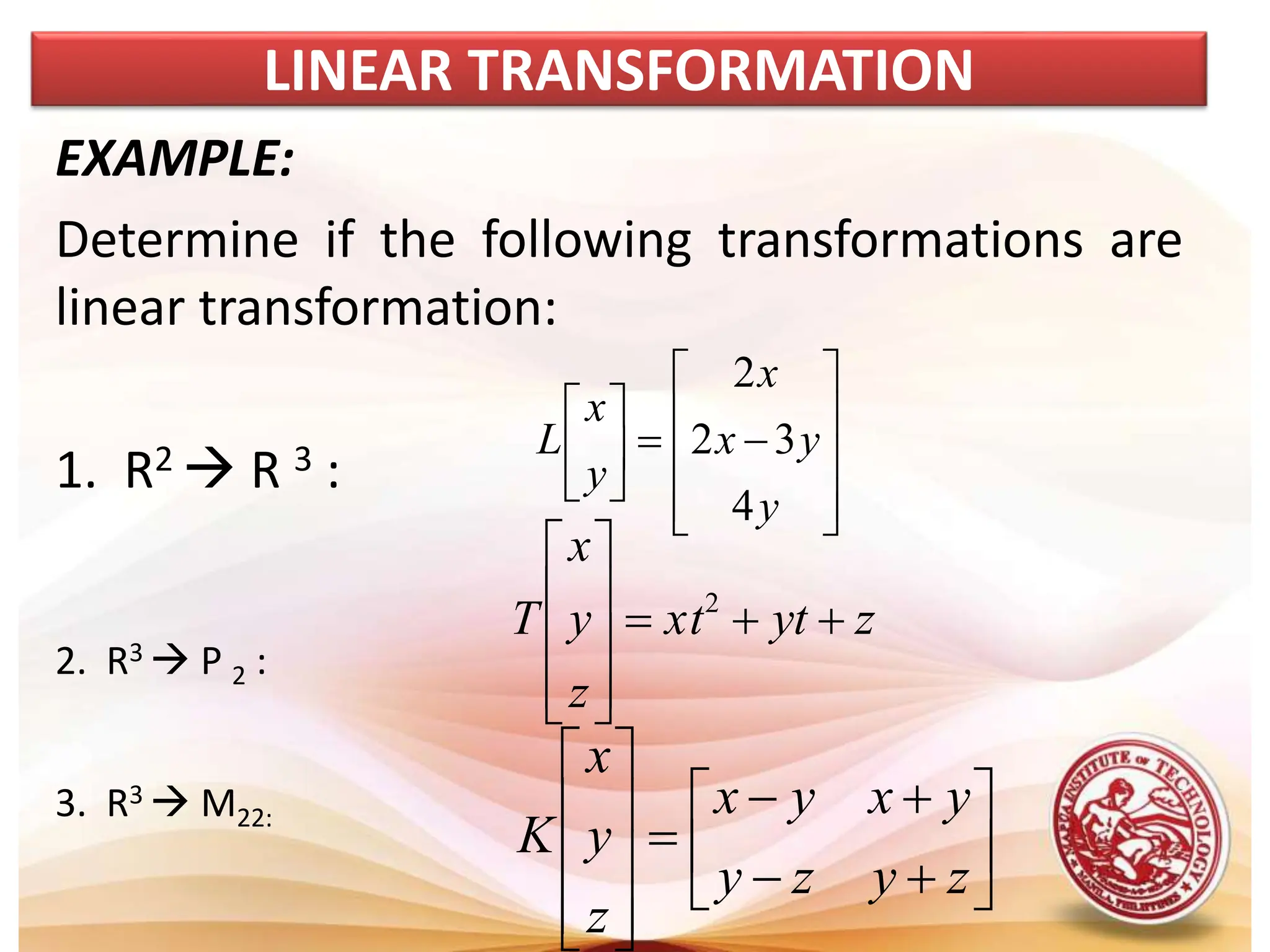
EXAMPLE:
Determine if the following transformations are
linear transformation:
1. R2  R 3 :
2. R3  P 2 :
3. R3  M22:
LINEAR TRANSFORMATION


















y
y
x
x
y
x
L
4
3
2
2
z
yt
xt
z
y
x
T 












2





















z
y
z
y
y
x
y
x
z
y
x
K
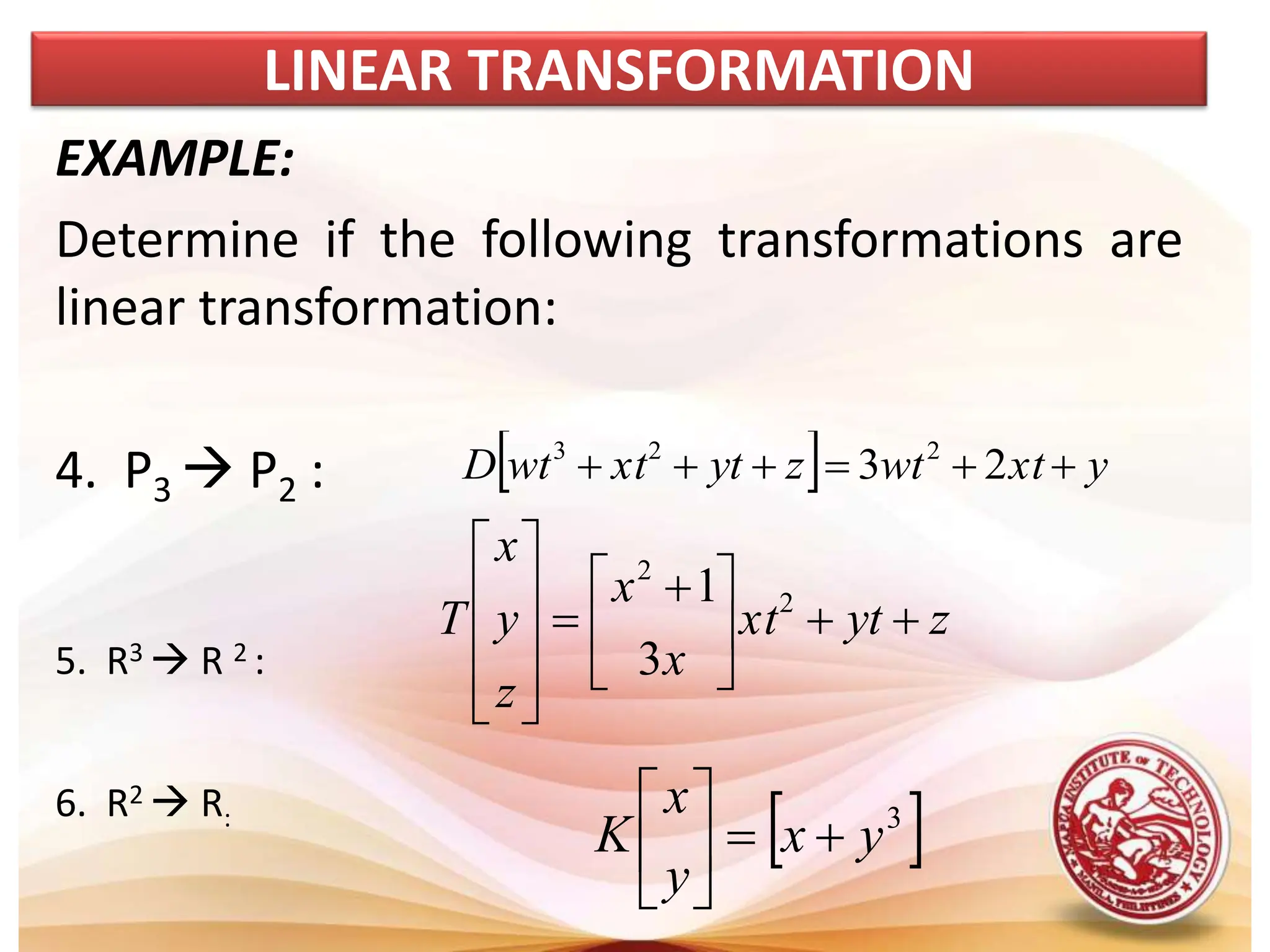
EXAMPLE:
Determine if the following transformations are
linear transformation:
4. P3  P2 :
5. R3  R 2 :
6. R2  R:
LINEAR TRANSFORMATION
  y
xt
wt
z
yt
xt
wt
D 




 2
3 2
2
3
z
yt
xt
x
x
z
y
x
T 






 











2
2
3
1
 
3
y
x
y
x
K 







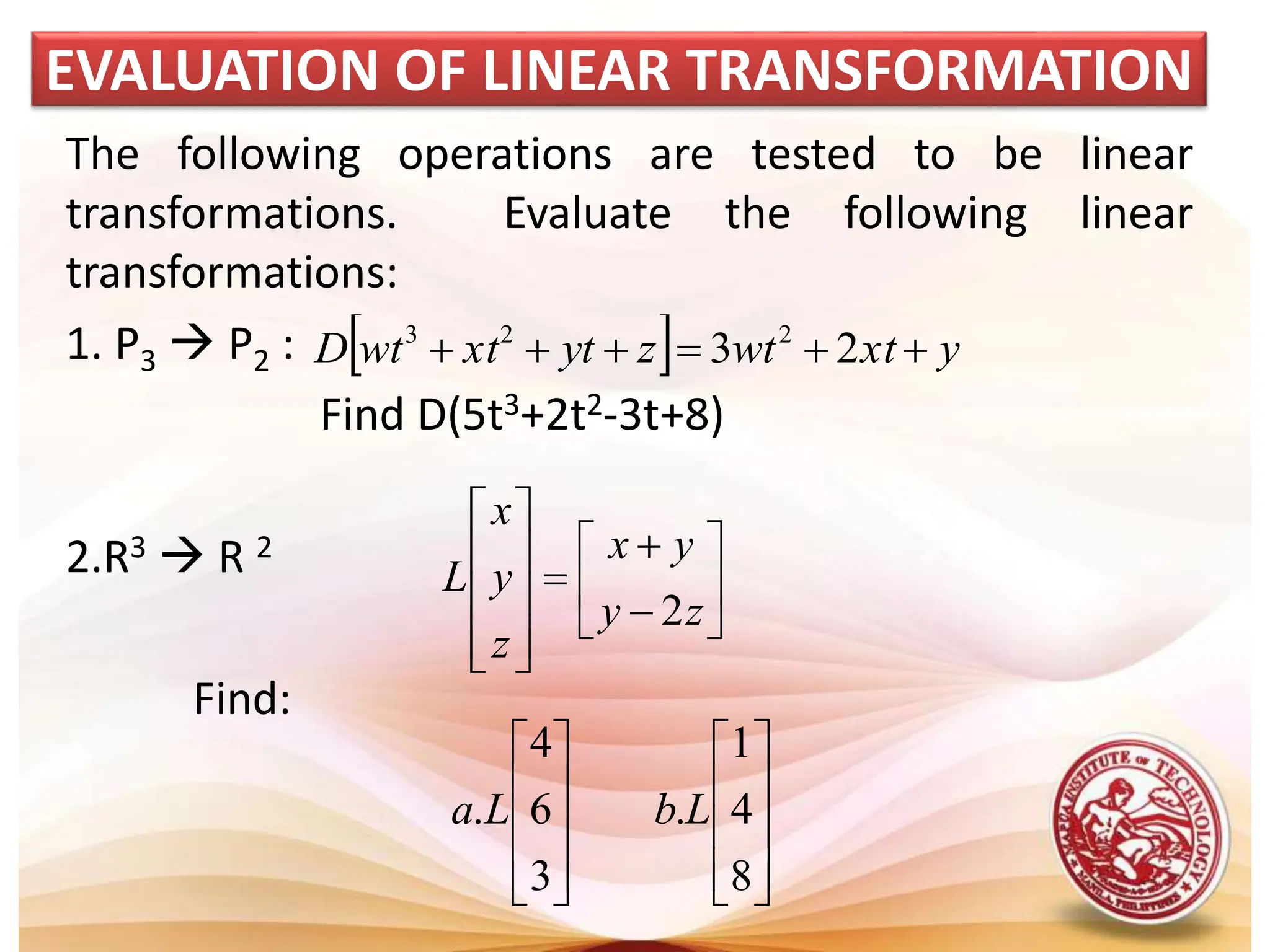
The following operations are tested to be linear
transformations. Evaluate the following linear
transformations:
1. P3  P2 :
Find D(5t3+2t2-3t+8)
2.R3  R 2
Find:
EVALUATION OF LINEAR TRANSFORMATION
  y
xt
wt
z
yt
xt
wt
D 




 2
3 2
2
3



















z
y
y
x
z
y
x
L
2




















8
4
1
.
3
6
4
. L
b
L
a
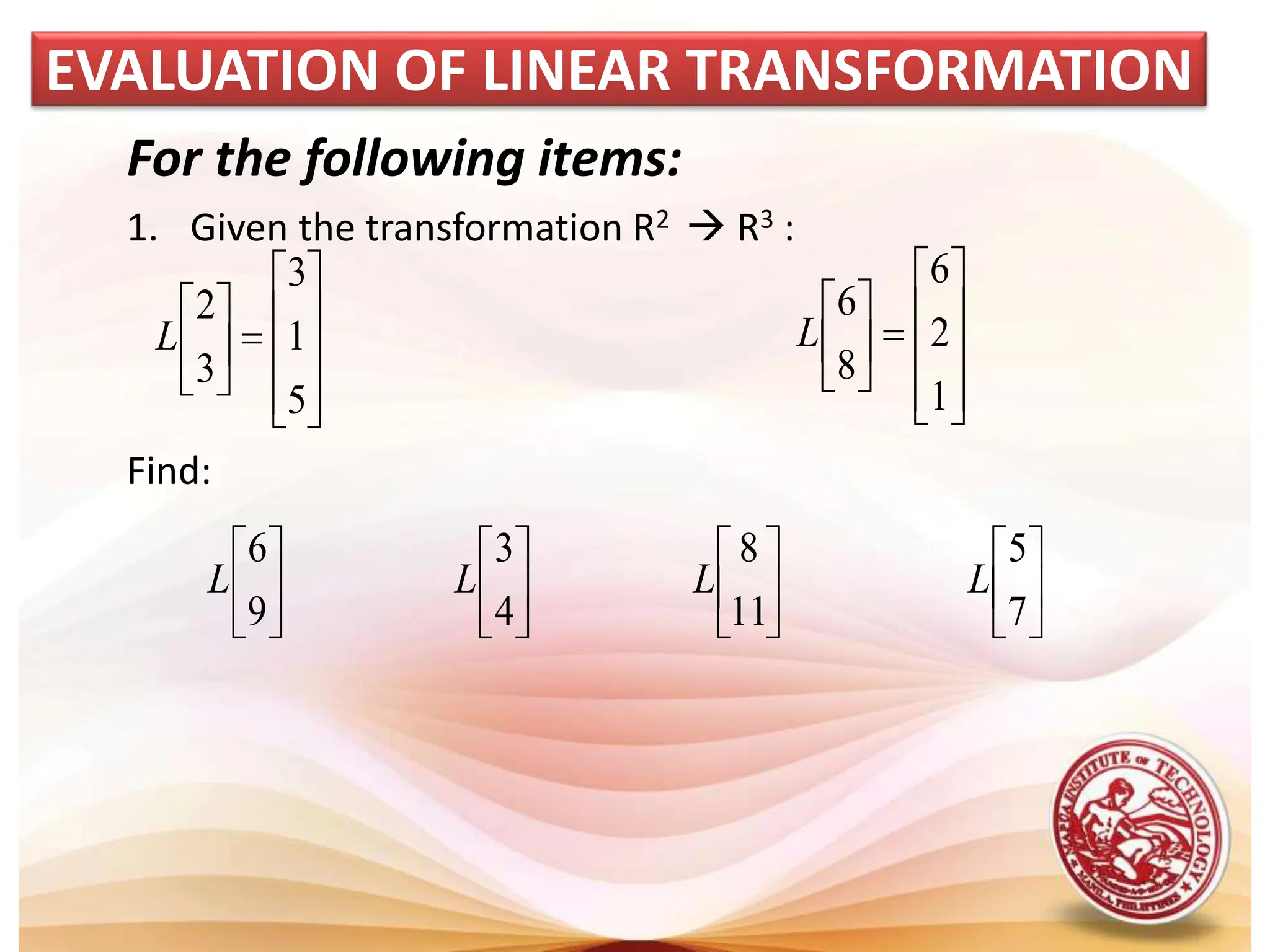
For the following items:
1. Given the transformation R2  R3 :
Find:
EVALUATION OF LINEAR TRANSFORMATION

















5
1
3
3
2
L

















1
2
6
8
6
L






9
6
L 





4
3
L 





11
8
L 





7
5
L
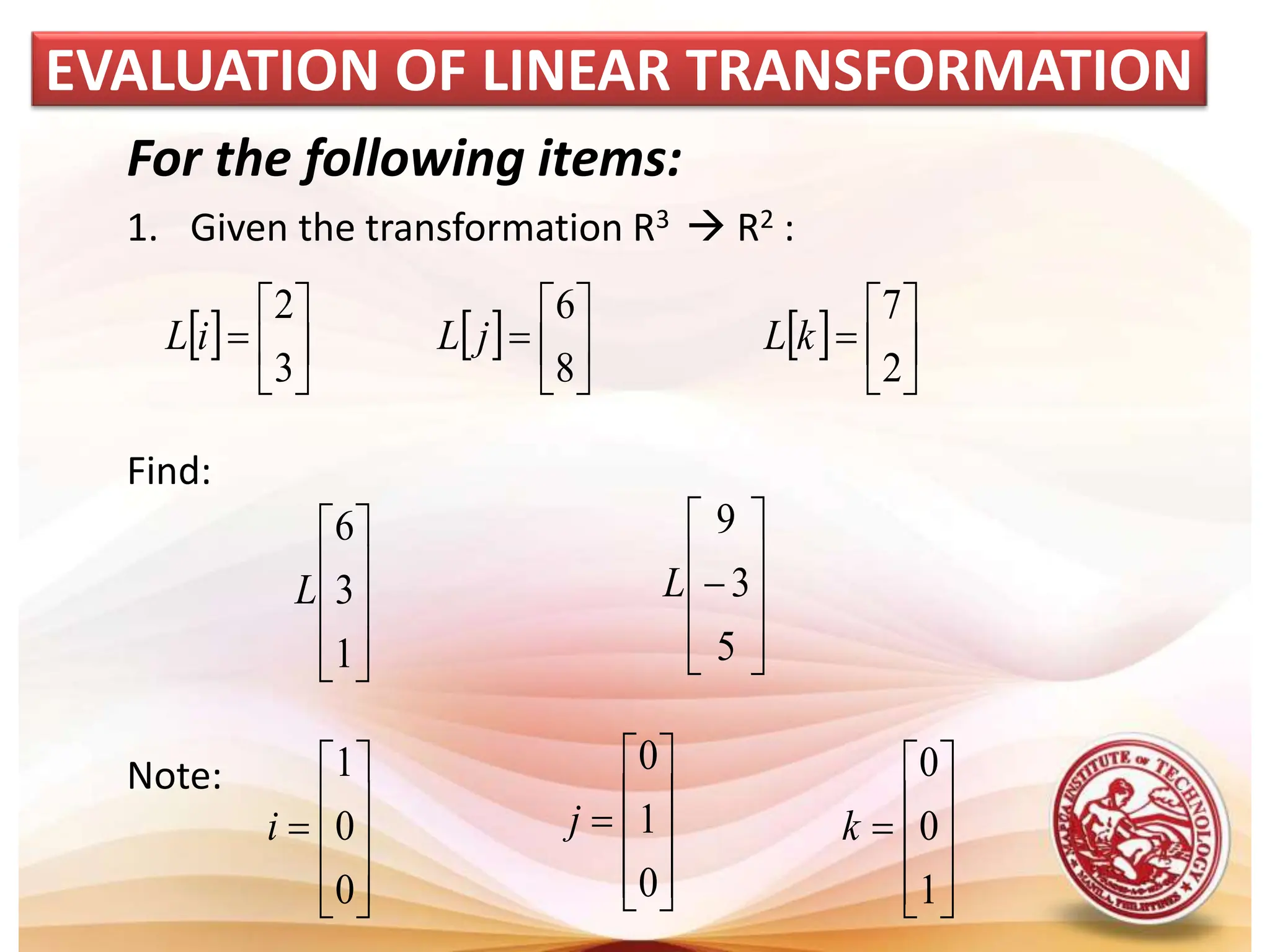
For the following items:
1. Given the transformation R3  R2 :
Find:
Note:
EVALUATION OF LINEAR TRANSFORMATION
  






3
2
i
L   






2
7
k
L
  






8
6
j
L










1
3
6
L











5
3
9
L











0
0
1
i











1
0
0
k











0
1
0
j
• Recall that a function is 1-1 if f(x) = f(y)
implies that x = y
Since a linear transformation is defined as a
function, the definition of 1-1 carries over to
linear transformations. That is
• Definition
A linear transformation L is 1-1 if for all
vectors u and v, L(u) = L(v)
implies that u = v
ONE TO ONE LINEAR TRANSFORMATION
DEFINITION:
• The kernel of a linear transformation L is the
set of all vectors v such that
L(v) = 0
Example: Find the kernel of
KERNEL
• The kernel of a linear transformation from a
vector space V to a vector space W is a
subspace of V.
THEOREM
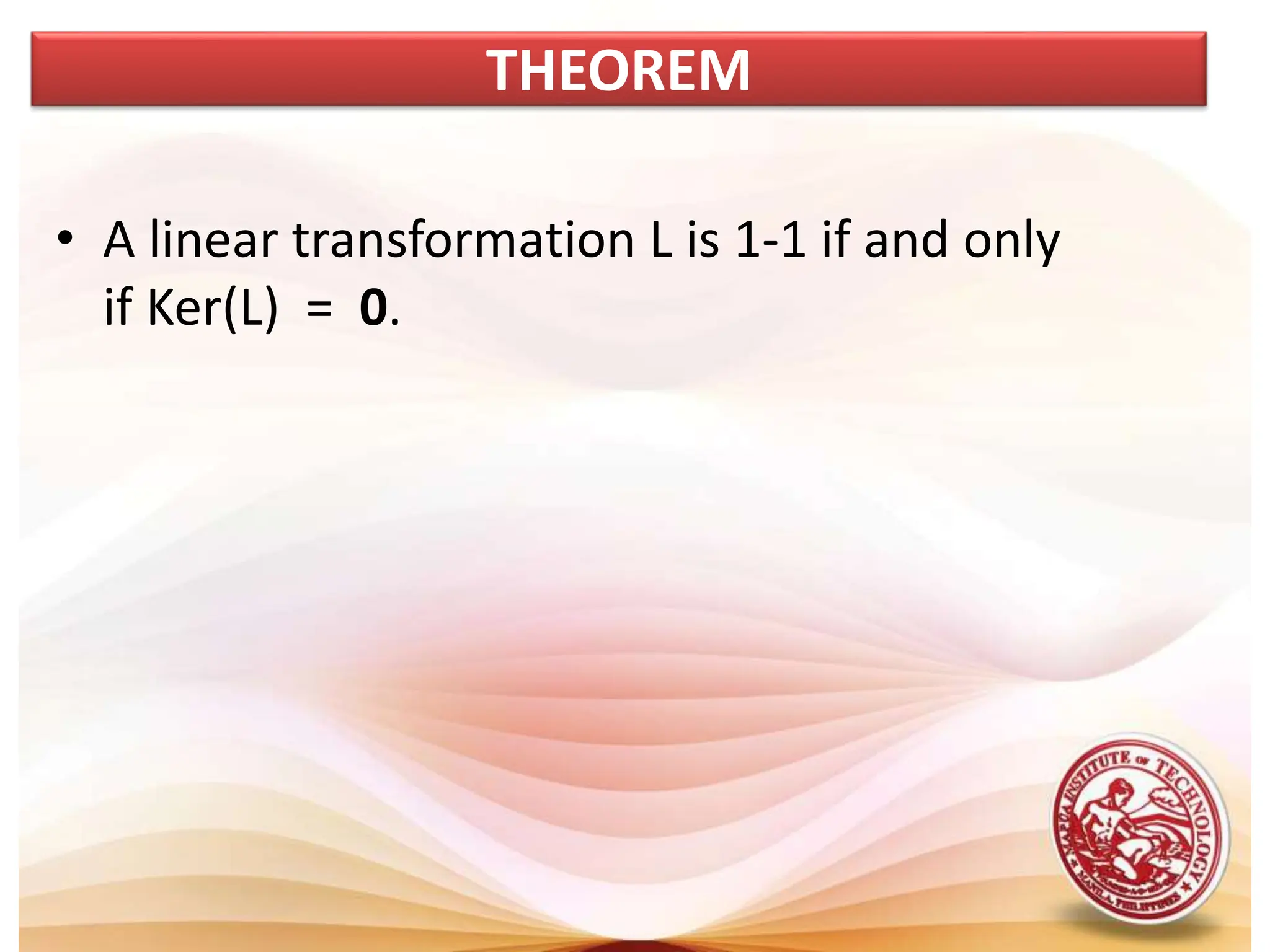
• A linear transformation L is 1-1 if and only
if Ker(L) = 0.
THEOREM
Definition
Let L be a linear transformation from a vector
space V to a vector space W. Then
the range of L is the set of all
vectors w in W such that there is a v in V with
L(v) = w
Theorem
The range of a linear transformation
L from V to W is a subspace of W.
RANGE
Let L be the linear transformation from R2  R3 be
defined by
L(v) = Av
with
• A. Find a basis for Ker(L).
• B. Determine of L is 1-1.
• C. Find a basis for the range of L.
• D. Determine if L is onto.
EXAMPLE
TEXTBOOKS
Elementary Linear Algebra, Bernard Kolman and David
R. Hill, 7th ed., 2003
WEBSITES:
http://en.wikipedia.org/wiki/Eigenvalue,_eigenvector_a
nd_eigenspace
SUGGESTED READINGS

Linear Algebra - Linear Transformation.pptx

  • 1.
    LINEAR TRANSFORMATION MATH 15- Linear Algebra Department of Mathematics
  • 2.
    At the endof this lesson, the students are expected to: •Define linear transformation. •Determine if a transformation is linear transformation. •Perform the transformation of given functions. OBJECTIVES
  • 3.
    DEFINITION: A transformation 𝐿is a linear transformation if the following expressions hold: For any real number: Linear Transformation ] [ ] [ ] [ v L u L v u L    ] [ ] [ u kL ku L 
  • 4.
    EXAMPLE: Determine if thefollowing transformations are linear transformation: 1. R2  R 3 : 2. R3  P 2 : 3. R3  M22: LINEAR TRANSFORMATION                   y y x x y x L 4 3 2 2 z yt xt z y x T              2                      z y z y y x y x z y x K
  • 5.
    EXAMPLE: Determine if thefollowing transformations are linear transformation: 4. P3  P2 : 5. R3  R 2 : 6. R2  R: LINEAR TRANSFORMATION   y xt wt z yt xt wt D       2 3 2 2 3 z yt xt x x z y x T                     2 2 3 1   3 y x y x K        
  • 6.
    The following operationsare tested to be linear transformations. Evaluate the following linear transformations: 1. P3  P2 : Find D(5t3+2t2-3t+8) 2.R3  R 2 Find: EVALUATION OF LINEAR TRANSFORMATION   y xt wt z yt xt wt D       2 3 2 2 3                    z y y x z y x L 2                     8 4 1 . 3 6 4 . L b L a
  • 7.
    For the followingitems: 1. Given the transformation R2  R3 : Find: EVALUATION OF LINEAR TRANSFORMATION                  5 1 3 3 2 L                  1 2 6 8 6 L       9 6 L       4 3 L       11 8 L       7 5 L
  • 8.
    For the followingitems: 1. Given the transformation R3  R2 : Find: Note: EVALUATION OF LINEAR TRANSFORMATION          3 2 i L          2 7 k L          8 6 j L           1 3 6 L            5 3 9 L            0 0 1 i            1 0 0 k            0 1 0 j
  • 9.
    • Recall thata function is 1-1 if f(x) = f(y) implies that x = y Since a linear transformation is defined as a function, the definition of 1-1 carries over to linear transformations. That is • Definition A linear transformation L is 1-1 if for all vectors u and v, L(u) = L(v) implies that u = v ONE TO ONE LINEAR TRANSFORMATION
  • 10.
    DEFINITION: • The kernelof a linear transformation L is the set of all vectors v such that L(v) = 0 Example: Find the kernel of KERNEL
  • 11.
    • The kernelof a linear transformation from a vector space V to a vector space W is a subspace of V. THEOREM
  • 12.
    • A lineartransformation L is 1-1 if and only if Ker(L) = 0. THEOREM
  • 13.
    Definition Let L bea linear transformation from a vector space V to a vector space W. Then the range of L is the set of all vectors w in W such that there is a v in V with L(v) = w Theorem The range of a linear transformation L from V to W is a subspace of W. RANGE
  • 14.
    Let L bethe linear transformation from R2  R3 be defined by L(v) = Av with • A. Find a basis for Ker(L). • B. Determine of L is 1-1. • C. Find a basis for the range of L. • D. Determine if L is onto. EXAMPLE
  • 15.
    TEXTBOOKS Elementary Linear Algebra,Bernard Kolman and David R. Hill, 7th ed., 2003 WEBSITES: http://en.wikipedia.org/wiki/Eigenvalue,_eigenvector_a nd_eigenspace SUGGESTED READINGS

Editor's Notes

  • #15 Solution The Ker(L) is the same as the null space of the matrix A.  We have          Hence a basis for Ker(L) is          {(3,-1)} L is not 1-1 since the Ker(L) is not the zero subspace. Now for the range.  If we let {ei} be the standard basis for R2, then          {L(e1), L(e2)}  will span the range of L.  These two vectors are just the columns of A.  In general  The columns of A span the range of L. A basis for the column space is L is given by the first column of A (the only corner of rref(A)).  That is a basis is         {(1,2,3)} Since the dimension of the range of A is 1 and the dimension of R3 is 3, L is not onto. A Few Theorems In the last example the dimension of R2 is 2, which is the sum of the dimensions of Ker(L) and the range of L.  This will be true in general.   Theorem Let L be a linear transformation from V to W.  Then         dim(Ker(L))  + dim(range(L))  =  dim(V)   Proof Let          S  =  {v1, ..., vk}  be a basis for Ker(L). Then extend this basis to a full basis for V.         T  =  {v1, ..., vk, vk+1, ..., vn}  We need to show that          U  =  {L(vk+1k+1), ..., L(vn)}  is a basis for range L.  If w is in the range of L then there is a v in V with L(v)  =  w.  Since T spans V, we can write         v  =  c1v1 + ... + ckvk + ck+1vk+1 + ... +  cnvn  so that         w  =  L(v)  =  L(c1v1 + ... + ckvk + ck+1vk+1 + ... +  cnvn)         =  c1L(v1) + ... + ckL(vk) + ck+1L(vk+1) + ... +  cnL(vn)         =  c10 + ... + ck0 + ck+1L(vk+1) + ... +  cnL(vn)         =  ck+1L(vk+1) + ... +  cnL(vn) hence U spans the range of L.  Now we need to show that U is a linearly independent set of vectors.  If          ck+1L(vk+1) + ... +  cnL(vn)  =  0 then         0  =  L(ck+1vk+1 + ... +  cnvn) hence          v  =  ck+1vk+1 + ... +  cnvn is in Ker(L).  But then v can be written as a linear combination of vectors in S.  That is         ck+1vk+1 + ... +  cnvn  =  c1v1 + ... + ckvk  Which means that all of the constants are zero since these are linearly independent.   We call the dimension of Ker(L) the nullity of L and the dimension of the rang of L the rank of L. We end this discussion with a corollary that follows immediately from the above theorem. Theorem Let L be a linear transformation from a vector space V to a vector space W with dim V  =  dim W, then the following are equivalent:         1.  L is 1-1.         2.  L is onto.