GP 116: Linear Algebra
Class Notes
Linear Transformations
Part 1
Dr. R. Palamakumbura
Linear Transformations
• You have already learnt about vector spaces.
• In this section we will learn about special type of
functions defined on vector spaces, that preserve the
algebraic structure of the space (addition and scalar
multiplication).
• These functions are called linear transformations and
we will see a close relationship with matrices and such
transformations.
Linear Transformations
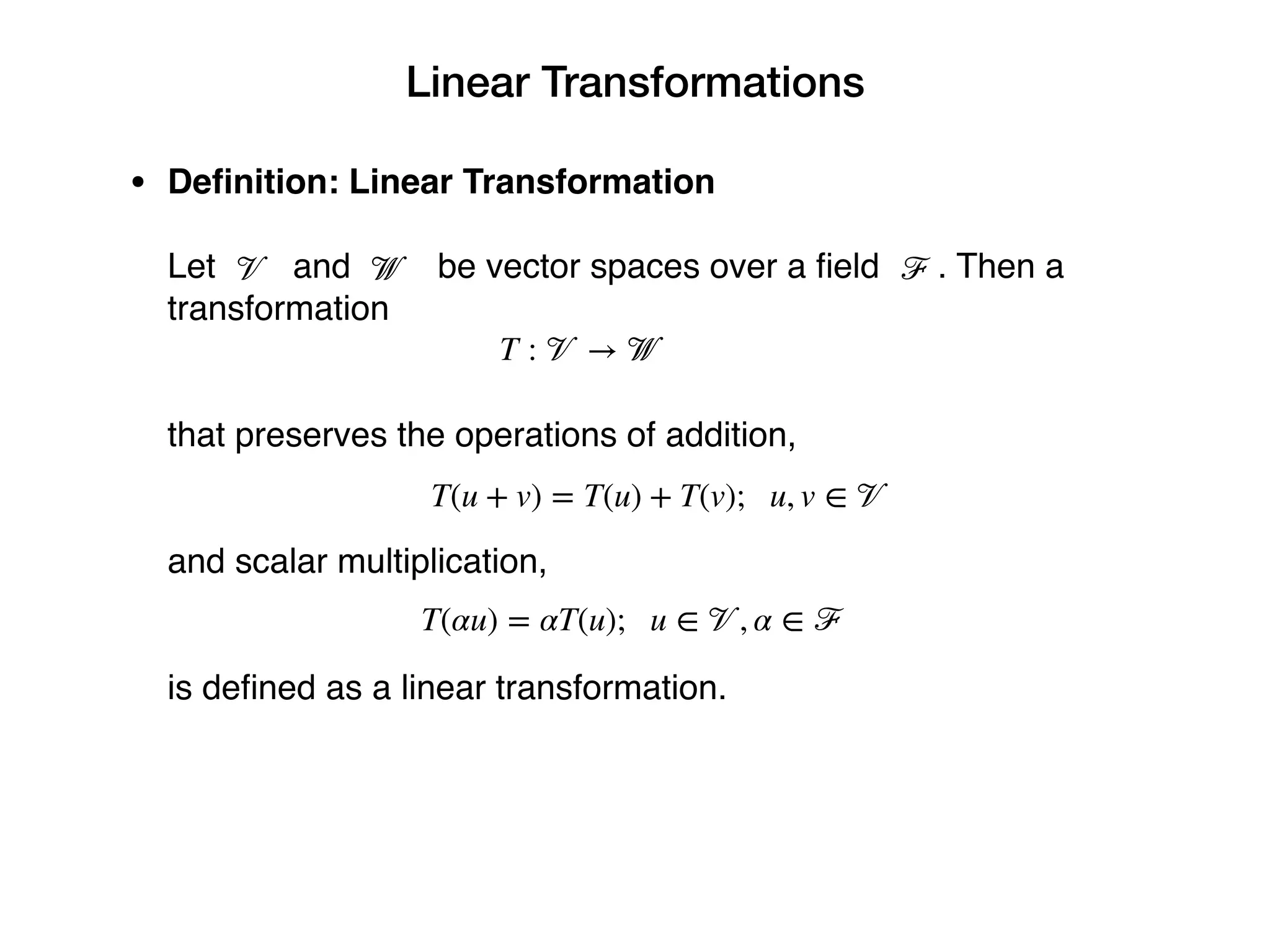
• Definition: Linear Transformation
Let and be vector spaces over a field . Then a
transformation
that preserves the operations of addition,
and scalar multiplication,
is defined as a linear transformation.
𝒱 𝒲 ℱ
T : 𝒱 → 𝒲
T(u + v) = T(u) + T(v); u, v ∈ 𝒱
T(αu) = αT(u); u ∈ 𝒱, α ∈ ℱ
Linear Transformations
• Note:
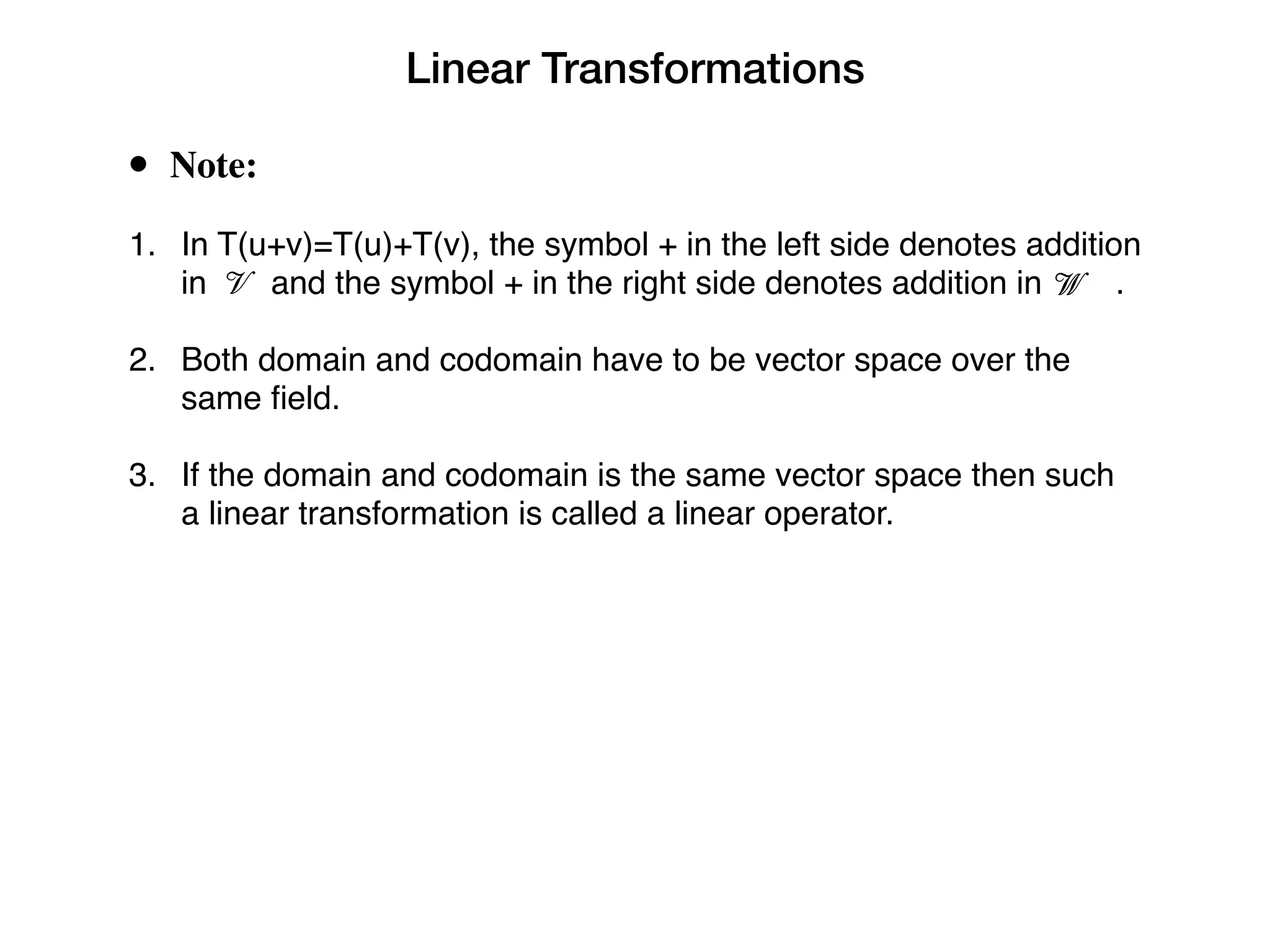
1. In T(u+v)=T(u)+T(v), the symbol + in the left side denotes addition
in and the symbol + in the right side denotes addition in .
2. Both domain and codomain have to be vector space over the
same field.
3. If the domain and codomain is the same vector space then such
a linear transformation is called a linear operator.
𝒱 𝒲
Linear Transformations
• Some Examples:
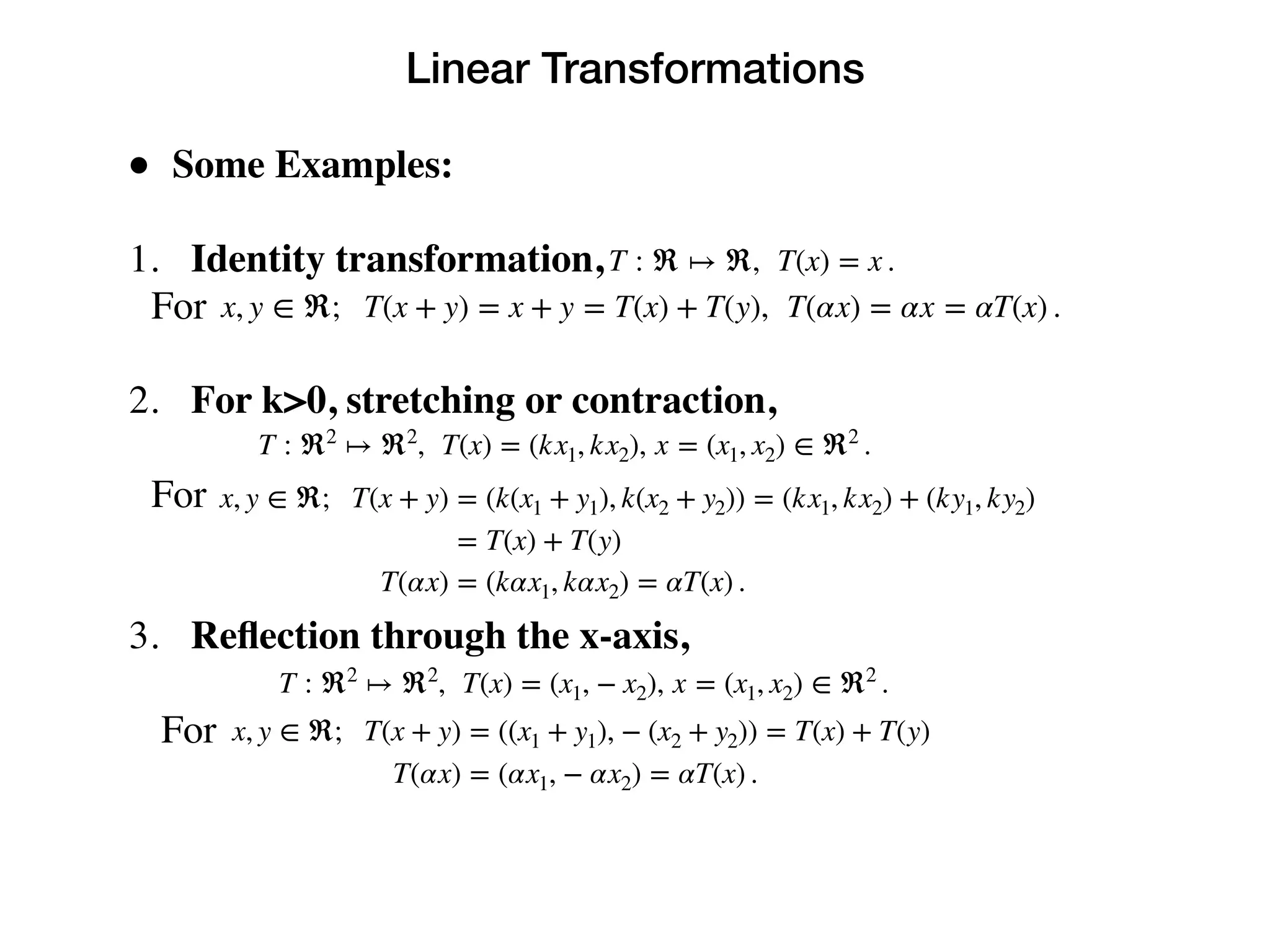
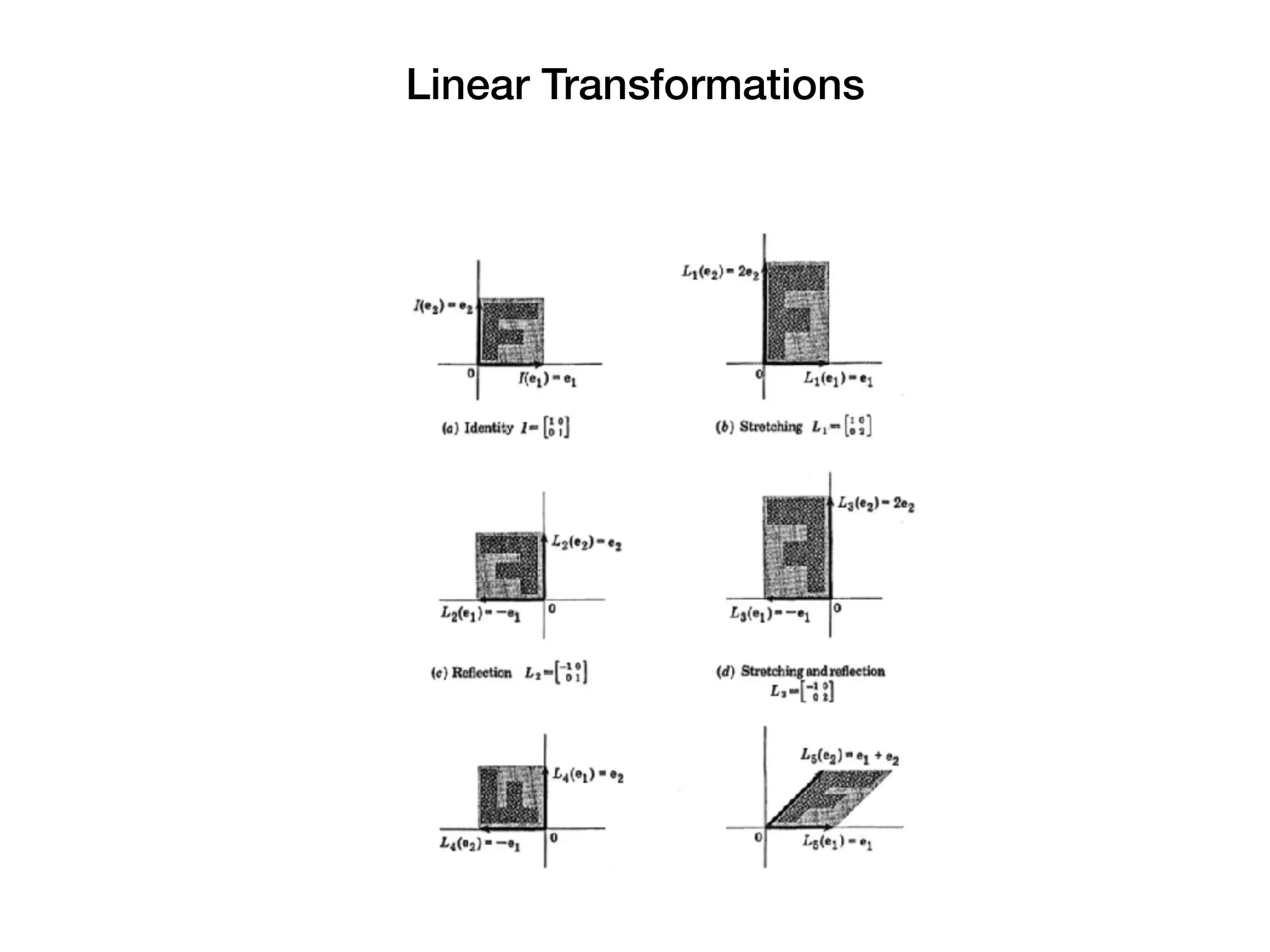
1. Identity transformation,
For
2. For k>0, stretching or contraction,
For
3. Reflection through the x-axis,
For
T : ℜ ↦ ℜ, T(x) = x .
x, y ∈ ℜ; T(x + y) = x + y = T(x) + T(y), T(αx) = αx = αT(x) .
T : ℜ2
↦ ℜ2
, T(x) = (kx1, kx2), x = (x1, x2) ∈ ℜ2
.
x, y ∈ ℜ; T(x + y) = (k(x1 + y1), k(x2 + y2)) = (kx1, kx2) + (ky1, ky2)
= T(x) + T(y)
T(αx) = (kαx1, kαx2) = αT(x) .
T : ℜ2
↦ ℜ2
, T(x) = (x1, − x2), x = (x1, x2) ∈ ℜ2
.
x, y ∈ ℜ; T(x + y) = ((x1 + y1), − (x2 + y2)) = T(x) + T(y)
T(αx) = (αx1, − αx2) = αT(x) .
Linear Transformations
• Some Examples:
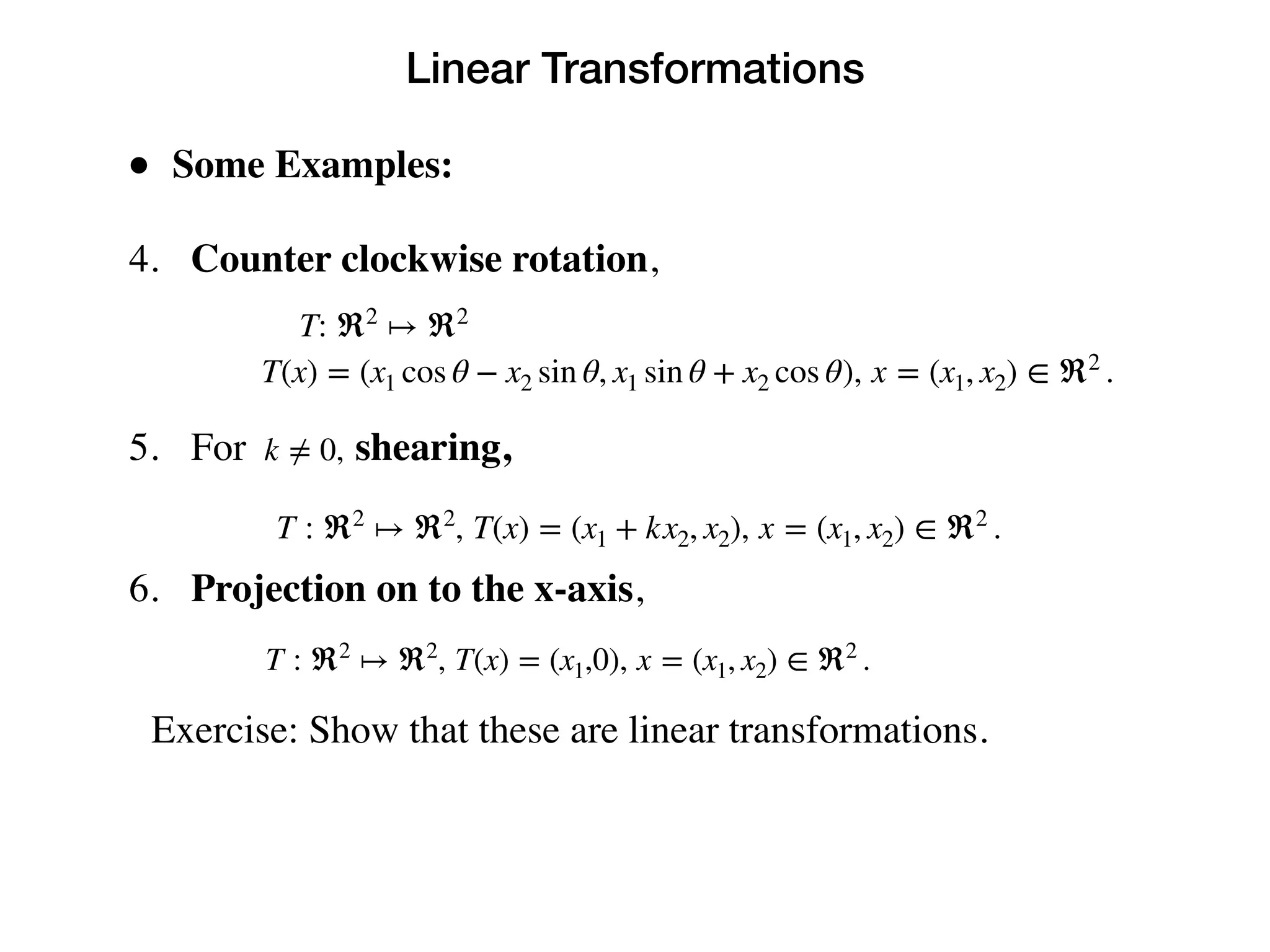
4. Counter clockwise rotation,
5. For shearing,
6. Projection on to the x-axis,
Exercise: Show that these are linear transformations.
T: ℜ2
↦ ℜ2
T(x) = (x1 cos θ − x2 sin θ, x1 sin θ + x2 cos θ), x = (x1, x2) ∈ ℜ2
.
k ≠ 0,
T : ℜ2
↦ ℜ2
, T(x) = (x1 + kx2, x2), x = (x1, x2) ∈ ℜ2
.
T : ℜ2
↦ ℜ2
, T(x) = (x1,0), x = (x1, x2) ∈ ℜ2
.
Linear Transformations
• Some Examples:
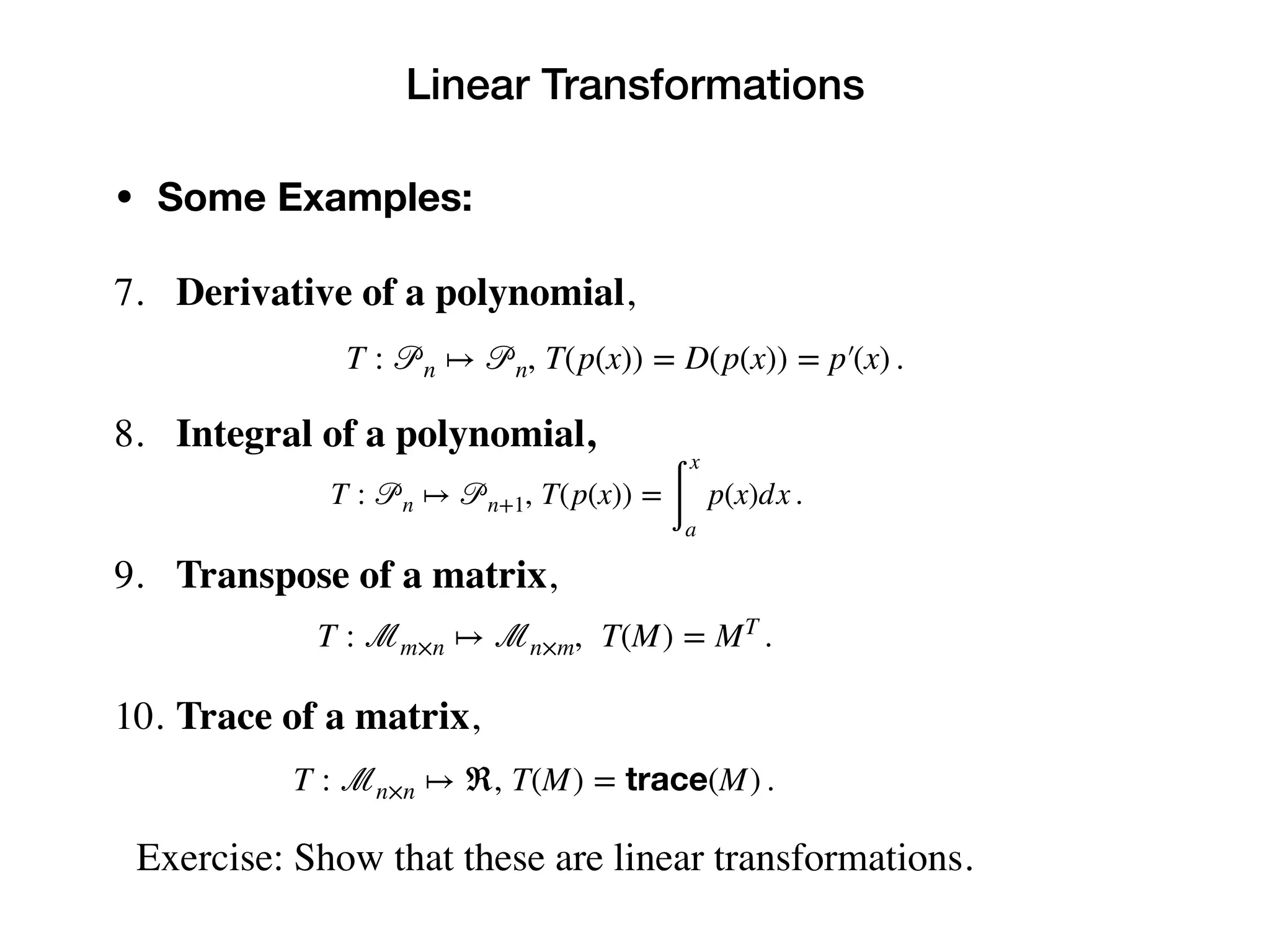
7. Derivative of a polynomial,
8. Integral of a polynomial,
9. Transpose of a matrix,
10. Trace of a matrix,
Exercise: Show that these are linear transformations.
T : 𝒫n ↦ 𝒫n, T(p(x)) = D(p(x)) = p′(x) .
T : 𝒫n ↦ 𝒫n+1, T(p(x)) =
∫
x
a
p(x)dx .
T : ℳm×n ↦ ℳn×m, T(M) = MT
.
T : ℳn×n ↦ ℜ, T(M) = trace(M) .
Linear Transformations
The following are not linear transformations.
1. Translation,
For
2. Quadratic function,
3. Trigonometric functions,
4. Determinant,
Exercise: Show that 2-4 are not linear transformations.
T : ℜ ↦ ℜ, T(x) = x + a, a ≠ 0.
x, y ∈ ℜ, T(x + y) = x + y + a ≠ (x + a) + (y + a) = T(x) + T(y) .
T : ℜ ↦ ℜ, T(x) = x2
.
T : ℜ ↦ [−1,1], T(x) = sin x .
T : ℳn×n ↦ ℜ, T(M) = det(M) .
Linear Transformations
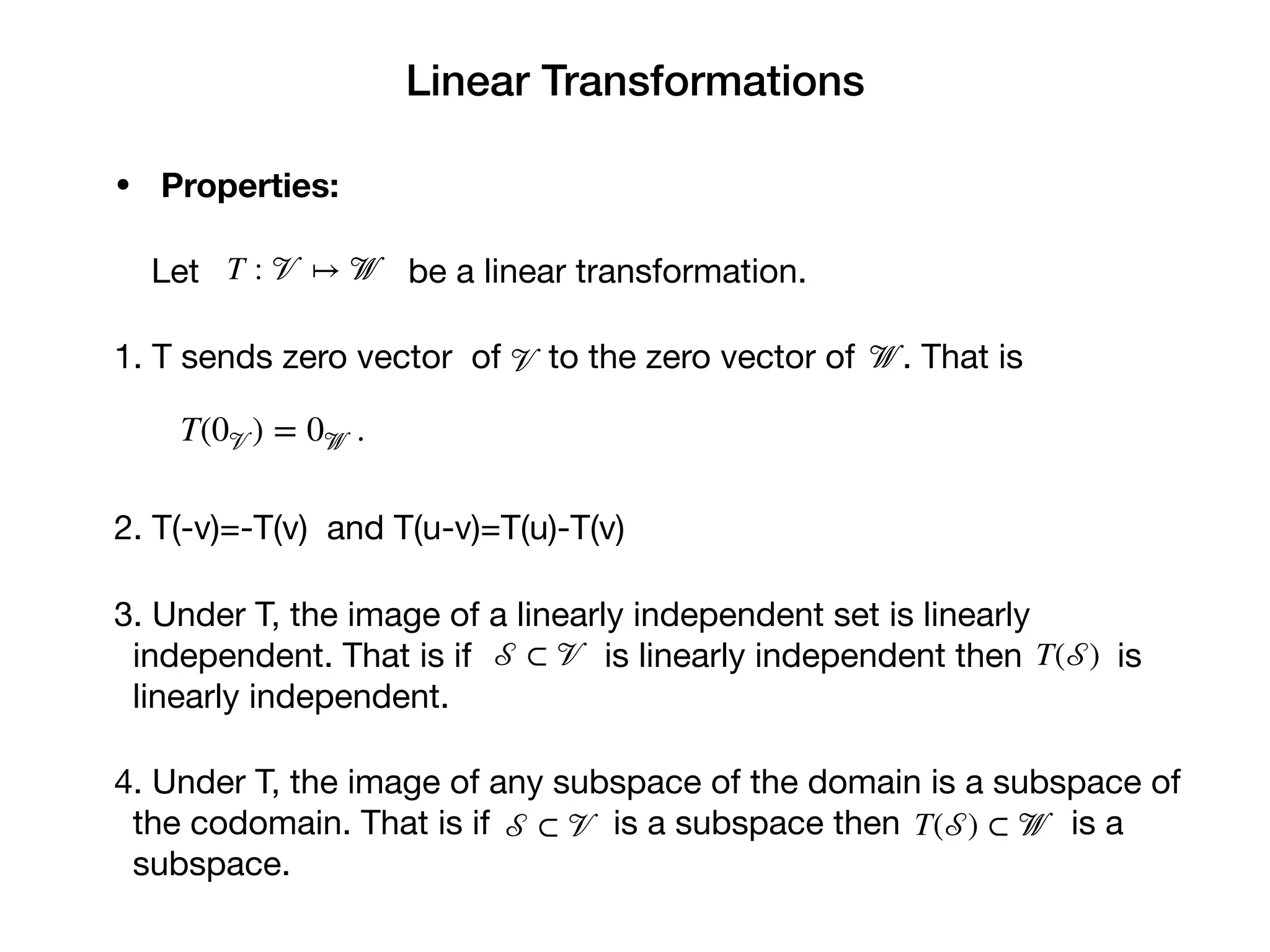
• Properties:
Let be a linear transformation.
1. T sends zero vector of to the zero vector of . That is
2. T(-v)=-T(v) and T(u-v)=T(u)-T(v)
3. Under T, the image of a linearly independent set is linearly
independent. That is if is linearly independent then is
linearly independent.
4. Under T, the image of any subspace of the domain is a subspace of
the codomain. That is if is a subspace then is a
subspace.
T : 𝒱 ↦ 𝒲
𝒲
𝒱
T(0𝒱) = 0𝒲 .
𝒮 ⊂ 𝒱 T(𝒮)
𝒮 ⊂ 𝒱 T(𝒮) ⊂ 𝒲
Linear Transformations
• Properties:
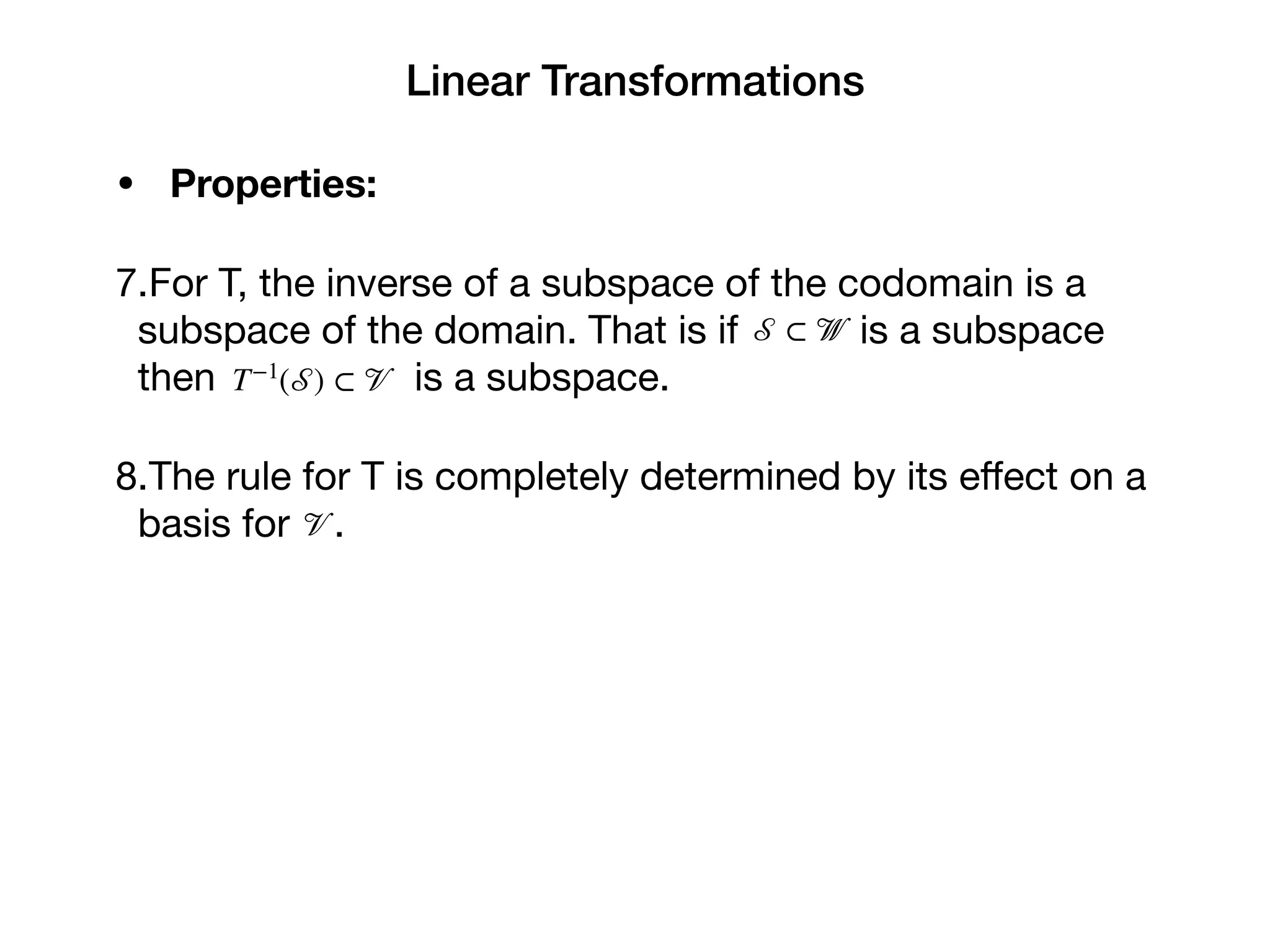
7.For T, the inverse of a subspace of the codomain is a
subspace of the domain. That is if is a subspace
then is a subspace.
8.The rule for T is completely determined by its effect on a
basis for .
𝒮 ⊂ 𝒲
T−1
(𝒮) ⊂ 𝒱
𝒱
Linear Transformations
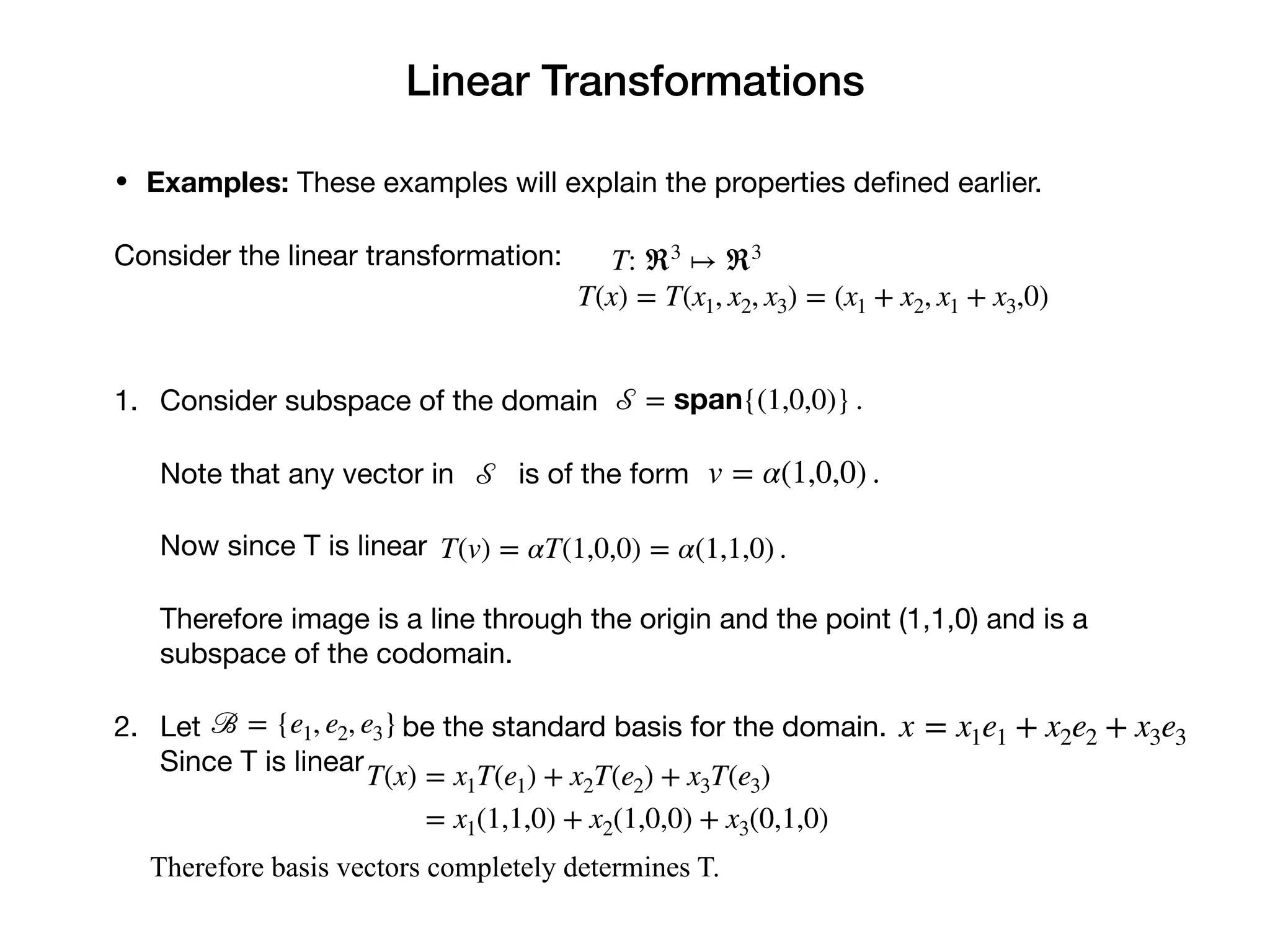
• Examples: These examples will explain the properties defined earlier.
Consider the linear transformation:
1. Consider subspace of the domain
Note that any vector in is of the form
Now since T is linear
Therefore image is a line through the origin and the point (1,1,0) and is a
subspace of the codomain.
2. Let be the standard basis for the domain.
Since T is linear
Therefore basis vectors completely determines T.
T: ℜ3
↦ ℜ3
T(x) = T(x1, x2, x3) = (x1 + x2, x1 + x3,0)
𝒮 = span{(1,0,0)} .
𝒮 v = α(1,0,0) .
T(v) = αT(1,0,0) = α(1,1,0) .
ℬ = {e1, e2, e3} x = x1e1 + x2e2 + x3e3
T(x) = x1T(e1) + x2T(e2) + x3T(e3)
= x1(1,1,0) + x2(1,0,0) + x3(0,1,0)

Linear Transformations_part1.pdf

  • 1.
    GP 116: LinearAlgebra Class Notes Linear Transformations Part 1 Dr. R. Palamakumbura
  • 2.
    Linear Transformations • Youhave already learnt about vector spaces. • In this section we will learn about special type of functions defined on vector spaces, that preserve the algebraic structure of the space (addition and scalar multiplication). • These functions are called linear transformations and we will see a close relationship with matrices and such transformations.
  • 3.
    Linear Transformations • Definition:Linear Transformation Let and be vector spaces over a field . Then a transformation that preserves the operations of addition, and scalar multiplication, is defined as a linear transformation. 𝒱 𝒲 ℱ T : 𝒱 → 𝒲 T(u + v) = T(u) + T(v); u, v ∈ 𝒱 T(αu) = αT(u); u ∈ 𝒱, α ∈ ℱ
  • 4.
    Linear Transformations • Note: 1.In T(u+v)=T(u)+T(v), the symbol + in the left side denotes addition in and the symbol + in the right side denotes addition in . 2. Both domain and codomain have to be vector space over the same field. 3. If the domain and codomain is the same vector space then such a linear transformation is called a linear operator. 𝒱 𝒲
  • 5.
    Linear Transformations • SomeExamples: 1. Identity transformation, For 2. For k>0, stretching or contraction, For 3. Reflection through the x-axis, For T : ℜ ↦ ℜ, T(x) = x . x, y ∈ ℜ; T(x + y) = x + y = T(x) + T(y), T(αx) = αx = αT(x) . T : ℜ2 ↦ ℜ2 , T(x) = (kx1, kx2), x = (x1, x2) ∈ ℜ2 . x, y ∈ ℜ; T(x + y) = (k(x1 + y1), k(x2 + y2)) = (kx1, kx2) + (ky1, ky2) = T(x) + T(y) T(αx) = (kαx1, kαx2) = αT(x) . T : ℜ2 ↦ ℜ2 , T(x) = (x1, − x2), x = (x1, x2) ∈ ℜ2 . x, y ∈ ℜ; T(x + y) = ((x1 + y1), − (x2 + y2)) = T(x) + T(y) T(αx) = (αx1, − αx2) = αT(x) .
  • 6.
    Linear Transformations • SomeExamples: 4. Counter clockwise rotation, 5. For shearing, 6. Projection on to the x-axis, Exercise: Show that these are linear transformations. T: ℜ2 ↦ ℜ2 T(x) = (x1 cos θ − x2 sin θ, x1 sin θ + x2 cos θ), x = (x1, x2) ∈ ℜ2 . k ≠ 0, T : ℜ2 ↦ ℜ2 , T(x) = (x1 + kx2, x2), x = (x1, x2) ∈ ℜ2 . T : ℜ2 ↦ ℜ2 , T(x) = (x1,0), x = (x1, x2) ∈ ℜ2 .
  • 7.
  • 8.
    Linear Transformations • SomeExamples: 7. Derivative of a polynomial, 8. Integral of a polynomial, 9. Transpose of a matrix, 10. Trace of a matrix, Exercise: Show that these are linear transformations. T : 𝒫n ↦ 𝒫n, T(p(x)) = D(p(x)) = p′(x) . T : 𝒫n ↦ 𝒫n+1, T(p(x)) = ∫ x a p(x)dx . T : ℳm×n ↦ ℳn×m, T(M) = MT . T : ℳn×n ↦ ℜ, T(M) = trace(M) .
  • 9.
    Linear Transformations The followingare not linear transformations. 1. Translation, For 2. Quadratic function, 3. Trigonometric functions, 4. Determinant, Exercise: Show that 2-4 are not linear transformations. T : ℜ ↦ ℜ, T(x) = x + a, a ≠ 0. x, y ∈ ℜ, T(x + y) = x + y + a ≠ (x + a) + (y + a) = T(x) + T(y) . T : ℜ ↦ ℜ, T(x) = x2 . T : ℜ ↦ [−1,1], T(x) = sin x . T : ℳn×n ↦ ℜ, T(M) = det(M) .
  • 10.
    Linear Transformations • Properties: Letbe a linear transformation. 1. T sends zero vector of to the zero vector of . That is 2. T(-v)=-T(v) and T(u-v)=T(u)-T(v) 3. Under T, the image of a linearly independent set is linearly independent. That is if is linearly independent then is linearly independent. 4. Under T, the image of any subspace of the domain is a subspace of the codomain. That is if is a subspace then is a subspace. T : 𝒱 ↦ 𝒲 𝒲 𝒱 T(0𝒱) = 0𝒲 . 𝒮 ⊂ 𝒱 T(𝒮) 𝒮 ⊂ 𝒱 T(𝒮) ⊂ 𝒲
  • 11.
    Linear Transformations • Properties: 7.ForT, the inverse of a subspace of the codomain is a subspace of the domain. That is if is a subspace then is a subspace. 8.The rule for T is completely determined by its effect on a basis for . 𝒮 ⊂ 𝒲 T−1 (𝒮) ⊂ 𝒱 𝒱
  • 12.
    Linear Transformations • Examples:These examples will explain the properties defined earlier. Consider the linear transformation: 1. Consider subspace of the domain Note that any vector in is of the form Now since T is linear Therefore image is a line through the origin and the point (1,1,0) and is a subspace of the codomain. 2. Let be the standard basis for the domain. Since T is linear Therefore basis vectors completely determines T. T: ℜ3 ↦ ℜ3 T(x) = T(x1, x2, x3) = (x1 + x2, x1 + x3,0) 𝒮 = span{(1,0,0)} . 𝒮 v = α(1,0,0) . T(v) = αT(1,0,0) = α(1,1,0) . ℬ = {e1, e2, e3} x = x1e1 + x2e2 + x3e3 T(x) = x1T(e1) + x2T(e2) + x3T(e3) = x1(1,1,0) + x2(1,0,0) + x3(0,1,0)