Chapter 3:
Linear transformations
Linear transformations, Algebra of
linear transformations, matrices,
dual spaces, double duals
Linear transformations
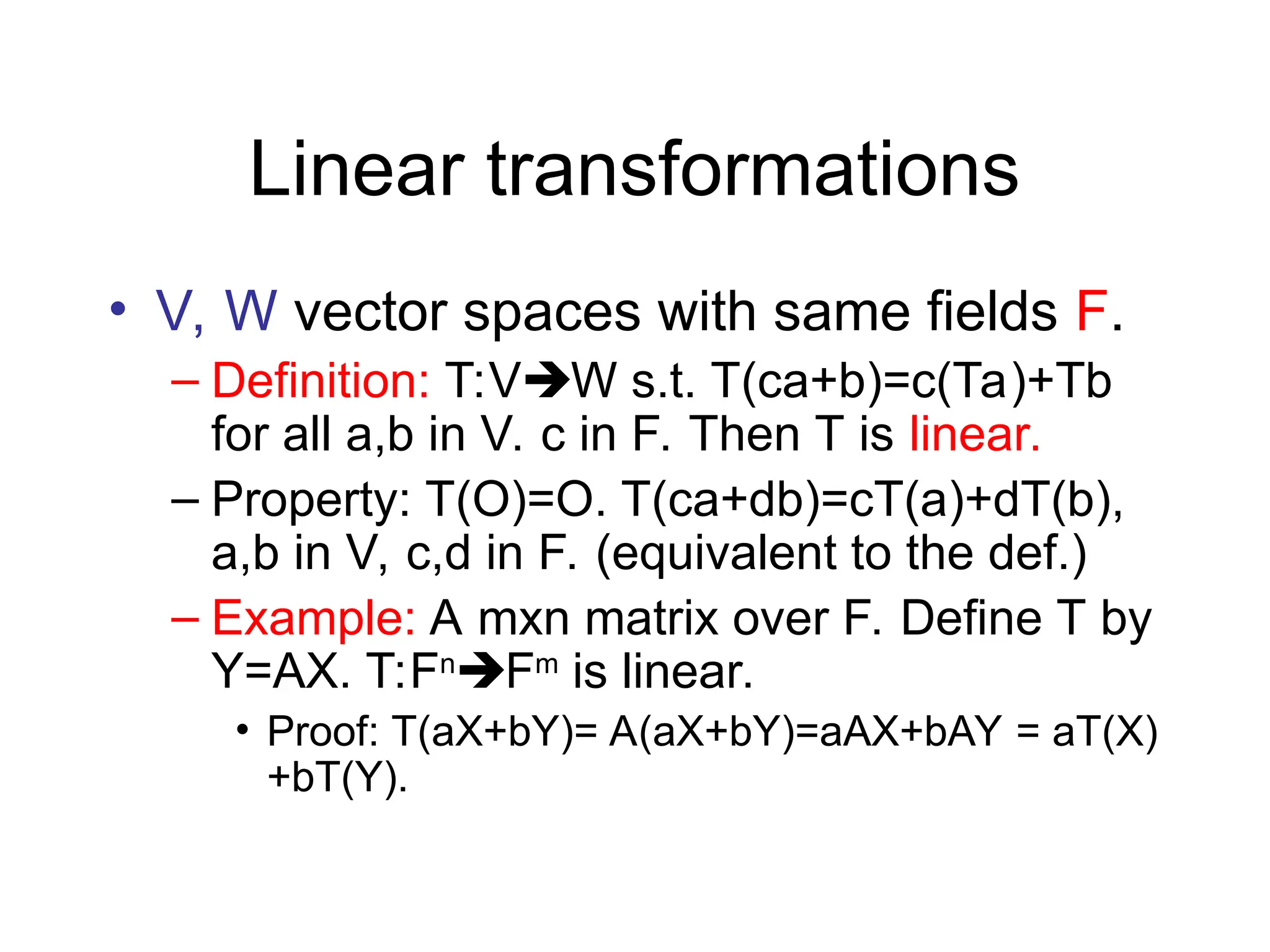
• V, W vector spaces with same fields F.
– Definition: T:VW s.t. T(ca+b)=c(Ta)+Tb
for all a,b in V. c in F. Then T is linear.
– Property: T(O)=O. T(ca+db)=cT(a)+dT(b),
a,b in V, c,d in F. (equivalent to the def.)
– Example: A mxn matrix over F. Define T by
Y=AX. T:Fn
Fm
is linear.
• Proof: T(aX+bY)= A(aX+bY)=aAX+bAY = aT(X)
+bT(Y).
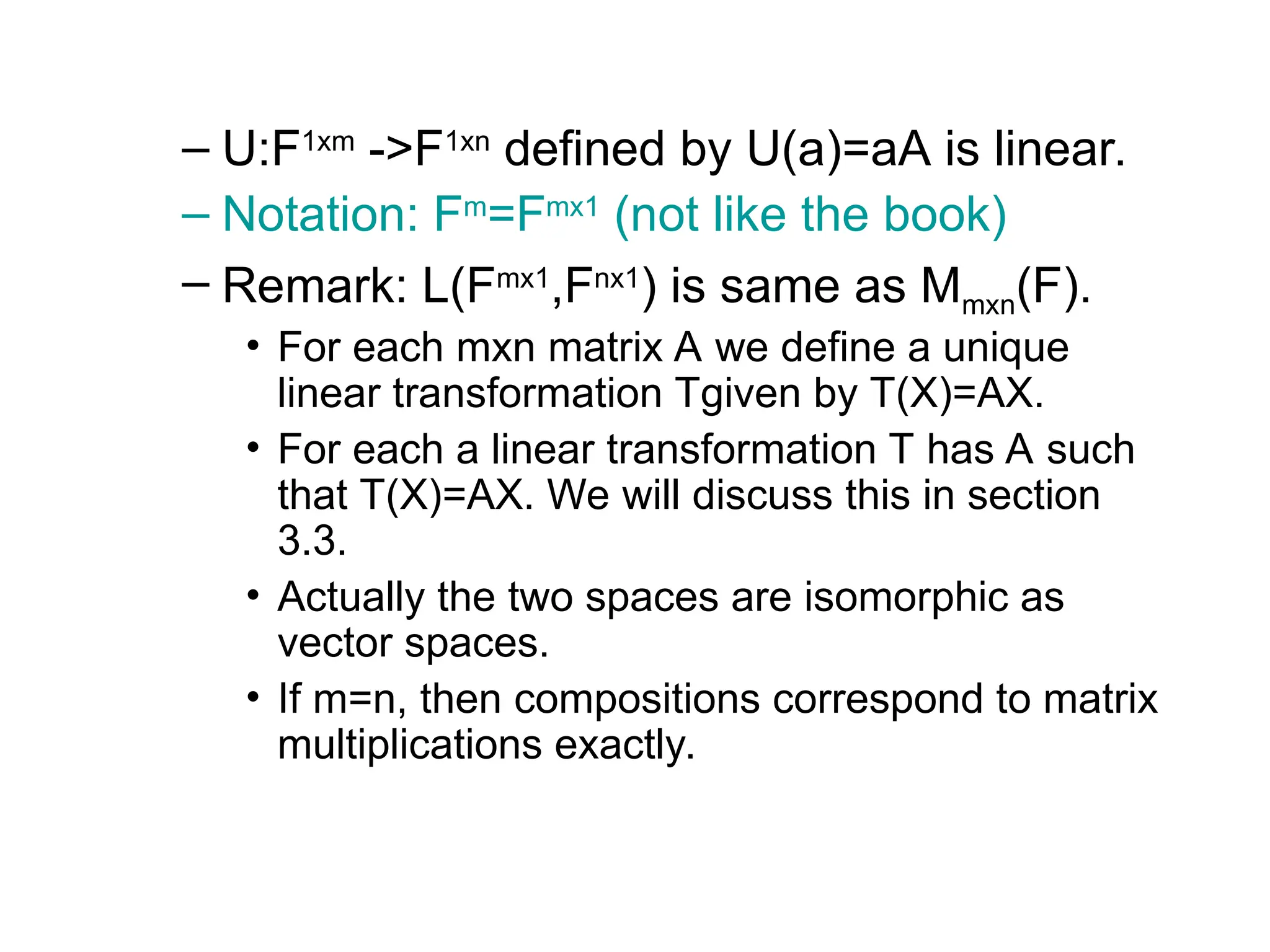
– U:F1xm
->F1xn
defined by U(a)=aA is linear.
– Notation: Fm
=Fmx1
(not like the book)
– Remark: L(Fmx1
,Fnx1
) is same as Mmxn(F).
• For each mxn matrix A we define a unique
linear transformation Tgiven by T(X)=AX.
• For each a linear transformation T has A such
that T(X)=AX. We will discuss this in section
3.3.
• Actually the two spaces are isomorphic as
vector spaces.
• If m=n, then compositions correspond to matrix
multiplications exactly.
• Example: T(x)=x+4. F=R. V=R. This is
not linear.
• Example: V = {f polynomial:FF}
T:V V defined by T(f)=Df.
• V={f:RR continuous}
• Theorem 1: V vector space over F.
basis . W another one with
vectors (any kind mn). Then
exists unique linear tranformation
T:VW s.t.
• Proof: Check the following map is linear.
• Null space of T :VW:= { v in V| Tv = 0}.
• Rank T:= dim{Tv|v in V} in W. = dim range T.
• Null space is a vector subspace of V.
• Range T is a vector subspace of W.
• Example:
• Null space z=t=0. X+2y=0 dim =1
• Range = W. dim = 3
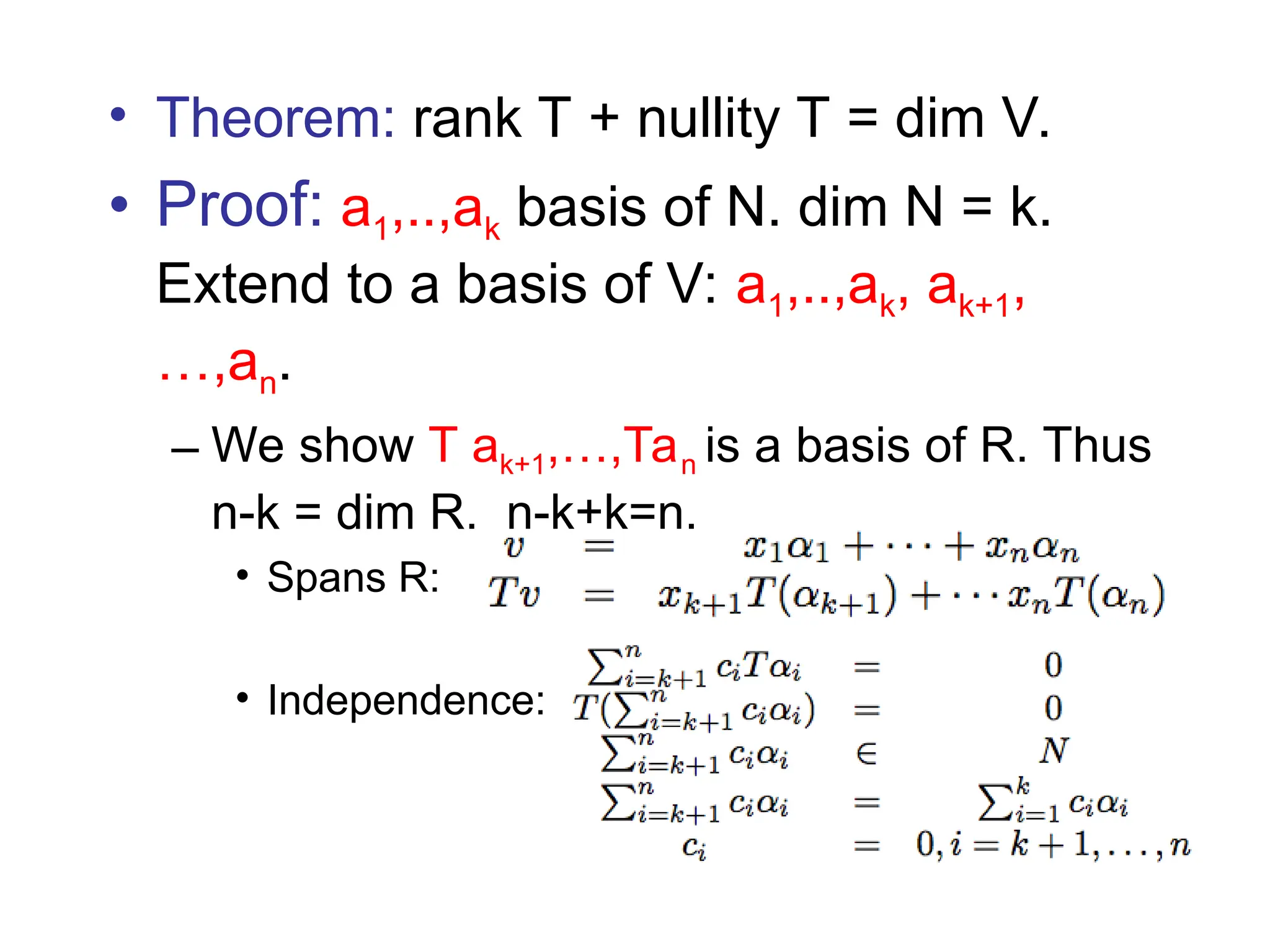
• Theorem: rank T + nullity T = dim V.
• Proof: a1,..,ak basis of N. dim N = k.
Extend to a basis of V: a1,..,ak, ak+1,
…,an.
– We show T ak+1,…,Tan is a basis of R. Thus
n-k = dim R. n-k+k=n.
• Spans R:
• Independence:
• Theorem 3: A mxn matrix.
Row rank A = Column rank A.
• Proof:
– column rank A = rank T where T:Rn
Rm
is
defined by Y=AX. ei goes to i-th column. So
range is spaned by column vectors.
– rankT+nullityT=n by above theorem.
– column rank A+ dim S = n where S={X|
AX=O} is the null space.
– dim S= n - row rank A (Ex 15 Ch. 5)
– row rank = column rank.
• (Ex 15 Ch. 5 ) Amxn
. S solution space. R r-r-e
matrix
• r = number of nonzero rows of R.
• RX=0 k1<k2<…<kr. J= {1,..,n}- {k1,k2,…,kr}.
– Solution spaces parameter u1,…,un-r.
– Or basis Ej given by setting uj=0 and other 0 and
xki= cij.
Algebra of linear
transformations
• Linear transformations can be added,
and multiplied by scalars. Hence they
form a vector space themselves.
• Theorem 4: T,U:VW linear.
– Define T+U:VW by (T+U)(a)=T(a)+U(a).
– Define cT:VW by cT(a)=c(T(a)).
– Then they are linear transformations.
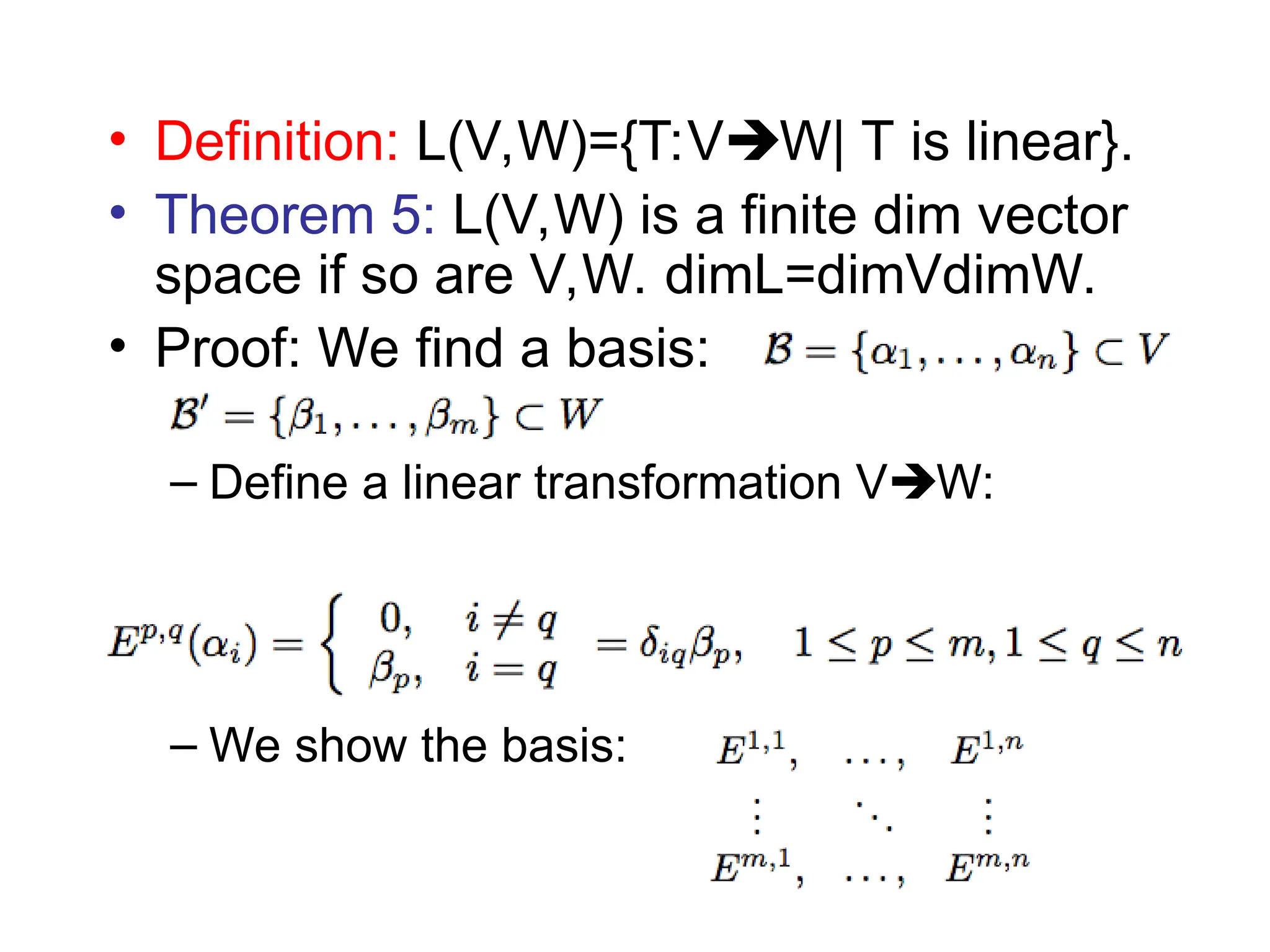
• Definition: L(V,W)={T:VW| T is linear}.
• Theorem 5: L(V,W) is a finite dim vector
space if so are V,W. dimL=dimVdimW.
• Proof: We find a basis:
– Define a linear transformation VW:
– We show the basis:
– Spans: T:VW.
• We show
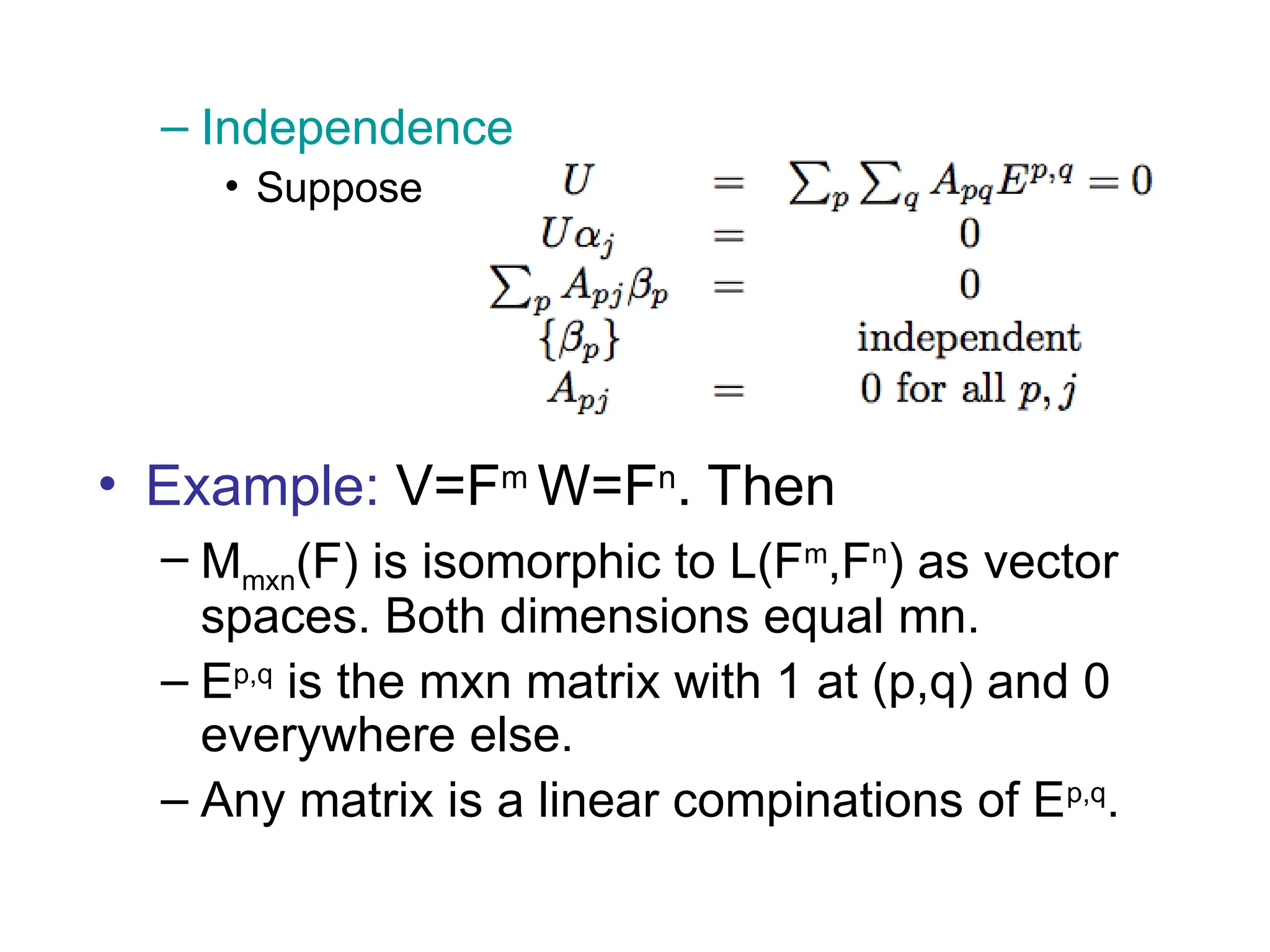
– Independence
• Suppose
• Example: V=Fm
W=Fn
. Then
– Mmxn(F) is isomorphic to L(Fm
,Fn
) as vector
spaces. Both dimensions equal mn.
– Ep,q
is the mxn matrix with 1 at (p,q) and 0
everywhere else.
– Any matrix is a linear compinations of Ep,q
.
• Theorem. T:VW, U:WZ.
UT:VZ defined by UT(a)= U(T(a)) is linear.
• Definition: Linear operator T:VV.
• L(V,V) has a multiplication.
– Define T0
=I, Tn
=T…T. n times.
– Example: A mxn matrix B pxm matrix
T defined by T(X)=AX. U defined by U(Y)=BY.
Then UT(X) = BAX. Thus
UT is defined by BA if T is defined by A and U by
B.
– Matrix multiplication is defined to mimic
composition.
• Lemma:
– IU=UI=U
– U(T1+T2)=UT1+UT2, (T1+T2)U=T1U+T2U.
– c(UT1)= (cU)T1=U(cT1).
• Remark: This make L(V,V) into linear
algebra (i.e., vector space with
multiplications) in fact same as the
matrix algebra Mnxn(F) if V=Fn
or more
generally dim V = n. (Example 10. P.78)
• Example: V={f:FF| f is a polynomial}.
– D:VV differentiation.
– T:VV: T sends f(x) to xf(x)
– DT-TD = I. We need to show DT-TD(f)= f
for each polynomial f.
– (QP-PQ=ihI In quantum mechanics.)
Invertible transformations
• T:VW is invertible if there exists U:WV such
that UT=Iv TU=Iw. U is denoted by T-1
.
• Theorem 7: If T is linear, then T-1
is linear.
• Definition: T:V W is nonsingular if Tc=0
implies c=0
– Equivalently the null space of T is {O}.
– T is one to one.
• Theorem 8: T is nonsingular iff T carries each
linearly independent set to a linearly
independent set.
• Theorem 9: V, W dim V = dim W.
T:V W is linear. TFAE:
– T is invertible.
– T is nonsingular
– T is onto.
• Proof: We use n=dim V = dim W.
rank T+nullity T = n.
– (ii) iff (iii): T is nonsingular iff nullity T =0 iff rank T
=n iff T is onto.
– (I)(ii): TX=0, T-1
TX=0, X=0.
– (ii)(i): T is nonsingular. T is onto. T is 1-1 onto.
The inverse function exists and is linear. T-1
exists.
Groups
• A group (G, .):
– A set G and an operation GxG->G:
• x(yz)=(xy)z
• There exists e s.t. xe=ex=x
• To each x, there exists x-1
s.t. xx-1
=e and
x-1
x=e.
• Example: The set of all 1-1 maps of
{1,2,…,n} to itself.
• Example: The set of nonsingular maps
GL(V,V) forms a group.
Isomorphisms
• V, W T:V->W one-to-one and onto
(invertible). Then T is an isomorphism.
V,W are isomorphic.
• Isomorphic relation is an equivalence
relation: V~V, V~W <-> W~V, V~W,
W~U -> V~W.
• Theorem 10: Every n-dim vector space
over F is isomorphic to Fn
.
(noncanonical)
• Proof: V n-dimensional
– Let B={a1,…,an} be a basis.
– Define T:V -> Fn
by
– One-to-one
– Onto
• Example: isomorphisms
There will be advantages in looking this way!

Linear Transformation Linear Algebra.pptx

  • 1.
    Chapter 3: Linear transformations Lineartransformations, Algebra of linear transformations, matrices, dual spaces, double duals
  • 2.
    Linear transformations • V,W vector spaces with same fields F. – Definition: T:VW s.t. T(ca+b)=c(Ta)+Tb for all a,b in V. c in F. Then T is linear. – Property: T(O)=O. T(ca+db)=cT(a)+dT(b), a,b in V, c,d in F. (equivalent to the def.) – Example: A mxn matrix over F. Define T by Y=AX. T:Fn Fm is linear. • Proof: T(aX+bY)= A(aX+bY)=aAX+bAY = aT(X) +bT(Y).
  • 3.
    – U:F1xm ->F1xn defined byU(a)=aA is linear. – Notation: Fm =Fmx1 (not like the book) – Remark: L(Fmx1 ,Fnx1 ) is same as Mmxn(F). • For each mxn matrix A we define a unique linear transformation Tgiven by T(X)=AX. • For each a linear transformation T has A such that T(X)=AX. We will discuss this in section 3.3. • Actually the two spaces are isomorphic as vector spaces. • If m=n, then compositions correspond to matrix multiplications exactly.
  • 4.
    • Example: T(x)=x+4.F=R. V=R. This is not linear. • Example: V = {f polynomial:FF} T:V V defined by T(f)=Df. • V={f:RR continuous}
  • 5.
    • Theorem 1:V vector space over F. basis . W another one with vectors (any kind mn). Then exists unique linear tranformation T:VW s.t. • Proof: Check the following map is linear.
  • 6.
    • Null spaceof T :VW:= { v in V| Tv = 0}. • Rank T:= dim{Tv|v in V} in W. = dim range T. • Null space is a vector subspace of V. • Range T is a vector subspace of W. • Example: • Null space z=t=0. X+2y=0 dim =1 • Range = W. dim = 3
  • 7.
    • Theorem: rankT + nullity T = dim V. • Proof: a1,..,ak basis of N. dim N = k. Extend to a basis of V: a1,..,ak, ak+1, …,an. – We show T ak+1,…,Tan is a basis of R. Thus n-k = dim R. n-k+k=n. • Spans R: • Independence:
  • 8.
    • Theorem 3:A mxn matrix. Row rank A = Column rank A. • Proof: – column rank A = rank T where T:Rn Rm is defined by Y=AX. ei goes to i-th column. So range is spaned by column vectors. – rankT+nullityT=n by above theorem. – column rank A+ dim S = n where S={X| AX=O} is the null space. – dim S= n - row rank A (Ex 15 Ch. 5) – row rank = column rank.
  • 9.
    • (Ex 15Ch. 5 ) Amxn . S solution space. R r-r-e matrix • r = number of nonzero rows of R. • RX=0 k1<k2<…<kr. J= {1,..,n}- {k1,k2,…,kr}. – Solution spaces parameter u1,…,un-r. – Or basis Ej given by setting uj=0 and other 0 and xki= cij.
  • 10.
    Algebra of linear transformations •Linear transformations can be added, and multiplied by scalars. Hence they form a vector space themselves. • Theorem 4: T,U:VW linear. – Define T+U:VW by (T+U)(a)=T(a)+U(a). – Define cT:VW by cT(a)=c(T(a)). – Then they are linear transformations.
  • 11.
    • Definition: L(V,W)={T:VW|T is linear}. • Theorem 5: L(V,W) is a finite dim vector space if so are V,W. dimL=dimVdimW. • Proof: We find a basis: – Define a linear transformation VW: – We show the basis:
  • 12.
  • 13.
    – Independence • Suppose •Example: V=Fm W=Fn . Then – Mmxn(F) is isomorphic to L(Fm ,Fn ) as vector spaces. Both dimensions equal mn. – Ep,q is the mxn matrix with 1 at (p,q) and 0 everywhere else. – Any matrix is a linear compinations of Ep,q .
  • 14.
    • Theorem. T:VW,U:WZ. UT:VZ defined by UT(a)= U(T(a)) is linear. • Definition: Linear operator T:VV. • L(V,V) has a multiplication. – Define T0 =I, Tn =T…T. n times. – Example: A mxn matrix B pxm matrix T defined by T(X)=AX. U defined by U(Y)=BY. Then UT(X) = BAX. Thus UT is defined by BA if T is defined by A and U by B. – Matrix multiplication is defined to mimic composition.
  • 15.
    • Lemma: – IU=UI=U –U(T1+T2)=UT1+UT2, (T1+T2)U=T1U+T2U. – c(UT1)= (cU)T1=U(cT1). • Remark: This make L(V,V) into linear algebra (i.e., vector space with multiplications) in fact same as the matrix algebra Mnxn(F) if V=Fn or more generally dim V = n. (Example 10. P.78)
  • 16.
    • Example: V={f:FF|f is a polynomial}. – D:VV differentiation. – T:VV: T sends f(x) to xf(x) – DT-TD = I. We need to show DT-TD(f)= f for each polynomial f. – (QP-PQ=ihI In quantum mechanics.)
  • 17.
    Invertible transformations • T:VWis invertible if there exists U:WV such that UT=Iv TU=Iw. U is denoted by T-1 . • Theorem 7: If T is linear, then T-1 is linear. • Definition: T:V W is nonsingular if Tc=0 implies c=0 – Equivalently the null space of T is {O}. – T is one to one. • Theorem 8: T is nonsingular iff T carries each linearly independent set to a linearly independent set.
  • 18.
    • Theorem 9:V, W dim V = dim W. T:V W is linear. TFAE: – T is invertible. – T is nonsingular – T is onto. • Proof: We use n=dim V = dim W. rank T+nullity T = n. – (ii) iff (iii): T is nonsingular iff nullity T =0 iff rank T =n iff T is onto. – (I)(ii): TX=0, T-1 TX=0, X=0. – (ii)(i): T is nonsingular. T is onto. T is 1-1 onto. The inverse function exists and is linear. T-1 exists.
  • 19.
    Groups • A group(G, .): – A set G and an operation GxG->G: • x(yz)=(xy)z • There exists e s.t. xe=ex=x • To each x, there exists x-1 s.t. xx-1 =e and x-1 x=e. • Example: The set of all 1-1 maps of {1,2,…,n} to itself. • Example: The set of nonsingular maps GL(V,V) forms a group.
  • 20.
    Isomorphisms • V, WT:V->W one-to-one and onto (invertible). Then T is an isomorphism. V,W are isomorphic. • Isomorphic relation is an equivalence relation: V~V, V~W <-> W~V, V~W, W~U -> V~W.
  • 21.
    • Theorem 10:Every n-dim vector space over F is isomorphic to Fn . (noncanonical) • Proof: V n-dimensional – Let B={a1,…,an} be a basis. – Define T:V -> Fn by – One-to-one – Onto
  • 22.
    • Example: isomorphisms Therewill be advantages in looking this way!

Editor's Notes