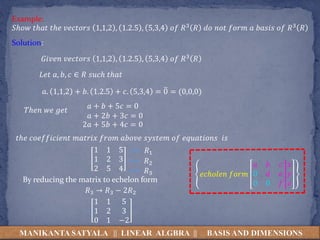
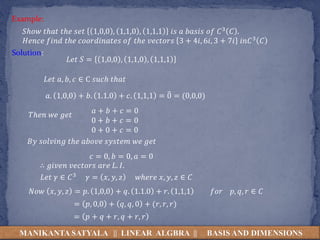
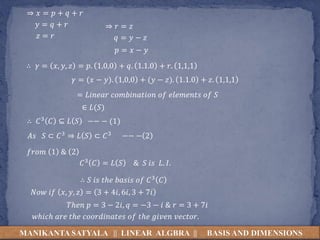
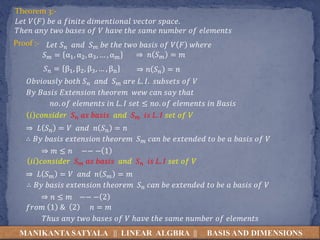
LINEAR ALGEBRA
BASIS ANDDIMENSION
MANIKANTA SATYALA
Department of Mathematics
VSM COLLEGE(A), Ramachandrapuram
2.
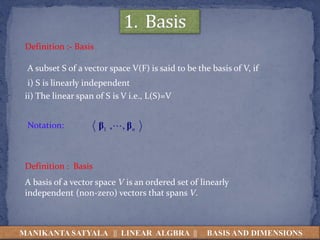
Definition : Basis
Abasis of a vector space V is an ordered set of linearly
independent (non-zero) vectors that spans V.
Notation: 1 , , n
β β
Definition :- Basis
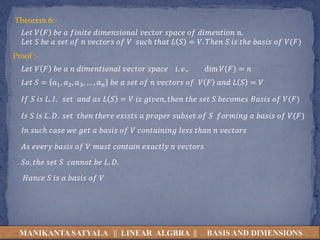
A subset S of a vector space V(F) is said to be the basis of V, if
i) S is linearly independent
ii) The linear span of S is V i.e., L(S)=V
MANIKANTA SATYALA || LINEAR ALGBRA || BASIS AND DIMENSIONS
3.
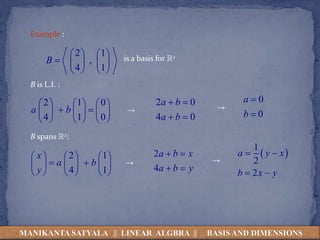
Example :
2 1
,
41
B
is a basis for R2
B is L.I. :
2 1 0
4 1 0
a b
→
2 0
4 0
a b
a b
→
0
0
a
b
B spans R2:
2 1
4 1
x
a b
y
→
2
4
a b x
a b y
→
1
2
2
a y x
b x y
MANIKANTA SATYALA || LINEAR ALGBRA || BASIS AND DIMENSIONS
4.
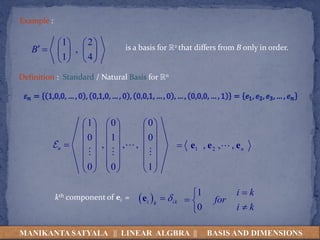
Example :
1 2
,
14
B
is a basis for R2 that differs from B only in order.
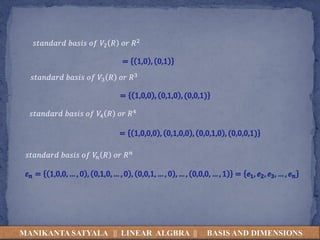
Definition : Standard / Natural Basis for Rn
1 0 0
0 1 0
, , ,
0 0 1
n
1 2
, , , n
e e e
i ik
k
e
kth component of ei =
1
0
i k
for
i k
MANIKANTA SATYALA || LINEAR ALGBRA || BASIS AND DIMENSIONS
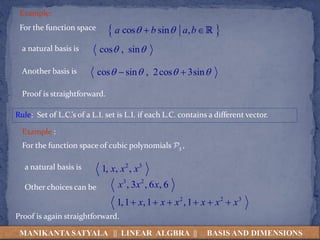
Example:
For the functionspace
cos sin ,
a b a b
a natural basis is cos , sin
Another basis is cos sin , 2cos 3sin
Proof is straightforward.
Example :
For the function space of cubic polynomials P3 ,
a natural basis is 2 3
1, , ,
x x x
Other choices can be
3 2
, 3 , 6 , 6
x x x
2 2 3
1,1 ,1 ,1
x x x x x x
Proof is again straightforward.
Rule: Set of L.C.’s of a L.I. set is L.I. if each L.C. contains a different vector.
MANIKANTA SATYALA || LINEAR ALGBRA || BASIS AND DIMENSIONS
7.
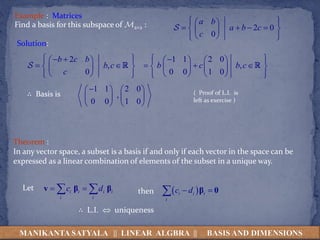
Example : Matrices
Finda basis for this subspace of M22 : 2 0
0
a b
a b c
c
2
,
0
b c b
b c
c
Solution:
1 1 2 0
,
0 0 1 0
b c b c
∴ Basis is
1 1 2 0
,
0 0 1 0
( Proof of L.I. is
left as exercise )
Theorem :
In any vector space, a subset is a basis if and only if each vector in the space can be
expressed as a linear combination of elements of the subset in a unique way.
Let i i i i
i i
c d
β
v β then
i i i
i
c d
β 0
∴ L.I. uniqueness
MANIKANTA SATYALA || LINEAR ALGBRA || BASIS AND DIMENSIONS
8.
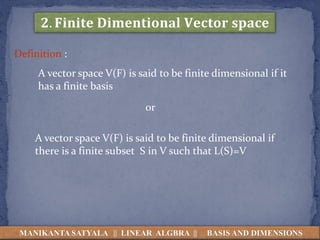
𝟐. 𝐅𝐢𝐧𝐢𝐭𝐞 𝐃𝐢𝐦𝐞𝐧𝐭𝐢𝐨𝐧𝐚𝐥𝐕𝐞𝐜𝐭𝐨𝐫 𝐬𝐩𝐚𝐜𝐞
Definition :
A vector space V(F) is said to be finite dimensional if it
has a finite basis
or
A vector space V(F) is said to be finite dimensional if
there is a finite subset S in V such that L(S)=V
MANIKANTA SATYALA || LINEAR ALGBRA || BASIS AND DIMENSIONS
9.
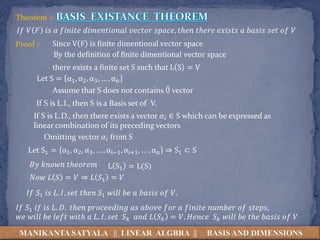
Theorem :-
𝐼𝑓 𝑉𝐹 𝑖𝑠 𝑎 𝑓𝑖𝑛𝑖𝑡𝑒 𝑑𝑖𝑚𝑒𝑛𝑡𝑖𝑜𝑛𝑎𝑙 𝑣𝑒𝑐𝑡𝑜𝑟 𝑠𝑝𝑎𝑐𝑒, 𝑡ℎ𝑒𝑛 𝑡ℎ𝑒𝑟𝑒 𝑒𝑥𝑖𝑠𝑡𝑠 𝑎 𝑏𝑎𝑠𝑖𝑠 𝑠𝑒𝑡 𝑜𝑓 𝑉
Proof :- Since V F is finite dimentional vector space
By the definition of finite dimentional vector space
there exists a finite set S such that L S = V
Let S = α1, α2, α3, … , αn
Assume that S does not contains 0 vector
If S is L.I., then S is a Basis set of V.
If S is L.D., then there exists a vector 𝛼𝑖 ∈ S which can be expressed as
linear combination of its preceding vectors
Omitting vector 𝛼𝑖 from S
Let S1 = α1, α2, α3, … , αi−1, αi+1, … , αn ⇒ S1 ⊂ S
𝐵𝑦 𝑘𝑛𝑜𝑤𝑛 𝑡ℎ𝑒𝑜𝑟𝑒𝑚 L S1 = L(S)
𝑁𝑜𝑤 𝐿 𝑆 = 𝑉 ⇒ 𝐿 𝑆1 = 𝑉
𝐼𝑓 𝑆1 𝑖𝑠 𝐿. 𝐼. 𝑠𝑒𝑡 𝑡ℎ𝑒𝑛 𝑆1 𝑤𝑖𝑙𝑙 𝑏𝑒 𝑎 𝑏𝑎𝑠𝑖𝑠 𝑜𝑓 𝑉.
𝐼𝑓 𝑆1 𝑖𝑓 𝑖𝑠 𝐿. 𝐷. 𝑡ℎ𝑒𝑛 𝑝𝑟𝑜𝑐𝑒𝑒𝑑𝑖𝑛𝑔 𝑎𝑠 𝑎𝑏𝑜𝑣𝑒 𝑓𝑜𝑟 𝑎 𝑓𝑖𝑛𝑖𝑡𝑒 𝑛𝑢𝑚𝑏𝑒𝑟 𝑜𝑓 𝑠𝑡𝑒𝑝𝑠,
𝑤𝑒 𝑤𝑖𝑙𝑙 𝑏𝑒 𝑙𝑒𝑓𝑡 𝑤𝑖𝑡ℎ 𝑎 𝐿. 𝐼. 𝑠𝑒𝑡 𝑆𝑘 𝑎𝑛𝑑 𝐿 𝑆𝑘 = 𝑉. 𝐻𝑒𝑛𝑐𝑒 𝑆𝑘 𝑤𝑖𝑙𝑙 𝑏𝑒 𝑡ℎ𝑒 𝑏𝑎𝑠𝑖𝑠 𝑜𝑓 𝑉
MANIKANTA SATYALA || LINEAR ALGBRA || BASIS AND DIMENSIONS
10.
MANIKANTA SATYALA ||LINEAR ALGBRA || BASIS AND DIMENSIONS
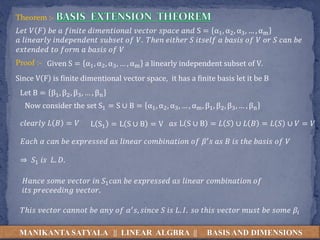
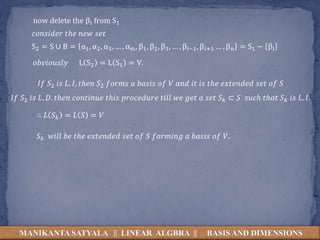
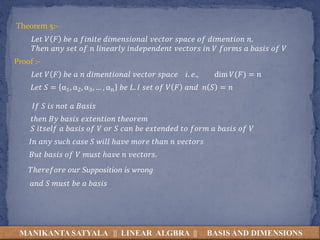
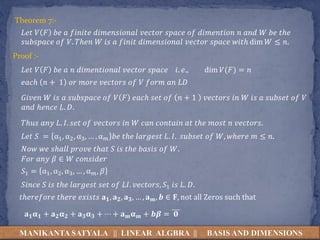
Theorem :-
𝐿𝑒𝑡 𝑉 𝐹 𝑏𝑒 𝑎 𝑓𝑖𝑛𝑖𝑡𝑒 𝑑𝑖𝑚𝑒𝑛𝑡𝑖𝑜𝑛𝑎𝑙 𝑣𝑒𝑐𝑡𝑜𝑟 𝑠𝑝𝑎𝑐𝑒 𝑎𝑛𝑑 S = α1, α2, α3, … , αm
𝑎 𝑙𝑖𝑛𝑒𝑎𝑟𝑙𝑦 𝑖𝑛𝑑𝑒𝑝𝑒𝑛𝑑𝑒𝑛𝑡 𝑠𝑢𝑏𝑠𝑒𝑡 𝑜𝑓 𝑉. 𝑇ℎ𝑒𝑛 𝑒𝑖𝑡ℎ𝑒𝑟 𝑆 𝑖𝑡𝑠𝑒𝑙𝑓 𝑎 𝑏𝑎𝑠𝑖𝑠 𝑜𝑓 𝑉 𝑜𝑟 𝑆 𝑐𝑎𝑛 𝑏𝑒
𝑒𝑥𝑡𝑒𝑛𝑑𝑒𝑑 𝑡𝑜 𝑓𝑜𝑟𝑚 𝑎 𝑏𝑎𝑠𝑖𝑠 𝑜𝑓 𝑉
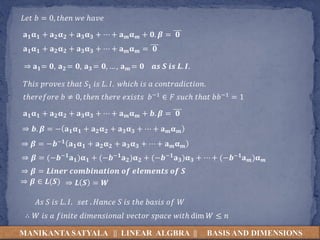
Proof :-
Since V F is finite dimentional vector space, it has a finite basis let it be B
Given S = α1, α2, α3, … , αm a linearly independent subset of V.
Let B = β1, β2, β3, … , βn
Now consider the set S1 = S ∪ B = α1, α2, α3, … , αm, β1, β2, β3, … , βn
𝑐𝑙𝑒𝑎𝑟𝑙𝑦 𝐿 𝐵 = 𝑉
𝐸𝑎𝑐ℎ 𝛼 𝑐𝑎𝑛 𝑏𝑒 𝑒𝑥𝑝𝑟𝑒𝑠𝑠𝑒𝑑 𝑎𝑠 𝑙𝑖𝑛𝑒𝑎𝑟 𝑐𝑜𝑚𝑏𝑖𝑛𝑎𝑡𝑖𝑜𝑛 𝑜𝑓 𝛽′𝑠 𝑎𝑠 𝐵 𝑖𝑠 𝑡ℎ𝑒 𝑏𝑎𝑠𝑖𝑠 𝑜𝑓 𝑉
⇒ 𝑆1 𝑖𝑠 𝐿. 𝐷.
𝐻𝑎𝑛𝑐𝑒 𝑠𝑜𝑚𝑒 𝑣𝑒𝑐𝑡𝑜𝑟 𝑖𝑛 𝑆1𝑐𝑎𝑛 𝑏𝑒 𝑒𝑥𝑝𝑟𝑒𝑠𝑠𝑒𝑑 𝑎𝑠 𝑙𝑖𝑛𝑒𝑎𝑟 𝑐𝑜𝑚𝑏𝑖𝑛𝑎𝑡𝑖𝑜𝑛 𝑜𝑓
𝑖𝑡𝑠 𝑝𝑟𝑒𝑐𝑒𝑒𝑑𝑖𝑛𝑔 𝑣𝑒𝑐𝑡𝑜𝑟.
𝑇ℎ𝑖𝑠 𝑣𝑒𝑐𝑡𝑜𝑟 𝑐𝑎𝑛𝑛𝑜𝑡 𝑏𝑒 𝑎𝑛𝑦 𝑜𝑓 𝛼′𝑠, 𝑠𝑖𝑛𝑐𝑒 𝑆 𝑖𝑠 𝐿. 𝐼. 𝑠𝑜 𝑡ℎ𝑖𝑠 𝑣𝑒𝑐𝑡𝑜𝑟 𝑚𝑢𝑠𝑡 𝑏𝑒 𝑠𝑜𝑚𝑒 𝛽𝑖
L S1 = L S ∪ B = V 𝑎𝑠 L S ∪ B = 𝐿 𝑆 ∪ 𝐿 𝐵 = 𝐿 𝑆 ∪ 𝑉 = 𝑉
MANIKANTA SATYALA ||LINEAR ALGBRA || BASIS AND DIMENSIONS
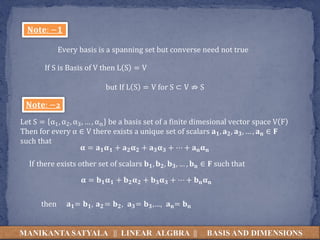
𝐍𝐨𝐭𝐞: −𝟏
Every basis is a spanning set but converse need not true
If S is Basis of V then L S = V
but If L S = V for S ⊂ V ⇏ S
𝐍𝐨𝐭𝐞: −2
Let S = α1, α2, α3, … , αn be a basis set of a finite dimesional vector space V F
Then for every α ∈ V there exists a unique set of scalars 𝐚𝟏, 𝐚𝟐, 𝐚𝟑, … , 𝐚𝐧 ∈ 𝐅
such that
𝛂 = 𝐚𝟏𝛂𝟏 + 𝐚𝟐𝛂𝟐 + 𝐚𝟑𝛂𝟑 + ⋯ + 𝐚𝐧𝛂𝐧
𝛂 = 𝐛𝟏𝛂𝟏 + 𝐛𝟐𝛂𝟐 + 𝐛𝟑𝛂𝟑 + ⋯ + 𝐛𝐧𝛂𝐧
If there exists other set of scalars 𝐛𝟏, 𝐛𝟐, 𝐛𝟑, … , 𝐛𝐧 ∈ 𝐅 such that
then 𝐚𝟏= 𝐛𝟏, 𝐚𝟐 = 𝐛𝟐, 𝐚𝟑= 𝐛𝟑,…, 𝐚𝐧= 𝐛𝐧
13.
MANIKANTA SATYALA ||LINEAR ALGBRA || BASIS AND DIMENSIONS
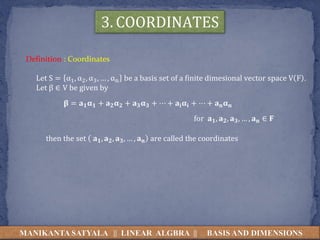
3. COORDINATES
Definition : Coordinates
Let S = α1, α2, α3, … , αn be a basis set of a finite dimesional vector space V F .
Let β ∈ V be given by
𝛃 = 𝐚𝟏𝛂𝟏 + 𝐚𝟐𝛂𝟐 + 𝐚𝟑𝛂𝟑 + ⋯ + 𝐚𝐢𝛂𝐢 + ⋯ + 𝐚𝐧𝛂𝐧
for 𝐚𝟏, 𝐚𝟐, 𝐚𝟑, … , 𝐚𝐧 ∈ 𝐅
then the set 𝐚𝟏, 𝐚𝟐, 𝐚𝟑, … , 𝐚𝐧 are called the coordinates
MANIKANTA SATYALA ||LINEAR ALGBRA || BASIS AND DIMENSIONS
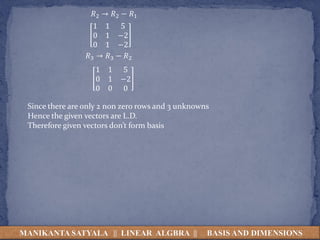
𝑅2 → 𝑅2 − 𝑅1
1 1 5
0 1 −2
0 1 −2
𝑅3 → 𝑅3 − 𝑅2
1 1 5
0 1 −2
0 0 0
Since there are only 2 non zero rows and 3 unknowns
Hence the given vectors are L.D.
Therefore given vectors don’t form basis
16.
MANIKANTA SATYALA ||LINEAR ALGBRA || BASIS AND DIMENSIONS
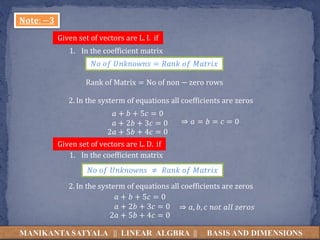
𝐍𝐨𝐭𝐞: −𝟑
Given set of vectors are L. I. if
1. In the coefficient matrix
𝑁𝑜 𝑜𝑓 𝑈𝑛𝑘𝑛𝑜𝑤𝑛𝑠 = 𝑅𝑎𝑛𝑘 𝑜𝑓 𝑀𝑎𝑡𝑟𝑖𝑥
Rank of Matrix = No of non − zero rows
2. In the systerm of equations all coefficients are zeros
𝑎 + 𝑏 + 5𝑐 = 0
𝑎 + 2𝑏 + 3𝑐 = 0
2𝑎 + 5𝑏 + 4𝑐 = 0
⇒ 𝑎 = 𝑏 = 𝑐 = 0
Given set of vectors are L. D. if
1. In the coefficient matrix
𝑁𝑜 𝑜𝑓 𝑈𝑛𝑘𝑛𝑜𝑤𝑛𝑠 ≠ 𝑅𝑎𝑛𝑘 𝑜𝑓 𝑀𝑎𝑡𝑟𝑖𝑥
2. In the systerm of equations all coefficients are zeros
𝑎 + 𝑏 + 5𝑐 = 0
𝑎 + 2𝑏 + 3𝑐 = 0
2𝑎 + 5𝑏 + 4𝑐 = 0
⇒ 𝑎, 𝑏, 𝑐 𝑛𝑜𝑡 𝑎𝑙𝑙 𝑧𝑒𝑟𝑜𝑠
MANIKANTA SATYALA ||LINEAR ALGBRA || BASIS AND DIMENSIONS
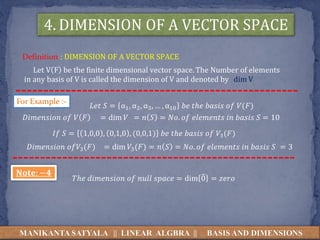
4. DIMENSION OF A VECTOR SPACE
Definition : DIMENSION OF A VECTOR SPACE
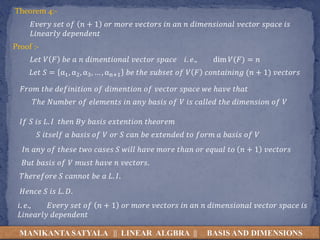
Let V F be the finite dimensional vector space. The Number of elements
in any basis of V is called the dimension of V and denoted by dim V
𝐿𝑒𝑡 𝑆 = α1, α2, α3, … , α10 𝑏𝑒 𝑡ℎ𝑒 𝑏𝑎𝑠𝑖𝑠 𝑜𝑓 𝑉(𝐹)
For Example :-
𝐷𝑖𝑚𝑒𝑛𝑠𝑖𝑜𝑛 𝑜𝑓 𝑉 𝐹 = dim 𝑉 = 𝑛 𝑆 = 𝑁𝑜. 𝑜𝑓 𝑒𝑙𝑒𝑚𝑒𝑛𝑡𝑠 𝑖𝑛 𝑏𝑎𝑠𝑖𝑠 𝑆 = 10
𝐍𝐨𝐭𝐞: −𝟒
𝑇ℎ𝑒 𝑑𝑖𝑚𝑒𝑛𝑠𝑖𝑜𝑛 𝑜𝑓 𝑛𝑢𝑙𝑙 𝑠𝑝𝑎𝑐𝑒 = dim 0 = 𝑧𝑒𝑟𝑜
𝐼𝑓 𝑆 = 1,0,0 , 0,1,0 , (0,0,1) 𝑏𝑒 𝑡ℎ𝑒 𝑏𝑎𝑠𝑖𝑠 𝑜𝑓 𝑉3(𝐹)
𝐷𝑖𝑚𝑒𝑛𝑠𝑖𝑜𝑛 𝑜𝑓𝑉3(𝐹) = dim 𝑉3(𝐹) = 𝑛 𝑆 = 𝑁𝑜. 𝑜𝑓 𝑒𝑙𝑒𝑚𝑒𝑛𝑡𝑠 𝑖𝑛 𝑏𝑎𝑠𝑖𝑠 𝑆 = 3
MANIKANTA SATYALA ||LINEAR ALGBRA || BASIS AND DIMENSIONS
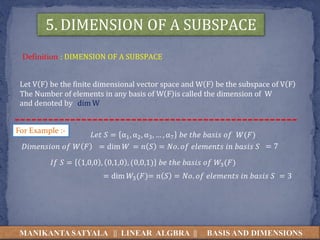
5. DIMENSION OF A SUBSPACE
Definition : DIMENSION OF A SUBSPACE
Let V F be the finite dimensional vector space and W F be the subspace of V F
The Number of elements in any basis of W F is called the dimension of W
and denoted by dim W
𝐿𝑒𝑡 𝑆 = α1, α2, α3, … , α7 𝑏𝑒 𝑡ℎ𝑒 𝑏𝑎𝑠𝑖𝑠 𝑜𝑓 𝑊(𝐹)
For Example :-
𝐷𝑖𝑚𝑒𝑛𝑠𝑖𝑜𝑛 𝑜𝑓 𝑊 𝐹 = dim 𝑊 = 𝑛 𝑆 = 𝑁𝑜. 𝑜𝑓 𝑒𝑙𝑒𝑚𝑒𝑛𝑡𝑠 𝑖𝑛 𝑏𝑎𝑠𝑖𝑠 𝑆 = 7
𝐼𝑓 𝑆 = 1,0,0 , 0,1,0 , (0,0,1) 𝑏𝑒 𝑡ℎ𝑒 𝑏𝑎𝑠𝑖𝑠 𝑜𝑓 𝑊3(𝐹)
= dim 𝑊3(𝐹)= 𝑛 𝑆 = 𝑁𝑜. 𝑜𝑓 𝑒𝑙𝑒𝑚𝑒𝑛𝑡𝑠 𝑖𝑛 𝑏𝑎𝑠𝑖𝑠 𝑆 = 3
MANIKANTA SATYALA ||LINEAR ALGBRA || BASIS AND DIMENSIONS
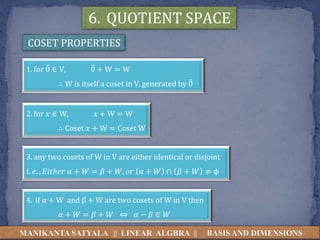
COSET PROPERTIES
1. for 0 ∈ V, 0 + W = W
∴ W is itself a coset in V, generated by 0
2. for 𝑥 ∈ W, 𝑥 + W = W
∴ Coset 𝑥 + W = Coset W
4. if α + W and β + W are two cosets of W in V then
𝛼 + 𝑊 = 𝛽 + 𝑊 ⇔ 𝛼 − 𝛽 ∈ 𝑊
3. any two cosets of W in V are either identical or disjoint
𝑖. 𝑒. , 𝐸𝑖𝑡ℎ𝑒𝑟 𝛼 + 𝑊 = 𝛽 + 𝑊, 𝑜𝑟 𝛼 + 𝑊 ∩ 𝛽 + 𝑊 ≠ ϕ
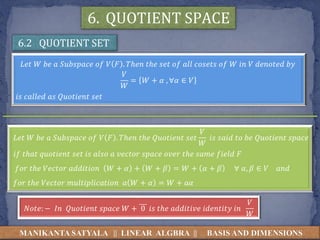
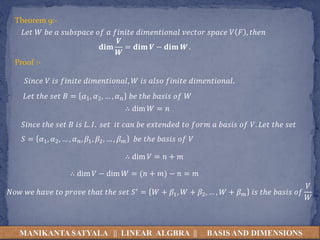
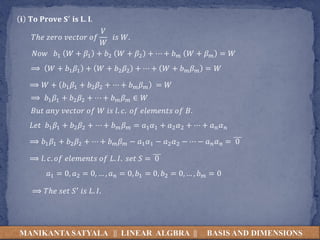
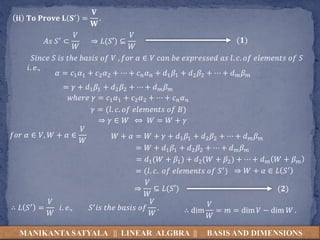
6. QUOTIENT SPACE