K.Anitha M.Sc., M.Phil.,
G.Nagalakshmi M.Sc., M.phil.,
 Eigen vector of a matrix A is a vector
represented by a matrix X such that when X
is multiplied with matrix A, then the
direction of the resultant matrix remains
same as vector X.
 Mathematically, above statement can be
represented as:
 AX = λX
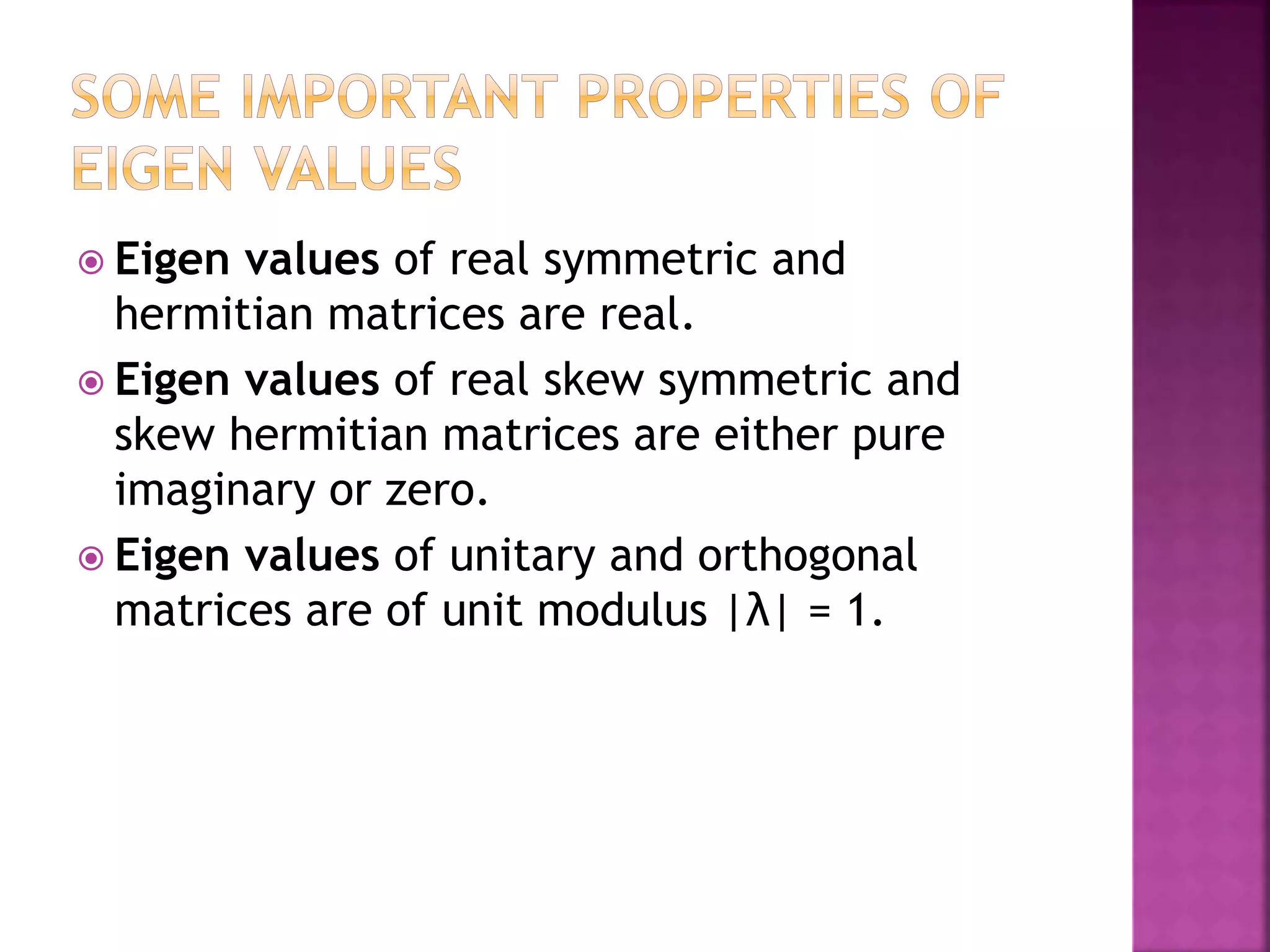
 Eigen values of real symmetric and
hermitian matrices are real.
 Eigen values of real skew symmetric and
skew hermitian matrices are either pure
imaginary or zero.
 Eigen values of unitary and orthogonal
matrices are of unit modulus |λ| = 1.
 If λ1, λ2…….λn are the eigen values of A, then
kλ1, kλ2…….kλn are eigen values of kA
 If λ1, λ2…….λn are the eigen values of A, then
1/λ1, 1/λ2…….1/λn are eigen values of A-1
 If λ1, λ2…….λn are the eigen values of A, then
λ1
k, λ2
k…….λn
k are eigen values of Ak
 Eigen values of A = Eigen Values of AT
(Transpose)
 Sum of Eigen Values = Trace of A (Sum of
diagonal elements of A)
 Product of Eigen Values = |A|
 Maximum number of distinct eigen values of
A = Size of A
 If A and B are two matrices of same order
then, Eigen values of AB = Eigen values of BA
 AX = λX
 => AX – λX = 0
 => (A – λI) X = 0 …..(1)
 Above condition will be true only if (A – λI) is
singular. That means,
 |A – λI| = 0 …..(2)
 (2) is known as characteristic equation of the
matrix.
 The roots of the characteristic equation are
the eigen values of the matrix A.
 Now, to find the eigen vectors, we simply put
each eigen value into (1) and solve it by
Gaussian elimination, that is, convert the
augmented matrix (A – λI) = 0 to row echelon
form and solve the linear system of
equations thus obtained.
 In linear algebra, an eigenvector or
characteristic vector of a linear
transformation is a nonzero vector that
changes at most by a scalar factor when that
linear transformation is applied to it. The
corresponding eigenvalue is the factor by
which the eigenvector is scaled.
Linear algebra
Linear algebra

Linear algebra

  • 1.
  • 2.
     Eigen vectorof a matrix A is a vector represented by a matrix X such that when X is multiplied with matrix A, then the direction of the resultant matrix remains same as vector X.  Mathematically, above statement can be represented as:  AX = λX
  • 3.
     Eigen valuesof real symmetric and hermitian matrices are real.  Eigen values of real skew symmetric and skew hermitian matrices are either pure imaginary or zero.  Eigen values of unitary and orthogonal matrices are of unit modulus |λ| = 1.
  • 4.
     If λ1,λ2…….λn are the eigen values of A, then kλ1, kλ2…….kλn are eigen values of kA  If λ1, λ2…….λn are the eigen values of A, then 1/λ1, 1/λ2…….1/λn are eigen values of A-1  If λ1, λ2…….λn are the eigen values of A, then λ1 k, λ2 k…….λn k are eigen values of Ak  Eigen values of A = Eigen Values of AT (Transpose)
  • 5.
     Sum ofEigen Values = Trace of A (Sum of diagonal elements of A)  Product of Eigen Values = |A|  Maximum number of distinct eigen values of A = Size of A  If A and B are two matrices of same order then, Eigen values of AB = Eigen values of BA
  • 6.
     AX =λX  => AX – λX = 0  => (A – λI) X = 0 …..(1)  Above condition will be true only if (A – λI) is singular. That means,  |A – λI| = 0 …..(2)  (2) is known as characteristic equation of the matrix.
  • 7.
     The rootsof the characteristic equation are the eigen values of the matrix A.  Now, to find the eigen vectors, we simply put each eigen value into (1) and solve it by Gaussian elimination, that is, convert the augmented matrix (A – λI) = 0 to row echelon form and solve the linear system of equations thus obtained.
  • 8.
     In linearalgebra, an eigenvector or characteristic vector of a linear transformation is a nonzero vector that changes at most by a scalar factor when that linear transformation is applied to it. The corresponding eigenvalue is the factor by which the eigenvector is scaled.