Lecture notes Statistics 
Estimation 
Rickard Sandberg e-mail:rickard.sandberg@hhs.se 
January 22, 2010
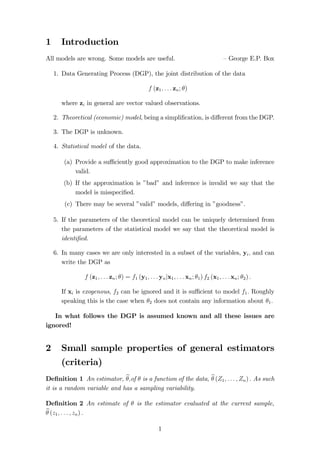
1 Introduction 
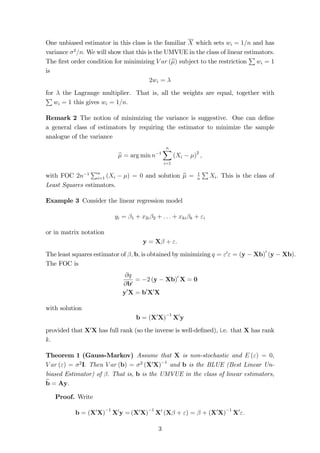
All models are wrong. Some models are useful. –George E.P. Box 
1. Data Generating Process (DGP), the joint distribution of the data 
f (z1; : : : zn; ) 
where zi in general are vector valued observations. 
2. Theoretical (economic) model, being a simpli…cation, is di¤erent fromthe DGP. 
3. The DGP is unknown. 
4. Statistical model of the data. 
(a) Provide a su¢ ciently good approximation to the DGP to make inference 
valid. 
(b) If the approximation is ”bad” and inference is invalid we say that the 
model is misspeci…ed. 
(c) There may be several ”valid”models, di¤ering in ”goodness”. 
5. If the parameters of the theoretical model can be uniquely determined from 
the parameters of the statistical model we say that the theoretical model is 
identi…ed. 
6. In many cases we are only interested in a subset of the variables, yi; and can 
write the DGP as 
f (z1; : : : zn; ) = f1 (y1; : : : ynjx1; : : : xn; 1) f2 (x1; : : : xn; 2) : 
If xi is exogenous, f2 can be ignored and it is su¢ cient to model f1: Roughly 
speaking this is the case when 2 does not contain any information about 1. 
In what follows the DGP is assumed known and all these issues are 
ignored! 
2 Small sample properties of general estimators 
(criteria) 
De…nition 1 An estimator, b;of  is a function of the data, b (Z1; : : : ;Zn) : As such 
it is a random variable and has a sampling variability. 
De…nition 2 An estimate of  is the estimator evaluated at the current sample, 
b (z1; : : : ; zn) : 
1
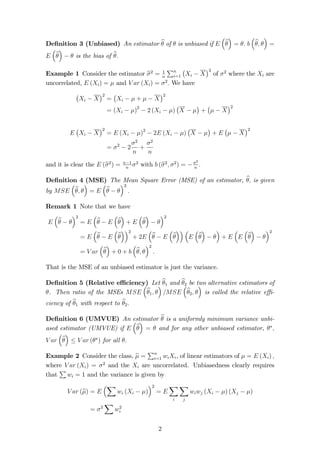
De…nition 3 (Unbiased) An estimator b of  is unbiased if E 
 
b 
 
= : b 
 
b;  
 
= 
E 
 
b 
 
  is the bias of b: 
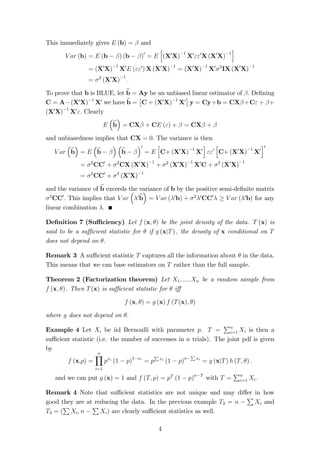
Example 1 Consider the estimator b2 = 1 
n 
Pn 
i=1 
 
Xi  X 
2 of 2 where the Xi are 
uncorrelated, E (Xi) =  and V ar (Xi) = 2: We have 
 
Xi  X 
2 
= 
 
Xi   +   X 
2 
= (Xi  )2  2 (Xi  ) 
 
X   
 
+ 
 
  X 
2 
E 
 
Xi  X 
2 
= E (Xi  )2  2E (Xi  ) 
 
X   
 
+ E 
 
  X 
2 
= 2  2 
2 
n 
+ 
2 
n 
n 2 with b (b2; 2) = 2 
and it is clear the E (b2) = n1 
n : 
De…nition 4 (MSE) The Mean Square Error (MSE) of an estimator, b;  
 
is given 
by MSE 
b;  
= E 
 
b   
2 
: 
Remark 1 Note that we have 
E 
 
b   
2 
= E 
 
b  E 
 
b 
 
+ E 
 
b 
 
  
2 
= E 
 
b  E 
 
b 
2 
+ 2E 
 
b  E 
 
b 
  
E 
 
b 


+ E 
 
E 
 
b 
 
  
2 
= V ar 
 
b 
 
+ 0 + b 
 
b;  
2 
: 
That is the MSE of an unbiased estimator is just the variance. 
De…nition 5 (Relative e¢ ciency) Let b1 and b2 be two alternative estimators of 
. Then ratio of the MSEs MSE 
 
b1;  
 
=MSE 
 
b2;  
 
is called the relative e¢ - 
ciency of b1 with respect to b2: 
De…nition 6 (UMVUE) An  
estimator b is a uniformly minimum variance unbi- 
ased estimator (UMVUE) if E 
b 
 
=  and for any other unbiased estimator, ; 
V ar 
 
b 
 
 V ar () for all : 
Example 2 Consider the class, b = 
Pn 
i=1 wiXi, of linear estimators of  = E (Xi) ; 
where 2 and the are uncorrelated. Unbiasedness clearly requires 
P 
V ar (Xi) = Xi that 
wi = 1 and the variance is given by 
V ar (b) = E 
X 
2 
wi (Xi  ) 
= E 
X 
i 
X 
j 
wiwj (Xi  ) (Xj  ) 
= 2 
X 
w2 
i 
2
One unbiased estimator in this class is the familiar X which sets wi = 1=n and has 
variance 2=n:We will show that this is the UMVUE in the class of linear estimators. 
P 
The …rst order condition for minimizing V ar (b) subject to the restriction 
wi = 1 
is 
2wi =  
for  the Lagrange multiplier. That is, all the weights are equal, together with 
P 
wi = 1 this gives wi = 1=n: 
Remark 2 The notion of minimizing the variance is suggestive. One can de…ne 
a general class of estimators by requiring the estimator to minimize the sample 
analogue of the variance 
b = arg min n1 
Xn 
i=1 
(Xi  )2 ; 
with FOC 2n1Pn 
i=1 (Xi  ) = 0 and solution b = 1 
n 
P 
Xi: This is the class of 
Least Squares estimators. 
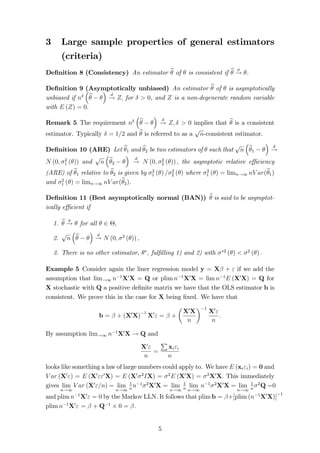
Example 3 Consider the linear regression model 
yi =
1 + x2i
2 + : : : + xki
k + i 
or in matrix notation 
y = X
+ : 
The least squares estimator of
; b; is obtained byminimizing q = 0 = (y  Xb)0 (y  Xb). 
The FOC is 
@q 
@b0 
= 2 (y  Xb)0X = 0 
y0X = b0X0X 
with solution 
b = (X0X)1X0y 
provided that X0X has full rank (so the inverse is well-de…ned), i.e. that X has rank 
k: 
Theorem 1 (Gauss-Markov) Assume that X is non-stochastic and E () = 0; 
V ar () = 2I: Then V ar (b) = 2 (X0X)1 and b is the BLUE (Best Linear Un- 
biased Estimator) of
: That is, b is the UMVUE in the class of linear estimators, 
eb 
= Ay: 
Proof. Write 
b = (X0X)1X0y =(X0X)1X0 (X
+ ) =
+ (X0X)1X0: 
3
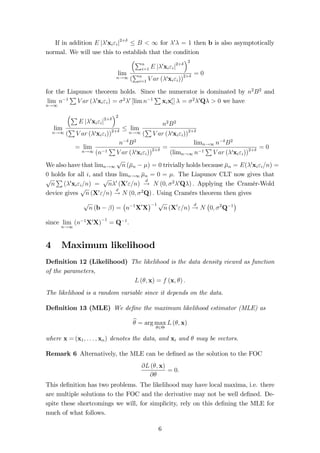
This immediately gives E (b) =
and 
V ar (b) = E (b
) (b
)0 = E 
h 
(X0X)1X00X(X0X)1 
i 
= (X0X)1X0E (0)X(X0X)1 = (X0X)1X02IX (X0X)1 
= 2 (X0X)1 : 
To prove that b is BLUE, let= Ay be an unbiased linear estimator of
: De…ning 
C eb 
 
 
= A(X0X)1X0 we have= 
C + (X0X)1X0 
y = Cy+b = CX
+C +
+ 
eb 
(X0X)1X0: Clearly 
E 
 
eb 
 
= CX
+ CE () +
= CX
+
and unbiasedness implies that CX = 0: The variance is then 
V ar 
 
eb 
 
= E 
 
eb
eb
0 = E 
h 
C+(X0X)1X0 
i 
0 
h 
C+(X0X)1X0 
i 
0 
= 2CC0 + 2CX(X0X)1 + 2 (X0X)1X0C + 2 (X0X)1 
= 2CC0 + 2 (X0X)1 
and the variance of eb 
exceeds the variance of b by the positive semi-de…nite matrix 
2CC0: This implies that V ar 
 
0eb 
 
= V ar (0b) + 20CC0  V ar (0b) for any 
linear combination : 
De…nition 7 (Su¢ ciency) Let f (x; ) be the joint density of the data. T (x) is 
said to be a su¢ cient statistic for  if g (xjT) ; the density of x conditional on T 
does not depend on : 
Remark 3 A su¢ cient statistic T captures all the information about  in the data. 
This means that we can base estimators on T rather than the full sample. 
Theorem 2 (Factorization theorem) Let X1; :::;Xn be a random sample from 
f (x; ). Then T(x) is su¢ cient statistic for  i¤ 
f (x; ) = g (x) f (T(x); ) 
where g does not depend on : 
Example 4 Let Xi be iid Bernoulli with parameter p. T = 
Pn 
i=1 Xi is then a 
su¢ cient statistic (i.e. the number of successes in n trials). The joint pdf is given 
by 
f (x;p) = 
Yn 
i=1 
pxi (1  p)1xi = p 
P 
xi (1  p)n 
P 
xi = g (xjT) h (T; ) : 
and we can put g (x) = 1 and f (T; p) = pT (1  p)nT with T = 
Pn 
i=1 Xi. 
Remark 4 Note that su¢ cient statistics are not unique and may di¤er in how 
P 
good they are at reducing the data. In the previous example T2 = n  
Xi and 
T3 = ( 
P 
Xi; n  
P 
Xi) are clearly su¢ cient statistics as well. 
4

Estimation rs

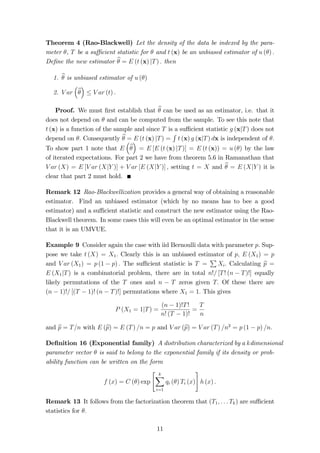
  • 1.
    Lecture notes Statistics Estimation Rickard Sandberg e-mail:rickard.sandberg@hhs.se January 22, 2010
  • 2.
    1 Introduction Allmodels are wrong. Some models are useful. –George E.P. Box 1. Data Generating Process (DGP), the joint distribution of the data f (z1; : : : zn; ) where zi in general are vector valued observations. 2. Theoretical (economic) model, being a simpli…cation, is di¤erent fromthe DGP. 3. The DGP is unknown. 4. Statistical model of the data. (a) Provide a su¢ ciently good approximation to the DGP to make inference valid. (b) If the approximation is ”bad” and inference is invalid we say that the model is misspeci…ed. (c) There may be several ”valid”models, di¤ering in ”goodness”. 5. If the parameters of the theoretical model can be uniquely determined from the parameters of the statistical model we say that the theoretical model is identi…ed. 6. In many cases we are only interested in a subset of the variables, yi; and can write the DGP as f (z1; : : : zn; ) = f1 (y1; : : : ynjx1; : : : xn; 1) f2 (x1; : : : xn; 2) : If xi is exogenous, f2 can be ignored and it is su¢ cient to model f1: Roughly speaking this is the case when 2 does not contain any information about 1. In what follows the DGP is assumed known and all these issues are ignored! 2 Small sample properties of general estimators (criteria) De…nition 1 An estimator, b;of is a function of the data, b (Z1; : : : ;Zn) : As such it is a random variable and has a sampling variability. De…nition 2 An estimate of is the estimator evaluated at the current sample, b (z1; : : : ; zn) : 1
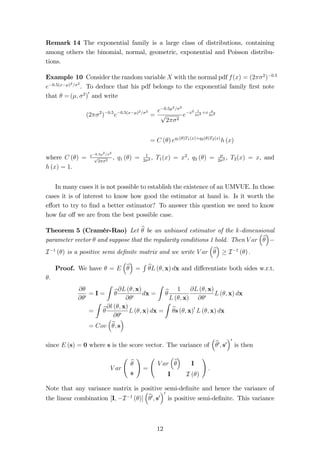
  • 3.
    De…nition 3 (Unbiased)An estimator b of is unbiased if E b = : b b; = E b is the bias of b: Example 1 Consider the estimator b2 = 1 n Pn i=1 Xi X 2 of 2 where the Xi are uncorrelated, E (Xi) = and V ar (Xi) = 2: We have Xi X 2 = Xi + X 2 = (Xi )2 2 (Xi ) X + X 2 E Xi X 2 = E (Xi )2 2E (Xi ) X + E X 2 = 2 2 2 n + 2 n n 2 with b (b2; 2) = 2 and it is clear the E (b2) = n1 n : De…nition 4 (MSE) The Mean Square Error (MSE) of an estimator, b; is given by MSE b; = E b 2 : Remark 1 Note that we have E b 2 = E b E b + E b 2 = E b E b 2 + 2E b E b E b + E E b 2 = V ar b + 0 + b b; 2 : That is the MSE of an unbiased estimator is just the variance. De…nition 5 (Relative e¢ ciency) Let b1 and b2 be two alternative estimators of . Then ratio of the MSEs MSE b1; =MSE b2; is called the relative e¢ - ciency of b1 with respect to b2: De…nition 6 (UMVUE) An estimator b is a uniformly minimum variance unbi- ased estimator (UMVUE) if E b = and for any other unbiased estimator, ; V ar b V ar () for all : Example 2 Consider the class, b = Pn i=1 wiXi, of linear estimators of = E (Xi) ; where 2 and the are uncorrelated. Unbiasedness clearly requires P V ar (Xi) = Xi that wi = 1 and the variance is given by V ar (b) = E X 2 wi (Xi ) = E X i X j wiwj (Xi ) (Xj ) = 2 X w2 i 2
  • 4.
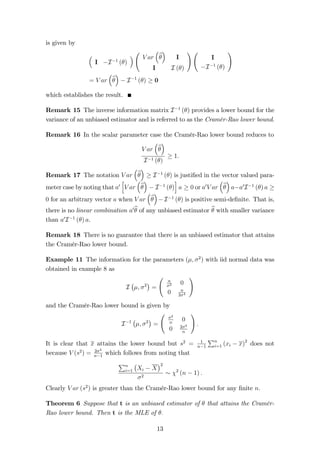
    One unbiased estimatorin this class is the familiar X which sets wi = 1=n and has variance 2=n:We will show that this is the UMVUE in the class of linear estimators. P The …rst order condition for minimizing V ar (b) subject to the restriction wi = 1 is 2wi = for the Lagrange multiplier. That is, all the weights are equal, together with P wi = 1 this gives wi = 1=n: Remark 2 The notion of minimizing the variance is suggestive. One can de…ne a general class of estimators by requiring the estimator to minimize the sample analogue of the variance b = arg min n1 Xn i=1 (Xi )2 ; with FOC 2n1Pn i=1 (Xi ) = 0 and solution b = 1 n P Xi: This is the class of Least Squares estimators. Example 3 Consider the linear regression model yi =
  • 5.
  • 6.
    2 + :: : + xki
  • 7.
    k + i or in matrix notation y = X
  • 8.
    + : Theleast squares estimator of
  • 9.
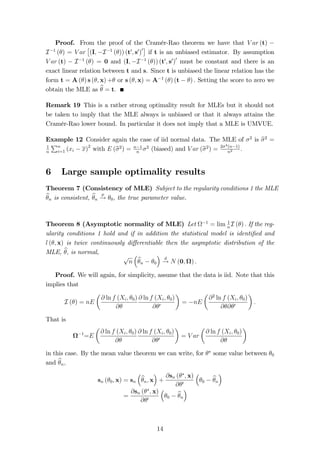
    ; b; isobtained byminimizing q = 0 = (y Xb)0 (y Xb). The FOC is @q @b0 = 2 (y Xb)0X = 0 y0X = b0X0X with solution b = (X0X)1X0y provided that X0X has full rank (so the inverse is well-de…ned), i.e. that X has rank k: Theorem 1 (Gauss-Markov) Assume that X is non-stochastic and E () = 0; V ar () = 2I: Then V ar (b) = 2 (X0X)1 and b is the BLUE (Best Linear Un- biased Estimator) of
  • 10.
    : That is,b is the UMVUE in the class of linear estimators, eb = Ay: Proof. Write b = (X0X)1X0y =(X0X)1X0 (X
  • 11.
  • 12.
  • 13.
  • 14.
    and V ar(b) = E (b
  • 15.
  • 16.
    )0 = E h (X0X)1X00X(X0X)1 i = (X0X)1X0E (0)X(X0X)1 = (X0X)1X02IX (X0X)1 = 2 (X0X)1 : To prove that b is BLUE, let= Ay be an unbiased linear estimator of
  • 17.
    : De…ning Ceb = A(X0X)1X0 we have= C + (X0X)1X0 y = Cy+b = CX
  • 18.
  • 19.
    + eb (X0X)1X0:Clearly E eb = CX
  • 20.
  • 21.
  • 22.
  • 23.
    and unbiasedness impliesthat CX = 0: The variance is then V ar eb = E eb
  • 24.
  • 25.
    0 = E h C+(X0X)1X0 i 0 h C+(X0X)1X0 i 0 = 2CC0 + 2CX(X0X)1 + 2 (X0X)1X0C + 2 (X0X)1 = 2CC0 + 2 (X0X)1 and the variance of eb exceeds the variance of b by the positive semi-de…nite matrix 2CC0: This implies that V ar 0eb = V ar (0b) + 20CC0 V ar (0b) for any linear combination : De…nition 7 (Su¢ ciency) Let f (x; ) be the joint density of the data. T (x) is said to be a su¢ cient statistic for if g (xjT) ; the density of x conditional on T does not depend on : Remark 3 A su¢ cient statistic T captures all the information about in the data. This means that we can base estimators on T rather than the full sample. Theorem 2 (Factorization theorem) Let X1; :::;Xn be a random sample from f (x; ). Then T(x) is su¢ cient statistic for i¤ f (x; ) = g (x) f (T(x); ) where g does not depend on : Example 4 Let Xi be iid Bernoulli with parameter p. T = Pn i=1 Xi is then a su¢ cient statistic (i.e. the number of successes in n trials). The joint pdf is given by f (x;p) = Yn i=1 pxi (1 p)1xi = p P xi (1 p)n P xi = g (xjT) h (T; ) : and we can put g (x) = 1 and f (T; p) = pT (1 p)nT with T = Pn i=1 Xi. Remark 4 Note that su¢ cient statistics are not unique and may di¤er in how P good they are at reducing the data. In the previous example T2 = n Xi and T3 = ( P Xi; n P Xi) are clearly su¢ cient statistics as well. 4