SSEC BHAVNAGAR
Subject: Vector Calculus & Linear Algebra
Group B2
Member:
Enrollment No: 140430117043,140430117045
Patel Yash N (3038), Prajapati Maulik R (3040)
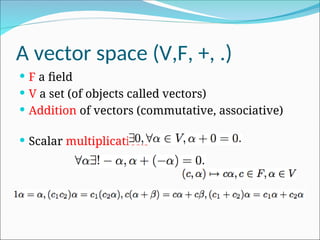
A vector space (V,F, +, .)
 F a field
 V a set (of objects called vectors)
 Addition of vectors (commutative, associative)
 Scalar multiplications
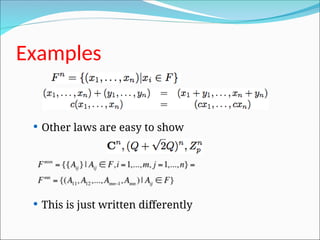
Examples
 Other laws are easy to show
 This is just written differently
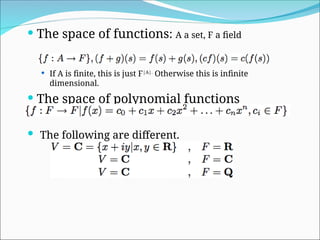
 The space of functions: A a set, F a field
 If A is finite, this is just F|A|.
Otherwise this is infinite
dimensional.
 The space of polynomial functions
 The following are different.
Subspaces
 V a vector space of a field F. A subspace W of V is a
subset W s.t. restricted operations of vector addition,
scalar multiplication make W into a vector space.
 +:WxW -> W, :FxW -> W.
 W nonempty subset of V is a vector subspace iff
for each pair of vectors a,b in W, and c in F, ca+b is in W.
(iff for all a,b in W, c, d in F, ca+db is in W.)
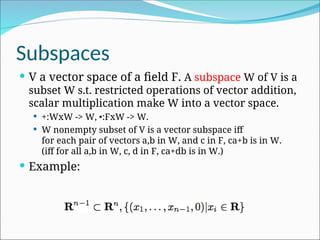
 Example:

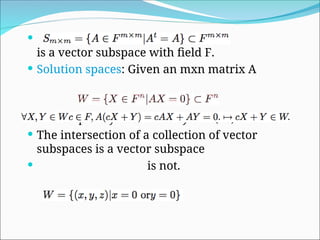
is a vector subspace with field F.
 Solution spaces: Given an mxn matrix A
 Example x+y+z=0 in R3
. x+y+z=1 (no)
 The intersection of a collection of vector
subspaces is a vector subspace
 is not.
Span(S)
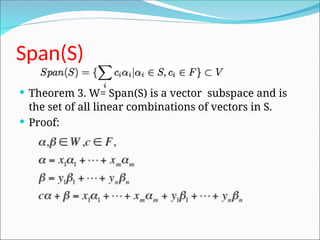
 Theorem 3. W= Span(S) is a vector subspace and is
the set of all linear combinations of vectors in S.
 Proof:
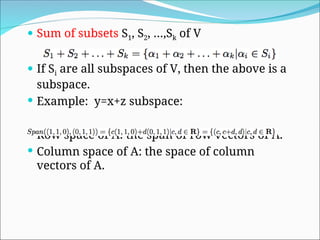
 Sum of subsets S1, S2, …,Sk of V
 If Si are all subspaces of V, then the above is a
subspace.
 Example: y=x+z subspace:
 Row space of A: the span of row vectors of A.
 Column space of A: the space of column
vectors of A.
Linear independence
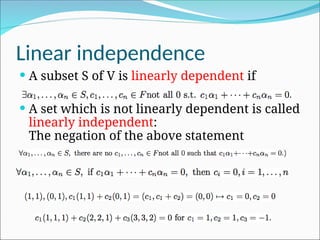
 A subset S of V is linearly dependent if
 A set which is not linearly dependent is called
linearly independent:
The negation of the above statement
Basis
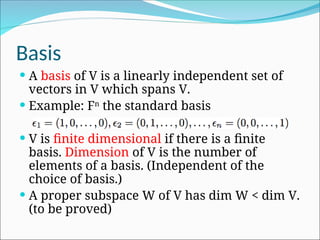
 A basis of V is a linearly independent set of
vectors in V which spans V.
 Example: Fn
the standard basis
 V is finite dimensional if there is a finite
basis. Dimension of V is the number of
elements of a basis. (Independent of the
choice of basis.)
 A proper subspace W of V has dim W < dim V.
(to be proved)
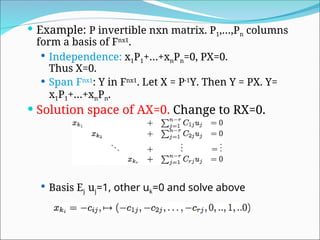
 Example: P invertible nxn matrix. P1,…,Pn columns
form a basis of Fnx1
.
 Independence: x1P1+…+xnPn=0, PX=0.
Thus X=0.
 Span Fnx1
: Y in Fnx1
. Let X = P-1
Y. Then Y = PX. Y=
x1P1+…+xnPn.
 Solution space of AX=0. Change to RX=0.
 Basis Ej uj=1, other uk=0 and solve above
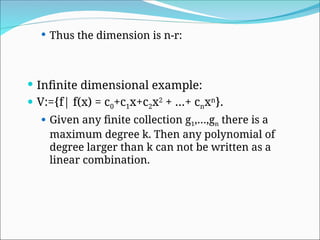
 Thus the dimension is n-r:
 Infinite dimensional example:
 V:={f| f(x) = c0+c1x+c2x2
+ …+ cnxn
}.
 Given any finite collection g1,…,gn there is a
maximum degree k. Then any polynomial of
degree larger than k can not be written as a
linear combination.
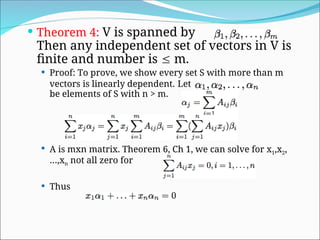
 Theorem 4: V is spanned by
Then any independent set of vectors in V is
finite and number is  m.
 Proof: To prove, we show every set S with more than m
vectors is linearly dependent. Let
be elements of S with n > m.
 A is mxn matrix. Theorem 6, Ch 1, we can solve for x1,x2,
…,xn not all zero for
 Thus
 Corollary. V is a finite d.v.s. Any two bases
have the same number of elements.
 Proof: B,B’ basis. Then |B’||B| and |B||B’|.
 This defines dimension.
 dim Fn
=n. dim Fmxn
=mn.
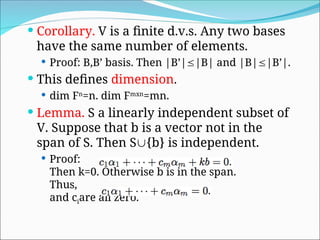
 Lemma. S a linearly independent subset of
V. Suppose that b is a vector not in the
span of S. Then S{b} is independent.
 Proof:
Then k=0. Otherwise b is in the span.
Thus,
and ciare all zero.
 Theorem 5. If W is a subspace of V, every
linearly independent subset of W is finite
and is a part of a basis of W.
 W a subspace of V. dim W  dim V.
 A set of linearly independent vectors can
be extended to a basis.
 A nxn-matrix. Rows (respectively columns)
of A are independent iff A is invertible.
(->) Rows of A are independent. Dim Rows A = n. Dim Rows
r.r.e R of A =n. R is I -> A is inv.
(<-) A=B.R. for r.r.e form R. B is inv. AB-1
is inv. R is inv. R=I.
Rows of R are independent. Dim Span R = n. Dim Span A = n.
Rows of A are independent.
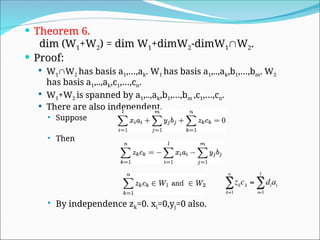
 Theorem 6.
dim (W1+W2) = dim W1+dimW2-dimW1W2.
 Proof:
 W1W2 has basis a1,…,ak. W1 has basis a1,..,ak,b1,…,bm. W2
has basis a1,..,ak,c1,…,cn.
 W1+W2 is spanned by a1,..,ak,b1,…,bm ,c1,…,cn.
 There are also independent.
 Suppose
 Then
 By independence zk=0. xi=0,yj=0 also.
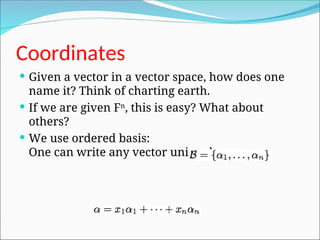
Coordinates
 Given a vector in a vector space, how does one
name it? Think of charting earth.
 If we are given Fn
, this is easy? What about
others?
 We use ordered basis:
One can write any vector uniquely
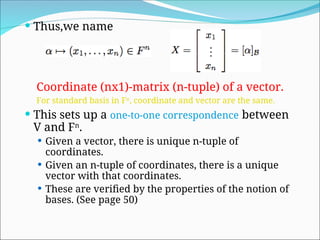
 Thus,we name
Coordinate (nx1)-matrix (n-tuple) of a vector.
For standard basis in Fn
, coordinate and vector are the same.
 This sets up a one-to-one correspondence between
V and Fn
.
 Given a vector, there is unique n-tuple of
coordinates.
 Given an n-tuple of coordinates, there is a unique
vector with that coordinates.
 These are verified by the properties of the notion of
bases. (See page 50)
Vector_Calculus_and linear algebra _presentation

Vector_Calculus_and linear algebra _presentation

  • 1.
    SSEC BHAVNAGAR Subject: VectorCalculus & Linear Algebra Group B2 Member: Enrollment No: 140430117043,140430117045 Patel Yash N (3038), Prajapati Maulik R (3040)
  • 3.
    A vector space(V,F, +, .)  F a field  V a set (of objects called vectors)  Addition of vectors (commutative, associative)  Scalar multiplications
  • 4.
    Examples  Other lawsare easy to show  This is just written differently
  • 5.
     The spaceof functions: A a set, F a field  If A is finite, this is just F|A|. Otherwise this is infinite dimensional.  The space of polynomial functions  The following are different.
  • 6.
    Subspaces  V avector space of a field F. A subspace W of V is a subset W s.t. restricted operations of vector addition, scalar multiplication make W into a vector space.  +:WxW -> W, :FxW -> W.  W nonempty subset of V is a vector subspace iff for each pair of vectors a,b in W, and c in F, ca+b is in W. (iff for all a,b in W, c, d in F, ca+db is in W.)  Example:
  • 7.
     is a vectorsubspace with field F.  Solution spaces: Given an mxn matrix A  Example x+y+z=0 in R3 . x+y+z=1 (no)  The intersection of a collection of vector subspaces is a vector subspace  is not.
  • 8.
    Span(S)  Theorem 3.W= Span(S) is a vector subspace and is the set of all linear combinations of vectors in S.  Proof:
  • 9.
     Sum ofsubsets S1, S2, …,Sk of V  If Si are all subspaces of V, then the above is a subspace.  Example: y=x+z subspace:  Row space of A: the span of row vectors of A.  Column space of A: the space of column vectors of A.
  • 10.
    Linear independence  Asubset S of V is linearly dependent if  A set which is not linearly dependent is called linearly independent: The negation of the above statement
  • 11.
    Basis  A basisof V is a linearly independent set of vectors in V which spans V.  Example: Fn the standard basis  V is finite dimensional if there is a finite basis. Dimension of V is the number of elements of a basis. (Independent of the choice of basis.)  A proper subspace W of V has dim W < dim V. (to be proved)
  • 12.
     Example: Pinvertible nxn matrix. P1,…,Pn columns form a basis of Fnx1 .  Independence: x1P1+…+xnPn=0, PX=0. Thus X=0.  Span Fnx1 : Y in Fnx1 . Let X = P-1 Y. Then Y = PX. Y= x1P1+…+xnPn.  Solution space of AX=0. Change to RX=0.  Basis Ej uj=1, other uk=0 and solve above
  • 13.
     Thus thedimension is n-r:  Infinite dimensional example:  V:={f| f(x) = c0+c1x+c2x2 + …+ cnxn }.  Given any finite collection g1,…,gn there is a maximum degree k. Then any polynomial of degree larger than k can not be written as a linear combination.
  • 14.
     Theorem 4:V is spanned by Then any independent set of vectors in V is finite and number is  m.  Proof: To prove, we show every set S with more than m vectors is linearly dependent. Let be elements of S with n > m.  A is mxn matrix. Theorem 6, Ch 1, we can solve for x1,x2, …,xn not all zero for  Thus
  • 15.
     Corollary. Vis a finite d.v.s. Any two bases have the same number of elements.  Proof: B,B’ basis. Then |B’||B| and |B||B’|.  This defines dimension.  dim Fn =n. dim Fmxn =mn.  Lemma. S a linearly independent subset of V. Suppose that b is a vector not in the span of S. Then S{b} is independent.  Proof: Then k=0. Otherwise b is in the span. Thus, and ciare all zero.
  • 16.
     Theorem 5.If W is a subspace of V, every linearly independent subset of W is finite and is a part of a basis of W.  W a subspace of V. dim W  dim V.  A set of linearly independent vectors can be extended to a basis.  A nxn-matrix. Rows (respectively columns) of A are independent iff A is invertible. (->) Rows of A are independent. Dim Rows A = n. Dim Rows r.r.e R of A =n. R is I -> A is inv. (<-) A=B.R. for r.r.e form R. B is inv. AB-1 is inv. R is inv. R=I. Rows of R are independent. Dim Span R = n. Dim Span A = n. Rows of A are independent.
  • 17.
     Theorem 6. dim(W1+W2) = dim W1+dimW2-dimW1W2.  Proof:  W1W2 has basis a1,…,ak. W1 has basis a1,..,ak,b1,…,bm. W2 has basis a1,..,ak,c1,…,cn.  W1+W2 is spanned by a1,..,ak,b1,…,bm ,c1,…,cn.  There are also independent.  Suppose  Then  By independence zk=0. xi=0,yj=0 also.
  • 18.
    Coordinates  Given avector in a vector space, how does one name it? Think of charting earth.  If we are given Fn , this is easy? What about others?  We use ordered basis: One can write any vector uniquely
  • 19.
     Thus,we name Coordinate(nx1)-matrix (n-tuple) of a vector. For standard basis in Fn , coordinate and vector are the same.  This sets up a one-to-one correspondence between V and Fn .  Given a vector, there is unique n-tuple of coordinates.  Given an n-tuple of coordinates, there is a unique vector with that coordinates.  These are verified by the properties of the notion of bases. (See page 50)