Introduction to Internet of Things (IoT)
Department of Robotics & Automation
JSS Academy of Technical Education, Bangalore-560060
(Course Code: 22ETC15H)
Books
• Sudip Misra, Anandarup Mukherjee, Arijit Roy, “Introduction to IoT”, Cambridge University Press
2021.
Reference
• S. Misra, C. Roy, and A. Mukherjee, 2020. Introduction to Industrial Internet of Things and
Industry 4.0. CRC Press.
• Vijay Madisetti and Arshdeep Bahga, “Internet of Things (A Hands-on-Approach)”,1st Edition,
VPT, 2014.
• Francis daCosta, “Rethinking the Internet of Things: A Scalable Approach to Connecting
Everything”, 1st Edition, Apress Publications, 2013.
https://onlinecourses.nptel.ac.in/noc22_cs53/preview
Further Learning
National Programme on Technology Enhanced Learning (NPTEL)
Course outcome (Course Skill Set)
CO3: Demonstrate the processing in IoT.
CO4: Explain Associated IoT Technologies.
At the end of the course, students will be able to,
IoT Processing Topologies and Types
Module 3
IoT Processing Topologies and Types: Data Format, Importance of Processing in IoT,
Processing Topologies, IoT Device Design and Selection Considerations, Processing
Offloading.
Module 3
Reference
Textbook 1: Chapter 6 – 6.1 to 6.5
• List common data types in IoT applications
• Understand the importance of processing
• Explain the various processing topologies in IoT
• Understand the importance of processing off loading toward achieving scalability and cost-
effectiveness of IoT solutions
• Determine the importance of choosing the right processing topologies and associated
considerations while designing IoT applications
• Determine the requirements that are associated with IoT-based processing of sensed and
communicated data.
Learning Outcomes
Data Format
• The Internet is a vast space where huge quantities and varieties of data are generated regularly and
flow freely.
• As of January 2018, there are a reported 4.021 billion Internet users worldwide.
• The massive volume of data generated by this huge number of users is further enhanced by the
multiple devices utilized by most users.
• Data-generating sources, non-human data generation sources such as sensor nodes and automated
monitoring systems further add to the data load on the Internet.
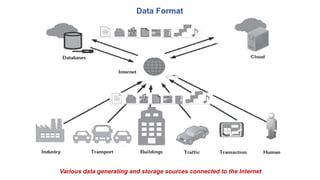
• This huge data volume is composed of a variety of data such as e-mails, text documents (Word docs,
PDFs, and others), social media posts, videos, audio files, and images, as shown in Fig.
Data Format
Various data generating and storage sources connected to the Internet
Data Format
Data can be broadly grouped into two types based on how they can be accessed and stored:
1. Structured data
2. Unstructured data.
Data Format
1. Structured data
• These are text data that have a pre-defined structure.
• Structured data are associated with relational database management systems (RDBMS).
• Primarily created by using length-limited data fields such as phone numbers, social security numbers, etc.
• Even if the data is human or machine generated, these data are easily searchable by querying algorithms
as well as human generated queries.
• Common usage of this type of data is associated with flight or train reservation systems, banking systems,
inventory controls, etc.
• Established languages such as Structured Query Language (SQL) are used for accessing these data in
RDBMS.
• In the context of IoT, structured data holds a minor share of the total generated data over the Internet.
Data Format
2. Un Structured data
• All the data on the Internet, which is not structured, is categorized as unstructured.
• These data types have no pre-defined structure and can vary according to applications and data generating
sources.
Example
• Human-generated unstructured data include text, e-mails, videos, images, phone recordings, chats. etc.
• Machine-generated unstructured data include sensor data from traffic, buildings, industries, satellite,
imagery, surveillance videos etc.
• This data type does not have fixed formats, which makes it very difficult for querying algorithms to perform a
look-up.
• Querying languages such as NoSQL are generally used for this data type.
Importance of Processing in IoT
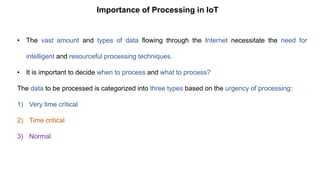
• The vast amount and types of data flowing through the Internet necessitate the need for
intelligent and resourceful processing techniques.
• It is important to decide when to process and what to process?
The data to be processed is categorized into three types based on the urgency of processing:
1) Very time critical
2) Time critical
3) Normal
Importance of Processing in IoT
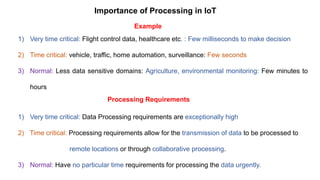
1) Very time critical: Flight control data, healthcare etc. : Few milliseconds to make decision
2) Time critical: vehicle, traffic, home automation, surveillance: Few seconds
3) Normal: Less data sensitive domains: Agriculture, environmental monitoring: Few minutes to
hours
1) Very time critical: Data Processing requirements are exceptionally high
2) Time critical: Processing requirements allow for the transmission of data to be processed to
remote locations or through collaborative processing.
3) Normal: Have no particular time requirements for processing the data urgently.
Processing Requirements
Example
Processing Topologies
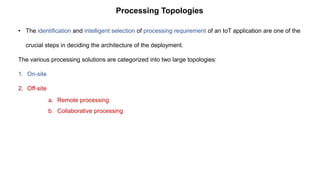
• The identification and intelligent selection of processing requirement of an IoT application are one of the
crucial steps in deciding the architecture of the deployment.
The various processing solutions are categorized into two large topologies:
1. On-site
2. Off-site
a. Remote processing
b. Collaborative processing
On-site processing
• The on-site processing topology signifies that the data is processed at the source itself.
• Very time critical applications that have a very low tolerance for latencies.
• Applications associated with healthcare and flight control systems (Realtime systems) have a quick data
generation rate.
• These show rapid temporal (time) changes, if missed, leads to catastrophic damages.
• The processing infrastructure should be fast and robust enough to handle such data.
Event detection using an on-site processing topology
Processing Topologies
Off-site processing
• The off-site processing allows for latencies (due to processing or network latencies)
• It is significantly cheaper than on-site processing topologies.
• Difference in cost is mainly due to the low demands and requirements of processing at the source itself.
• Not required to process data on an urgent basis.
• Sensor node is responsible for the collection and framing of data that is transmitted to another location
(remote location: server or cloud) for processing.
• Off-site topology has a few dedicated high-processing enabled devices.
• Multiple nodes can be used to share their processing power in order to collaboratively process the data.
Processing Topologies
Off-site processing
Processing Topologies
Remote processing
• Most common processing topologies prevalent in present-day IoT solutions.
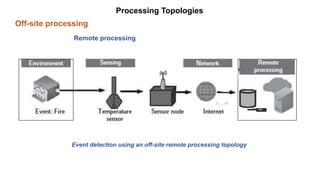
• It encompasses sensing of data by various sensor nodes; the data is then forwarded to a remote server or a
cloud-based infrastructure for further processing and analytics.
• The processing of data from hundreds and thousands of sensor nodes can be simultaneously offloaded to a
single, powerful computing platform.
• This results in massive cost and energy savings by enabling the reuse and reallocation of the same
processing resource.
• Enabling the deployment of smaller and simpler processing nodes at the site of deployment.
Off-site processing
Processing Topologies
Remote processing
Event detection using an off-site remote processing topology
Off-site processing
Processing Topologies
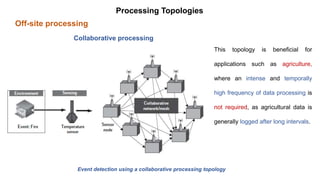
Collaborative processing
• This processing topology used in scenarios with limited or no network connectivity, especially systems
lacking a network.
• This topology is quite economical for large-scale deployments spread over vast areas, where providing
networked access to a remote infrastructure is not viable.
• In such scenarios, the solution is to club together the processing power of nearby processing nodes and
collaboratively process the data.
• This approach also reduces latencies due to the transfer of data over the network.
• Additionally, it conserves bandwidth of the network, especially ones connecting to the Internet.
Off-site processing
Processing Topologies
Collaborative processing
Event detection using a collaborative processing topology
This topology is beneficial for
applications such as agriculture,
where an intense and temporally
high frequency of data processing is
not required, as agricultural data is
generally logged after long intervals.
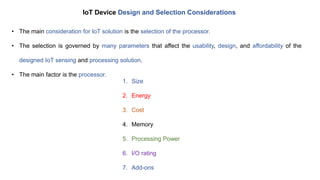
IoT Device Design and Selection Considerations
• The main consideration for IoT solution is the selection of the processor.
• The selection is governed by many parameters that affect the usability, design, and affordability of the
designed IoT sensing and processing solution.
• The main factor is the processor.
1. Size
2. Energy
3. Cost
4. Memory
5. Processing Power
6. I/O rating
7. Add-ons
IoT Device Design and Selection Considerations
Size
• Crucial factors for deciding the form factor and the energy consumption of a sensor node.
• Larger the form factor, larger is the energy consumption of the hardware.
• Large form factors are not suitable for a significant bulk of IoT applications, which rely on minimal form
factor solutions (e.g., wearables).
Energy
• The energy requirements of a processor is the most important deciding factor in designing IoT-based
sensing solutions.
• Higher the energy requirements, higher is the energy source (battery) replacement frequency.
• This lowers the long-term sustainability of sensing hardware for IoT-based applications.
IoT Device Design and Selection Considerations
Cost
• Cheaper cost of the hardware enables a much higher density of hardware deployment by users of an
IoT solution.
Memory
• The memory requirements (both volatile and non-volatile memory) determines the capabilities the
device.
• Features such as local data processing, data storage, data filtering, data formatting, etc. rely heavily on
the memory.
• Devices with higher memory tend to be costlier.
IoT Device Design and Selection Considerations
Processing power
• Processing power is vital in deciding what type of sensors can be accommodated with the IoT
device/node, and what processing features can integrate on-site with the IoT device.
• The processing power also decides the type of applications the device can be associated with.
• Applications that handle video and image data require IoT devices with higher processing power.
• The processor, is the deciding factor in determining the circuit complexity, energy usage, and support of
various sensing solutions and sensor types.
• Newer processors have a I/O voltage rating of 3.3 V, as compared to 5 V for the older processors.
• This translates to requiring additional voltage and logic conversion circuitry to interface legacy
technologies and sensors with the newer processors.
• The low power consumption due to reduced I/O voltage levels, this additional voltage and circuitry
affects the complexity of the circuits & also the costs.
I/O rating
IoT Device Design and Selection Considerations
• The support of various add-ons a processor, an IoT device provides, such as ADC units, in-built clock
circuits, connections to USB and ethernet, inbuilt wireless access capabilities, etc. helps in defining the
robustness and usability of IoT device in various application scenarios.
• The provision for these add-ons also decides how fast a solution can be developed.
Add-ons
Processing Offloading
• The processing offloading paradigm is important for the development of densely deployable, energy-
conserving, miniaturized, and cheap IoT-based solutions for sensing tasks.
• Majority of IoT applications, the bulk of the processing is carried out remotely in order to keep the on-
site devices simple, small, and economical.
Data offloading is divided into three parts:
1) Offload location: Outlines where all the processing can be offloaded in the IoT architecture.
2) Offload decision making: How to choose where to offload the processing to and by how much.
3) Offloading considerations: Deciding when to offload.
Processing Offloading
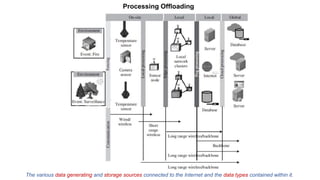
The various data generating and storage sources connected to the Internet and the data types contained within it.
Processing Offloading
Offload location
• The choice of offload location decides the applicability, cost, and sustainability of the IoT application
and deployment.
• The offload location are categorized into four types
1. Edge
2. Fog
3. Remote Server
4. Cloud
Processing Offloading
Offload location
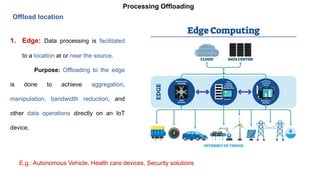
1. Edge: Data processing is facilitated
to a location at or near the source.
Purpose: Offloading to the edge
is done to achieve aggregation,
manipulation, bandwidth reduction, and
other data operations directly on an IoT
device.
E.g.: Autonomous Vehicle, Health care devices, Security solutions
Processing Offloading
Offload location
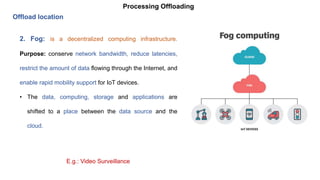
2. Fog: is a decentralized computing infrastructure.
Purpose: conserve network bandwidth, reduce latencies,
restrict the amount of data flowing through the Internet, and
enable rapid mobility support for IoT devices.
• The data, computing, storage and applications are
shifted to a place between the data source and the
cloud.
E.g.: Video Surveillance
Processing Offloading
Offload location
3. Remote Server: A remote server with good processing power is used with IoT-based applications
to offload the processing from resource constrained IoT devices.
• Rapid scalability is an issue with remote servers, and are costlier and hard to maintain.
Processing Offloading
Offload location
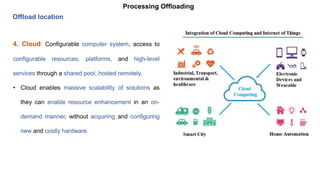
4. Cloud: Configurable computer system, access to
configurable resources, platforms, and high-level
services through a shared pool, hosted remotely.
• Cloud enables massive scalability of solutions as
they can enable resource enhancement in an on-
demand manner, without acquiring and configuring
new and costly hardware.
Offload decision making
• Where to offload and how much to offload is the major deciding factors in the deployment of an offsite
processing topology.
• The decision making is done considering data generation rate, network bandwidth, the criticality of
applications, processing resource available at the offload site, etc.
• Offload decision making approaches are;
1. Naive Approach
2. Bargaining based approach
3. Learning based approach
Offload decision making
1. Naive Approach
• It is a rule-based approach in which the data from IoT devices are offloaded to the nearest location
based on the offload criteria.
• Statistical measures are used for generating the rules for offload decision making.
Offload decision making
2. Bargaining based approach
• Processing-intensive approach
• Enables the improvement of network traffic congestion, enhances QoS (quality of service) parameters
such as bandwidth, latencies, etc.
• Approach tries to maximize the QoS by reducing the qualities of certain parameters & enhancing the
others
Example: Game theory is a common example of the bargaining based approach.
Quality of service (QoS) is the use of technologies that work on a network to control traffic and ensure the performance of critical
applications with limited network capacity.
Offload decision making
3. Learning based approach:
• Rely on past behavior and trends of data flow through the IoT architecture.
• The optimization of QoS parameters is done by learning from historical trends and optimizing previous
solutions.
• The memory and processing requirements are high during the decision making stages.
Example of a learning based approach is machine learning.
Machine learning is a subfield of artificial intelligence, defined as the capability of a machine to imitate intelligent human
behavior.
Offloading Considerations
• The parameters need to be considered while deciding on the offloading type.
1. Bandwidth
2. Latency
3. Criticality
4. Resources
5. Data Volume
1. Bandwidth: The maximum amount of data that can be transmitted over the network between two
points. Data-carrying capacity used to describe the data rate of that network.
2. Latency: It is the time delay incurred between the start and completion of an operation.
• Latency can be due to the network (network latency) or the processor (processing latency).
3. Criticality: Defines the importance of a task being pursued by an IoT application.
• The more critical a task is, the lesser latency is expected from the IoT solution.
• Example: Detection of fire Vs. Detection of agricultural field parameters.
Offloading Considerations
4. Resources: Signifies the actual capabilities of an offload location.
• The capabilities may be the processing power, analytical algorithms, etc.
5. Data volume: The amount of data generated by a source that can be handled by the offload location.
• For large and dense IoT deployments, the offload location should be robust enough to address the
processing issues related to huge data volumes.
Offloading Considerations
End of Module

IoT Processing Topologies.pptx

  • 1.
    Introduction to Internetof Things (IoT) Department of Robotics & Automation JSS Academy of Technical Education, Bangalore-560060 (Course Code: 22ETC15H)
  • 2.
    Books • Sudip Misra,Anandarup Mukherjee, Arijit Roy, “Introduction to IoT”, Cambridge University Press 2021. Reference • S. Misra, C. Roy, and A. Mukherjee, 2020. Introduction to Industrial Internet of Things and Industry 4.0. CRC Press. • Vijay Madisetti and Arshdeep Bahga, “Internet of Things (A Hands-on-Approach)”,1st Edition, VPT, 2014. • Francis daCosta, “Rethinking the Internet of Things: A Scalable Approach to Connecting Everything”, 1st Edition, Apress Publications, 2013. https://onlinecourses.nptel.ac.in/noc22_cs53/preview Further Learning National Programme on Technology Enhanced Learning (NPTEL)
  • 3.
    Course outcome (CourseSkill Set) CO3: Demonstrate the processing in IoT. CO4: Explain Associated IoT Technologies. At the end of the course, students will be able to,
  • 4.
    IoT Processing Topologiesand Types Module 3
  • 5.
    IoT Processing Topologiesand Types: Data Format, Importance of Processing in IoT, Processing Topologies, IoT Device Design and Selection Considerations, Processing Offloading. Module 3 Reference Textbook 1: Chapter 6 – 6.1 to 6.5
  • 6.
    • List commondata types in IoT applications • Understand the importance of processing • Explain the various processing topologies in IoT • Understand the importance of processing off loading toward achieving scalability and cost- effectiveness of IoT solutions • Determine the importance of choosing the right processing topologies and associated considerations while designing IoT applications • Determine the requirements that are associated with IoT-based processing of sensed and communicated data. Learning Outcomes
  • 7.
    Data Format • TheInternet is a vast space where huge quantities and varieties of data are generated regularly and flow freely. • As of January 2018, there are a reported 4.021 billion Internet users worldwide. • The massive volume of data generated by this huge number of users is further enhanced by the multiple devices utilized by most users. • Data-generating sources, non-human data generation sources such as sensor nodes and automated monitoring systems further add to the data load on the Internet. • This huge data volume is composed of a variety of data such as e-mails, text documents (Word docs, PDFs, and others), social media posts, videos, audio files, and images, as shown in Fig.
  • 8.
    Data Format Various datagenerating and storage sources connected to the Internet
  • 9.
    Data Format Data canbe broadly grouped into two types based on how they can be accessed and stored: 1. Structured data 2. Unstructured data.
  • 10.
    Data Format 1. Structureddata • These are text data that have a pre-defined structure. • Structured data are associated with relational database management systems (RDBMS). • Primarily created by using length-limited data fields such as phone numbers, social security numbers, etc. • Even if the data is human or machine generated, these data are easily searchable by querying algorithms as well as human generated queries. • Common usage of this type of data is associated with flight or train reservation systems, banking systems, inventory controls, etc. • Established languages such as Structured Query Language (SQL) are used for accessing these data in RDBMS. • In the context of IoT, structured data holds a minor share of the total generated data over the Internet.
  • 11.
    Data Format 2. UnStructured data • All the data on the Internet, which is not structured, is categorized as unstructured. • These data types have no pre-defined structure and can vary according to applications and data generating sources. Example • Human-generated unstructured data include text, e-mails, videos, images, phone recordings, chats. etc. • Machine-generated unstructured data include sensor data from traffic, buildings, industries, satellite, imagery, surveillance videos etc. • This data type does not have fixed formats, which makes it very difficult for querying algorithms to perform a look-up. • Querying languages such as NoSQL are generally used for this data type.
  • 12.
    Importance of Processingin IoT • The vast amount and types of data flowing through the Internet necessitate the need for intelligent and resourceful processing techniques. • It is important to decide when to process and what to process? The data to be processed is categorized into three types based on the urgency of processing: 1) Very time critical 2) Time critical 3) Normal
  • 13.
    Importance of Processingin IoT 1) Very time critical: Flight control data, healthcare etc. : Few milliseconds to make decision 2) Time critical: vehicle, traffic, home automation, surveillance: Few seconds 3) Normal: Less data sensitive domains: Agriculture, environmental monitoring: Few minutes to hours 1) Very time critical: Data Processing requirements are exceptionally high 2) Time critical: Processing requirements allow for the transmission of data to be processed to remote locations or through collaborative processing. 3) Normal: Have no particular time requirements for processing the data urgently. Processing Requirements Example
  • 14.
    Processing Topologies • Theidentification and intelligent selection of processing requirement of an IoT application are one of the crucial steps in deciding the architecture of the deployment. The various processing solutions are categorized into two large topologies: 1. On-site 2. Off-site a. Remote processing b. Collaborative processing
  • 15.
    On-site processing • Theon-site processing topology signifies that the data is processed at the source itself. • Very time critical applications that have a very low tolerance for latencies. • Applications associated with healthcare and flight control systems (Realtime systems) have a quick data generation rate. • These show rapid temporal (time) changes, if missed, leads to catastrophic damages. • The processing infrastructure should be fast and robust enough to handle such data. Event detection using an on-site processing topology Processing Topologies
  • 16.
    Off-site processing • Theoff-site processing allows for latencies (due to processing or network latencies) • It is significantly cheaper than on-site processing topologies. • Difference in cost is mainly due to the low demands and requirements of processing at the source itself. • Not required to process data on an urgent basis. • Sensor node is responsible for the collection and framing of data that is transmitted to another location (remote location: server or cloud) for processing. • Off-site topology has a few dedicated high-processing enabled devices. • Multiple nodes can be used to share their processing power in order to collaboratively process the data. Processing Topologies
  • 17.
    Off-site processing Processing Topologies Remoteprocessing • Most common processing topologies prevalent in present-day IoT solutions. • It encompasses sensing of data by various sensor nodes; the data is then forwarded to a remote server or a cloud-based infrastructure for further processing and analytics. • The processing of data from hundreds and thousands of sensor nodes can be simultaneously offloaded to a single, powerful computing platform. • This results in massive cost and energy savings by enabling the reuse and reallocation of the same processing resource. • Enabling the deployment of smaller and simpler processing nodes at the site of deployment.
  • 18.
    Off-site processing Processing Topologies Remoteprocessing Event detection using an off-site remote processing topology
  • 19.
    Off-site processing Processing Topologies Collaborativeprocessing • This processing topology used in scenarios with limited or no network connectivity, especially systems lacking a network. • This topology is quite economical for large-scale deployments spread over vast areas, where providing networked access to a remote infrastructure is not viable. • In such scenarios, the solution is to club together the processing power of nearby processing nodes and collaboratively process the data. • This approach also reduces latencies due to the transfer of data over the network. • Additionally, it conserves bandwidth of the network, especially ones connecting to the Internet.
  • 20.
    Off-site processing Processing Topologies Collaborativeprocessing Event detection using a collaborative processing topology This topology is beneficial for applications such as agriculture, where an intense and temporally high frequency of data processing is not required, as agricultural data is generally logged after long intervals.
  • 21.
    IoT Device Designand Selection Considerations • The main consideration for IoT solution is the selection of the processor. • The selection is governed by many parameters that affect the usability, design, and affordability of the designed IoT sensing and processing solution. • The main factor is the processor. 1. Size 2. Energy 3. Cost 4. Memory 5. Processing Power 6. I/O rating 7. Add-ons
  • 22.
    IoT Device Designand Selection Considerations Size • Crucial factors for deciding the form factor and the energy consumption of a sensor node. • Larger the form factor, larger is the energy consumption of the hardware. • Large form factors are not suitable for a significant bulk of IoT applications, which rely on minimal form factor solutions (e.g., wearables). Energy • The energy requirements of a processor is the most important deciding factor in designing IoT-based sensing solutions. • Higher the energy requirements, higher is the energy source (battery) replacement frequency. • This lowers the long-term sustainability of sensing hardware for IoT-based applications.
  • 23.
    IoT Device Designand Selection Considerations Cost • Cheaper cost of the hardware enables a much higher density of hardware deployment by users of an IoT solution. Memory • The memory requirements (both volatile and non-volatile memory) determines the capabilities the device. • Features such as local data processing, data storage, data filtering, data formatting, etc. rely heavily on the memory. • Devices with higher memory tend to be costlier.
  • 24.
    IoT Device Designand Selection Considerations Processing power • Processing power is vital in deciding what type of sensors can be accommodated with the IoT device/node, and what processing features can integrate on-site with the IoT device. • The processing power also decides the type of applications the device can be associated with. • Applications that handle video and image data require IoT devices with higher processing power. • The processor, is the deciding factor in determining the circuit complexity, energy usage, and support of various sensing solutions and sensor types. • Newer processors have a I/O voltage rating of 3.3 V, as compared to 5 V for the older processors. • This translates to requiring additional voltage and logic conversion circuitry to interface legacy technologies and sensors with the newer processors. • The low power consumption due to reduced I/O voltage levels, this additional voltage and circuitry affects the complexity of the circuits & also the costs. I/O rating
  • 25.
    IoT Device Designand Selection Considerations • The support of various add-ons a processor, an IoT device provides, such as ADC units, in-built clock circuits, connections to USB and ethernet, inbuilt wireless access capabilities, etc. helps in defining the robustness and usability of IoT device in various application scenarios. • The provision for these add-ons also decides how fast a solution can be developed. Add-ons
  • 26.
    Processing Offloading • Theprocessing offloading paradigm is important for the development of densely deployable, energy- conserving, miniaturized, and cheap IoT-based solutions for sensing tasks. • Majority of IoT applications, the bulk of the processing is carried out remotely in order to keep the on- site devices simple, small, and economical. Data offloading is divided into three parts: 1) Offload location: Outlines where all the processing can be offloaded in the IoT architecture. 2) Offload decision making: How to choose where to offload the processing to and by how much. 3) Offloading considerations: Deciding when to offload.
  • 27.
    Processing Offloading The variousdata generating and storage sources connected to the Internet and the data types contained within it.
  • 28.
    Processing Offloading Offload location •The choice of offload location decides the applicability, cost, and sustainability of the IoT application and deployment. • The offload location are categorized into four types 1. Edge 2. Fog 3. Remote Server 4. Cloud
  • 29.
    Processing Offloading Offload location 1.Edge: Data processing is facilitated to a location at or near the source. Purpose: Offloading to the edge is done to achieve aggregation, manipulation, bandwidth reduction, and other data operations directly on an IoT device. E.g.: Autonomous Vehicle, Health care devices, Security solutions
  • 30.
    Processing Offloading Offload location 2.Fog: is a decentralized computing infrastructure. Purpose: conserve network bandwidth, reduce latencies, restrict the amount of data flowing through the Internet, and enable rapid mobility support for IoT devices. • The data, computing, storage and applications are shifted to a place between the data source and the cloud. E.g.: Video Surveillance
  • 31.
    Processing Offloading Offload location 3.Remote Server: A remote server with good processing power is used with IoT-based applications to offload the processing from resource constrained IoT devices. • Rapid scalability is an issue with remote servers, and are costlier and hard to maintain.
  • 32.
    Processing Offloading Offload location 4.Cloud: Configurable computer system, access to configurable resources, platforms, and high-level services through a shared pool, hosted remotely. • Cloud enables massive scalability of solutions as they can enable resource enhancement in an on- demand manner, without acquiring and configuring new and costly hardware.
  • 33.
    Offload decision making •Where to offload and how much to offload is the major deciding factors in the deployment of an offsite processing topology. • The decision making is done considering data generation rate, network bandwidth, the criticality of applications, processing resource available at the offload site, etc. • Offload decision making approaches are; 1. Naive Approach 2. Bargaining based approach 3. Learning based approach
  • 34.
    Offload decision making 1.Naive Approach • It is a rule-based approach in which the data from IoT devices are offloaded to the nearest location based on the offload criteria. • Statistical measures are used for generating the rules for offload decision making.
  • 35.
    Offload decision making 2.Bargaining based approach • Processing-intensive approach • Enables the improvement of network traffic congestion, enhances QoS (quality of service) parameters such as bandwidth, latencies, etc. • Approach tries to maximize the QoS by reducing the qualities of certain parameters & enhancing the others Example: Game theory is a common example of the bargaining based approach. Quality of service (QoS) is the use of technologies that work on a network to control traffic and ensure the performance of critical applications with limited network capacity.
  • 36.
    Offload decision making 3.Learning based approach: • Rely on past behavior and trends of data flow through the IoT architecture. • The optimization of QoS parameters is done by learning from historical trends and optimizing previous solutions. • The memory and processing requirements are high during the decision making stages. Example of a learning based approach is machine learning. Machine learning is a subfield of artificial intelligence, defined as the capability of a machine to imitate intelligent human behavior.
  • 37.
    Offloading Considerations • Theparameters need to be considered while deciding on the offloading type. 1. Bandwidth 2. Latency 3. Criticality 4. Resources 5. Data Volume
  • 38.
    1. Bandwidth: Themaximum amount of data that can be transmitted over the network between two points. Data-carrying capacity used to describe the data rate of that network. 2. Latency: It is the time delay incurred between the start and completion of an operation. • Latency can be due to the network (network latency) or the processor (processing latency). 3. Criticality: Defines the importance of a task being pursued by an IoT application. • The more critical a task is, the lesser latency is expected from the IoT solution. • Example: Detection of fire Vs. Detection of agricultural field parameters. Offloading Considerations
  • 39.
    4. Resources: Signifiesthe actual capabilities of an offload location. • The capabilities may be the processing power, analytical algorithms, etc. 5. Data volume: The amount of data generated by a source that can be handled by the offload location. • For large and dense IoT deployments, the offload location should be robust enough to address the processing issues related to huge data volumes. Offloading Considerations
  • 40.