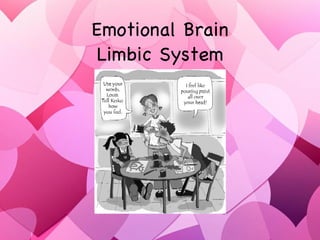
Emotional Brain Limbic System
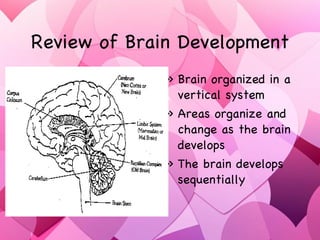
Review of Brain Development Brain organized in a vertical system Areas organize and change as the brain develops The brain develops sequentially
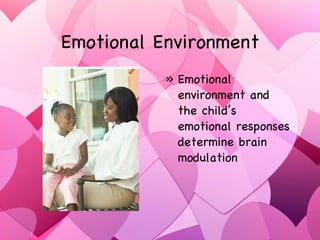
Emotional Environment Emotional environment and the child’s emotional responses determine brain modulation
Limbic System Consists of donut shaped structures that wrap around the brain stem in the middle of the brain Brain’s specialist for emotional matters Sense of smell is processed directly in the limbic system
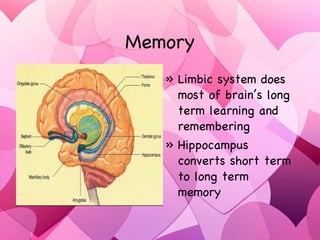
Memory Limbic system does most of brain’s long term learning and remembering Hippocampus converts short term to long term memory
Memory cont’d We remember what we pay attention to, we pay attention to what we care about The more intense the emotional arousal, the stronger the imprint
Memory Con’d Many potent emotional memories date from the first few years of life
Development of  Emotional Circuits Among first brain constructs are those that process emotion - laid down before birth Early emotional experiences form a kind of template around which later emotional development is organized These experiences have”a disproportionate importance” in organizing the mature brain.
Limbic System cont’d Emotions develop in layers, each more complex than the last as the child responds to her emotional environment Emotional learning becomes ingrained as experiences are repeated over and over
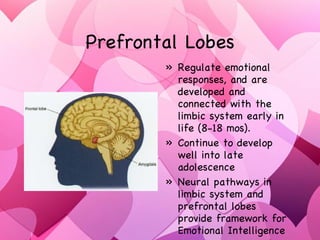
Prefrontal Lobes Regulate emotional responses, and are developed and connected with the limbic system early in life (8-18 mos). Continue to develop well into late adolescence Neural pathways in limbic system and prefrontal lobes provide framework for Emotional Intelligence
Emotional Intelligence http://psychology.about.com/library/quiz/bl_eq_quiz.htm
Emotional Intelligence Defined Peter Salovey, Yale psychologist and John Mayer, University of New Hampshire psychologist first proposed that we also have emotional intelligence Daniel Goleman popularized this in his book  Emotional Intelligence
Five Domains of  Emotional Intelligence
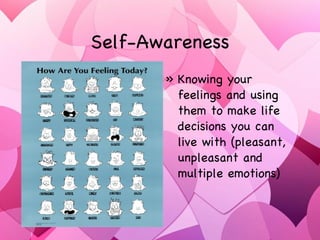
Self-Awareness Knowing your feelings and using them to make life decisions you can live with (pleasant, unpleasant and multiple emotions)
Mood Management The ability to handle distressing emotions in appropriate ways to maintain our well being
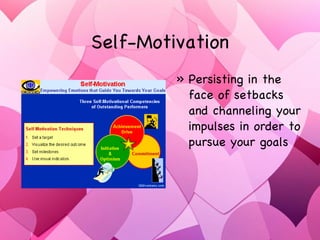
Self-Motivation Persisting in the face of setbacks and channeling your impulses in order to pursue your goals
Empathy Ability to recognize and share another’s feelings
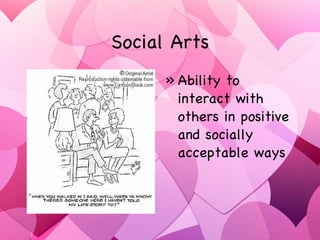
Social Arts Ability to interact with others in positive and socially acceptable ways
Why is this important and when does it start? Studies show that EQ is a better predictor of job success that IQ Schools who have EI programs see improvement in emotional skills and academic achievement It starts in the beginning and throughout life
Basic Needs for the Foundation of Emotional Intelligence
Survival Essential children feel secure that their needs for survival are being met Fundamental task of infant is how to get needs met in his world
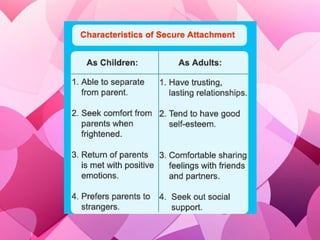
Love Child needs to feel loved and emotionally secure Pre-wired to fall madly in love with caregiver Consistent, nurturing relationships with same caregiver early in life is essential Secure attachment is only beginning http://www.youtube.com/watch?v=fLrBrk9DXVk&feature=related
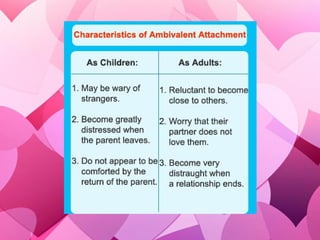
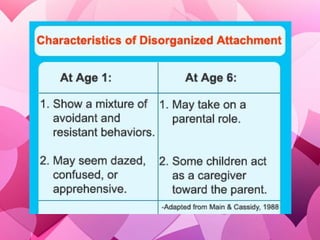
Attachment Mary Ainsworth came up with stranger situation http://www.youtube.com/watch?v=36GI_1PBQpM&feature=related   Discovered 4 types of attachment patterns


Fostering Secure Attachment Collaboration Reflective Dialog Repair Coherent Narratives Emotional Communication
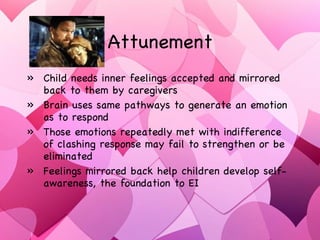
Attunement Child needs inner feelings accepted and mirrored back to them by caregivers Brain uses same pathways to generate an emotion as to respond Those emotions repeatedly met with indifference of clashing response may fail to strengthen or be eliminated Feelings mirrored back help children develop self-awareness, the foundation to EI
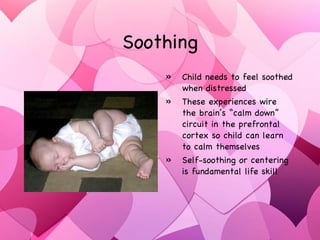
Soothing Child needs to feel soothed when distressed These experiences wire the brain’s “calm down” circuit in the prefrontal cortex so child can learn to calm themselves Self-soothing or centering is fundamental life skill
Encouragement and Boundaries Child needs encouragement and appropriate boundaries to allow innate temperament to blossom into healthy personality Bold vs. Shy

Limbic System And Emotional Intelligence

  • 1.
  • 2.
    Review of BrainDevelopment Brain organized in a vertical system Areas organize and change as the brain develops The brain develops sequentially
  • 3.
    Emotional Environment Emotionalenvironment and the child’s emotional responses determine brain modulation
  • 4.
    Limbic System Consistsof donut shaped structures that wrap around the brain stem in the middle of the brain Brain’s specialist for emotional matters Sense of smell is processed directly in the limbic system
  • 5.
    Memory Limbic systemdoes most of brain’s long term learning and remembering Hippocampus converts short term to long term memory
  • 6.
    Memory cont’d Weremember what we pay attention to, we pay attention to what we care about The more intense the emotional arousal, the stronger the imprint
  • 7.
    Memory Con’d Manypotent emotional memories date from the first few years of life
  • 8.
    Development of Emotional Circuits Among first brain constructs are those that process emotion - laid down before birth Early emotional experiences form a kind of template around which later emotional development is organized These experiences have”a disproportionate importance” in organizing the mature brain.
  • 9.
    Limbic System cont’dEmotions develop in layers, each more complex than the last as the child responds to her emotional environment Emotional learning becomes ingrained as experiences are repeated over and over
  • 10.
    Prefrontal Lobes Regulateemotional responses, and are developed and connected with the limbic system early in life (8-18 mos). Continue to develop well into late adolescence Neural pathways in limbic system and prefrontal lobes provide framework for Emotional Intelligence
  • 11.
  • 12.
    Emotional Intelligence DefinedPeter Salovey, Yale psychologist and John Mayer, University of New Hampshire psychologist first proposed that we also have emotional intelligence Daniel Goleman popularized this in his book Emotional Intelligence
  • 13.
    Five Domains of Emotional Intelligence
  • 14.
    Self-Awareness Knowing yourfeelings and using them to make life decisions you can live with (pleasant, unpleasant and multiple emotions)
  • 15.
    Mood Management Theability to handle distressing emotions in appropriate ways to maintain our well being
  • 16.
    Self-Motivation Persisting inthe face of setbacks and channeling your impulses in order to pursue your goals
  • 17.
    Empathy Ability torecognize and share another’s feelings
  • 18.
    Social Arts Abilityto interact with others in positive and socially acceptable ways
  • 19.
    Why is thisimportant and when does it start? Studies show that EQ is a better predictor of job success that IQ Schools who have EI programs see improvement in emotional skills and academic achievement It starts in the beginning and throughout life
  • 20.
    Basic Needs forthe Foundation of Emotional Intelligence
  • 21.
    Survival Essential childrenfeel secure that their needs for survival are being met Fundamental task of infant is how to get needs met in his world
  • 22.
    Love Child needsto feel loved and emotionally secure Pre-wired to fall madly in love with caregiver Consistent, nurturing relationships with same caregiver early in life is essential Secure attachment is only beginning http://www.youtube.com/watch?v=fLrBrk9DXVk&feature=related
  • 23.
    Attachment Mary Ainsworthcame up with stranger situation http://www.youtube.com/watch?v=36GI_1PBQpM&feature=related Discovered 4 types of attachment patterns
  • 24.
  • 25.
  • 26.
  • 27.
  • 28.
    Fostering Secure AttachmentCollaboration Reflective Dialog Repair Coherent Narratives Emotional Communication
  • 29.
    Attunement Child needsinner feelings accepted and mirrored back to them by caregivers Brain uses same pathways to generate an emotion as to respond Those emotions repeatedly met with indifference of clashing response may fail to strengthen or be eliminated Feelings mirrored back help children develop self-awareness, the foundation to EI
  • 30.
    Soothing Child needsto feel soothed when distressed These experiences wire the brain’s “calm down” circuit in the prefrontal cortex so child can learn to calm themselves Self-soothing or centering is fundamental life skill
  • 31.
    Encouragement and BoundariesChild needs encouragement and appropriate boundaries to allow innate temperament to blossom into healthy personality Bold vs. Shy

Editor's Notes

  • #5 Hand model: wrap one hand around fist of other to demonstrate