Layers of the Brain The brain develops sequentially from the brainstem up, with the cortex developing last and continuously throughout life
Brain Stem and  Mid Brain: Survival The autonomic nervous system is regulated by the brain stem.  It is the first part of the brain to develop and mature.  Babies are born with autonomic nervous system neurons fully myelinated (e.g. heart beat, breathing, sucking)
Organization of Nervous System
 
Brain Stem & Mid Brain cont’d Brain stem and mid-brain monitor the outer world through sensory input and activates the body to respond in ways that ensure self-preservation. Brain stem processes information at a subconscious level; it is quick and reactive
Brain Stem & Mid Brain cont’d Functions: Autonomic nervous system Fight/freeze/flight response Defense mechanisms Territoriality Reflexes (along with the spinal cord) Rote responses Routine  Habits This is the least plastic layer of the brain - highly resistant to change
Brain Stem & Mid Brain cont’d Nickname is Reptilian Brain
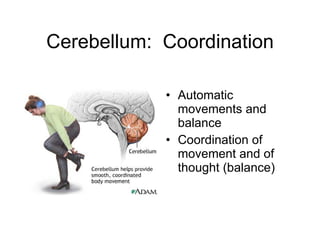
Cerebellum:  Coordination Automatic movements and balance Coordination of movement and of thought (balance)
Cerebellum:Coordination cont’d Procedural memory motor skills Does not involve conscious thought, except when first learning (riding a bike) Matures in early childhood Works with brain stem
Limbic System: Emotions Receives, interprets and responds to emotional signals sent from the body Processes information at the subconscious level and forms emotional patterns. Long term memory Matures during puberty The heart of the brain
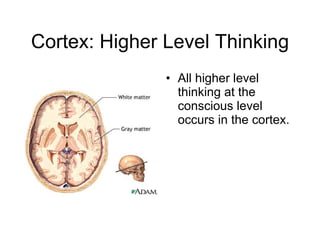
Cortex: Higher Level Thinking All higher level thinking at the conscious level occurs in the cortex.
Cortex: Higher Level Thinking Making sense of the world, decision making,creativity, reason, logic, imagination, self awareness, self control everything that makes us uniquely human is the result of the interplay between the cortex working in harmony with the lower brain structures.
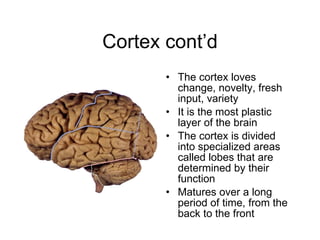
Cortex cont’d The cortex loves change, novelty, fresh input, variety It is the most plastic layer of the brain The cortex is divided into specialized areas called lobes that are determined by their function Matures over a long period of time, from the back to the front
 
 
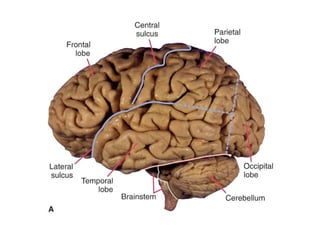
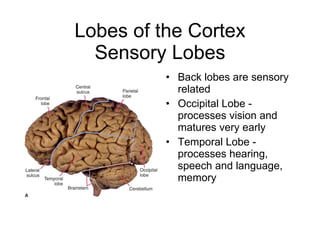
Lobes of the Cortex Sensory Lobes Back lobes are sensory related Occipital Lobe -  processes vision and matures very early Temporal Lobe - processes hearing, speech and language, memory
 
Lobes cont’d Parietal Lobe - processes incoming sensory information; touch, pressure, pain, cold, heat, taste, proprioception Frontal Lobe -  Gross and fine motor movements
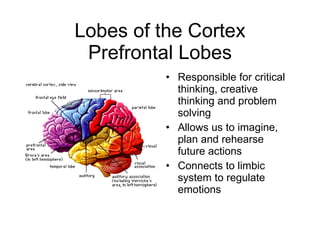
Lobes of the Cortex Prefrontal Lobes Responsible for critical thinking, creative thinking and problem solving Allows us to imagine, plan and rehearse future actions Connects to limbic system to regulate emotions
Prefrontal Lobes cont’d Integrates emotions with thought (essential to the decision making process) Working memory   Remembering something or a series of things for a short time Max number for adults is 7 (+ or - 2)
Prefrontal Lobes cont’d Touch fingers lightly on forehead to engage the frontal lobes  Prefrontal lobes start to develop around 8 months and continue to develop into late adolescence (around 18-20 or longer)
Phineas Gage  Case study 1848 was a 25 year old railroad worker Tamping iron through left cheek out top of skull
Phineas Gage cont’d Frontal lobe damage Memory and mental abilities intact Personality was not!
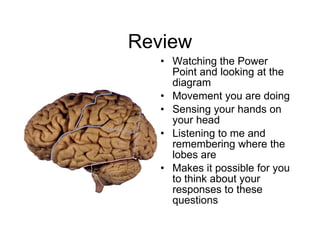
Review Watching the Power Point and looking at the diagram Movement you are doing Sensing your hands on your head Listening to me and remembering where the lobes are Makes it possible for you to think about your responses to these questions

Layers and Lobes

  • 1.
    Layers of theBrain The brain develops sequentially from the brainstem up, with the cortex developing last and continuously throughout life
  • 2.
    Brain Stem and Mid Brain: Survival The autonomic nervous system is regulated by the brain stem. It is the first part of the brain to develop and mature. Babies are born with autonomic nervous system neurons fully myelinated (e.g. heart beat, breathing, sucking)
  • 3.
  • 4.
  • 5.
    Brain Stem &Mid Brain cont’d Brain stem and mid-brain monitor the outer world through sensory input and activates the body to respond in ways that ensure self-preservation. Brain stem processes information at a subconscious level; it is quick and reactive
  • 6.
    Brain Stem &Mid Brain cont’d Functions: Autonomic nervous system Fight/freeze/flight response Defense mechanisms Territoriality Reflexes (along with the spinal cord) Rote responses Routine Habits This is the least plastic layer of the brain - highly resistant to change
  • 7.
    Brain Stem &Mid Brain cont’d Nickname is Reptilian Brain
  • 8.
    Cerebellum: CoordinationAutomatic movements and balance Coordination of movement and of thought (balance)
  • 9.
    Cerebellum:Coordination cont’d Proceduralmemory motor skills Does not involve conscious thought, except when first learning (riding a bike) Matures in early childhood Works with brain stem
  • 10.
    Limbic System: EmotionsReceives, interprets and responds to emotional signals sent from the body Processes information at the subconscious level and forms emotional patterns. Long term memory Matures during puberty The heart of the brain
  • 11.
    Cortex: Higher LevelThinking All higher level thinking at the conscious level occurs in the cortex.
  • 12.
    Cortex: Higher LevelThinking Making sense of the world, decision making,creativity, reason, logic, imagination, self awareness, self control everything that makes us uniquely human is the result of the interplay between the cortex working in harmony with the lower brain structures.
  • 13.
    Cortex cont’d Thecortex loves change, novelty, fresh input, variety It is the most plastic layer of the brain The cortex is divided into specialized areas called lobes that are determined by their function Matures over a long period of time, from the back to the front
  • 14.
  • 15.
  • 16.
    Lobes of theCortex Sensory Lobes Back lobes are sensory related Occipital Lobe - processes vision and matures very early Temporal Lobe - processes hearing, speech and language, memory
  • 17.
  • 18.
    Lobes cont’d ParietalLobe - processes incoming sensory information; touch, pressure, pain, cold, heat, taste, proprioception Frontal Lobe - Gross and fine motor movements
  • 19.
    Lobes of theCortex Prefrontal Lobes Responsible for critical thinking, creative thinking and problem solving Allows us to imagine, plan and rehearse future actions Connects to limbic system to regulate emotions
  • 20.
    Prefrontal Lobes cont’dIntegrates emotions with thought (essential to the decision making process) Working memory Remembering something or a series of things for a short time Max number for adults is 7 (+ or - 2)
  • 21.
    Prefrontal Lobes cont’dTouch fingers lightly on forehead to engage the frontal lobes Prefrontal lobes start to develop around 8 months and continue to develop into late adolescence (around 18-20 or longer)
  • 22.
    Phineas Gage Case study 1848 was a 25 year old railroad worker Tamping iron through left cheek out top of skull
  • 23.
    Phineas Gage cont’dFrontal lobe damage Memory and mental abilities intact Personality was not!
  • 24.
    Review Watching thePower Point and looking at the diagram Movement you are doing Sensing your hands on your head Listening to me and remembering where the lobes are Makes it possible for you to think about your responses to these questions

Editor's Notes

  • #2 Hand Model: two fists together/ thumbs represent the front of brain/ little fingers , the back of brain/ Arms leading to wrist represents the spinal cord which becomes the brain stem.
  • #4 CNS: processes, interprets, stores information; issues orders to muscles, glands, organs) Spinal cord is bridge between brain and peripheral nerves Sympathetic mobilizes body for action, energy output Para conserves energy, maintains quiet state
  • #6 Picture of levels of the brain stem Caudal means situated toward bottom of body
  • #7 Habits are hard to break - need to be replaced with another habit
  • #8 Put reptile on Big Brain and lizard on shoulder.
  • #10 Other procedural driving along same route Don’t think about it again once triggered by movement
  • #11 Hand Model index and third finger deep inside the middle of the brain. We will explore this area in more detail later on
  • #12 Hand Model the bulk of your hands represents the area of the brain called the cerebrum filed with axons and glial cells (white matter) Imagine you have on a pair of gloves about 1/8” thick (put on gloves) This is the cortex cortex is Greek for bark Contains up to 75% of all neurons. (gray matter) If you could peel the cortex off the brain and spread it out it would be out 2’X 2’. (show crumpled piece of paper and smooth out
  • #14 Back matures first in early childhood, the front matures in late adolescence
  • #16 Sulci are ridges or folds in the brain that maximize surface area. Deepest ones separate major areas of cortex
  • #17 Occipital - hands on back of head Temporal - hands on sides of head just above ears
  • #19 Parietal - headband with hands sitting slightly back on head Frontal another headband sitting in front of the last one pro·pri·o·cep·tor n a sensory nerve ending in muscles, tendons, and joints that provides a sense of the body’s position by responding to stimuli from within the body
  • #20 Hands on forehead
  • #21 Working memory - where you put your car keys, what three things did you go downstairs to do?, tec. Working memory temporarily decreases with stress (some stress is good, too much is bad) Age of 3 a child can hold one item in her working memory. The number of units she can hold then increases by one every other year: 5-3 items 9-4 11-5 13-6 15-7 Don’t expect a 3 year old to remember directions that have more than one step
  • #22 This helps us to connect thinking and feeling if we’re stressed; helps us remember where we put our car keys, etc.
  • #23 Phineas Gage was a 19th century railworker who survived serious brain damage. He was the first brain patient from whom we got evidence that damage to the prefrontal cortex could change aspects of personality and affect social behaviour. On 13 September 1848 he was using a yard-long spike to tamp explosive powder into a hole in a rock. A spark ignited the powder, which exploded, sending the spike through his left cheekbone and out through the top of his head. The spike landed about 25 to 30 yards behind him. Despite the destruction of most of the front part of the left side of his brain,
  • #24 he survived with his perception, memory, language and motor functions intact. However, a piece of iron had turned him into a different person – as a friend said, “Gage is no longer Gage.” Some time later he was able to go back to work, but his personality had changed so much that his employers would not give him his job back. Before the accident he had been their most able and efficient foreman, polite and friendly, well-balanced and shrewd. After the accident he became fitful, irreverent, extremely profane, obstinate and vacillating. He never worked as a foreman or on the railroad again. He had a succession of jobs – appearing in Barnum’s traveling circus, exhibiting his injury and the tamping iron; working at a livery stable in New Hampshire, and looking after horses in Chile. Around 1859 his health began to fail, he began to suffer epileptic seizures and died in May 1860. His skull is preserved at the Warren Anatomical Museum at Harvard Medical School. This picture is taken from the Wikipedia online encyclopedia - a link is provided below.
  • #25 Occipital Frontal Parietal Temporal prefrontal