Attachment and Neuroscience,
understanding the problem.
Strategies to support pupils with
attachment difficulties
Lady Lumley’s School
September 2015
Aims for today:
• For staff to have an understanding of the
affects of early experience on the developing
brain (in relation to attachment difficulties)
• For staff to be confident in the strategies they
are using (and know where to find more
information/support)
Brain development: Some Key
Principles
• Neural development is dependent on
neural activity, which is mediated by
experience.
• Cognitive activity shapes the neural
networks that facilitate it in the first place.
• Nature and nurture.
• Neuroplasicity continues much longer than
we realise
• There is a major re-structuring of the brain
in adolescence
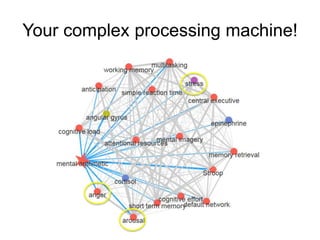
Your complex processing machine!
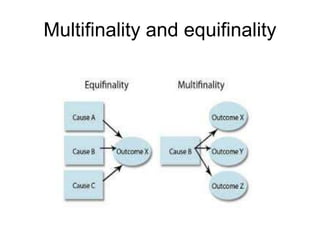
Multifinality and equifinality
Children with Reactive Attachment
Disorder (RAD)….
….believe they are truly awful and unlovable deep
down. They have low self-esteem, poor self-
confidence and self-image. They can behave in a
way that forces adults to criticize and reject them
and this confirms the belief that they, the child, are
unworthy and undeserving after all. RAD children
and their families need a great deal of regular
specialized long term help and support in order that
the child can begin to trust and develop positive
relationships, learn some self-discipline, self control
and begin to take responsibility for their actions and
develop cause and effect thinking.
Reactive Attachment Difficulty (RAD)
Deep inside the RAD child is highly
anxious, unhappy and desperate to
survive in what seems to them a very
unsafe and hostile world.
They manipulate their world to control, as if they
don’t have control they believe they will not
survive.
It is a very long and slow process to change this.
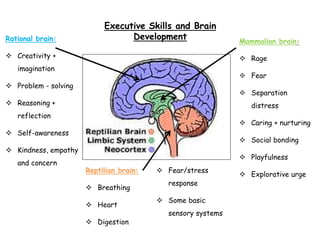
Reptilian brain:
 Breathing
 Heart
 Digestion
 Fear/stress
response
 Some basic
sensory systems
Mammalian brain:
 Rage
 Fear
 Separation
distress
 Caring + nurturing
 Social bonding
 Playfulness
 Explorative urge
Rational brain:
 Creativity +
imagination
 Problem - solving
 Reasoning +
reflection
 Self-awareness
 Kindness, empathy
and concern
Executive Skills and Brain
Development
The pre-frontal lobes develop very
quickly in the first two years of life
• Children who experience trauma, disruption
neglect, or unresponsive parenting in the early
years are likely to have underdeveloped pre-
frontal lobes.
• Low density and weight of this area
• Fewer neural pathways
• Less strong neural strength of pathways
The good news is that the pre-frontal lobes keep
developing all your life – so consistent , good
care/management can lead to good outcomes
Role of the pre-frontal lobes
• Executive functions
• Vital link between the mammelian limbic
system (emotions) and the human/rational
neo-cortex (cognitive skills)
• Decisions about how to react to a situation
• Planning complex actions over time
• Regulation of emotional states
Some functions of the middle
Prefrontal lobes (1)
• Bodily Regulation - integration of autonomic activity
in the body with cortical activity (thinking skills used
to apply brakes or accelerator)
• Attuned communication - reading signals from
others and responding to them
• Emotional Balance – monitor and inhibit firing in the
limbic area
• Response flexibility – pausing before acting,
considering outcomes of actions before deciding to
act
Some functions of the middle
Prefrontal lobes (2)
• Empathy – interpreting of feeling states of others and
setting up resonance circuit so you experience the
same feeling state
• Self-knowing awareness – calling up autobiographical
memories and linking these with feeling states
• Fear moderation – release of neurotransmitter GABA
into limbic area to calm fear messages (in the
amygdala)
So what do we do when a pupil has
RAD ???
• Don’t panic
• Get informed
• Don’t take their challenging behaviour
personally
• Get help when you need it
• Act as support for each other
References
• Broderick, P. & Blewitt, P. (2014). The Life Span: Human Development for Helping
Professionals (4th Edition). USA:Pearson.
• Doom, J.R. & Gunnar, M,R.(2013). Stress Physiology and Developmental
Psychopathology: Past, Present and Future. Developmental Psychopathology, 25(4
Pt2),1359-73.
• Karmiloff-Smith, A. (2012). From Constructivism to Neuroconstructivism: Activity-
Dependent Structuring of the Human Brain. In Marti, E. & Rodriguez, C. (Eds.) After
Piaget. (pp.1-14). USA:Transaction Publishers.
• Lupien, S.J., McEwen, B.S., Gunnar, M.R., & Heim, C. (2009). Effects of Stress
Throughout the Lifespan on the Brain, Behaviour and Cognition. Nature Reviews
Neuroscience, 10(6), 433-445.
• Pianta, R. & Walsh, D. (1996). High-Risk Children in Schools: Constructing Sustaining
Relationships. New York: Routledge.
• Scher, A., Hall, W.A., Zaidman-Zait, A. & Weinberg, J.(2010). Sleep Quality, Cortisol
Levels and Behavioural Regulation in Toddlers. Developmental Psychobiology, 52(1),
44-53.
• Wenzel, A.J & Gunnar, M.R (2013). Protective Role of Executive Function Skills in
High-Risk Environments. Encyclopedia of Childhood Development, pp.1-7.

Attachment

  • 1.
    Attachment and Neuroscience, understandingthe problem. Strategies to support pupils with attachment difficulties Lady Lumley’s School September 2015
  • 2.
    Aims for today: •For staff to have an understanding of the affects of early experience on the developing brain (in relation to attachment difficulties) • For staff to be confident in the strategies they are using (and know where to find more information/support)
  • 3.
    Brain development: SomeKey Principles • Neural development is dependent on neural activity, which is mediated by experience. • Cognitive activity shapes the neural networks that facilitate it in the first place. • Nature and nurture. • Neuroplasicity continues much longer than we realise • There is a major re-structuring of the brain in adolescence
  • 4.
  • 5.
  • 6.
    Children with ReactiveAttachment Disorder (RAD)…. ….believe they are truly awful and unlovable deep down. They have low self-esteem, poor self- confidence and self-image. They can behave in a way that forces adults to criticize and reject them and this confirms the belief that they, the child, are unworthy and undeserving after all. RAD children and their families need a great deal of regular specialized long term help and support in order that the child can begin to trust and develop positive relationships, learn some self-discipline, self control and begin to take responsibility for their actions and develop cause and effect thinking.
  • 7.
    Reactive Attachment Difficulty(RAD) Deep inside the RAD child is highly anxious, unhappy and desperate to survive in what seems to them a very unsafe and hostile world. They manipulate their world to control, as if they don’t have control they believe they will not survive. It is a very long and slow process to change this.
  • 8.
    Reptilian brain:  Breathing Heart  Digestion  Fear/stress response  Some basic sensory systems Mammalian brain:  Rage  Fear  Separation distress  Caring + nurturing  Social bonding  Playfulness  Explorative urge Rational brain:  Creativity + imagination  Problem - solving  Reasoning + reflection  Self-awareness  Kindness, empathy and concern Executive Skills and Brain Development
  • 9.
    The pre-frontal lobesdevelop very quickly in the first two years of life • Children who experience trauma, disruption neglect, or unresponsive parenting in the early years are likely to have underdeveloped pre- frontal lobes. • Low density and weight of this area • Fewer neural pathways • Less strong neural strength of pathways The good news is that the pre-frontal lobes keep developing all your life – so consistent , good care/management can lead to good outcomes
  • 10.
    Role of thepre-frontal lobes • Executive functions • Vital link between the mammelian limbic system (emotions) and the human/rational neo-cortex (cognitive skills) • Decisions about how to react to a situation • Planning complex actions over time • Regulation of emotional states
  • 11.
    Some functions ofthe middle Prefrontal lobes (1) • Bodily Regulation - integration of autonomic activity in the body with cortical activity (thinking skills used to apply brakes or accelerator) • Attuned communication - reading signals from others and responding to them • Emotional Balance – monitor and inhibit firing in the limbic area • Response flexibility – pausing before acting, considering outcomes of actions before deciding to act
  • 12.
    Some functions ofthe middle Prefrontal lobes (2) • Empathy – interpreting of feeling states of others and setting up resonance circuit so you experience the same feeling state • Self-knowing awareness – calling up autobiographical memories and linking these with feeling states • Fear moderation – release of neurotransmitter GABA into limbic area to calm fear messages (in the amygdala)
  • 13.
    So what dowe do when a pupil has RAD ??? • Don’t panic • Get informed • Don’t take their challenging behaviour personally • Get help when you need it • Act as support for each other
  • 14.
    References • Broderick, P.& Blewitt, P. (2014). The Life Span: Human Development for Helping Professionals (4th Edition). USA:Pearson. • Doom, J.R. & Gunnar, M,R.(2013). Stress Physiology and Developmental Psychopathology: Past, Present and Future. Developmental Psychopathology, 25(4 Pt2),1359-73. • Karmiloff-Smith, A. (2012). From Constructivism to Neuroconstructivism: Activity- Dependent Structuring of the Human Brain. In Marti, E. & Rodriguez, C. (Eds.) After Piaget. (pp.1-14). USA:Transaction Publishers. • Lupien, S.J., McEwen, B.S., Gunnar, M.R., & Heim, C. (2009). Effects of Stress Throughout the Lifespan on the Brain, Behaviour and Cognition. Nature Reviews Neuroscience, 10(6), 433-445. • Pianta, R. & Walsh, D. (1996). High-Risk Children in Schools: Constructing Sustaining Relationships. New York: Routledge. • Scher, A., Hall, W.A., Zaidman-Zait, A. & Weinberg, J.(2010). Sleep Quality, Cortisol Levels and Behavioural Regulation in Toddlers. Developmental Psychobiology, 52(1), 44-53. • Wenzel, A.J & Gunnar, M.R (2013). Protective Role of Executive Function Skills in High-Risk Environments. Encyclopedia of Childhood Development, pp.1-7.