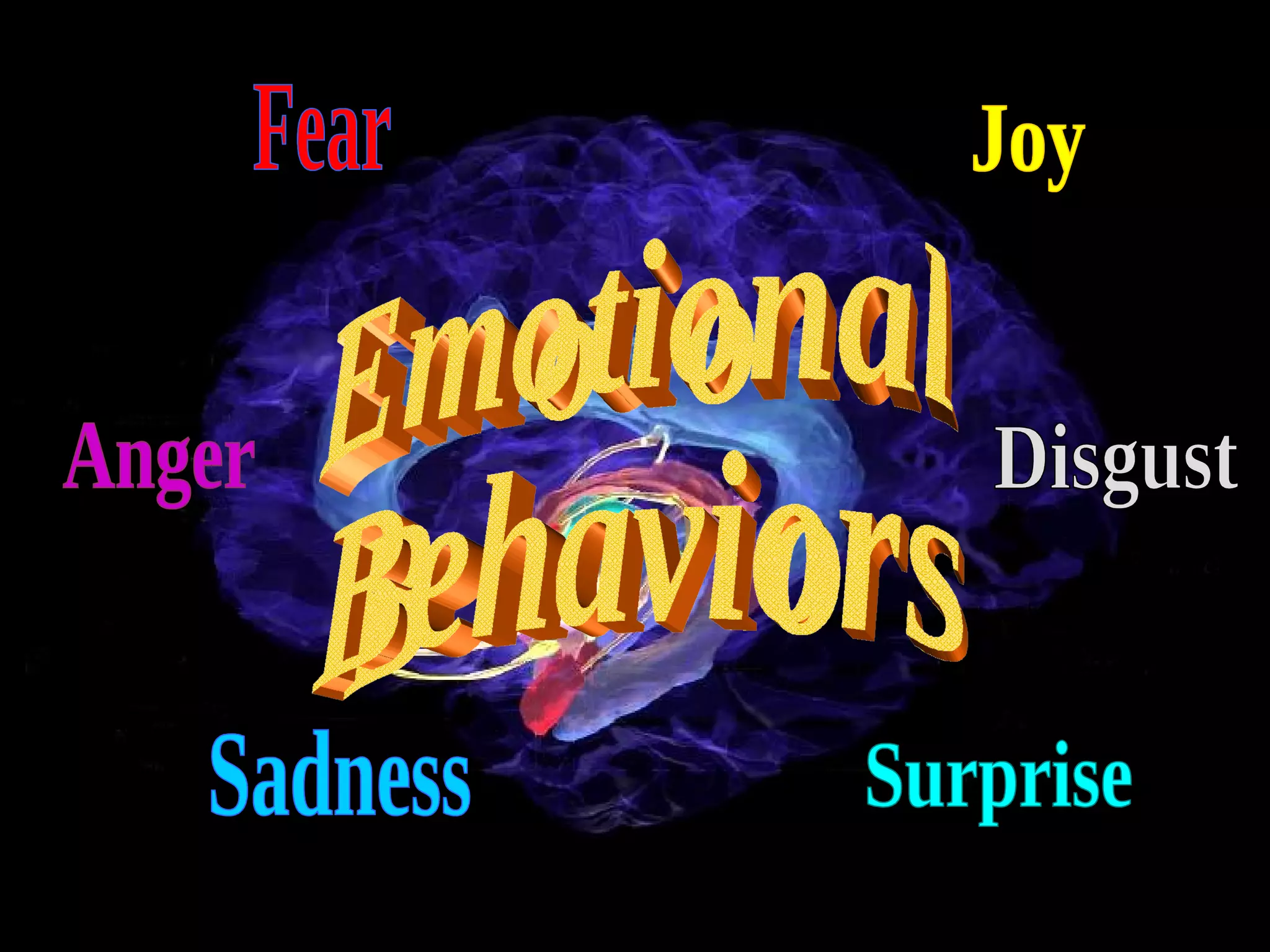
Fear Anger Sadness Joy Disgust Surprise Emotional Behaviors
What is Emotion? Observable behaviors as opposed to feelings which are private experiences
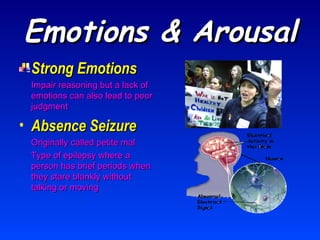
Emotions & Arousal Strong Emotions Impair reasoning but a lack of emotions can also lead to poor judgment Absence Seizure Originally called petite mal Type of epilepsy where a person has brief periods when they stare blankly without talking or moving
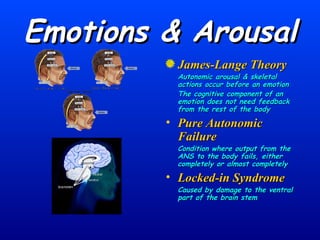
Emotions & Arousal James-Lange Theory Autonomic arousal & skeletal actions occur before an emotion The cognitive component of an emotion does not need feedback from the rest of the body Pure Autonomic Failure Condition where output from the ANS to the body fails, either completely or almost completely Locked-in Syndrome Caused by damage to the ventral part of the brain stem
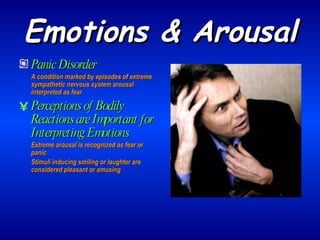
Emotions & Arousal Panic Disorder A condition marked by episodes of extreme sympathetic nervous system arousal interpreted as fear Perceptions of Bodily Reactions are Important for Interpreting Emotions Extreme arousal is recognized as fear or panic Stimuli inducing smiling or laughter are considered pleasant or amusing
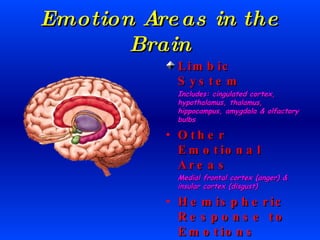
Emotion Areas in the Brain Limbic System Includes: cingulated cortex, hypothalamus, thalamus, hippocampus, amygdala & olfactory bulbs Other Emotional Areas Medial frontal cortex (anger) & insular cortex (disgust) Hemispheric Response to Emotions Right hemisphere especially activated by unpleasant emotions
Stress & Health Stress A nonspecific response of the body to any demand made on it Psychosomatic Illness An illness whose onset is influenced by personality, emotions or experience Ulcers:  from a combination of bacteria & current & past experiences & drugs irritating the digestive system wall Heart disease:   more common in frequently hostile individuals Voodoo death:  due to the belief that a curse has destined death Serendipity:  stumbling on something interesting while looking for something else
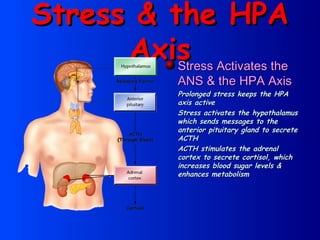
Stress & the HPA Axis Stress Activates the ANS & the HPA Axis Prolonged stress keeps the HPA axis active Stress activates the hypothalamus which sends messages to the anterior pituitary gland to secrete ACTH ACTH stimulates the adrenal cortex to secrete cortisol, which increases blood sugar levels & enhances metabolism
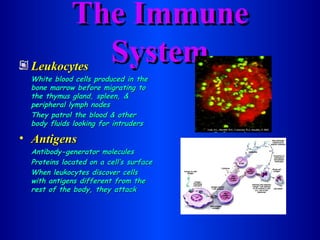
The Immune System Leukocytes White blood cells produced in the bone marrow before migrating to the thymus gland, spleen, & peripheral lymph nodes They patrol the blood & other body fluids looking for intruders Antigens Antibody-generator molecules Proteins located on a cell’s surface When leukocytes discover cells with antigens different from the rest of the body, they attack
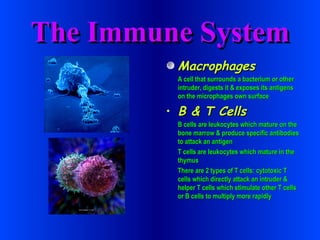
The Immune System Macrophages A cell that surrounds a bacterium or other intruder, digests it & exposes its antigens on the microphages own surface B & T Cells B cells are leukocytes which mature on the bone marrow & produce specific antibodies to attack an antigen T cells are leukocytes which mature in the thymus There are 2 types of T cells: cytotoxic T cells which directly attack an intruder & helper T cells which stimulate other T cells or B cells to multiply more rapidly
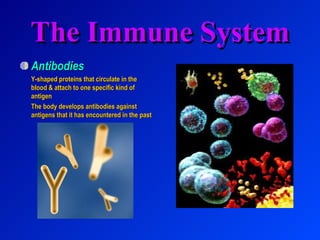
The Immune System Antibodies Y-shaped proteins that circulate in the blood & attach to one specific kind of antigen The body develops antibodies against antigens that it has encountered in the past
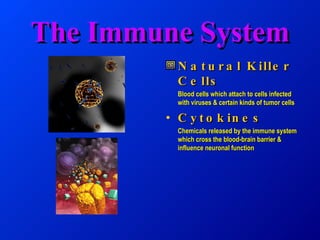
The Immune System Natural Killer Cells Blood cells which attach to cells infected with viruses & certain kinds of tumor cells Cytokines Chemicals released by the immune system which cross the blood-brain barrier & influence neuronal function
Psychoneuroimmunology Stress & the Immune System & the CNS How stress influences the immune system & how the immune system influences the CNS The body can handle stressors like illness Prolonged stress leads to prolonged increases in cortisol & other hormones This directs energy away from synthesizing proteins, including immune system proteins Extremely prolonged stress weakens the immune system High cortisol levels impair memory & increase the vulnerability of neurons in the hippocampus Toxins from overstimulation kill neurons
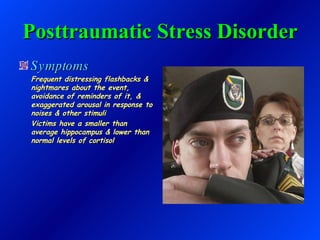
Posttraumatic Stress Disorder Symptoms Frequent distressing flashbacks & nightmares about the event, avoidance of reminders of it, & exaggerated arousal in response to noises & other stimuli Victims have a smaller than average hippocampus & lower than normal levels of cortisol
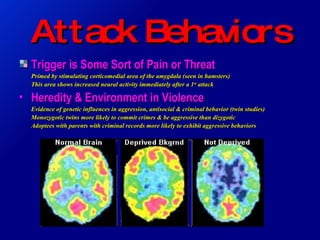
Attack Behaviors Trigger is Some Sort of Pain or Threat Primed by stimulating corticomedial area of the amygdala (seen in hamsters) This area shows increased neural activity immediately after a 1 st  attack  Heredity & Environment in Violence Evidence of genetic influences in aggression, antisocial & criminal behavior (twin studies) Monozygotic twins more likely to commit crimes & be aggressive than dizygotic Adoptees with parents with criminal records more likely to exhibit aggressive behaviors
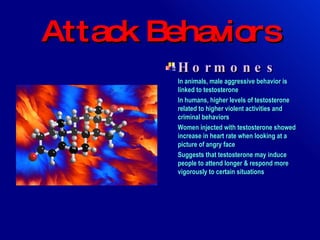
Attack Behaviors Hormones In animals, male aggressive behavior is linked to testosterone In humans, higher levels of testosterone related to higher violent activities and criminal behaviors Women injected with testosterone showed increase in heart rate when looking at a picture of angry face Suggests that testosterone may induce people to attend longer & respond more vigorously to certain situations
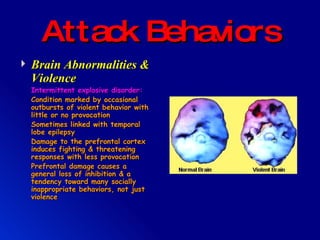
Attack Behaviors Brain Abnormalities & Violence Intermittent explosive disorder: Condition marked by occasional outbursts of violent behavior with little or no provocation Sometimes linked with temporal lobe epilepsy Damage to the prefrontal cortex induces fighting & threatening responses with less provocation Prefrontal damage causes a general loss of inhibition & a tendency toward many socially inappropriate behaviors, not just violence
Attack Behaviors Serotonin Synapses & Aggressive Behavior Turnover:   The amount of release & resynthesis of a neurotransmitter by a presynaptic neuron Social isolation induces a drop in serotonin turnover in brains of male mice; this further increases the possibility of aggressive behavior toward other males Monkeys with the lowest serotonin turnover had the highest amount of aggressive behaviors; they also died earlier Low serotonin turnover are not only linked specifically to violence but to decreased inhibition impulses In humans, lower-than-normal serotonin turnover was found in those convicted of violent crimes or attempted suicides Neurons synthesize serotonin from tryptophan A diet high in other amino acids but low in tryptophan impairs the brain’s ability to synthesize serotonin An increase in aggressive behaviors was found in young men a few hours after eating a diet low in tryptophan
Escape, Fear & Anxiety The Amygdala Fear is a temporary experience Anxiety is longer lasting The startle reflex The response to a sudden, unexpected loud noise The amygdala enhances the startle reflex by sending axons to the hypothalamus & relaying information to the central gray area of the midbrain
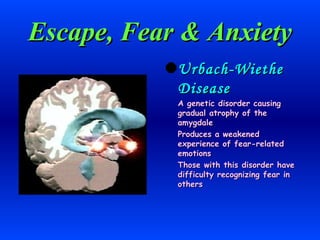
Escape, Fear & Anxiety Urbach-Wiethe Disease A genetic disorder causing gradual atrophy of the amygdale Produces a weakened experience of fear-related emotions Those with this disorder have difficulty recognizing fear in others
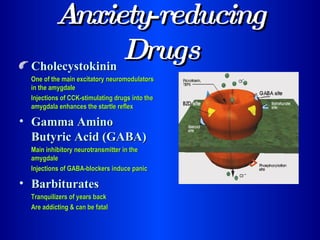
Anxiety-reducing Drugs Cholecystokinin One of the main excitatory neuromodulators in the amygdale Injections of CCK-stimulating drugs into the amygdala enhances the startle reflex Gamma Amino Butyric Acid (GABA) Main inhibitory neurotransmitter in the amygdale Injections of GABA-blockers induce panic Barbiturates Tranquilizers of years back Are addicting & can be fatal
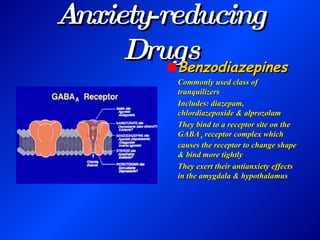
Anxiety-reducing Drugs Benzodiazepines Commonly used class of tranquilizers Includes: diazepam, chlordiazepoxide & alprozolam They bind to a receptor site on the GABA A  receptor complex which causes the receptor to change shape & bind more tightly They exert their antianxiety effects in the amygdala & hypothalamus
Anxiety-reducing Drugs Diazepam-binding Inhibitor (DBI)  aka  Endozepine A protein that binds to the same sites as benzodiazepines but blocks their behavioral effects Alcohol’s effects Alcohol has similar behavioral effects as benzodiazepines Combinations of alcohol & tranquilizers can be fatal Alcohol, benzodiazepines & barbiturates exhibit  cross-tolerance

Chapter 12: Emotional Behaviors

  • 1.
    Fear Anger SadnessJoy Disgust Surprise Emotional Behaviors
  • 2.
    What is Emotion?Observable behaviors as opposed to feelings which are private experiences
  • 3.
    Emotions & ArousalStrong Emotions Impair reasoning but a lack of emotions can also lead to poor judgment Absence Seizure Originally called petite mal Type of epilepsy where a person has brief periods when they stare blankly without talking or moving
  • 4.
    Emotions & ArousalJames-Lange Theory Autonomic arousal & skeletal actions occur before an emotion The cognitive component of an emotion does not need feedback from the rest of the body Pure Autonomic Failure Condition where output from the ANS to the body fails, either completely or almost completely Locked-in Syndrome Caused by damage to the ventral part of the brain stem
  • 5.
    Emotions & ArousalPanic Disorder A condition marked by episodes of extreme sympathetic nervous system arousal interpreted as fear Perceptions of Bodily Reactions are Important for Interpreting Emotions Extreme arousal is recognized as fear or panic Stimuli inducing smiling or laughter are considered pleasant or amusing
  • 6.
    Emotion Areas inthe Brain Limbic System Includes: cingulated cortex, hypothalamus, thalamus, hippocampus, amygdala & olfactory bulbs Other Emotional Areas Medial frontal cortex (anger) & insular cortex (disgust) Hemispheric Response to Emotions Right hemisphere especially activated by unpleasant emotions
  • 7.
    Stress & HealthStress A nonspecific response of the body to any demand made on it Psychosomatic Illness An illness whose onset is influenced by personality, emotions or experience Ulcers: from a combination of bacteria & current & past experiences & drugs irritating the digestive system wall Heart disease: more common in frequently hostile individuals Voodoo death: due to the belief that a curse has destined death Serendipity: stumbling on something interesting while looking for something else
  • 8.
    Stress & theHPA Axis Stress Activates the ANS & the HPA Axis Prolonged stress keeps the HPA axis active Stress activates the hypothalamus which sends messages to the anterior pituitary gland to secrete ACTH ACTH stimulates the adrenal cortex to secrete cortisol, which increases blood sugar levels & enhances metabolism
  • 9.
    The Immune SystemLeukocytes White blood cells produced in the bone marrow before migrating to the thymus gland, spleen, & peripheral lymph nodes They patrol the blood & other body fluids looking for intruders Antigens Antibody-generator molecules Proteins located on a cell’s surface When leukocytes discover cells with antigens different from the rest of the body, they attack
  • 10.
    The Immune SystemMacrophages A cell that surrounds a bacterium or other intruder, digests it & exposes its antigens on the microphages own surface B & T Cells B cells are leukocytes which mature on the bone marrow & produce specific antibodies to attack an antigen T cells are leukocytes which mature in the thymus There are 2 types of T cells: cytotoxic T cells which directly attack an intruder & helper T cells which stimulate other T cells or B cells to multiply more rapidly
  • 11.
    The Immune SystemAntibodies Y-shaped proteins that circulate in the blood & attach to one specific kind of antigen The body develops antibodies against antigens that it has encountered in the past
  • 12.
    The Immune SystemNatural Killer Cells Blood cells which attach to cells infected with viruses & certain kinds of tumor cells Cytokines Chemicals released by the immune system which cross the blood-brain barrier & influence neuronal function
  • 13.
    Psychoneuroimmunology Stress &the Immune System & the CNS How stress influences the immune system & how the immune system influences the CNS The body can handle stressors like illness Prolonged stress leads to prolonged increases in cortisol & other hormones This directs energy away from synthesizing proteins, including immune system proteins Extremely prolonged stress weakens the immune system High cortisol levels impair memory & increase the vulnerability of neurons in the hippocampus Toxins from overstimulation kill neurons
  • 14.
    Posttraumatic Stress DisorderSymptoms Frequent distressing flashbacks & nightmares about the event, avoidance of reminders of it, & exaggerated arousal in response to noises & other stimuli Victims have a smaller than average hippocampus & lower than normal levels of cortisol
  • 15.
    Attack Behaviors Triggeris Some Sort of Pain or Threat Primed by stimulating corticomedial area of the amygdala (seen in hamsters) This area shows increased neural activity immediately after a 1 st attack Heredity & Environment in Violence Evidence of genetic influences in aggression, antisocial & criminal behavior (twin studies) Monozygotic twins more likely to commit crimes & be aggressive than dizygotic Adoptees with parents with criminal records more likely to exhibit aggressive behaviors
  • 16.
    Attack Behaviors HormonesIn animals, male aggressive behavior is linked to testosterone In humans, higher levels of testosterone related to higher violent activities and criminal behaviors Women injected with testosterone showed increase in heart rate when looking at a picture of angry face Suggests that testosterone may induce people to attend longer & respond more vigorously to certain situations
  • 17.
    Attack Behaviors BrainAbnormalities & Violence Intermittent explosive disorder: Condition marked by occasional outbursts of violent behavior with little or no provocation Sometimes linked with temporal lobe epilepsy Damage to the prefrontal cortex induces fighting & threatening responses with less provocation Prefrontal damage causes a general loss of inhibition & a tendency toward many socially inappropriate behaviors, not just violence
  • 18.
    Attack Behaviors SerotoninSynapses & Aggressive Behavior Turnover: The amount of release & resynthesis of a neurotransmitter by a presynaptic neuron Social isolation induces a drop in serotonin turnover in brains of male mice; this further increases the possibility of aggressive behavior toward other males Monkeys with the lowest serotonin turnover had the highest amount of aggressive behaviors; they also died earlier Low serotonin turnover are not only linked specifically to violence but to decreased inhibition impulses In humans, lower-than-normal serotonin turnover was found in those convicted of violent crimes or attempted suicides Neurons synthesize serotonin from tryptophan A diet high in other amino acids but low in tryptophan impairs the brain’s ability to synthesize serotonin An increase in aggressive behaviors was found in young men a few hours after eating a diet low in tryptophan
  • 19.
    Escape, Fear &Anxiety The Amygdala Fear is a temporary experience Anxiety is longer lasting The startle reflex The response to a sudden, unexpected loud noise The amygdala enhances the startle reflex by sending axons to the hypothalamus & relaying information to the central gray area of the midbrain
  • 20.
    Escape, Fear &Anxiety Urbach-Wiethe Disease A genetic disorder causing gradual atrophy of the amygdale Produces a weakened experience of fear-related emotions Those with this disorder have difficulty recognizing fear in others
  • 21.
    Anxiety-reducing Drugs CholecystokininOne of the main excitatory neuromodulators in the amygdale Injections of CCK-stimulating drugs into the amygdala enhances the startle reflex Gamma Amino Butyric Acid (GABA) Main inhibitory neurotransmitter in the amygdale Injections of GABA-blockers induce panic Barbiturates Tranquilizers of years back Are addicting & can be fatal
  • 22.
    Anxiety-reducing Drugs BenzodiazepinesCommonly used class of tranquilizers Includes: diazepam, chlordiazepoxide & alprozolam They bind to a receptor site on the GABA A receptor complex which causes the receptor to change shape & bind more tightly They exert their antianxiety effects in the amygdala & hypothalamus
  • 23.
    Anxiety-reducing Drugs Diazepam-bindingInhibitor (DBI) aka Endozepine A protein that binds to the same sites as benzodiazepines but blocks their behavioral effects Alcohol’s effects Alcohol has similar behavioral effects as benzodiazepines Combinations of alcohol & tranquilizers can be fatal Alcohol, benzodiazepines & barbiturates exhibit cross-tolerance