LIGHT SOURCES
1. Natural Sources of Light
2. Artificial Sources of Light
Light from natural sources such as the sun is known as
white light.
Artificial light from sources such as candles, tungsten
filaments and gas discharge lamps, etc., has a different
mix of frequency components which produce a different
colour light.
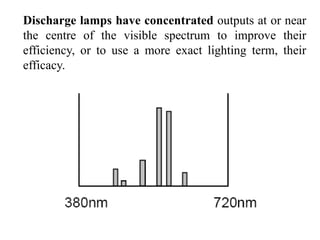
Discharge lamps have concentrated outputs at or near
the centre of the visible spectrum to improve their
efficiency, or to use a more exact lighting term, their
efficacy.
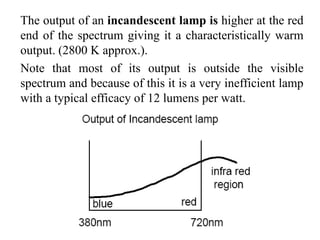
The output of an incandescent lamp is higher at the red
end of the spectrum giving it a characteristically warm
output. (2800 K approx.).
Note that most of its output is outside the visible
spectrum and because of this it is a very inefficient lamp
with a typical efficacy of 12 lumens per watt.
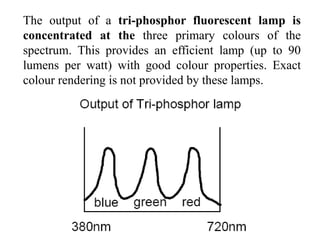
The output of a tri-phosphor fluorescent lamp is
concentrated at the three primary colours of the
spectrum. This provides an efficient lamp (up to 90
lumens per watt) with good colour properties. Exact
colour rendering is not provided by these lamps.
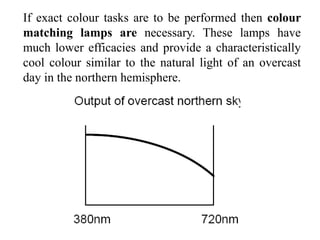
If exact colour tasks are to be performed then colour
matching lamps are necessary. These lamps have
much lower efficacies and provide a characteristically
cool colour similar to the natural light of an overcast
day in the northern hemisphere.
1. INCANDESCENT LAMP
2. DISCHARGE LAMP
The incandescent lamp emits light by reason of its
temperature and the Discharge lamp emits light due to an
electric current flowing in a gas.
LAMP TYPES
Incandescent Lamps
Light is emitted from a tungsten filament operating at a
very high temperature inside a glass bulb. The operating
temperature is limited by the melting point of the filament,
vaporization of the filament occurs as this point is
approached and this reduces the life of the lamp. The bulb
usually contains an inert gas, normally argon. The
temperature of the filament is around 2800K but even at
this temperature only about 10% of the energy used is
emitted as light in the visible region of the spectrum -
hence its inefficiency.
Types of Incandescent Filament Lamp:
GLS (General Lighting System), Candle, Decorative,
Reflector, Pygmy, Strip, Extra Low Voltage (12V) *
*These lamps are commonly referred to as Low Voltage
incandescent lamps and have the following advantages:
1) more compact;
2) longer life;
3) increased efficacy,
4) more precise beam control
5) Higher colour temperature than GLS.
Balanced against following are the problems of:
1. high energy cost;
2. heat dissipation
3. transformers often prove problematic;
4. significant colour shift when dimmed.
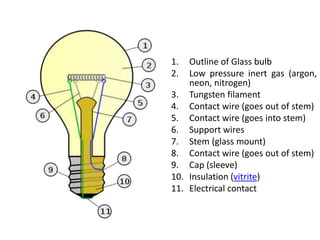
1. Outline of Glass bulb
2. Low pressure inert gas (argon,
neon, nitrogen)
3. Tungsten filament
4. Contact wire (goes out of stem)
5. Contact wire (goes into stem)
6. Support wires
7. Stem (glass mount)
8. Contact wire (goes out of stem)
9. Cap (sleeve)
10. Insulation (vitrite)
11. Electrical contact
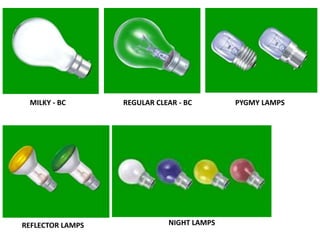
PYGMY LAMPSREGULAR CLEAR - BCMILKY - BC
NIGHT LAMPSREFLECTOR LAMPS
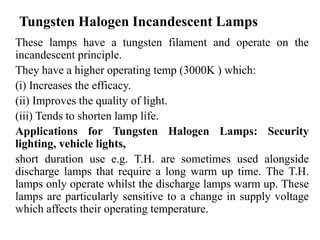
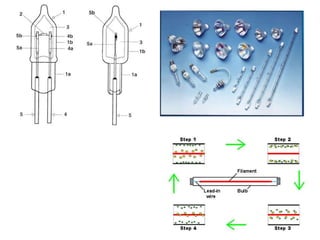
Tungsten Halogen Incandescent Lamps
These lamps have a tungsten filament and operate on the
incandescent principle.
They have a higher operating temp (3000K ) which:
(i) Increases the efficacy.
(ii) Improves the quality of light.
(iii) Tends to shorten lamp life.
Applications for Tungsten Halogen Lamps: Security
lighting, vehicle lights,
short duration use e.g. T.H. are sometimes used alongside
discharge lamps that require a long warm up time. The T.H.
lamps only operate whilst the discharge lamps warm up. These
lamps are particularly sensitive to a change in supply voltage
which affects their operating temperature.
LOW PRESSURE DISCHARGE LAMPS
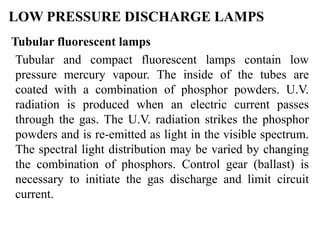
Tubular fluorescent lamps
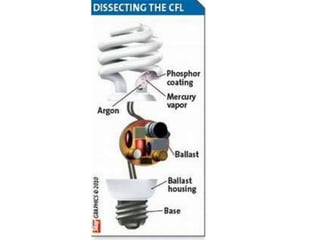
Tubular and compact fluorescent lamps contain low
pressure mercury vapour. The inside of the tubes are
coated with a combination of phosphor powders. U.V.
radiation is produced when an electric current passes
through the gas. The U.V. radiation strikes the phosphor
powders and is re-emitted as light in the visible spectrum.
The spectral light distribution may be varied by changing
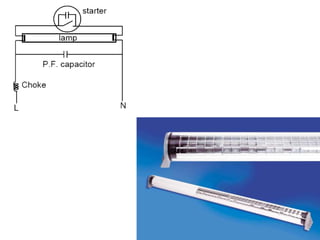
the combination of phosphors. Control gear (ballast) is
necessary to initiate the gas discharge and limit circuit
current.
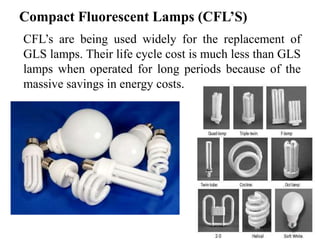
Compact Fluorescent Lamps (CFL’S)
CFL’s are being used widely for the replacement of
GLS lamps. Their life cycle cost is much less than GLS
lamps when operated for long periods because of the
massive savings in energy costs.
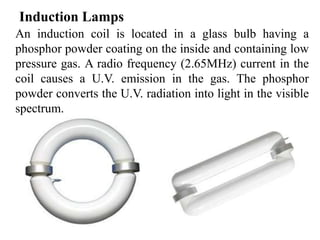
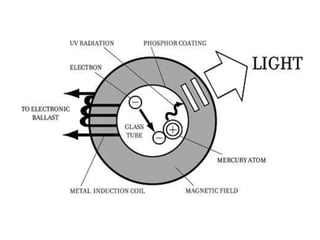
Induction Lamps
An induction coil is located in a glass bulb having a
phosphor powder coating on the inside and containing low
pressure gas. A radio frequency (2.65MHz) current in the
coil causes a U.V. emission in the gas. The phosphor
powder converts the U.V. radiation into light in the visible
spectrum.
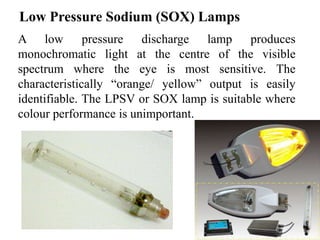
Low Pressure Sodium (SOX) Lamps
A low pressure discharge lamp produces
monochromatic light at the centre of the visible
spectrum where the eye is most sensitive. The
characteristically “orange/ yellow” output is easily
identifiable. The LPSV or SOX lamp is suitable where
colour performance is unimportant.
Cold Cathode (Neon) Lamps:
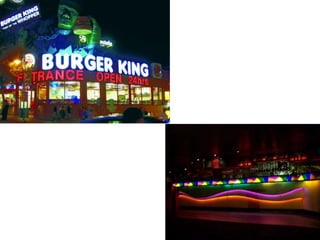
These lamps are mainly used for signs. Neon gas is
frequently used and produces a characteristic red colour.
The colour of the discharge may be changed by varying the
gas type. . The lamps do not have a fluorescent powder
coating. The tube may be shaped as desired and lamp life is
up to 30,000 hours with an efficacy of up to 50 lm/W.
There is no starter or choke and a high voltage transformer
(10kV) is necessary to initiate the gas discharge.
HIGH PRESSURE DISCHARGE LAMPS
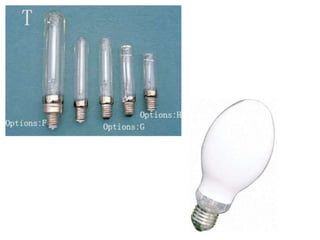
High Pressure Sodium (SON) Lamps
This lamp has a much better colour rendering performance
than the low pressure version. Emphasis is on the red and
yellow regions providing a warm “golden yellow” output.
Applications: High bay industrial lighting, Gymnasia,
Street Lighting.
A range of ‘plug in’ son lamps are available as direct
replacements for HPMV lamps.
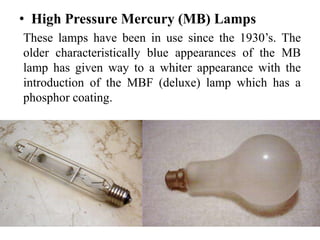
• High Pressure Mercury (MB) Lamps
These lamps have been in use since the 1930’s. The
older characteristically blue appearances of the MB
lamp has given way to a whiter appearance with the
introduction of the MBF (deluxe) lamp which has a
phosphor coating.
Metal Halide (MBI) Lamps
These lamps have largely replaced MBF lamps because
of their improved colour rendering and higher efficacy.
The addition of halides improves the colour rendering
to such an extent that they are widely used for sports
stadia where good colour performance is important.

Light sources

  • 1.
    LIGHT SOURCES 1. NaturalSources of Light 2. Artificial Sources of Light Light from natural sources such as the sun is known as white light. Artificial light from sources such as candles, tungsten filaments and gas discharge lamps, etc., has a different mix of frequency components which produce a different colour light.
  • 2.
    Discharge lamps haveconcentrated outputs at or near the centre of the visible spectrum to improve their efficiency, or to use a more exact lighting term, their efficacy.
  • 3.
    The output ofan incandescent lamp is higher at the red end of the spectrum giving it a characteristically warm output. (2800 K approx.). Note that most of its output is outside the visible spectrum and because of this it is a very inefficient lamp with a typical efficacy of 12 lumens per watt.
  • 4.
    The output ofa tri-phosphor fluorescent lamp is concentrated at the three primary colours of the spectrum. This provides an efficient lamp (up to 90 lumens per watt) with good colour properties. Exact colour rendering is not provided by these lamps.
  • 5.
    If exact colourtasks are to be performed then colour matching lamps are necessary. These lamps have much lower efficacies and provide a characteristically cool colour similar to the natural light of an overcast day in the northern hemisphere.
  • 6.
    1. INCANDESCENT LAMP 2.DISCHARGE LAMP The incandescent lamp emits light by reason of its temperature and the Discharge lamp emits light due to an electric current flowing in a gas. LAMP TYPES
  • 7.
    Incandescent Lamps Light isemitted from a tungsten filament operating at a very high temperature inside a glass bulb. The operating temperature is limited by the melting point of the filament, vaporization of the filament occurs as this point is approached and this reduces the life of the lamp. The bulb usually contains an inert gas, normally argon. The temperature of the filament is around 2800K but even at this temperature only about 10% of the energy used is emitted as light in the visible region of the spectrum - hence its inefficiency.
  • 8.
    Types of IncandescentFilament Lamp: GLS (General Lighting System), Candle, Decorative, Reflector, Pygmy, Strip, Extra Low Voltage (12V) * *These lamps are commonly referred to as Low Voltage incandescent lamps and have the following advantages: 1) more compact; 2) longer life; 3) increased efficacy, 4) more precise beam control 5) Higher colour temperature than GLS. Balanced against following are the problems of: 1. high energy cost; 2. heat dissipation 3. transformers often prove problematic; 4. significant colour shift when dimmed.
  • 9.
    1. Outline ofGlass bulb 2. Low pressure inert gas (argon, neon, nitrogen) 3. Tungsten filament 4. Contact wire (goes out of stem) 5. Contact wire (goes into stem) 6. Support wires 7. Stem (glass mount) 8. Contact wire (goes out of stem) 9. Cap (sleeve) 10. Insulation (vitrite) 11. Electrical contact
  • 10.
    PYGMY LAMPSREGULAR CLEAR- BCMILKY - BC NIGHT LAMPSREFLECTOR LAMPS
  • 11.
    Tungsten Halogen IncandescentLamps These lamps have a tungsten filament and operate on the incandescent principle. They have a higher operating temp (3000K ) which: (i) Increases the efficacy. (ii) Improves the quality of light. (iii) Tends to shorten lamp life. Applications for Tungsten Halogen Lamps: Security lighting, vehicle lights, short duration use e.g. T.H. are sometimes used alongside discharge lamps that require a long warm up time. The T.H. lamps only operate whilst the discharge lamps warm up. These lamps are particularly sensitive to a change in supply voltage which affects their operating temperature.
  • 13.
    LOW PRESSURE DISCHARGELAMPS Tubular fluorescent lamps Tubular and compact fluorescent lamps contain low pressure mercury vapour. The inside of the tubes are coated with a combination of phosphor powders. U.V. radiation is produced when an electric current passes through the gas. The U.V. radiation strikes the phosphor powders and is re-emitted as light in the visible spectrum. The spectral light distribution may be varied by changing the combination of phosphors. Control gear (ballast) is necessary to initiate the gas discharge and limit circuit current.
  • 15.
    Compact Fluorescent Lamps(CFL’S) CFL’s are being used widely for the replacement of GLS lamps. Their life cycle cost is much less than GLS lamps when operated for long periods because of the massive savings in energy costs.
  • 17.
    Induction Lamps An inductioncoil is located in a glass bulb having a phosphor powder coating on the inside and containing low pressure gas. A radio frequency (2.65MHz) current in the coil causes a U.V. emission in the gas. The phosphor powder converts the U.V. radiation into light in the visible spectrum.
  • 19.
    Low Pressure Sodium(SOX) Lamps A low pressure discharge lamp produces monochromatic light at the centre of the visible spectrum where the eye is most sensitive. The characteristically “orange/ yellow” output is easily identifiable. The LPSV or SOX lamp is suitable where colour performance is unimportant.
  • 20.
    Cold Cathode (Neon)Lamps: These lamps are mainly used for signs. Neon gas is frequently used and produces a characteristic red colour. The colour of the discharge may be changed by varying the gas type. . The lamps do not have a fluorescent powder coating. The tube may be shaped as desired and lamp life is up to 30,000 hours with an efficacy of up to 50 lm/W. There is no starter or choke and a high voltage transformer (10kV) is necessary to initiate the gas discharge.
  • 22.
    HIGH PRESSURE DISCHARGELAMPS High Pressure Sodium (SON) Lamps This lamp has a much better colour rendering performance than the low pressure version. Emphasis is on the red and yellow regions providing a warm “golden yellow” output. Applications: High bay industrial lighting, Gymnasia, Street Lighting. A range of ‘plug in’ son lamps are available as direct replacements for HPMV lamps.
  • 24.
    • High PressureMercury (MB) Lamps These lamps have been in use since the 1930’s. The older characteristically blue appearances of the MB lamp has given way to a whiter appearance with the introduction of the MBF (deluxe) lamp which has a phosphor coating.
  • 25.
    Metal Halide (MBI)Lamps These lamps have largely replaced MBF lamps because of their improved colour rendering and higher efficacy. The addition of halides improves the colour rendering to such an extent that they are widely used for sports stadia where good colour performance is important.