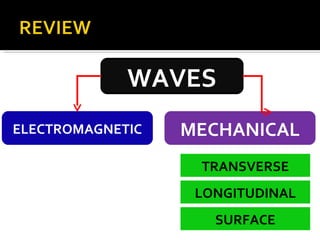





WAVES MECHANICAL ELECTROMAGNETIC TRANSVERSE LONGITUDINAL SURFACE
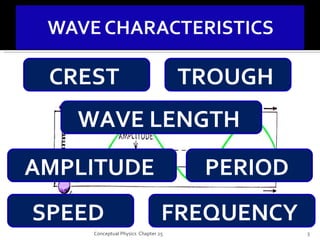
Conceptual Physics  Chapter 25 CREST  TROUGH  WAVE LENGTH  AMPLITUDE  SPEED  FREQUENCY  PERIOD
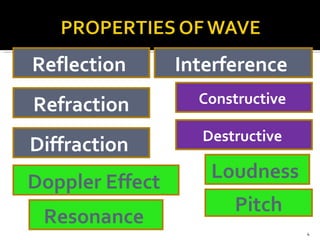
Reflection  Refraction Diffraction  Interference  Constructive  Destructive  Doppler Effect  Loudness  Pitch Resonance
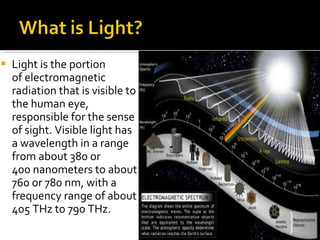
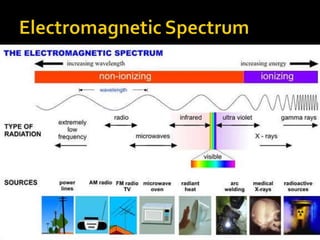
Light is the portion of electromagnetic radiation that is visible to the human eye, responsible for the sense of sight. Visible light has a wavelength in a range from about 380 or 400 nanometers to about 760 or 780 nm, with a frequency range of about 405 THz to 790 THz. 
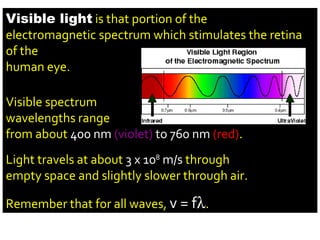
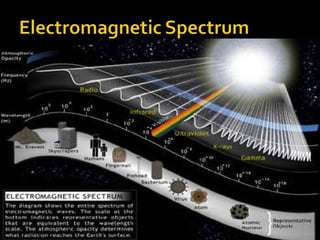
Visible light  is that portion of the electromagnetic spectrum which stimulates the retina of the human eye. Visible spectrum wavelengths range from about  400 nm  (violet)  to 760 nm  (red) . Light travels at about  3 x 10 8  m/s  through empty space and slightly slower through air. Remember that for all waves,  v = f  .
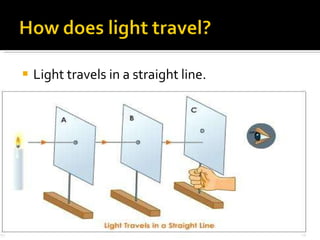
Light travels in a straight line.
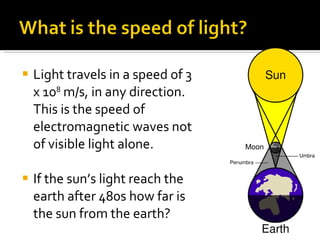
Light travels in a speed of 3 x 10 8  m/s, in any direction. This is the speed of electromagnetic waves not of visible light alone. If the sun’s light reach the earth after 480s how far is the sun from the earth?
Reflection  Refraction Diffraction Dispersion Polarization Interference
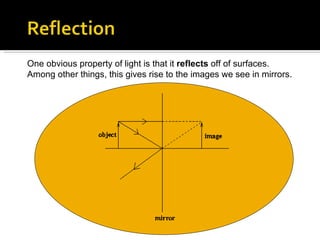
One obvious property of light is that it  reflects  off of surfaces. Among other things, this gives rise to the images we see in mirrors.
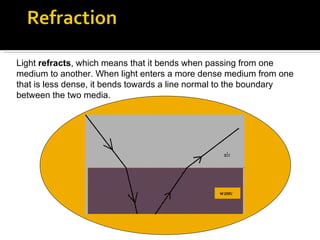
Light  refracts , which means that it bends when passing from one medium to another. When light enters a more dense medium from one that is less dense, it bends towards a line normal to the boundary between the two media.
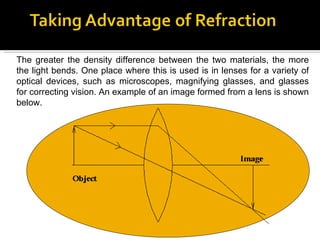
The greater the density difference between the two materials, the more the light bends. One place where this is used is in lenses for a variety of optical devices, such as microscopes, magnifying glasses, and glasses for correcting vision. An example of an image formed from a lens is shown below.
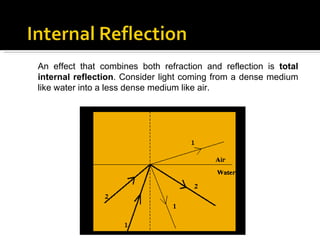
An effect that combines both refraction and reflection is  total internal reflection . Consider light coming from a dense medium like water into a less dense medium like air.
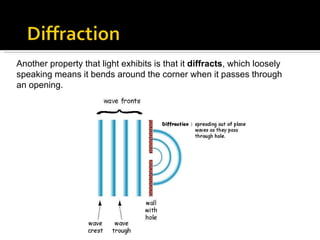
Another property that light exhibits is that it  diffracts , which loosely speaking means it bends around the corner when it passes through an opening.
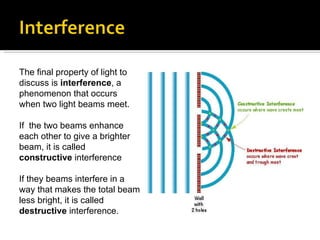
The final property of light to discuss is  interference , a phenomenon that occurs when two light beams meet.  If  the two beams enhance each other to give a brighter beam, it is called  constructive  interference If they beams interfere in a way that makes the total beam less bright, it is called  destructive  interference.
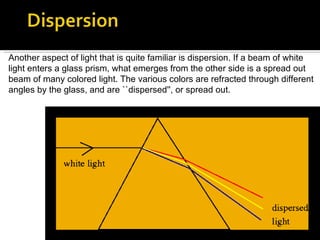
Another aspect of light that is quite familiar is dispersion. If a beam of white light enters a glass prism, what emerges from the other side is a spread out beam of many colored light. The various colors are refracted through different angles by the glass, and are ``dispersed'', or spread out.
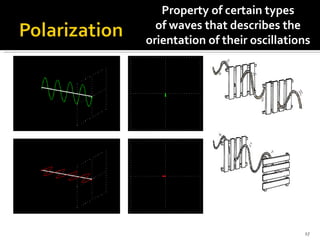
Property of certain types of waves that describes the orientation of their oscillations


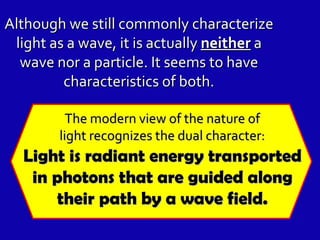
Although we still commonly characterize light as a wave, it is actually  neither  a wave nor a particle. It seems to have characteristics of both. The modern view of the nature of light recognizes the dual character: Light is radiant energy transported in photons that are guided along their path by a wave field.
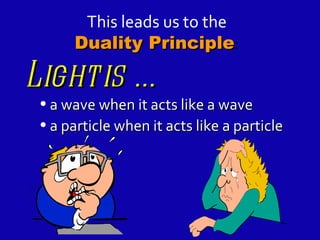
This leads us to the Duality Principle : Light is ... a wave when it acts like a wave a particle when it acts like a particle
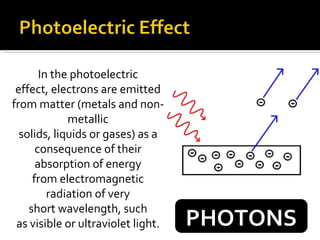
In the photoelectric effect, electrons are emitted from matter (metals and non-metallic solids, liquids or gases) as a consequence of their absorption of energy from electromagnetic radiation of very short wavelength, such as visible or ultraviolet light. PHOTONS
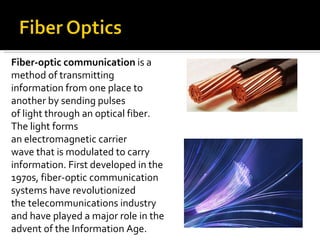
Fiber-optic communication  is a method of transmitting information from one place to another by sending pulses of light through an optical fiber. The light forms an electromagnetic carrier wave that is modulated to carry information. First developed in the 1970s, fiber-optic communication systems have revolutionized the telecommunications industry and have played a major role in the advent of the Information Age.
 
Do we see because we have eyes  or because there is light?
 
“ Our deepest fear is not that we are inadequate. Our deepest fear is that we are powerful beyond measure. It is our  LIGHT ,  not our darkness, that most frightens us. We ask ourselves, who am I to be brilliant, gorgeous, talented, and fabulous? Actually, who are you not to be? You are a child of God. Your playing small doesn’t serve the world. There’s nothing enlightened about shrinking so that other people won’t feel insecure around you. We are all meant to shine, as children do. We are born to make manifest the glory of God that is within us. It’s not just in some of us, it’s in everyone. And as we let our own  LIGHT  shines, we unconsciously give other people permission to do the same. As we are liberated from our own fear, our presence automatically liberates others.”
 
 
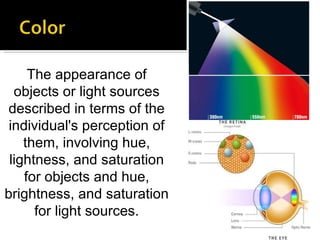
The appearance of objects or light sources described in terms of the individual's perception of them, involving hue, lightness, and saturation for objects and hue, brightness, and saturation for light sources.
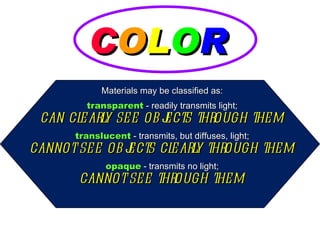
C O L O R Materials may be classified as: transparent   - readily transmits light; can clearly see objects through them translucent  - transmits, but diffuses, light; cannot see objects clearly through them opaque  - transmits no light; cannot see through them
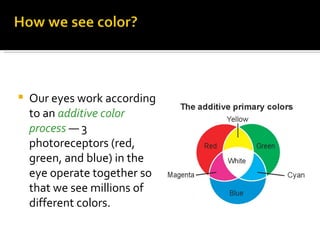
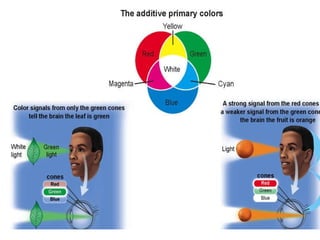
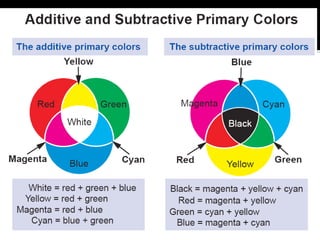
Our eyes work according to an  additive color process   — 3 photoreceptors (red, green, and blue) in the eye operate together so that we see millions of different colors.
 
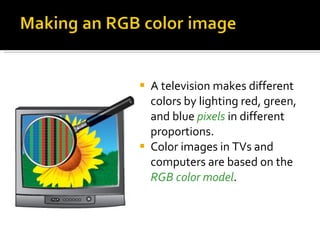
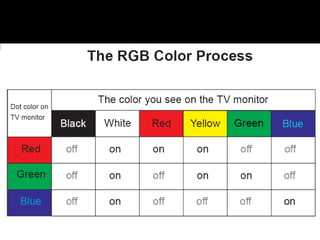
A television makes different colors by lighting red, green, and blue  pixels   in different proportions. Color images in TVs and computers are based on the  RGB color model .
 
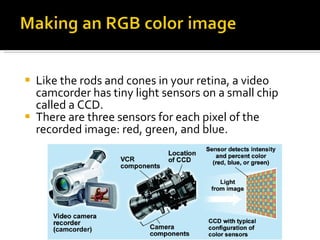
Like the rods and cones in your retina, a video camcorder has tiny light sensors on a small chip called a CCD. There are three sensors for each pixel of the recorded image: red, green, and blue.
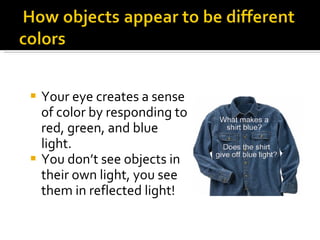
Your eye creates a sense of color by responding to red, green, and blue light. You don’t see objects in their own light, you see them in reflected light!
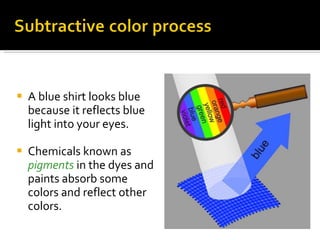
A blue shirt looks blue because it reflects blue light into your eyes. Chemicals known as  pigments   in the dyes and paints absorb some colors and reflect other colors.
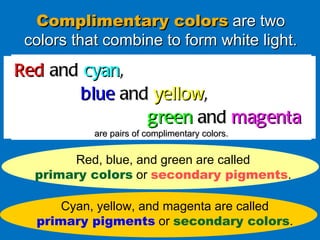
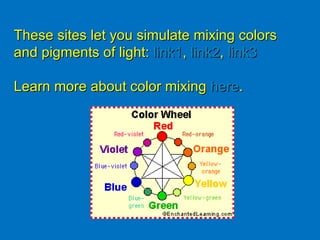
Complimentary colors   are two colors that combine to form white light. Red  and  cyan ,  blue  and  yellow ,  green  and  magenta are pairs of complimentary colors. Red, blue, and green are called primary colors  or  secondary pigments . Cyan, yellow, and magenta are called primary pigments  or  secondary colors .
 
These sites let you simulate mixing colors and pigments of light:  link1 ,  link2 ,  link3 Learn more about color mixing  here .
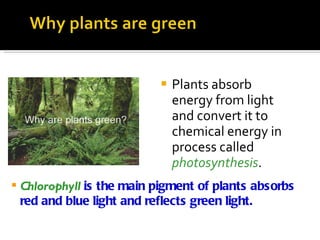
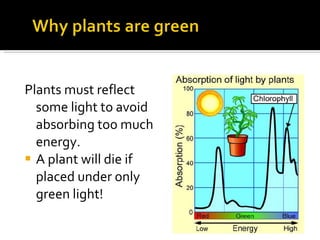
Plants absorb energy from light and convert it to chemical energy in process called  photosynthesis . Chlorophyll   is the main pigment of plants absorbs red and blue light and reflects green light.
Plants must reflect some light to avoid absorbing too much energy. A plant will die if placed under only green light!
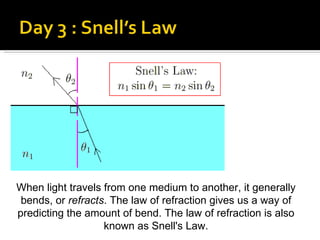
When light travels from one medium to another, it generally bends, or  refracts . The law of refraction gives us a way of predicting the amount of bend. The law of refraction is also known as Snell's Law.


Light by kim

  • 1.
  • 2.
    WAVES MECHANICAL ELECTROMAGNETICTRANSVERSE LONGITUDINAL SURFACE
  • 3.
    Conceptual Physics Chapter 25 CREST TROUGH WAVE LENGTH AMPLITUDE SPEED FREQUENCY PERIOD
  • 4.
    Reflection RefractionDiffraction Interference Constructive Destructive Doppler Effect Loudness Pitch Resonance
  • 5.
    Light is the portionof electromagnetic radiation that is visible to the human eye, responsible for the sense of sight. Visible light has a wavelength in a range from about 380 or 400 nanometers to about 760 or 780 nm, with a frequency range of about 405 THz to 790 THz. 
  • 6.
    Visible light is that portion of the electromagnetic spectrum which stimulates the retina of the human eye. Visible spectrum wavelengths range from about 400 nm (violet) to 760 nm (red) . Light travels at about 3 x 10 8 m/s through empty space and slightly slower through air. Remember that for all waves, v = f  .
  • 7.
    Light travels ina straight line.
  • 8.
    Light travels ina speed of 3 x 10 8 m/s, in any direction. This is the speed of electromagnetic waves not of visible light alone. If the sun’s light reach the earth after 480s how far is the sun from the earth?
  • 9.
    Reflection RefractionDiffraction Dispersion Polarization Interference
  • 10.
    One obvious propertyof light is that it reflects off of surfaces. Among other things, this gives rise to the images we see in mirrors.
  • 11.
    Light refracts, which means that it bends when passing from one medium to another. When light enters a more dense medium from one that is less dense, it bends towards a line normal to the boundary between the two media.
  • 12.
    The greater thedensity difference between the two materials, the more the light bends. One place where this is used is in lenses for a variety of optical devices, such as microscopes, magnifying glasses, and glasses for correcting vision. An example of an image formed from a lens is shown below.
  • 13.
    An effect thatcombines both refraction and reflection is total internal reflection . Consider light coming from a dense medium like water into a less dense medium like air.
  • 14.
    Another property thatlight exhibits is that it diffracts , which loosely speaking means it bends around the corner when it passes through an opening.
  • 15.
    The final propertyof light to discuss is interference , a phenomenon that occurs when two light beams meet. If the two beams enhance each other to give a brighter beam, it is called constructive interference If they beams interfere in a way that makes the total beam less bright, it is called destructive interference.
  • 16.
    Another aspect oflight that is quite familiar is dispersion. If a beam of white light enters a glass prism, what emerges from the other side is a spread out beam of many colored light. The various colors are refracted through different angles by the glass, and are ``dispersed'', or spread out.
  • 17.
    Property of certaintypes of waves that describes the orientation of their oscillations
  • 18.
  • 19.
  • 20.
  • 21.
    Although we stillcommonly characterize light as a wave, it is actually neither a wave nor a particle. It seems to have characteristics of both. The modern view of the nature of light recognizes the dual character: Light is radiant energy transported in photons that are guided along their path by a wave field.
  • 22.
    This leads usto the Duality Principle : Light is ... a wave when it acts like a wave a particle when it acts like a particle
  • 23.
    In the photoelectric effect, electrons areemitted from matter (metals and non-metallic solids, liquids or gases) as a consequence of their absorption of energy from electromagnetic radiation of very short wavelength, such as visible or ultraviolet light. PHOTONS
  • 24.
    Fiber-optic communication  isa method of transmitting information from one place to another by sending pulses of light through an optical fiber. The light forms an electromagnetic carrier wave that is modulated to carry information. First developed in the 1970s, fiber-optic communication systems have revolutionized the telecommunications industry and have played a major role in the advent of the Information Age.
  • 25.
  • 26.
    Do we seebecause we have eyes or because there is light?
  • 27.
  • 28.
    “ Our deepestfear is not that we are inadequate. Our deepest fear is that we are powerful beyond measure. It is our LIGHT , not our darkness, that most frightens us. We ask ourselves, who am I to be brilliant, gorgeous, talented, and fabulous? Actually, who are you not to be? You are a child of God. Your playing small doesn’t serve the world. There’s nothing enlightened about shrinking so that other people won’t feel insecure around you. We are all meant to shine, as children do. We are born to make manifest the glory of God that is within us. It’s not just in some of us, it’s in everyone. And as we let our own LIGHT shines, we unconsciously give other people permission to do the same. As we are liberated from our own fear, our presence automatically liberates others.”
  • 29.
  • 30.
  • 31.
    The appearance ofobjects or light sources described in terms of the individual's perception of them, involving hue, lightness, and saturation for objects and hue, brightness, and saturation for light sources.
  • 32.
    C O LO R Materials may be classified as: transparent - readily transmits light; can clearly see objects through them translucent - transmits, but diffuses, light; cannot see objects clearly through them opaque - transmits no light; cannot see through them
  • 33.
    Our eyes workaccording to an additive color process — 3 photoreceptors (red, green, and blue) in the eye operate together so that we see millions of different colors.
  • 34.
  • 35.
    A television makesdifferent colors by lighting red, green, and blue pixels in different proportions. Color images in TVs and computers are based on the RGB color model .
  • 36.
  • 37.
    Like the rodsand cones in your retina, a video camcorder has tiny light sensors on a small chip called a CCD. There are three sensors for each pixel of the recorded image: red, green, and blue.
  • 38.
    Your eye createsa sense of color by responding to red, green, and blue light. You don’t see objects in their own light, you see them in reflected light!
  • 39.
    A blue shirtlooks blue because it reflects blue light into your eyes. Chemicals known as pigments in the dyes and paints absorb some colors and reflect other colors.
  • 40.
    Complimentary colors are two colors that combine to form white light. Red and cyan , blue and yellow , green and magenta are pairs of complimentary colors. Red, blue, and green are called primary colors or secondary pigments . Cyan, yellow, and magenta are called primary pigments or secondary colors .
  • 41.
  • 42.
    These sites letyou simulate mixing colors and pigments of light: link1 , link2 , link3 Learn more about color mixing here .
  • 43.
    Plants absorb energyfrom light and convert it to chemical energy in process called photosynthesis . Chlorophyll is the main pigment of plants absorbs red and blue light and reflects green light.
  • 44.
    Plants must reflectsome light to avoid absorbing too much energy. A plant will die if placed under only green light!
  • 45.
    When light travelsfrom one medium to another, it generally bends, or  refracts . The law of refraction gives us a way of predicting the amount of bend. The law of refraction is also known as Snell's Law.
  • 46.
  • 47.
  • 48.