Chapter 16 - 19
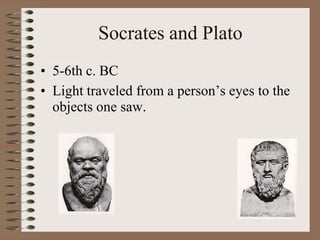
Socrates and Plato
• 5-6th c. BC
• Light traveled from a person’s eyes to the
objects one saw.
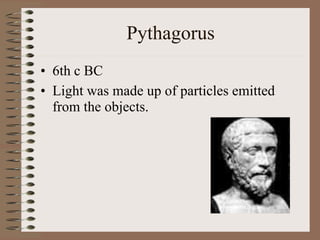
Pythagorus
• 6th c BC
• Light was made up of particles emitted
from the objects.
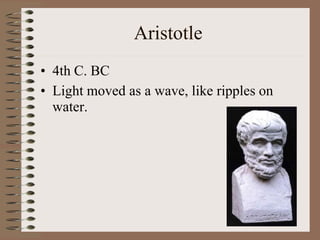
Aristotle
• 4th C. BC
• Light moved as a wave, like ripples on
water.
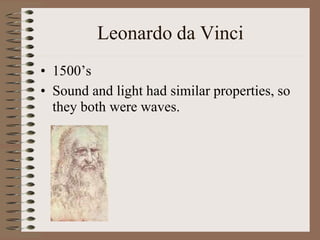
Leonardo da Vinci
• 1500’s
• Sound and light had similar properties, so
they both were waves.
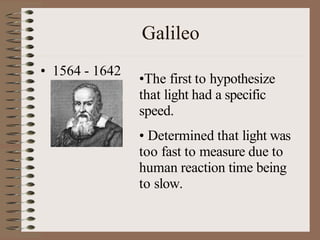
Galileo
• 1564 - 1642
•The first to hypothesize
that light had a specific
speed.
• Determined that light was
too fast to measure due to
human reaction time being
to slow.
Olaus Roemer
• 1644-1710
•He was the first to determine that light
did travel with a measurable speed.
• It took 22min. to cross a diameter of the
Earth’s orbit giving a speed of light of
2.2*10^8m/s
1675 was the year of the first demonstration that
light travels at a finite speed (a definable number)
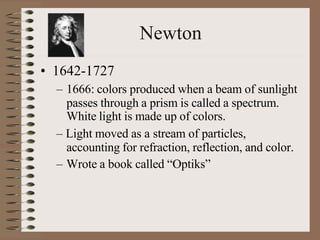
Newton
• 1642-1727
– 1666: colors produced when a beam of sunlight
passes through a prism is called a spectrum.
White light is made up of colors.
– Light moved as a stream of particles,
accounting for refraction, reflection, and color.
– Wrote a book called “Optiks”
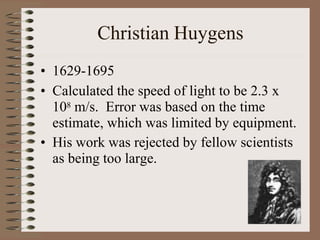
Christian Huygens
• 1629-1695
• Calculated the speed of light to be 2.3 x
108 m/s. Error was based on the time
estimate, which was limited by equipment.
• His work was rejected by fellow scientists
as being too large.
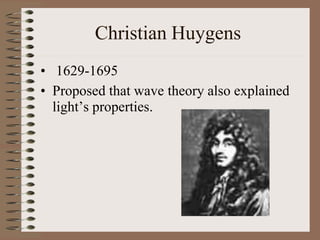
Christian Huygens
• 1629-1695
• Proposed that wave theory also explained
light’s properties.
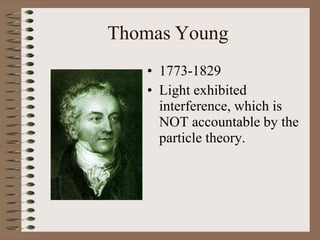
Thomas Young
• 1773-1829
• Light exhibited
interference, which is
NOT accountable by the
particle theory.
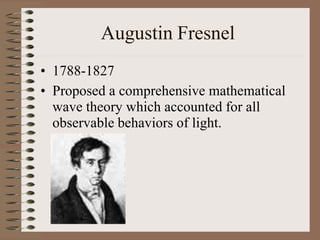
Augustin Fresnel
• 1788-1827
• Proposed a comprehensive mathematical
wave theory which accounted for all
observable behaviors of light.
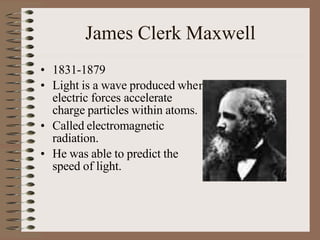
James Clerk Maxwell
n
• 1831-1879
• Light is a wave produced whe
electric forces accelerate
charge particles within atoms.
• Called electromagnetic
radiation.
• He was able to predict the
speed of light.
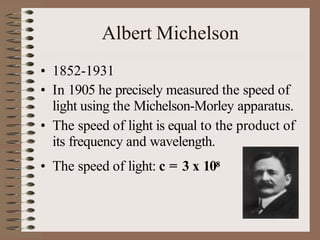
Albert Michelson
• 1852-1931
• In 1905 he precisely measured the speed of
light using the Michelson-Morley apparatus.
• The speed of light is equal to the product of
its frequency and wavelength.
• The speed of light: c = 3 x 10⁸
PRESENT
• Neither the wave model nor the particle
model alone can explain all of the
properties and behaviors of light. The
present theory unifies the wave and
particle natures of light.
The Nature of Light
• Wave model of light: light behaves as a
wave, showing properties of reflection,
refraction, diffraction, and interference.
• Particle model of light: light behaves as a
particle, showing properties of reflection
and refraction.
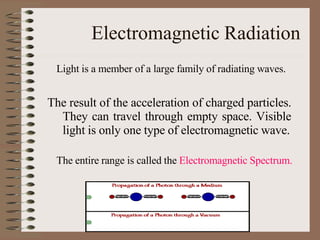
Electromagnetic Radiation
Light is a member of a large family of radiating waves.
The result of the acceleration of charged particles.
They can travel through empty space. Visible
light is only one type of electromagnetic wave.
The entire range is called the Electromagnetic Spectrum.
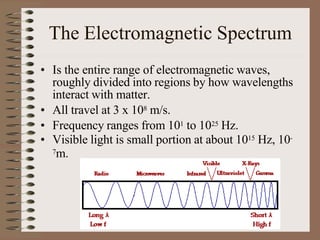
The Electromagnetic Spectrum
• Is the entire range of electromagnetic waves,
roughly divided into regions by how wavelengths
interact with matter.
• All travel at 3 x 10⁸ m/s.
• Frequency ranges from 101 to 1025 Hz.
• Visible light is small portion at about 1015 Hz, 10-
7m.
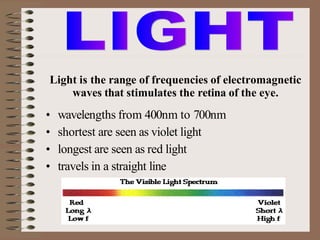
• wavelengths from 400nm to 700nm
• shortest are seen as violet light
• longest are seen as red light
• travels in a straight line
Light is the range of frequencies of electromagnetic
waves that stimulates the retina of the eye.
Energy and Electromagnetic
Waves
The energy of electromagnetic waves
depends on wavelength.
In the standard wave model, energy depends
on amplitude. For electromagnetic waves,
the shorter the wavelength(l), the greater
its energy.
Types of Electromagnetic
Waves
Gamma rays – Have the shortest wavelength
and the greatest energy (wavelengths of
gamma rays are shorter than the width of
an atom) These are used to destroy cancer
cells.
X rays – penetrate all but the very dense part
of the body.
Types of Electromagnetic
Waves
Ultraviolet light – sun/sunlight/tanning beds.
Sunburns occur when ultraviolet light
damages skin cells.
Visible light – ROYGBIV Shortest
wavelength is violet, longest wavelength is
Red.
White light – A mixture of all visible colors
of the spectrum.
Types of Electromagnetic
Waves
Infrared light – Wavelengths longer than
visible light. Responsible for warming the
earth and heat.
Microwaves.
Radio waves – longest wavelengths of the
electromagnetic spectrum.
Medium
Light travels in a vacuum.
No transmitting medium is necessary, but if a
medium is present, it may pass through
that as well.
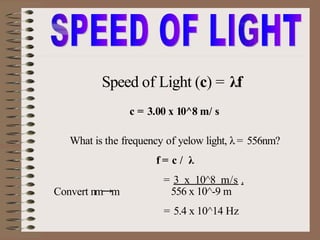
Speed of Light (c) = λf
What is the frequency of yelow light, λ = 556nm?
f = c / λ
= 3 x 10^8 m/s .
Convert nm→m 556 x 10^-9 m
= 5.4 x 10^14 Hz
c = 3.00 x 10^8 m/ s
The Speed of Light
• The speed of light is dependent on the
medium through which light travels
• The speed of light determines the
wavelength.
Fun Facts about the speed of
light.
Light is so fast that if a beam of light could travel
around the earth it would take 7.5 trips in 1
second.
It takes 8 minutes for light from the sun to reach our
eyes.
It takes 4 years for light from the star Alpha Centauri
(nearest star next to the sun) to reach earth.
A light year is the distance light travels in 1 year.
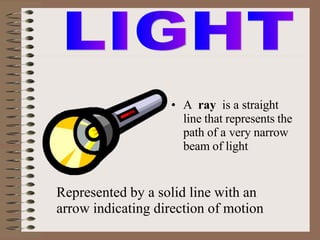
• A ray is a straight
line that represents the
path of a very narrow
beam of light
Represented by a solid line with an
arrow indicating direction of motion
A BEAM
• A beam is a collection of rays.
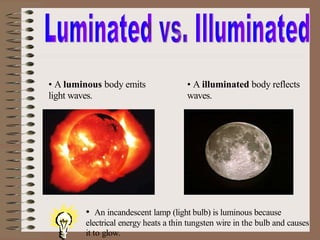
• A luminous body emits
light waves.
• A illuminated body reflects
waves.
• An incandescent lamp (light bulb) is luminous because
electrical energy heats a thin tungsten wire in the bulb and causes
it to glow.
Luminous Vs. Illuminated
Luminous objects are themselves a source of
light.
Illuminated objects are visible only when
light reflects off of them.
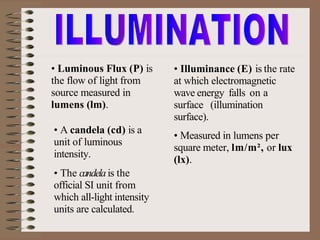
• Luminous Flux (P) is
the flow of light from
source measured in
lumens (lm).
• Illuminance (E) is the rate
at which electromagnetic
wave energy falls on a
surface (illumination
surface).
• Measured in lumens per
square meter, lm/m², or lux
(lx).
• A candela (cd) is a
unit of luminous
intensity.
• The candelais the
official SI unit from
which all-light intensity
units are calculated.
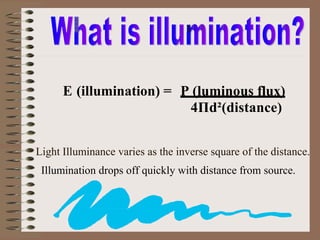
E (illumination) = P (luminous flux)
4Пd²(distance)
Light Illuminance varies as the inverse square of the distance.
Illumination drops off quickly with distance from source.
Light and Matter
• Light that shines upon materials can be
reflected, absorbed, or transmitted.
• Materials are classified as transparent,
translucent, or opaque.
• This depends on the material.
Transparent, translucent and
opaque
• Transparent objects allow light to be fully
transmitted.
• Translucent objects allow light to be partially
transmitted. Some light is absorbed and/or
reflected.
• Opaque objects absorb all light. They cast dark
shadows.
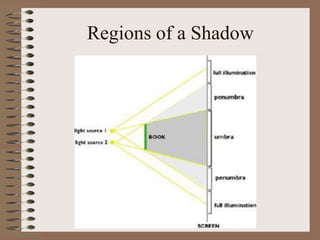
SHADOWS
• formed when an object blocks all of the light from
a light source.
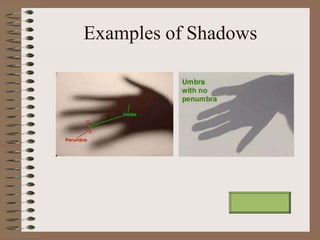
• have a darker part on the inside called the umbra
where all of the light is blocked.
• have a lighter part around the edges called the
penumbra.
– formed when light from one source is blocked with
light from another source filling in some of the shadow
or when light from a broad source is only partially
blocked.
Examples of Shadows
Regions of a Shadow
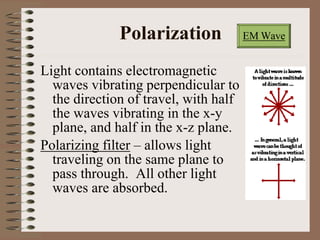
Polarization
Light contains electromagnetic
waves vibrating perpendicular to
the direction of travel, with half
the waves vibrating in the x-y
plane, and half in the x-z plane.
Polarizing filter – allows light
traveling on the same plane to
pass through. All other light
waves are absorbed.
EM Wave
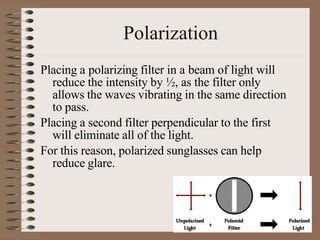
Polarization
Placing a polarizing filter in a beam of light will
reduce the intensity by ½, as the filter only
allows the waves vibrating in the same direction
to pass.
Placing a second filter perpendicular to the first
will eliminate all of the light.
For this reason, polarized sunglasses can help
reduce glare.
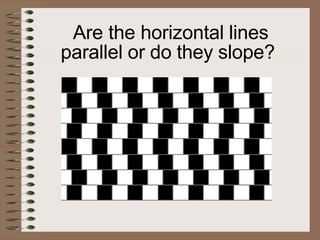
Are the horizontal lines
parallel or do they slope?
Can you see the three faces?
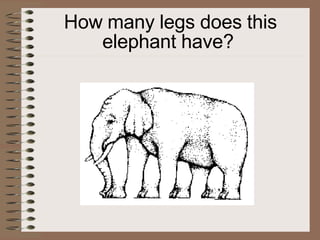
How many legs does this
elephant have?
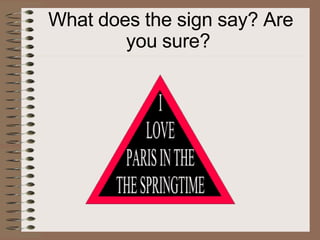
What does the sign say? Are
you sure?
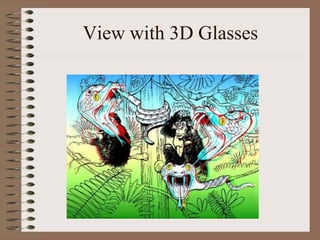
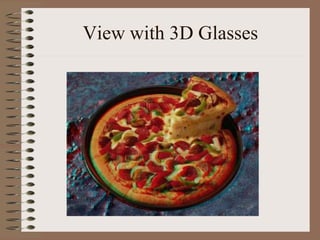
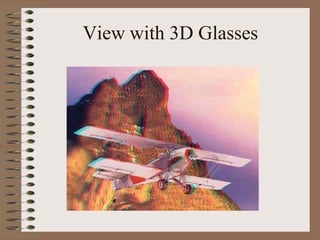
3D Viewing
• The glasses have two Polaroid filters.
Each filter has a different polarization
axis - one is horizontal and the other is
vertical. There are two projectors also
having two different polarizing filters.
The result of this arrangement of
projectors and filters, is that the left
eye sees the movie which is projected
from the right projector while the right
eye sees the movie which is projected
from the left projector. This gives the
viewer a perception of depth.
View with 3D Glasses

LIGHT.pptx

  • 1.
  • 2.
    Socrates and Plato •5-6th c. BC • Light traveled from a person’s eyes to the objects one saw.
  • 3.
    Pythagorus • 6th cBC • Light was made up of particles emitted from the objects.
  • 4.
    Aristotle • 4th C.BC • Light moved as a wave, like ripples on water.
  • 5.
    Leonardo da Vinci •1500’s • Sound and light had similar properties, so they both were waves.
  • 6.
    Galileo • 1564 -1642 •The first to hypothesize that light had a specific speed. • Determined that light was too fast to measure due to human reaction time being to slow.
  • 7.
    Olaus Roemer • 1644-1710 •Hewas the first to determine that light did travel with a measurable speed. • It took 22min. to cross a diameter of the Earth’s orbit giving a speed of light of 2.2*10^8m/s 1675 was the year of the first demonstration that light travels at a finite speed (a definable number)
  • 8.
    Newton • 1642-1727 – 1666:colors produced when a beam of sunlight passes through a prism is called a spectrum. White light is made up of colors. – Light moved as a stream of particles, accounting for refraction, reflection, and color. – Wrote a book called “Optiks”
  • 9.
    Christian Huygens • 1629-1695 •Calculated the speed of light to be 2.3 x 10⁸ m/s. Error was based on the time estimate, which was limited by equipment. • His work was rejected by fellow scientists as being too large.
  • 10.
    Christian Huygens • 1629-1695 •Proposed that wave theory also explained light’s properties.
  • 11.
    Thomas Young • 1773-1829 •Light exhibited interference, which is NOT accountable by the particle theory.
  • 12.
    Augustin Fresnel • 1788-1827 •Proposed a comprehensive mathematical wave theory which accounted for all observable behaviors of light.
  • 13.
    James Clerk Maxwell n •1831-1879 • Light is a wave produced whe electric forces accelerate charge particles within atoms. • Called electromagnetic radiation. • He was able to predict the speed of light.
  • 14.
    Albert Michelson • 1852-1931 •In 1905 he precisely measured the speed of light using the Michelson-Morley apparatus. • The speed of light is equal to the product of its frequency and wavelength. • The speed of light: c = 3 x 10⁸
  • 15.
    PRESENT • Neither thewave model nor the particle model alone can explain all of the properties and behaviors of light. The present theory unifies the wave and particle natures of light.
  • 16.
    The Nature ofLight • Wave model of light: light behaves as a wave, showing properties of reflection, refraction, diffraction, and interference. • Particle model of light: light behaves as a particle, showing properties of reflection and refraction.
  • 17.
    Electromagnetic Radiation Light isa member of a large family of radiating waves. The result of the acceleration of charged particles. They can travel through empty space. Visible light is only one type of electromagnetic wave. The entire range is called the Electromagnetic Spectrum.
  • 18.
    The Electromagnetic Spectrum •Is the entire range of electromagnetic waves, roughly divided into regions by how wavelengths interact with matter. • All travel at 3 x 10⁸ m/s. • Frequency ranges from 101 to 1025 Hz. • Visible light is small portion at about 1015 Hz, 10- 7m.
  • 19.
    • wavelengths from400nm to 700nm • shortest are seen as violet light • longest are seen as red light • travels in a straight line Light is the range of frequencies of electromagnetic waves that stimulates the retina of the eye.
  • 20.
    Energy and Electromagnetic Waves Theenergy of electromagnetic waves depends on wavelength. In the standard wave model, energy depends on amplitude. For electromagnetic waves, the shorter the wavelength(l), the greater its energy.
  • 21.
    Types of Electromagnetic Waves Gammarays – Have the shortest wavelength and the greatest energy (wavelengths of gamma rays are shorter than the width of an atom) These are used to destroy cancer cells. X rays – penetrate all but the very dense part of the body.
  • 22.
    Types of Electromagnetic Waves Ultravioletlight – sun/sunlight/tanning beds. Sunburns occur when ultraviolet light damages skin cells. Visible light – ROYGBIV Shortest wavelength is violet, longest wavelength is Red. White light – A mixture of all visible colors of the spectrum.
  • 23.
    Types of Electromagnetic Waves Infraredlight – Wavelengths longer than visible light. Responsible for warming the earth and heat. Microwaves. Radio waves – longest wavelengths of the electromagnetic spectrum.
  • 24.
    Medium Light travels ina vacuum. No transmitting medium is necessary, but if a medium is present, it may pass through that as well.
  • 25.
    Speed of Light(c) = λf What is the frequency of yelow light, λ = 556nm? f = c / λ = 3 x 10^8 m/s . Convert nm→m 556 x 10^-9 m = 5.4 x 10^14 Hz c = 3.00 x 10^8 m/ s
  • 26.
    The Speed ofLight • The speed of light is dependent on the medium through which light travels • The speed of light determines the wavelength.
  • 27.
    Fun Facts aboutthe speed of light. Light is so fast that if a beam of light could travel around the earth it would take 7.5 trips in 1 second. It takes 8 minutes for light from the sun to reach our eyes. It takes 4 years for light from the star Alpha Centauri (nearest star next to the sun) to reach earth. A light year is the distance light travels in 1 year.
  • 28.
    • A rayis a straight line that represents the path of a very narrow beam of light Represented by a solid line with an arrow indicating direction of motion
  • 29.
    A BEAM • Abeam is a collection of rays.
  • 30.
    • A luminousbody emits light waves. • A illuminated body reflects waves. • An incandescent lamp (light bulb) is luminous because electrical energy heats a thin tungsten wire in the bulb and causes it to glow.
  • 31.
    Luminous Vs. Illuminated Luminousobjects are themselves a source of light. Illuminated objects are visible only when light reflects off of them.
  • 32.
    • Luminous Flux(P) is the flow of light from source measured in lumens (lm). • Illuminance (E) is the rate at which electromagnetic wave energy falls on a surface (illumination surface). • Measured in lumens per square meter, lm/m², or lux (lx). • A candela (cd) is a unit of luminous intensity. • The candelais the official SI unit from which all-light intensity units are calculated.
  • 33.
    E (illumination) =P (luminous flux) 4Пd²(distance) Light Illuminance varies as the inverse square of the distance. Illumination drops off quickly with distance from source.
  • 34.
    Light and Matter •Light that shines upon materials can be reflected, absorbed, or transmitted. • Materials are classified as transparent, translucent, or opaque. • This depends on the material.
  • 35.
    Transparent, translucent and opaque •Transparent objects allow light to be fully transmitted. • Translucent objects allow light to be partially transmitted. Some light is absorbed and/or reflected. • Opaque objects absorb all light. They cast dark shadows.
  • 36.
    SHADOWS • formed whenan object blocks all of the light from a light source. • have a darker part on the inside called the umbra where all of the light is blocked. • have a lighter part around the edges called the penumbra. – formed when light from one source is blocked with light from another source filling in some of the shadow or when light from a broad source is only partially blocked.
  • 37.
  • 38.
  • 39.
    Polarization Light contains electromagnetic wavesvibrating perpendicular to the direction of travel, with half the waves vibrating in the x-y plane, and half in the x-z plane. Polarizing filter – allows light traveling on the same plane to pass through. All other light waves are absorbed. EM Wave
  • 40.
    Polarization Placing a polarizingfilter in a beam of light will reduce the intensity by ½, as the filter only allows the waves vibrating in the same direction to pass. Placing a second filter perpendicular to the first will eliminate all of the light. For this reason, polarized sunglasses can help reduce glare.
  • 41.
    Are the horizontallines parallel or do they slope?
  • 42.
    Can you seethe three faces?
  • 43.
    How many legsdoes this elephant have?
  • 44.
    What does thesign say? Are you sure?
  • 45.
    3D Viewing • Theglasses have two Polaroid filters. Each filter has a different polarization axis - one is horizontal and the other is vertical. There are two projectors also having two different polarizing filters. The result of this arrangement of projectors and filters, is that the left eye sees the movie which is projected from the right projector while the right eye sees the movie which is projected from the left projector. This gives the viewer a perception of depth.
  • 46.
    View with 3DGlasses
  • 47.
    View with 3DGlasses
  • 48.
    View with 3DGlasses