Illumination Design
Illumination
Design
By
Engr. Amando D.Lanuza, PEE
Presentor:
A newly passed Professional
Electrical Engineer
 12 years in government service as City
Electrical Engineer.
 A former OFW
A former Barangay Electrician
3 time IIEE Chapter President of IIEE
Sorsogon
INTRODUCTION
 Light- is a form of radiant energy
from natural sources(e.g. sun and
stars), and artificial sources (e.g.
candle and electric lamps). It travels in
a form of an electromagnetic wave,
so it has wavelength and a known
speed. Like other electromagnetic
radiation, it can be reflected and
refracted.
 Lighting – is the application of
light to illuminate objects,
surfaces, scenes, pictures and
people
Lighting on the other hand is
the application of light to
illuminate objects, surfaces,
scenes, pictures and people.
Lighting
concepts and
Units
Luminous flux (Ø)- All the radiated
power emitted by a light source.
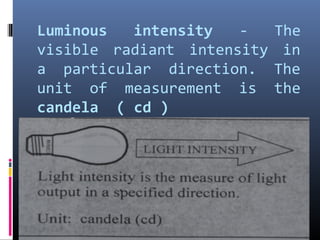
Luminous intensity - The
visible radiant intensity in
a particular direction. The
unit of measurement is the
candela ( cd )
Illuminance (E)- is a measure of
the amount of light falling on a
surface. Unit of measurement is
lux (lx)
Luminous Efficacy (ŋ)
 Luminous efficacy indicates the
efficiency of the light source with
which the electrical power
consumed is converted into light.
The unit of measurement is lumens
per watt ( lm/W).
Lighting
System
Design
 The design for indoor
lighting system general
illumination is considered to
be more of an art than a
science and it involves many
variable factors.
Factors for indoor lighting
includes:
 Size and shapes of the space.
 Types of finishes on ceilings, walls and
floors.
 The details of the construction
 The economic consideration of both the
initial and operating cost.
 The compatability of the lighting system
with the architectural design.
 The type of activities that will be carried
out in a particular area.
Objectives and design
consideration:
 Determination of required level of
illumination.
 Quality required
 Quantity required
 Area atmosphere
 Area description and Use
 Selection of System Luminaire.
Determination of required level
of illumination
 See table for recommended illumination level
for different types of occupancies by
Illuminating Engineering Society of North
America (IESNA)
Quality of Light
 Pertains to the distribution of brightness in
the lighting installation. Involves the
comfort of seeing the environment .
Factors to consider are , brightness,
contrast or luminance ratio, glare,
diffuseness and color.
Quantity required
 The quantity of light involves adequate level
of illumination for the average person under
normal condition.
 Area Atmosphere
 Analyze the environment in which the
lighting system will operate. For example, are
dirt, water vapor, explosive gasses or
corrosive vapor present?
Area description and use:
 A complete description is required for each
area to be lighted, this includes physical
characteristics such as room dimensions,
room reflectance and work location.
 Selection of system luminaire
 Selection of the type of luminare for a given
application depends upon the requirements
and conditions stated above.
Determining Average
Illuminance
 The average illuminance level can be
determined when a given number of
luminaires used in a space is known.
Likewise, the number of luminaires
can be determined given the average
illuminance level.
 Within the room, the illuminance is
determined based on the horizontal
plane, which is considered as the
work plane. The work plane is
measured at the height of the visual
task. In the office this would generally
be at a height of 0.75 meter above the
floor, the average height of an office
table. In the corridors , the work plane
is usually considered to be the floor.
The general equation for the
illuminance in a work place
is:
 Ø(TOTAL) x CU x LLF
 E WP = ------------------------------
 A WP
 Where:
 E wp - Work plane illuminance, lx
 Ø(TOTAL) – total system lamp lumen
 output, (lm).
 CU – coefficient of utilization.
 LLF- light loss factor
 A wp – area of work plane , m²
 Work plane illuminance,Ewp :
The average maintained luminous flux
that hits the work plane per unit area. The unit
of measurement is lx.
 Total system lamp lumen output , Ø total:
refers to the quantity of light produced by
all lamps that are lighting a space.
 Coefficient of utilization ,CU:
The ratio of the lumens that reaches the
work plane to the total lumens given off by
the lighting system
 All the lumens from the lamps in a lighting
system generally do not reach the work
plane. Some of them are absorbed by the
floors, walls and ceilings before reaching the
work plane. The fraction of luminous flux
emitted by the lamps that reaches the work
plane in a space is the coefficient of
utilization. If 50% of the light given off by the
lamp reaches the work plane, then CU is 0.50,
in some cases the CU can be grater than 1.0
for rooms with higher reflectances and lamps
with higher efficacy.
 Light Loss Factor (LLF):
 is the ratio of illuminance
when it reaches the lower
level( just before corrective action
takes place) to the initial level.
The total light loss is the product
of all the individual factors that
contribute to the loss of light. It is
also known as the maintenance
factor.
 Light Loss Factor (LLF) equation is:
 LLF = LLD x LDD x RSDD
 where :
 LLD - Lamp Lumen Depreciation Factor
The depreciation of lumen output of
lamp through life.
 LDD- Lamp Dirt Depreciation Factor
With the passage of time, dirt
accumulates on lamps resulting to
loss of light.
 RSDD- Room Surface Dirt
Depreciation Factor:
 With the passage of time, the
accumulation of dirt on the surface of
the room further reduces the amount
of light that reaches the work plane
Indoor Lighting Calculation
 The Lumen Method:
This method is used to design
general overall lighting of the
room. This method calculates the
illuminance that represents the
average of the values at all points
over the entire work plane of the
room.
 The average illuminace of the work plane (E)
 TILL x CU x LLF
 E = ----------------------
 Area
 Where :
 TILL = total initial lamp lumens
Sample simplified
calculation
 Find out if two -36WT8
fluorescent lamp is enough to
illuminate a typical dining room
with dimension 3m x 4m ,
assuming the CU is 0.65 and LLF is
0.95 .
Solution:
 Looking at the manufacturer’s data of 36WT8
fluorescent lamp, luminous flux is 3350 lm.
 using the formula:
 TILL x CU x LLF 2 x 3350 xo.65 x 0.95
 E = -------------- = --------------- --------=
 Area 3 m x 4m
 = 334.78 lux
 Looking at the Table:
Recommended level of
illumination by IESNA for Dining
rooms is 540 lux.
 Therefore:
 2 -36WT8 FL is not enough
 Use 3 - sets
Uniformity of Light:
The average illumination at work plane is
directly related to the maximum spacing of
the luminaire to the mounting height ratio
represented by:
S
ratio = -----
MH
Where : S = spacing of light fixtures
MH = mounting height
 Assume that the mounting height of lighting
fixture is 3 meters from the floor. What is the
maximum spacing of fluorescent.
 Recommende spacing and mounting height
ratio:
 Type of light s/mh Ratio
 Direct concentrating 0.40
 Direct spread 1.20
 Diffused 1.30
 Semi –direct/ indirect 1.50
 Using the formula:
 s
 ratio = ------ =
 mh
 s = 3 x 0.40 = 1.2m
 An office room having a dimension of 8 m x 20 m
 Is to be lighted with a maintained illumination.
How many 3- lamp 36wFL parabolic troffer are
required .
 From the formula:
 illumination x area
 N = ----------------------------------------
 lamp per fixture x lumen x CUx LLF
 Looking at the manufacturer’s data of
36watts fluorescent lamp , luminous flux
= 335000 lumens.
 Recommended illumination level for offices is
1600m lux
 Assume CU = 0.65
 LLF= 0.85
 Substituting values:
 1600 (8 x 20)
 N = ---------------------------
 3 x 3350 x 1.0 x 0.95
 N = 26.8
 use : 24 sets or 28 to make it
 symmetrical
 The design of lighting system
requires knowledge of basic
lighting terms combined
simple mathematical or
graphical presentation and
technics.
 The methods and calculation in the
lighting system design presented in
this presentation are based on the
recommended procedures of
Illuminating Engineering Society of
North America (IESNA) .The formula
presented are only meant to be a
general overview on illumination
design calculation.
Illumination

Illumination

  • 1.
  • 2.
    Presentor: A newly passedProfessional Electrical Engineer  12 years in government service as City Electrical Engineer.  A former OFW A former Barangay Electrician 3 time IIEE Chapter President of IIEE Sorsogon
  • 3.
    INTRODUCTION  Light- isa form of radiant energy from natural sources(e.g. sun and stars), and artificial sources (e.g. candle and electric lamps). It travels in a form of an electromagnetic wave, so it has wavelength and a known speed. Like other electromagnetic radiation, it can be reflected and refracted.
  • 4.
     Lighting –is the application of light to illuminate objects, surfaces, scenes, pictures and people Lighting on the other hand is the application of light to illuminate objects, surfaces, scenes, pictures and people.
  • 5.
  • 6.
    Luminous flux (Ø)-All the radiated power emitted by a light source.
  • 7.
    Luminous intensity -The visible radiant intensity in a particular direction. The unit of measurement is the candela ( cd )
  • 8.
    Illuminance (E)- isa measure of the amount of light falling on a surface. Unit of measurement is lux (lx)
  • 9.
    Luminous Efficacy (ŋ) Luminous efficacy indicates the efficiency of the light source with which the electrical power consumed is converted into light. The unit of measurement is lumens per watt ( lm/W).
  • 10.
  • 11.
     The designfor indoor lighting system general illumination is considered to be more of an art than a science and it involves many variable factors.
  • 12.
    Factors for indoorlighting includes:  Size and shapes of the space.  Types of finishes on ceilings, walls and floors.  The details of the construction  The economic consideration of both the initial and operating cost.  The compatability of the lighting system with the architectural design.  The type of activities that will be carried out in a particular area.
  • 13.
    Objectives and design consideration: Determination of required level of illumination.  Quality required  Quantity required  Area atmosphere  Area description and Use  Selection of System Luminaire.
  • 14.
    Determination of requiredlevel of illumination  See table for recommended illumination level for different types of occupancies by Illuminating Engineering Society of North America (IESNA)
  • 15.
    Quality of Light Pertains to the distribution of brightness in the lighting installation. Involves the comfort of seeing the environment . Factors to consider are , brightness, contrast or luminance ratio, glare, diffuseness and color.
  • 16.
    Quantity required  Thequantity of light involves adequate level of illumination for the average person under normal condition.  Area Atmosphere  Analyze the environment in which the lighting system will operate. For example, are dirt, water vapor, explosive gasses or corrosive vapor present?
  • 17.
    Area description anduse:  A complete description is required for each area to be lighted, this includes physical characteristics such as room dimensions, room reflectance and work location.  Selection of system luminaire  Selection of the type of luminare for a given application depends upon the requirements and conditions stated above.
  • 18.
    Determining Average Illuminance  Theaverage illuminance level can be determined when a given number of luminaires used in a space is known. Likewise, the number of luminaires can be determined given the average illuminance level.
  • 19.
     Within theroom, the illuminance is determined based on the horizontal plane, which is considered as the work plane. The work plane is measured at the height of the visual task. In the office this would generally be at a height of 0.75 meter above the floor, the average height of an office table. In the corridors , the work plane is usually considered to be the floor.
  • 20.
    The general equationfor the illuminance in a work place is:  Ø(TOTAL) x CU x LLF  E WP = ------------------------------  A WP
  • 21.
     Where:  Ewp - Work plane illuminance, lx  Ø(TOTAL) – total system lamp lumen  output, (lm).  CU – coefficient of utilization.  LLF- light loss factor  A wp – area of work plane , m²
  • 22.
     Work planeilluminance,Ewp : The average maintained luminous flux that hits the work plane per unit area. The unit of measurement is lx.  Total system lamp lumen output , Ø total: refers to the quantity of light produced by all lamps that are lighting a space.  Coefficient of utilization ,CU: The ratio of the lumens that reaches the work plane to the total lumens given off by the lighting system
  • 23.
     All thelumens from the lamps in a lighting system generally do not reach the work plane. Some of them are absorbed by the floors, walls and ceilings before reaching the work plane. The fraction of luminous flux emitted by the lamps that reaches the work plane in a space is the coefficient of utilization. If 50% of the light given off by the lamp reaches the work plane, then CU is 0.50, in some cases the CU can be grater than 1.0 for rooms with higher reflectances and lamps with higher efficacy.
  • 24.
     Light LossFactor (LLF):  is the ratio of illuminance when it reaches the lower level( just before corrective action takes place) to the initial level. The total light loss is the product of all the individual factors that contribute to the loss of light. It is also known as the maintenance factor.
  • 25.
     Light LossFactor (LLF) equation is:  LLF = LLD x LDD x RSDD  where :  LLD - Lamp Lumen Depreciation Factor The depreciation of lumen output of lamp through life.  LDD- Lamp Dirt Depreciation Factor With the passage of time, dirt accumulates on lamps resulting to loss of light.
  • 26.
     RSDD- RoomSurface Dirt Depreciation Factor:  With the passage of time, the accumulation of dirt on the surface of the room further reduces the amount of light that reaches the work plane
  • 27.
    Indoor Lighting Calculation The Lumen Method: This method is used to design general overall lighting of the room. This method calculates the illuminance that represents the average of the values at all points over the entire work plane of the room.
  • 28.
     The averageilluminace of the work plane (E)  TILL x CU x LLF  E = ----------------------  Area  Where :  TILL = total initial lamp lumens
  • 29.
    Sample simplified calculation  Findout if two -36WT8 fluorescent lamp is enough to illuminate a typical dining room with dimension 3m x 4m , assuming the CU is 0.65 and LLF is 0.95 .
  • 30.
    Solution:  Looking atthe manufacturer’s data of 36WT8 fluorescent lamp, luminous flux is 3350 lm.  using the formula:  TILL x CU x LLF 2 x 3350 xo.65 x 0.95  E = -------------- = --------------- --------=  Area 3 m x 4m  = 334.78 lux
  • 31.
     Looking atthe Table: Recommended level of illumination by IESNA for Dining rooms is 540 lux.  Therefore:  2 -36WT8 FL is not enough  Use 3 - sets
  • 32.
    Uniformity of Light: Theaverage illumination at work plane is directly related to the maximum spacing of the luminaire to the mounting height ratio represented by: S ratio = ----- MH Where : S = spacing of light fixtures MH = mounting height
  • 33.
     Assume thatthe mounting height of lighting fixture is 3 meters from the floor. What is the maximum spacing of fluorescent.  Recommende spacing and mounting height ratio:  Type of light s/mh Ratio  Direct concentrating 0.40  Direct spread 1.20  Diffused 1.30  Semi –direct/ indirect 1.50
  • 34.
     Using theformula:  s  ratio = ------ =  mh  s = 3 x 0.40 = 1.2m
  • 35.
     An officeroom having a dimension of 8 m x 20 m  Is to be lighted with a maintained illumination. How many 3- lamp 36wFL parabolic troffer are required .  From the formula:  illumination x area  N = ----------------------------------------  lamp per fixture x lumen x CUx LLF
  • 36.
     Looking atthe manufacturer’s data of 36watts fluorescent lamp , luminous flux = 335000 lumens.  Recommended illumination level for offices is 1600m lux  Assume CU = 0.65  LLF= 0.85
  • 37.
     Substituting values: 1600 (8 x 20)  N = ---------------------------  3 x 3350 x 1.0 x 0.95  N = 26.8  use : 24 sets or 28 to make it  symmetrical
  • 40.
     The designof lighting system requires knowledge of basic lighting terms combined simple mathematical or graphical presentation and technics.
  • 41.
     The methodsand calculation in the lighting system design presented in this presentation are based on the recommended procedures of Illuminating Engineering Society of North America (IESNA) .The formula presented are only meant to be a general overview on illumination design calculation.