Chapter Two:
Dr. Steven Mendoza
East Los Angeles Community
College
Theories of Development
PowerPoints prepared by Cathie Robertson, Grossmont College
Five Questions Central to
Theories
• Do early experiences of breast-feeding
or bonding or abuse linger into
adulthood, even if they seem to be
forgotten?
• How important are specific school
experiences in human intelligence?
• Can a person develop moral values
without being taught them?
Five Questions Central to
Theories, cont.
• Does culture elicit behavior, e.g., is
violent crime more common in one place
than another; for example, in China or
Canada?
• If your parents or grandparents
schizophrenia, or alcoholism, will you
develop them suffer from depression,?
• Of all questions—Why or Why not?
When and How?, So What?
• Developmental theory—systematic
statement of principles and
generalizations that provides a
coherent framework for studying
development
What Theories Do
What Theories Do, cont.
• Theories
– form basis for hypotheses that can be
tested by research studies
• formulating right question is more difficult that
finding right answers
– generate discoveries
– offer insight and guidance by providing
coherent view
What Theories Do, cont.
• Different Types
– grand theories—comprehensive, traditional
theories
• originated in psychology
– minitheories—theories that focus on
specific area of development
• originated more in sociology through study of
social groups and family structures
– emergent theories—new, comprehensive
groupings of minitheories
• multidisciplinary approach includes historic
events and genetic discoveries
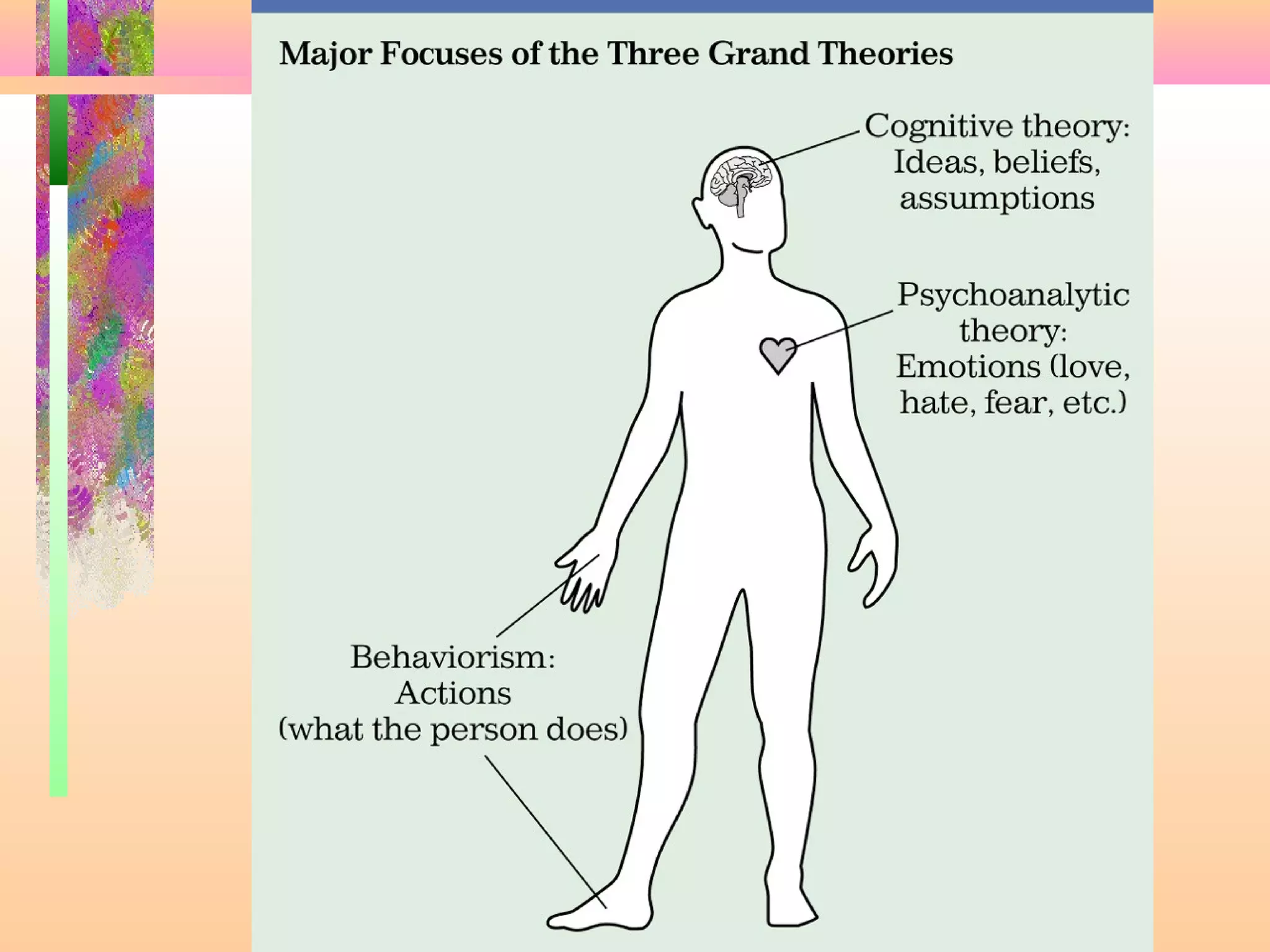
Grand Theories
• Grand Theories—powerful framework
for interpreting and understanding
change and development that applies to
all individuals in all contexts, across all
contents
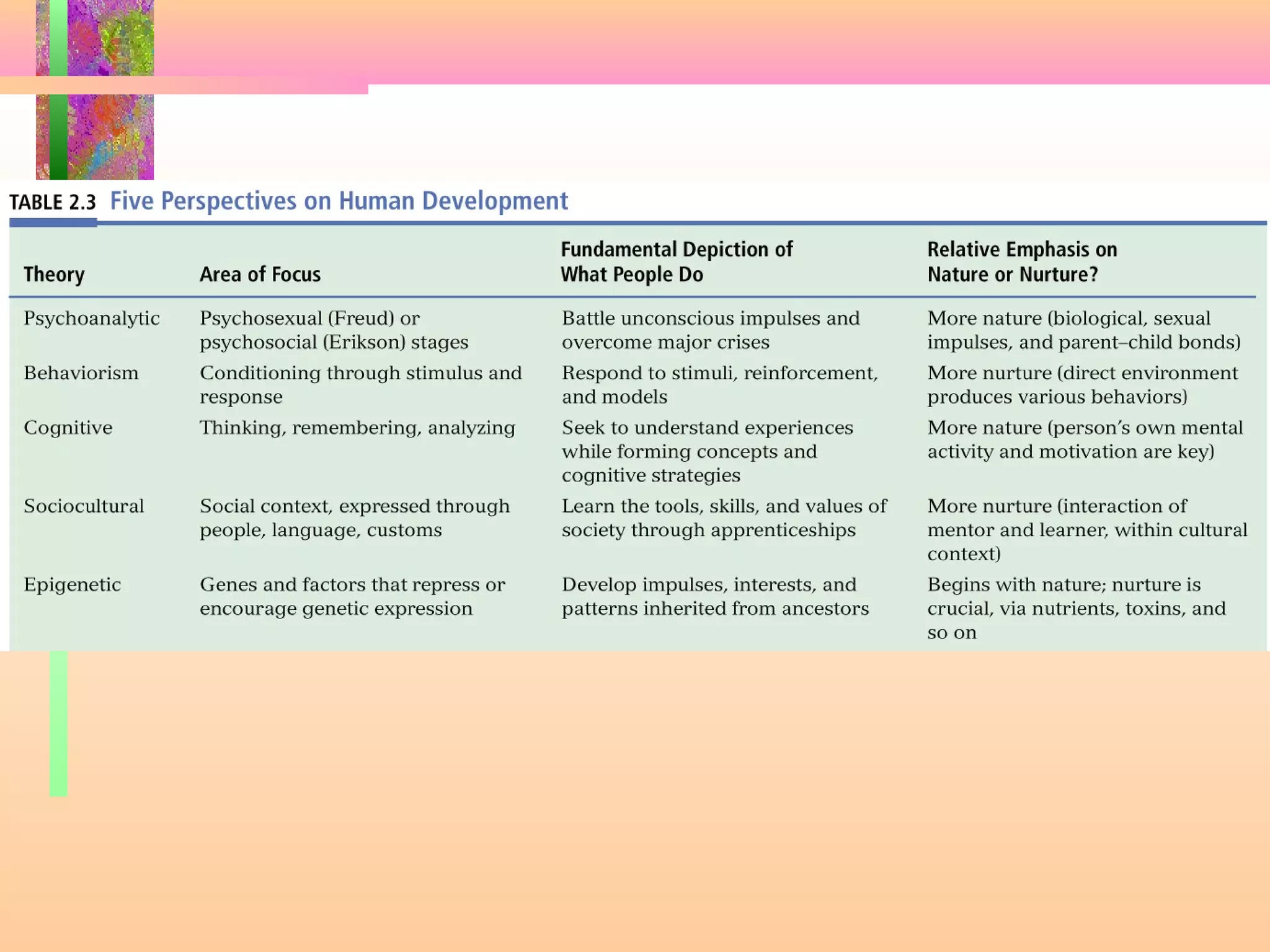
• Psychoanalytic theory interprets
human development in terms of
motives and drives
Psychoanalytic Theory
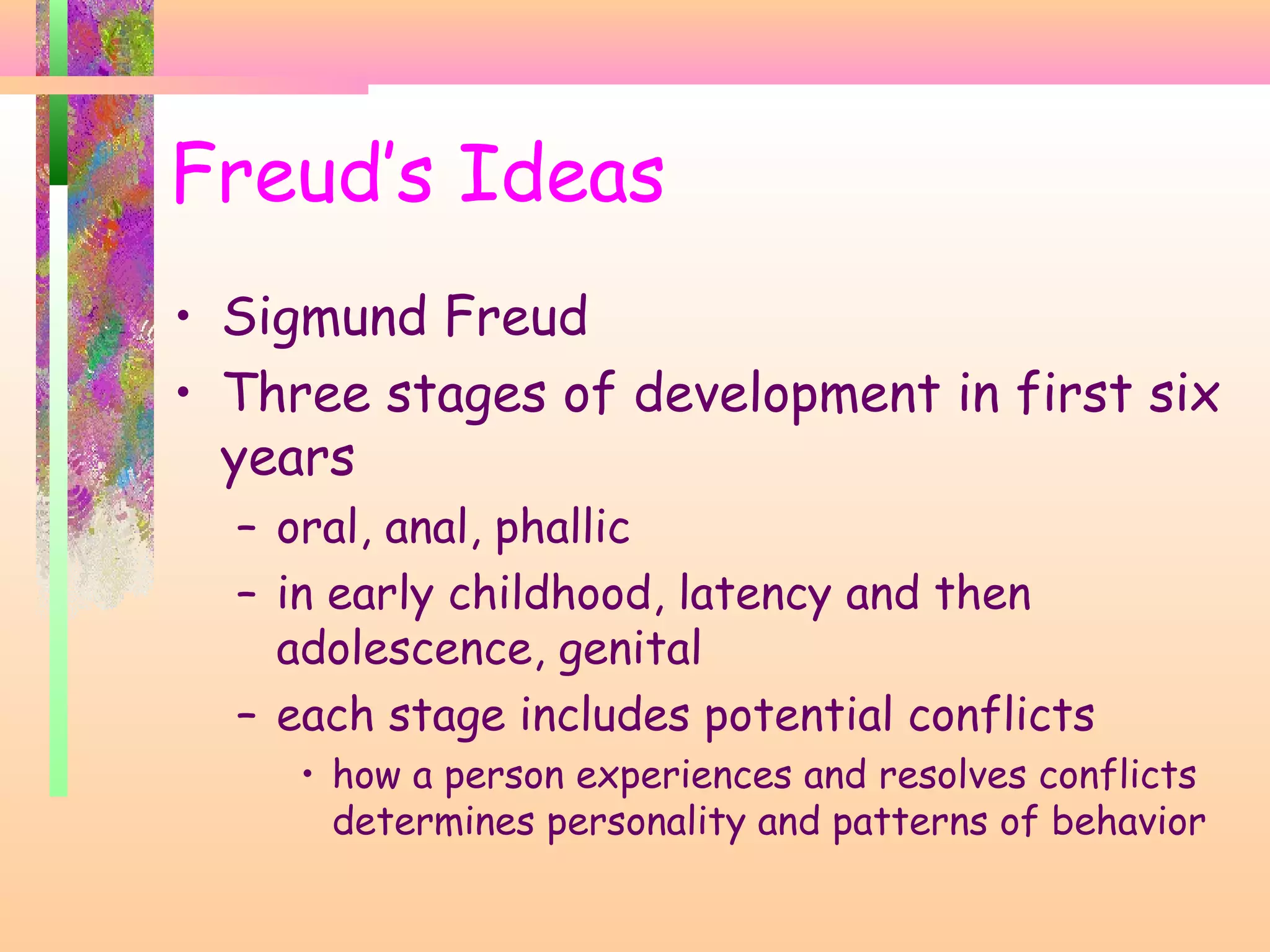
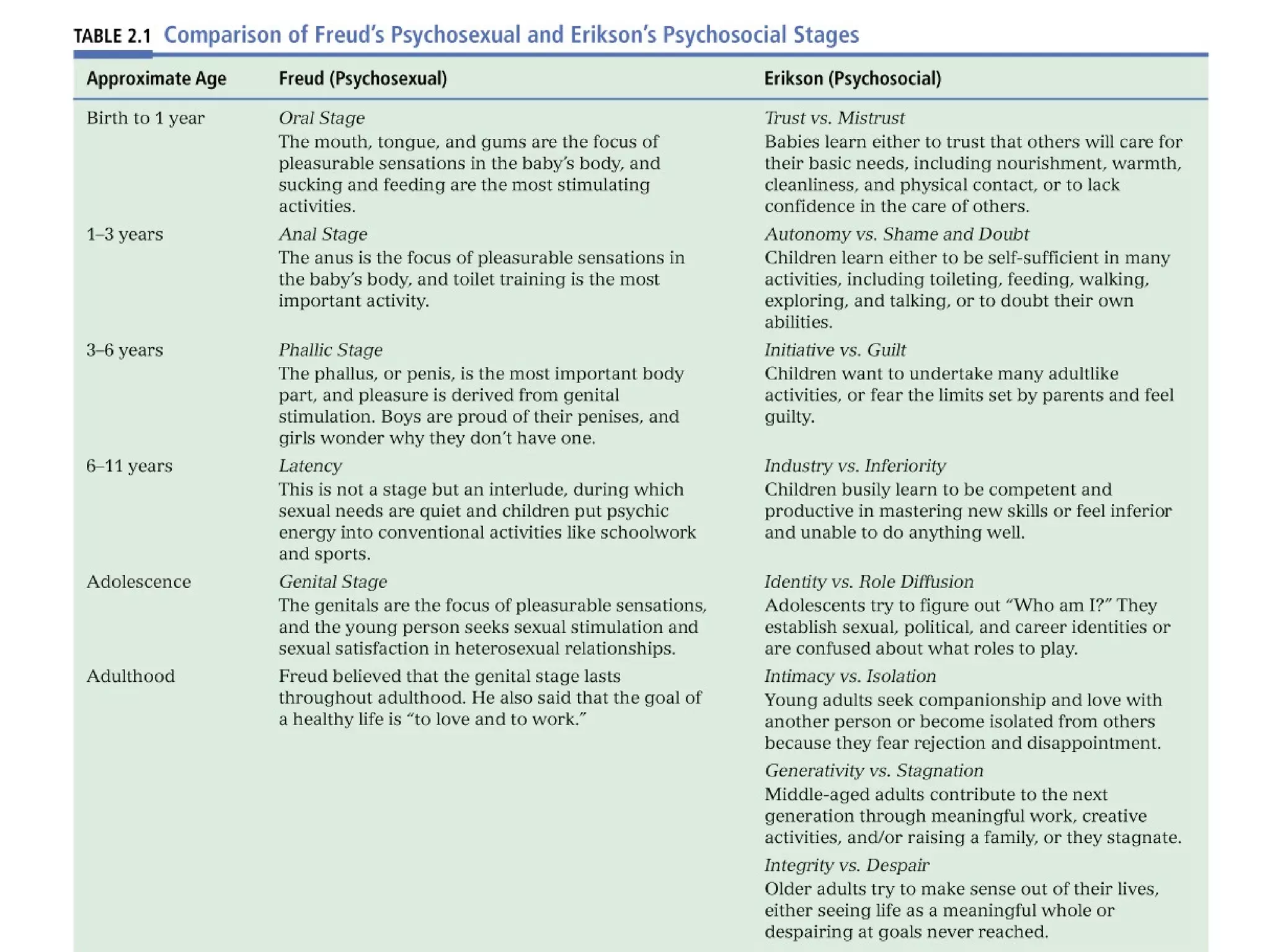
Freud’s Ideas
• Sigmund Freud
• Three stages of development in first six
years
– oral, anal, phallic
– in early childhood, latency and then
adolescence, genital
– each stage includes potential conflicts
• how a person experiences and resolves conflicts
determines personality and patterns of behavior
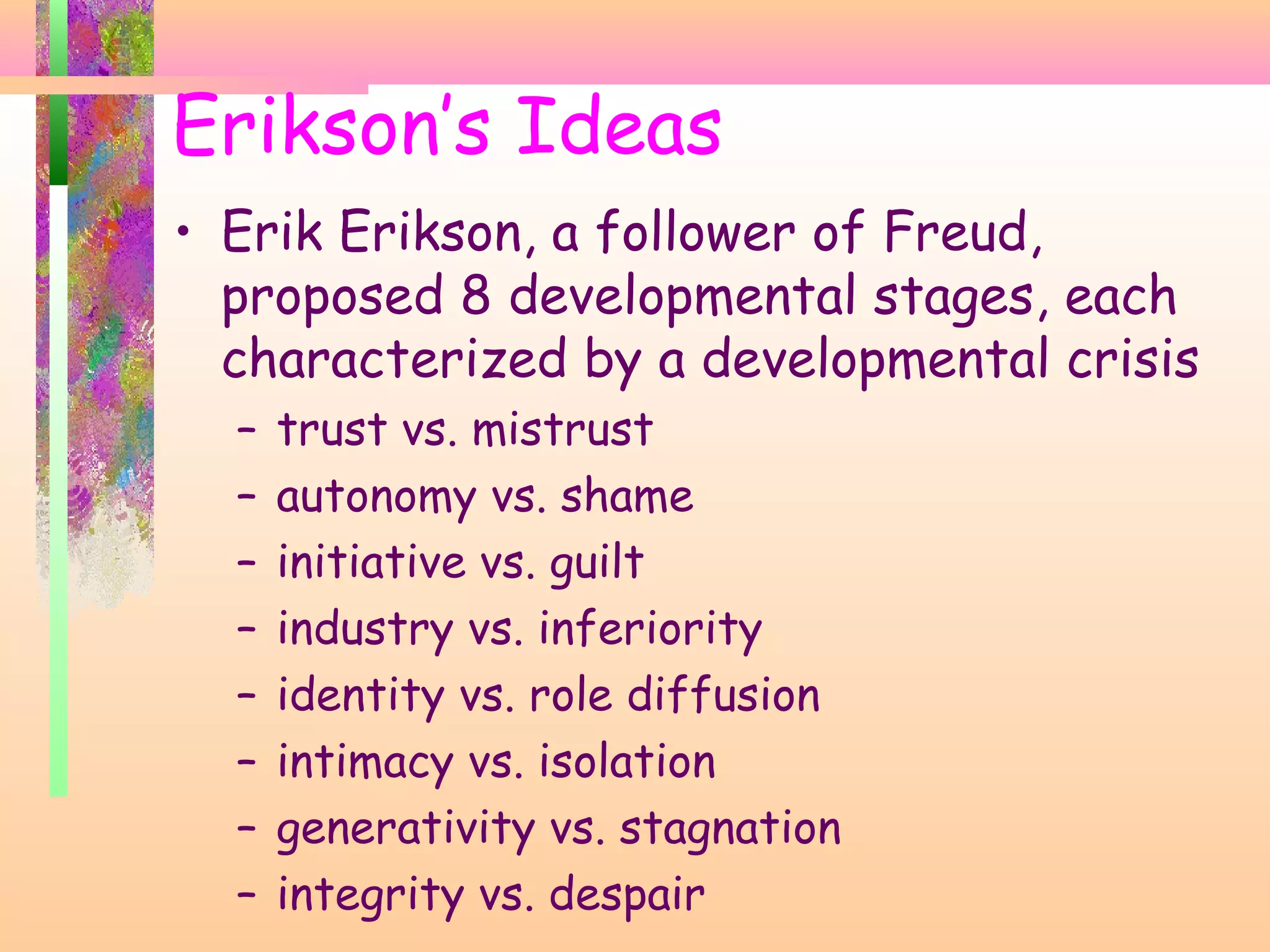
Erikson’s Ideas
• Erik Erikson, a follower of Freud,
proposed 8 developmental stages, each
characterized by a developmental crisis
– trust vs. mistrust
– autonomy vs. shame
– initiative vs. guilt
– industry vs. inferiority
– identity vs. role diffusion
– intimacy vs. isolation
– generativity vs. stagnation
– integrity vs. despair
• Behaviorism is built on laws of
behavior and processes by which
behavior is learned
– focus: ways we learn specific behaviors
that can be described, analyzed, and
predicted with scientific accuracy
Behaviorism
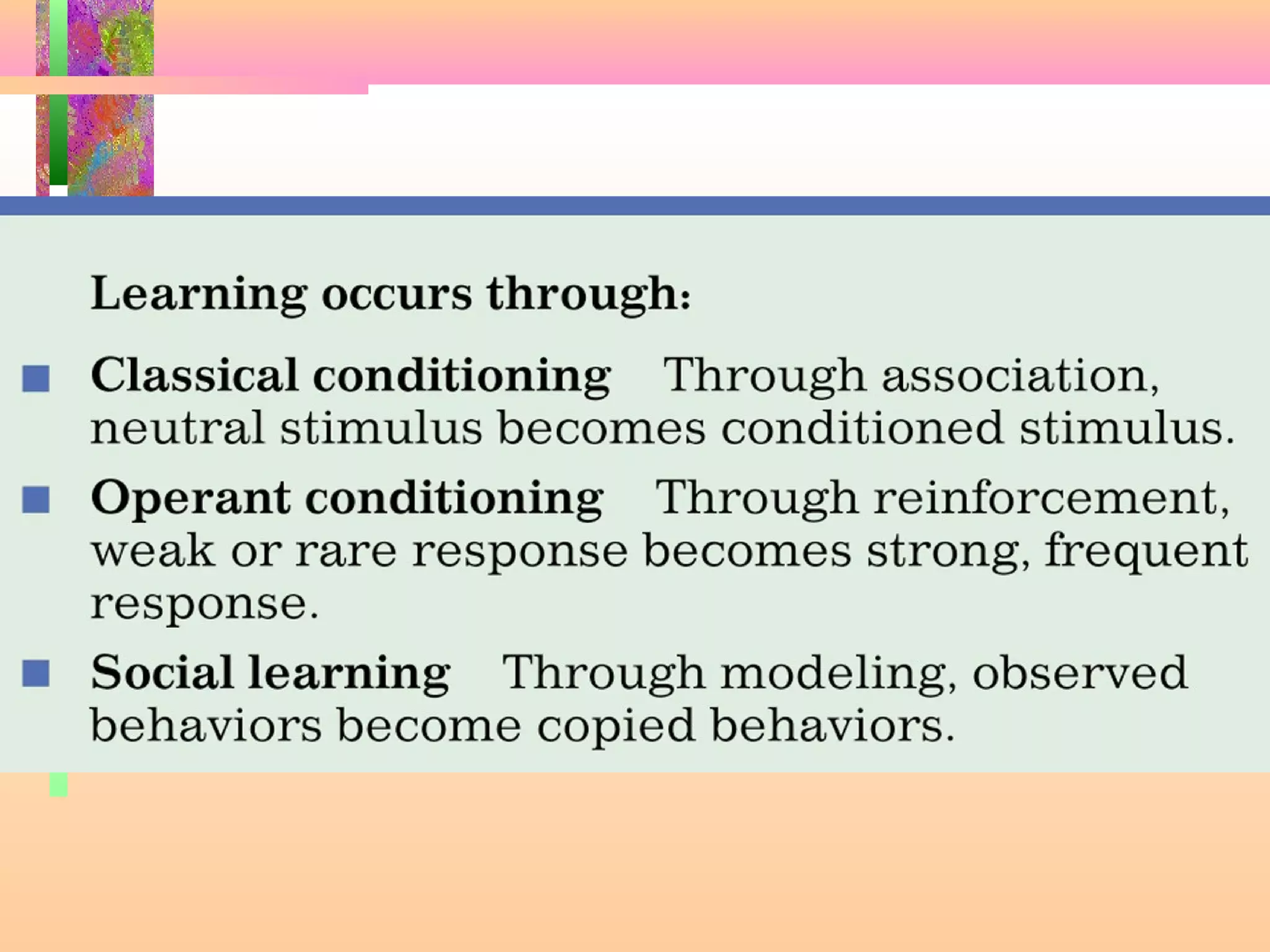
• Conditioning—any process in which
behavior is learned
• Classical conditioning—Ivan Pavlov
– process by which a neutral stimulus become
associated with a meaningful stimulus
• stimulus and response (respondent conditioning)
• Operant conditioning—B. F. Skinner
– process by which a response is gradually
learned via reinforcement or punishment
• also called instrumental conditioning
Laws of Behavior
Social Learning
• Extension of learning theory that
includes modeling which involves people
observing behavior and patterning their
own after it
• Modeling
– process in which people observe, then copy
behavior
– Alfred Bandura—most likely to occur if model
is admired or observer is inexperienced
– self-efficacy motivates people to change
themselves and their contexts
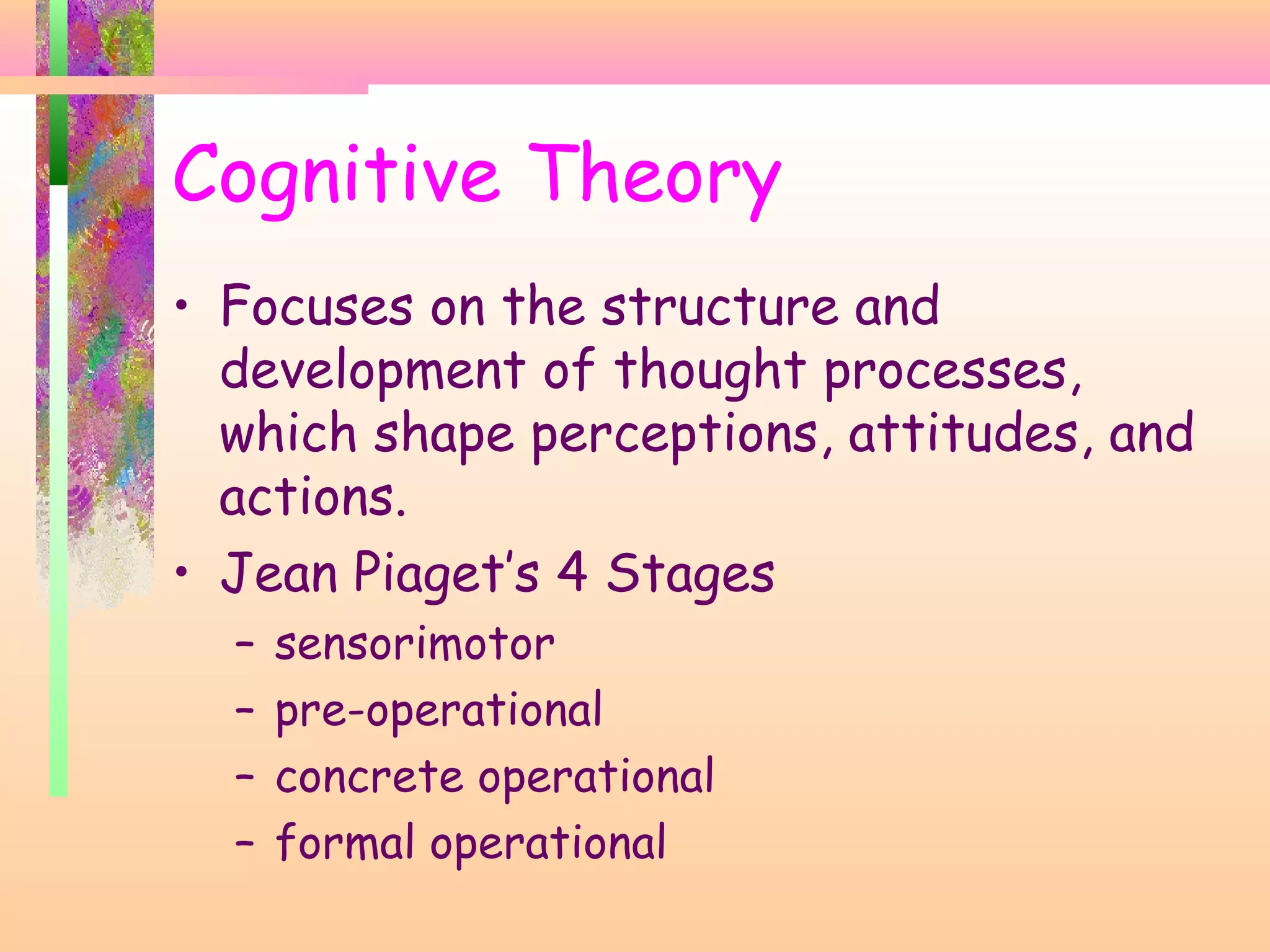
• Focuses on the structure and
development of thought processes,
which shape perceptions, attitudes, and
actions.
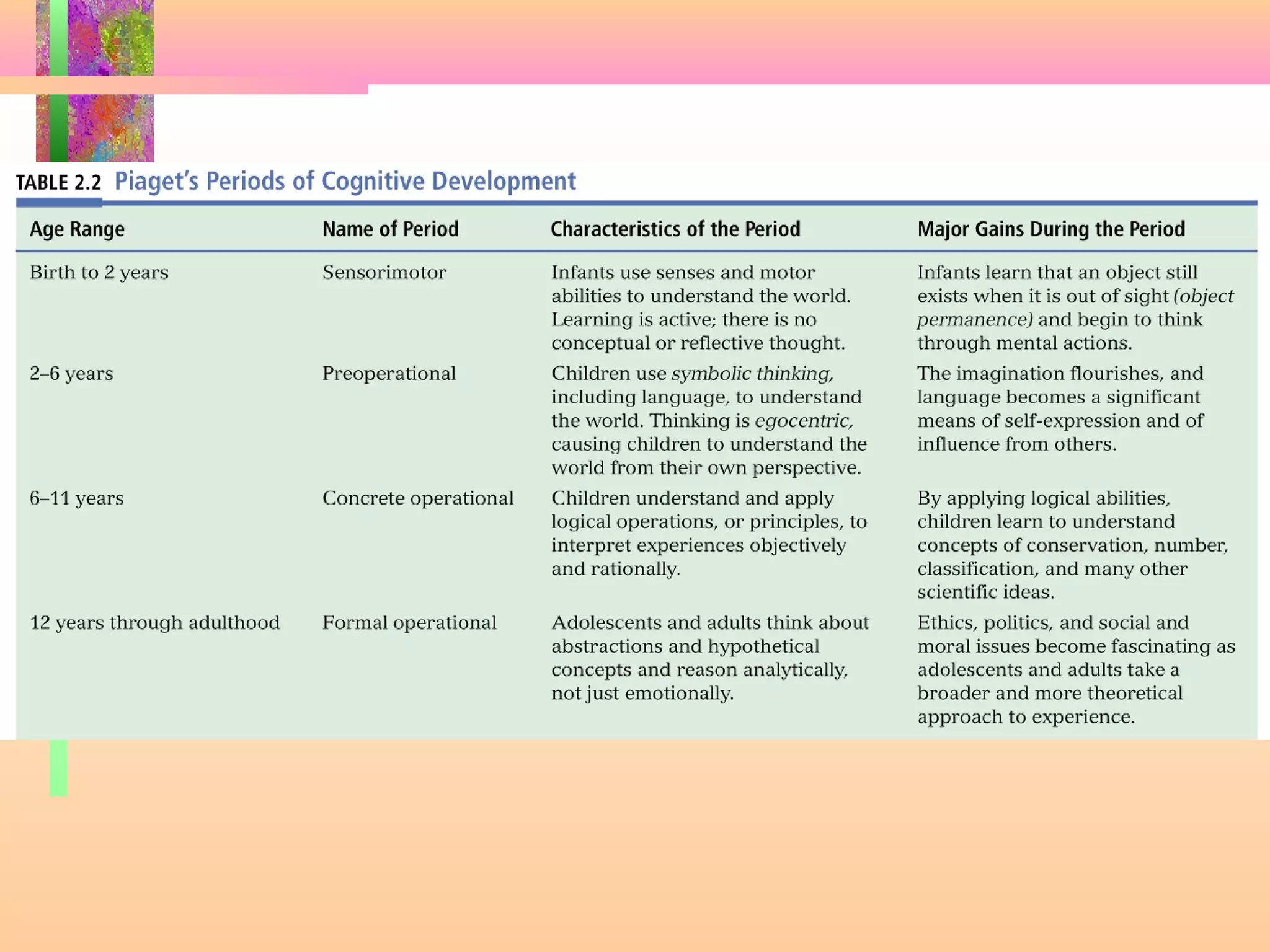
• Jean Piaget’s 4 Stages
– sensorimotor
– pre-operational
– concrete operational
– formal operational
Cognitive Theory
Cognitive Theory, cont.
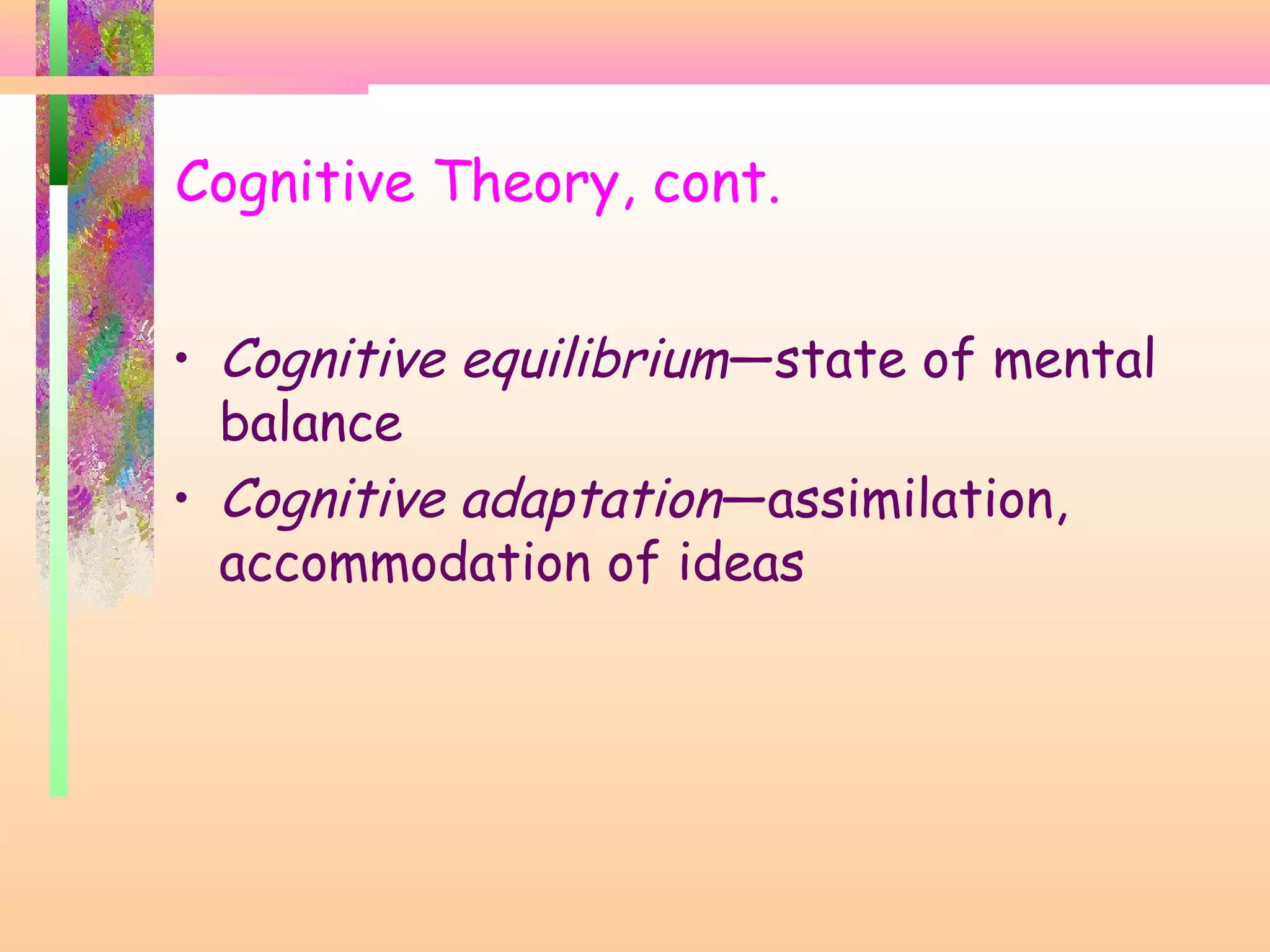
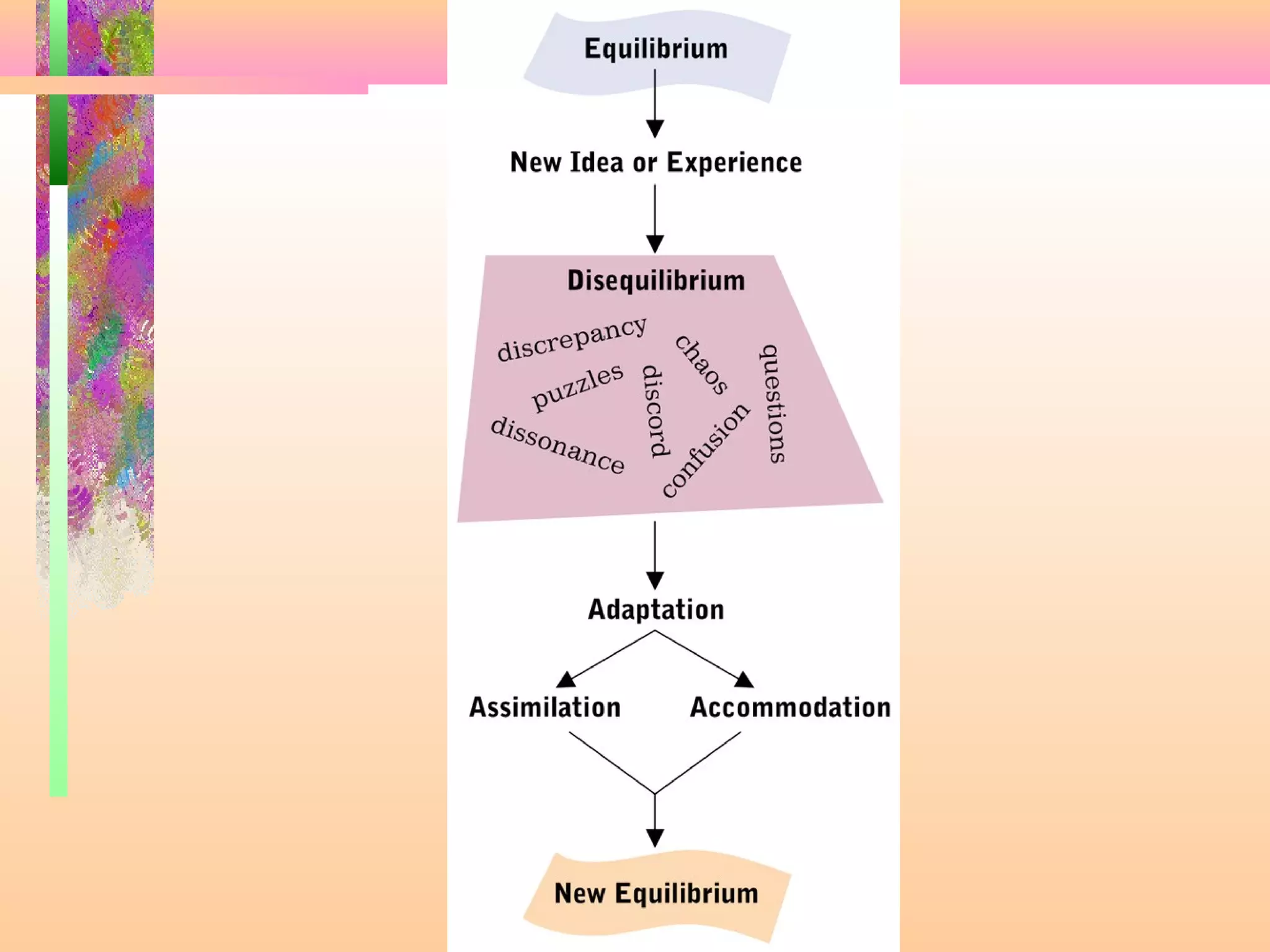
• Cognitive equilibrium—state of mental
balance
• Cognitive adaptation—assimilation,
accommodation of ideas
• Emergent theories arise from several
accumulated minitheories and may be
the new systematic and comprehensive
theories of the future
Emergent Theories
Sociocultural Theory
• Seeks to explain growth of individual
knowledge, development, and
competencies in terms of guidance,
support, and structure supplied by the
society
– human development is the result of dynamic
interaction of the developing persons and
their surrounding culture
• Guided participation—tutor engages
learner in joint activities, providing
instruction and direct involvement in
learning
• Apprenticeship in thinking—mentor
provides instruction and support needed
by novice
Guided Participation
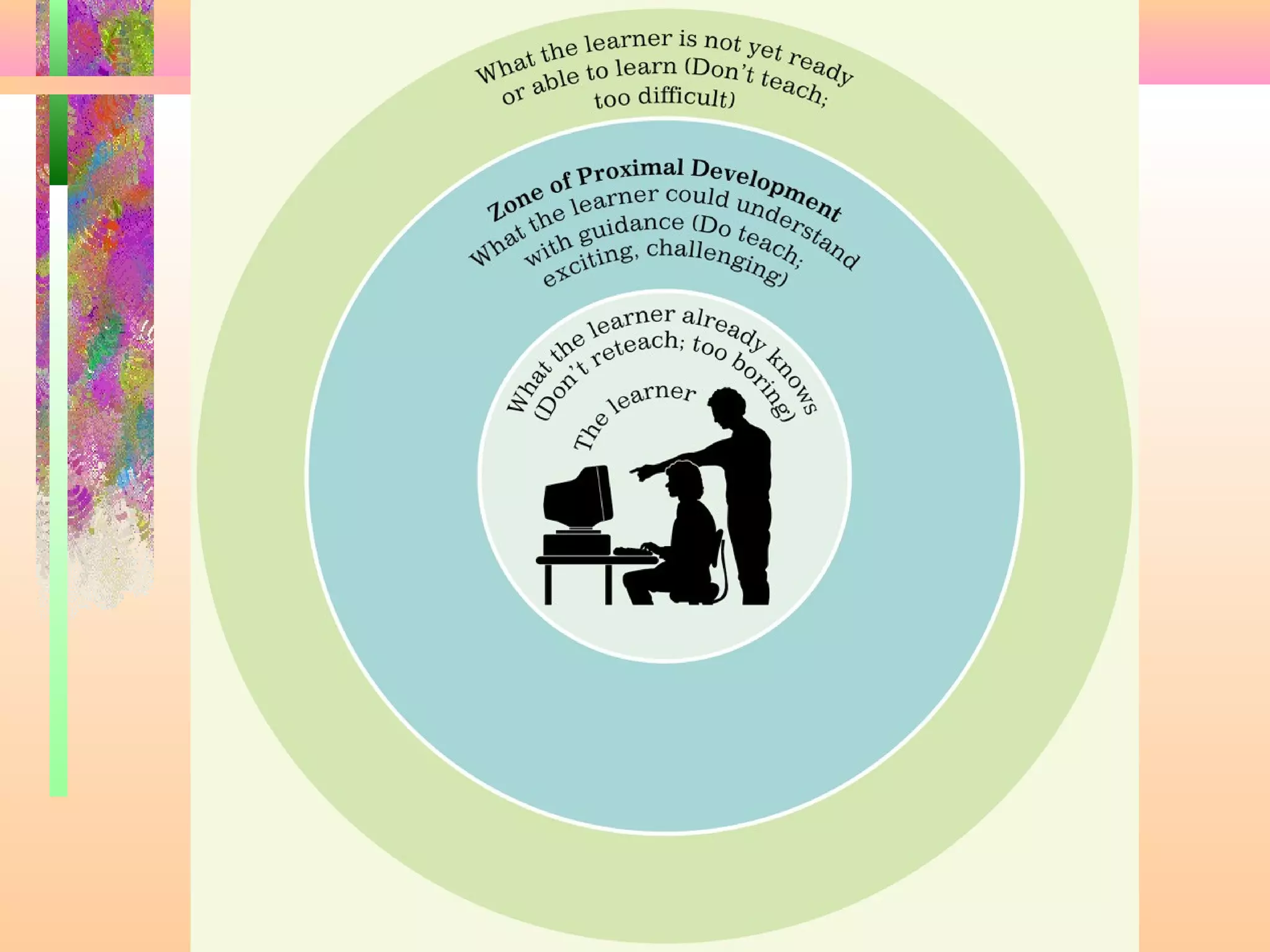
• Zone of proximal development—range of
skills learner can perform with
assistance but not independently
– learner is drawn into learning by teacher
• Cultural variations: Basic principles are
universal, but skills, challenges, and
opportunities vary from culture to
culture, depending on the values and
structures of the culture’s society
The Zone of Proximal
Development
Epigenetic Theory
• Emphasizes the interaction between
genes and the environment—the newest
developmental theory
– stresses that we have powerful instincts
and abilities that arise from our biological
heritage. Timing and pace of certain
developmental changes are genetically
guided
– performism—everything is set in advance by
genes and then is gradually manifested in
the course of maturation
• Genetic refers to the entire genome
that makes up the particular genes that
cause each person to be unique
– each human has a genetic foundation that is
unique
– epigenetic theory acknowledges the
powerful instincts and abilities that arise
from our biological heritage
With, On, and Around
the Genes
With, On, and Around the Genes, cont.
• Epi = with, around, before, after, on, or
near = surrounding factors
– epigenetic—surrounding factors that affect
expression of genetic instructions
– some surrounding factors may be stress
factors; others may be facilitating factors
• Genetic-environmental Interactions
– genes never function alone
• Adaptation of the Genes
– selective adaptation means that genes for
the traits that are most useful will become
more frequent, thus making survival of
species more likely
Genetic Adaptation
What Theories Can
Contribute
• Psychoanalytic theory has made us
aware of importance of early childhood
experiences
• Behaviorism has shown effect of
immediate environment on learning
• Cognitive theory helps us understand
how intellectual process and thinking
affect actions
What Theories Can Contribute, cont.
• Sociocultural theory has reminded us
that development is embedded in a rich
and multifaceted context
• Epigenetic theory emphasizes
interactions between inherited forces
and immediate contexts
What Theories Can Contribute, cont.
• Eclectic perspective
– approach taken by most developmentalists
in which they apply aspects of each of the
various theories rather than staying with
just one
The Nature-Nurture
Controversy
• Is it heredity or environment that
shapes us?
• How much is a result of any given
characteristics, behavior or pattern
of development is a result of genes
and how much is a result of experiences
• Policy and practice: nature/nurture
theories are implicit in many public
policies
• AD/HD and homosexuality—How and to
what extent are nature and nurture
involved in each case?
• Evidence from AD/HD research that it
can come from either
Theoretical Perspectives on
Hyperactivity and Homosexuality
Theoretical Perspectives on
Hyperactivity and Homosexuality, cont.
• Earlier assumptions about homosexuality:
more nurture than nature. As hypotheses
tested, nurture was revealed as less
crucial
– sexual orientation may be a matter of nature
– sexual expression may be a matter of cultural
attitude (nurture) but not sexual orientation
– evidence supporting nature as main factor
(e.g., affect of genetic linkage, prenatal
hormones)
Theoretical Perspectives on
Hyperactivity and Homosexuality, cont.
• Ideology often adds to complexity and
polarization of opinions on many
subjects when nature and nurture are
considered
• Important to separate assumptions
from facts
– done via research and testing of hypotheses

Life span development

  • 1.
    Chapter Two: Dr. StevenMendoza East Los Angeles Community College Theories of Development PowerPoints prepared by Cathie Robertson, Grossmont College
  • 2.
    Five Questions Centralto Theories • Do early experiences of breast-feeding or bonding or abuse linger into adulthood, even if they seem to be forgotten? • How important are specific school experiences in human intelligence? • Can a person develop moral values without being taught them?
  • 3.
    Five Questions Centralto Theories, cont. • Does culture elicit behavior, e.g., is violent crime more common in one place than another; for example, in China or Canada? • If your parents or grandparents schizophrenia, or alcoholism, will you develop them suffer from depression,? • Of all questions—Why or Why not? When and How?, So What?
  • 4.
    • Developmental theory—systematic statementof principles and generalizations that provides a coherent framework for studying development What Theories Do
  • 5.
    What Theories Do,cont. • Theories – form basis for hypotheses that can be tested by research studies • formulating right question is more difficult that finding right answers – generate discoveries – offer insight and guidance by providing coherent view
  • 6.
    What Theories Do,cont. • Different Types – grand theories—comprehensive, traditional theories • originated in psychology – minitheories—theories that focus on specific area of development • originated more in sociology through study of social groups and family structures – emergent theories—new, comprehensive groupings of minitheories • multidisciplinary approach includes historic events and genetic discoveries
  • 7.
    Grand Theories • GrandTheories—powerful framework for interpreting and understanding change and development that applies to all individuals in all contexts, across all contents
  • 9.
    • Psychoanalytic theoryinterprets human development in terms of motives and drives Psychoanalytic Theory
  • 10.
    Freud’s Ideas • SigmundFreud • Three stages of development in first six years – oral, anal, phallic – in early childhood, latency and then adolescence, genital – each stage includes potential conflicts • how a person experiences and resolves conflicts determines personality and patterns of behavior
  • 11.
    Erikson’s Ideas • ErikErikson, a follower of Freud, proposed 8 developmental stages, each characterized by a developmental crisis – trust vs. mistrust – autonomy vs. shame – initiative vs. guilt – industry vs. inferiority – identity vs. role diffusion – intimacy vs. isolation – generativity vs. stagnation – integrity vs. despair
  • 13.
    • Behaviorism isbuilt on laws of behavior and processes by which behavior is learned – focus: ways we learn specific behaviors that can be described, analyzed, and predicted with scientific accuracy Behaviorism
  • 14.
    • Conditioning—any processin which behavior is learned • Classical conditioning—Ivan Pavlov – process by which a neutral stimulus become associated with a meaningful stimulus • stimulus and response (respondent conditioning) • Operant conditioning—B. F. Skinner – process by which a response is gradually learned via reinforcement or punishment • also called instrumental conditioning Laws of Behavior
  • 16.
    Social Learning • Extensionof learning theory that includes modeling which involves people observing behavior and patterning their own after it • Modeling – process in which people observe, then copy behavior – Alfred Bandura—most likely to occur if model is admired or observer is inexperienced – self-efficacy motivates people to change themselves and their contexts
  • 17.
    • Focuses onthe structure and development of thought processes, which shape perceptions, attitudes, and actions. • Jean Piaget’s 4 Stages – sensorimotor – pre-operational – concrete operational – formal operational Cognitive Theory
  • 18.
    Cognitive Theory, cont. •Cognitive equilibrium—state of mental balance • Cognitive adaptation—assimilation, accommodation of ideas
  • 21.
    • Emergent theoriesarise from several accumulated minitheories and may be the new systematic and comprehensive theories of the future Emergent Theories
  • 22.
    Sociocultural Theory • Seeksto explain growth of individual knowledge, development, and competencies in terms of guidance, support, and structure supplied by the society – human development is the result of dynamic interaction of the developing persons and their surrounding culture
  • 23.
    • Guided participation—tutorengages learner in joint activities, providing instruction and direct involvement in learning • Apprenticeship in thinking—mentor provides instruction and support needed by novice Guided Participation
  • 24.
    • Zone ofproximal development—range of skills learner can perform with assistance but not independently – learner is drawn into learning by teacher • Cultural variations: Basic principles are universal, but skills, challenges, and opportunities vary from culture to culture, depending on the values and structures of the culture’s society The Zone of Proximal Development
  • 26.
    Epigenetic Theory • Emphasizesthe interaction between genes and the environment—the newest developmental theory – stresses that we have powerful instincts and abilities that arise from our biological heritage. Timing and pace of certain developmental changes are genetically guided – performism—everything is set in advance by genes and then is gradually manifested in the course of maturation
  • 27.
    • Genetic refersto the entire genome that makes up the particular genes that cause each person to be unique – each human has a genetic foundation that is unique – epigenetic theory acknowledges the powerful instincts and abilities that arise from our biological heritage With, On, and Around the Genes
  • 28.
    With, On, andAround the Genes, cont. • Epi = with, around, before, after, on, or near = surrounding factors – epigenetic—surrounding factors that affect expression of genetic instructions – some surrounding factors may be stress factors; others may be facilitating factors • Genetic-environmental Interactions – genes never function alone
  • 29.
    • Adaptation ofthe Genes – selective adaptation means that genes for the traits that are most useful will become more frequent, thus making survival of species more likely Genetic Adaptation
  • 30.
    What Theories Can Contribute •Psychoanalytic theory has made us aware of importance of early childhood experiences • Behaviorism has shown effect of immediate environment on learning • Cognitive theory helps us understand how intellectual process and thinking affect actions
  • 31.
    What Theories CanContribute, cont. • Sociocultural theory has reminded us that development is embedded in a rich and multifaceted context • Epigenetic theory emphasizes interactions between inherited forces and immediate contexts
  • 33.
    What Theories CanContribute, cont. • Eclectic perspective – approach taken by most developmentalists in which they apply aspects of each of the various theories rather than staying with just one
  • 34.
    The Nature-Nurture Controversy • Isit heredity or environment that shapes us? • How much is a result of any given characteristics, behavior or pattern of development is a result of genes and how much is a result of experiences • Policy and practice: nature/nurture theories are implicit in many public policies
  • 35.
    • AD/HD andhomosexuality—How and to what extent are nature and nurture involved in each case? • Evidence from AD/HD research that it can come from either Theoretical Perspectives on Hyperactivity and Homosexuality
  • 36.
    Theoretical Perspectives on Hyperactivityand Homosexuality, cont. • Earlier assumptions about homosexuality: more nurture than nature. As hypotheses tested, nurture was revealed as less crucial – sexual orientation may be a matter of nature – sexual expression may be a matter of cultural attitude (nurture) but not sexual orientation – evidence supporting nature as main factor (e.g., affect of genetic linkage, prenatal hormones)
  • 37.
    Theoretical Perspectives on Hyperactivityand Homosexuality, cont. • Ideology often adds to complexity and polarization of opinions on many subjects when nature and nurture are considered • Important to separate assumptions from facts – done via research and testing of hypotheses