Learning Objectives
1.Physical, cognitive, and psychosocial development that
occurs during childhood and adolescence.
2.Piaget’s concrete operation and Erickson’s Industry vs.
inferiority stage of development.
3.Discuss the following:
 Piaget’s formal operational stage
 Moral reasoning according to Kohlberg theory
 Erickson’s Identity vs. identity confusion stage
 Relationships with parents and peer group
• Physical, Cognitive, and Psychosocial
Development Occur During
Childhood
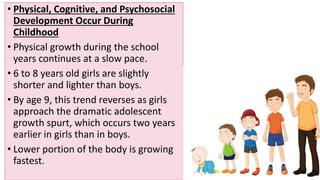
• Physical growth during the school
years continues at a slow pace.
• 6 to 8 years old girls are slightly
shorter and lighter than boys.
• By age 9, this trend reverses as girls
approach the dramatic adolescent
growth spurt, which occurs two years
earlier in girls than in boys.
• Lower portion of the body is growing
fastest.
• Girls have slightly more body fat and boys more muscle.
• After age 8, girls begin accumulating fat at a faster rate, and they will
add even more during adolescence (Hauspie & Roelants, 2012).
• Bones of the body lengthen and broaden.
• Between ages 6 and 12, all 20 primary teeth are lost and replaced by
permanent ones, girls lose their teeth slightly earlier than boys.
• Flexibility: Compared with preschoolers, school-age children are
physically more elastic.
Example:
• Swing bats
• kick balls
• jump over hurdles
• Balance: Improved balance supports many athletic skills.
Example:
Running, hopping, skipping, throwing, kicking, and the rapid changes of
direction.
• Force: Older youngsters can throw and kick a ball harder and propel
themselves farther off the ground when running and jumping than
they could at earlier ages (Haywood & Getchell, 2014).
Cognitive Development:
Piaget’s Concrete Operation
• Piaget’s concrete operational stage, 7 to 11 years of age.
• Compared with early childhood, thought is more logical, flexible, and
organized.
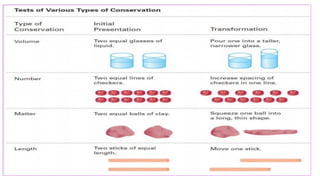
• Conservation: focusing on several aspects of a problem and relating
them, rather than centering on just one.
• In middle childhood, child develop reversibility, the capacity to think
through a series of steps and then mentally reverse direction,
returning to the starting point.
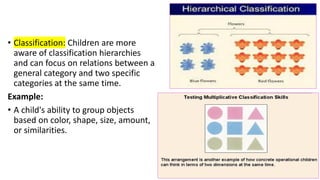
• Classification: Children are more
aware of classification hierarchies
and can focus on relations between a
general category and two specific
categories at the same time.
Example:
• A child's ability to group objects
based on color, shape, size, amount,
or similarities.
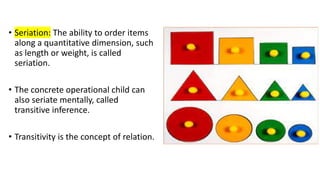
• Seriation: The ability to order items
along a quantitative dimension, such
as length or weight, is called
seriation.
• The concrete operational child can
also seriate mentally, called
transitive inference.
• Transitivity is the concept of relation.
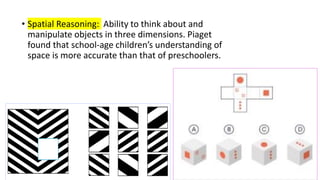
• Spatial Reasoning: Ability to think about and
manipulate objects in three dimensions. Piaget
found that school-age children’s understanding of
space is more accurate than that of preschoolers.
• Executive function: is a set of mental skills that include working
memory, cognitive flexibility, and inhibitory control.
Working memory- allows us to work with information without
losing track of what we’re doing.
Cognitive flexibility-ability to adapt behavior & thinking in
response to the environment.
• Psychosocial Development:
• Erickson’s Industry vs. Inferiority Stage of Development
• Children in middle childhood are very busy or industrious.
• They are constantly doing, planning, playing, getting together with
friends, and achieving.
• This is a very active time.
• Erikson believed that if these industrious children view themselves as
successful in their endeavors, they will get a sense of competence for
future challenges.
• If a child feels that they are not measuring up to their peers, feelings of
inferiority and self-doubt will develop.
• These feelings of inferiority can lead to an inferiority complex that lasts
into adulthood.
Physical, Cognitive, and Psychosocial Development Occur
During Adolescence
• Hormonal Changes: Hormonal changes that underlie puberty occur
gradually and are under way in middle childhood.
• Secretions of growth hormone (GH) and thyroxine increase, leads to
tremendous gain in body size and skeletal maturity.
• Body Growth: The first outward sign of puberty is the rapid gain in
height and weight known as the growth spurt.
• Muscle–Fat Makeup: Around age 8, girls start to add fat on their
arms, legs, and trunk, a trend that accelerates between ages 11 and
16.
• In contrast, arm and leg fat decreases in adolescent boys.
• Motor Development and Physical Activity: Puberty brings steady
improvements in gross motor performance, but the pattern of change
differs for boys and girls.
• Girls’ gains are slow and gradual, leveling off by age 14.
• In contrast, boys show a dramatic spurt in strength, speed, and
endurance that continues through the teenage years.
• By mid adolescence, few girls perform as well as the average boy in
running speed, broad jump, or throwing distance.
• Sexual Maturation: Changes in physical features related to sexual
functioning.
Cognitive development:
Piaget’s formal operational stage
• 11-15 & continue through adulthood. Individuals think in abstract, &
logical terms.
• They might think about what an ideal parent is like and compare their
parents to this ideal standard.
• According to Piaget, around age 11 young people enter the formal
operational stage, in which they develop the capacity for abstract,
systematic, scientific thinking.
• Whereas concrete operational children can “operate on reality,” formal
operational adolescents can “operate on operations.”
• Working memory: increases, enabling more information to be held in
mind at once and combined into increasingly complex.
• Inhibition: both of irrelevant stimuli and of well-learned responses in
situations where they are inappropriate, improves, supporting gains
in attention and reasoning.
• Attention: becomes more selective and flexible—better-adapted to
the changing demands of tasks.
• Planning on complex tasks with multiple steps improves, becoming
better-organized and efficient.
• Strategies become more effective, enhancing storage, representation,
and retrieval of information.
• Knowledge increases, easing strategy use.
• Metacognition: expands, leading to new insights into effective
strategies for acquiring information and solving problems.
Psychosocial development:
Erickson’s Identity vs. identity confusion stage
• Erikson (1950, 1968) was the first to recognize identity as the major
personality attainment of adolescence & crucial step toward
becoming a productive, content adult.
• Identity Vs Role Confusion: Adolescence (10 to 20 years)
• During the adolescent years individuals face finding out who they are,
what they are all about, and where they are going in life.
• If adolescents explore roles in a healthy manner and arrive at a
positive path to follow in life, they achieve a positive identity, if they
do not, identity confusion reigns.
The most important psychosocial changes in puberty and early
adolescence are the growing ability of:
absorbing the perspectives of others
an increased ability of introspection
the development of personal and sexual identity
 the establishment of a system of values
increasing autonomy from family
more personal independence
greater importance of peer relationships of sometimes
subcultural quality
emergence of skills and coping strategies to overcome
problems and crises.
Moral Reasoning According to Kohlberg Theory
• Morality is externally controlled. Children accept the rules of
authority figures and judge actions by their consequences. Behaviors
that result in punishment are viewed as bad, those that lead to
rewards as good.
• Stage 1 - Obedience & Punishment: Earliest stage of moral
development.
• Children see rules as fixed and absolute.
• Obeying the rules is important to avoid punishment.
• Morality is motivated solely by punishment.
• Stage 2 - Individualism & Exchange: Children account individual points
of view.
• Judge actions based on how they serve individual needs.
• Reciprocity is possible but only if it serves one's own interests.
• The goal is to avoid punishment.
• Individuals regard conformity to social rules as important, but not for
reasons of self-interest. Rather, they believe that actively maintaining
the current social system ensures positive relationships and societal
order.
• Stage 3 Interpersonal Relationships:
• Emphasizes the maintenance happy interpersonal relationships and
pleasing others.
• Need to avoid rejection, disaffection, or disapproval from others.
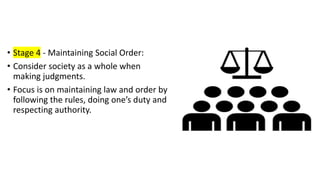
• Stage 4 - Maintaining Social Order:
• Consider society as a whole when
making judgments.
• Focus is on maintaining law and order by
following the rules, doing one’s duty and
respecting authority.
• People look beyond convention to determine moral norms and
appropriate social interactions.
• Judgment is based on self-chosen principles, moral reasoning is
based on individual rights and justice.
• Stage 5 - Social Contract & Individual Rights:
• Begin to account the differing values, opinions and beliefs of other
people.
• Laws are important but members of the society should agree upon
these standards.
• Stage 6 - Universal Principles:
• Reasoning is based on universal ethical principles and abstract
reasoning.
• Follow these internalized principles of justice, even if its against the
law.
• Moral judgment is motivated by one's own conscience.
Relationships with Parents and Peer
Group
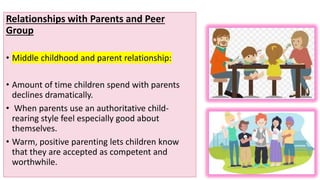
• Middle childhood and parent relationship:
• Amount of time children spend with parents
declines dramatically.
• When parents use an authoritative child-
rearing style feel especially good about
themselves.
• Warm, positive parenting lets children know
that they are accepted as competent and
worthwhile.
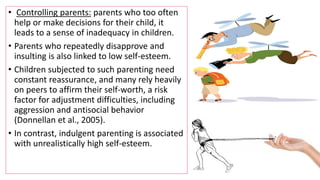
• Controlling parents: parents who too often
help or make decisions for their child, it
leads to a sense of inadequacy in children.
• Parents who repeatedly disapprove and
insulting is also linked to low self-esteem.
• Children subjected to such parenting need
constant reassurance, and many rely heavily
on peers to affirm their self-worth, a risk
factor for adjustment difficulties, including
aggression and antisocial behavior
(Donnellan et al., 2005).
• In contrast, indulgent parenting is associated
with unrealistically high self-esteem.
• Middle childhood and peer relationship: By
the end of middle childhood, children
display a strong desire for group belonging.
• They form peer groups, children acquire
many social skills within the group,
cooperation, leadership, and loyalty to
collective goals.
• Parent adolescent relationships: Puberty
triggers psychological distancing from
parents.
• In addition, as young people look more
mature, parents give them more freedom
to think and decide for themselves, more
opportunities to regulate their own
activities, and more responsibility
(McElhaney et al., 2009).
• They deidealize their parents, viewing them
as “just people.”
• Peer adolescent relationships: As adolescents
spend less time with family members, peers
become increasingly important.
• In industrialized nations, young people spend
most of each weekday with age mates in school
as well as much out-of-class time together.
• According to adolescent, friends are their most
important sources of social support (Brown &
Larson, 2009).
• As frankness and faithfulness increase, self-
disclosure (sharing of private thoughts and
feelings) between friends rises.
Recommended Reading
Development Through the Lifespan by Laura E. Berk

6 # school child & adolescence (dev psy)

  • 2.
    Learning Objectives 1.Physical, cognitive,and psychosocial development that occurs during childhood and adolescence. 2.Piaget’s concrete operation and Erickson’s Industry vs. inferiority stage of development. 3.Discuss the following:  Piaget’s formal operational stage  Moral reasoning according to Kohlberg theory  Erickson’s Identity vs. identity confusion stage  Relationships with parents and peer group
  • 3.
    • Physical, Cognitive,and Psychosocial Development Occur During Childhood • Physical growth during the school years continues at a slow pace. • 6 to 8 years old girls are slightly shorter and lighter than boys. • By age 9, this trend reverses as girls approach the dramatic adolescent growth spurt, which occurs two years earlier in girls than in boys. • Lower portion of the body is growing fastest.
  • 4.
    • Girls haveslightly more body fat and boys more muscle. • After age 8, girls begin accumulating fat at a faster rate, and they will add even more during adolescence (Hauspie & Roelants, 2012). • Bones of the body lengthen and broaden. • Between ages 6 and 12, all 20 primary teeth are lost and replaced by permanent ones, girls lose their teeth slightly earlier than boys. • Flexibility: Compared with preschoolers, school-age children are physically more elastic. Example: • Swing bats • kick balls • jump over hurdles
  • 5.
    • Balance: Improvedbalance supports many athletic skills. Example: Running, hopping, skipping, throwing, kicking, and the rapid changes of direction. • Force: Older youngsters can throw and kick a ball harder and propel themselves farther off the ground when running and jumping than they could at earlier ages (Haywood & Getchell, 2014).
  • 6.
    Cognitive Development: Piaget’s ConcreteOperation • Piaget’s concrete operational stage, 7 to 11 years of age. • Compared with early childhood, thought is more logical, flexible, and organized. • Conservation: focusing on several aspects of a problem and relating them, rather than centering on just one. • In middle childhood, child develop reversibility, the capacity to think through a series of steps and then mentally reverse direction, returning to the starting point.
  • 8.
    • Classification: Childrenare more aware of classification hierarchies and can focus on relations between a general category and two specific categories at the same time. Example: • A child's ability to group objects based on color, shape, size, amount, or similarities.
  • 9.
    • Seriation: Theability to order items along a quantitative dimension, such as length or weight, is called seriation. • The concrete operational child can also seriate mentally, called transitive inference. • Transitivity is the concept of relation.
  • 10.
    • Spatial Reasoning:Ability to think about and manipulate objects in three dimensions. Piaget found that school-age children’s understanding of space is more accurate than that of preschoolers.
  • 11.
    • Executive function:is a set of mental skills that include working memory, cognitive flexibility, and inhibitory control. Working memory- allows us to work with information without losing track of what we’re doing. Cognitive flexibility-ability to adapt behavior & thinking in response to the environment.
  • 12.
    • Psychosocial Development: •Erickson’s Industry vs. Inferiority Stage of Development • Children in middle childhood are very busy or industrious. • They are constantly doing, planning, playing, getting together with friends, and achieving. • This is a very active time. • Erikson believed that if these industrious children view themselves as successful in their endeavors, they will get a sense of competence for future challenges. • If a child feels that they are not measuring up to their peers, feelings of inferiority and self-doubt will develop. • These feelings of inferiority can lead to an inferiority complex that lasts into adulthood.
  • 13.
    Physical, Cognitive, andPsychosocial Development Occur During Adolescence • Hormonal Changes: Hormonal changes that underlie puberty occur gradually and are under way in middle childhood. • Secretions of growth hormone (GH) and thyroxine increase, leads to tremendous gain in body size and skeletal maturity. • Body Growth: The first outward sign of puberty is the rapid gain in height and weight known as the growth spurt. • Muscle–Fat Makeup: Around age 8, girls start to add fat on their arms, legs, and trunk, a trend that accelerates between ages 11 and 16. • In contrast, arm and leg fat decreases in adolescent boys.
  • 14.
    • Motor Developmentand Physical Activity: Puberty brings steady improvements in gross motor performance, but the pattern of change differs for boys and girls. • Girls’ gains are slow and gradual, leveling off by age 14. • In contrast, boys show a dramatic spurt in strength, speed, and endurance that continues through the teenage years. • By mid adolescence, few girls perform as well as the average boy in running speed, broad jump, or throwing distance. • Sexual Maturation: Changes in physical features related to sexual functioning.
  • 15.
    Cognitive development: Piaget’s formaloperational stage • 11-15 & continue through adulthood. Individuals think in abstract, & logical terms. • They might think about what an ideal parent is like and compare their parents to this ideal standard. • According to Piaget, around age 11 young people enter the formal operational stage, in which they develop the capacity for abstract, systematic, scientific thinking. • Whereas concrete operational children can “operate on reality,” formal operational adolescents can “operate on operations.”
  • 16.
    • Working memory:increases, enabling more information to be held in mind at once and combined into increasingly complex. • Inhibition: both of irrelevant stimuli and of well-learned responses in situations where they are inappropriate, improves, supporting gains in attention and reasoning. • Attention: becomes more selective and flexible—better-adapted to the changing demands of tasks.
  • 17.
    • Planning oncomplex tasks with multiple steps improves, becoming better-organized and efficient. • Strategies become more effective, enhancing storage, representation, and retrieval of information. • Knowledge increases, easing strategy use. • Metacognition: expands, leading to new insights into effective strategies for acquiring information and solving problems.
  • 18.
    Psychosocial development: Erickson’s Identityvs. identity confusion stage • Erikson (1950, 1968) was the first to recognize identity as the major personality attainment of adolescence & crucial step toward becoming a productive, content adult. • Identity Vs Role Confusion: Adolescence (10 to 20 years) • During the adolescent years individuals face finding out who they are, what they are all about, and where they are going in life. • If adolescents explore roles in a healthy manner and arrive at a positive path to follow in life, they achieve a positive identity, if they do not, identity confusion reigns.
  • 19.
    The most importantpsychosocial changes in puberty and early adolescence are the growing ability of: absorbing the perspectives of others an increased ability of introspection the development of personal and sexual identity  the establishment of a system of values increasing autonomy from family more personal independence greater importance of peer relationships of sometimes subcultural quality emergence of skills and coping strategies to overcome problems and crises.
  • 20.
    Moral Reasoning Accordingto Kohlberg Theory
  • 21.
    • Morality isexternally controlled. Children accept the rules of authority figures and judge actions by their consequences. Behaviors that result in punishment are viewed as bad, those that lead to rewards as good. • Stage 1 - Obedience & Punishment: Earliest stage of moral development. • Children see rules as fixed and absolute. • Obeying the rules is important to avoid punishment. • Morality is motivated solely by punishment.
  • 22.
    • Stage 2- Individualism & Exchange: Children account individual points of view. • Judge actions based on how they serve individual needs. • Reciprocity is possible but only if it serves one's own interests. • The goal is to avoid punishment.
  • 23.
    • Individuals regardconformity to social rules as important, but not for reasons of self-interest. Rather, they believe that actively maintaining the current social system ensures positive relationships and societal order. • Stage 3 Interpersonal Relationships: • Emphasizes the maintenance happy interpersonal relationships and pleasing others. • Need to avoid rejection, disaffection, or disapproval from others.
  • 24.
    • Stage 4- Maintaining Social Order: • Consider society as a whole when making judgments. • Focus is on maintaining law and order by following the rules, doing one’s duty and respecting authority.
  • 25.
    • People lookbeyond convention to determine moral norms and appropriate social interactions. • Judgment is based on self-chosen principles, moral reasoning is based on individual rights and justice. • Stage 5 - Social Contract & Individual Rights: • Begin to account the differing values, opinions and beliefs of other people. • Laws are important but members of the society should agree upon these standards.
  • 26.
    • Stage 6- Universal Principles: • Reasoning is based on universal ethical principles and abstract reasoning. • Follow these internalized principles of justice, even if its against the law. • Moral judgment is motivated by one's own conscience.
  • 27.
    Relationships with Parentsand Peer Group • Middle childhood and parent relationship: • Amount of time children spend with parents declines dramatically. • When parents use an authoritative child- rearing style feel especially good about themselves. • Warm, positive parenting lets children know that they are accepted as competent and worthwhile.
  • 28.
    • Controlling parents:parents who too often help or make decisions for their child, it leads to a sense of inadequacy in children. • Parents who repeatedly disapprove and insulting is also linked to low self-esteem. • Children subjected to such parenting need constant reassurance, and many rely heavily on peers to affirm their self-worth, a risk factor for adjustment difficulties, including aggression and antisocial behavior (Donnellan et al., 2005). • In contrast, indulgent parenting is associated with unrealistically high self-esteem.
  • 29.
    • Middle childhoodand peer relationship: By the end of middle childhood, children display a strong desire for group belonging. • They form peer groups, children acquire many social skills within the group, cooperation, leadership, and loyalty to collective goals.
  • 30.
    • Parent adolescentrelationships: Puberty triggers psychological distancing from parents. • In addition, as young people look more mature, parents give them more freedom to think and decide for themselves, more opportunities to regulate their own activities, and more responsibility (McElhaney et al., 2009). • They deidealize their parents, viewing them as “just people.”
  • 31.
    • Peer adolescentrelationships: As adolescents spend less time with family members, peers become increasingly important. • In industrialized nations, young people spend most of each weekday with age mates in school as well as much out-of-class time together. • According to adolescent, friends are their most important sources of social support (Brown & Larson, 2009). • As frankness and faithfulness increase, self- disclosure (sharing of private thoughts and feelings) between friends rises.
  • 32.
    Recommended Reading Development Throughthe Lifespan by Laura E. Berk